
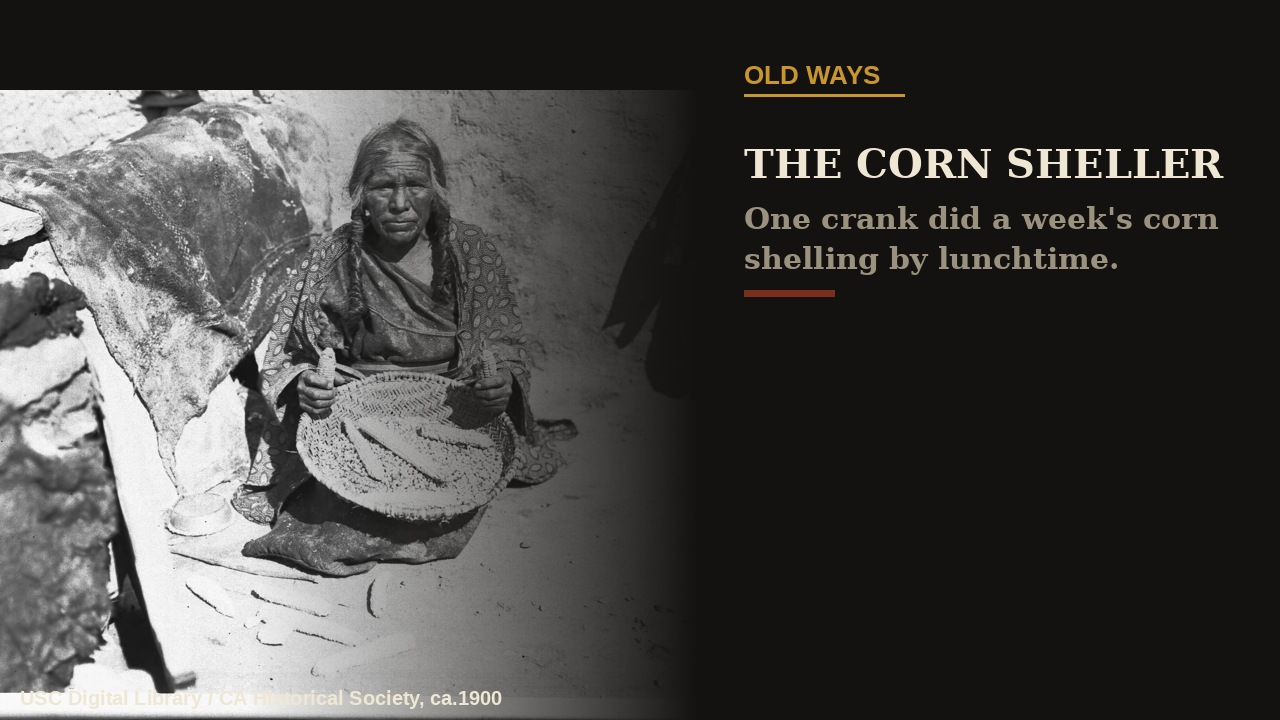
In 1956, nearly one acre in five of the entire United States corn crop was still being shelled without a machine — by hand, ear by ear, the same way it had been done for two hundred years. That holdout lasted right up to the edge of living memory, even though a working mechanical corn sheller had existed since 1838 and had been selling by the hundreds of thousands for generations.
The object itself is almost comically simple: a crank, a pair of toothed wheels, and a funnel to feed the ear in. What is not simple is the century of patent warfare it set off, the single design that sold an estimated one million units, and the genuinely stubborn persistence of the hand method it was supposed to have replaced decades earlier.
Here is how corn shellers worked, how one farm family’s autumn chore became a piece of patent history, and why the machine took far longer to finish the job than its inventors expected.
Shelling corn by hand was already a two-century-old chore before anyone patented a machine for it
Corn is unlike wheat or oats in one crucial respect: the edible part does not come loose on its own. A harvested ear has to be stripped of its kernels before it can be ground into meal, fed to livestock, or stored as seed, and for the first two centuries of European farming in North America that stripping was done entirely by hand — rubbing one dried ear against another until the kernels gave way, or working a thumb or a simple hand tool down each row.
The practice itself long predates any patent. Indigenous communities in the eastern woodlands held communal corn-processing gatherings, complete with feasts, dances and games, to mark the end of harvest, and colonial settlers adopted both the crop and the custom from them. By the early 1800s, shelling and husking corn by hand was simply one of the fixed, unavoidable items on an American farm’s autumn calendar, alongside storing the unshelled ears in a corn crib built specifically to hold them until shelling day arrived.
The first real corn sheller was patented in 1838, and imitators flooded the patent office within decades
The earliest working, hand-cranked corn sheller on record belongs to Lester R. Denison of Saybrook, Connecticut, who patented his “Machine for Shelling Corn” on October 8, 1838. Denison’s design used a rotating cylinder ringed with spiral metal teeth: an ear was held against it by a spring-mounted counter-plate, and the spiral motion dragged the ear through while the teeth stripped the kernels and ejected the bare cob out the side.
Once the principle was proven, the patent office was flooded. Francis N. Smith of Kinderhook, New York, had a cast-iron sheller on the market by around 1845, manufactured by the firm of Hanna & Peaslee; a surviving example is now held by The Henry Ford museum. Three decades later, Theophilus Weaver of Harrisburg, Pennsylvania, was selling his own version under the brand name Champion. By the time machinist Asahel Huntington Patch filed his own corn-sheller patent on July 4, 1871, more than 350 other corn-shelling devices had already been patented in the United States — an extraordinary density of competing inventors chasing one unglamorous farm chore.
Turning the crank: how a cast-iron corn sheller actually worked
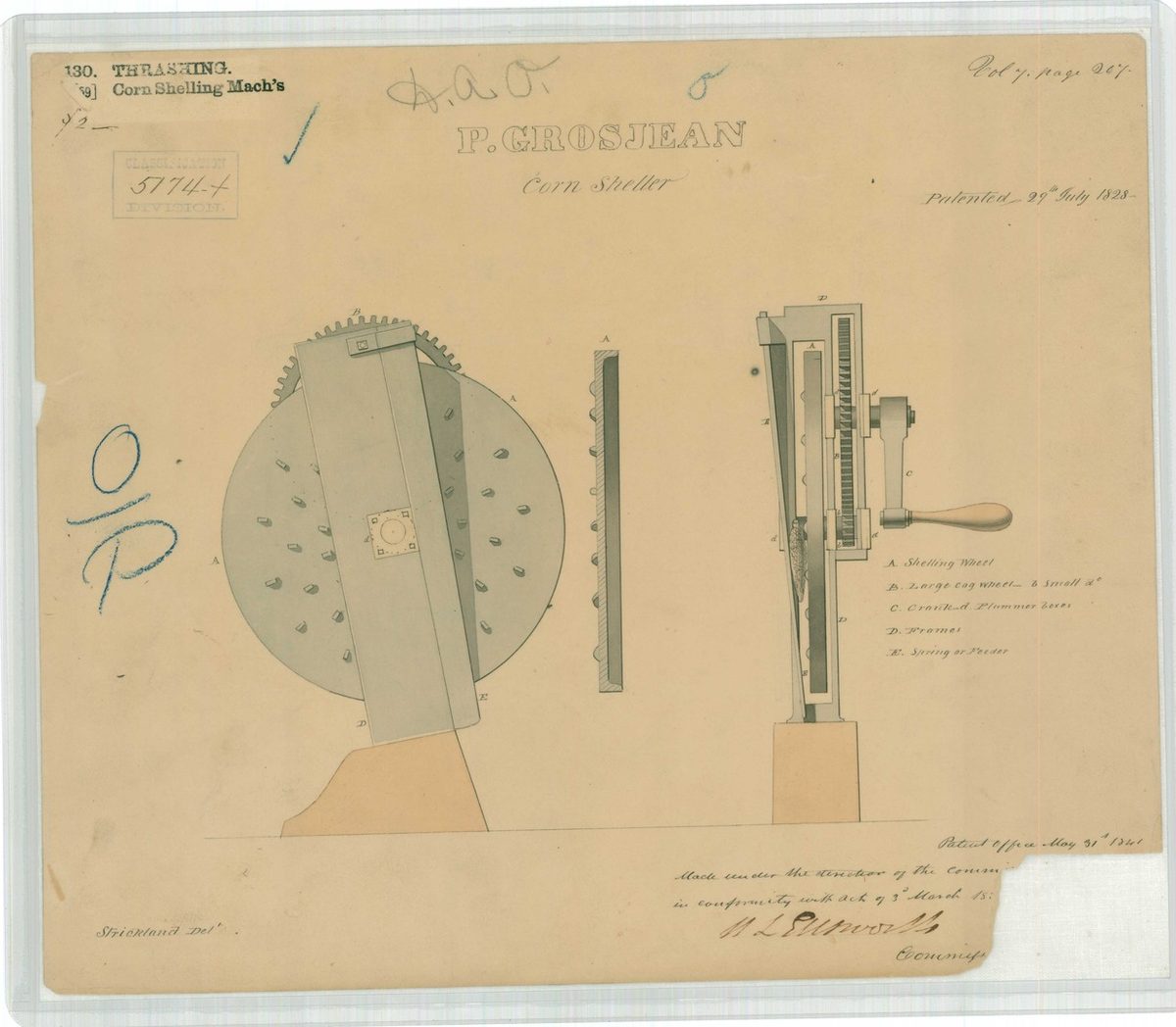
Most of the machines that reached American barns followed the same basic logic, refined by inventors like Ancil Stickney of Concord, New Hampshire, whose 1857 patent improved on an earlier design by J. D. Briggs. A solid cast wheel, roughly eight inches across and studded with rows of teeth, sat inside a stationary frame. Facing it was a second, spring-loaded toothed plate, pressed toward the wheel but free to give slightly under pressure.
An ear of corn went in tip-first through a funnel-shaped mouth. Turning the crank carried the ear downward between the two toothed surfaces, which squeezed and rolled it as it passed, stripping the kernels loose. The stripped cob was lifted back up and out the top or ejected out the side, depending on the model, while the loose kernels dropped through a screen into a pail or box below.
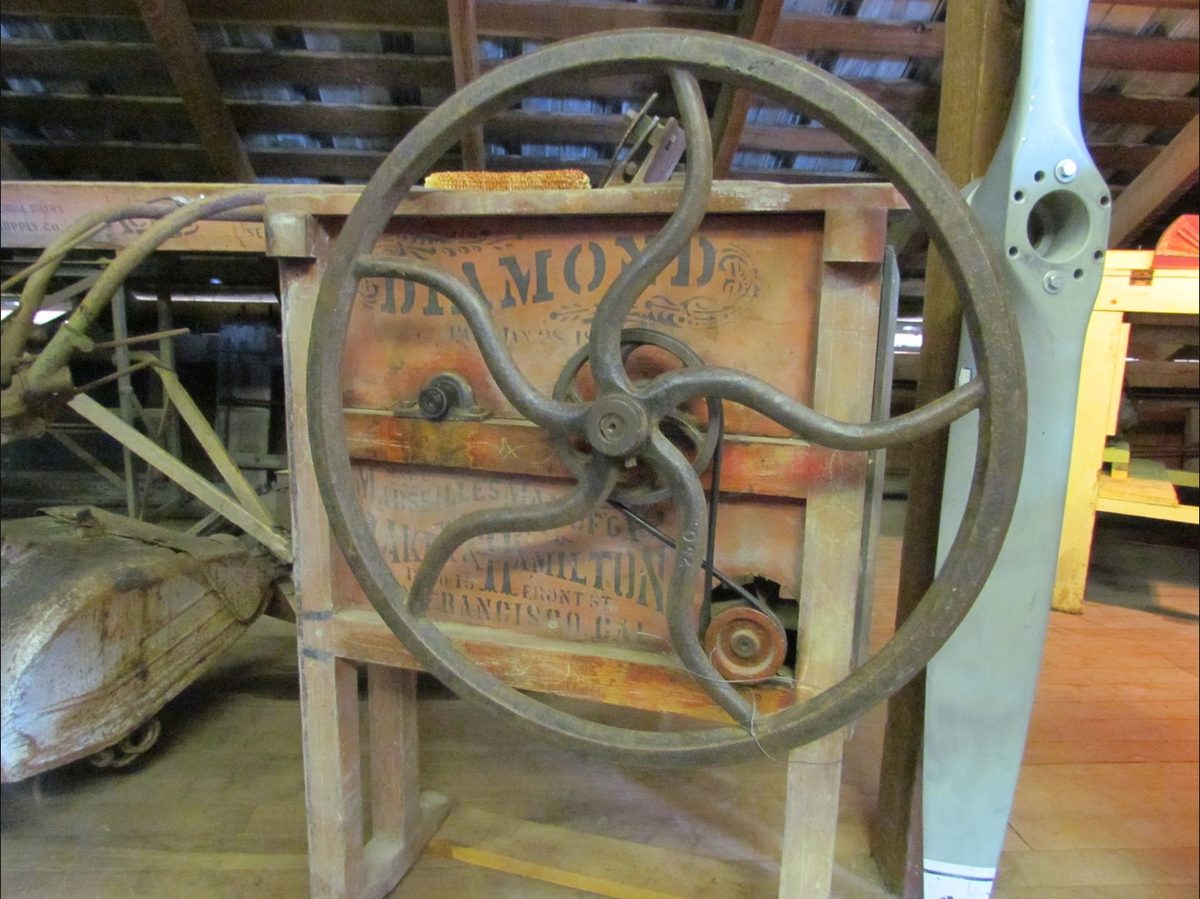
The freestanding household version typically weighed around 125 pounds and bolted to a wooden box or a barn post. A flywheel on the crank’s far end kept the mechanism turning smoothly between strokes, and a careless hand feeding ears too quickly would jam the toothed wheel, forcing the operator to stop cranking and clear it by hand. Some later models added a small fan to blow away the dust the process kicked up.
A second common style, the box sheller, mounted the same basic mechanism — a frame, an axle shaft, the toothed sheller wheel, a spring, a tension ring, and the crank — directly onto a wooden box rather than a standalone iron frame, so the shelled kernels dropped straight into storage instead of a separate pail. Both styles relied on the same spring-loaded give in the counter-plate, which let one side of the mechanism flex independently of the other. On some designs that made it possible to feed and shell two ears side by side at once, nearly doubling the rate a single crank arm could produce.
One design sold an estimated one million units and ran a company for seventy years
Patch’s 1871 patent was not his last. In 1886, at the age of 61, he patented an improved design that became the Black Hawk Corn Sheller — a machine that went on to sell an estimated one million units worldwide. Patch and a Kentucky partner, William Douglas Meriwether Jr., had already bought the Southern Agricultural Implement Works in Clarksville, Tennessee, in 1875, with Patch serving as its superintendent. After his death, his wife and children founded their own company to keep manufacturing his designs, and it operated until 1955 — eighty-four years after his first corn-sheller patent, and eleven years into the decade that finally made the hand-crank machine obsolete.
Patch’s earlier corn-sheller design had already drawn outside attention: his patent agent, the New York firm of Munn & Company — which also published Scientific American and was, by its own later account, responsible for handling over 100,000 American patents — featured his second corn-sheller design in the magazine’s May 4, 1872 issue. A trade press write-up like that was a meaningful credential for a machinist competing against several hundred rival patents for the same farmer’s attention.
Shelling corn was a neighborhood event, not a solitary chore
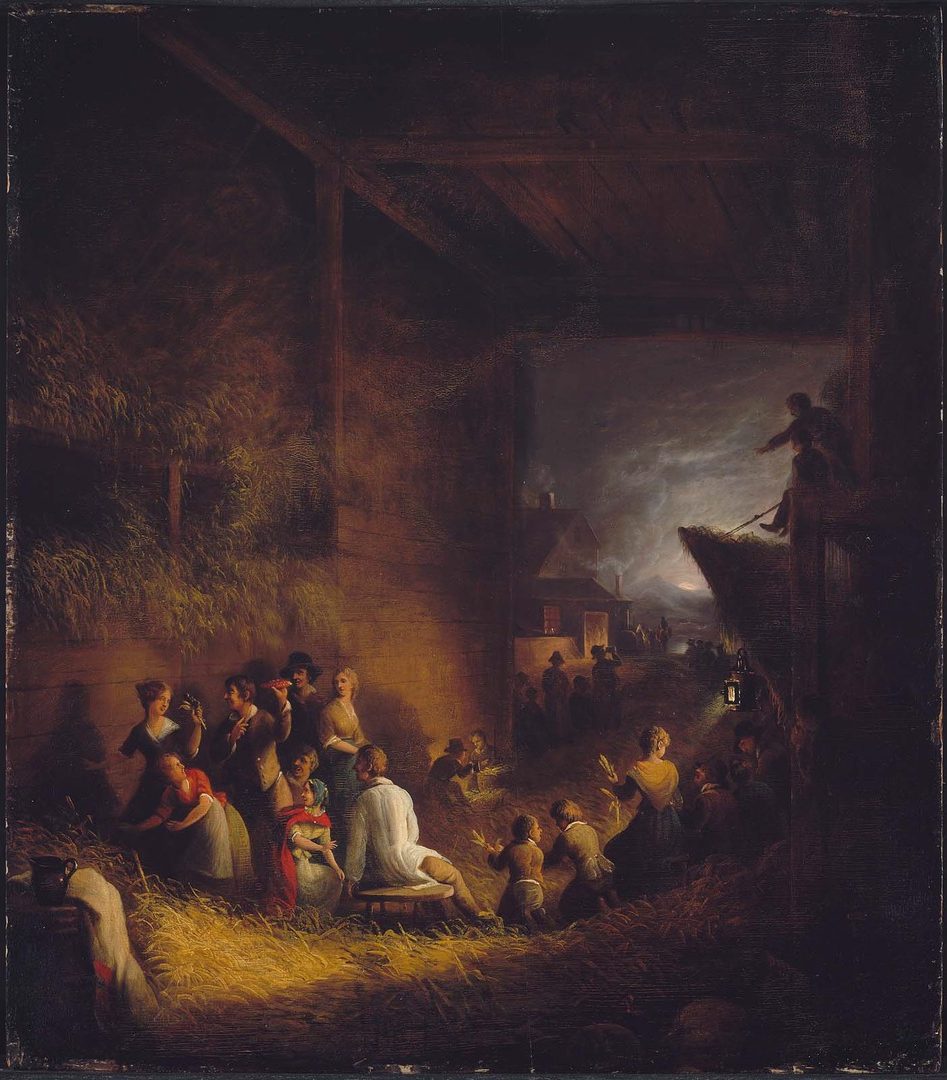
Smaller household shellers turned an all-day job into an afternoon one, but the labor around them stayed social for far longer than the machines themselves lasted. Families and neighbors gathered for shelling days much as they did for the corn-husking “frolics” that preceded them, traditions that North Carolina’s historic-sites agency traces back to pre-contact Native American harvest gatherings, later adopted wholesale by European settlers along with the custom of rewarding whoever found a red ear with a kiss, or a drink of cider.
Shelling day doubled as the farm’s unofficial seed-breeding program. Farmers set aside their best-looking ears at harvest, dried them through winter, and in spring stripped the kernels from each tip with a small tapered tool. The high-quality center kernels, called “flats,” went back into the ground; the odd-sized kernels from the ends, called “rounds,” were kept separately for finishing out a field or replanting a washed-out patch. Nobody involved would have called it genetic selection, but it was repeated, deliberate, and done every single autumn.
Bigger farms needed more than a crank, so shelling got horsepower of its own
A single household sheller could handle one family’s corn, but a farm shelling for market, or for a large herd, needed more throughput than any arm could supply. Larger shellers were built to run from a horse-powered treadmill or sweep, and later from a belt looped off a steam traction engine — the Illinois State Museum holds a photograph of exactly this arrangement, a steam tractor driving a corn sheller by belt on the Sadorus family farm around the turn of the twentieth century. These bigger rigs could process a wagonload at a time and often travelled, like the threshing crews that worked the same farms, from one neighbor’s place to the next. The custom operator never really went away, either: USDA survey data from 1960 found that custom crews, rather than the farm’s own family or hired hands, still did about a third of all field corn shelling nationwide, and as much as four-fifths of it on the smallest farms — the same arrangement as the horse- and steam-powered rigs a century earlier, just with a tractor and a combine attachment doing the travelling instead.
The combine finally made shelling disappear into a single pass, but not overnight
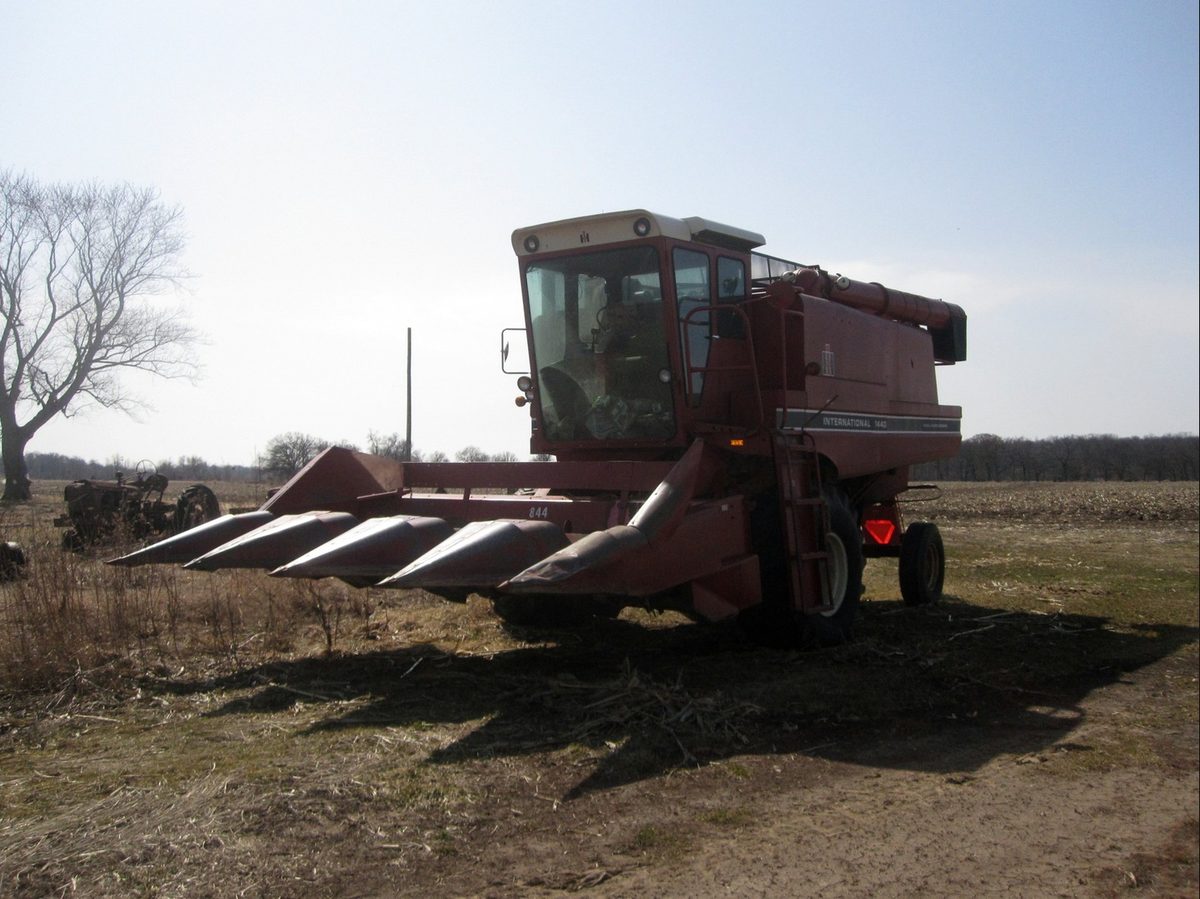
The machine that actually ended the hand-crank sheller’s working life was not a better sheller. It was the mechanical corn picker, which emerged in practical form around the 1880s and matured over the following decades, and then the self-propelled combine fitted with a corn head. Deere & Co. engineer C. Morrison harvested corn with a self-propelled combine and a shielded snapping-roll corn head in 1952, building on combine-cylinder shelling work by G. E. Pickard and D. F. Hopkins at the University of Illinois; John Deere began selling that corn head commercially in 1955.
Even after that, the changeover was gradual rather than instant. USDA survey data put hand harvesting at 19 percent of the national corn crop as late as 1956; by 1960 that figure had fallen only to about 10 percent, while mechanical pickers still handled 75 percent and field-shelling combines were just beginning their rise, from 3 percent of the crop in 1956 to 15 percent in 1960. Man-hours needed per acre of corn harvest fell by roughly three-quarters between the late 1930s and the early 1960s, but the last sliver of hand labor proved the hardest to dislodge. Combine-harvested acreage did not overtake picker-harvested acreage nationally until 1965, and by then the cast-iron machine that Lester Denison had patented 127 years earlier was a barn fixture rather than a working tool.
What survives of all this is mostly the iron itself: a rusted sheller bolted to a post in a hundred-year-old barn, or a Black Hawk turning up at a farm auction. The object did exactly what it was built to do, and did it so well that it was still finishing the job a full generation after engineers had already built something faster. The question the Old Ways series keeps returning to applies just as well here: how would you shell a winter’s corn for the stock, if all you had was a crank, two toothed wheels, and whoever showed up to help?
Watch the full history
The video companion covers the same machine in about 44 seconds — the mouth, the crank, and the two gears that did the work.

Related reading
- Why a Corn Crib’s Walls Lean Outward, and Why It Never Fell Over
- How Skep Beekeeping Worked Before the Movable-Frame Hive
- Who Really Worked in America’s Summer Kitchens
- How the Dog-Powered Butter Churn Actually Worked
Shop this video
Shop the styles/items featured in this video:
Works cited
- U.S. Patent No. 972, Lester R. Denison of Saybrook, Connecticut, “Machine for Shelling Corn,” issued October 8, 1838. Link.
- U.S. Patent No. 18,361, Ancil Stickney of Concord, New Hampshire, “Corn-Sheller,” issued October 6, 1857. Link.
- “Patented on the Fourth of July: The History behind a Truly Corny Model.” Hagley Museum and Library, on Asahel Huntington Patch’s Patent No. 116,627 and the Black Hawk Corn Sheller. Link.
- “Corn Sheller, circa 1845.” The Henry Ford, object ID 00.3.9371, patented by Francis N. Smith of Kinderhook, New York, manufactured by Hanna & Peaslee. Link.
- “Champion Corn Sheller, circa 1875.” The Henry Ford, object ID 00.3.16560, patented by Theophilus Weaver of Harrisburg, Pennsylvania. Link.
- Boblenz, James N. “Crib to Kitchen: Hand-Crank Corn Shellers.” Farm Collector, March 1, 2008. Link.
- “Automated Machinery: Steam and Gas Powered.” Illinois State Museum, Of Time, Place and Memory online exhibit. Link.
- “Cornshucking History.” North Carolina Historic Sites, North Carolina Department of Natural and Cultural Resources. Link.
- Csorba, Julius J., and John W. Kirkbride. Harvesting of Corn, Small Grains, and Related Crops: Data on Practices. USDA Economic Research Service and Statistical Reporting Service, Statistical Bulletin No. 354, December 1964.
- “Shielded Snapping Rolls.” American Heritage of Invention & Technology, ASABE Historic Landmark, John Deere Des Moines Works, Ankeny, Iowa. Link.