
On July 11, 1876, the U.S. Patent Office granted a Philadelphia machinist named John G. Baker a patent for a single cast-iron machine built to do three unrelated jobs: press lard, stuff sausage, and, fitted with a different plate, squeeze cider from crushed apples. Baker signed the patent straight over to the Enterprise Manufacturing Company, which spent the next several decades selling that combination machine to farms that had no intention of ever buying three separate presses for three jobs that each took up only a handful of days a year.
The machine existed because a kettle, however long it simmered, could never get all the fat. Every autumn, once a hard frost promised the meat would keep, farm families slaughtered one or more hogs and spent the better part of a day turning the animal into everything that would carry them through winter — and the fat that didn’t melt cleanly out in the rendering kettle still had real value trapped inside it. A press supplied the force a pot of simmering water couldn’t: a screw or a geared crank, bearing straight down on a perforated basket of scraps, squeezing out a second harvest of fat the kettle had left behind.
What that crock of combined lard amounted to was not a side dish. For most rural households before electric refrigeration, it was the only cooking fat in the kitchen — and one hog’s worth of it had to last until the next hog went under the knife, a full year later. This is how farms rendered lard for most of a century, one pressing at a time.
Hog-killing day came only once a hard frost could be trusted
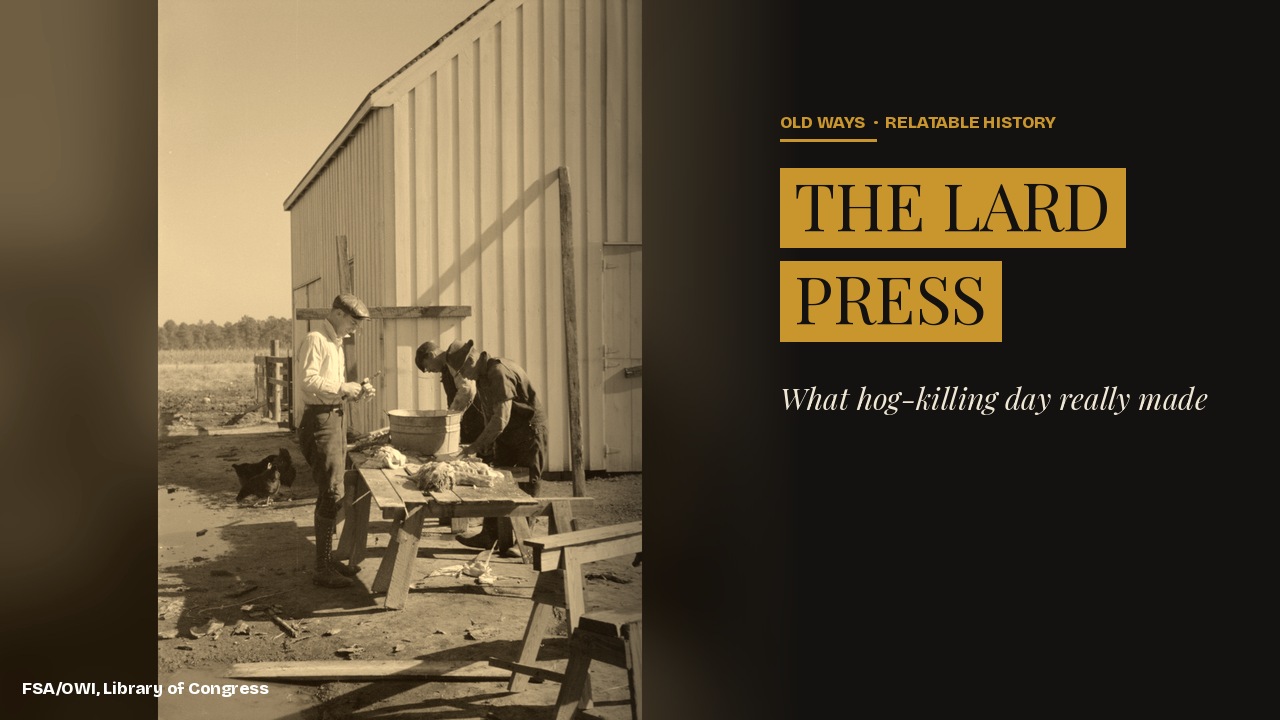
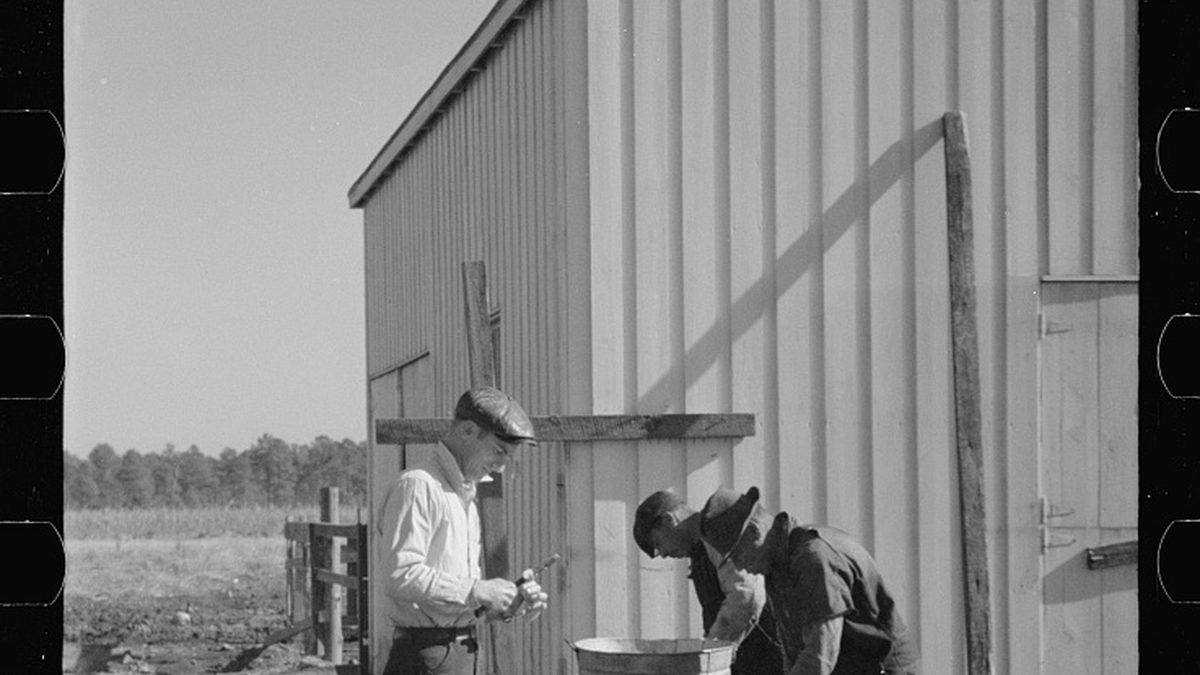
The day had a name any farming community recognized without explanation, the same way a husking bee or a quilting bee named a specific day’s shared labor. It came deliberately in late autumn or early winter, timed to the season’s first hard, lasting frost, because warm weather meant spoiled meat and wasted work. According to the Encyclopedia of North Carolina, families sometimes pooled their neighbors’ labor to process as many as a hundred hogs in a single operation, animals that had spent the fall fattening on corn, peas, or whatever mast they could glean from the harvested fields and surrounding woods.
The work itself followed a set order. Large stones heated in an open fire went into barrels of water until it was hot enough to loosen a hog’s bristles; the animal was killed, bled, scalded, hung from a gambrel, and scraped clean, then left to cool overnight before the real cutting began the next day. A 2003 Southern Foodways Alliance interview with a Tennessee farm family recorded scalding water held at roughly 140 degrees Fahrenheit — hot enough to loosen hair, but hot enough also to “set” it permanently if the carcass stayed in too long, which made judging the temperature by feel a skill in its own right. Six hogs on that farm, each bought as 80-to-90-pound shoats and fattened to around three hundred pounds, could keep a family’s smokehouse and lard cellar stocked for a winter.
None of this work was solo. Men typically handled the killing and heaviest lifting; women ran the kettle and judged by eye and smell when a batch had rendered enough to come off the heat; children salted cracklings and kept the fire fed. The press — whichever kind a family owned — came out only on this one day, or the few days immediately after, and then went back onto a shelf for another eleven months.
How farms rendered lard when a kettle wasn’t enough
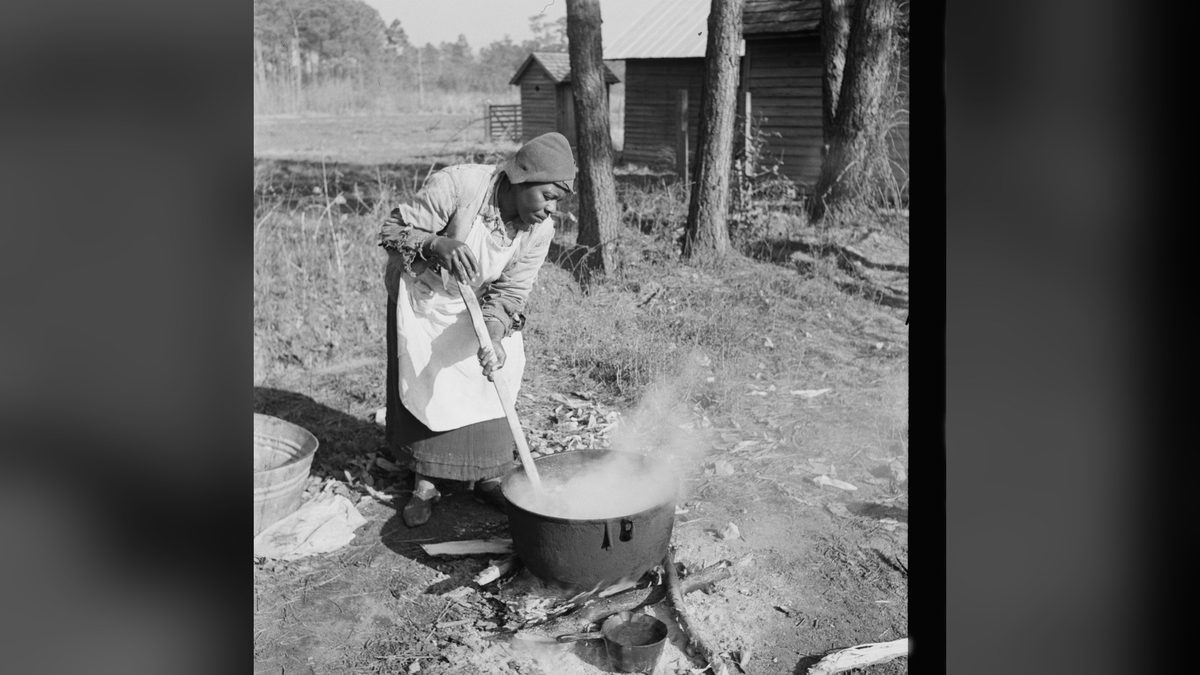
Rendering began with the trimmings taken off the carcass during butchering, chopped into small, even pieces and dropped into a large iron kettle set over an open fire. It cooked down slowly, two to four hours, with someone stirring more or less constantly using a long iron paddle so nothing stuck to the kettle’s bottom and scorched, which would ruin the whole batch’s flavor. As the fat liquefied, the palest, cleanest lard could be ladled off first and strained through cloth into stoneware crocks, prized for pie crust and baking, where a clean, nearly flavorless fat mattered. Later pours, darker and more assertive, went toward frying.
What never fully melted was the problem the kettle alone couldn’t solve: scraps of fat still bound up with connective tissue and bits of meat, holding real fat the boiling water simply couldn’t shake loose by heat alone. That residue, still warm and pliable, is what went into the press. A screw or a geared crank forced a plate down through a perforated basket holding the scraps, applying far more sustained pressure than a kettle’s heat or a cook’s two hands twisting a cloth ever could, and a second, clear harvest of fat ran out through the basket’s holes into a waiting pan. What stayed behind in the basket, dry and barely holding together, came out as cracklings — salted while still warm and eaten on the spot, what one Texas rancher and museum curator called, in a 2003 account of his own family’s butchering days, “a forerunner of today’s pork skins.”
The mechanism was patented, and the patent still reads clearly
Baker’s 1876 patent spells out exactly how the Enterprise press worked, and the description still reads clearly a century and a half later. A cast-iron vessel held the material to be pressed. Inside it sat a perforated plate and a perforated casing, with a piston that moved up and down inside that casing. The piston connected to a toothed rack running in guides on a frame that hinged along one side of the vessel and locked against a stud on the other, so the whole assembly could swing open for loading and swing shut and lock for pressing. Turning a handle rotated an inclined spindle carrying a scroll wheel that engaged the rack’s teeth, driving the piston down with steady, geared force. For lard, the oil forced its way through the perforations and ran out a spout at the bottom of the vessel. Swap in a tapering spout at that same outlet, and the machine became a sausage stuffer instead.
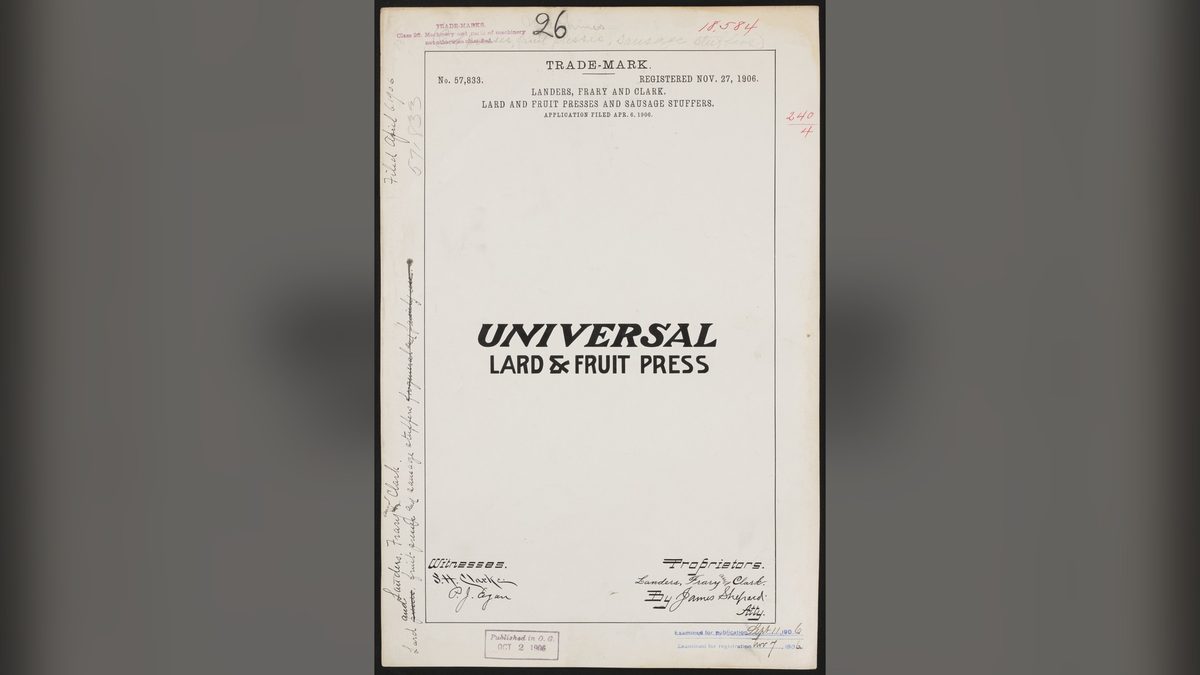
It is worth pausing on how deliberately generic that design was. Baker and Enterprise were not selling farms a lard press that happened to also stuff sausage — they engineered one machine from the outset to do either job, because a 19th-century farm household had no use for two or three single-purpose presses that would each sit idle 360-some days a year. Enterprise was not alone in the business, either: in 1906 the Connecticut hardware firm Landers, Frary and Clark registered its own trademark for a nearly identical machine, the “Universal Lard & Fruit Press,” filed that April and registered that November — evidence this was a whole category of farm tool, not one company’s curiosity.
The same press, refitted, pressed cider too
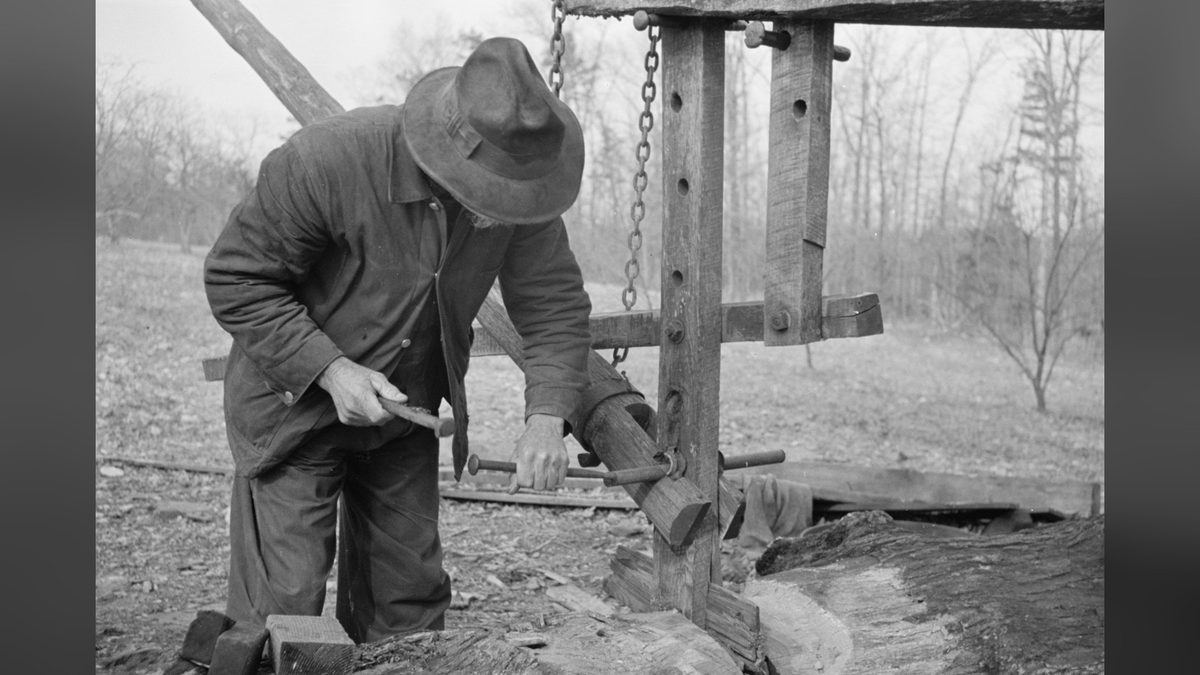
Before a family could afford a factory-made cast-iron press, the same basic principle worked in cruder form. Scraps packed into a wooden box or a hollowed log, both bored through with holes, sat under a plain wooden screw turned by hand — slower and harder on the arms, but mechanically doing the same job a geared Enterprise press would later do with far less effort. That same crude, wooden-screw design, scaled up, is what crushed apples into cider on the same kind of farms, which is exactly why manufacturers like Enterprise built one machine that could be reconfigured for either job rather than two machines that would each sit idle most of the year.
The logic held because none of these were daily machines. A press got used hard for a handful of days around hog-killing time, sat through the cider pressing a few weeks earlier or later depending on the harvest, and then went back to a barn shelf or a back porch for the rest of the year. Buying three single-purpose machines for three short seasonal jobs made far less sense on a cash-poor farm than buying one that did all three adequately — the same economy of scale behind the presses that turned curds into wheels of cheese on those same farms.
One crock had to carry a family a full year
Once the kettle and the press had both done their work, the combined lard went into stoneware crocks to cool and set solid overnight, then got sealed under a slate lid or an inverted plate weighted down with a stone and carried to the coldest corner of the cellar. Properly stored, it kept for most of a year without turning rancid. A crock used for lard, notably, could never be used for anything else again — the fat soaked permanently into the unglazed pottery — so families that rendered their own lard kept dedicated crocks for exactly that purpose, year after year.
The lard itself wasn’t graded by a label; it was graded by memory and by pour. The earliest, palest batch, rendered at the lowest heat, went toward baking — pie crust, biscuits, cakes — where a clean, nearly flavorless fat mattered. Later batches, darker and more assertive, went toward frying potatoes, meat, and vegetables, where the flavor was welcome rather than a flaw.
Lard’s usefulness didn’t stop at the skillet. It went into homemade soap alongside lye, greased axles and boot leather, and fueled simple grease lamps before kerosene became common and cheap. During both World Wars, the U.S. government ran campaigns asking households to save their cooking fats rather than use them up entirely, because rendered fat could be processed into glycerin, a component of explosives — one wartime poster put the request in exactly four words.

A cottonseed-oil rival with a steer on the label went after lard first
Lard’s first serious commercial rival wasn’t Crisco. Two decades before Procter & Gamble’s product reached shelves, the N.K. Fairbank Company of Chicago was already selling Cottolene, a solid white cooking fat made from cottonseed oil blended with a small amount of beef tallow, packaged in labeled buckets meant to sit right next to the lard crock it was trying to replace. By the mid-1890s Fairbank had distribution sites in St. Louis, New York, Boston, Philadelphia, San Francisco, and Montreal, and the product had already collected a Grand Prize at the 1904 Louisiana Purchase Exposition and gold medals at international fairs in Paris and Charleston.
Cottolene’s advertising did not try to compete on price. It competed on the idea that rendered animal fat was crude and vaguely unhealthy, while Cottolene was clean, modern, and physician-approved — one slogan promised buyers it would “shorten your food and lengthen your life.” The company even sponsored a branded cookbook, Home Helps, whose first edition was edited by Sarah Tyson Rorer of the Philadelphia Cooking School, specifically to teach housewives how to bake with the new product. Food historian Alice Ross has argued the campaign worked partly by leaning on class prejudice already in the air: home-rendered lard and the hog-killing traditions behind it read, to an increasingly urban and image-conscious buying public, as rural and unfashionable in a way a tin of bright white shortening did not.
Crisco finished what Cottolene started
Crisco went on sale in 1911, after Cottolene had already softened the market for a non-lard shortening, but it had an advance Cottolene never had: hydrogenation. Procter & Gamble’s chemists found a way to force hydrogen into liquid vegetable oil — first cottonseed oil, later soybean oil — turning it solid at room temperature, much like lard, but through an industrial process rather than an animal’s fat. The company’s marketing leaned hard into exactly that novelty, promising buyers a product that was, in its own slogan, “all vegetable” and “digestible.”
What nobody selling or buying Crisco in 1911 knew was that hydrogenation also produced trans fats, since linked to heart disease — a cost that didn’t surface in scientific studies until the 1990s. None of that mattered yet in the early 20th century. What mattered on a farm was that Crisco needed no hog, no hard frost, no kettle, no press, and no cellar crock — only a trip to a store that kept getting easier to reach as rural electrification and better roads spread across the countryside. Lard held on stubbornly in home kitchens for decades, and wartime shortages briefly sent households back to their own rendering kettles, but by the middle of the century the press that had squeezed out a family’s cooking fat for a hundred years had mostly gone quiet, its patent dates still legible in the iron.
Watch the full history
The long-form video below walks through the press on camera, alongside the kettle it worked next to on hog-killing day.

Related reading
- The History of Cheese Pressing: From Roman Molds to Jefferson’s 1,235-Pound Wheel — the same mechanical idea — weight, patience, and a perforated container — turned curds into cheese.
- How a Smokehouse Cured a Year’s Worth of Meat With Only Salt, Smoke, and Time — the building that preserved the rest of the hog once the rendering was done.
- How Cream Separators Worked, and Why Every Farm Wanted One — another farm machine built to force fat out of raw material faster than nature would.
- How Cider, Not Beer, Became Colonial America’s Everyday Drink — the other job the same wooden screw press was built to do.
- How a Root Cellar Kept Vegetables All Winter — the cold cellar where the finished crocks of lard were stored alongside the rest of the farm’s winter food.
What a lard press and its decline really track is a much larger shift: cooking fat going from something a family produced within its own household economy — an animal they raised, a machine they owned outright, a crock they filled with their own labor — to something bought ready-made from a company whose factory and marketing department the buyer never saw. Lard is an unusually clean case of that shift, because the object that did the extra work of getting the last of the fat out has survived in such numbers that it still turns up, patent dates and all, at flea markets and farm museums.
None of this makes home rendering look naive in hindsight. A crock that cost nothing but a day of shared labor and kept a family in cooking fat for a year was, by any measure, a genuinely efficient piece of household economics — it simply couldn’t compete, eventually, with a product that required no animal, no season, and no particular skill to use correctly.
How much lard do you think one hog rendered for a winter of cooking?
Shop the styles and items featured in this video
- The Fat Kitchen: How to Render, Cure & Cook with Lard, Tallow & Poultry Fat — view on Amazon.
Works cited
- Baker, John G. “Improvement in Lard-Presses and Sausage-Stuffers.” US Patent 179,757, assignor to the Enterprise Manufacturing Company. Issued 11 July 1876. Link.
- “Universal Lard & Fruit Press.” Trade-Mark No. 57,833, Landers, Frary & Clark. Application filed 6 April 1906; registered 27 November 1906. U.S. Patent Office.
- Enterprise Sausage Stuffer and Lard Press trade card, Enterprise Manufacturing Co. of Pennsylvania, c. 1893. Michael Zinman World’s Fairs Collection, Library Company of Philadelphia.
- “Sausage Stuffer, 1850-1900.” Object ID 30.884.1, The Henry Ford Museum. Link.
- “Save Waste Fats for Explosives.” U.S. Office of War Information, Poster No. 61, 1943.
- Powell, William S. “Hog Killing.” Encyclopedia of North Carolina. University of North Carolina Press, 2006. Link.
- “A Tennessee Hog Killing.” Southern Foodways Alliance Oral History Program, interview by Evan Hatch, January 2003. Link.
- Ross, Alice. “Hearth to Hearth: Cottolene and the Mysterious Disappearance of Lard.” Journal of Antiques and Collectibles, February 2002.
- Charles, Dan. “The Forgotten, Fascinating Saga Of Crisco.” NPR, The Salt, 9 January 2012. Link.
- Locher, Paul. “Lard, Scrapple and Cracklins Complete the Butchering Job.” Farm and Dairy, 5 June 2025. Link.
- Trew, Delbert. “It’s All Trew: Snap, Crackle, Pop.” Farm Collector, 1 October 2003. Link.