
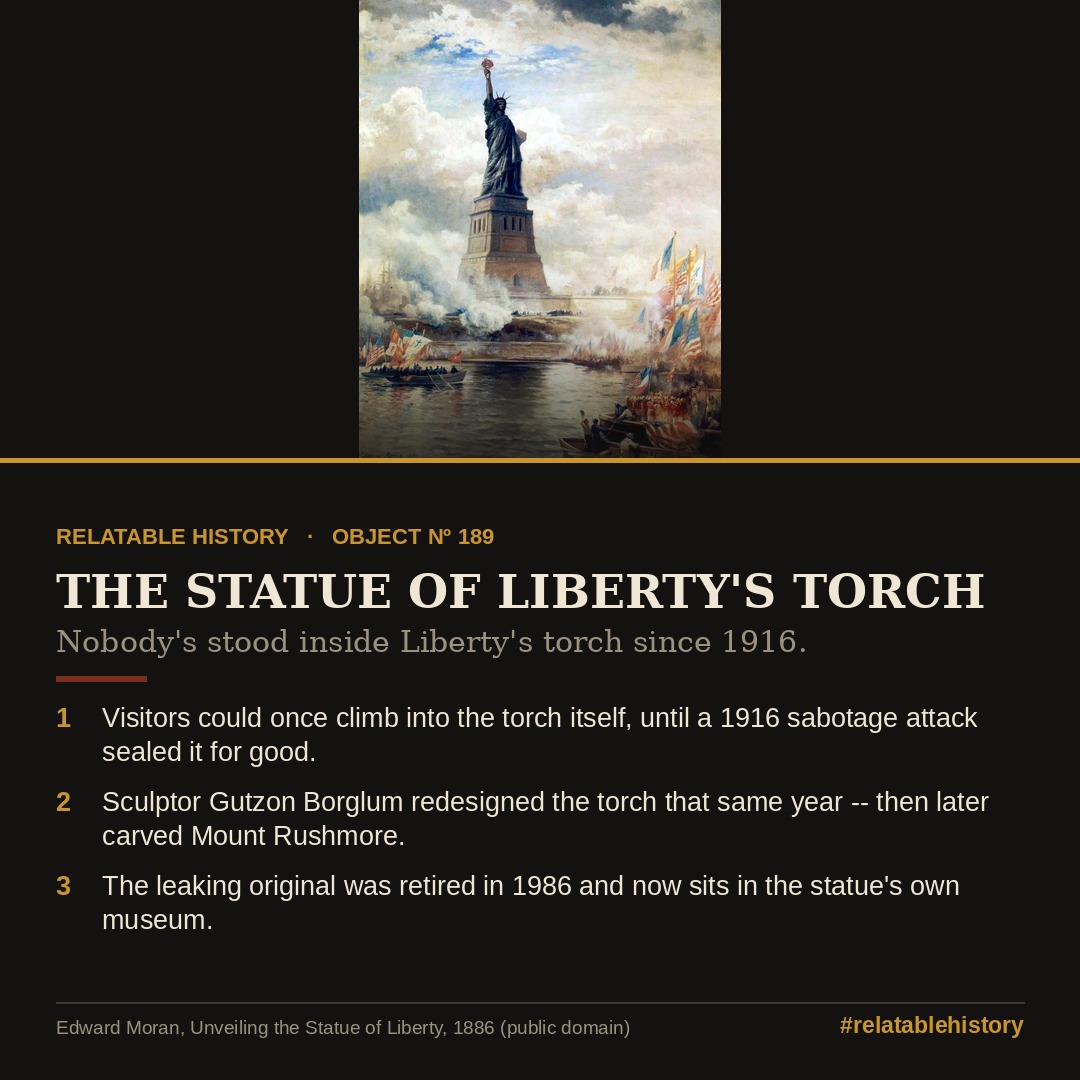
When the Statue of Liberty’s torch was switched on for the first time, on the night of November 22, 1886, it did not produce the glow visitors imagine from the old engravings. Nine arc lamps had been wired inside the flame, shining out through portholes cut into the copper, and the effect was dim enough that at least one contemporary account compared it, unflatteringly, to a glow-worm rather than a beacon. That was already the second attempt at lighting it. It would not be the last.
What gets lost in the torch’s familiar outline — sealed in 1916, replaced in 1986 — is that for sixteen of those years it was not a decorative flourish at all. By order of President Grover Cleveland, the statue, its pedestal and its light were placed under the U.S. Lighthouse Board, the same federal agency responsible for every working lighthouse on the American coast — a statue whose own commemorative purpose has its own disputed origin story. Liberty was, by law, a navigational aid, filed in the same registers as the lights at Sandy Hook and Montauk, with its own electrical plant and its own keeper.
That bureaucratic detail is the thread that actually runs through this object’s history. Lighting a thirty-story copper figure at night without destroying it turned out to be a genuinely hard engineering problem, and the torch went through four distinct, mostly unsuccessful attempts to solve it before anyone got it right.
For sixteen years, the torch was a federal lighthouse — and a disappointing one
The lighting system installed for the 1886 dedication was the work of James J. Wood, an electrician with the American Electric Manufacturing Company. Nine arc lamps lit the torch itself, through the portholes Bartholdi had cut into the copper flame after the Army Corps of Engineers vetoed his original plan for floodlights on the balcony — the Corps worried that strong lights at that height would confuse ships navigating the harbor. A separate set of five arc lamps, fitted with reflectors, lit the statue’s exterior from the corners of the old fort beneath it, and fourteen incandescent lamps lit the interior — the same era’s engineers were making comparable lighting and sighting compromises on navigation instruments built for a pre-electric harbor. One dynamo ran the entire system.
A civilian keeper lived on the island and tended that equipment, the same job description the Lighthouse Board used for every other light in its care — not a role most people associate with the statue at all, but for a decade and a half it was a literal part of the title. It was never a good lighthouse, though. The light was too weak to be of much practical use to ships, and within fifteen years the government had concluded as much. On December 30, 1901, President Theodore Roosevelt approved a Treasury Department recommendation to transfer the statue from the Lighthouse Board to the War Department. The transfer took effect on March 1, 1902, and the beacon was extinguished that day. The statue has not been an official aid to navigation since.
Before it was sealed, the torch doubled as a fundraising ride
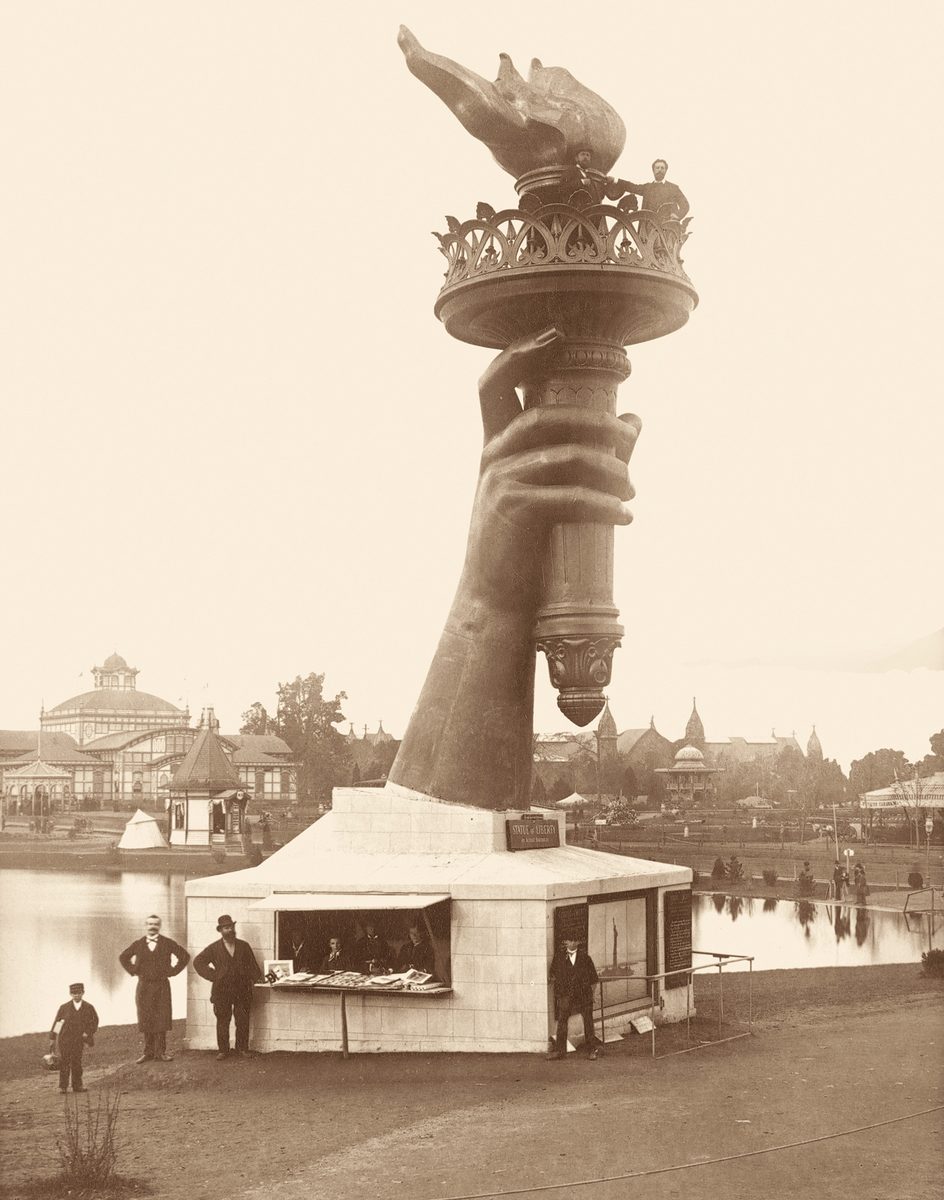
The torch-bearing arm existed years before the rest of the statue did. Bartholdi finished it in France and shipped it ahead of schedule so it could be exhibited at the 1876 Centennial Exposition in Philadelphia, where organizers charged fifty cents for visitors willing to climb a narrow interior ladder to a platform built around the flame. The fee went toward the pedestal fund. After the exposition closed, the arm spent six more years on display in Madison Square Park in New York, still raising money, before it was finally reunited with the rest of the statue for the 1886 dedication.
Once the completed statue opened, the climb got harder rather than easier: a single fifty-four-rung ladder was the only way up, and the platform at the top held about a dozen people at a time. It stayed open to the public, awkwardly, for thirty-odd more years — which is longer than most retellings of this object’s story acknowledge, since the 1916 closure tends to get treated as the beginning of the restriction rather than the end of a much older and more cramped arrangement.
A 1916 sabotage attack is blamed for the closure — the record is messier than that
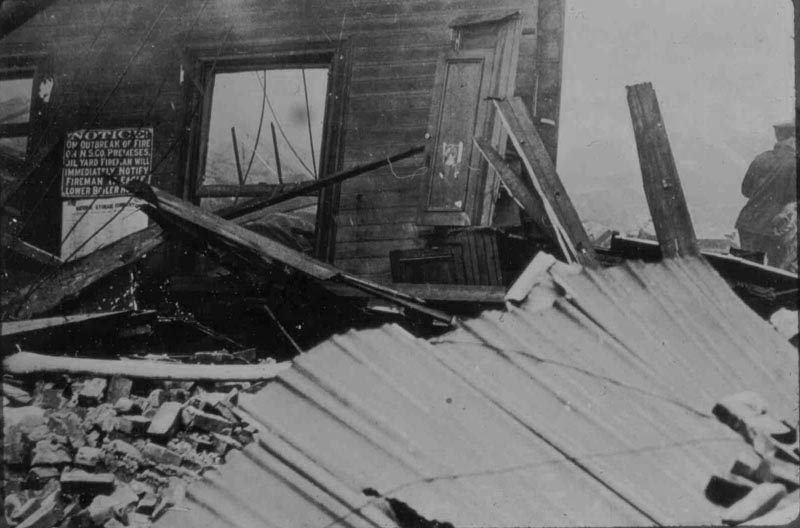
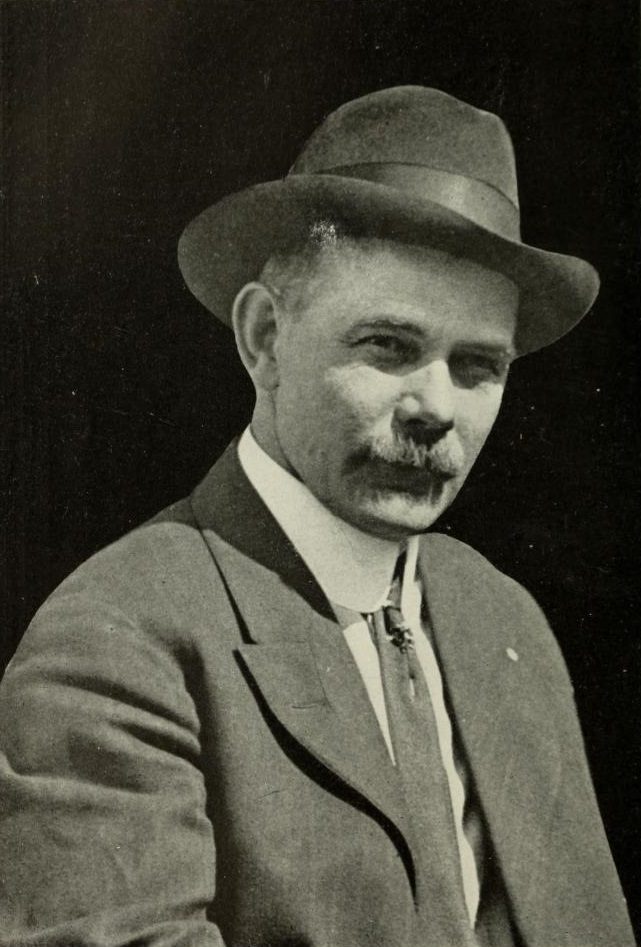
Just after 2 a.m. on July 30, 1916, German agents set off a series of explosions at Black Tom, a munitions depot on a pier off the Jersey City waterfront holding roughly two million pounds of ammunition awaiting shipment to the Allies. The blast has been compared in force to a magnitude 5.5 earthquake; it shattered tens of thousands of windows across lower Manhattan, was felt as far away as Maryland, and forced the evacuation of newly arrived immigrants from Ellis Island. Several people were killed and hundreds injured. Property damage ran past twenty million dollars. Investigators first arrested officials of the depot’s own railroad and storage companies over safety violations; the sabotage itself did not come fully to light until the 1930s, when a former depot watchman, Michael Kristoff, was identified as the man paid to set the first small fires. He was never tried, and died in 1928 before the case against Germany was complete.
The Statue of Liberty, just over a mile away, took fragments from the blast and sustained an estimated hundred thousand dollars in damage. The standard version of the story, repeated in most retellings, is that this damage is why the torch was closed to visitors for good. A more skeptical reconstruction of the record complicates that: one investigation into the torch’s access history found that the public climb actually continued for another year and concluded that the 1917 closure was driven by overcrowding on that fifty-four-rung ladder rather than by blast damage, calling the sabotage explanation for the closure itself an apparently untrue but durable rumor — the same kind of after-the-fact myth-making that attaches itself to other famous objects whose real manufacturing history gets simplified into legend. What is not disputed is that the statue really was struck by debris that night, and that whichever event actually ended public access, it never reopened. It took over two decades for anyone to even formally establish who was behind the attack: lawyer John McCloy’s investigation led to a 1939 ruling against Germany by the Mixed Claims Commission, ordering fifty million dollars in reparations that World War Two delayed and that were not finally paid out until 1979 — a reparations saga as drawn-out as the postwar search for Japan’s missing Honjo Masamune sword, another object the chaos of a world war swallowed for decades.
Gutzon Borglum’s fix leaked for seventy years
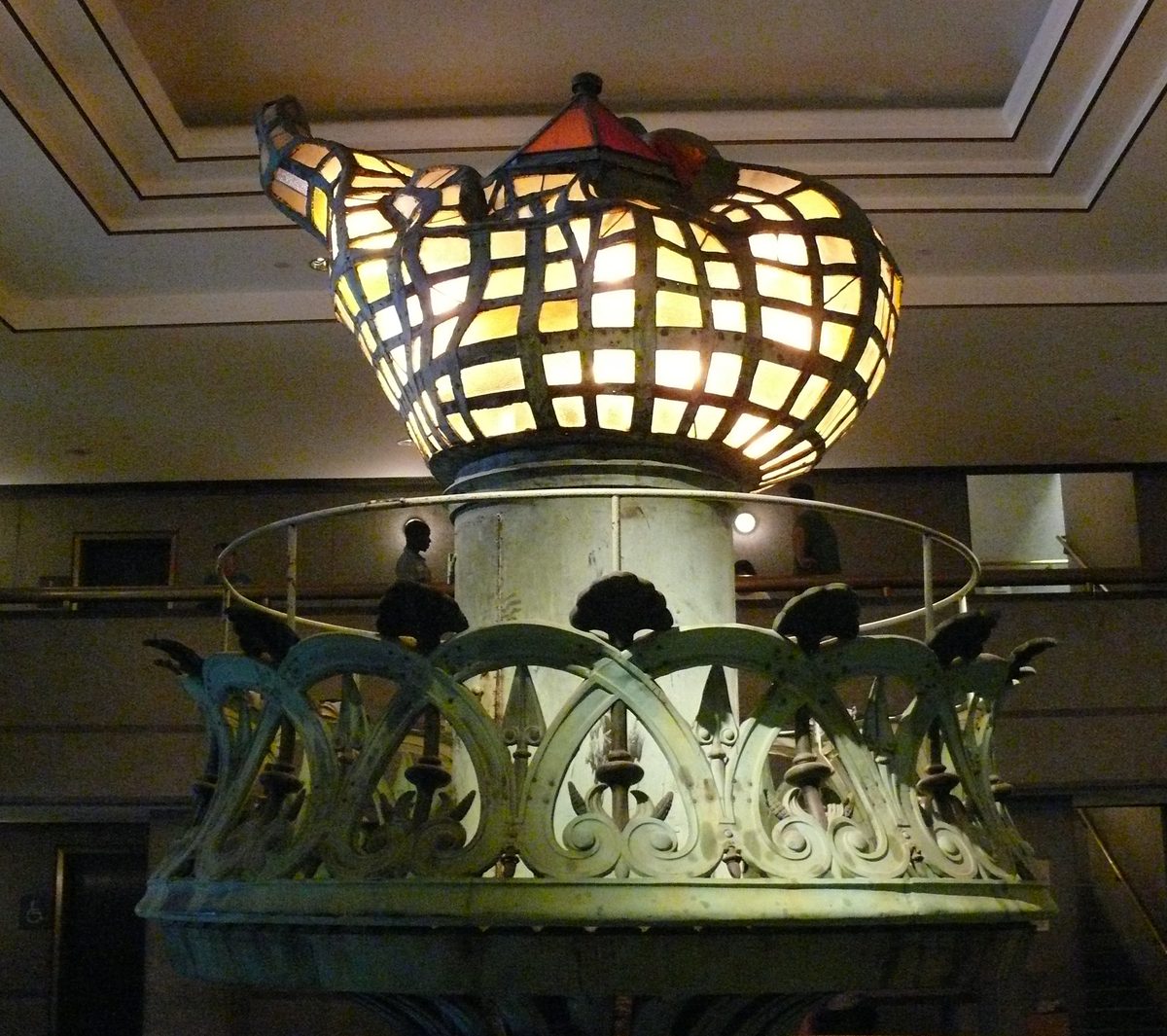
Whatever closed the torch to the public, the explosion’s near-miss did prompt a rebuild. Sculptor Gutzon Borglum — who would not start carving Mount Rushmore for another decade — was brought in to redesign the flame in 1916. His version cut away most of the remaining copper and replaced it with amber-colored glass panes, braced by copper bands, with lamps mounted inside to shine out through the glass at night.
It solved the glow-worm problem and created a worse one. The glass panes were never watertight, and rain worked its way through the seams for the next seventy years, corroding the copper arm and the torch’s internal support structure a little more with every storm. By the time anyone did a serious structural survey of the statue in the early 1980s, Borglum’s torch was not a lighting fixture anyone could patch again. It had to come off entirely.
The 1986 replacement fixed the problem by lighting the torch from outside
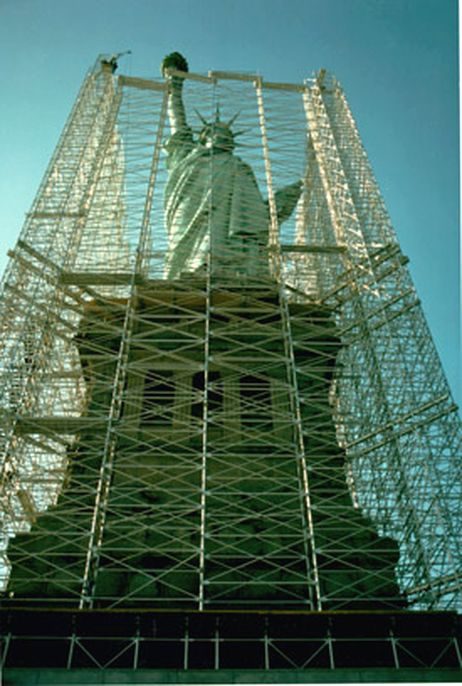
In May 1982, the Reagan administration appointed former Chrysler chairman Lee Iacocca to lead a private fundraising campaign for the statue’s centennial restoration, run jointly with the National Park Service through the newly created Statue of Liberty-Ellis Island Foundation. The statue closed to visitors in 1984 and stayed wrapped in scaffolding for two years while crews replaced more than a thousand corroded iron ribs and thousands of rivets, stripped seven layers of old interior paint with liquid nitrogen, patched holes in the copper skin, and inserted Teflon sheeting between the new internal frame and the copper to stop the two metals from corroding each other the way the original iron-and-copper pairing had.
The restoration went well beyond the torch. Engineers reinforced the statue’s right arm, whose internal framework had been a known weak point since the nineteenth century, and braced the seven spikes of the crown. Two new elevators were installed, one running to the top of the pedestal for general visitors and a second, for emergencies only, reaching up into the crown. The torch itself got the most visible fix: rather than attempt a third version of lamps-behind-glass, the team removed Borglum’s leaking flame entirely and replaced it with a solid copper torch sheathed in 24-karat gold leaf, lit at night by floodlights mounted on the outside of the balcony — functionally the same approach the Army Corps of Engineers had vetoed for the statue’s exterior back in 1886, a hundred years and two failed interior-lighting designs later. The statue was rededicated on July 4, 1986, as the centerpiece of the three-day Liberty Weekend celebration, and reopened to the public the following day.
The old torch didn’t disappear — it moved twice
Borglum’s corroded torch was not scrapped. After its removal in 1984 it went on display just inside the statue’s pedestal, where it stayed for more than three decades, visible to the roughly one in five Liberty Island visitors with a ticket into the base. For much of that time, the person with the most regular hands-on access to the sealed original was a single maintenance worker, Charlie Deleo, who spent thirty-three years climbing the statue’s interior ladders to clean and repair the lighting and became known on the island as the “Keeper of the Flame” — a title with genuine lighthouse-service pedigree, even though the statue’s actual lighthouse status had ended decades before he ever made the climb.
In November 2018, with a new museum under construction elsewhere on the island, engineers dismantled the old torch into two sections — the flame and tube lifted out by crane, the heavier base skated across the ground on neoprene pads — and carried both pieces roughly 470 feet on a hydraulically stabilized transporter before craning them in through window openings in the unfinished building. The Statue of Liberty Museum opened to the public on May 16, 2019. The torch, sixteen feet tall, twelve feet wide and weighing thirty-six hundred pounds, is the final object visitors reach, the centerpiece of the museum’s Inspiration Gallery, close enough now to examine the century of water damage up close.
Line up the four lighting designs and a pattern falls out that the sealed-since-1916 version of this story tends to flatten: nobody actually solved the problem of lighting this torch until they stopped trying to light it from the inside altogether. Arc lamps through portholes, amber glass that leaked for seventy years, and finally gold leaf lit by floodlights from the balcony — the fix that worked was the one the Army Corps had suggested in 1886 and been turned down. The statue spent sixteen years as a legally registered lighthouse and well over a century failing, in one way or another, to actually light itself.
A hundred forty years after her dedication, would you have trusted that climb?
Watch the full history
The short video version covers the 1916 closure and the Borglum redesign in under a minute; everything above it — the lighthouse years, the 1876 fundraising climb, and where the original torch ended up — is the part that didn’t fit.

Related reading
- The Statue of Liberty Was Built to Honor the End of Slavery
- The Honjo Masamune Disappearance: What Happened to Japan’s Lost Sword
- Where Damascus Steel Was Made (It Wasn’t Damascus)
- How a Sextant Works, From Tall Ships to Apollo 13
Works cited
- U.S. Coast Guard Historian’s Office. “Statue of Liberty Light.” Assets: Land, history.uscg.mil.
- “Liberty Island: A Chronology.” Statue of Liberty National Monument, National Park Service. Link.
- “Statue of Liberty’s Original Torch Completes Move to New Home.” National Park Service, 2018. Link.
- “TWE Remembers: The Black Tom Explosion.” Council on Foreign Relations. Link.
- Nix, Elizabeth. “The Black Tom Explosion.” History.com, A&E Television Networks. Link.
- “Statue of Liberty’s Original Torch Gets New Home.” Smithsonian Magazine, Smart News.
- “Statue of Liberty Restoration and Centennial.” EBSCO Research Starters. Link.
- “Could Visitors Once Go Into the Statue of Liberty’s Arm?” The Straight Dope. Link.
- “10 Fun Facts About the Torch of NYC’s Statue of Liberty.” Untapped Cities. Link.
- “Statue of Liberty Museum Will Open on May 16.” BroadwayWorld, 2019. Link.