
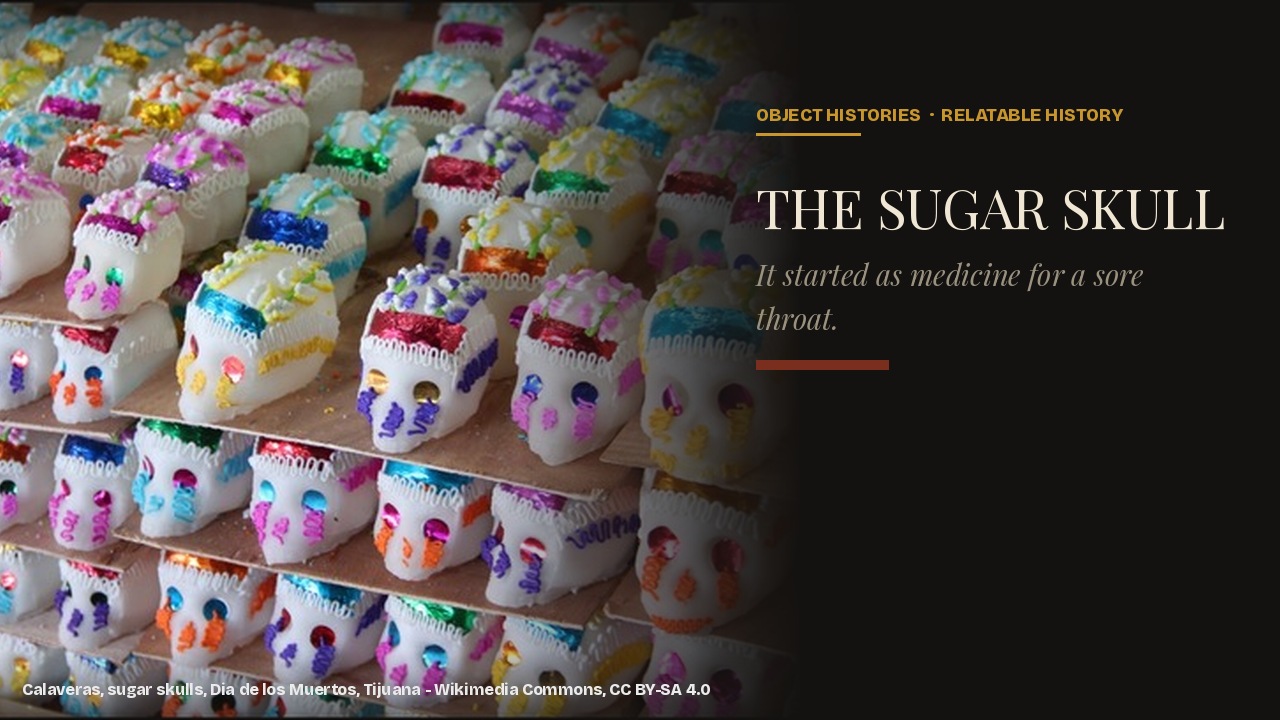
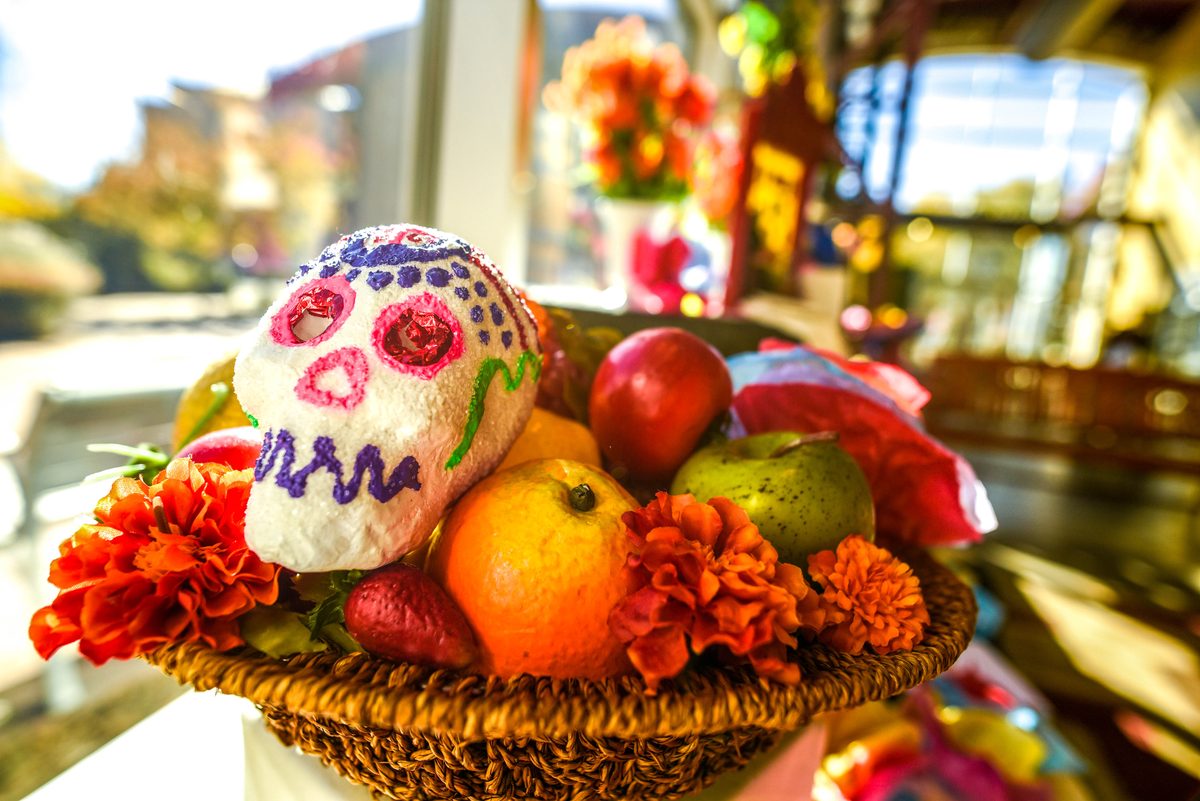
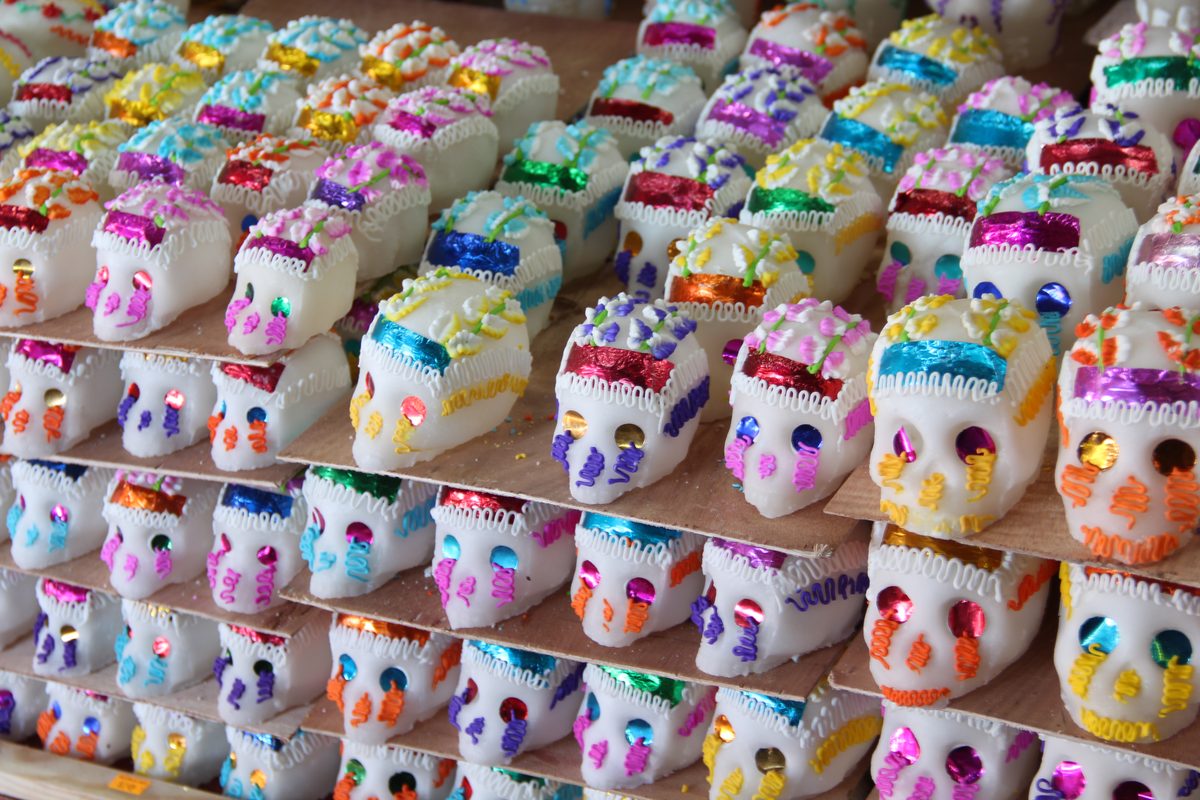
Buy a decorated sugar skull in a Mexican market this week and the vendor will often offer to write a name across its forehead, in icing or a strip of metallic foil. That one small custom is the thread this whole object hangs from, because the candy underneath the decoration was never invented for an altar at all. In Islamic-era Spain, apothecaries sold essentially the same paste as medicine: a refined sugar confection meant to be dissolved slowly against a sore or inflamed throat.
Centuries and an ocean later, that medicinal recipe landed in a country that already had an elaborate, specific relationship with the human skull as a religious image, and the two things fused into a seasonal craft that a handful of Mexican workshops still practice almost unchanged. Along the way it also picked up a satirical cartoonist, a muralist who gave the joke a permanent face, and — improbably — a twenty-first-century spy film.
The documented parts of that chain run through named apothecary trades, an excavated skull rack with a genuinely disputed body count, and a UNESCO file. Where the paper trail runs out is almost as interesting as where it holds.
A sugar paste built to be medicine, not memento
The word for the paste, alfeñique, comes from Arabic: al-fanid named a type of refined, pulled sugar candy sold across Islamic-era Iberia. Apothecaries in Al-Andalus cooked sugar with water and, depending on the shop, honey or ground almond, then worked the hot mixture into a stretchable paste. It was commerce, not ceremony: a sweet dissolved slowly to coat and soothe a raw throat, sold the way a lozenge is sold today.
The name outlived the empire that coined it. Spanish kept alfeñique largely intact from the Arabic, and the Portuguese cognate, alfenim, still names a related sugar-paste confection in Portugal and the Azores — a linguistic fossil of a trade that had nothing to do with Mexico, death, or November.
That specific paste, not sugar candy in general, is what Spanish colonists carried across the Atlantic to New Spain in the sixteenth century. What it met there is the part of the story that actually explains the skull shape.
It landed in a culture that already thought hard about skulls
Central Mexico did not need to invent a reason to decorate a skull. The Aztec Lady of the Dead, Mictecacihuatl, led a periodic observance honoring the dead that predated any Spanish calendar; after the conquest, missionaries folded that observance onto the Catholic feast days already sitting in early November, All Saints’ and All Souls’. The fusion is still the backbone of the holiday UNESCO would later file under a single name.
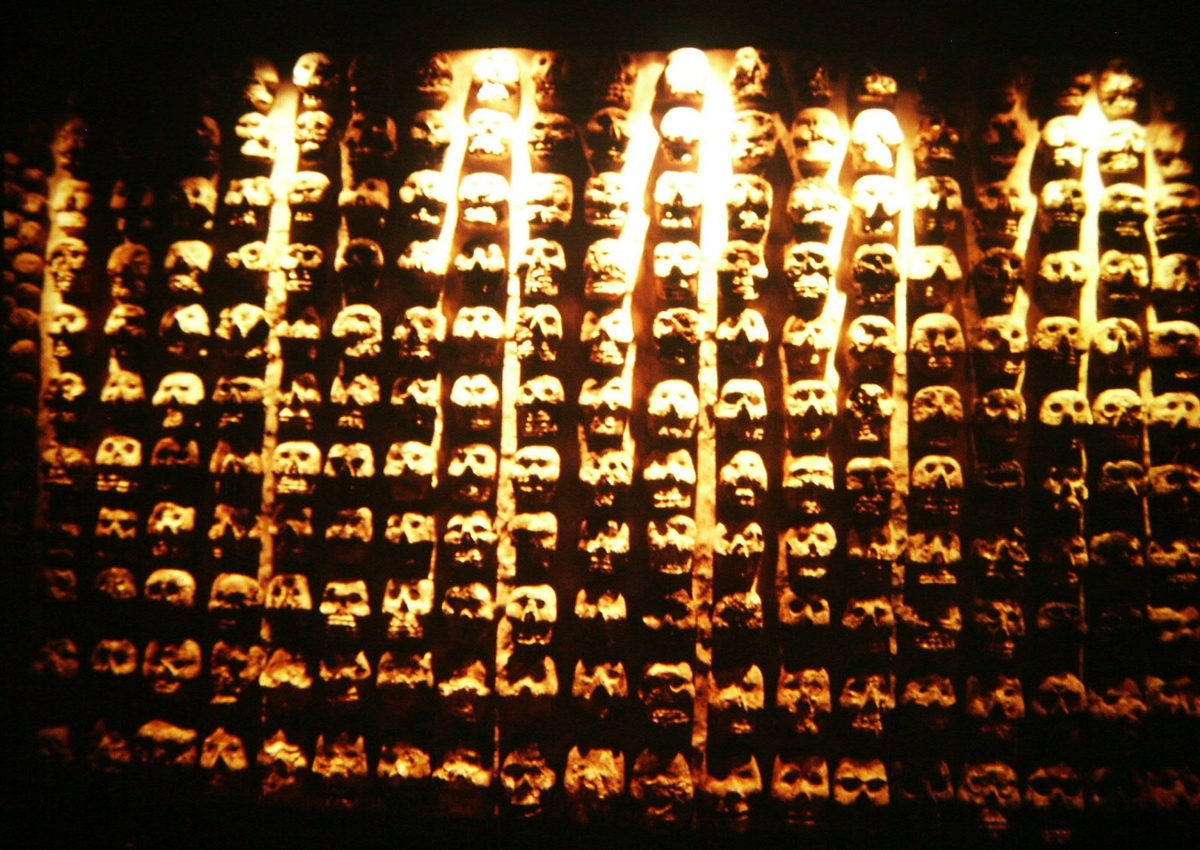
The imagery was not symbolic alone. Beneath modern Mexico City, archaeologists have spent a decade digging out a structure at the Templo Mayor built from actual human skulls — a rack known as the tzompantli. The first announced count, reported by Archaeology magazine in August 2015, was modest and explicitly incomplete: 35 skulls visible at the dig site, with excavator Raúl Barrera of Mexico’s National Institute of Anthropology and History expecting many more below. Two more years of digging proved him right — Smithsonian Magazine’s later reporting put the total past 675 skulls and fragments, including, unexpectedly, women and children, which undercut the older assumption that the rack held only captured male warriors. Researchers now estimate the complete structure, built between 1485 and 1502, may have held tens of thousands of skulls at its largest; Spanish conquistador accounts claimed over 100,000, a number most historians now treat as wartime exaggeration rather than an actual count.
There was also a gentler, edible version of the same impulse. Aztec worshippers shaped ground amaranth seed, called tzoalli or huauhtli, into figures of their gods for festivals, then broke the figures apart and ate them as an act of devotion. Spanish authorities moved to outlaw amaranth cultivation specifically because of that ritual use not long after the conquest, and the crop has never fully recovered across Mesoamerica; it survives mainly in a honeyed snack called alegría. So when imported sugar became cheap enough for ordinary households, it arrived with a banned domestic ingredient to replace and a ready-made religious vocabulary of skulls and effigies already waiting for it.
Sugar had one practical advantage amaranth paste never offered: it kept. A tzoalli figure, bound only with vegetable paste, had to be broken apart and eaten within the festival itself or it spoiled. A sugar skull, by contrast, can sit on an altar for the better part of a month, through the whole run-up to November 1st and 2nd, without rotting — which is a large part of why the imported candy displaced the native one so completely once it was available at all.
A two-part wooden mold that hasn’t needed a redesign
The craft itself is plainer than the history behind it. Artisans mix powdered sugar with beaten egg white — and, in some regional recipes, a native plant extract with natural binding properties — into a paste with roughly the working consistency of clay. Water and sugar alone will not hold a shape by hand; the egg white is what lets the paste be pressed firmly into a carved wooden mold split into two skull-shaped halves. Once unmolded, the two sides are joined with a thinned sugar paste, left to dry and harden, and then decorated by hand with colored icing, foil, sequins, or wax.
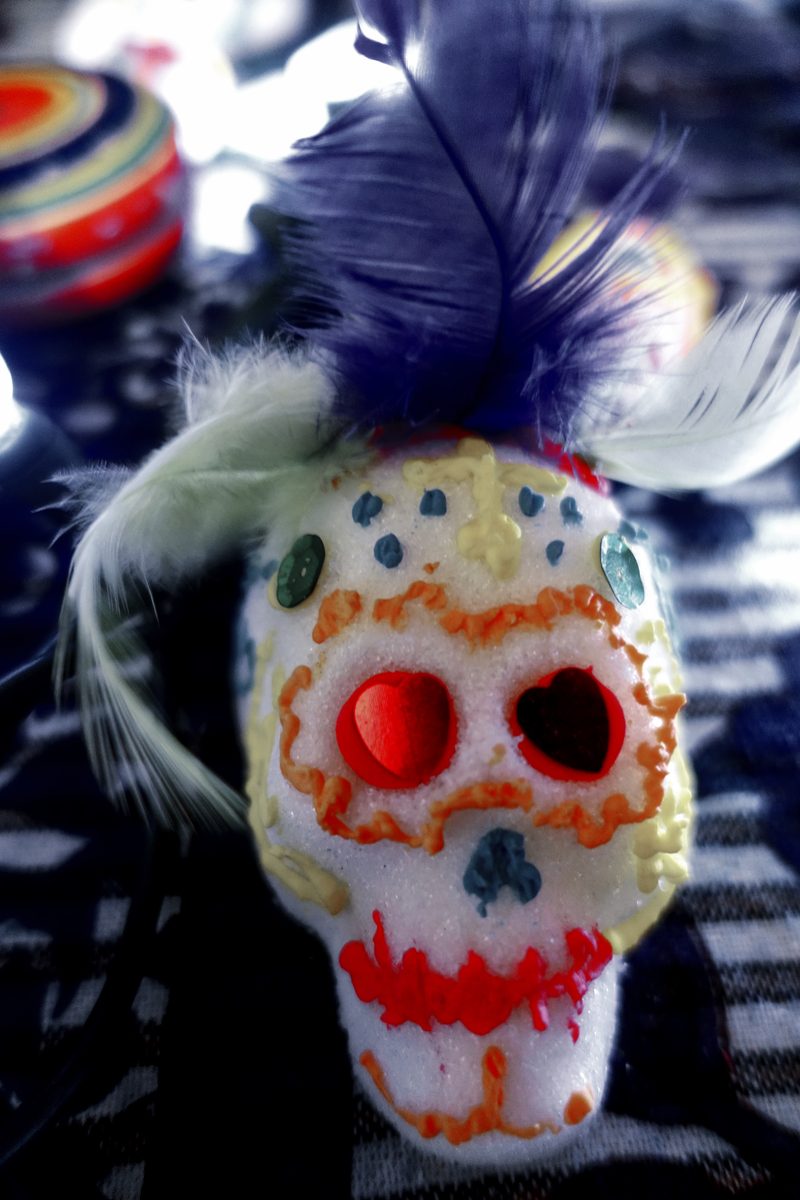
Every region does it slightly differently. Oaxacan artisans favor a crystallized sugar shell with a soft honey center; workshops around Puebla work almond and pumpkin-seed paste into the mix; the State of Mexico, centered on the city of Toluca, keeps the plain white moulded paste that most people picture. Toluca has stayed the acknowledged capital of the craft long enough to support both a dedicated museum, the Museo del Alfeñique, and an annual trade fair under the city’s Portales arcades every October into early November, where vendors sell skulls, coffins, and skeletons by the thousand and judge a contest for the best-decorated piece. Some of the families selling there work from wooden molds handed down for multiple generations, meaning a given skull’s exact shape can predate the person buying it by a century or more.
The name on the forehead
Which brings the story back to where it opened. A name written across a sugar skull’s brow can go either way. Added to a skull that joins a family’s home altar, it names a specific relative the ofrenda is built to welcome back for the night. Handed to someone living, it is a small joke about their own mortality — a candy with their name on it, eaten or kept on a shelf. The same mold, the same paste, and the same gesture in icing serve a solemn purpose and a comic one without any change to the object at all.
From an insult about garbanzo sellers to the world’s most recognized skeleton
The skull’s modern face came from somewhere much more specific than religion. José Guadalupe Posada, a Mexico City printmaker who spent his career producing cheap broadsides, etched a skeletal figure in the early 1910s to mock a precise, local kind of social climbing: garbanceras, women who sold garbanzo beans for a living but dressed above their station in European fashion while looking down on their own indigenous roots. A 1913 broadside from the workshop that printed the image simply labeled her la calavera garbancera. Posada died in 1913, before the figure became anything more than one print among hundreds he produced that year.
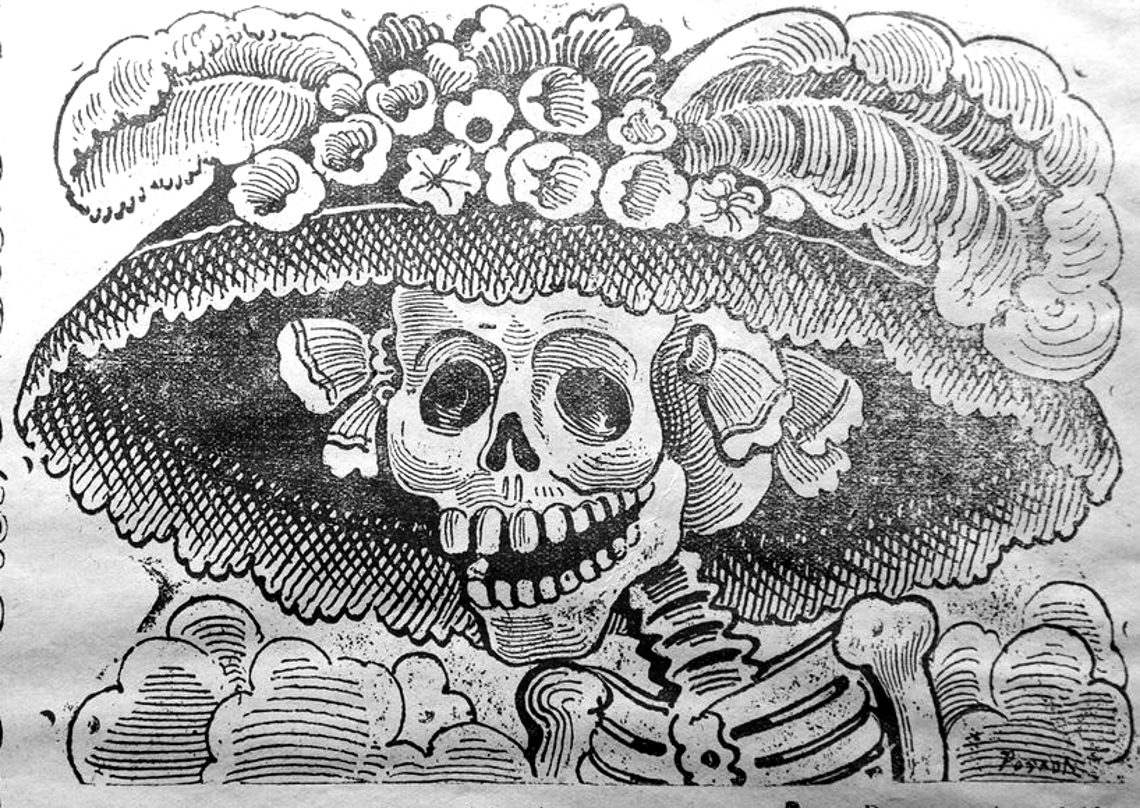
The muralist Diego Rivera and the writer Frances Toor gave the figure her lasting name, Catrina — roughly, “the dapper one” — in a 1930 book collecting Posada’s prints. It was Rivera alone, though, who gave her the fully dressed body people now picture: his 1947 mural Sueño de una Tarde Dominical en la Alameda Central (Dream of a Sunday Afternoon in Alameda Park) placed a complete, elegantly dressed skeleton — plumed hat, boa, gloves — at the composition’s center, on Rivera’s own painted arm. A joke about one very local, very 1910s kind of pretension became, through that single mural, the default face of Mexican death imagery worldwide, printed on fabric and face-painted at parties that have nothing to do with either Posada’s satire or the older altar tradition.
None of that required the sugar skull itself. Posada’s print and Rivera’s mural are works on paper and plaster, not candy — but once Catrina became shorthand for the holiday’s entire visual language, every object inside that language absorbed some of her fame by association, the skull most of all, since it was already the one physical object a visitor could actually buy and take home.
Recognition, and one accidental invention
In 2003, UNESCO proclaimed Mexico’s observance — filed under the official title “Indigenous festivity dedicated to the dead” — a Masterpiece of the Oral and Intangible Heritage of Humanity. When that early program was absorbed into the newer Representative List of the Intangible Cultural Heritage of Humanity in 2008, the item transferred automatically rather than being reassessed. UNESCO’s own file describes the tradition as a fusion of pre-Hispanic religious rites with the Catholic feast days the Spanish introduced in the sixteenth century — the same blended ancestry traced through the candy itself.
By then the sugar skull’s image had already escaped the altar entirely, recognizable worldwide with no context attached. Then, briefly, fiction got ahead of history. The opening sequence of the 2015 James Bond film Spectre, shot on location in Mexico City, staged a sprawling Day of the Dead parade — giant skeleton puppets, masked drummers, a street-filling procession — that had never actually been held there as a real annual event. Tourists started arriving expecting to see it anyway. Lourdes Berho, head of the Mexico Tourism Board, said the film’s exposure “started to create expectations that we would have something,” and the city delivered: Mexico City staged its own first official Day of the Dead parade on October 29, 2016, openly modeled on a film set, with roughly 135,000 people expected to attend.
The skull now carries two separate kinds of authenticity on its forehead at once: a documented five-century craft pressed in wooden molds that have not changed, and a nine-year-old civic tradition invented to match a movie. Next time a vendor offers to write a name across one, the more interesting question isn’t whose name belongs there. It’s how many centuries of borrowed history you’re about to hand them.
Watch the full history
The video below covers the same five centuries in under six minutes, from the apothecary paste to the Toluca workshops.

Related reading
- Is the Day of the Dead Really a Pre-Hispanic Tradition?
- The Print Trail That Turned a Pumpkin Into a Jack-o’-Lantern
- The Furcula: The Science and Superstition Behind the Wishbone
- The Original Jack-o’-Lanterns Were Turnips, Not Pumpkins
Works cited
- Pomar, María Teresa. Alfeñique. CONACULTA, 2004.
- Fernández de Calderón, Cándida, ed. Great Masters of Mexican Folk Art: From the Collection of Fomento Cultural Banamex. 2nd ed. Fomento Cultural Banamex, A.C., 2003.
- Vanderbilt University, Center for Latin American, Caribbean & Latinx Studies. “Amaranthus cruentus.” CLACX Garden Plant Database. Link.
- “Mictecacihuatl.” Encyclopædia Britannica.
- Powell, Eric A. “Aztec Skull Rack Unearthed in Mexico.” Archaeology magazine, Archaeological Institute of America, August 21, 2015. Link.
- “Aztec ‘Skull Tower’ Contains the Remains of Women and Children.” Smithsonian Magazine.
- Thelmadatter, Leigh. “On Day of the Dead, Sugar-Based Folk Art Such as the Popular Sugar Skulls Survives and Thrives.” Mexico News Daily, October 16, 2021.
- “Catrina.” Encyclopædia Britannica.
- UNESCO Intangible Cultural Heritage. “Indigenous Festivity Dedicated to the Dead.” Representative List of the Intangible Cultural Heritage of Humanity. Link.
- “Bond Inspires Mexico City Day of the Dead Parade.” BBC News, October 30, 2016. Link.