
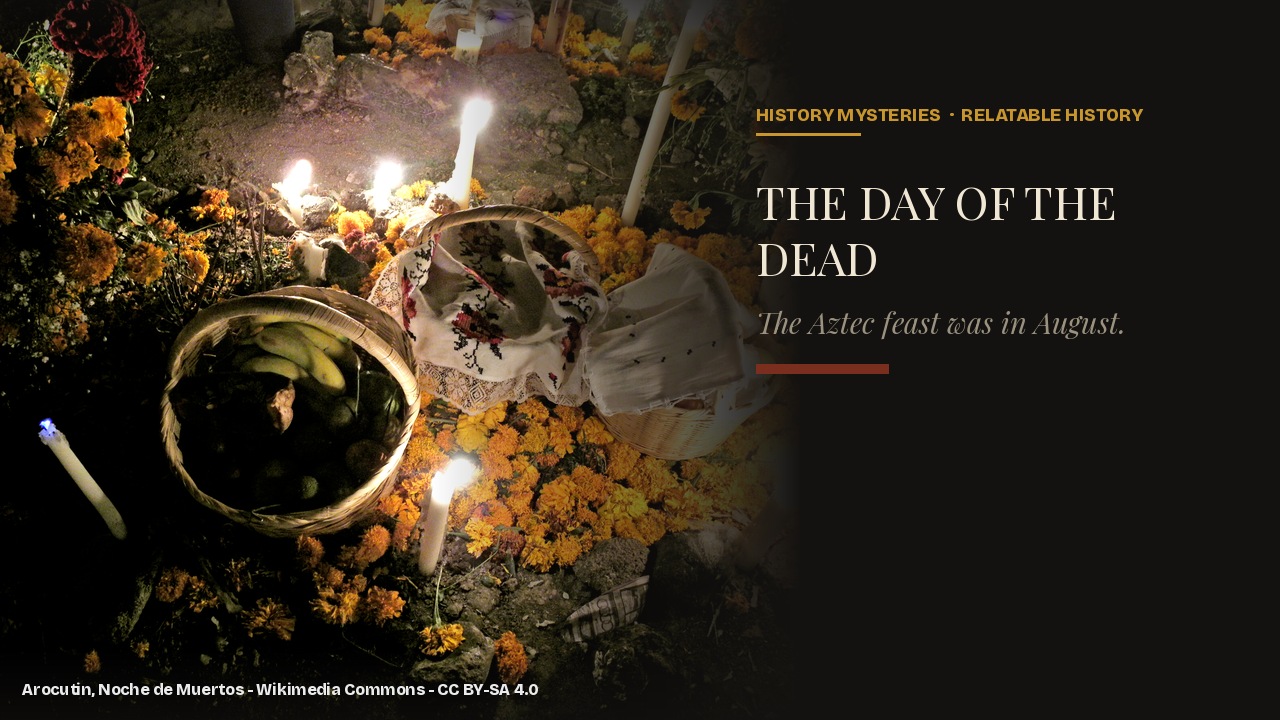
In 2008 UNESCO added Mexico’s Day of the Dead to its list of the intangible cultural heritage of humanity, a recognition that treats the festival as a living practice worth protecting. What the listing does not settle, and was never asked to settle, is how old the practice actually is. Mexican schoolbooks teach a three-thousand-year lineage running straight back to the Aztec world. The documents that would prove it have a gap exactly where the proof should be, and for fifty years two camps of serious historians have read that gap in opposite directions.
The dispute has a name in the literature: continuity versus construction. One side, running from the poet-essayist Octavio Paz through the anthropologist Patricia Fernández Kelly, treats the modern festival’s imagery as a direct, if transformed, inheritance from Mexica ritual. The other, built mainly by the anthropologist Stanley Brandes and historians at Mexico’s own National Institute of Anthropology and History (INAH), argues that the skull-and-skeleton version of the holiday familiar today is substantially a nineteenth- and twentieth-century invention laid over a medieval Catholic calendar. Both sides agree on the facts they can point to. They disagree on what the facts add up to.
What follows is not a reconstruction of a lost original. It is a walk through the actual paper trail — the friars’ calendars, the Iberian wills, a suppressed newspaper, and the government that had the most to gain from an indigenous-sounding holiday — in the order the documents were written, not the order the story is usually told.
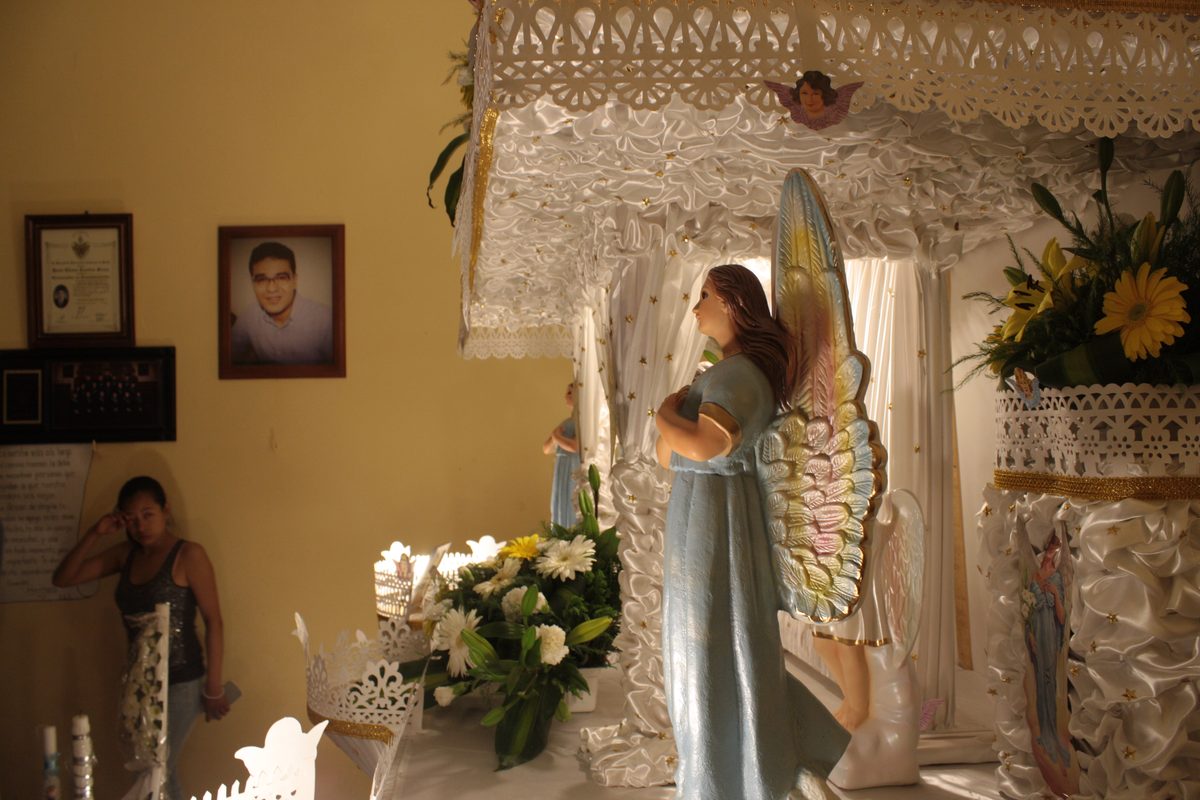
The Mexica calendar put its feasts for the dead in August, not November
The strongest documentary evidence anyone has for a pre-Hispanic festival of the dead comes from the Spanish friars who catalogued the Mexica solar calendar after the conquest — eighteen months of twenty days, two of which were dedicated to the dead. Diego Durán’s correlation places Miccailhuitontli, the lesser feast of the departed, in roughly the second half of August, and Huey Miccailhuitontli, the greater feast, running from late August into September. Bernardino de Sahagún’s independent correlation puts the same months about a month earlier.
Both estimates land nowhere near the first and second of November. That is not a small discrepancy to explain away, and the friars’ two correlations do not even agree with each other closely enough to let a scholar fix a precise Gregorian date. What is not in dispute is the existence of the Mexica feasts themselves, nor that they involved offerings, food and remembrance for the dead. What is in dispute is whether anything carries those two August weeks forward to the present November dates at all.
The November dates are entirely Catholic, and that part isn’t contested
Unlike the calendar correlation, the origin of November 1 and 2 is not seriously argued by either camp. Pope Gregory III dedicated an oratory to all the saints inside St Peter’s in Rome in 735; Gregory IV extended the feast to the whole Latin Church in the following century. All Souls, the second of November, was added later still, by Odilo, the abbot of the Burgundian monastery of Cluny, sometime around the year 1000. The two-day structure that frames the modern festival is medieval European liturgy, full stop.
The strongest case for continuity is a two-day split
If the continuity argument has a genuinely strong piece of evidence, this is it. Mexico, uniquely among Latin American Catholic countries, splits the two November days by age: the first for dead children, the second for dead adults. The art historian Ruben Córdova argues this split is a fossil of the Mexica calendar, tracing it to Durán’s own account of Miccailhuitontli, and writes that “some remnant of indigenous belief has been compressed down to two days and covertly transposed to the Catholic liturgical calendar.” He is careful to pair that claim with a warning: the indigenous content of the modern festival, he says, is “greatly overestimated” both in Mexico and abroad.
Two more pieces of evidence sit on the continuity side and neither is in dispute. Cempasúchil, the marigold that still defines the look of every altar, is native to Mesoamerica and was used ritually long before the conquest; it does not grow wild in Spain, so its presence on the altar cannot be explained as colonial borrowing the way the bread and sweets can. And the Mexica had an elaborate, well-documented geography of the afterlife — Mictlan, the underworld reached by a four-year journey through nine testing levels, guided on the way by a small dog. Neither fact is invented. What is missing is a document that shows either one walking, uninterrupted, into the festival as it is celebrated today.
Spain already had its own Day of the Dead, paperwork included
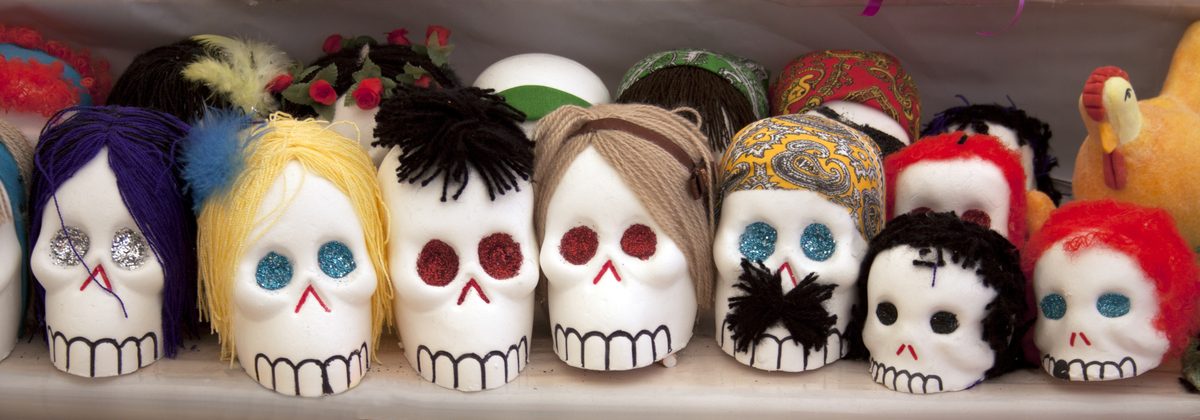
Set against that thin indigenous paper trail is a thick Iberian one. Majorcan wills from 1344 record bread and sweets donated for the souls of the dead. A Barcelona silversmiths’ guild document from 1671 uses the phrase Diada dels Morts — day of the dead — and names pa de morts, bread of the dead, as a standard offering. Sixteenth-century parish records from Zamora list comparable practices. Almost everything the Mexican festival is known for today, short of the sugar skull itself, was already ordinary Spanish Catholic practice before a single friar reached the Valley of Mexico.
It crossed the Atlantic early and it crossed intact. In the 1740s the Capuchin friar Francisco de Ajofrín kept a diary in Mexico City describing the market held before All Saints: sugar figures, sugar coffins, sugar tombs and figures of the dead, sold openly in the street — a full century before the date popular histories usually give for the first sugar figurines. Read closely, though, Ajofrín’s account never once mentions a skull, or a skeleton.
Where the skulls actually come from
Brandes traces the skeleton imagery to a different, much later source: nineteenth-century Mexican political journalism. The country’s first illustrated newspaper, El Calavera — The Skull — began publishing in Mexico City in January 1847. It ran thirty-one issues before the government suppressed it and jailed its editors for trying to incite rebellion. The skull on the masthead was a satirical device, a way of attacking public figures who could not safely be attacked by name.
The engraver Manuel Manilla worked in that satirical tradition before José Guadalupe Posada (1852–1913) joined the publisher Antonio Vanegas Arroyo and made the calavera famous. Posada’s best-known image, the elegant catrina — a fleshless skull dressed in fine European fashion — mocked Mexican social climbers, not the Aztec dead. Brandes does find one genuine European antecedent worth naming: the medieval Dance of Death, the danse macabre tradition that produced Hans Holbein’s famous woodcuts, which he calls the only prior tradition that shares the calavera’s streak of dark humour. Even so, he argues the evidence points against any direct line of influence from Holbein’s Europe to Posada’s Mexico City — the resemblance is closer to parallel invention than inheritance.
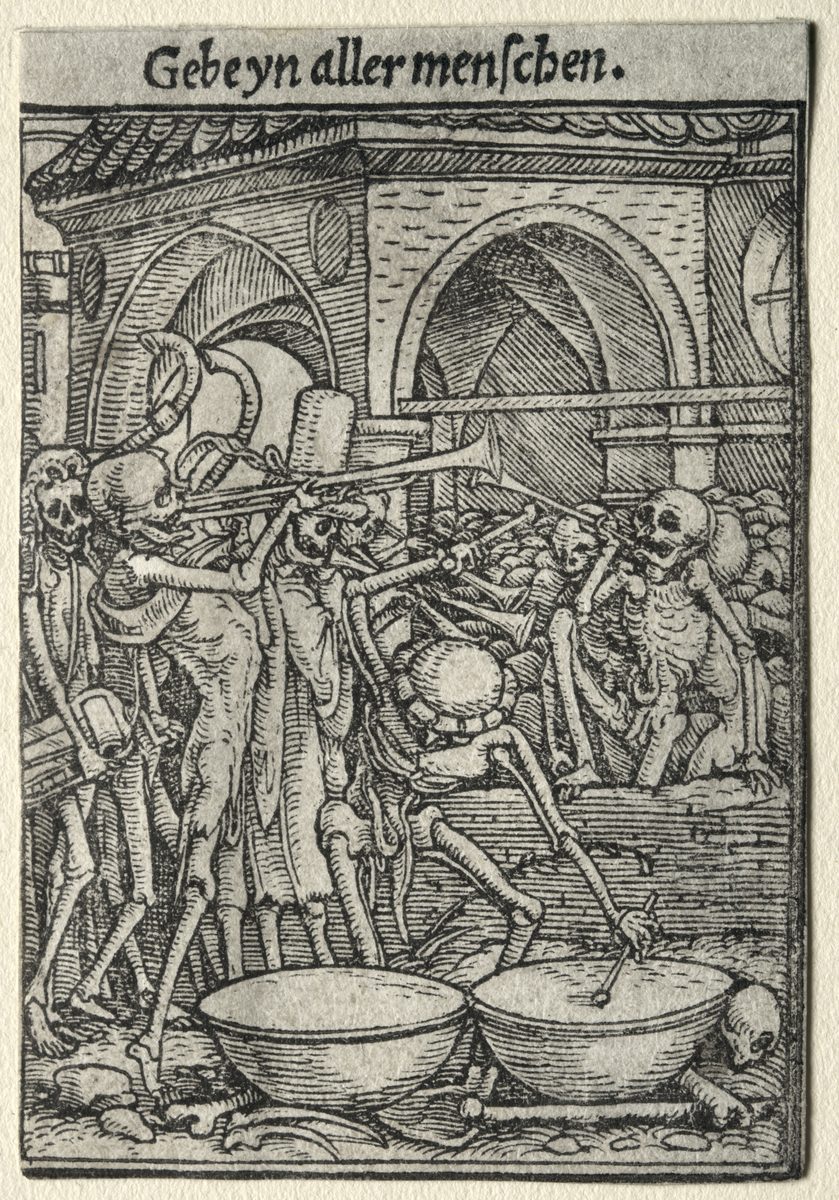
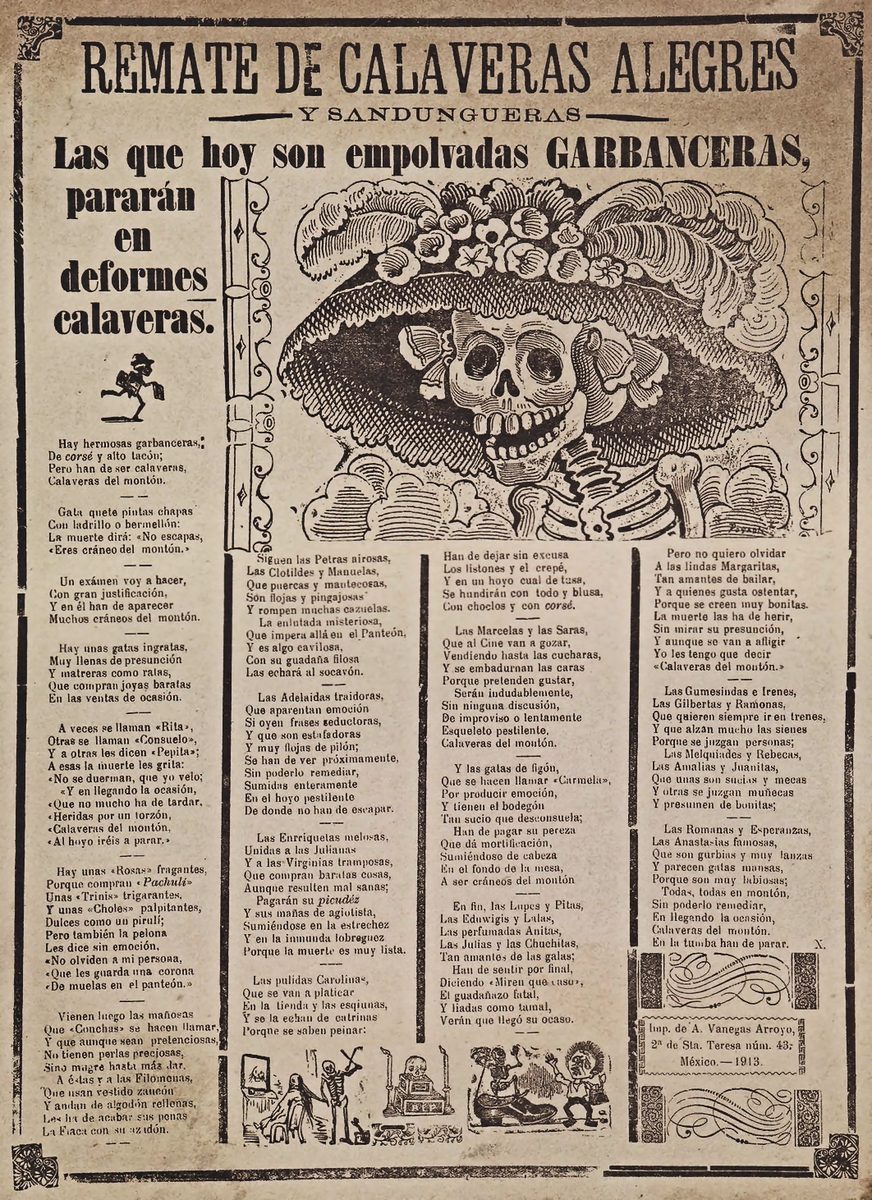
A catastrophe, or an invention of the 1930s
Brandes offers his own theory for why Mexico, rather than Spain, built such an elaborate visual culture around death. Using figures from the demographers Sherburne Cook and Woodrow Borah, he points to the collapse of central Mexico’s population from roughly 25.2 million in 1519 to 16.8 million just thirteen years later, to 6.3 million by 1548, to about 1.075 million in 1605, and down to roughly 730,000 by the 1620s — a decline of more than ninety-seven percent in a single century, driven mainly by epidemic disease the population had no immunity against. A society burying its dead at that scale, already working inside a Catholic framework that owned a feast for the dead, is, in his telling, the actual condition that produced the elaboration. He is careful to call this reasonable to propose, not proven.
The hardest version of the construction argument belongs to Elsa Malvido, the historian who founded INAH’s own workshop on the study of death. Quoted in the newspaper El Universal, Malvido argued that Day of the Dead customs trace to medieval, Jesuit-influenced Catholic Europe, that All Saints and All Souls were a tenth-century French invention, and that the supposed Mexica origin of the home altar specifically was manufactured during the presidency of Lázaro Cárdenas in the 1930s — a government with an active programme of indigenismo and clear political reasons to recast a Catholic holiday as an indigenous one. Diego Rivera’s 1946 mural placing Posada’s catrina in a Tehuana dress is usually read as part of that same nationalist turn — and it is the single image most responsible for fixing the pre-Hispanic version of the holiday in the popular imagination, schoolbooks included, eighty years later.
Both camps are working the same documentary silence, and it is worth being exact about what that silence actually contains. No source anywhere traces a continuous line of skull or skeleton imagery from the Mexica world to the present day. The friars’ own calendars put the feasts for the dead in August and September, a month or so apart depending on whose correlation is used, and neither correlation lands anywhere near November. The skeletons that define the festival today surface for the first time in a newspaper shut down for incitement in 1847, more than three hundred years after the conquest. Nothing in the surviving archive joins those two facts to each other.
UNESCO’s 2008 inscription recognised a living tradition; it did not rule on its age, and it was never asked to. The gap between what the documents will support and what gets taught in a Mexican classroom is, at this point, the most durable part of the whole story — durable enough to have outlasted fifty years of historians trying to close it.
Watch the full history
The video companion covers the same friars, the same calendar gap, and the same fifty-year argument in about ten minutes.

Related reading
- The Print Trail That Turned a Pumpkin Into a Jack-o’-Lantern
- The Original Jack-o’-Lanterns Were Turnips, Not Pumpkins
- How Houdini’s Code Worked, and Why It Could Never Prove Anything
- Inside the Discovery of the Great Pyramid’s Big Void
Works cited
- Brandes, Stanley. “Iconography in Mexico’s Day of the Dead: Origins and Meaning.” Ethnohistory 45, no. 2 (1998): 181–218. Link.
- Brandes, Stanley. “Sugar, Colonialism, and Death: On the Origins of Mexico’s Day of the Dead.” Comparative Studies in Society and History 39, no. 2 (1997): 270–299. Link.
- Fernández Kelly, Patricia. “Death in Mexican Folk Culture.” American Quarterly 25 (1974): 516–35.
- Córdova, Ruben C. The Day of the Dead in Art. San Antonio: City of San Antonio Department of Arts & Culture, 2019. Link.
- Cook, Sherburne F., and Woodrow Borah. Essays in Population History: Mexico and California, vol. 3. Berkeley: University of California Press, 1979.
- Paz, Octavio. The Labyrinth of Solitude. Translated by Lysander Kemp. New York: Grove Press, 1961.
- Durán, Diego. Book of the Gods and Rites and The Ancient Calendar. Translated and edited by Fernando Horcasitas and Doris Heyden. Norman: University of Oklahoma Press, 1971.
- Sahagún, Bernardino de. Florentine Codex: General History of the Things of New Spain. Translated by Arthur J. O. Anderson and Charles E. Dibble. Santa Fe: School of American Research / University of Utah, 1950–1982.
- “Día de Muertos, un invento cardenista, decía Elsa Malvido.” El Universal. Link.
- UNESCO. “Indigenous Festivity Dedicated to the Dead.” Representative List of the Intangible Cultural Heritage of Humanity, inscribed 2008. Link.