
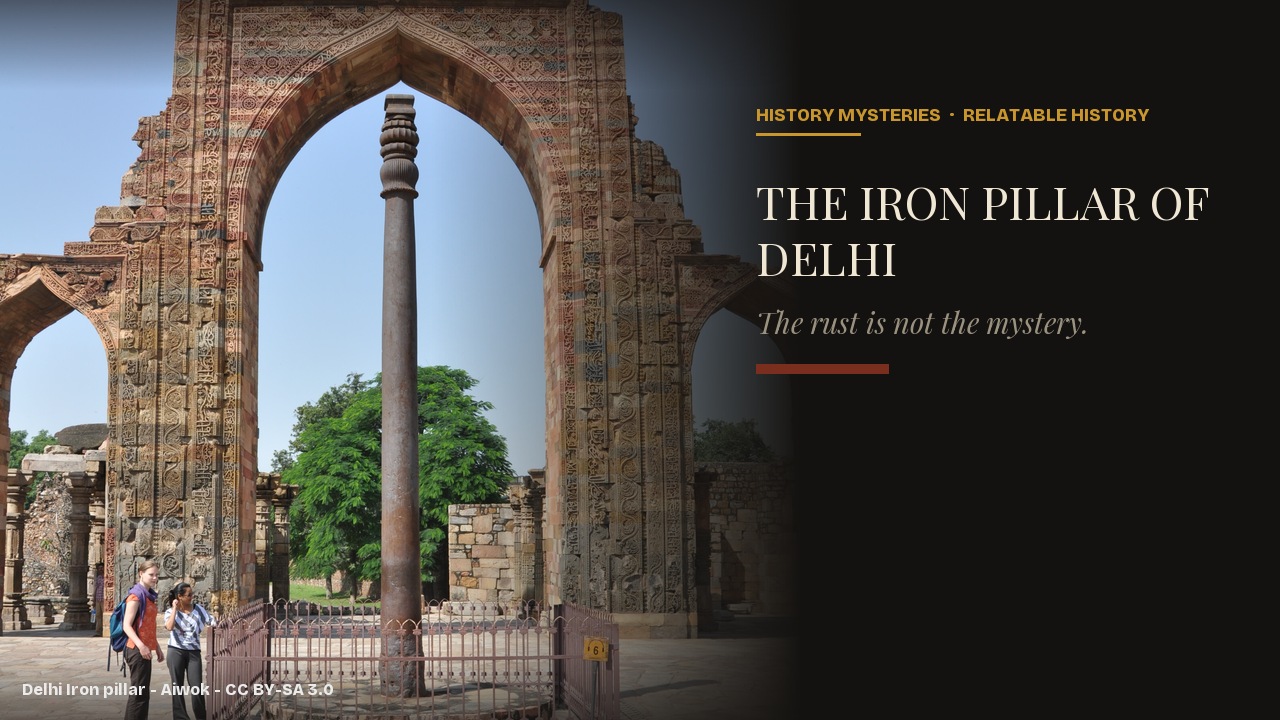
Nobody disputes why a six-tonne iron shaft has stood in the open air at Delhi for roughly sixteen hundred years without rusting through. That question has a settled metallurgical answer, and the short video version of this story tells it in under a minute. The question that has never had an answer, and that two centuries of epigraphists, archaeologists and metallurgists have argued about without reaching agreement, is simpler to ask and much harder to settle: who built the Delhi Iron Pillar, and where did it stand before someone brought it to the city it’s now named for?
There is no foundry record, no royal decree announcing the project, and no contemporary account of the six tonnes of iron travelling anywhere. What survives is the object itself, a single damaged inscription on its surface, and roughly a dozen later inscriptions other people added over the following thousand years, each confident about something the others don’t agree on. This article is about reconstructing an eighteen-centuries-old chain of custody from that evidence — and about where the chain still has gaps nobody has closed.
Who Built the Delhi Iron Pillar? Not in One Piece, and Not by One Smith
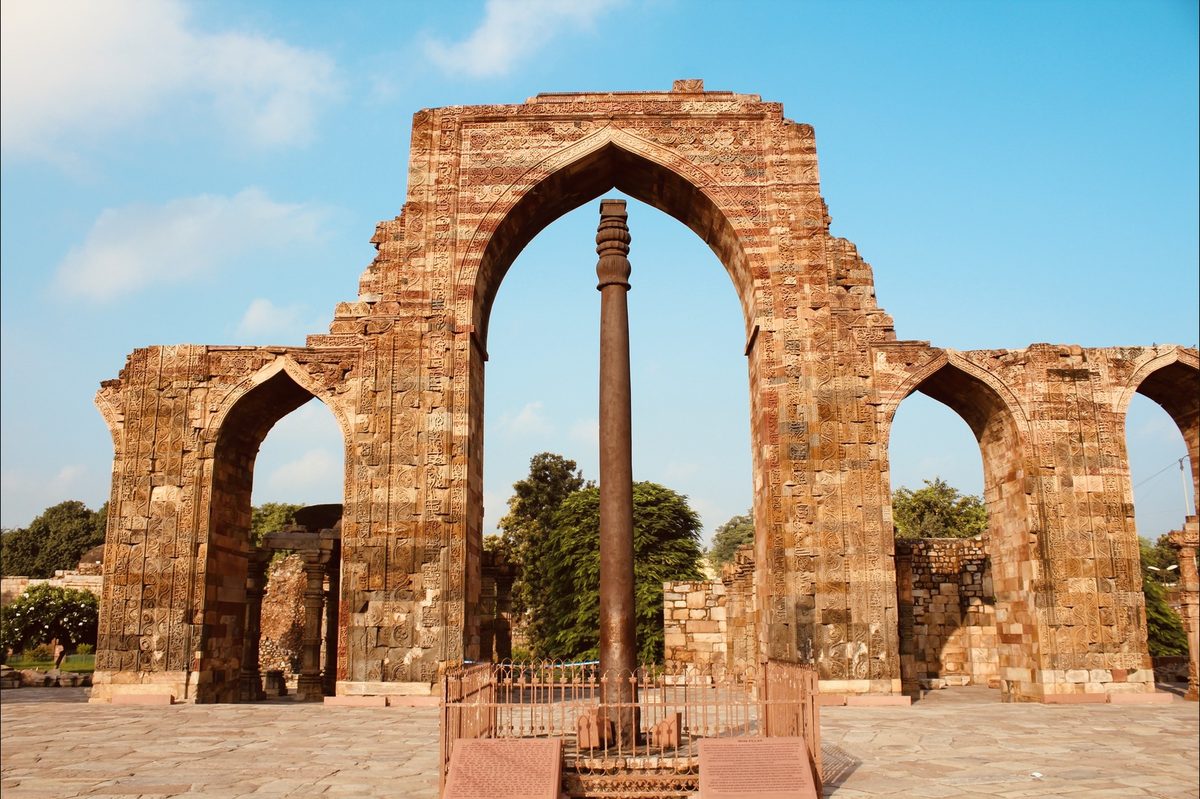
The pillar that stands today in the courtyard of Delhi’s Qutb complex rises 7.02 metres above the pavement, with a further 0.93 metres buried below it, according to the UNESCO/ICOMOS evaluation that backed the complex’s 1993 World Heritage listing. It weighs close to six tonnes. The same evaluation calls it the largest known composite iron object to survive from so early a period — and “composite” is the word worth pausing on. Blast furnaces capable of melting iron into a single pour didn’t exist yet in Gupta-era India. The pillar was built from dozens of smaller wrought-iron blooms, individually hammered and forge-welded together at high temperature until they behaved as one continuous shaft. A 1963 technical study by M. K. Ghosh and B. B. Lal, described in a 2009 Tribune retrospective on the pillar, confirmed the welded-bloom construction directly: the iron was never cast.
There’s a gap at the top of the shaft, a socket-like cavity that most scholars read as the mounting point for a now-missing capital — almost certainly an image of Garuda, the eagle that carries Vishnu, since the pillar’s own inscription describes itself as a dhvaja, a standard, raised for Vishnu. Whatever sat up there is gone, along with any plaque that might have named the smiths who built the shaft beneath it.
What the rust-resistance debate actually settled, briefly
Because the composition question keeps resurfacing in the origin debate, it’s worth being precise about what’s actually agreed. Different investigators across the twentieth century measured different numbers for the iron’s phosphorus content — metallurgist Robert Hadfield found about 0.11% in 1912, chemist M. N. Ghosh measured roughly 0.28% in 1963, and later averaged estimates land closer to 0.25% — a real spread, not measurement error, reflecting how unevenly phosphorus distributes through hand-forged iron. What all of them agree on is that it’s five to ten times the phosphorus modern blast-furnace iron carries, because ancient Indian smelting used no lime flux, leaving phosphorus in the metal that a modern furnace would strip out as slag.
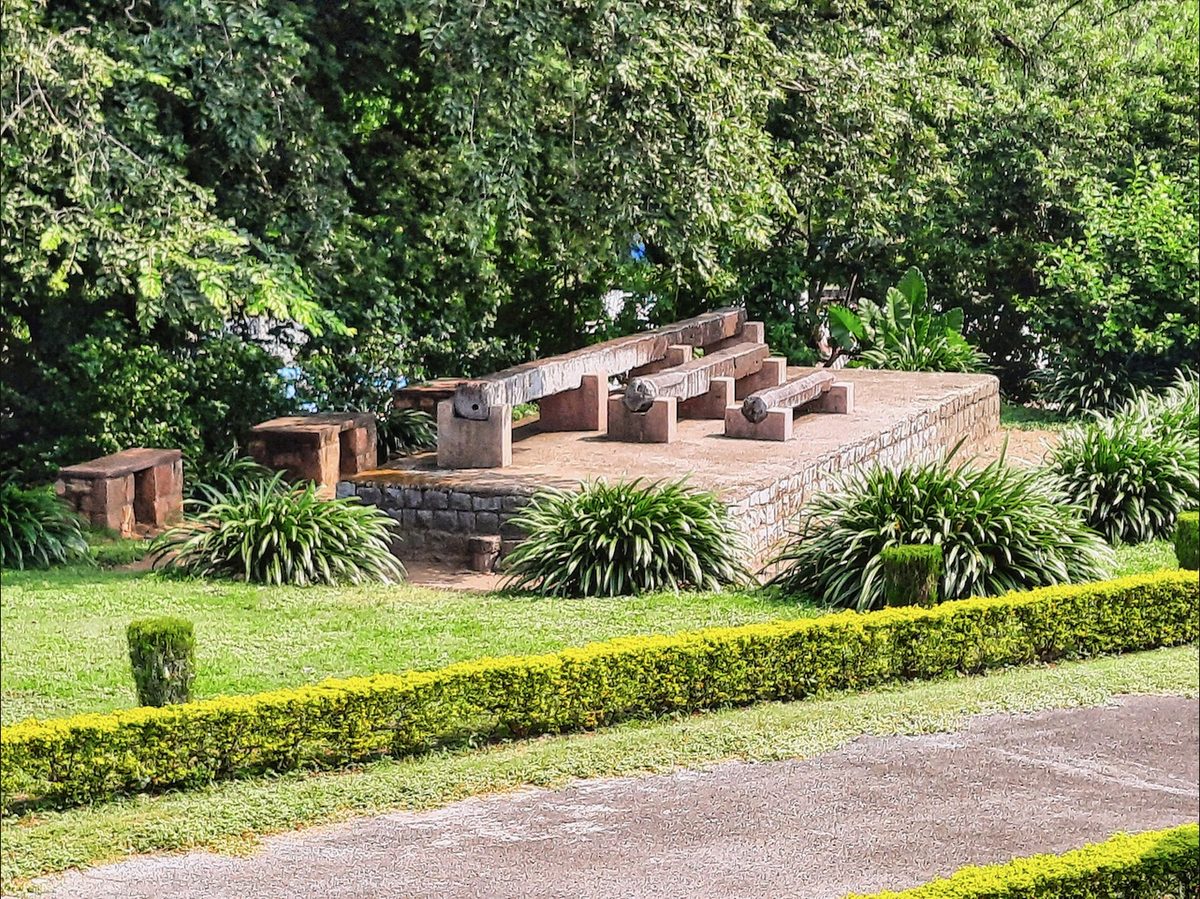
In a 2000 paper in Corrosion Science, metallurgist R. Balasubramaniam showed what that phosphorus does: at the metal’s surface it helps form a compact, initially amorphous iron oxyhydroxide layer — a protective film the paper names misawite — which converts over centuries, through Delhi’s cycle of wetting and drying, into a crystalline iron hydrogen phosphate hydrate with very low porosity. That crystalline layer is what has kept oxygen and moisture away from the metal underneath for sixteen hundred years. It’s grown, by Balasubramaniam’s later estimate, only about a fifth of a millimetre thick in all that time. No lost technology, no modern myth of ancient super-alloys — just impure iron, a dry climate, and sixteen centuries to let the chemistry finish its work. The much larger sister pillar at Dhar, 375 kilometres south, is made from comparable iron and has mostly rusted and now lies broken into three pieces — a reminder that Delhi’s climate did real work here too.
A king named Chandra, with two good candidates
The pillar’s main inscription — three lines of Sanskrit in Gupta-era Brahmi script, cut into the shaft about waist height — is the only contemporary document anyone has. It praises a king called Chandra for military victories reaching across the Indus into Bengal, and says a dhvaja of Vishnu was set up on a hill named Vishnupada after Chandra’s death. It gives no calendar date, and names no dynasty.
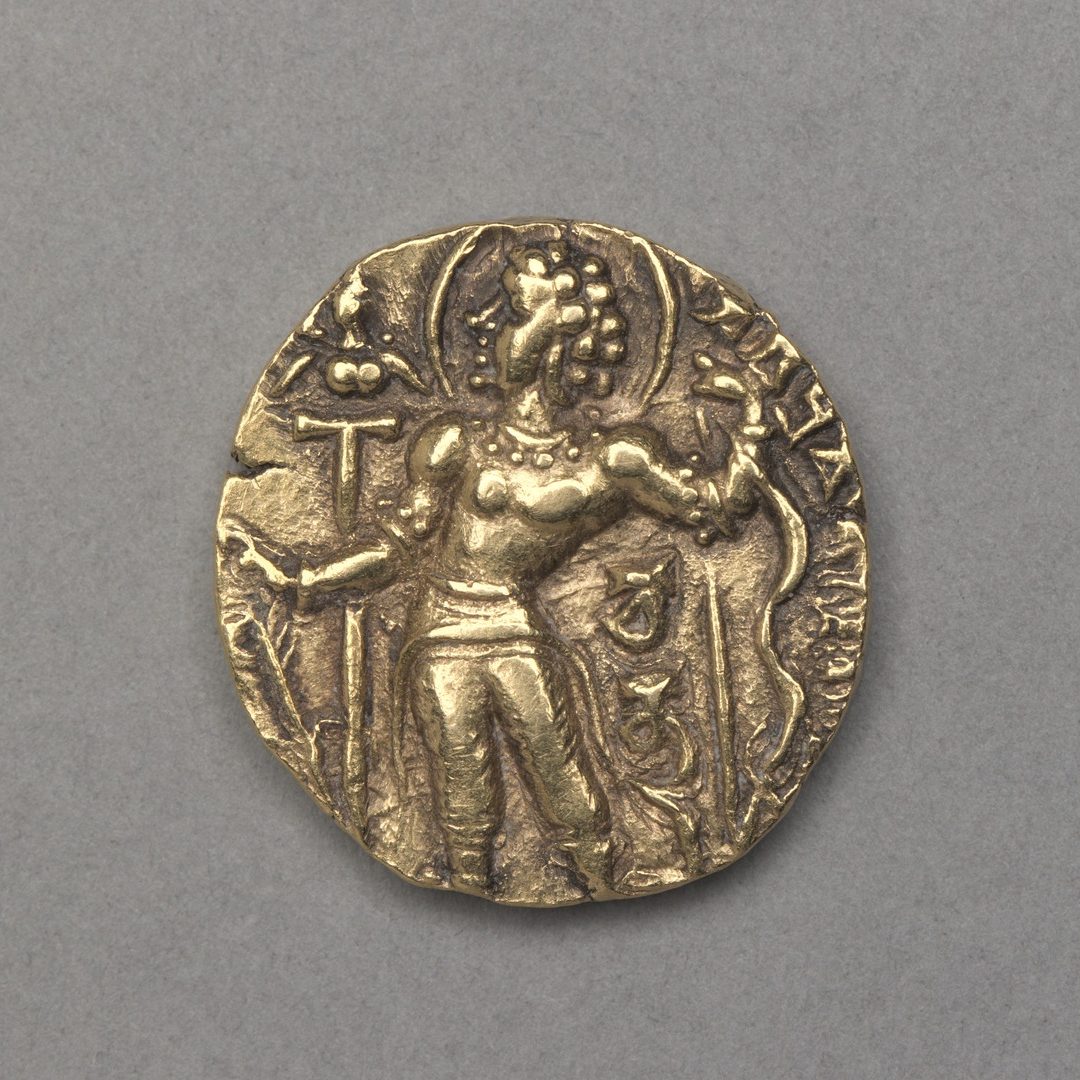
The British civil servant and epigraphist Vincent A. Smith took up the identity question directly in an 1897 paper in the Journal of the Royal Asiatic Society, working through and rejecting a proposed identification of Chandra with a minor Bengal chieftain named Chandravarman. Most scholars since have converged on a different reading: that Chandra is a shortened form of Chandragupta, and specifically Chandragupta II, the Gupta emperor who ruled roughly 375–415 CE and whose own gold coinage bears the royal titles the inscription echoes. The identification isn’t universal — a handful of scholars have floated Samudragupta or Chandragupta I instead — but Chandragupta II is where the consensus sits.
Two professors, two mountains, one pillar
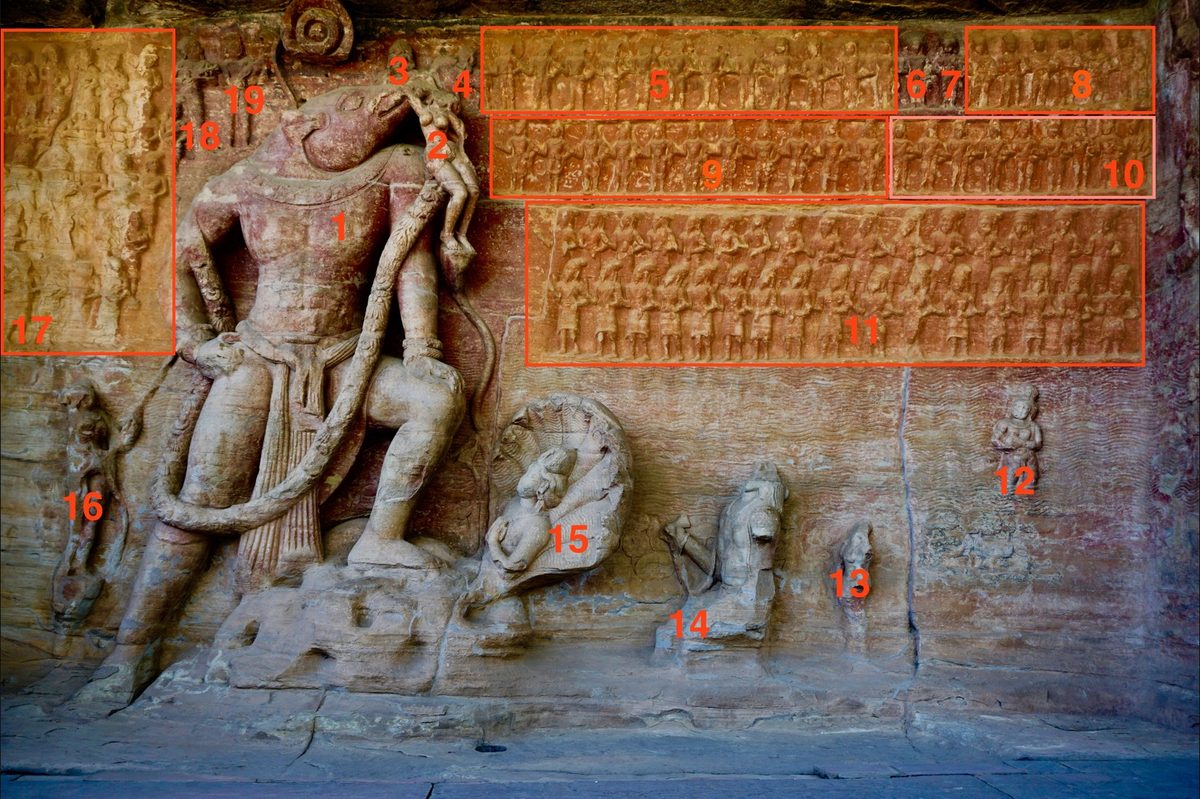
Where “Vishnupada” actually was is the part of the inscription that has never been settled, and it matters more than it sounds: whoever controls that identification controls the pillar’s entire pre-Delhi history. Smith’s 1897 paper leaned toward Mathura, on the strength of its own Vishnu associations in Gupta-era texts. A different, more recent case has built around Udayagiri, a complex of rock-cut Hindu shrines near Vidisha in central India that Chandragupta II is independently known to have patronised — the site’s famous Varaha relief, showing Vishnu’s boar incarnation rescuing the earth goddess, is itself dated to 401 CE, squarely in his reign.
Balasubramaniam has made the Udayagiri case his own research focus, identifying it in his published work as Vishnupadagiri and proposing that the pillar originally stood in front of the Varaha cave as a garudastambha — a standard for Vishnu’s mount — possibly also serving an astronomical function given Udayagiri’s documented use as a solstice-observation site under the Guptas. Nothing about this is settled across the field. What’s genuinely interesting is that both proposals come from careful readers of the same seventeen-syllable inscription, a century apart, reaching incompatible conclusions — and that neither side has the one thing that would end the argument: an inscription or excavated foundation actually naming Vishnupada’s location.
How it got to Delhi — documented facts and a tenacious legend
Wherever it started, the pillar was moved, and that move is itself only partly documented. A short inscription cut into the pillar and dated to 1052 CE names Anangpal, a king of the Tomara dynasty credited with founding Delhi, as the ruler who “peopled Dilli” — which popular tradition reads as crediting him with bringing the pillar to his new capital at Lal Kot. A rival, later legend instead credits the Delhi Sultanate’s Qutbuddin Aibak, or his successor Iltutmish, with hauling it from Udayagiri as a trophy of conquest when the Quwwat-ul-Islam mosque was built around it in the 1190s.
A 2022 essay in The Wire by historian Shashank Shekhar Sinha pushes back on the trophy framing specifically. Reusing and re-inscribing an earlier ruler’s standing pillar, Sinha argues, was an established practice among rulers across early and medieval northern India — a way of claiming continuity with (or dominion over) a predecessor’s sacred landscape, not simply looting metal. Later Delhi sultans added their own inscriptions to the pillar too, including one from 1233 recording repairs, which supports the pattern: whoever controlled Delhi kept adding their name to it rather than melting it down, which is itself a kind of evidence about what the object meant to each of them.
The crater that isn’t folklore, even though the story around it is thin
Partway up the pillar’s northern face is a shallow, lopsided crater, long explained by Delhi guides as the scar of a cannonball fired at the pillar sometime in the Mughal or Maratha period. A detailed 2009 technical study by Balasubramaniam and V. N. Prabhakar, published in the Indian Journal of History of Science, confirmed the physical half of that story and left the historical half open. Plaster-cast analysis of the crater shows plastic deformation consistent with a roughly 120-millimetre projectile striking at about fifteen degrees from horizontal, fired from a cannon positioned some thirty feet to the north — real ballistic evidence, not guesswork.
What the paper is careful to say is that nothing documents who fired it or when. It favours Nadir Shah’s brief, violent occupation of Delhi in the spring of 1739 as the likeliest context, reasoning that an attempt to dislodge the missing capital, or to search for treasure inside it, fits both the timing and the angle of the shot. But the authors say so explicitly: “the final judgment must wait till further corroboratory evidences surface,” and they note that earlier writers had made the same Nadir Shah attribution “without any supporting evidence” at all. The crater is real. The story told about it is still, formally, a hypothesis.
Why you can no longer put your arms around it
For most of the twentieth century, a popular tradition held that standing with your back to the pillar and linking your hands behind it — arms wrapped around six tonnes of fifteen-centuries-old iron — would grant a wish if your fingers met. Tens of thousands of visitors tried it every year. The 2009 Tribune retrospective reports that the Archaeological Survey of India fenced the pillar off in 1997, ending the practice for good: the constant contact of hands and backs was wearing at a surface that had survived sixteen centuries of weather without equivalent damage. The pillar now stands behind a low railing a few feet out, close enough to photograph and far enough that nobody’s embrace is deciding its next test for corrosion resistance.
What’s actually left unsettled, once the rust is off the table
Line up what’s solid against what isn’t and the shape of the mystery gets clearer rather than murkier. The chemistry is not in serious dispute: an iron rich in phosphorus, a dry climate that lets a protective phosphate layer finish forming instead of washing away, and sixteen centuries for that layer to do its work. Every metallurgist who has tested the pillar, from Hadfield in 1912 to Balasubramaniam a century later, is arguing about exact percentages, not about the mechanism itself.
The pillar’s biography is the part that stayed open. The capital is still missing its Garuda. The inscription still doesn’t say which Chandra, which is why Vincent Smith’s 1897 argument and the modern consensus around Chandragupta II can both claim to be reading the same seventeen syllables carefully. The hill is still an argument between Udayagiri and Mathura, with nobody holding the one inscription or excavated foundation that would end it. And somewhere between the fifth century and the thirteenth, eight hundred kilometres of road and six tonnes of iron went from wherever Vishnupada was to a hilltop fort in Delhi, without a single contemporary writer thinking the journey worth recording. A monument built specifically so people would remember something has, in its own transport, produced the one gap in the record that nobody has managed to close.
Who do you think moved it?
Watch the full history
The nine-and-a-half-minute video version walks through the metallurgy, the inscription, and the century of scholarly argument in more of a narrative than this article attempts — start there if you want the short version before the long one.

Related reading
- Why the Lycurgus Cup Turns From Green to Red — another ancient object whose “impossible” property turned out to be explainable chemistry, not lost technology
- Where Damascus Steel Was Made (It Wasn’t Damascus) — a parallel case of ancient ironworking skill getting mythologised past what the metallurgy actually shows
- Is the Cascajal Block Really Writing? Inside a Twenty-Year Argument — the same shape of dispute — one object, incompatible scholarly readings, no corroborating find to settle it
- Why Karahan Tepe Was Buried on Purpose — another Belief & Ritual mystery from the same Ancient World shelf
Works cited
- Balasubramaniam, R. “On the Corrosion Resistance of the Delhi Iron Pillar.” Corrosion Science 42, no. 12 (2000): 2103–2129. Link.
- Balasubramaniam, R. “New Insights on the Corrosion-Resistant Delhi Iron Pillar.” In Metallurgy in India: A Retrospective, edited by P. Ramachandra Rao and N. G. Goswami, 104–133. Jamshedpur: National Metallurgical Laboratory, 2001.
- Balasubramaniam, R., and V. N. Prabhakar. “On Technical Analysis of Cannon Shot Crater on Delhi Iron Pillar.” Indian Journal of History of Science 44, no. 1 (2009): 29–46. Link.
- Smith, Vincent A. “Art. I.—The Iron Pillar of Delhi (Mihrauḷī) and the Emperor Candra (Chandra).” Journal of the Royal Asiatic Society 29, no. 1 (1897): 1–18. Link.
- Simharajan, T. “The Iron Pillar That Won’t Rust.” The Tribune, Spectrum, 19 April 2009. Link.
- Dalal, Kurush. “Mystery of Delhi’s Iron Pillar.” Live History India, 29 May 2020. Link.
- UNESCO/ICOMOS. Qutb Minar and Its Monuments, Delhi, World Heritage Nomination Advisory Evaluation, document 233. Paris: ICOMOS, 1993.
- Balasubramaniam, R. Delhi Iron Pillar: New Insights. New Delhi: Aryan Books International, 2002.
- Sinha, Shashank Shekhar. “The Travelling Pillar.” The Wire, 11 April 2022. Link.