
In the tenth century, the Fatimid caliph al-Mu’izz li-Din Allah told a craftsman he wanted a pen that would not stain his hands or his robes, and that would not need dipping in an inkwell every few words. According to the court chronicler al-Qadi al-Nu’man, the craftsman delivered: a pen cast in gold, with a reservoir inside its own body, that released ink steadily onto the page no matter which way the caliph turned his hand. It is the oldest surviving description of anything resembling a fountain pen, and it describes a problem that would not be solved again, reliably, for roughly nine hundred years — which is where the real history of the fountain pen actually starts.
Between that gold pen and the one that eventually became an ordinary desk object sits a genuinely strange chain of near-successes: a French patent almost nobody remembers, a self-taught American who filed his own patent in 1884, and a legend about a ruined business deal that no surviving document actually confirms. The history of the fountain pen is not one invention. It is roughly nine centuries of capable people solving the same leaking problem, mostly without knowing anyone else had tried.
What finally made the idea work was not a single breakthrough so much as a feed mechanism precise enough to stop gravity from doing what gravity does to an open tube of ink. Getting there took a gold pen, a lost patent, an insurance salesman, and roughly a thousand shirt pockets ruined along the way.
The history of the fountain pen starts with a pen nobody needed to patent
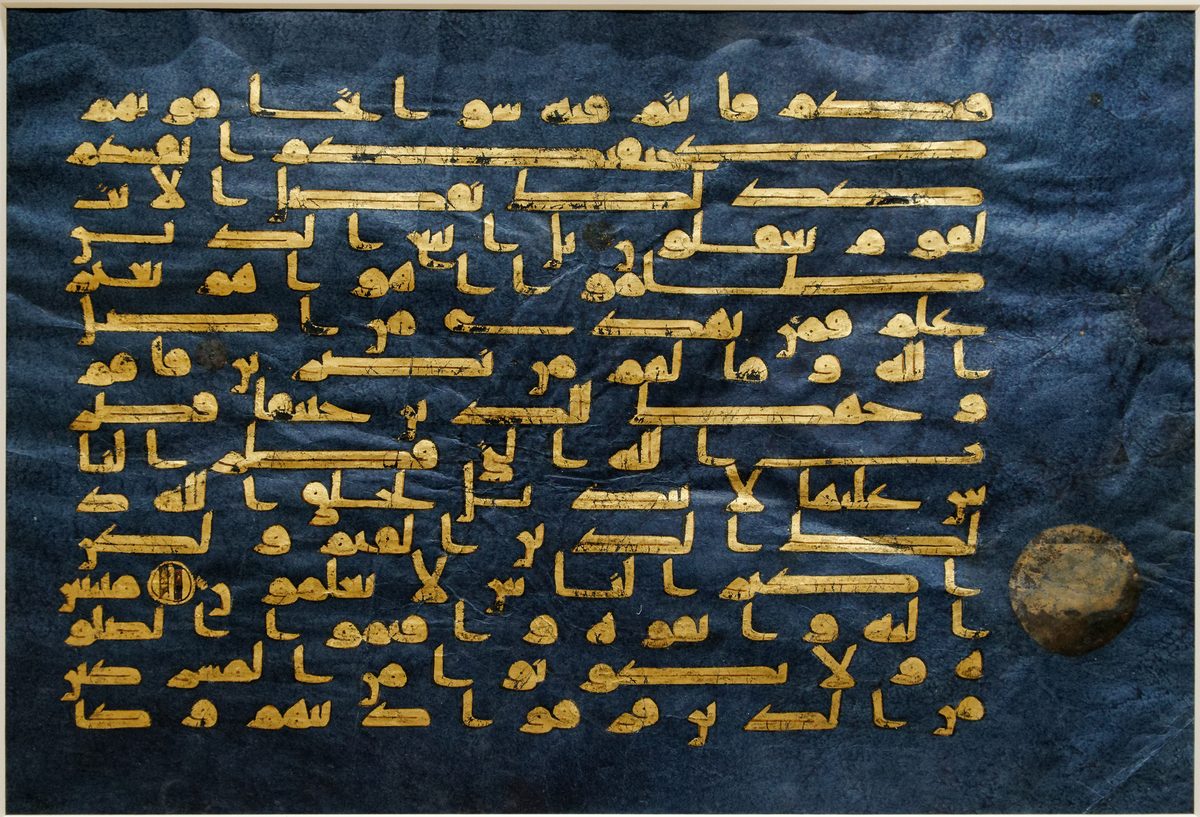
Al-Qadi al-Nu’man’s account, recorded in his Kitab al-Majalis wa-l-musayarat, survives as a single, specific anecdote rather than a technical description historians can reconstruct from. The caliph is said to have rejected the craftsman’s early attempts before accepting a design that held its ink reservoir inside the body of the pen itself, rather than requiring a separate inkwell. No example of the pen itself is known to survive, and nothing says the design was ever reproduced.
That detail matters more than it first appears. A good idea that is never patented, never manufactured, and never passed to another craftsman is not really an invention in any lasting sense; it is a single object that solved one person’s problem once. The gap between al-Mu’izz’s pen and the next documented attempt at the same idea is not a gap in cleverness. It is a gap in the infrastructure — patent offices, manufacturing, advertising — that turns a clever object into a durable one.
A Romanian engineering student patented one in 1827, and it still didn’t stick
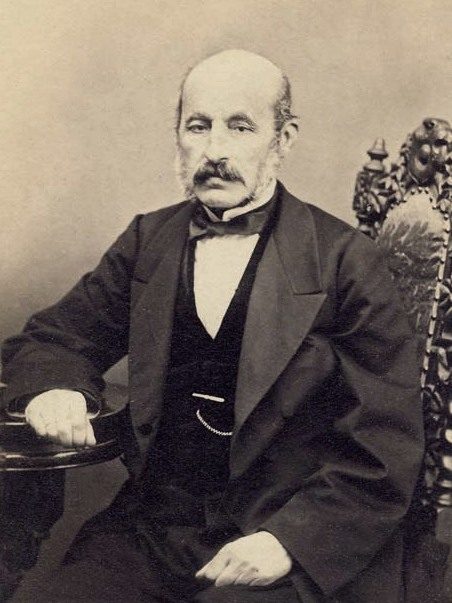
That infrastructure existed, barely, by 1827, when Petrache Poenaru — a Romanian studying in Paris under the engineer Louis Puissant — filed a patent with the French government for what he called a self-refilling reservoir pen. French patent number 3,208, dated May 25, 1827, protected the design for five years. Poenaru later filed the same idea in Vienna. Romanian sources call it the first patent of invention ever obtained by a Romanian citizen, which is a real historical footnote even though the pen itself went nowhere commercially.
Poenaru did not spend his career on pens. He went on to study mining and metallurgy in England, ran the Saint Sava school in Bucharest, served as a deputy in the Wallachian assembly, sat on the commission that helped free Roma people who had been enslaved in the principality, and was eventually elected to the Romanian Academy. The pen was one invention among a long engineering and political career, not the project he returned to and refined. Nobody manufactured it at scale, and it is barely remembered outside Romanian histories of science — which is exactly the fate that nearly met every other reservoir pen filed before the 1880s.
What actually made Lewis Waterman’s version different
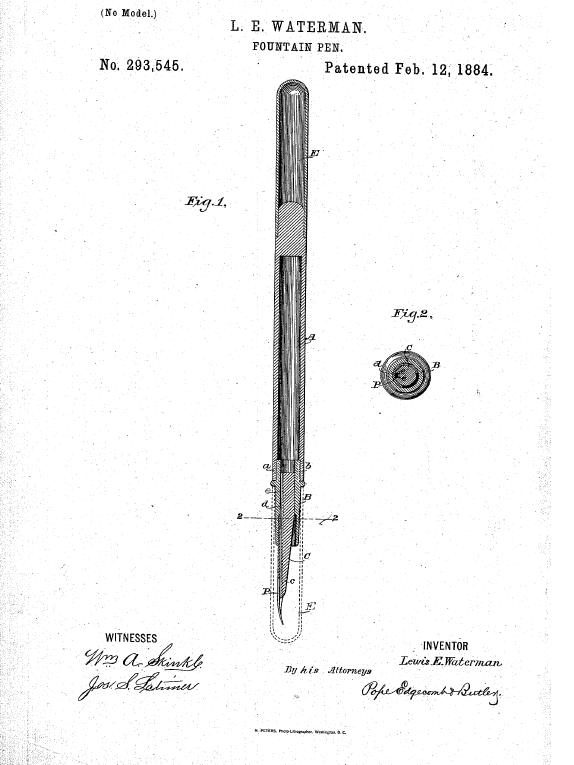
Company legend holds that Lewis Edson Waterman, a New York insurance broker, lost a client’s signature when a borrowed pen leaked ink across a contract, and that he set out afterward to build a pen that wouldn’t do that. No contemporary document confirms the story, and it may be exactly the kind of origin myth that gets attached to a successful product after the fact. What is not in dispute is the patent: U.S. Patent No. 293,545, filed in September 1883 and granted in February 1884, in Waterman’s own name, for a mechanism that solved the actual engineering problem every reservoir pen before it had failed to solve.
The problem was never getting ink into a pen. It was controlling how fast ink left it. A sealed reservoir with nothing but a hole at the nib either floods the page in a blot or starves and skips, because nothing is regulating the air that has to replace the ink as it drains. Waterman’s feed bar cut a tapered groove down its length, with narrow slits running deeper beside it. Ink travelled down the groove by gravity and capillary attraction; air travelled the opposite direction through the same channel to replace it; and the slits kept the two from mixing into bubbles that would block the flow entirely. If the ink started flowing too fast, more air could enter and automatically slow it back down. It was a self-regulating system built from a single grooved bar, and it is the direct ancestor of the feed in a fountain pen made today.
Fountain pens got marketed as gifts almost immediately
Waterman built an actual company around the patent, and by the early 1900s it was running seasonal advertising aimed squarely at the gift market. Surviving L. E. Waterman Co. advertisements from December 1903 and 1904, held in the Smithsonian Libraries’ Trade Literature Collection, show Santa Claus himself presenting Waterman’s Ideal Fountain Pen, alongside notice of a catalog of gift pens and a Grand Prize the company had won at the 1904 Louisiana Purchase Exposition in St. Louis. A pen was, by design, being sold as something you gave someone, not only something you used yourself.
That marketing choice outlasted the Edwardian era by decades. A fountain pen stayed a default graduation, retirement and commencement gift well into the twentieth century, in a way that is difficult to imagine any writing tool being treated today — and it is a large part of why a pen, rather than some other object, ended up being the thing handed out as a keepsake at the signing of a surrender document two world wars later.
The army built a version specifically for the trenches
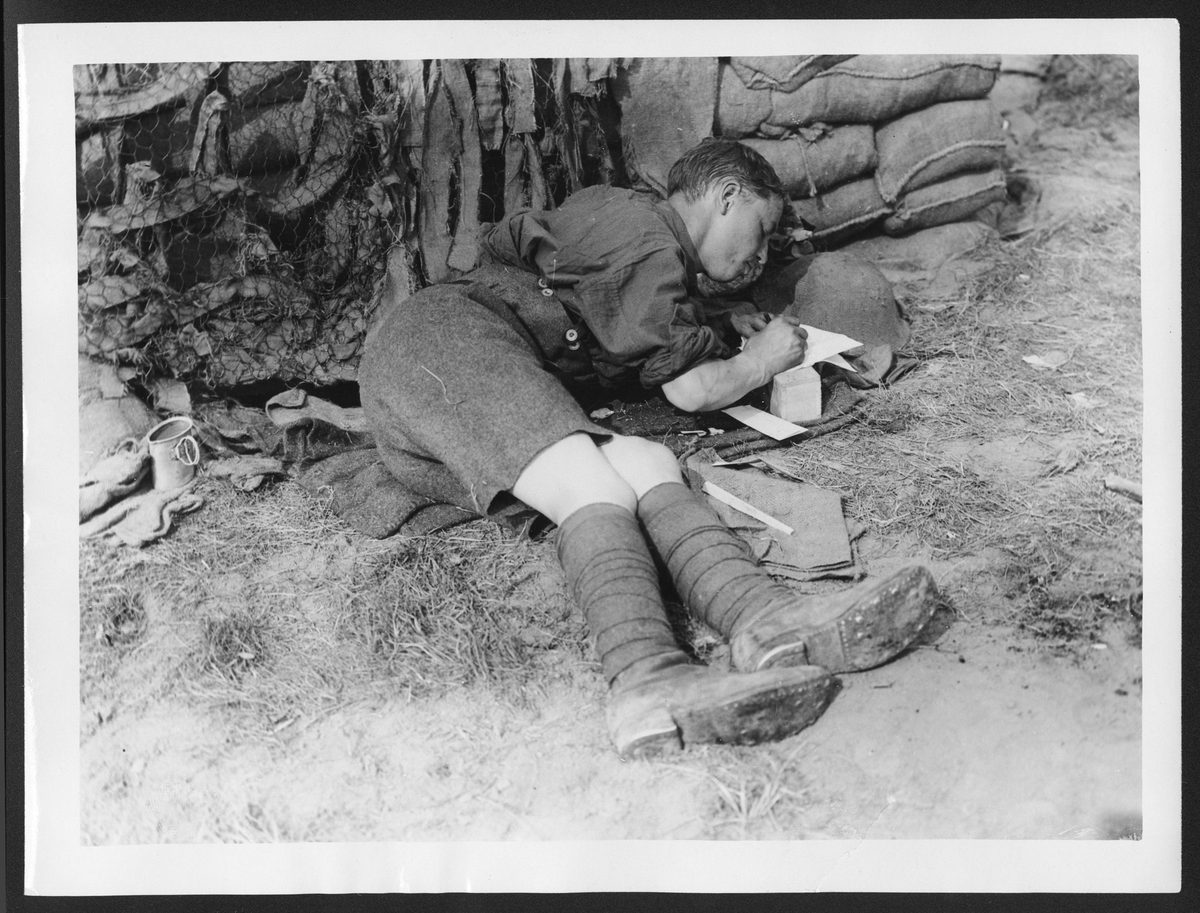
By the First World War, soldiers needed a pen that worked without a bottle of ink nearby, and manufacturers built for exactly that market. Parker’s wartime “Jack Knife Safety” pen, sold from 1916 through 1919, carried an unusually long cap that doubled as a storage tube for dry ink tablets: a soldier could drop a pellet or two into the barrel, add water, and mix his own ink in the field instead of carrying a bottle that would almost certainly break or leak in a kit bag. Parker’s 1916 catalog priced the four available sizes between $2.75 and $5.25, with an optional metal pocket clip running anywhere from a quarter to five dollars in solid gold.
Almost none of these pens survive. Collectors estimate fewer than five examples of some variants are known today, and the design was mostly abandoned once the war ended in favor of ordinary self-filling pens that didn’t require carrying ink tablets at all. It is a reminder that a huge share of any object’s manufacturing history — the version built for one specific, temporary problem — simply does not survive to be collected or remembered.
A seven-dollar pen with a twenty-five-year warranty
By 1921, Parker was selling the opposite kind of pen: a deliberately showy one. The Duofold, nicknamed “Big Red” for its bright “Chinese Lacquer Red” hard rubber body, stood out instantly against the black pens every other maker was still selling, and Parker priced it at seven dollars — more than double the going rate for a decent pen at the time — backed by a twenty-five-year warranty. It sold well enough for most of a decade to help cement Parker among the top tier of American pen makers, alongside Sheaffer, Waterman, Wahl and Conklin. A fountain pen by the 1920s was not just a tool. It had become a visible, priced statement about the owner, in a way a pencil never was and a ballpoint never would be.
The pens that ended a war, and the pen that almost immediately replaced them
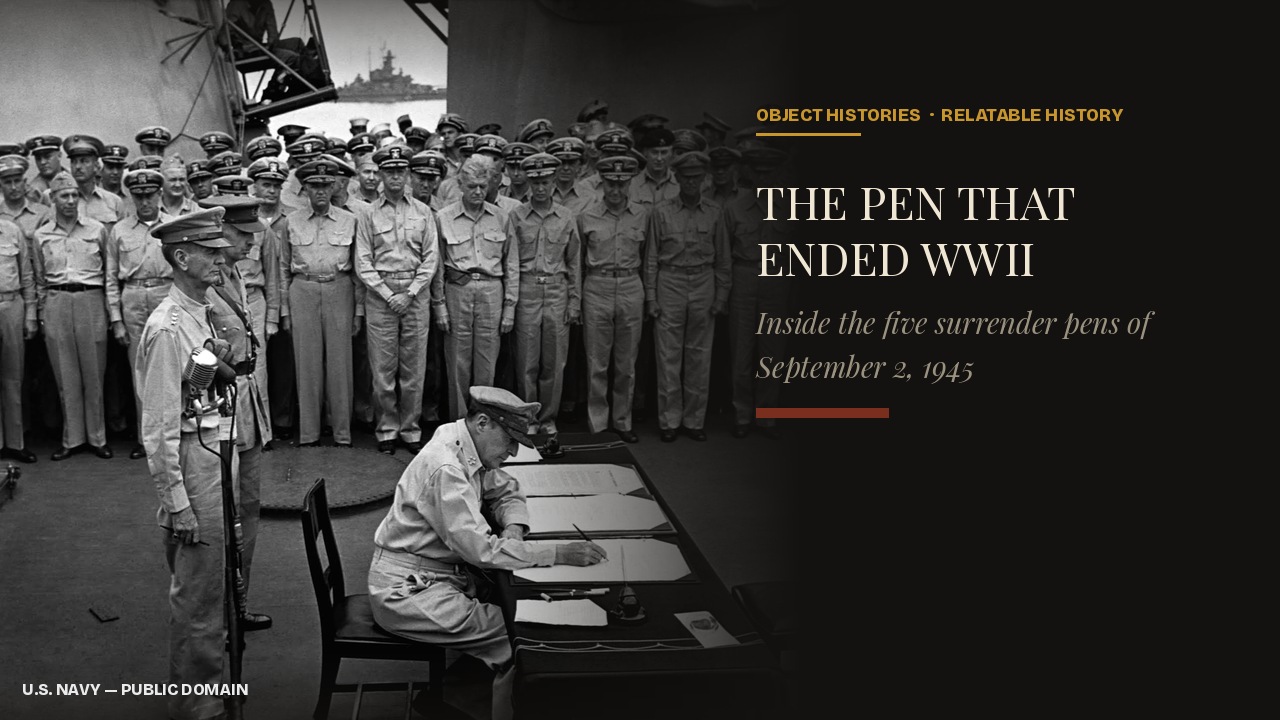
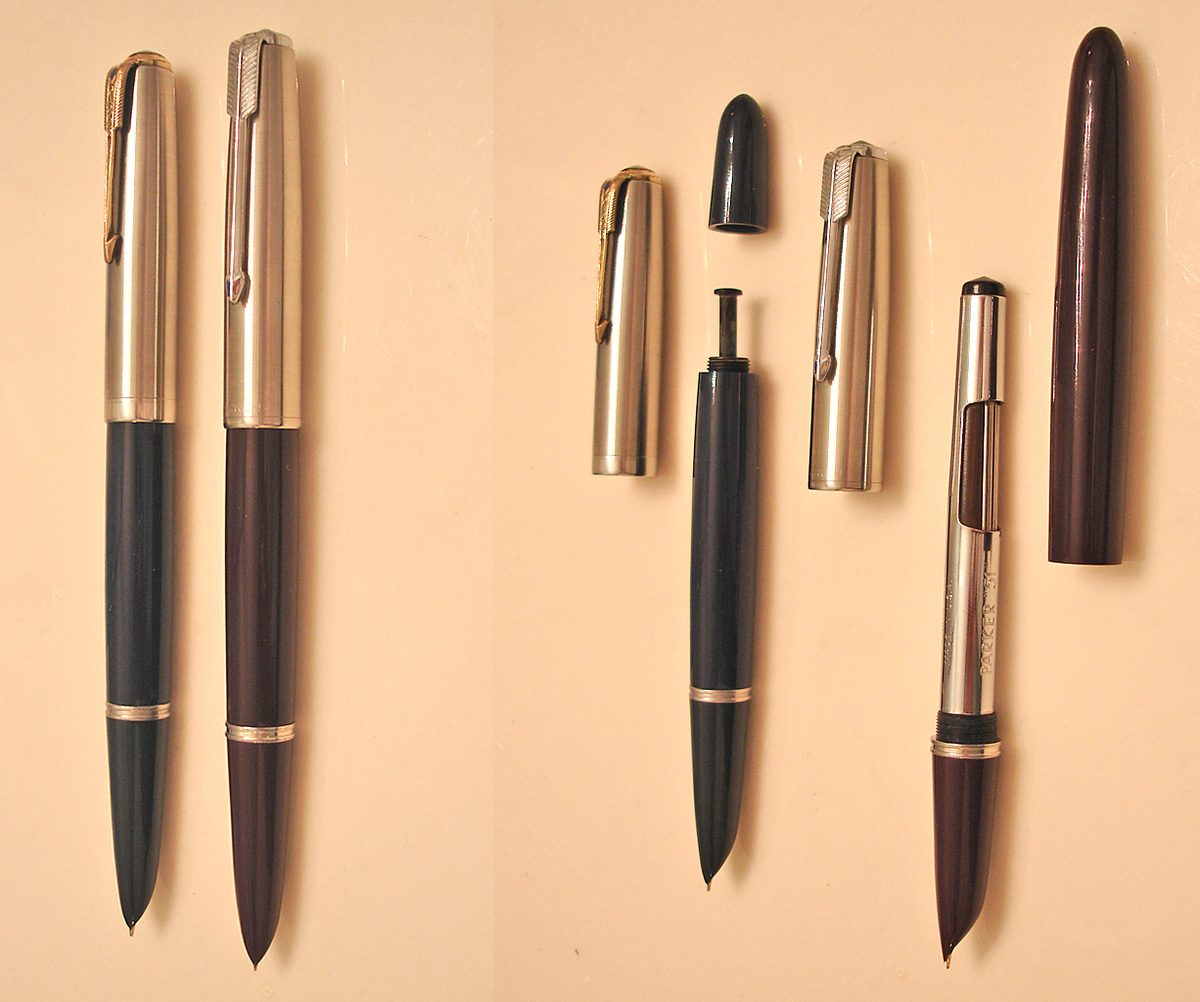
That is the world the Parker 51 was born into in 1941, and why there was never any real doubt which kind of object would sit on the desk when Japan’s surrender was signed aboard the USS Missouri on September 2, 1945. General Douglas MacArthur signed the document five separate times with different pens, a deliberate piece of stagecraft, then gave them away: one to West Point, one to the Naval Academy, and one each to Generals Jonathan Wainwright and Arthur Percival, the two Allied commanders who had themselves been forced to surrender the Philippines and Singapore earlier in the war. Historians still don’t agree on where the main pen — a 1928 Parker Duofold — ended up afterward; some accounts say MacArthur kept it, others that it was his wife’s smaller pen all along. One surviving MacArthur surrender pen, a plain black desk pen rather than the famous red Duofold, is now held at the West Point Museum.
The Parker 51 itself was so sought-after during the war that it barely reached ordinary soldiers at all. The National Museum of the United States Air Force holds one from a serviceman stationed in the China-Burma-India theater, where normal PX supply chains didn’t reach: the base store there received exactly two Parker 51s for the entire posting, and raffled them off at fifteen dollars a ticket. That scarcity is its own kind of evidence for how far the fountain pen had travelled from functional object to prestige object in sixty years.
It is also almost exactly the moment the fountain pen’s run as the obvious default started to end.
The ballpoint took less than twenty years to end it
A workable ballpoint mechanism had existed in rough form since the 1880s, but every early version used fountain-pen ink, which was too thin to sit on a rolling ball without smearing. The Hungarian journalist Laszlo Jozsef Biro noticed that newspaper printing ink dried almost instantly and didn’t smudge, and spent years, with his chemist brother Gyorgy, working out an ink thick enough to feed through a tiny rolling ball without clogging it. Biro filed his key patent, U.S. Patent No. 2,390,636, in June 1943, after already patenting versions in Britain and Switzerland in 1938.
The often-repeated claim that the Royal Air Force ordered thirty thousand Biro pens in 1943 because they worked better than fountain pens at high altitude is flagged even by Germany’s own patent office as probable legend rather than documented fact — though the underlying mechanical point is real: a ballpoint’s ink isn’t pulled out by gravity and air pressure the way a fountain pen’s is, so it doesn’t blot when cabin pressure changes. Biro sold his patent rights for comparatively little, and it was the businessman Marcel Bich who turned the idea into a mass product, licensing the design and launching the cheap, reliable BIC Cristal in 1950. Within a decade, a ballpoint cost pennies, never needed refilling with a bottle, and could be thrown away without a second thought. The one advantage a fountain pen still had over every earlier reservoir pen — that it worked reliably without spilling — had just been matched by something that also didn’t need cleaning, care or a steady hand.
Watch the full history
The video version covers the surrender pens, the Waterman patent and the object’s rise and fall in just over five minutes.

Related reading
- Who Invented Carbon Paper, Really? Four Credible Answers — its own disputed, multi-claimant invention story mirrors the fountain pen’s
- The History of Ticker Tape Parades Starts With a Broken Wall Street Machine — another communication-technology object whose mechanism is worth seeing in detail
- Drift Bottle Science: How Sealed Notes Helped Map the World’s Oceans — a different object built entirely around getting a handwritten message to someone far away
- The Telephone Companies America’s Farmers Built Themselves — a reminder that “who gets credit for connecting people” is a recurring theme on this site
Shop the styles/items featured in this video:
Works cited
- Qadi al-Nu’man, Kitab al-Majalis wa-l-musayarat, ed. H. Feki, I. Chabbouh and M. Yalaoui (Beirut, 1997), 289-290, as cited in François Déroche et al., Islamic Codicology: An Introduction to the Study of Manuscripts in Arabic Script (Al-Furqan Islamic Heritage Foundation, 2005). Link.
- Crăciun, Petre. “Petrache Poenaru, 1799-1875.” Univers Ingineresc, Romanian General Association of Engineers (AGIR), no. 2 (2005). Link.
- Waterman, Lewis E. “Fountain-Pen.” U.S. Patent No. 293,545, filed September 18, 1883, granted February 12, 1884. Link.
- “A Fountain Pen for Christmas: L. E. Waterman Co. Advertisements, 1903 and 1904.” Trade Literature Collection, Smithsonian Libraries, National Museum of American History.
- Mamoulides, Jim. “The Parker Trench Pen.” PenHero.com, September 30, 2017. Link.
- Mamoulides, Jim. “Parker Duofold Flattop.” PenHero.com, 2005. Link.
- “Mightier Than the Sword: The Parker Pens That Ended World War II.” The National WWII Museum. Link.
- “Witnesses: Percival & Wainwright on V-J Day.” The National WWII Museum. Link.
- “Parker 51 Fountain Pen.” Fact sheet, National Museum of the United States Air Force.
- “László József Bíró.” National Inventors Hall of Fame. Link.
- Bíró, László József. “Writing Instrument.” U.S. Patent No. 2,390,636, filed June 17, 1943, granted December 11, 1945. Link.
- “Der Kugelschreiber” [The Ballpoint Pen]. Milestones: Inventions That Made History, German Patent and Trade Mark Office (DPMA). Link.