
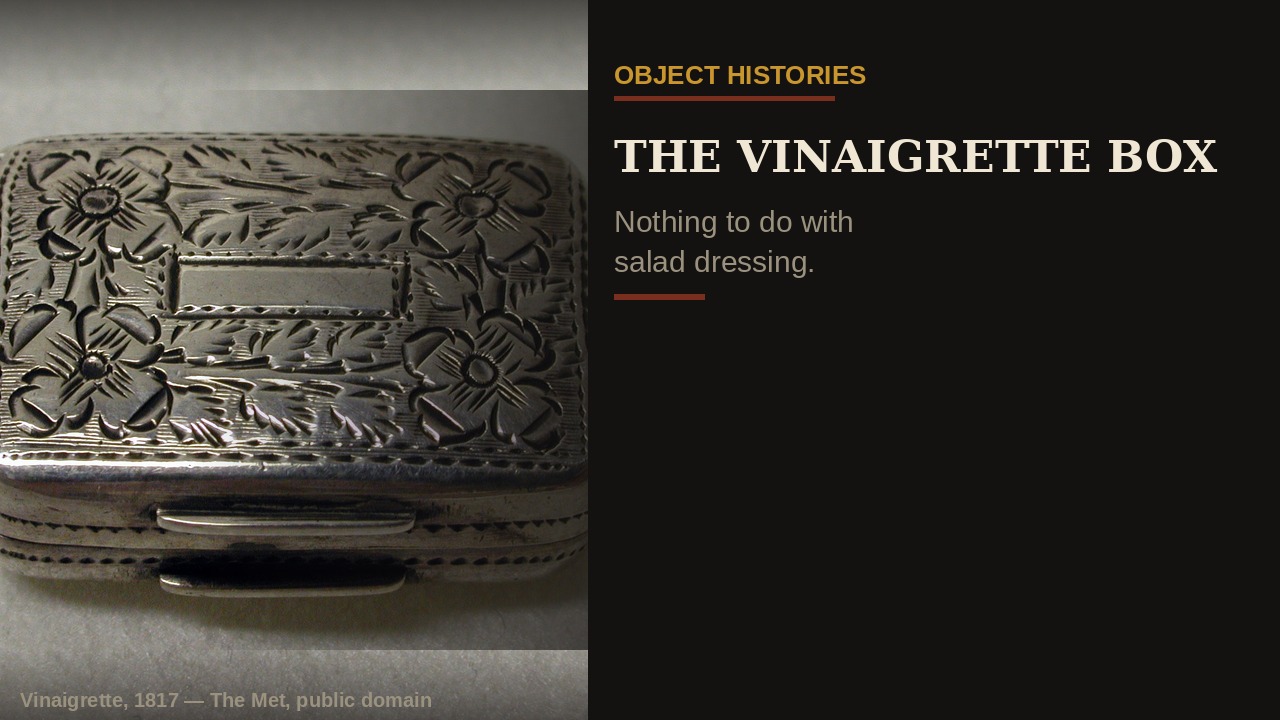
A vinaigrette looks, at first glance, like nothing more than a miniature silver snuff box. Open the lid, though, and a second lid appears underneath it — a pierced, decorative grille, guarding a tiny sponge. For roughly a century, that two-lid design was everyday jewellery for well-off British women, tucked into a reticule or hung from a chatelaine. It was also real medical equipment, built on a theory of disease that outlived the evidence against it.
This is the fuller history of the vinaigrette box that the object’s shape only hints at: where it came from, who manufactured it by the thousand, and how the very theory that justified carrying one was finally overturned — not by the physician who actually disproved it, but by a heat wave that made an entire government building unbearable to sit in.
A short history of the vinaigrette box starts with its silver grille
A vinaigrette is built around one simple problem: how do you carry a strong, specific smell on your person without it spilling, smearing, or evaporating within minutes? The answer, refined across the eighteenth century, was a small hinged box, usually sterling silver, with two lids stacked one inside the other. Lift the outer lid and a second, inner lid sits beneath it — a grille, stamped or pierced with a pattern of holes, sometimes elaborate enough to double as decoration in its own right. Underneath that grille sat a small sponge, soaked in aromatic vinegar: vinegar infused with herbs, spices, or essential oils, sharp enough to cut through almost anything. The grille did the actual engineering work, letting scent escape in a controlled trickle when the box was opened, while keeping the sodden sponge itself out of contact with skin, gloves, or clothing.
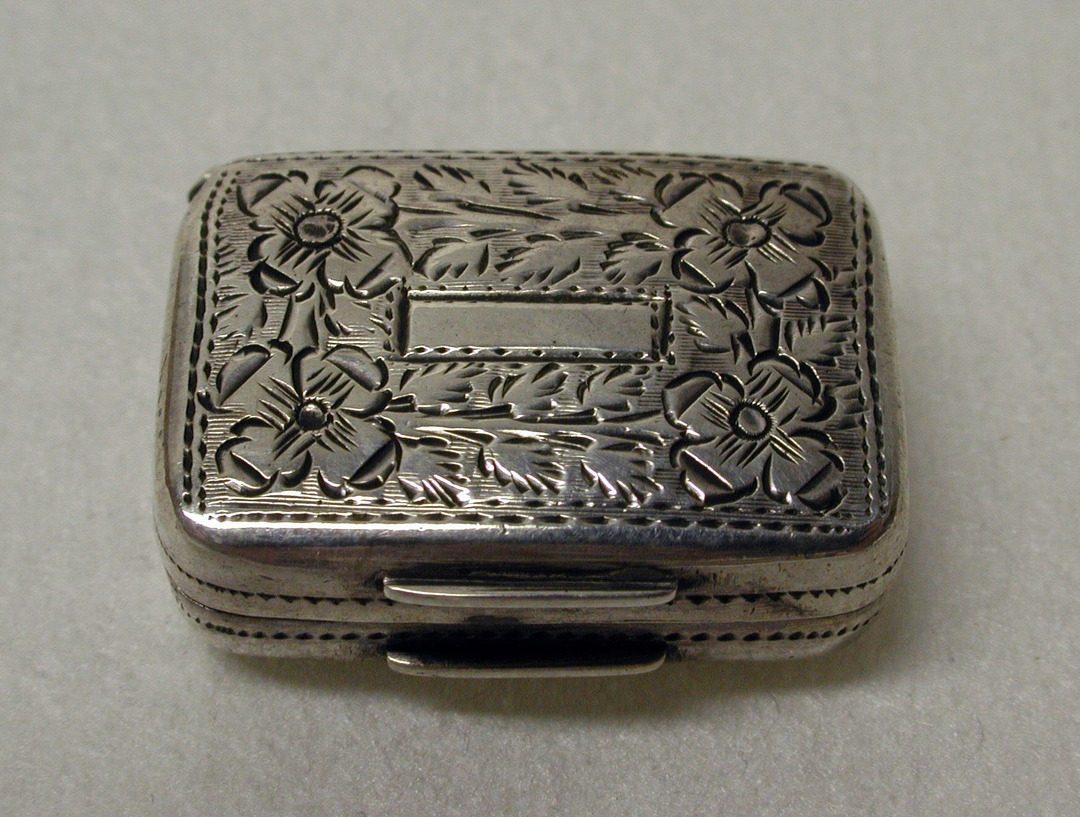
A silver vinaigrette made in 1845, now held by the Metropolitan Museum of Art, shows how small these objects actually were: 48 by 34 by 11 millimetres, barely larger than a folded postage stamp, engraved on its front cover with a basket of flowers and on its back with the owner’s initials and a date. Surviving examples turn up decorated with stippled lace-work borders, inscriptions, and bright floral engraving — they were jewellery as much as equipment, and were treated that way: given as gifts, engraved as keepsakes, passed down through families.
They were also, functionally, a close cousin of smelling salts. The Science Museum Group, which holds a Nathaniel Mills vinaigrette from 1827, notes outright that a vinaigrette could be used “much like smelling salts”: when its owner felt faint, she opened the lid and inhaled. Fainting was a frequent, almost expected event in Georgian and Victorian social life — in overheated ballrooms, packed churches, under tightly laced stays — and a vinaigrette doubled as the fastest tool at hand for reviving a companion who had just gone down. A later generation split this use off into its own, plainer bottle.
The vinaigrette’s own ancestor, the pomander, is centuries older
The vinaigrette did not appear out of nowhere. Its direct ancestor is the pomander — a hollow scent container, usually gold or silver, carried on a chain or belt and packed with a solid perfumed paste rather than a liquid-soaked sponge. The form is far older than most people assume. A silver-gilt pomander in the Victoria and Albert Museum’s collection, shaped like a segmented apple and dated to the mid-to-late 1300s, opens into four compartments that “would originally have held spices or perfumes”; its gallery label reads it as a love token, worn hanging from a woman’s girdle, its inner panels engraved with scenes from the Judgement of Paris. We’ve told that object’s fuller story, and the long reach of the theory behind it, elsewhere on this site.
By the time pomanders turn up constantly in sixteenth- and seventeenth-century portraiture, held deliberately near the face, the solid-paste design had already been in use for roughly two hundred years. What changed over the eighteenth century was practical rather than symbolic: solid ambergris-and-musk paste gave way to a vinegar-soaked sponge, which was cheaper, easier to refresh, and arguably delivered a sharper, more immediate smell. The ball shape flattened into a pocket-sized hinged box. By the time the word “vinaigrette” was in common use, the object had become something closer to a piece of flatware than a sphere: thinner, rectangular, built to sit flat in a pocket rather than swing from a chain.

The miasma theory held that bad air itself caused disease
The reason any of this counted as medicine, rather than just perfume, was a specific and, for its time, perfectly rational theory of disease called miasma theory. The idea held that rotting organic matter — sewage, stagnant water, decaying waste — released poisonous vapours into the air, and that breathing those vapours was itself what caused fevers, plague, and cholera. It was not a fringe belief. As the historian Stephen Halliday put it in a widely cited 2001 article in the BMJ, miasma theory was “an obstinate belief” that persisted among British physicians and public officials well into the second half of the nineteenth century, even as contradicting evidence accumulated. If foul air caused disease directly, then carrying a strong, clean, competing scent close to the nose was not superstition; it was a defensible medical precaution — the eighteenth- and nineteenth-century equivalent of a surgical mask.
That logic shaped public health policy at a scale far larger than one woman’s silver box: hospital ventilation and quarantine rules alike targeted smell as much as contact. None of it worked the way anyone believed it worked — vinegar does nothing to cholera bacteria or the parasite behind plague — but the theory was internally coherent, testable by the standards of its day, and consistent with what educated Georgians and early Victorians could actually observe: that the worst outbreaks of disease did, in fact, cluster around the smelliest, filthiest parts of a city. The correlation was real. The causation, as the next fifty years would prove, ran in a completely different direction.
Birmingham turned the vinaigrette into an industrial product
Almost every surviving vinaigrette traces back to one city: Birmingham. In 1762, the manufacturer and engineer Matthew Boulton built his Soho Manufactory on the edge of the city to mass-produce small decorative metal goods — what the trade called “toys”: buttons, buckles, and small silverware made at volume. That scale is why Birmingham earned the nickname “the toy-shop of the world,” and why, by the century’s end, the city had become Britain’s centre for the fine small silverwork a vinaigrette required — the same trade that also produced the snuffboxes Georgian courtiers gave one another as diplomatic gifts.
There was one problem: Birmingham had no assay office of its own. Every finished piece of sterling silver has to be hallmarked — stamped with marks proving it actually meets the legal purity standard rather than being a cheaper alloy sold as the real thing — and until the 1770s, that meant shipping finished Birmingham silverware to London or Chester and waiting for it to be tested and returned. Boulton, whose own firm made sterling silverware, led the campaign against this, and in 1773 an Act of Parliament established new assay offices in both Birmingham and Sheffield. Birmingham’s office opened that year, hallmarking local precious-metal goods with its own distinguishing town mark: an anchor, chosen then and still used today.
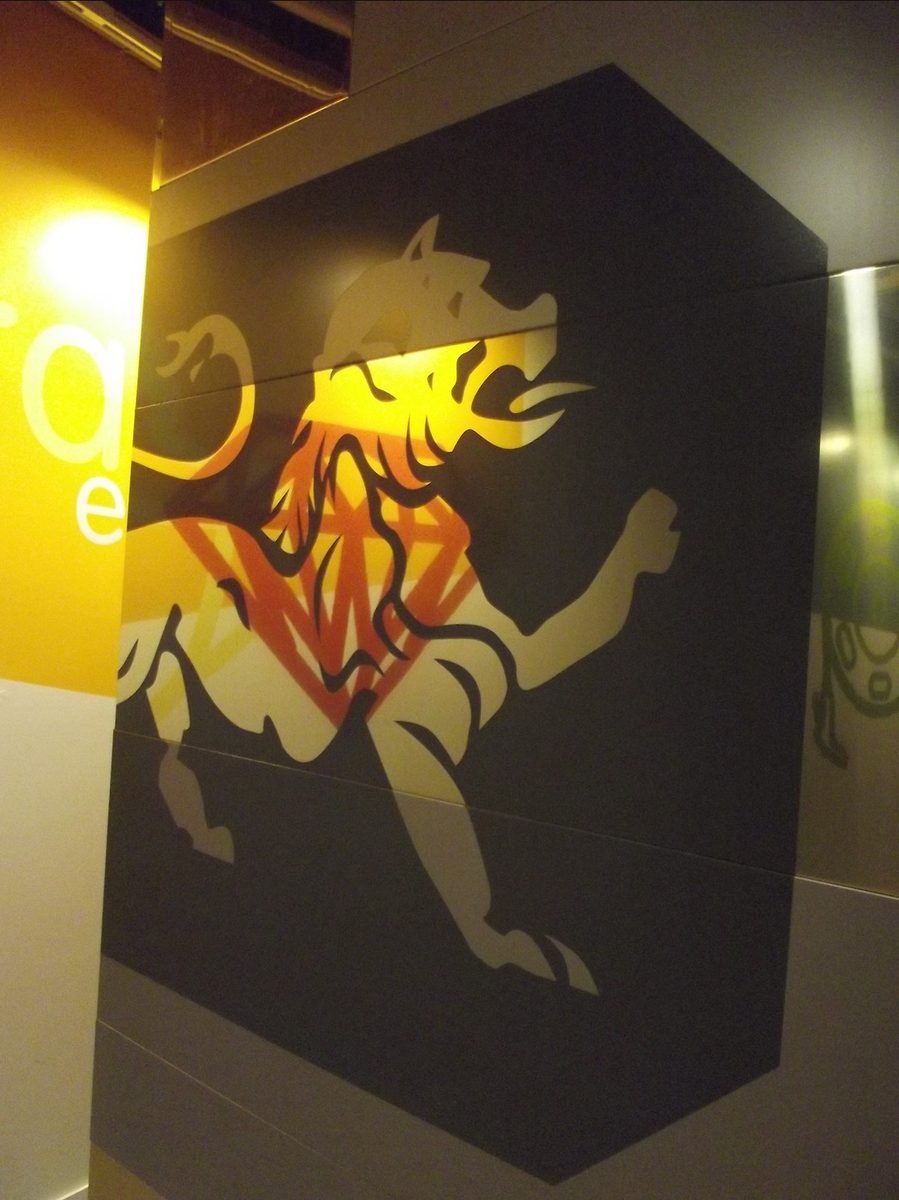
The anchor sat alongside Britain’s national standard mark, a lion, which had its own complicated history by the time Birmingham vinaigrettes were being stamped. A walking lion mark was introduced in 1544 to guarantee sterling-standard silver; it was dropped between 1697 and 1720, when Parliament briefly mandated a higher-purity “Britannia” silver standard to stop silversmiths melting down coinage; and it returned afterward, altered again in 1822. A Birmingham vinaigrette, in other words, typically carries two separate guarantees stamped into the same tiny surface: the anchor certifying where it was tested, and the lion certifying what it was actually made of.
Nathaniel Mills and sons built a vinaigrette empire
Within that Birmingham trade, one workshop came to dominate vinaigrette manufacture almost completely: Nathaniel Mills, working with his sons from the early nineteenth century into the 1850s. A rectangular silver-and-gold vinaigrette in the Science Museum Group’s collection, stamped “N.M” and hallmarked in Birmingham in 1827, is a typical example of the firm’s output — and the museum’s own catalogue record states plainly that Birmingham, driven largely by workshops like Mills’s, accounted for roughly ninety percent of all the vinaigrettes made in the United Kingdom.
Mills vinaigrettes turn up constantly at auction today in a startling range of shapes well beyond the plain rectangular box: book-shaped cases with engraved “spines,” cockle shells, fish, woven baskets, even miniature castles small enough to hang from a watch chain. Their range of shapes was a byproduct of the market: a vinaigrette had to work as fashion, long after serious physicians stopped believing vinegar vapour did much against disease at all.
The Great Stink of 1858 was miasma theory’s loudest public moment
The belief that smell itself caused disease reached its most dramatic public moment three decades after Mills’s firm was at its peak output. In the summer of 1858, an unusually hot, dry season baked the raw sewage and industrial waste that by then filled the River Thames into a stretch of stinking sludge that ran directly past the Houses of Parliament. Newspapers and cartoonists christened it the Great Stink. Punch ran illustrations of a skeletal “Father Thames” presenting the city with its own filthy, diseased offspring, and of Death himself rowing a small boat through the sludge.

By the logic of miasma theory, this looked like an imminent catastrophe: cholera and typhoid were already spreading through the city, and officials assumed the smell outside Parliament’s own windows was the direct cause. The effect on Parliament itself was immediate, and in retrospect almost comic. According to the Museum of London’s own account of the episode, members were affected badly enough that they rushed through emergency funding — an initial £2.5 million, worth more than £250 million today — for a sewer system that had, in fact, already been designed and was simply waiting on money. The stink did what years of public-health argument had failed to do: it got Parliament to act immediately, for reasons that were almost entirely wrong.
John Snow had already proven the real cause, four years earlier
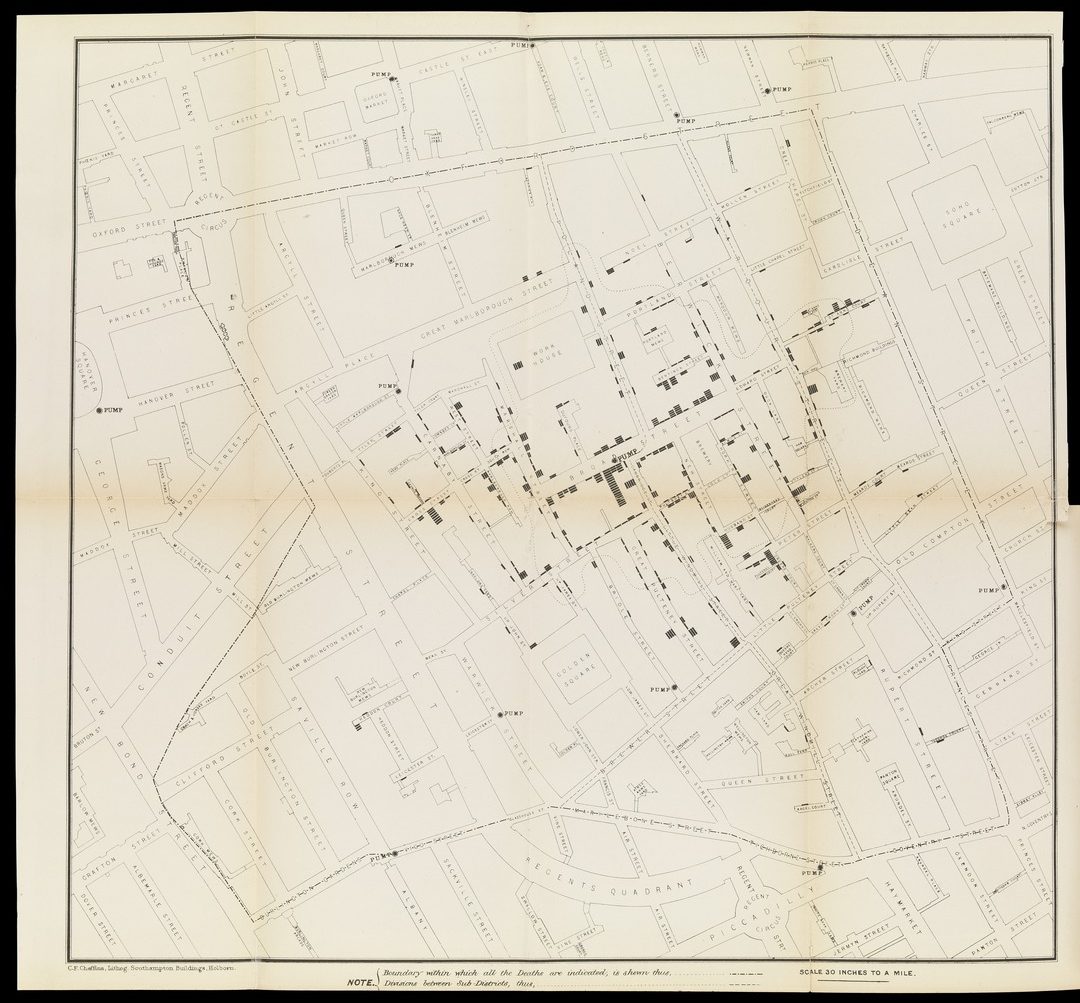
The irony is that the real cause of London’s cholera had already been identified, years before the Great Stink, by a physician the city’s medical establishment mostly ignored. During a ferocious cholera outbreak in Soho in 1854 that killed several hundred people within about ten days, the London physician John Snow rejected the miasma explanation and investigated differently: he went door to door, asking which pump supplied each household’s water, and plotted every death on a hand-drawn map of the neighbourhood. Deaths clustered overwhelmingly around a single public water pump on Broad Street. Snow convinced local officials to remove the pump’s handle; new cases fell sharply afterward. A widely cited 2000 reassessment of the episode in The Lancet complicates the tidy version of this story slightly, but its central finding holds: cholera travelled through contaminated water, not through smell, and the outbreak’s own geography proved it.
Almost nobody believed him at the time. Snow’s waterborne theory directly contradicted the medical consensus, and it took the overwhelming physical evidence of the Great Stink — not Snow’s careful map — to force Parliament into action. The civil engineer Joseph Bazalgette, chief engineer of the Metropolitan Board of Works, took the funding the Great Stink produced and built a system whose scale is still startling: roughly 1,100 miles of new street-level drains feeding into about 82 miles of brick-lined intercepting sewers, carrying waste eastward and pumped out downstream from stations at Deptford, Crossness, and Abbey Mills. The project consumed an estimated 318 million bricks. It opened in stages from 1865 and was declared complete in 1875 — a full seventeen years after the stink that finally paid for it.
Bazalgette’s sewers were built to solve a smell. They solved an actual disease problem almost as a side effect, years before germ theory was fully accepted in British medical teaching through the 1870s and ’80s. And that, quietly, is what ended the vinaigrette. Women kept carrying them into the 1870s out of habit and fashion, but once sanitation visibly improved and germ theory replaced miasma in medical education, the entire premise behind the object stopped making sense to anyone. Built around a theory that turned out to be wrong, it had no job left to do, and it vanished from fashionable jewellery within a generation.
Watch the full history
The video below covers the same ground with the objects and portraits on screen — the vinaigrette itself, Boulton’s Birmingham, and the Thames at its worst in 1858.

What a vinaigrette actually proves, a century and a half later, is not really about vinegar or silver. It is a reminder that a wrong scientific theory can still produce a fully coherent set of objects, industries, and habits around itself — a Birmingham manufacturing trade, a national hallmarking system, a piece of jewellery engraved and passed down for generations — all built on a cause-and-effect relationship that simply did not exist. Miasma theory was not stupidity. It was a reasonable conclusion from incomplete evidence, held onto past the point where better evidence was available, because that evidence came from a man nobody in power was ready to believe yet.
Nathaniel Mills’s workshop is long closed, the Soho Manufactory is gone, and Bazalgette’s sewers, extended and rebuilt many times since, still carry London’s waste today. The vinaigrettes themselves mostly sit in museum drawers now: the Metropolitan Museum alone holds dozens, and Birmingham’s own Assay Office still displays the city’s hallmarking history to visitors.
Would you have trusted a vinegar-soaked sponge to get you safely through Georgian London?
Related reading
- What Was in Victorian Smelling Salts — the vinaigrette’s closer, plainer cousin, once miasma theory gave way to frank medicine.
- The Pomander Was Built on Miasma Theory, and Outlived It — the vinaigrette’s own two-centuries-older ancestor, and the fuller story of the theory itself.
- The Bloodletting Craze That Nearly Wiped Out Europe’s Leeches — another disease treatment built on confident, coherent, and completely wrong medical theory.
- Climbing Boys: The Children Britain Sent Up Chimneys — another Georgian and Victorian hazard that took decades of evidence to finally act on.
Shop the history
If you want to go deeper into this story, these are genuinely useful next reads and references:
- The Ghost Map, by Steven Johnson — a full account of Snow’s 1854 investigation.
- The Great Stink of London, by Stephen Halliday — the fuller story of 1858 and Bazalgette’s sewers.
- Bradbury’s Book of Hallmarks — for reading the marks on a vinaigrette like this one yourself.
Works cited
- Brody, H., Rip, M.R., Vinten-Johansen, P., Paneth, N., Rachman, S. "Map-making and Myth-making in Broad Street: The London Cholera Epidemic, 1854." The Lancet, vol. 356, no. 9223, 2000, pp. 64–68. Link.
- Halliday, Stephen. "Death and Miasma in Victorian London: An Obstinate Belief." BMJ, vol. 323, no. 7327, 2001, pp. 1469–1471. Link.
- Metropolitan Museum of Art. "Vinaigrette Box, M. or A. Ebsen, 1845." The Libraries, Metropolitan Museum of Art, New York.
- Science Museum Group Collection. "Silver and Gold Vinaigrette, Rectangular, Hinged" (attrib. Nathaniel Mills, Birmingham, 1827). Science Museum, London, object A642068. Link.
- Victoria and Albert Museum. "Pomander," museum no. M.205:1 to 3-1925, London. Link.
- Birmingham Museums Trust. "Local Historic People: Matthew Boulton." Link.
- Revolutionary Players (History West Midlands / Birmingham Museums Trust). "The Soho Manufactory: The Ingenious Mr Boulton." Link.
- Collinson, Alwyn. "How Bazalgette Built London’s First Super-Sewer." London Museum (Museum of London). Link.
- The Goldsmiths’ Company Assay Office, London. "History of Hallmarking." Link.