
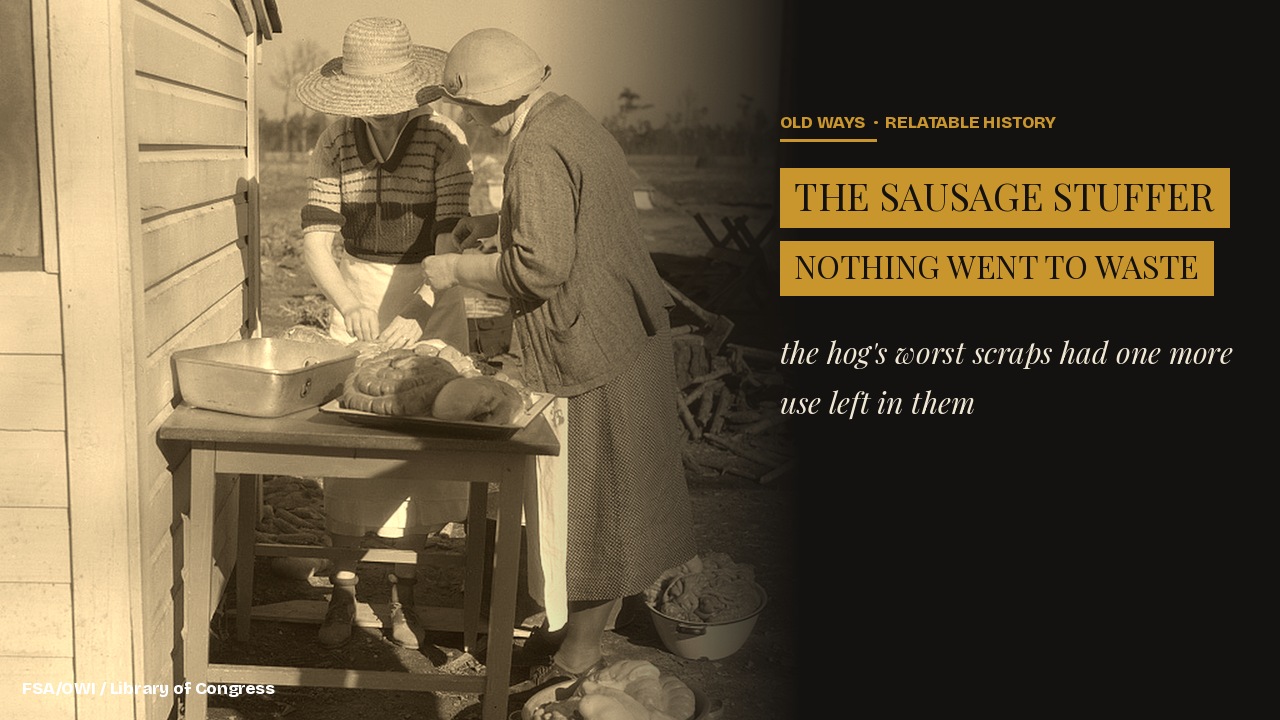
In February 1921, the United States government told American farmers exactly how much sage to put in their sausage. Two ounces, Farmers’ Bulletin No. 1186 specified, for every hundred pounds of ground pork and fat — alongside four ounces of black pepper, a pound and a half of salt, and a single ounce of nutmeg. It was a strange thing for Washington to put in writing, except that it wasn’t really an oddity. It was one small, codified piece of a much larger body of household knowledge that every hog-killing family needed to get right, because the sausage stuffer sitting on the kitchen table only ran once a year, and a mistake with it meant a leaner winter.
The sausage stuffer was a hand-cranked cast-iron grinder, clamped to the edge of a table, that turned the parts of a butchered hog nobody could sell or roast into a food that would keep. It didn’t do much — grind, season, stuff — but it was the one machine standing between a family and a wasted animal.
Here is what that machine actually was, the oddly specific government recipe it eventually helped formalize, the neighborly labor that made the whole day possible, and why — once refrigeration and the corner grocery arrived — it went quiet almost everywhere at once.
A Philadelphia Company Turned a Farm Chore Into a Mail-Order Product
The machine itself was simple: a cast-iron hand grinder clamped to a tabletop, with a hopper on top and a crank on the side turning an internal auger. For grinding, the auger forced meat through a perforated steel plate. For stuffing, a household swapped that plate for a smooth, funnel-shaped tube — and that tube is where the name “stuffing horn” comes from, because the earliest versions really were hollowed animal horns rather than cast metal. A sausage stuffer in the collection of the New Hampshire Historical Society, dated to around 1825, shows how old the basic idea is: a carved wooden plunger worked by hand through a separate wooden funnel, decades before any factory touched the design.
By the time cast iron took over, the trade had a recognizable leader. The Enterprise Manufacturing Company, founded in Philadelphia in 1864, built both large grinders for butcher shops and smaller ones for home kitchens, alongside other cast-iron household tools that had nothing to do with meat at all — coffee mills, fruit presses, tobacco cutters. A farm household in the 1880s or 1890s might own one combination machine that ground and stuffed using interchangeable parts, or two separate tools instead: a grinder for chopping, and a dedicated stuffer built as nothing more than a piston worked by a hand lever, useful on a day when more than one person needed to be stuffing casings at once. Either way, a well-kept example from that era, oiled and stored dry between uses, can still do the job it was built for a century and a half later.
Cleaning a Casing Was the Least Glamorous Step, and the Most Essential
Grinding and stuffing a hog’s worth of trimmings was a two-person job, and the harder of the two roles was turning the crank. Pushing a hopper full of cold, stiff fat and meat through a narrow plate for an hour or more at a stretch was real labor, traded off whenever an arm gave out. The second person fed the hopper and, once stuffing began, held the casing steady over the horn as the ground, seasoned meat filled it — adding a little water, as the USDA bulletin advised, if the meat needed softening to slip through easily.
The casing itself came from the hog being butchered, almost always the small intestine. The modern version of the same technique, laid out by the United Nations Food and Agriculture Organization, still follows essentially the same steps a farm kitchen used a century earlier: the intestine is turned inside out, its mucous lining scraped away by hand or machine until only the thin, workable layer underneath is left, and the cleaned casing is salted and kept until needed. A family doing this in a farm kitchen was performing, without the machinery, the same basic procedure industrial casing processors still rely on today.
Once the meat was seasoned and ground, most households fried a small test patty before committing a whole batch to casing, adjusting the salt or pepper by taste. Only then did the stuffer’s crank push the mixture down the horn in a steady, continuous rope. As the filled casing grew, someone twisted it by hand every six to eight inches, pinching and rotating until a natural seal formed — the same motion as twisting the ends of a balloon — turning one long tube into a string of individual links without a single knot.
The Government Eventually Wrote Down What Farm Kitchens Already Knew
Seasoning a batch of pure pork sausage had been, for generations, a matter of family habit — sage and black pepper in most places, sometimes red pepper or coriander depending on where a family’s own kitchen traditions came from. In 1921 the USDA put numbers to the habit. Pork on the Farm: Killing, Curing, and Canning gave a specific formula for a hundred pounds of meat and fat: two ounces of sage, four ounces of black pepper, a pound and a half of salt, and an ounce of nutmeg, mixed in before the meat ever touched the stuffer. The same bulletin noted that sausage packed into muslin bags and sealed with paraffin kept longer than sausage in casings — a detail that suggests not every household trusted the casing to hold through a whole winter.
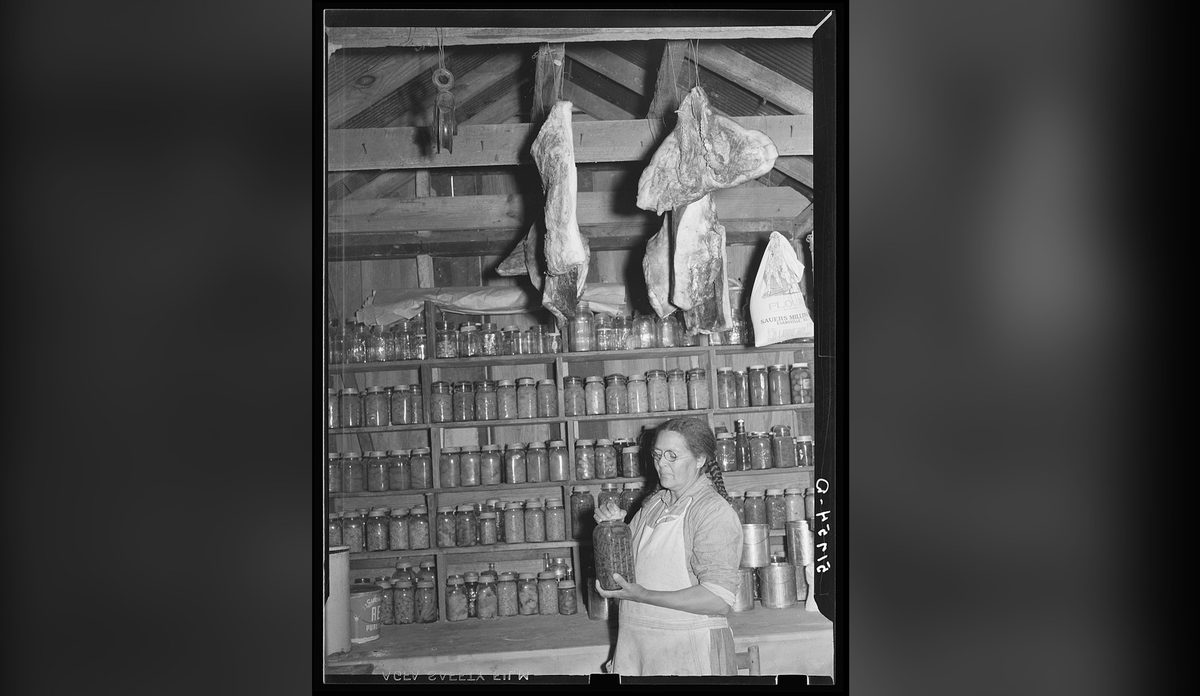
The bulletin set out separate formulas for the hams, shoulders, and bacon that never went into the grinder at all. A dry cure called for five pounds of salt, four pounds of molasses, two ounces of saltpeter, and three ounces each of black and red pepper per hundred pounds of meat, left in cure roughly two days for every pound an individual cut weighed — twenty days for a ten-pound ham. A brine cure used nine pounds of salt (ten in warm weather), sugar, saltpeter, and water, timed at four days per pound for ham and three days per pound for bacon and smaller cuts; pickled fatback, bound for the lard pot later, took ten pounds of salt and two ounces of saltpeter in four gallons of water. None of it could begin, the bulletin warned, “before the animal heat is out of” the meat: a carcass needed to cool to between 34 and 40 degrees Fahrenheit first, usually twenty-four to thirty-six hours after killing.
The Grinder Only Came Out Once a Year, and Neighbors Made That Possible
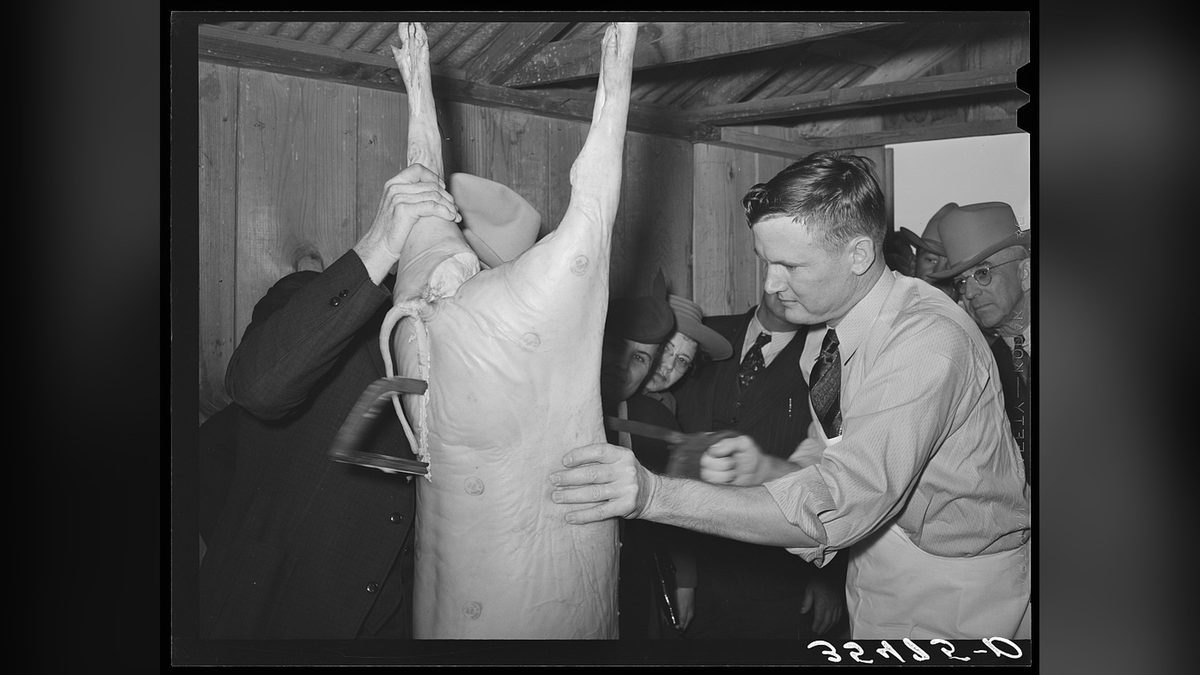
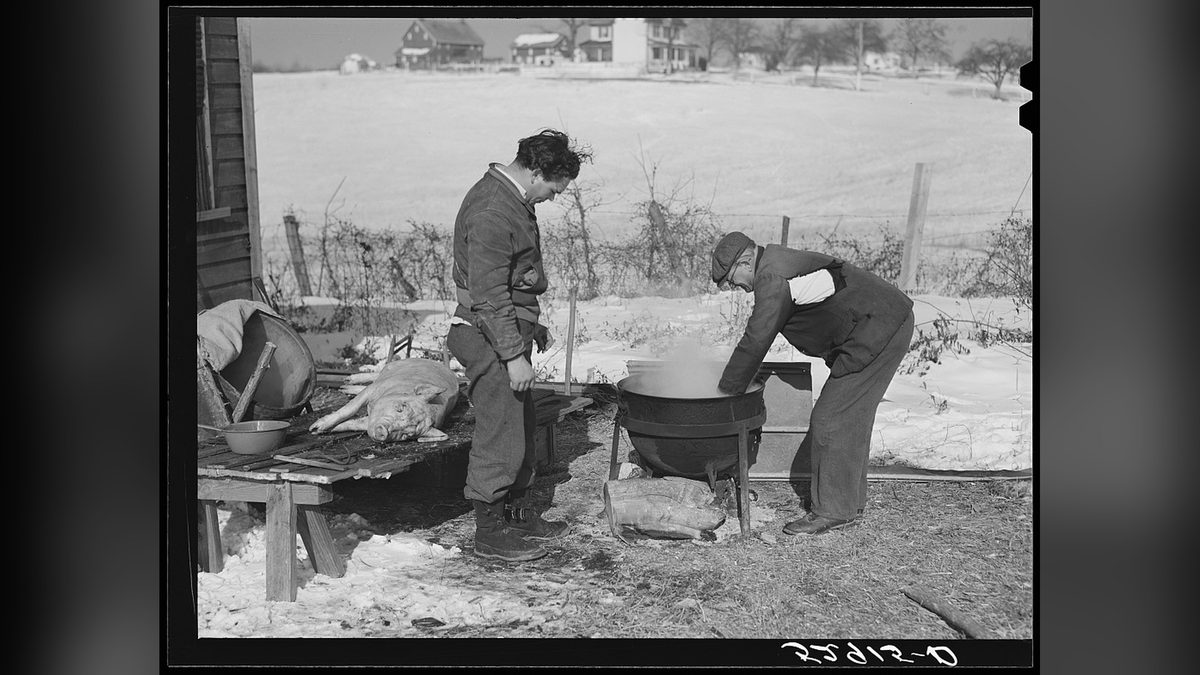
None of this ran on a convenient schedule. Without refrigeration, a hog could only be killed, butchered, and worked up into sausage and cured meat during the handful of cold weeks each year when fresh meat wouldn’t spoil before the stuffer, the salt, and the smokehouse could get to it. That made the day itself a logistical bottleneck: a single household rarely had enough hands to kill a hog, scald and scrape it, break it down into cuts, grind and stuff the trimmings, and render the fat, all inside the daylight hours of one winter day.
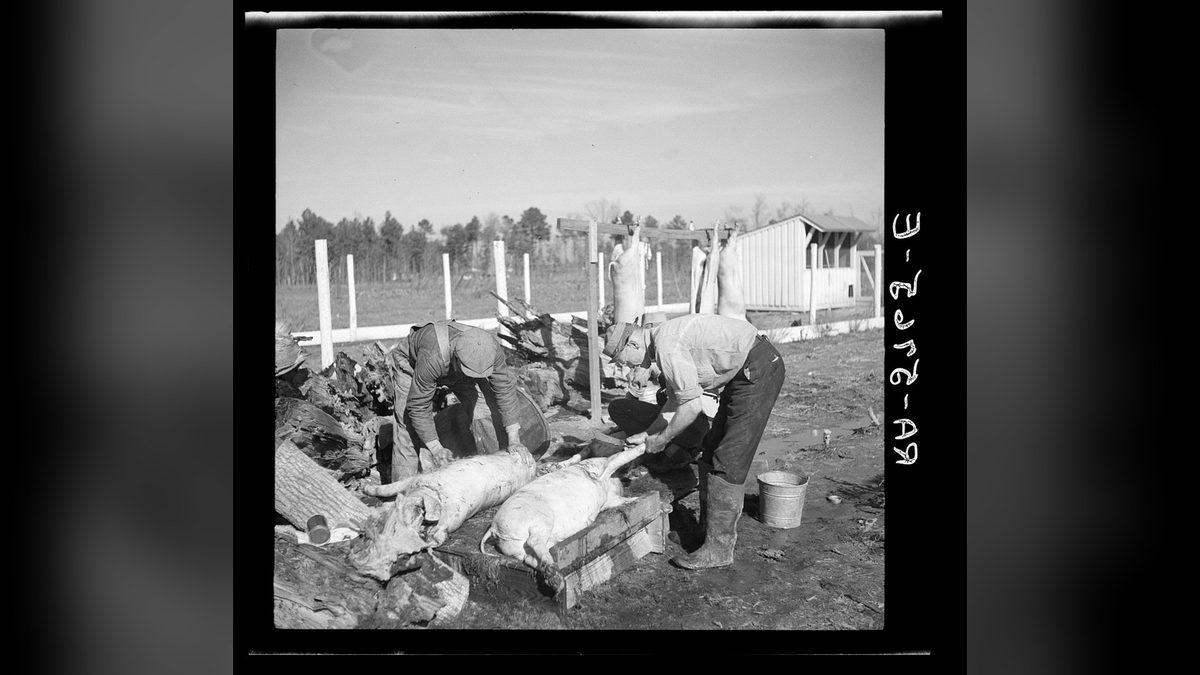
So neighbors pitched in, and returned the favor when it was someone else’s turn. A writer collecting Appalachian hog-killing recollections described it as a neighborhood-wide “willingness… to pitch in and help each other,” the same cooperative arrangement that powered a barn-raising or a quilting bee. A Tennessee farmer interviewed decades later by the Southern Foodways Alliance recalled killing six hogs in a single day with five friends, timed deliberately for the season’s first hard cold snap so the curing meat would stay cool through the weeks that followed. The sausage stuffer’s part in that day came near the end of the line, after the carcass work was finished and the scraps — too small or too oddly shaped for a roast or a chop — were finally ready for the grinder.
Refrigeration, Not a Better Grinder, Is What Finally Retired It
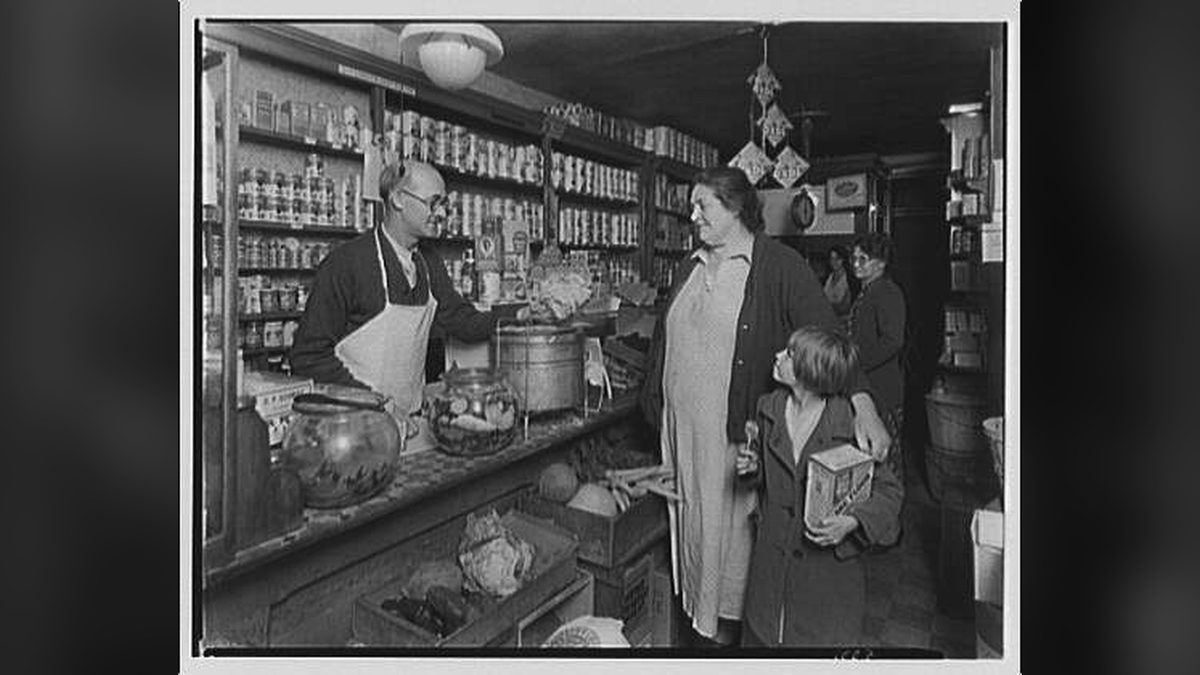
The hand-cranked sausage stuffer didn’t lose to a better sausage stuffer. It lost to the two things that made hog-killing day itself unnecessary: industrial meatpacking and rural electricity. Gustavus Swift had already shown, decades earlier, how centralized meatpacking could reach households a farm never could — he shipped the first refrigerated railcar of fresh meat east in 1877, and by the time Swift & Company incorporated in 1885 with $300,000 in capital, commercial meatpacking was well on its way toward making a farm’s own hog optional for any family willing to simply buy its meat.
Rural electrification finished the job. President Franklin Roosevelt created the Rural Electrification Administration by executive order in May 1935, and rural electric cooperatives spread out from there state by state — Wyoming’s first cooperative delivered its first power in December 1937, and by 1951 roughly three-quarters of that state’s farms and ranches were connected. Wherever the lines reached, a refrigerator or a chest freezer usually followed soon after, and a family no longer needed to process an entire hog’s worth of meat in one frantic cold-weather week just to keep it from spoiling.
By the 1950s, the cast-iron grinder that had been an annual fixture for nearly a century was, for most households, a relic in a barn or a basement. It never entirely disappeared — hunters still crank them for venison, and a modern wave of home charcuterie and backyard homesteading has sent collectors hunting flea markets for exactly this kind of iron antique — but the emergency it was built to solve, a once-a-year race against spoilage, had been solved by other means.
What a sausage stuffer really measures is how differently a household budgeted risk when there was no backup plan for spoiled food. A machine built to clamp onto a kitchen table and grind whatever was left of an animal wasn’t a convenience; it was the last step in making sure a year’s meat supply didn’t go to waste over bad timing or bad weather. The government bulletin, the borrowed neighbor, and the Philadelphia ironworks all existed to manage the same narrow, unforgiving window.
Most of those cast-iron grinders are still perfectly functional, oiled and stored somewhere, waiting for someone willing to use one the old way. What would it take for your own household to use every scrap of an animal, the way farm families once had no choice but to do?
Watch the full history
The video covers the same machine in under eight minutes; the full recipe, the neighborly labor, and the reasons it disappeared are above.

Related reading
- How Hog Killing Day Worked on the American Farm — the fuller story of the one day a year the stuffer was needed at all.
- The 250-Year-Old Box That Kept Flies Off Dinner Without a Fridge — another way farm kitchens solved food safety before refrigeration existed.
- What Was a War Garden? Inside America’s WWI Food Front — a different wartime push toward growing and preserving your own food.
- How Much Firewood Heated a Farmhouse Through a 19th-Century Winter — another Old Ways look at the physical labor behind a 19th-century household.