
Ask most people who invented the electric toaster and you will probably hear a name that never belonged to a real inventor. The real story starts in 1893, when an English firm called Crompton & Company built the first standalone electric toaster ever sold. It was called the Eclipse, and it worked by exposing a slice of bread to bare, glowing resistance wire, close enough and long enough to brown one side. Then you had to flip the bread yourself, by hand, and watch it the entire time, because the wire did not know the difference between toast and kindling.
That was not a minor design quirk. For the next three decades, every electric toaster sold anywhere ran on some version of the same unsolved problem: live wire that stayed red-hot for as long as it was plugged in, with no way to turn itself off and no way to stop if the bread sat too long. Early-appliance house fires were common enough that insurance companies of the era kept records on them.
The people who actually solved that problem were four real engineers working in stages across three decades: an alloy chemist in Illinois, a General Electric engineer in New York, a husband-and-wife patent team in Michigan, and a factory mechanic in Minnesota who got tired of burnt cafeteria toast. None of them is the name most people would give you today if you asked who invented the electric toaster. For about a decade, that credit instead went to a Scottish engineer named Alan MacMasters, who never existed at all — he was invented, literally, by a bored university student in 2012, and the fabrication ended up quoted in newspapers, taught to schoolchildren, and logged by the Bank of England as an eligible nominee for Britain’s fifty-pound note.
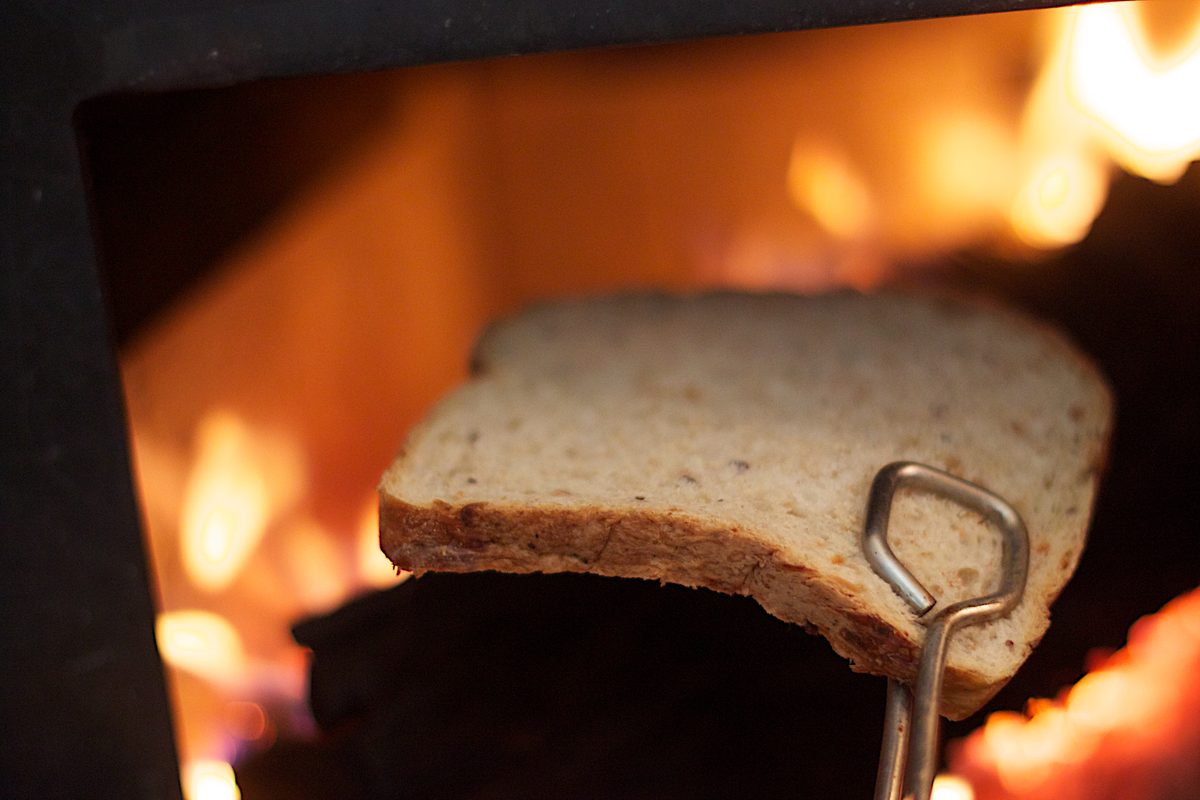
The first electric toaster could only brown one side, and it ran hot the whole time it was plugged in
Crompton & Company, based in Chelmsford, Essex, was already in the business of electric heating when it built the Eclipse. The toaster used an open heating element made of plain iron wire, arranged so bread could be propped against it. Iron wire glows when current runs through it, but it also oxidizes and grows brittle under repeated heating and cooling, and it eventually snaps. Crompton’s own electric space heaters had the identical failure mode, which is most of why so little technical detail about the Eclipse survives: it was not reliable enough to become a lasting commercial product, and the company moved on.
What the Eclipse proved was simpler and more important than any one model: a wire could be made to glow hot enough, consistently enough, to toast bread without an open flame. What it could not prove was that the wire could survive doing that job for more than a short run of uses. Toasting one side at a time, by necessity, because nobody had yet built a wire that could be trusted on both sides of the bread at once without a person standing there the entire time.
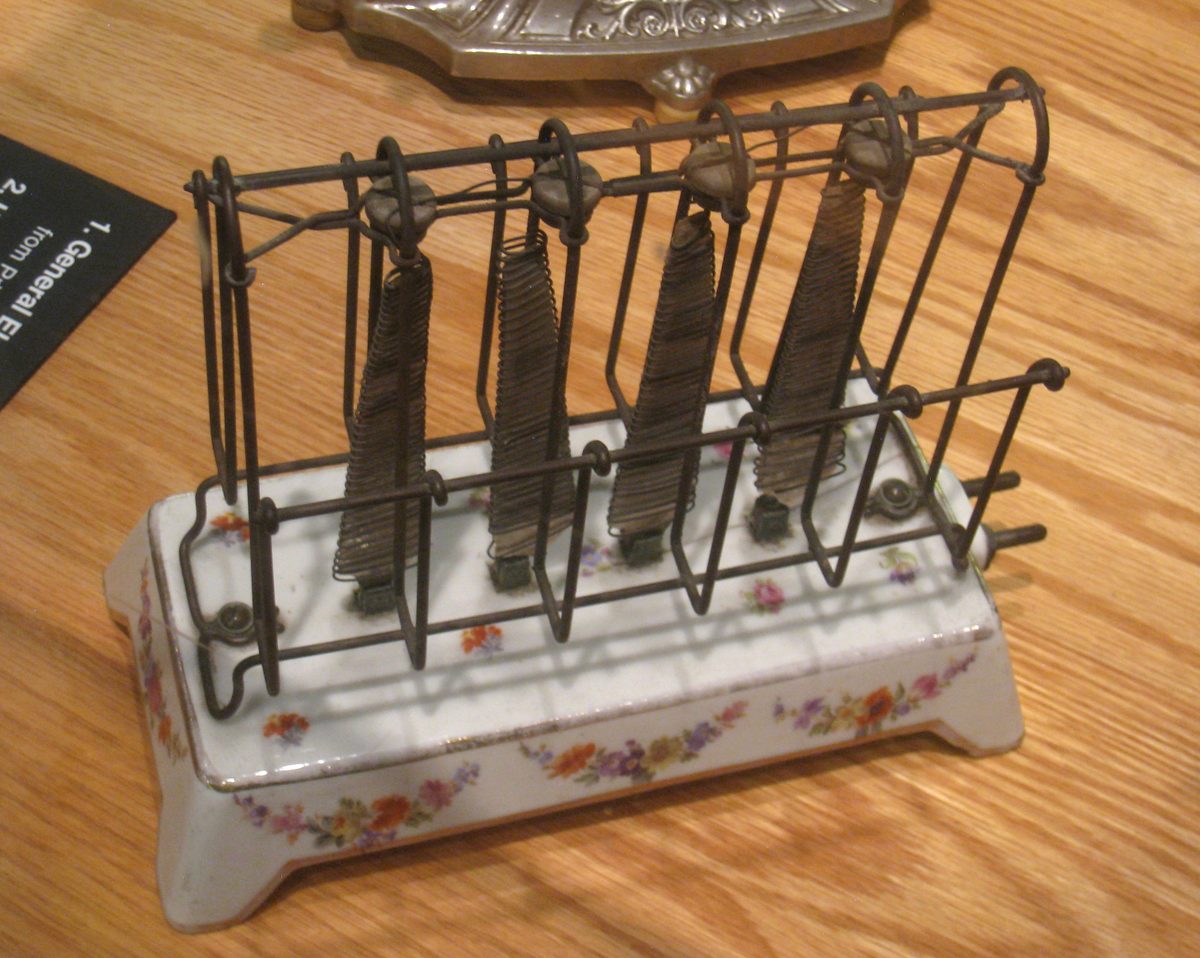
A metallurgist in Illinois solved the one problem every toaster maker actually had
The material question sat unresolved for twelve years, until Albert L. Marsh, an engineer working in Lake Bluff, Illinois, filed a patent in March 1905 for what the filing calls an “electric resistance element.” Granted the following February as US Patent 811,859, it claimed resistance wire made mostly of nickel with a smaller share of chromium or a similar metal — the patent’s preferred example runs about 85 percent nickel to 15 percent chromium. Marsh and his backer, the Hoskins Manufacturing Company, sold the alloy under the trade name Chromel; it is better known today by its generic name, nichrome.
Nichrome solved the exact failure that had sunk the Eclipse. It could be heated to a dull cherry-red and cooled back down, cycle after cycle, without oxidizing apart or turning brittle the way plain iron or steel wire did. It also did not need the sealed vacuum environment a light-bulb filament requires to survive at similar temperatures, which meant it could sit in open air, inside an ordinary kitchen appliance, and just keep working. Within a few years of the patent, nichrome wire was showing up in toasters from multiple manufacturers, General Electric among them, and when GE began selling its own version of the same alloy without a license, Marsh sued and won, which made both him and Hoskins considerably wealthier than the original toaster side-business ever had.
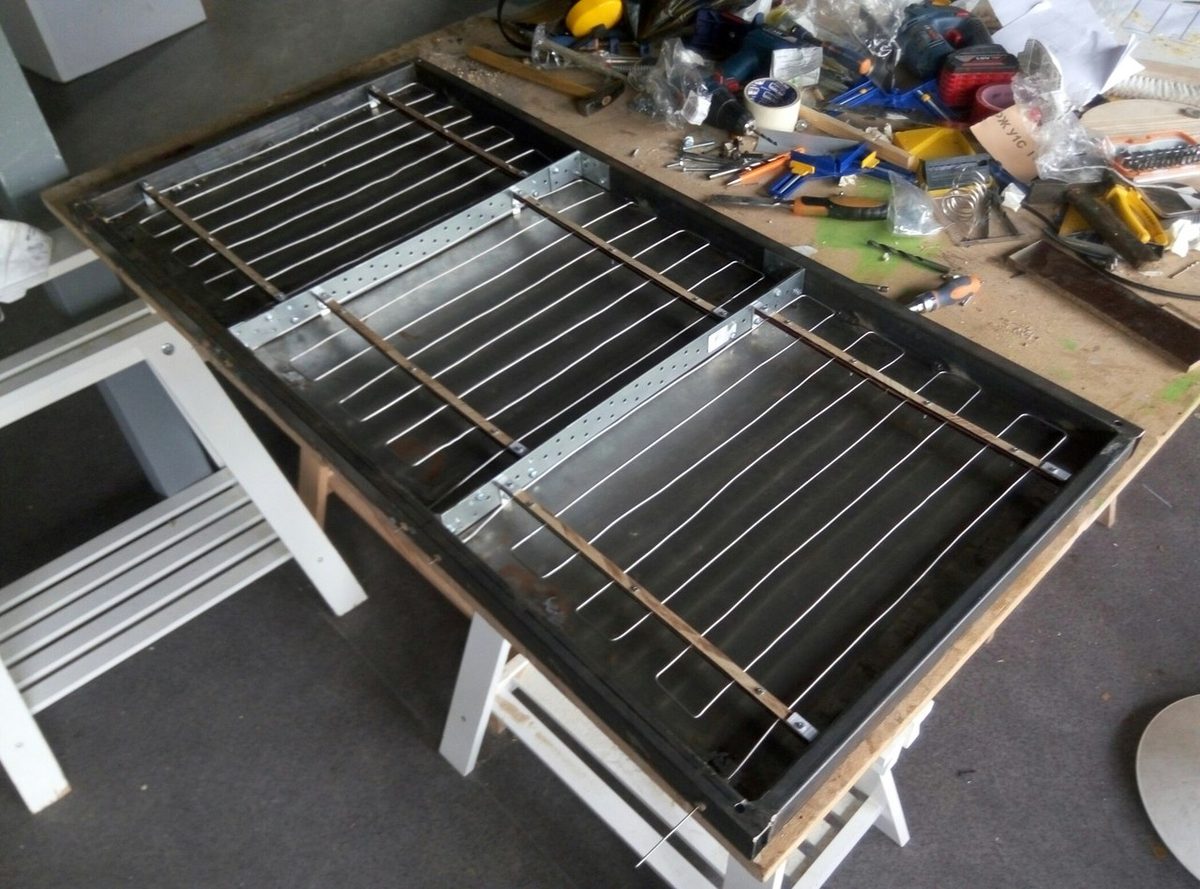
General Electric’s D-12 sold well in 1909, but it still had no way to stop itself
Once nichrome existed, the next step was obvious and GE took it fast. Its D-12 toaster, patented by GE engineer Frank Shailor and sold starting in 1909, is generally credited as the first electric toaster to actually sell well in the United States, at roughly three dollars apiece. It used four vertical nichrome heating elements arranged around an open frame, so bread leaned against glowing wire with nothing between them but air.
What the D-12 did not have was any mechanism to turn itself off. No thermostat, no timer, no automatic shutoff of any kind. It toasted only one side at a time, so using it meant standing in front of it, flipping the bread by hand, and watching the whole process, because bread left too long against that wire did not simply overcook — it could, and on a documented number of occasions did, catch fire. A better alloy had fixed the wire. It had not fixed the toaster.
Getting a toaster to run itself took two more inventions and sixteen more years
The fix came in pieces, from people working independently of each other. In 1913, Michigan inventors Lloyd Groff Copeman and his wife Hazel Berger Copeman patented an automatic bread turner, built into the Copeman Electric Stove Company’s own toaster, so a motor flipped the bread partway through instead of a person doing it by hand. It solved one half of the standing-and-watching problem and left the other half — knowing when to stop — completely untouched.
The half that mattered more came from a factory mechanic named Charles P. Strite, working in Stillwater, Minnesota, who was simply tired of the burnt toast coming out of his plant’s cafeteria. He began working on a fix in 1919 and filed his application in June 1920 for what the patent calls a “bread-toaster”: an enclosed oven with a spring-wound clock mechanism that lowered the bread into the heat, held it for a set interval, then released a catch that cut the current and lifted the toast back up on its own. It was granted as US Patent 1,394,450 on October 18, 1921, and it is the direct ancestor of the pop-up mechanism still used today.
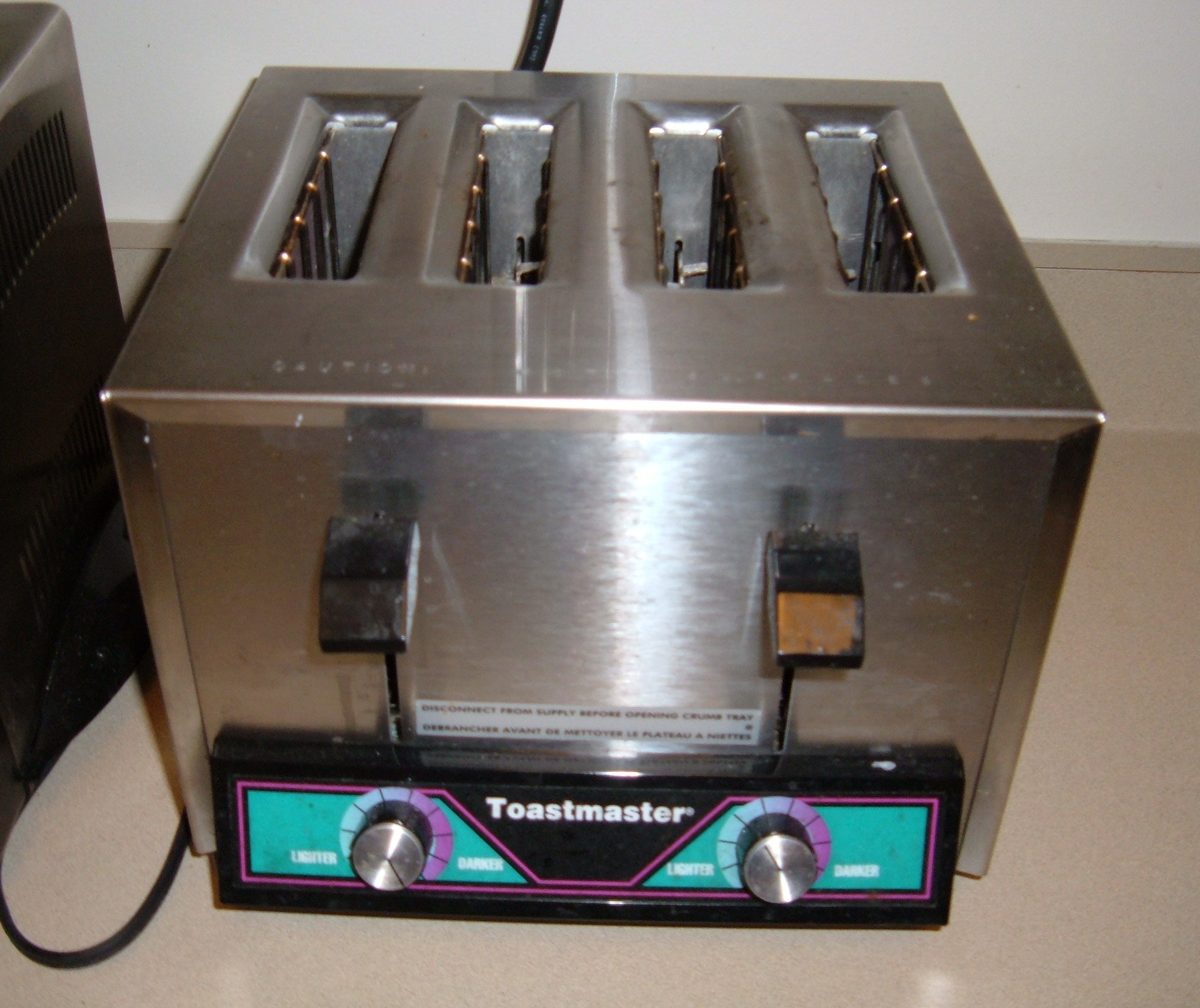
Strite formed the Waters Genter Company to build it, sold an industrial version to restaurant and cafeteria kitchens under the name Toastmaster, and in 1925 released the Model 1-A-1 for home kitchens — the first toaster that could brown both sides of the bread at once, run on an adjustable timer, and eject the toast with no one standing over it. That is, in rough outline, still the shape of the countertop toaster most people own now. From Crompton’s bare wire in 1893 to a toaster you could genuinely walk away from took thirty-two years, four separate inventors, and one lawsuit.
None of that story has a famous Scottish inventor in it — but for a decade, a lot of people thought it did
In February 2012, a University of Surrey lecturer warned a dynamics class against citing Wikipedia, mentioning in passing that a friend of his had once vandalized the site’s toaster article as a prank. A student sitting in that lecture, who has since been identified only by the pseudonym Alex, decided to try the same trick himself. He edited the Wikipedia article on the toaster to credit a fictional Edinburgh engineer named Alan MacMasters with inventing the first electric toaster in 1893 — the same year as the real Eclipse, simply relocated to Scotland and given a human face, borrowed from a real acquaintance’s name.
The following year, Alex built the fictional MacMasters a full biography page, illustrated with a photograph of himself digitally altered to look like a nineteenth-century studio portrait. By his own later account, friends told him at the time that the doctored photo looked obviously fake. That, he said, was part of the joke.
The hoax grew because journalists cited Wikipedia, and then Wikipedia cited the journalists
From there the fabrication took on a life its creator never engineered. Other Wikipedia editors, with no idea the entry was invented, added further detail over the following years: that MacMasters’ toaster had been a commercial failure, that he had also invented the electric kettle, that he had helped light the London Underground, even that his toaster had caused one of Britain’s earliest fatal household appliance fires. The Scotsman and the Mirror both printed the invented biography as established fact. A primary school in Scotland built an entire lesson day around him. A professional chef built him a dessert on the televised cooking competition Great British Menu. During the 2014 Scottish independence campaign, pro-independence groups cited MacMasters’ invention as evidence that a small, independent Scotland could still produce world-changing engineers.
The strangest documented trace of the hoax sits in an official government record. When the Bank of England opened public nominations in 2018 for a historical scientist to appear on a redesigned fifty-pound note, it received 227,299 submissions and published a list of 989 names that met the basic eligibility rules — real, deceased, and a contributor to UK science. Alan MacMasters’ name is on that published list, a fictional person logged among real eligible nominees by one of the country’s own institutions.
What kept the story alive for so long was not simple credulity; it was a closed loop. Journalists and even reference books cited the Wikipedia article as their source, and Wikipedia editors then cited those same newspaper and book mentions as independent confirmation that the article was accurate. Researchers who study misinformation call this pattern citogenesis: a claim with no original source becomes, through enough rounds of mutual citation, functionally indistinguishable from one that does. Nobody along that chain had gone back to check a genuine nineteenth-century record, because there was no such record to find.

It took a bored teenager noticing a bad photo-edit to end a decade-old fabrication
The fiction finally collapsed in July 2022, and not because any historian or professional fact-checker went looking for it. A 15-year-old in Kent, sitting in a class where a teacher happened to mention MacMasters as the toaster’s inventor, got curious enough afterward to look closely at the supposedly Victorian photograph still sitting on the Wikipedia page. He thought it looked edited, and said so on a forum dedicated to tracking Wikipedia vandalism. Other users there traced the article’s entire citation trail, found it led in a circle back to itself, and within days Wikipedia’s own editors labeled the page a hoax, deleted it, and blocked the account that had built the fabricated biography a decade earlier.
Alex, tracked down afterward by the Wikipedia-watchdog site Wikipediocracy, said he never expected the prank to travel as far as it did, and that the moment it actually started to worry him was seeing Alan MacMasters listed as a real historical figure inside a published book about Victorian engineers. He said he still edits Wikipedia, anonymously, partly as a quiet form of apology, and that he expected the false story to keep resurfacing for years regardless.
So who invented the electric toaster? Four real engineers, in stages
Line the two stories up next to each other and the gap is almost comic. The real electric toaster took Crompton, Marsh, Shailor, the Copemans and Strite more than three decades of genuine engineering — a failed alloy, a successful one, a patent lawsuit, two independent mechanical fixes, and one company’s factory frustration turned into a consumer product — to become something safe enough to leave unattended on a kitchen counter. The fake inventor took one lecture-hall joke, a few minutes of editing, and a single doctored photograph, and it still took the internet ten years to notice.
How long do you think a made-up fact can survive online if nobody happens to look closely at one photograph?
Watch the full history
The video version of this story covers the same two timelines side by side, in under six minutes.

Related reading
- Why the Dorabella Cipher Remains Unsolved — another unresolved puzzle from the same shelf.
- How Houdini’s Code Worked, and Why It Could Never Prove Anything — another case where the story people wanted to believe outran the evidence.
- The Robertson Panel UFO Report, Explained — a different kind of official record that shaped what the public believed for decades.
- What Really Happened to the Peking Man Fossils? — when the real record and the popular one quietly diverge.
Shop
Want to see someone actually attempt a toaster from scratch, or pick up the modern descendant of the 1925 Toastmaster? A few picks connected to this story:
- The Toaster Project: Or, Rebuilding an Everyday Appliance from Scratch — Thomas Thwaites’s account of attempting to build an electric toaster entirely from raw materials, mined ore included.
- Nostalgia Retro 2-Slice Toaster — a modern take on the countertop shape this article traces back to the 1925 Toastmaster.
Works cited
- Marsh, Albert L. Electric Resistance Element. US Patent 811,859, filed March 15, 1905, granted February 6, 1906. Link.
- Strite, Charles P. Bread-Toaster. US Patent 1,394,450, filed June 22, 1920, granted October 18, 1921. Link.
- Wohleber, Curt. “The Toaster.” Invention & Technology, Fall 2005. Link.
- “Marsh’s Wires and the Birth of the Toaster.” Chemistry World. Link.
- “Toasting Albert Marsh: Nichrome and the Electric Toaster.” Lake Forest–Lake Bluff History Museum, online exhibits. Link.
- Bank of England. New £50 Note: Nomination and Character Selection Summary (list of 989 eligible public nominations from 227,299 submissions). Link.
- Rauwerda, Annie. “A Wikipedia Hoax About the Inventor of the Toaster Lasted a Decade.” Inverse, August 12, 2022. Link.
- “15-Year-Old Uncovers Major Wikipedia Toaster Hoax That Fooled the Media for Years.” IFLScience. Link.
- “The Edinburgh Toaster Conspiracy: How One Man Persuaded the World That the Toaster Was Invented in Scotland’s Capital.” The Scotsman (Edinburgh News).
- Williams, Al. “Don’t Believe Everything You Read: The Great Electric Toaster Hoax.” Hackaday, November 23, 2022. Link.