
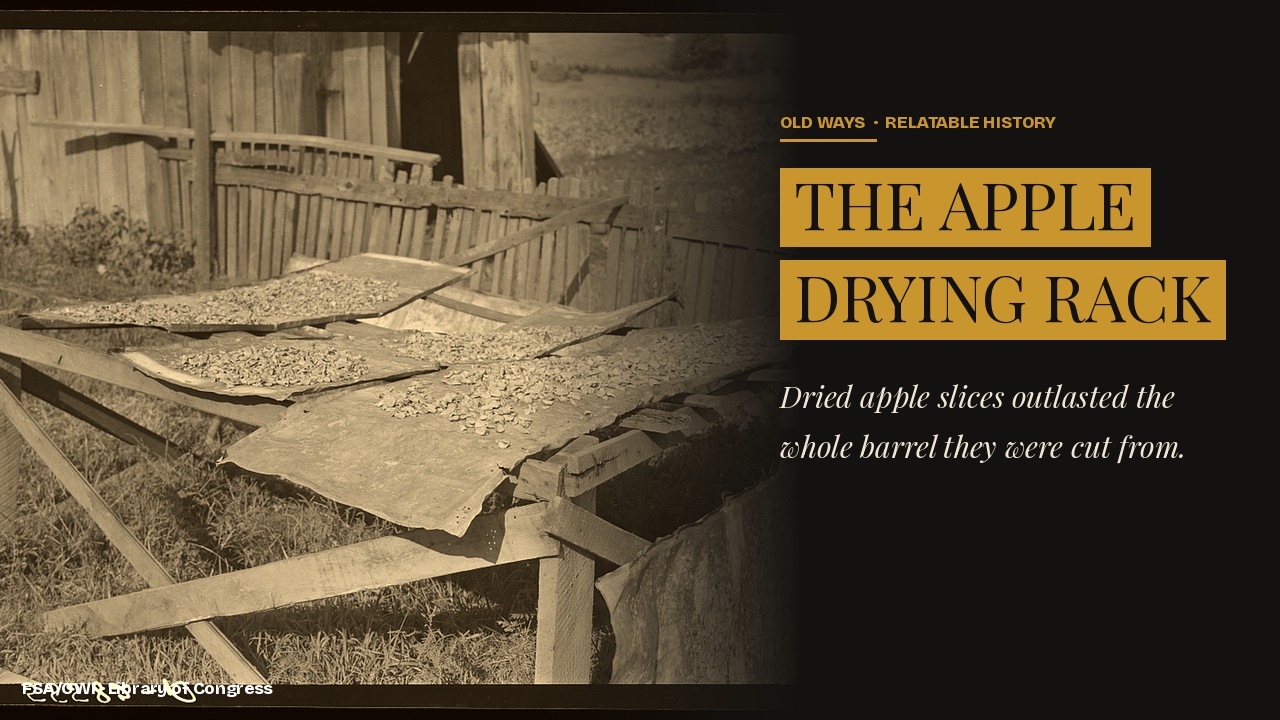
Drying apples before refrigeration was not a specialty skill; it was one of the ordinary jobs of a rural autumn, done with a wooden frame, a length of kitchen string, or, on farms producing enough to sell, a small building with its own furnace. For roughly a century, one religious community in colonial Pennsylvania ran what amounted to a small food business out of one such building, and the product was nothing more exotic than sliced apples left to dry. The Single Sisters of the Moravian settlement at Bethlehem kept a separate building — long dated to 1749, within the first decade of the town’s founding — whose only job was cutting and drying apples from the orchard behind it, known locally as the Schnitz House after the Pennsylvania German word for cutting or slicing. The dried apples it produced were sold, not just eaten at home, and the arrangement ran until around 1840, when the Sisters wound down that side of their economy.
Bethlehem’s operation was unusual mainly in being organized and roofed. Across the rest of rural America, the same problem — a fall harvest of apples far larger than any cellar could keep fresh through winter — got the same answer in farmhouse after farmhouse. Slice the fruit thin, dry it hard, and it would keep a year or more in a fraction of the space a barrel of whole apples needed.
What follows is the longer version of that story: why a Moravian sisterhood turned apple drying into a business, how the equipment on an ordinary farm and in a commercial dryhouse actually worked, how a patent lawsuit accidentally revealed just how old the industrial method already was, and what finally made a rack full of apple slices unnecessary.
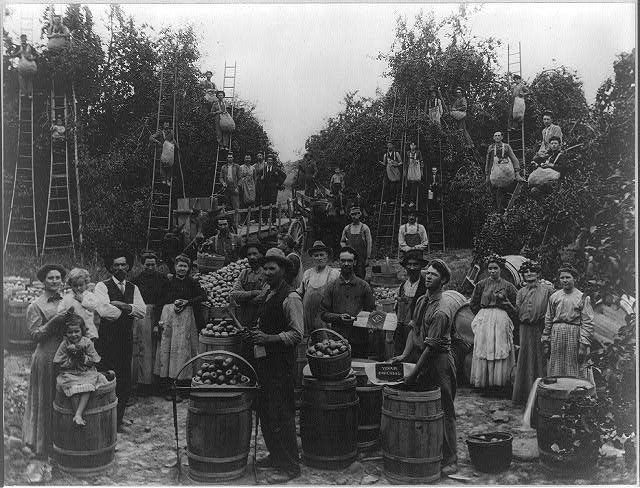
A Pennsylvania sisterhood ran an apple-drying business for about a century
Bethlehem was founded by Moravian settlers in 1741 along the Lehigh River, built as a communal religious society rather than an ordinary town. Its unmarried women lived and worked together in the Sisters’ House, supporting the community through needlework, weaving, and other trades carried on for the group’s benefit. Among those trades was fruit. The Sisters’ House owned a large orchard, and according to the county history compiled by William J. Heller, “the sale of dried apples was extensive” — extensive enough that a separate building, the Schnitz House, was raised specifically to prepare the fruit, rather than doing the work in a kitchen already busy with everything else a household needed.
The nineteenth-century lawyer and local historian John Hill Martin, writing in 1873, described the building as it still stood in his own time: a long, one-story log house plastered over on the outside to look like stone, set back from Church Street on the lot next to the Sisters’ House. “It was erected in the early days of the settlement,” he wrote, “and used by the Sisters as a place to cut and dry apples, which were then extensively used in the winter for pies, by the inhabitants.” Martin adds, with evident affection for his subject, that Pennsylvania Germans of the period treated pie as close to a dietary necessity, eating it at nearly every meal alongside strong coffee three times a day.
Heller’s later history gives the operation an end date that Martin does not: the Sisters’ dried-apple enterprise was wound down, on financial grounds, around 1840. That means the Schnitz House ran as a going concern for close to a hundred years, almost exactly a century before the rest of the country’s farmhouses would have any real alternative to drying their own.
Not every apple, and not just any week, would do
Farm households did not dry whatever apples happened to be on hand. Varieties that held their shape and flavor through the process were favored over ones that turned to mush, and the living-history program at North Carolina’s Horne Creek Farm, which still dries apples by the traditional methods its own nineteenth-century owners used, names Maiden’s Blush, Horse apples, Ben Davis, and Sweet Winesap as varieties that turn up again and again in old farm records for exactly that reason. Timing mattered too: these were tart apples that ripened during the hot, dry stretch of late summer, when open-air drying actually worked rather than inviting mold in damp weather.
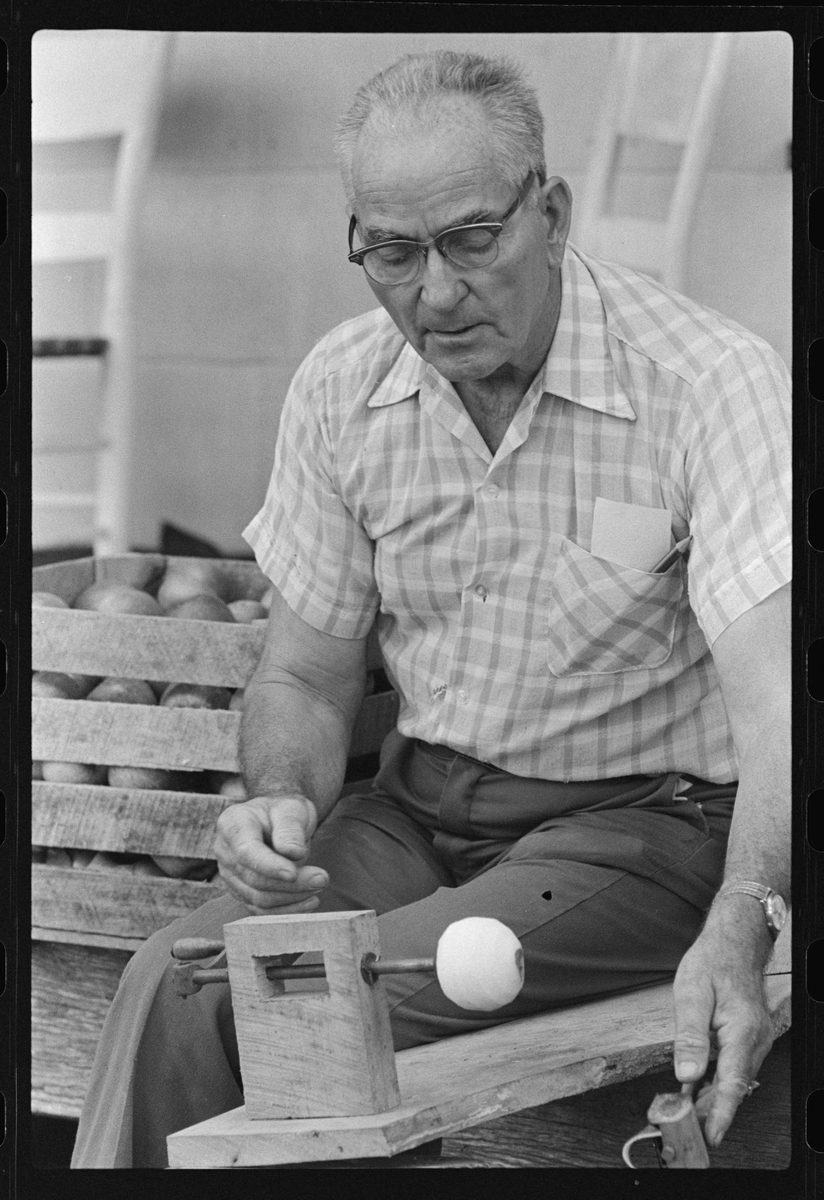
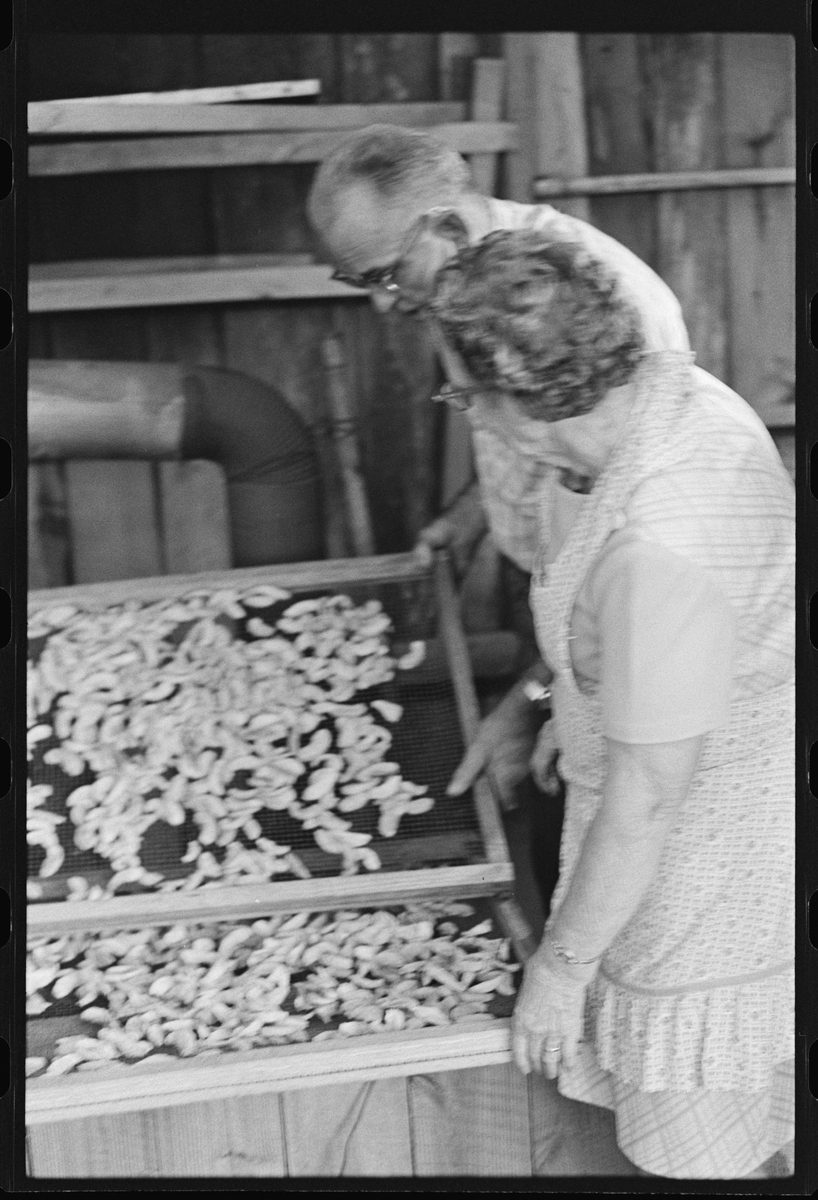
The preparation itself needed no special skill, which is part of why it was a job a whole family could share. Apples were peeled — sometimes by hand, sometimes with a geared, hand-cranked peeler that could pare an apple in a few turns of the handle — cored, and cut into six or eight wedges, or sliced crosswise into rings bound for a drying string instead of a rack. Spread in a single layer with air able to move around every piece, the slices lost their moisture gradually rather than all at once, which kept them from spoiling before they had dried all the way through. Left in the open sun, a batch would brown, shrink, and turn leathery over several days, flipped periodically so both sides dried evenly.
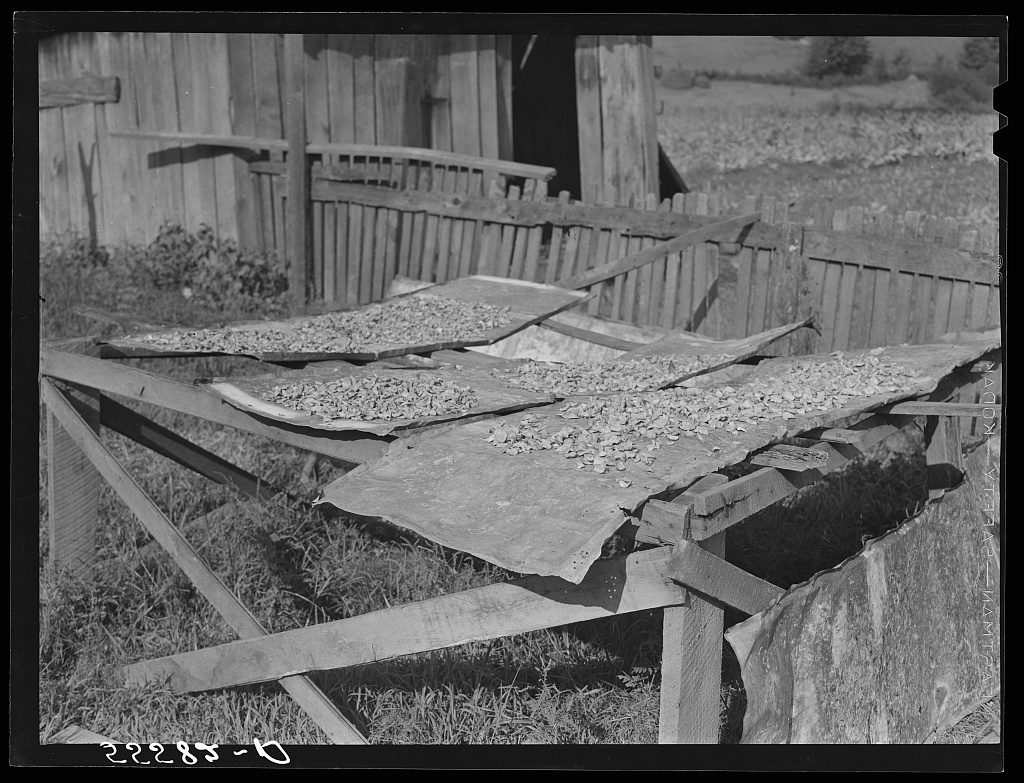
Drying apples before refrigeration: a dryhouse did in a day what open air needed a week for
A farm drying in real volume, rather than just enough for its own pantry, usually built a small dedicated building for the job — the kind of plank dryhouse the Hauser family used at what is now Horne Creek Farm, with a rock or brick furnace inside and wooden trays stacked above it to catch the rising heat. The design detail that made this safe rather than destructive was indirection: the furnace warmed a column of air passing beneath or beside the trays, and the fruit itself never touched flame or smoke. A dryhouse tended closely could finish a batch in about a day, against several days of unpredictable weather for the same batch dried outdoors.
There was a visible trade-off between the two methods, and it showed up on the finished product. Pennsylvania’s own Department of Agriculture noted in a bulletin from 1900, more than a century after the Schnitz House first opened, that apples dried at home were “rarely sulphured” and so came out darker than the commercially evaporated fruit sold in city markets — and that plenty of city buyers actually preferred the honest, home-dried, darker product once they could get it. Sulphur fumigation, which kept commercially dried fruit pale and bright for buyers who judged quality by color as much as by taste, was a market-driven refinement layered onto a process that worked perfectly well without it.
The commercial industry patented a method farms already used
The leap from a farmhouse dryhouse to an industrial evaporator is usually credited to Charles Alden, a Massachusetts inventor who patented an apparatus and process for preserving fruits and vegetables with heated, circulating air — original patent No. 121,569 in December 1871, reissued and broadened as No. 5,648 in November 1873. Alden exhibited his dried fruits at the 1876 Centennial Exhibition in Philadelphia, and the Alden Fruit-Preserving Company spent the following years promoting “The Alden Process” as something close to a patent on preserved food itself. Alden evaporators went into use across the country, including a factory built in Milford, Delaware, in 1872 to take advantage of the region’s fresh-fruit supply, according to the Hagley Museum and Library, which holds one of Alden’s patent models.
The claim to a genuinely new invention did not hold up in court. Sued for patent infringement in 1885, the Alden Evaporating Fruit Company lost: the Circuit Court for the Northern District of New York found that Alden’s core process claim — maturing and preserving fruit by exposing it to heated, humid air that grew more humid and less hot as it moved past the fruit — had already been in ordinary use before his patent, including in apparatus the Shaker communities had been running since 1860 and in conventional dry-houses besides. The court voided that part of the patent outright. Alden’s real contribution, in other words, was less a new method than a patented, branded, aggressively marketed version of what farm dryhouses had already been doing for a generation.
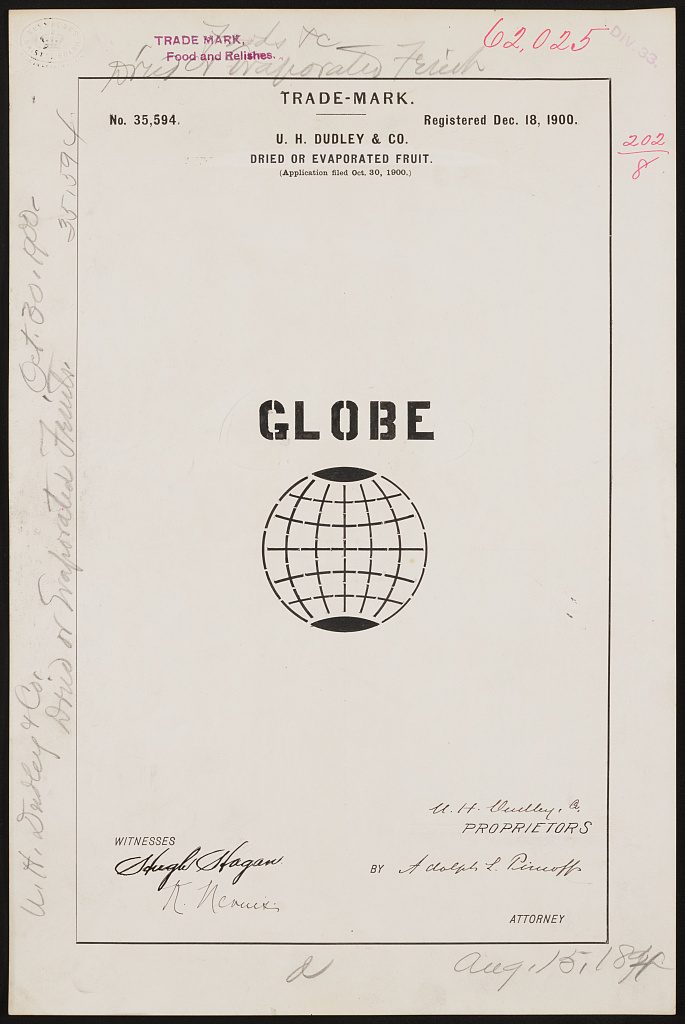
By the time the U.S. Department of Agriculture published a detailed guide to the industry in 1923, apple drying had become almost entirely a machine process at commercial scale, run through purpose-built plants with graders, hand-cranked and power-driven peelers, slicers, and a sulphuring chamber the bulletin calls a “bleacher” — a closed box fitted with a slat-and-chain conveyor and a stove for burning sulphur, built into the workroom alongside the rest of the equipment. The bulletin’s own figures give a sense of scale: in 1909, the first year for which it considered the numbers reliable, commercial apple-drying output came to 44,568,000 pounds, about 70 percent of it from western New York, with a rapidly growing California industry whose average output climbed from roughly 6,800,000 pounds a year between 1910 and 1916 to a peak of about 25,000,000 pounds in 1919. The 1920 census found 252,289 American farms still reporting some production of dried fruit.
What a dried apple became back in the kitchen
Once dry, slices or rings went into cloth sacks, rye-straw baskets, or barrels and were kept somewhere cool and dark, where they held for a year or longer without further attention. Through the winter, dried apple went a long way: soaked in water for a few hours, the slices plumped back up enough for a pie filling or a pot of applesauce, with a flavor families often described as richer and more concentrated than the fresh fruit had been in autumn. Pennsylvania Dutch households built an entire signature dish around the practice, schnitz un knepp — dried apples simmered slowly with a smoked ham bone, topped with dumplings, and served as a complete one-pot winter meal that exists only because someone dried the apples first. Food historian Patricia Bixler Reber, who has traced the dish and the word schnitz through period Pennsylvania German sources, notes it was already being described in print by the 1860s as apples, fat pork, and dough dumplings cooked together — recognizably the same dish still served in the region today.
Why the rack’s job ended, and why it never fully disappeared
What eventually displaced the drying rack was not a better way to dry fruit; it was a set of better ways to avoid needing to. Home canning, cheaper glass jars, mechanical refrigeration, and fast rail shipping of fresh produce all arrived over the early twentieth century and quietly took over the job drying had always done. There is a certain irony in the timing: the USDA was still publishing detailed instructions for building a commercial evaporator plant in 1923, describing an industry handling tens of millions of pounds of fruit a year, at almost exactly the moment household refrigeration was about to make the plainer, farmhouse version of the same practice unnecessary for most American families. Bethlehem’s own Schnitz House had anticipated that ending by roughly eighty years — its commercial run was already over by 1840, long before refrigeration had anything to do with it.
The practice itself never fully vanished, though. It simply moved from a farmhouse necessity to a homesteading choice, and the basic method — thin slices, moving air, patience — works exactly as well today as it did in a Moravian sisterhood’s drying house nearly three centuries ago, with or without a single volt of electricity.
Watch the full history
The video version covers the rack, the string, and the dryhouse in about eight minutes, with the Pennsylvania Dutch dish they fed into.

Related reading
- Why Corn Was Soaked in Lye Before It Became Breakfast
- Why the Dorabella Cipher Remains Unsolved
- Why Waffles Have a Grid Pattern (It’s Not About the Syrup)
- The History of the Sausage Stuffer: How Farms Wasted Nothing From a Hog
Shop the styles/items featured in this video
Works cited
- Martin, John Hill. Historical Sketch of Bethlehem in Pennsylvania, with Some Account of the Moravian Church. Philadelphia, 1873. Link.
- Heller, William J., ed. History of Northampton County, Pennsylvania, and the Grand Valley of the Lehigh, vol. 2. American Historical Society, 1920. Link.
- Caldwell, Joseph S. Evaporation of Fruits. U.S. Department of Agriculture, Department Bulletin No. 1141. Washington, D.C.: Government Printing Office, 1923. Link.
- Alden Evaporating Fruit Co. v. Bowen, 24 F. 787 (C.C.N.D.N.Y. 1885). Link.
- “Something Is Fishy about Charles Alden’s Patent Model.” Hagley Museum and Library. Link.
- “Drying.” Horne Creek Living History Farm, North Carolina Historic Sites. Link.
- Reber, Patricia Bixler. “Schnitz – Dried Apple Slices, 1749 Schnitz House, Schnitz Baskets, Schnitz un Knepp.” Researching Food History (blog), September 25, 2017. Link.
- Trade-Mark No. 35,594 (“Globe,” dried or evaporated fruit), U.H. Dudley & Co., registered December 18, 1900. Library of Congress, Prints and Photographs Division.