
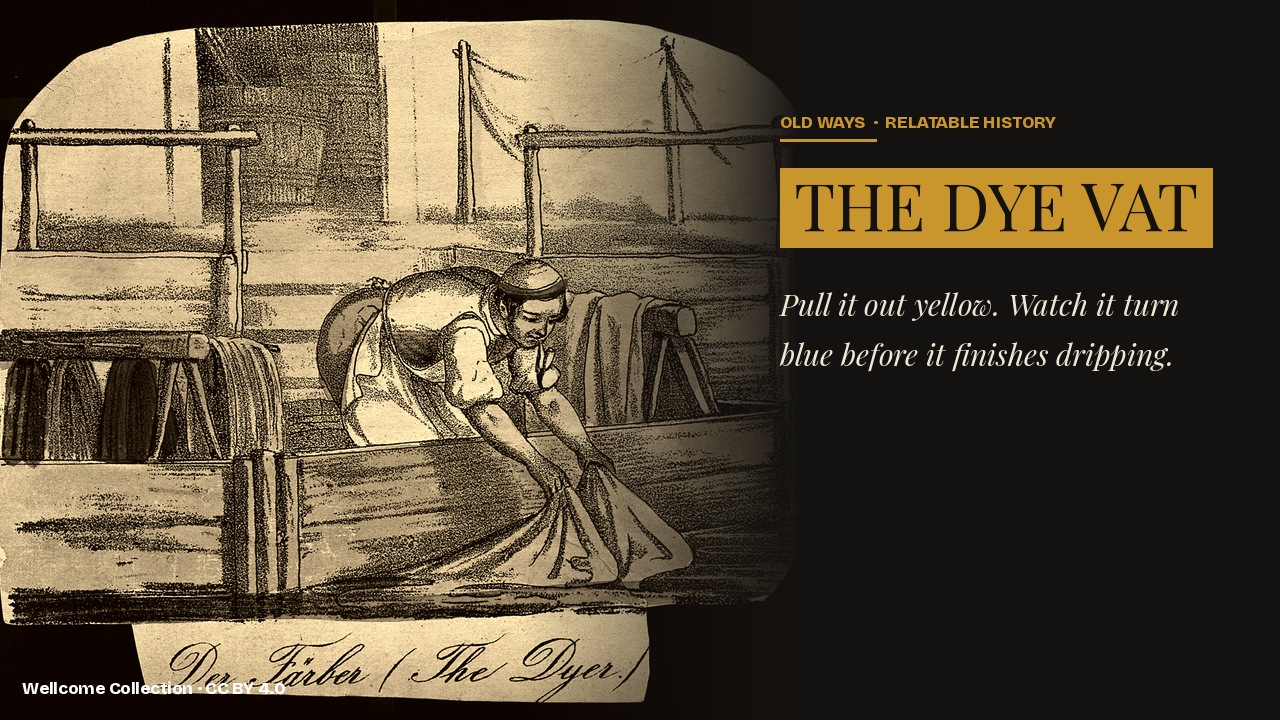
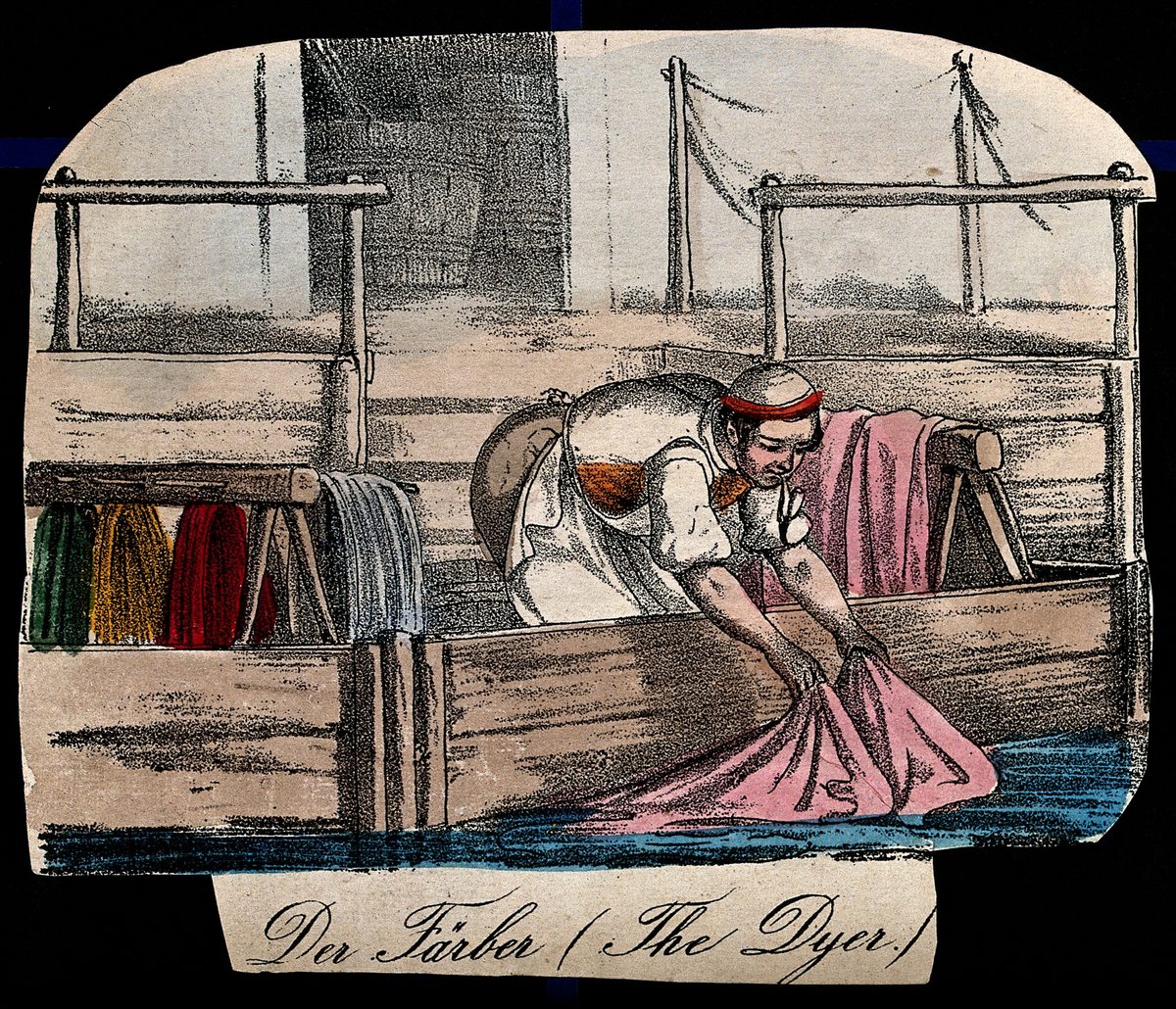
Pull a skein of wool out of an indigo vat and it is the wrong color. Not blue — a flat, swampy yellow-green, the color of dishwater, with none of the blue anyone was promised. Watch it for sixty seconds in the open air and it turns, visibly, into a deep, true blue. That one trick, repeated in sheds and kitchens across America for more than a century, is the reason indigo could ever work as a home dye at all.
Before synthetic dye arrived in a five-cent paper packet, color for homespun wool and linen came from whatever a household could grow, trade for, or ferment in a crock by the fire. This is how colonial Americans dyed cloth: not with a bottle of liquid color, but with a living, slow-fermenting vat that had to be fed, watched, and kept alive for months or years at a stretch, plus a shorter list of plant dyes that needed nothing more than boiling water and a mineral to lock the color in place.
The ingredients ranged from a plant grown as a cash crop on plantations worth a fortune in London, to insects imported by the ton from Mexico, to the hulls of a tree in the backyard. What they had in common was patience, a working knowledge of chemistry nobody called chemistry, and a result that had to survive years of washing, sun, and wear with no label to guarantee it.
What Went Into an American Dye Vat
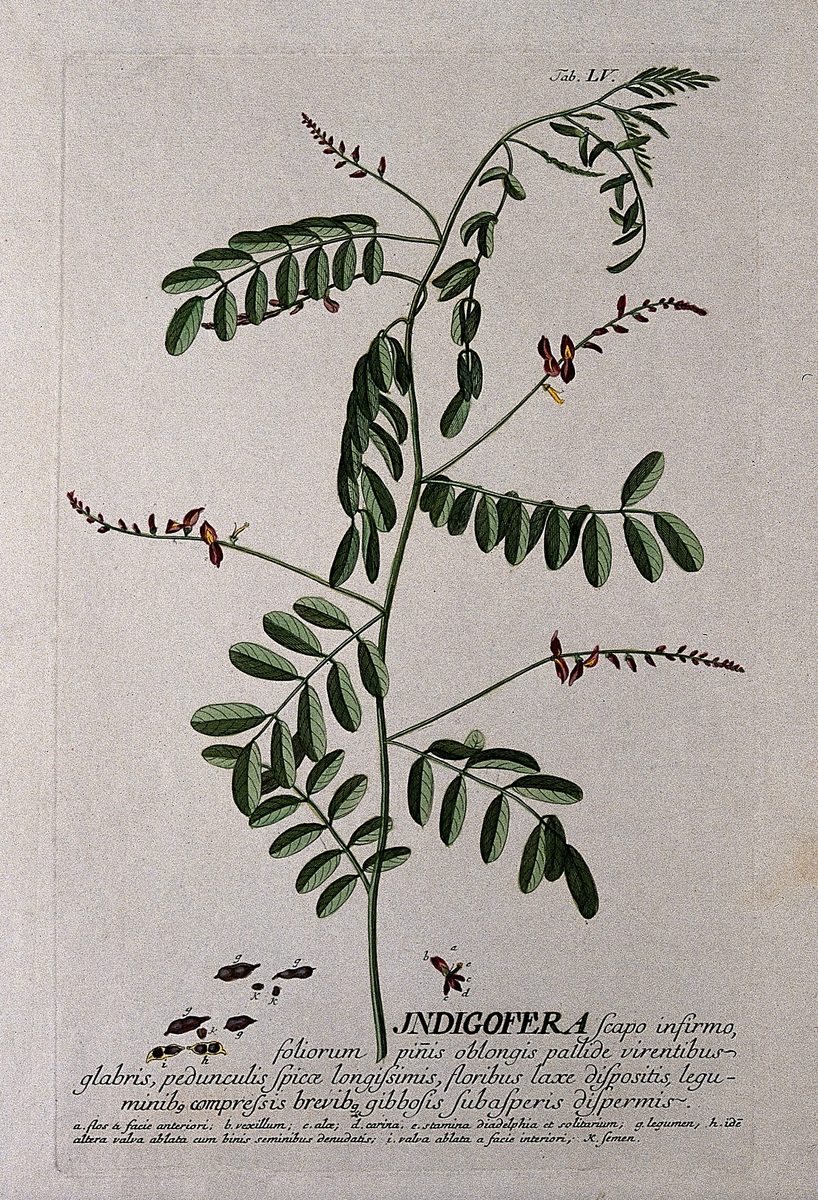
The grandest version was the indigo vat, built around dried cakes of blue-black pigment pressed from the indigo plant and shipped from export plantations. Most households, though, never touched a scrap of imported indigo and dyed just as reliably with whatever grew nearby. Black walnut hulls and butternut bark, boiled down, gave a rich brown. Onion skins, saved in a kitchen jar through the year, made a dependable gold with nothing more exotic than hot water. Sumac berries and oak galls, paired with a rusty nail or two, turned wool close to black. Madder root, imported but inexpensive, gave orange and red.
For a true scarlet, a household paid dearly: cochineal, a dried and ground insect imported from Mexico and Central America, where it lived on the pads of the prickly pear cactus. Spanish colonists built an industry around it almost as soon as Hernán Cortés reached Mexico in 1519 — by 1523 they were already developing a cochineal trade meant to rival Venice’s own red dyes — and by around 1570, cochineal red was effectively the only acceptable red for European royal and church vestments. For roughly three centuries, cochineal ranked behind only New World silver as a Spanish export, which says something about how far a single insect could travel to dye one American housewife’s best dress, assuming she could afford it at all.
Color alone wasn’t enough; it had to stick. A 1982 study for the Journal of the American Institute for Conservation tested the five mordants that had been standard practice for generations — alum, chrome, copper, iron, and tin — and found that alum and tin gave the brightest colors but faded roughly three times faster than the others, while iron, the mordant colonial households often called copperas, reliably pushed a dye bath toward brown. Chrome, common in professional dyeing today, wasn’t used by home dyers until the early 1800s. Indigo needed no mordant at all, which was part of its appeal: once it was in the fiber, it stayed.
How Colonial Americans Dyed Cloth Without Any Blue Dye in the House
Indigo, as a chemical, is almost useless on its own. In its natural state it won’t dissolve in water, which means it can’t soak into a fiber, which means it can’t dye anything. The entire trick of an indigo vat is forcing that insoluble blue pigment to become a different, soluble compound — stripping away its oxygen in a process dye chemists call reduction — and then letting the fiber pull that compound back out of the liquid.
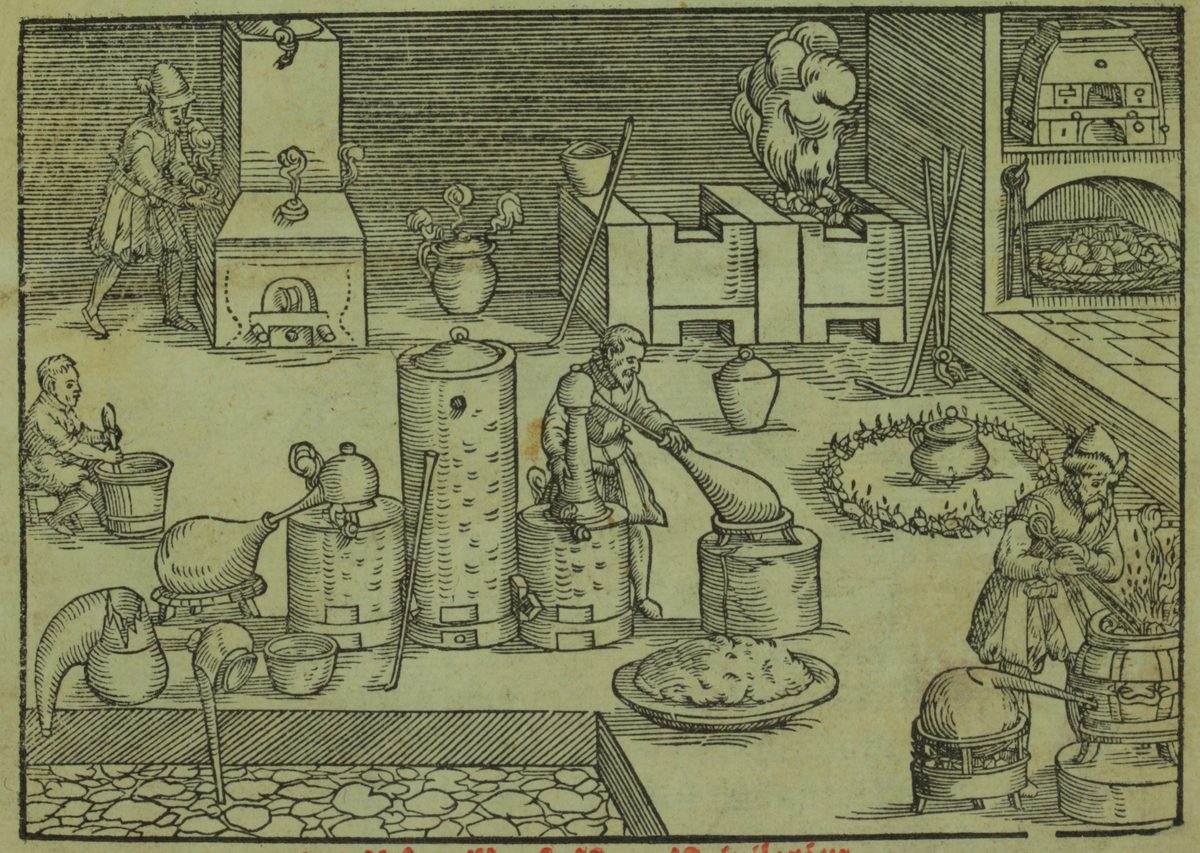
There were two ways to manage that reduction: quickly, with mineral chemicals, or slowly, by fermentation, which is the only option a colonial household had. Wood-ash lye made the water strongly alkaline; sometimes bran, sugar, or stale urine fed naturally occurring bacteria that did the actual reducing, working over three to ten days rather than minutes. A vat that was working showed it: a dark, coppery froth dyers called the “bloom” or the “flower” formed on the surface, and the smell told an experienced dyer everything she needed to know. A healthy vat announced itself as surely as a loaf of proofing bread.
Once a vat was “ripe,” the fiber went in yellow-green and came out yellow-green — that reduced form carries no real color beyond a murky tint. The blue only appears once the wet fiber meets open air: oxygen reacts with the compound sitting in the fibers and converts it back into true, insoluble indigo, visibly, in the time it takes to lift a skein out of the vat and hang it on a line. Dip it again, air it again, and the blue deepens — a pale “sky” blue after one or two dips, a near-black “navy” after six or eight.
The Cash Crop That Started the Whole Industry
America’s indigo trade has a specific starting point, and it runs through a woman barely out of her teens. Eliza Lucas had moved with her family to a plantation near Charleston, South Carolina, in 1738; by 1744, with help from a dye expert her father sent from Montserrat, she had grown enough indigo to begin producing usable dye cake and shipped a sample to England to test the market. It worked. Within a few years, South Carolina plantations exporting indigo to English dye houses — built on enslaved labor — had become one of the most profitable businesses in the colony.
The numbers escalate fast. By 1747, South Carolina was exporting 138,300 pounds of indigo dye a year, worth more than £16,800 sterling. By 1775, on the eve of the Revolution, that had grown to over 1.1 million pounds, worth roughly £242,000 — and indigo had become close to a third of everything the colony shipped to England. Eliza Lucas, who married into the Pinckney family and lived until 1793, is remembered today for a plant that very few ordinary American households ever actually touched, since almost all of that indigo went straight to export rather than into a neighbor’s dye vat. What home dyers used was usually a smaller, resold, or lower-grade cake trickling back through local trade — the plantation economy and the farmhouse vat ran on the same plant, but rarely the same supply chain.
Keeping a Vat Alive Was a Household Skill, Passed Down Like a Sourdough Starter
Dyeing wasn’t a weekly chore; it was seasonal, timed to when fiber was actually ready to color. Sheep were sheared in late spring, the wool carded and spun over the summer, and a household set aside a day or two in the fall — before the heavy sewing season — to dye everything it would need for the year at once. At Greenfield Village’s reconstructed 1760 Daggett Farmhouse, a modern demonstration of exactly this kind of household dye day prepares roughly fifty skeins at a time, each batch spending one to two hours in a copper pot over an open fire with a mineral mordant stirred in.
An indigo vat, once alive, was too valuable to dump after a single batch. Starting one from nothing could take a week or more of fermenting before it produced any usable blue at all, so an established household kept the same vat going for months, feeding it more lye and indigo whenever the bloom weakened — tended the way a baker keeps a sourdough starter alive rather than mixing a fresh one from scratch every time. A woman with a long-running, reliably ripe vat earned a quiet local reputation for it, and neighbors without one of their own simply waited their turn.
When a Dye Became a Political Label: Butternut and the Civil War
Of all the household dyes, only one ever became a slur, a slogan, and a uniform color at the same time. Butternut hulls, simmered in warm water, release a dark brown dye that colored wool, cotton, or flax a yellow-brown or brownish gray. By the early 1800s, “butternut” homespun was already strongly identified with poorer farm households in the Ohio River Valley — and when the Civil War began, the word traveled in two directions at once.
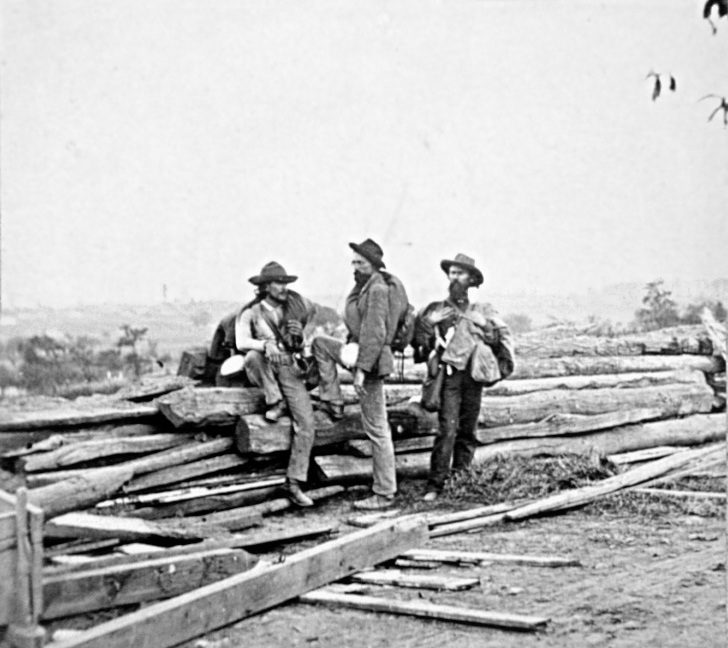
In the North, “Butternuts” became shorthand for Peace Democrats who opposed the war, led in Ohio by Clement Vallandigham, who argued against the Lincoln administration’s war measures in a notorious House speech on February 20, 1861, and again after the Emancipation Proclamation in 1863. The label stuck hard enough that, according to a report in the New York Times on August 18, 1863, soldiers of the 3rd Ohio Infantry tore off their own butternut-colored coats rather than be mistaken for Confederate sympathizers.
In the South, it was simply practical. The Confederacy’s supply lines for the deeper gray-blue dyes used in its official uniforms were never reliable, and by some accounts — including the Journal of the American Leather Chemists Association in 1915 — units in Tennessee and Kentucky in particular were issued “jeans” uniforms dyed with butternut bark rather than true “Confederate gray.” A period reference work, John S. Farmer’s Slang and Its Analogues (1890), later defined the term partly by this fact: western Confederate uniforms, it noted, were often “dyed brown with the juice of the Butternut” rather than any official dyestuff at all. The Smithsonian’s own catalog of the standard Confederate uniform lists “gray or butternut” as interchangeable options for the wool shell jacket — a dye bath from a backyard tree, worn into some of the costliest battles in American history.
The Chemist Who Ended the Home Dye Vat in a Single Easter Vacation
Nothing about fermentation vats, mordants, or imported insects survived contact with an eighteen-year-old chemistry student’s accident. In 1856, during his Easter break from London’s Royal College of Chemistry, William Henry Perkin was trying to synthesize quinine from coal-tar chemicals under his teacher, August Hofmann. He failed at that, but the sludge left behind in his flask dyed silk a vivid, stable purple unlike anything found in nature. He patented it, opened a dye factory at Greenford Green the next year, and had sold the business and retired by his mid-thirties — rich, and the accidental founder of the entire synthetic dye industry.
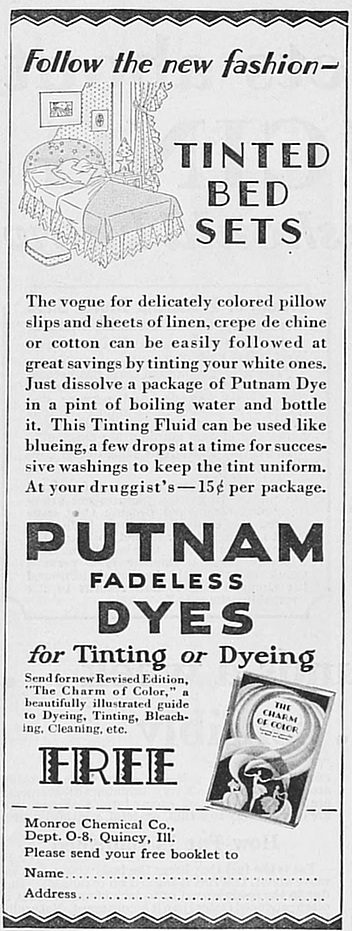
It took a few more decades for that chemistry to reach an American farmhouse in a form anyone could use without a laboratory. By the early 1880s, companies were selling stable, synthetic coal-tar dyes to households in cheap paper packets. A Diamond Dyes trade card from Wells, Richardson & Company, printed sometime between 1880 and 1890 and sold through a country retailer in upstate New York, is one small piece of the flood of inexpensive consumer goods that reached ordinary American households in exactly those years. A nickel packet promised an exact, repeatable color with no week-long ferment, no smell, and no risk of a vat dying overnight. Within a generation, keeping a live dye vat going in the kitchen went from ordinary housework to something only a grandmother still remembered how to do.
Watch the full history
The video version covers the same vat, the same chemistry trick, and the same century of American households keeping it alive, in just over nine minutes.

None of this — the fermentation, the mordants, the imported insects and plantation economics — was obscure specialist knowledge at the time. It was ordinary competence, held by millions of households who never wrote most of it down because everyone already knew it. That is usually how the most widely practiced skills in history disappear fastest: not through loss, but through replacement by something simpler that nobody felt the need to preserve the old way against.
What survives is mostly indirect — a color name like “butternut” still carrying its 1860s political charge, a shade of blue still called “indigo” by people who have never fermented a vat in their life, a trade card in a museum collection advertising the five-cent product that made the whole elaborate system obsolete. What’s growing near you right now that could dye a shirt?
Related reading
- The History of the Pie Funnel, From Plain Clay Tube to Ceramic Bird
- The Native American Craft Behind Every Farm Basket
- Why Christmas Nutcrackers Are Shaped Like Kings and Soldiers
- Drying Apples Before Refrigeration: How Farm Families Did It
Works cited
- National Park Service. “Eliza L. Pinckney.” Charles Pinckney National Historic Site. Link.
- Crews, Patricia Cox. “The Influence of Mordant on the Lightfastness of Yellow Natural Dyes.” Journal of the American Institute for Conservation 21, no. 2 (1982): 43–58. Link.
- The Weavers of the Colonial Williamsburg Foundation. “Preparing for Dye Days.” Colonial Williamsburg Foundation.
- Smithsonian Institution, National Museum of American History. “Confederate Uniform.” Link.
- Barnett, Tracy L. “Butternuts.” Civil War Monitor, Fall 2026. Link.
- Taylor, Jordan. “Dyeing Wool the Colonial Way.” The Henry Ford, November 11, 2014. Link.
- “Trade Card for Diamond Dyes Company, 1880-1890.” The Henry Ford, Object ID 89.0.541.413. Link.
- “William Henry Perkin.” Science History Institute. Link.
- Audinet, Karthika. “The Art and Science of Natural Indigo in South India.” In Blue Gold: The Art and Science of Indigo. Mingei International Museum, 2025. Link.
- Shoemaker, Peter BG. “Red All Over: How a Tiny Bug Changed the Way We See the World.” Humanities 36, no. 4 (July/August 2015). Link.