
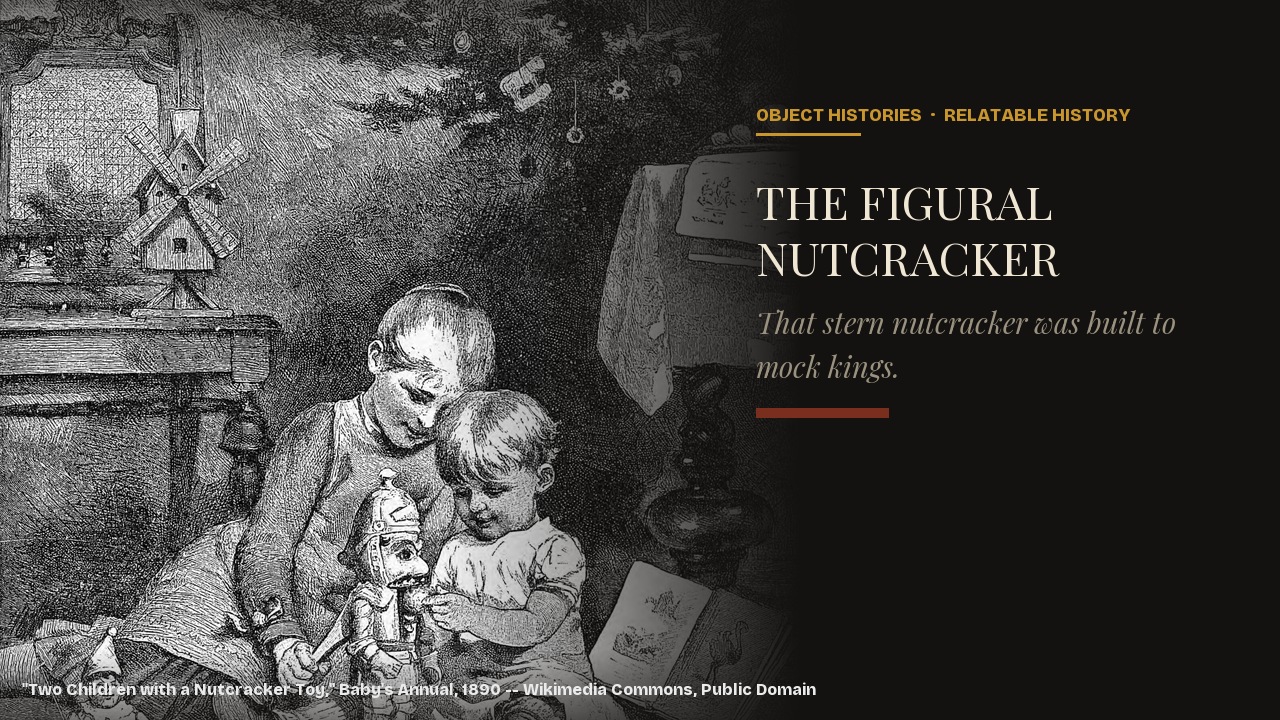
The wooden king glowering on your mantel this December was carved as an insult, and the insult still works: his entire function is to grind his jaw open and shut, over and over, cracking nuts for someone else’s amusement — exactly the kind of grinding, repetitive labor he would never have had to do himself. German toymakers built that joke into the shape of kings, soldiers and officials more than a century and a half ago, and it is still the shape nearly every nutcracker sold today takes, whether or not anyone buying one knows why.
The joke came out of real desperation. The toymakers who built the first figural nutcrackers were themselves descended from miners put out of work when the easy silver and tin ran out in Germany’s Ore Mountains, and the cottage craft they built to replace mining eventually produced one of the most recognizable objects in the world. The man usually credited with industrializing the design is recorded under at least three different given names across otherwise reliable sources — a small, telling sign of how patchy the record still is for an object this famous.
The bigger surprise is that the nutcracker’s other defining association, the Tchaikovsky ballet, grew up almost entirely apart from the toy, through a chain of adaptations involving two unrelated writers who happened to share a surname. The toy and the tale did not actually merge for decades, and didn’t reach America in force until a war and a near-flop of a ballet premiere both intervened. That tangle — a regional satire, two Hoffmanns, a Russian ballet and a postwar Christmas market — is the real story behind the figure on the mantel.
A mining bust in the Ore Mountains built an entire toy economy by accident
The Erzgebirge, the Ore Mountains straddling the Saxony-Bohemia border, had been mined for silver and tin since at least the twelfth century, with the richest years in the fifteenth and sixteenth centuries. By the seventeenth century the easily reached deposits were largely exhausted, and the region needed a new way to make a living. It found one in the spruce forests covering the slopes.
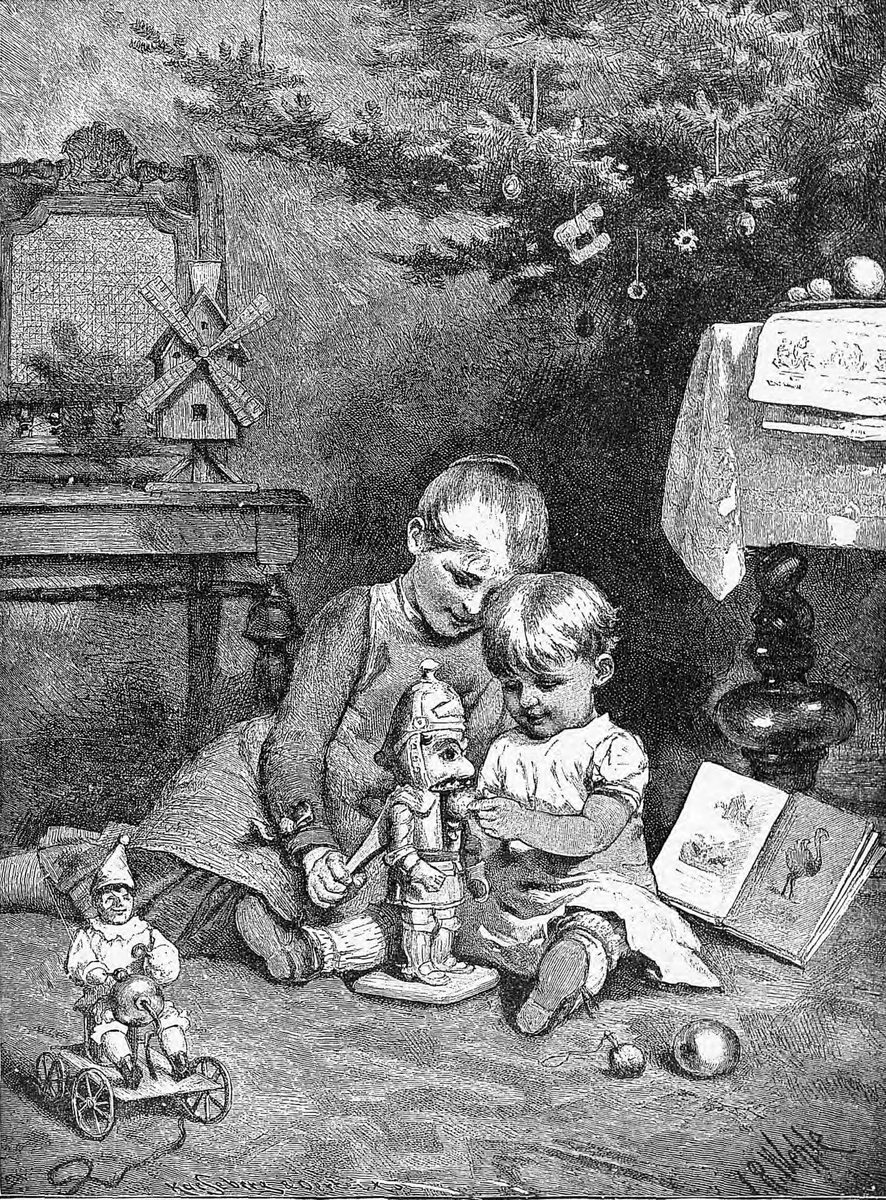
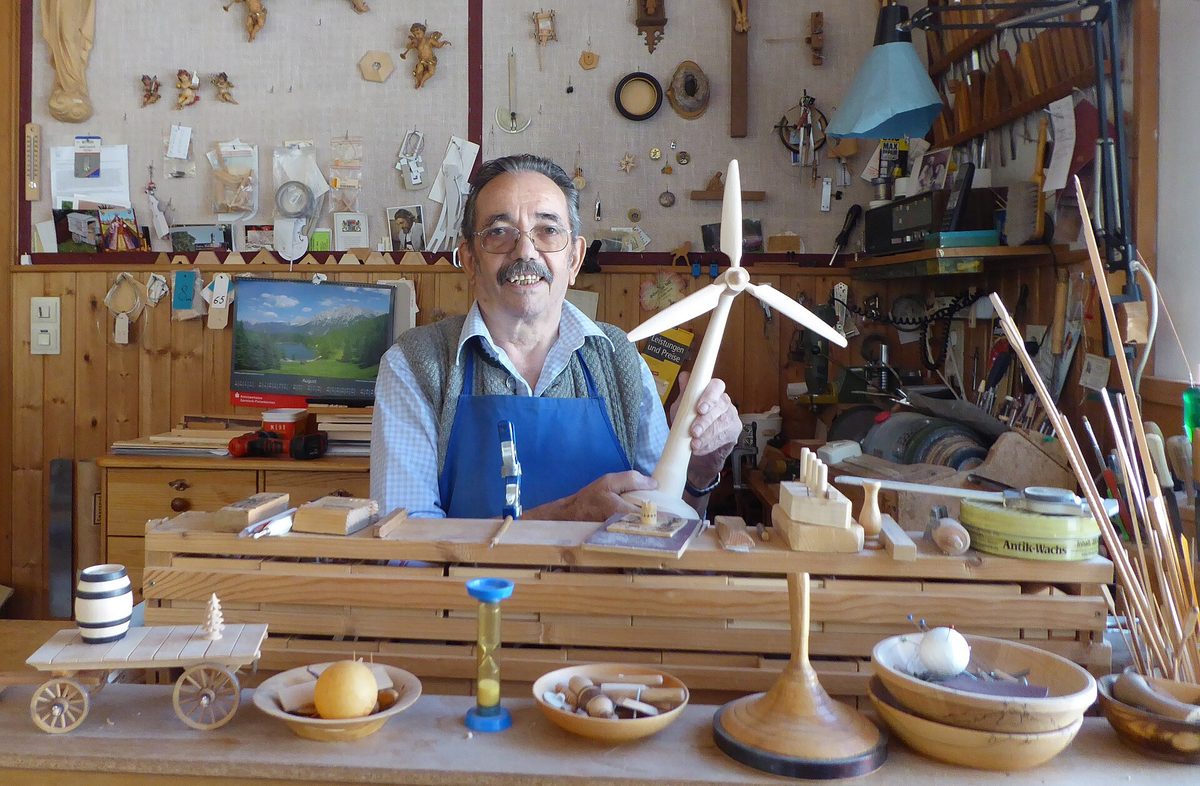
Miners, and especially miners disabled by the work, began carving and turning wood in their spare time to supplement what mining still paid — clothes pegs, buttons, spoons, whisks, plates, spindles, and small wooden models of the mines themselves, sold at markets and shown in schools for a fee. The trade grew steadily rather than suddenly: records count roughly twenty-three woodturners working around 1670 and about a hundred a century later. By 1868, toy production was recorded in forty-three separate villages. What had started as a side income for out-of-work miners shifted to commercial, full-time production by the mid-eighteenth century, and by the nineteenth, wood processing was the region’s main livelihood, not a supplement to one.
It stayed a genuine cottage industry long after it became the main trade. In Seiffen, the village most associated with the craft today, whole families worked fourteen to eighteen hours a day on piecework, and middlemen who sold the finished toys onward kept the prices paid to the makers low. The nutcracker, when it eventually arrived, was a late addition to a toy economy that had already been running for more than a century.

The toy was designed to put the ruling class to work
Out of that world came a very specific kind of object. If you are going to carve a figure whose entire purpose is manual labor — clamping down, grinding, working its jaw until something breaks open — why not give it the face of someone who never had to do manual labor? Seiffen’s toymakers built kings. They built soldiers, foresters, firefighters, cavalry officers, and night watchmen, every one of them dressed in the trappings of status and stuck doing the same grinding, undignified job forever: cracking nuts, one at a time, for whoever happened to own them.
Local folklore supplies an origin story for the hinged jaw itself — a poor farmer offering a reward for a device that could crack his walnuts, a puppet maker and a tailor and a blacksmith all failing before a soldier gets it right with a simple lever. It is a good story and it is undocumented: no contemporary source ties it to a date, a place, or a real soldier. What is documented is the economics underneath it — miners’ families who had genuinely done the grinding work, carving the people who hadn’t.
The craftsman credited with the standard design is recorded under three different names
For decades the figural nutcracker was one folk-toy tradition among several coming out of the Erzgebirge, alongside incense-smoking figures and wooden pyramids. The shift from folk curiosity to a recognizable, mass-produced design is usually credited to a single Seiffen workshop, beginning around 1870. A museum record from the Mindener Museum dates the first turned and painted nutcrackers of this kind to a workshop run by a man it names Friedrich Wilhelm Füchtner. The German Christmas trade press, in a 2019 interview with one of his living descendants, names the ancestor Gotthelf Friedrich Füchtner. A regional newspaper profile from the same Seiffen workshop, in 2021, calls him simply Wilhelm Füchtner and dates the first nutcracker to around 1870 as well, describing him as a carpenter who needed income in the winter months when construction work stopped. Three sources, three versions of his given names, the same surname, the same town, and roughly the same decade.
What the sources agree on is the design itself: a king figure with a clear, repeatable silhouette, alongside soldier, miner, forester, firefighter, cuirassier and night-watchman variants, turned on a simple lathe rather than carved freehand piece by piece. That repeatability was the actual innovation. It let one workshop produce consistent figures fast enough to sell at a regional scale, and the basic body — oversized head, wide hinged mouth, lever at the back — is still what most people picture when they hear the word nutcracker. The family’s Seiffen workshop is still making nutcrackers six generations later. In 2016, a great-great-grandson, Markus Füchtner, built a single miniature travel nutcracker, named it Wilhelm after the founding ancestor, and sent it around the world with a friend; it has since visited roughly forty countries, met a cosmonaut, ridden with the German Olympic bobsled team, and been unofficially adopted as an ambassador for the whole region. It is not for sale and no copies have been made.
Two unrelated writers named Hoffmann each put a king nutcracker at the center of a story
The toy’s redesign around 1870 was not made up from nothing. According to the Mindener Museum’s own record, Füchtner modeled his king on a specific illustrated children’s book: König Nußknacker und der arme Reinhold (King Nutcracker and Poor Reinhold), published in 1851 by Heinrich Hoffmann — the same Heinrich Hoffmann who wrote the much darker cautionary-tale classic Struwwelpeter. An English translation, by the playwright James Robinson Planché, survives today in the Metropolitan Museum of Art’s collection.
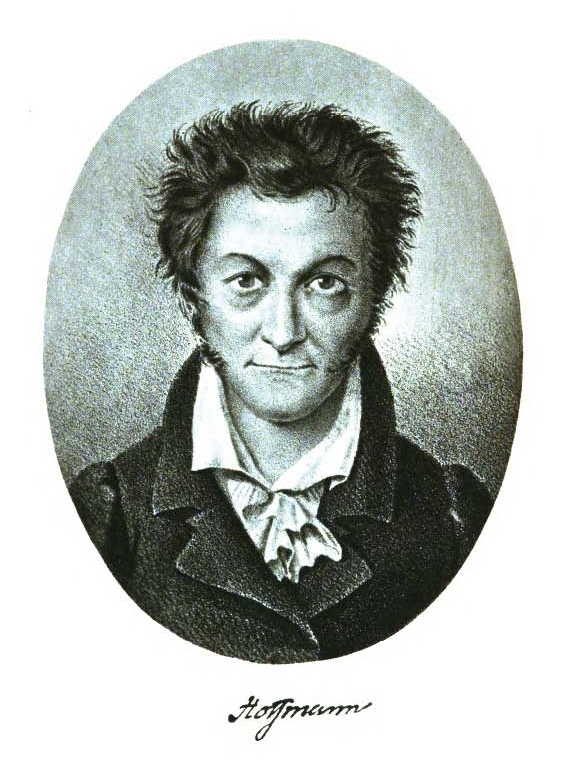
That is a different book by a different Hoffmann than the one most people assume is behind the nutcracker. Thirty-five years earlier, in 1816, the writer E.T.A. Hoffmann — no relation — had published The Nutcracker and the Mouse King, a dark, strange fairy tale about a girl’s Christmas gift coming to life to fight a seven-headed mouse king. E.T.A. Hoffmann’s story has nothing to do with Saxon miners, satire, or any of the toy’s actual design history; it is literary fantasy, written in Berlin, decades before Füchtner’s workshop existed. Two Hoffmanns, two separate king-nutcracker stories, thirty-five years apart, and the toy industry quietly drew on the obscurer one.
The toy, the tale and the ballet took a century to merge, and a war to cross the Atlantic
E.T.A. Hoffmann’s original tale was grotesque enough that it needed softening before it could become a Christmas staple. In 1844, Alexandre Dumas père published a gentler French retelling, keeping the heroine’s basic story but trimming the horror and adding warmth. It was Dumas’s version, not either Hoffmann’s, that choreographer Marius Petipa and composer Pyotr Tchaikovsky adapted into a ballet for the Imperial Mariinsky Theatre in St. Petersburg, premiering in 1892. By most accounts the premiere landed flat: critics found the child-centered plot thin and the dancing underwhelming next to Tchaikovsky’s score. It took later productions, built around the ballet’s transformations and visual spectacle rather than its story, for audiences to come around.

Even so, the carved Erzgebirge toy and the Russian ballet stayed on separate continents for another half-century. What finally moved the object itself into American homes was the Second World War: American soldiers stationed in occupied Germany encountered Saxon-style nutcrackers while shopping in German Christmas markets, and a market for them in the United States began to take shape in the years that followed. The decisive push, though, came from the ballet. George Balanchine, who had watched the Mariinsky’s production as a child in St. Petersburg, staged his own version for the New York City Ballet in 1954. The production was reportedly controversial inside the company before it opened; once it did, with Maria Tallchief as the Sugar Plum Fairy, it became an annual sensation credited with helping keep the financially struggling company afloat. Audiences who had just watched a wooden soldier come to life on stage went looking for one of their own to put under the tree, and the German workshops obliged. The Nutcracker is now so central to American ballet’s finances that, by one industry estimate, ticket sales for the production account for nearly half of the average company’s annual season revenue.
Watch the full history
The long-form video covers the Ore Mountains economy, the Füchtner workshop and the ballet’s rocky start in just over six minutes.

Related reading
- How to Store Root Vegetables All Winter Without a Cellar — a related piece of craft and object history
- Drying Apples Before Refrigeration: How Farm Families Did It — another household craft built around the materials a region actually had
- Why the Dorabella Cipher Remains Unsolved — a related piece of craft and object history
- Why Waffles Have a Grid Pattern (It’s Not About the Syrup) — another everyday object whose shape turns out to have a documented reason
Production in the Erzgebirge never stopped, and the design Füchtner’s workshop settled on — whatever his exact name — has barely changed in a hundred and fifty years. In April 2024, Saxony’s state government formally nominated the whole regional craft, nutcrackers included, for Germany’s federal register of intangible cultural heritage, with a decision expected the following year; the bid describes a Christmas without these carved figures as unthinkable in the region that invented them.
Which means the king on your mantel this year is a direct descendant of a joke that out-of-work miners’ families started telling with a lathe, more than a century and a half ago, at the expense of people who never had to grind anything themselves. He crossed an ocean on the strength of a near-flop ballet and a soldier’s souvenir shopping, not because anyone planned it that way. Would you want the king cracking your nuts, or the soldier?
Works cited
- Braukmüller, Heide. “Vom Bergmann zum Spielzeugmacher” [From Miner to Toymaker]. Der Anschnitt 51, no. 5–6 (1999). Deutsches Bergbau-Museum Bochum. Link.
- Mindener Museum. Nussknacker [nutcracker, carved wood, c.1920], Objekt im Fokus, inv. 4 B 11.74. museum-digital. Link.
- Schimke, Robert. “Kunsthandwerk-Klassiker in Miniaturausgabe: Die Geschichte des wohl meistgereisten Nussknackers der Welt.” Deutsche Handwerks Zeitung, November 8, 2019. Link.
- Pachmann, Ina. “Nussknacker und Schwibbögen: Seiffen, das Erzgebirge von seiner schönsten Seite.” Berliner Zeitung, December 9, 2021. Link.
- Hoffmann, Heinrich. König Nußknacker und der arme Reinhold. Leipzig: Friedrich Volckmar, 1851.
- The Metropolitan Museum of Art. King Nut-Cracker; Or, The Dream of Poor Reinhold. Translated by James Robinson Planché. Object no. 1984.1030.
- Blakemore, Erin. “The Nutcracker Was a Flop. So How Did It Come to Save American Ballet?” National Geographic, December 5, 2024. Link.
- Gattignolo, Meghan. “Deep Dive into Culture: Nutcrackers.” Customs House Museum & Cultural Center, December 22, 2021. Link.
- Sächsische Staatsregierung. Press release: Saxony nominates “Kunsthandwerk aus dem Erzgebirge” for Germany’s Federal Register of Intangible Cultural Heritage, April 12, 2024. Link.
- Leavenworth Nutcracker Museum. “Collection.” nutcrackermuseum.com. Link.