
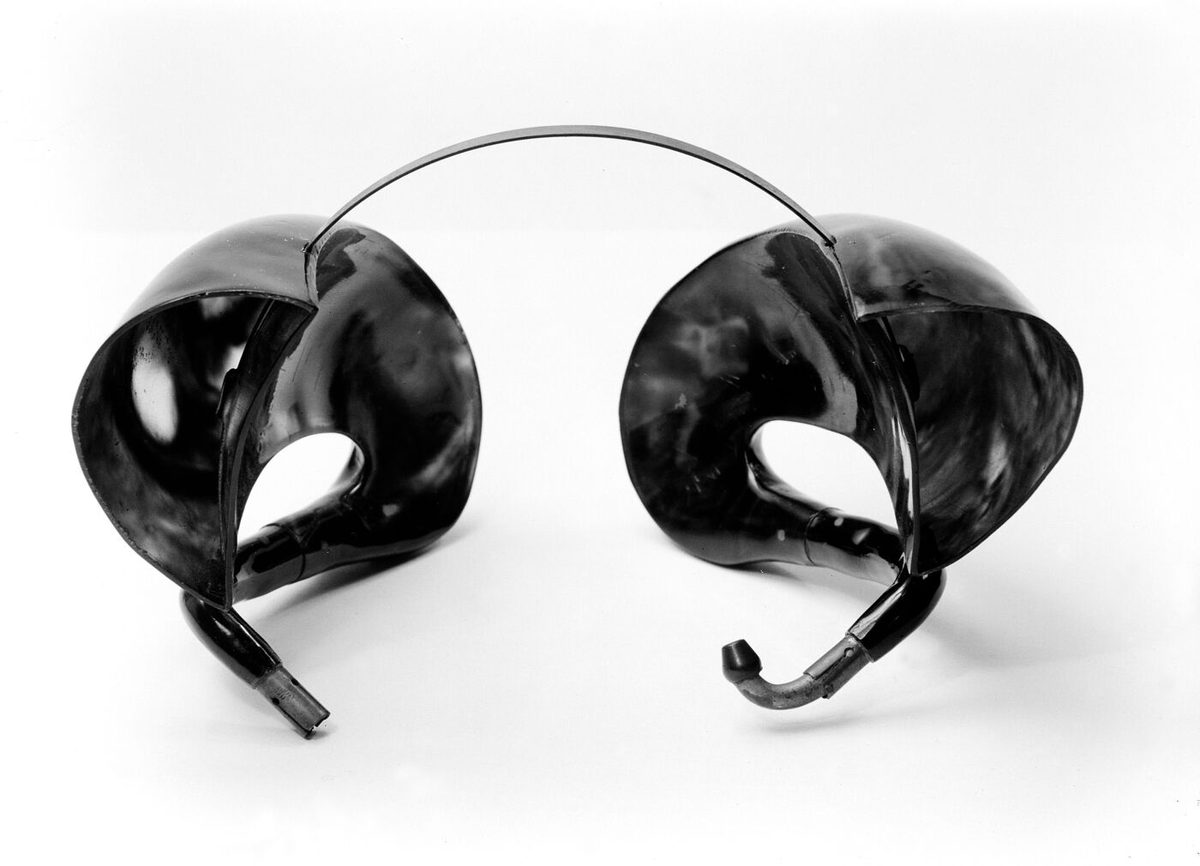
In 2003 a team at the Central Institute for the Deaf in St Louis put a two-hundred-year-old hearing aid on an artificial head in an anechoic chamber and measured what it actually did. The device was an Aurolese Phone, a painted metal flower on a headband made by F. C. Rein of London around 1802, with a hollow stem that curled into the wearer’s ear. Across the frequencies that matter for speech it made sounds 3.5 decibels louder. That is roughly what you get by cupping a hand behind your ear.
That number is the honest starting point for understanding how ear trumpets worked, because it cuts both ways. A full-sized trumpet did far better than the flower, and a good one was worth every shilling to someone losing their hearing. But the same industry that knew bigger was louder spent a century making trumpets smaller, prettier and harder to see, and its customers paid handsomely for the trade-off. What follows is the physics, the London trade, the disguises, the one famous user whose trumpets survive, and the telephone technology that finally made the brass redundant.
A cupped hand was the first ear trumpet, and it never stopped being the benchmark
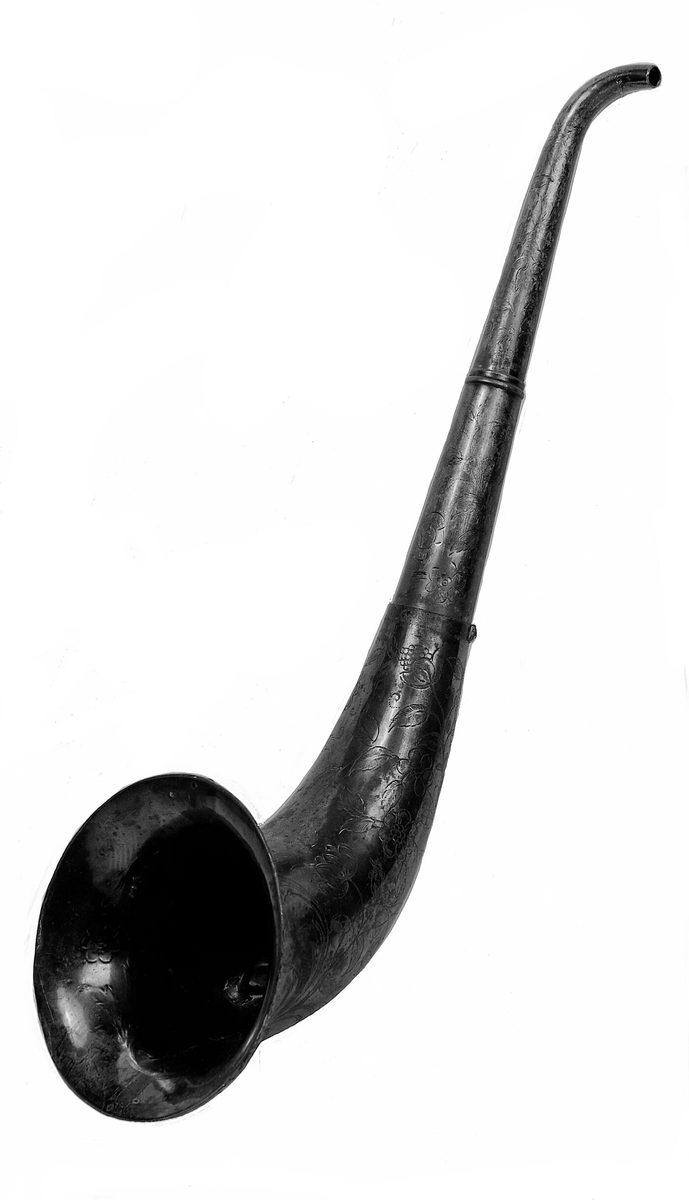
Every acoustic hearing aid before electricity did one thing: it gathered sound over a larger area than the ear and funnelled it into the ear canal. The idea is old. The design historian Magdalena Zdrodowska traces funnel-shaped “artificial ears” through Leonardo da Vinci in 1493 and Giambattista della Porta in 1558, both aimed at hearing people who wanted to listen at a distance; by 1624 a French writer was describing silver and copper funnels that gentlemen held to their ears.
The theory arrived with Athanasius Kircher, the Jesuit polymath born in Geisa in 1608 who spent most of his life in Rome. His Musurgia Universalis of 1650 described a “tuba stentorophonica”, a horn for throwing the voice, and his Phonurgia Nova of 1673 set out the principle every trumpet maker afterwards relied on: sound is amplified when it is reflected. That is why trumpets were made of metal that could be burnished smooth inside, and why the curled-shell shape that echoes a ram’s horn stayed popular for two centuries. The sound bounces its way down a narrowing tube and arrives concentrated.
How much it arrives concentrated depends almost entirely on size. Zdrodowska cites a 1984 audiology survey that found a six-metre trumpet could add 40 decibels; the trumpets people actually carried managed 15 to 25, against the 10 to 15 that a cupped hand provides. Those figures put the flower headband’s 3.5 in perspective. A good London trumpet did real work. A pretty one, often, did not.
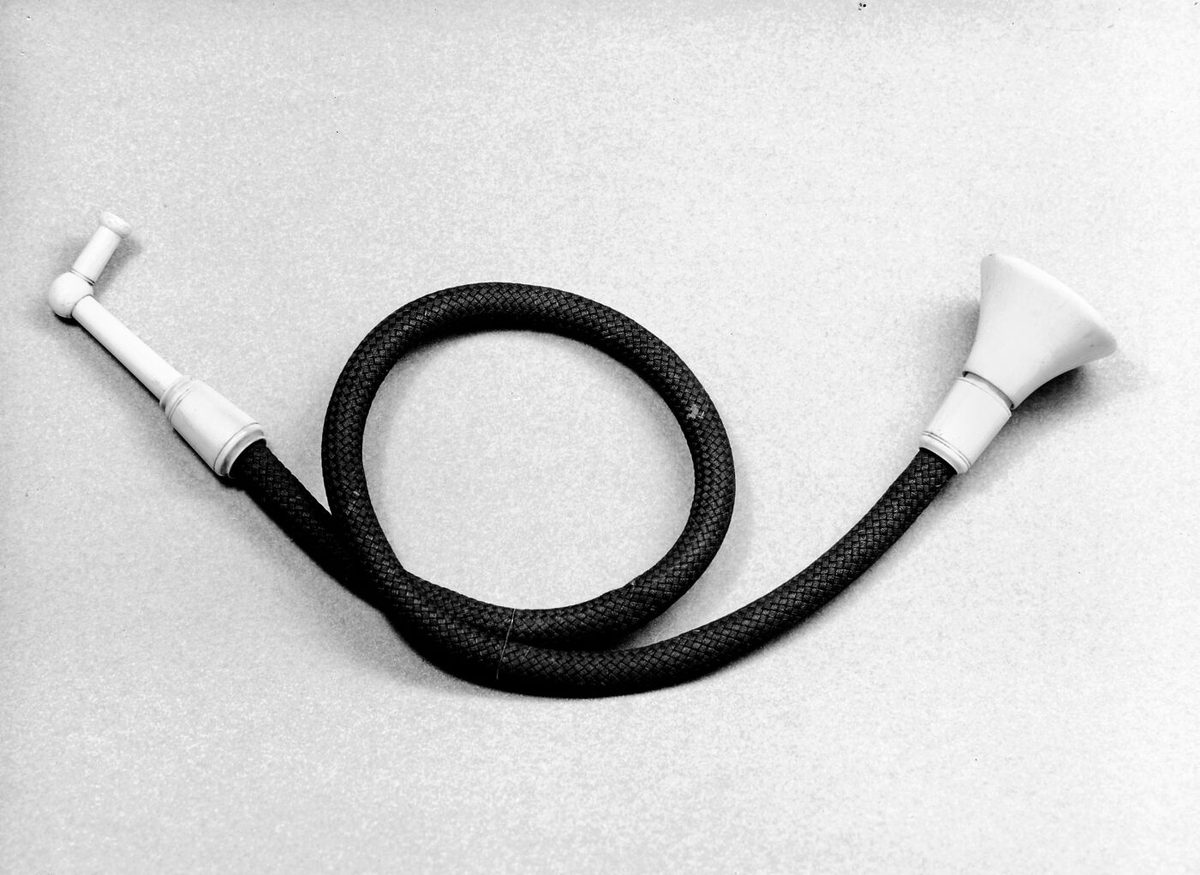
The most effective device in the whole catalogue was also the least glamorous. The conversation tube was a flexible hose with a mouthpiece at one end and an earpiece at the other; the speaker talked into one cone and the listener held the other to the ear. It added only about 15 decibels, but because the speaker’s voice went straight down the pipe it arrived without the room noise, and a 1900 catalogue called it the most powerful instrument for the very deaf. The Wellcome Collection’s catalogue note for its example explains the appeal in one phrase: it removed the need for the speaker to come close.
How ear trumpets worked as a business: 108 Strand and the “Paradise for the Deaf”
The Science Museum Group’s record for the firm is short and definite. Established in 1800 by Frederic C. Rein, originally at 108 Strand, London: the earliest firm known to manufacture hearing aids on a commercial basis. It made ear trumpets, acoustic urns and speaking tubes for churches, and it stayed in business until 1963, which means the company outlived the object it was founded to sell by several decades. A portable telescopic trumpet in the Wellcome collection carries the full boast engraved on the barrel: sole inventors and only makers, no. 108, Strand.
Rein’s London showroom was known as the “Paradise for the Deaf”, and wealthy customers went there to try instruments in person. In 1910 the proprietor told the deaf writer Evan Yellon that hundreds of orders came by post, and that the firm would try to fit customers abroad from written particulars, but that fitting really needed the customer in the room. Prices ran from a few shillings for a plain trumpet to three, five, ten or fifteen guineas for the powerful tubes. A guinea was twenty-one shillings, so the top of that range was a serious sum for a household to spend on one ear.
The trade Rein started filled up with rivals. Thomas Hawksley of London published a whole Catalogue of Otoacoustical Instruments to Aid the Deaf, and the general surgical-instrument makers carried trumpets by the page. Zdrodowska’s reading of those catalogues shows the same designs sold at every price: silver and gold plate for the carriage trade, then tin, nickel, copper and brass versions of the identical shape for the aspiring clerk. The famous “London dome” form, a rounded bell on a short curved neck, often carried the engraved flower-and-plant motifs that were Rein’s trademark, and the dearest trumpets were closed with a decorative lattice over the mouth that did nothing for the acoustics and everything for the look.
None of this was regulated. Trumpets were not treated as medical devices, no instrument existed to measure how much a given horn amplified, and the customer diagnosed their own deafness and picked a remedy from a catalogue. The makers could only describe one model as more “powerful” than another and note that a wider mouth meant more sound. It was true, and it was all the guidance a buyer had.
Hiding the trumpet cost decibels, and buyers paid for it anyway
The 2003 St Louis study that measured the flower headband was really a survey of camouflage. Its authors, led by the librarian Cathy Sarli, combed museum and trade catalogues for nineteenth-century hearing devices built to be concealed and found them hidden inside fans, parasols, lorgnettes, water canteens, walking sticks, hats, books and chairs, and worn on the body as artificial ear-shells, bouquet holders, and receivers tucked into hair and beards. The collection they drew on, now at the Becker Medical Library, holds more than four hundred devices going back to 1796.
The Science Museum in London displays the neatest example of the genre. A pair of miniature Rein trumpets in gilt brass with ivory earpieces, made some time between 1805 and 1900, was designed to sit around the ears and disappear under a woman’s hair. Each one is 69 millimetres long and weighs twenty grams, and the pair came in a velvet-lined leatherette box. The museum describes them as a variation on the “bugle” form devised by the French ear specialist Jean Pierre Bonnafont, who thought the trumpets of his day cumbersome. The fix was to make them so small they could hardly work.
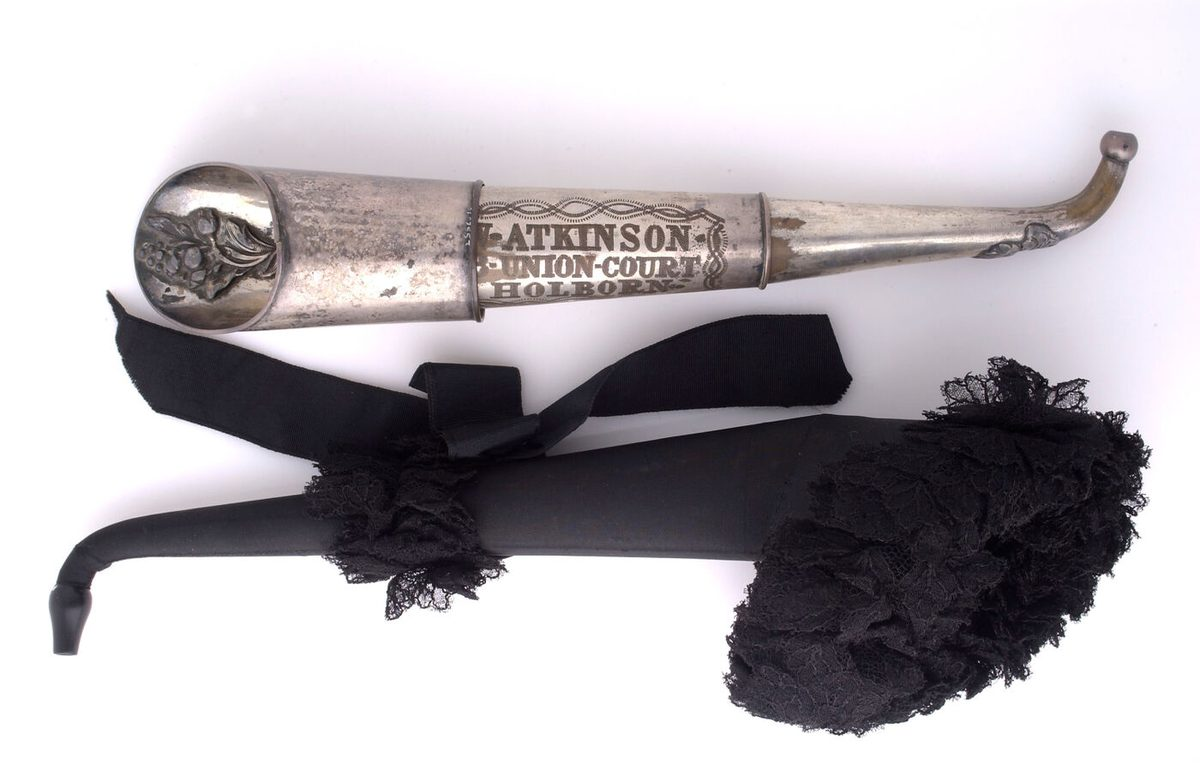
Men had their own version: a U-shaped sound channel that sat under the chin with its open side facing the speaker, the narrow ends in both ears and the whole thing covered by a beard. Walking sticks carried a small trumpet in the handle, to be pressed to the ear when needed. Some ladies’ fans only pretended to be fans. And the “mourning trumpet”, wrapped in black silk, lace and ribbon to blend with widow’s dress, could go a step too far: Zdrodowska describes one in the Thackray Museum in Leeds whose bell was so completely covered in fabric, to stop the metal glinting and giving the game away, that it could not amplify anything at all. An expensive dummy, bought and carried by someone who needed the real thing.
Why would anyone do that? Zdrodowska’s answer is that in polite society the visible trumpet announced a condition that was otherwise invisible, and that in a culture built on smooth conversation the deaf were expected to manage the awkwardness on everyone else’s behalf. A glass eye could pass as an eye. A trumpet could never pass as an ear, so it had to pass as something else. The cheap end of the market went further still, selling one-centimetre “ear tubes” and artificial eardrums that fitted entirely inside the ear canal. In 1919 The Volta Review warned that the five-dollar pairs were not worth five cents as cures and could wreck what hearing remained.
The acoustic chair put the listener on a throne and the speaker on their knees
The most theatrical solution belongs to a king. In 1819 an acoustic chair was made for John VI of Portugal and Brazil, who was hard of hearing. The arms ended in carved lions’ heads with open mouths; a visitor who wished to address the king knelt and spoke into a lion, and the sound was carried to a tube at the back of the chair that ended at the royal ear. Nobody had to raise a horn to the sovereign’s head, and the etiquette of kneeling covered the mechanism entirely.
The Museum of Liverpool owns a gilded recreation of that chair. For years it sat in the window of the Liverpool Hearing Centre on Bold Street, and in 2017 it was donated to the museum. The chair is usually attributed to Rein’s workshop; the museum’s own record for the recreation names no maker, so treat the attribution as trade tradition rather than paperwork. Either way it was not unique. Sarli’s survey lists chairs and thrones as a category, with sound carried through the armrests to a discreet earpiece, which is exactly the trick in the armchair the video describes.
Beethoven’s four trumpets, and the notebooks that replaced them
The best-documented user of ear trumpets is Ludwig van Beethoven, and the documentation is unusually good because the trumpets themselves survive. The Beethoven-Haus in Bonn records that as his hearing worsened he turned to Johann Nepomuk Mälzel, the Viennese mechanic and inventor born in 1772, with whom he was in close contact around 1812 and 1813. Mälzel produced several trumpets in different shapes, some of them meant to be fixed to the head with a metal circlet so the composer’s hands were free. Four are in Bonn today; a fifth belongs to the Society of Friends of Music in Vienna.
Beethoven’s own verdict wobbled. In 1814 he told his lawyer the trumpets were useless, but letters over the following years show him using them and even specifying that one needed different trumpets for music, for speech and for halls of different sizes, which is a fair summary of what the physics allows. Mälzel also gave him the metronome, which Beethoven was the first major composer to use.
From 1818 the trumpets were no longer enough. Beethoven began carrying blank notebooks in which visitors wrote their side of a conversation while he answered aloud. After his death in 1827 his secretary Anton Schindler took the books, doctored and destroyed entries to flatter himself and the composer, and in 1846 sold the 137 that remained to the Royal Library in Berlin. The conversation books, not the horns, are how we know what people said to Beethoven in his last decade.
The telephone did what brass could not
A trumpet can only collect sound. It cannot make more of it. Adding energy to a signal needed electricity, and the parts arrived from the telephone industry. Miller Reese Hutchison, an Alabama engineering student who had studied ear anatomy to help a deaf childhood friend, patented an electrical hearing device in the 1890s and in 1898 began selling it as the Akouphone through a company in Mobile, at four hundred dollars each. It borrowed its parts from the telephone, and it was a long way from portable.
His more portable Acousticon, patented in 1902, made the technology famous. Queen Alexandra, consort of Edward VII, said it restored ninety per cent of her hearing, had Hutchison fit her personally, and invited him to the coronation that year. The device went on show at the St Louis World’s Fair in 1904, and Thomas Edison, who later hired Hutchison, wore one at his wife’s insistence. The same decade’s obsession with capturing sound, the era of the wax cylinder, had produced the means to boost it.
The Computer History Museum’s curator David Brock summarises what happened next. The first electric aids were conspicuous and users wanted them smaller, so hearing-aid makers, alongside radio makers, became the hungriest customers for smaller vacuum tubes. Wartime demand shrank the tubes further and matured printed circuits. Then, at the end of the 1940s, came the transistor, and its earliest commercial use of all was in hearing aids. Rein & Son, still trading in London, closed in 1963, by which time the transistor hearing aid was ordinary.
What the trumpet tells you
The ear trumpet is a device whose engineering was solved early and whose problem was never engineering. Kircher had the principle in 1673. By 1800 a London firm could sell you a horn that added twenty decibels and would still work today. Everything the next century did to it, the flowers and lattices, the gilt miniatures under the hair, the beard channel, the silk-wrapped dummy, the lion on the arm of a throne, was an attempt to solve the other problem: that using it told the world something the user would rather it did not know.
That is why the 3.5-decibel flower matters more than its number suggests. Somebody chose it over a horn that would have let them hear, and they were not foolish. They were doing what the room required. The transistor did not end that calculation; it only made the hiding easier.
So the question from the video stands. Would you have hidden yours in a hairbrush, or worn it loud and proud?
Watch the full history
The eight-minute video follows the object from cupped hands and seashells to the armchair, and on to the first battery-powered aids.

Related reading
- The Shofar and the Western Wall Ban — the other horn in this series, and the one that was never meant to be quiet.
- The Wax Cylinder Phonograph — what the telephone generation did with sound once it could be captured as well as funnelled.
- The Glass Eye — the Victorian prosthesis built to be invisible, for the same reasons the trumpet was hidden.
- Wooden Dentures — another body part the nineteenth century tried to replace with craftsmanship.
- Smelling Salts — the other small object a Victorian lady kept close and hoped nobody noticed.
Shop the items in this history
- Hearing Happiness: Deafness Cures in History, by Jaipreet Virdi
- When the Mind Hears: A History of the Deaf, by Harlan Lane
- Beethoven: The Complete Symphonies
Works cited
- Sarli, Cathy C., Rosalie M. Uchanski, Arnold Heidbreder, Kimberly Readmond, and Brent Spehar. “19th-Century Camouflaged Mechanical Hearing Devices.” Otology & Neurotology 24, no. 4 (July 2003): 691–698.
- Zdrodowska, Magdalena. “‘Thrice Precious Tube!’: Negotiating the Visibility and Efficiency of Early Hearing Aids.” Journal of Design History 36, no. 4 (December 2023): 323–340.
- Bush, Sarah. “A Headband That Could Help You Hear: The Aurolese Phone.” Bernard Becker Medical Library, Washington University School of Medicine, 22 November 2022. Link.
- Sarli, Cathy. “Deafness in Disguise: 19th and 20th Century Concealed Hearing Devices.” D-Lib Magazine 12, no. 9 (September 2006). doi:10.1045/september2006-featured.collection. Link.
- Science Museum Group. “FC Rein and Son, 1800–1963.” Science Museum Group Collection Online, people record cp71592. Link.
- Science Museum Group. “Miniature Ear Trumpets.” Object A139040, Sir Henry Wellcome’s Museum Collection. Science Museum Group Collection Online. Link.
- National Museums Liverpool. “Amplifon Acoustic Chair.” Object MOL.2017.50, Museum of Liverpool. Link.
- Beethoven-Haus Bonn. “Beethovens mittelgroßes Hörrohr, gefertigt von Johann Nepomuk Maelzel, 1813.” Digital Archives, object R 2 c. Link.
- Beethoven-Haus Bonn. “Conversation Books.” Digital Archives glossary. Link.
- Rodriguez, Victor. “Miller Reese Hutchison.” Encyclopedia of Alabama. Alabama Humanities Alliance and Auburn University, 31 March 2026. Link.
- Brock, David C. “Amplifying History.” Computer History Museum, CHM Blog, 6 March 2024. Link.
- Tronchin, Lamberto. “The ‘Phonurgia Nova’ of Athanasius Kircher: The Marvellous Sound World of 17th Century.” University of Bologna; conference paper, hosted by the Agosto Foundation. Link.