
Thomas Jefferson once treated a cold New York nursery’s entire stock of maple trees as a weapon against slavery. In November 1791 he bought all sixty sugar maples a Long Island grower named Prince had for sale and shipped them to Monticello, where enslaved laborers dug the holes and set them in a grove below the house. Jefferson was not planting shade. He had joined a campaign, led by the physician and abolitionist Benjamin Rush, to make American maple sugar a substitute for cane sugar grown by enslaved people in the Caribbean, on the theory that a sweetener requiring only “the labour of children” would starve the market that made slavery profitable.
Almost none of the sixty trees lived. The real history of maple sugaring runs mostly through people Jefferson never credited: the Indigenous nations of the northeastern woodlands who had been boiling sap for generations before any European recorded it, and the farm families who kept using essentially the same tap and the same hanging bucket for roughly a century and a half afterward. That simple equipment sat underneath a genuine scholarly dispute over when sugar making actually began, a political movement that never achieved its goal, a two-decade engineering race to replace it, and eventually a theft large enough to count as one of the biggest in Canadian history.
This is the fuller version of that story: how far back the evidence for tapping actually goes, what Jefferson’s maple orchard was really trying to accomplish, who finally got the bucket off the tree, and why a warehouse of barrels in rural Quebec turned out to be worth robbing.
Whether Native peoples invented maple sugar, or only maple syrup, is a real scholarly argument
The earliest European writers to describe maple sap already found a working method in place, not something being invented in front of them. André Thevet wrote about it in 1557, drawing on Jacques Cartier’s voyages; Marc Lescarbot described Mi’kmaq sap processing around 1606 and 1607; the Jesuit Paul Le Jeune recorded it among the Montagnais in the 1630s; and by the 1670s and 1680s, French writers including Nicolas Denys and Chrestien Le Clercq were describing both syrup and, in Le Clercq’s account, hardened sugar among the Mi’kmaq.
How much further back the practice runs before those written accounts is a genuine argument among historians and anthropologists, not settled trivia. In a 1989 paper in the Journal of Ethnobiology, anthropologist Patrick Munson laid out both sides. Researchers arguing for deep antiquity point to the cultural weight maple products carry across dozens of Indigenous nations, the complete absence of any European loanword for maple sugar in their languages, and a Kickapoo chief’s account, recorded in 1825, that describes sugar making before metal kettles existed. Researchers on the other side argue that boiling sap all the way down to true crystallized sugar, as opposed to syrup, was not practical without a metal kettle, and that European observers are conspicuously silent about sugar, specifically, before roughly 1675.
Munson tried to settle it experimentally, actually boiling sap using the methods on record: dropping fire-heated stones into a hollowed wooden trough or bark container, and simmering it in a shallow birch-bark tray held over coals. Both methods reliably produced real syrup in the 55 to 65 percent sugar range. Pushing either one the rest of the way to hardened sugar, which needs close to 90 percent concentration, scorched the batch or set the bark container on fire. His conclusion split the difference: syrup making is almost certainly old enough to predate any European contact, while sugar made as a hard, storable cake most likely only became practical once metal kettles reached Indigenous communities through trade in the 1600s. Several Great Lakes sites have been proposed as pre-contact “sugar camps,” but Munson is careful to note that nothing recovered from any of them unambiguously proves what the site was used for, and suggests calling them “syrup camps” until stronger evidence turns up.
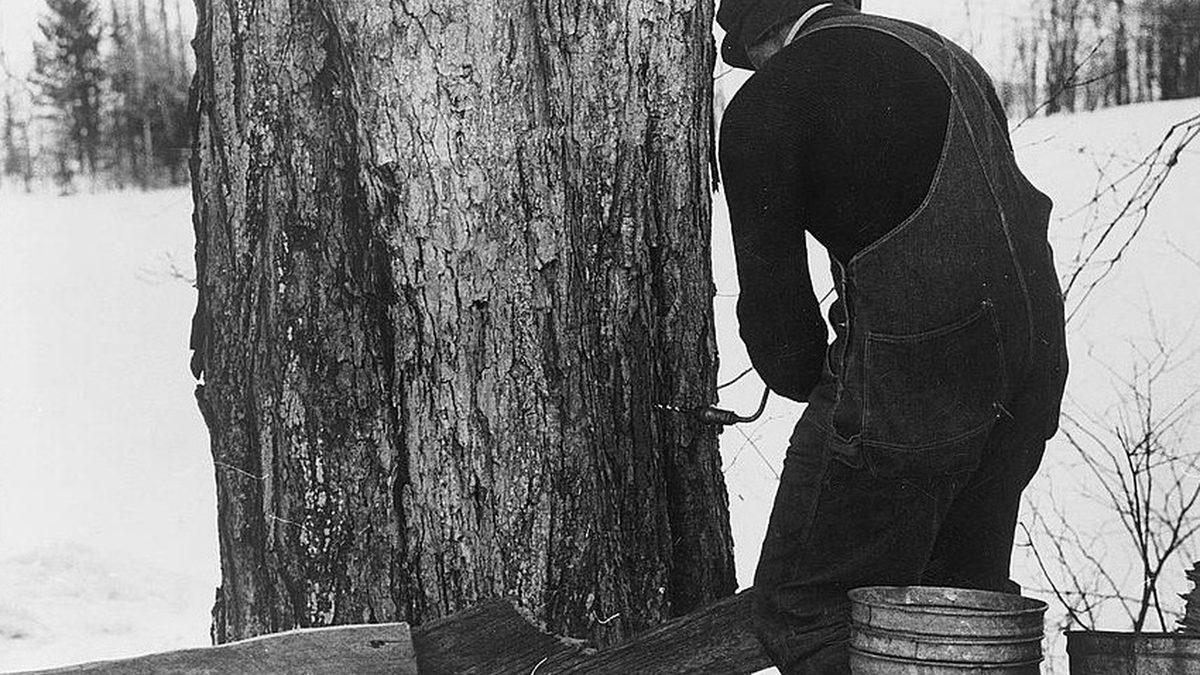
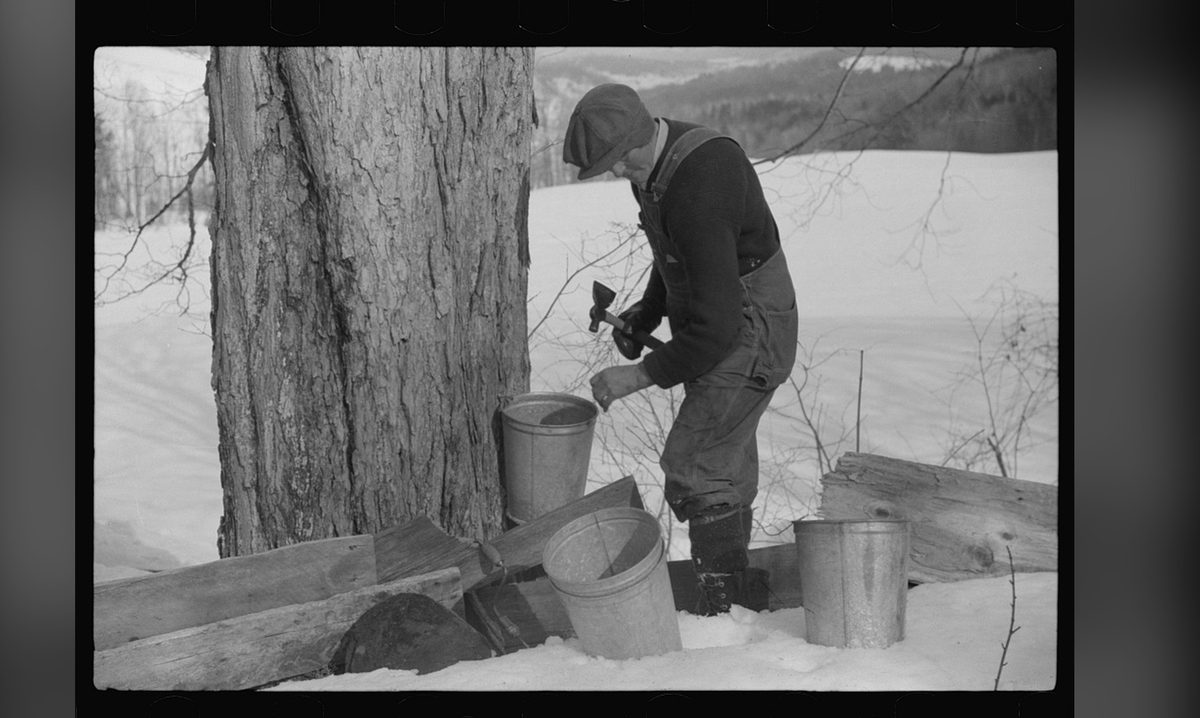
Whichever side of that argument holds up, the tapping method itself, a cut or drilled hole, a hollow spile to steer the drip, and a container underneath, was already the working design Indigenous communities handed to the settlers who arrived centuries later, and it is the same basic design a New England farm was still using in the twentieth century.
Jefferson tried to turn a maple orchard into an antislavery commodity
Benjamin Rush published his case for maple sugar in 1792, arguing that if American farmers produced it at scale, the country could “lessen or destroy the consumption of West Indian sugar, and thus indirectly destroy negro slavery.” Philadelphia Quakers picked up the same reasoning soon after, decades before the better known free-produce boycotts of slave-grown cotton in the following century. Jefferson, a correspondent of Rush’s, joined almost immediately. Writing to Benjamin Vaughan in June 1790, he hoped for a sugar that needed only the labor of children to replace one that, in his words, “renders the slavery of the blacks necessary.”
He acted on it as more than a letter. That same November he bought fifty pounds of refined maple sugar in Philadelphia, and the following year he traveled to Long Island and bought out a nursery’s entire stock of sugar maples, sixty trees, which reached Monticello in November 1791 and were planted by enslaved laborers. Writing to William Short that same month, he described demand for maple sugar as already outrunning the supply reaching market. To another correspondent he predicted that rising prices for West Indian cane sugar would simply force Americans to do without it.
The trees did not cooperate. Monticello’s climate rarely produces the hard, repeated freeze-thaw swing that drives sap up a maple trunk, and by 1794 only eight of the original sixty had survived. The large-scale maple plantations Jefferson had pictured never materialized, though he kept the idea alive for years, writing in 1808 that he saw no reason every farmer shouldn’t keep a sugar orchard the way they kept an apple orchard. He eventually abandoned maples for a different antislavery sugar substitute, beet sugar, which he wrote in 1813 “promises to supplant the cane particularly.” The political campaign ran directly through the same tap-and-bucket technology described above. It simply never scaled the way its backers wanted it to.
Replacing the bucket took two decades and a roll of blood-transfusion tubing
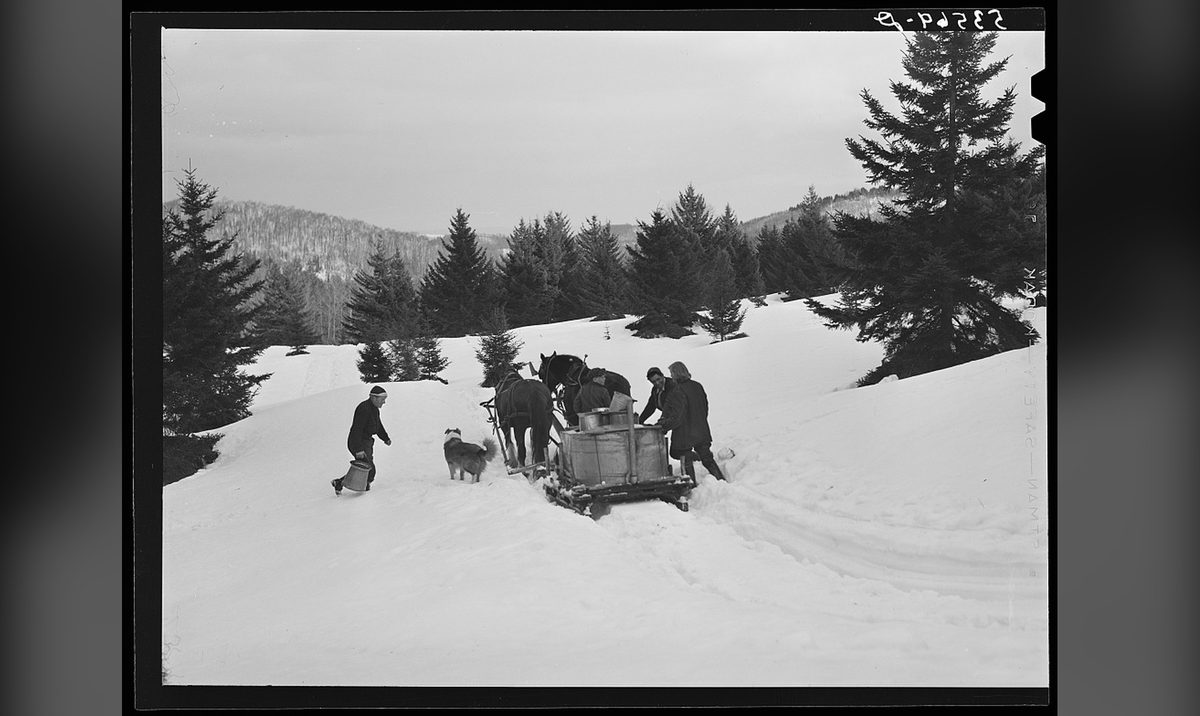
Carved wooden spiles gave way to cheap stamped tin ones by the mid-1800s, and the galvanized pail with its slanted lid became standard not long after, but an open, vented bucket had a hard ceiling built into its design: nothing about it could ever hold pressure. The first attempt to pipe sap instead of carrying it dates to 1794, when a farmer named Garrett Boone near Cooperstown, New York, tried a wooden-trough pipeline that cracked and leaked. Metal gravity systems had more success afterward, including a fifty thousand tap network the Horse Shoe Forestry Company ran through the Adirondacks between 1896 and 1908, and a metal “gooseneck” system patented in 1916 by William Brower of Mayfield, New York, that saw real commercial use into the 1920s. None of it could build vacuum, because none of it was sealed.
Plastic solved that, and it arrived almost by accident. Nelson Griggs, an MIT-trained engineer from Montpelier, Vermont, ran the first serious plastic-tubing trials at the University of Vermont’s Proctor Maple Research Center in the spring of 1955. That same year, an engineer named George Breen, who had bought a Vermont sugarbush from the writers Helen and Scott Nearing, began lining his own trees with tubing cut from surplus blood-transfusion line he purchased from 3M. Their work fed into 3M’s commercial Mapleflo system, sold starting in 1958, while a separate inventor in central New York, Robert Lamb, developed a competing Naturalflow system using his own extruded tubing, offered the same year.
The advantage was not just convenience. A vented bucket can never hold negative pressure, while a sealed tubing network can, and a vacuum pump pulling on that closed line measurably increases how much sap a single tap gives up, on top of cutting the bacterial buildup that gradually seals an open tap hole shut. Within roughly a decade, vacuum tubing had become standard on larger commercial operations, ending the twice-daily walk through the sugarbush that the bucket and spile had required for as long as anyone could document.
A single Quebec warehouse holds enough syrup to be worth stealing by the truckload
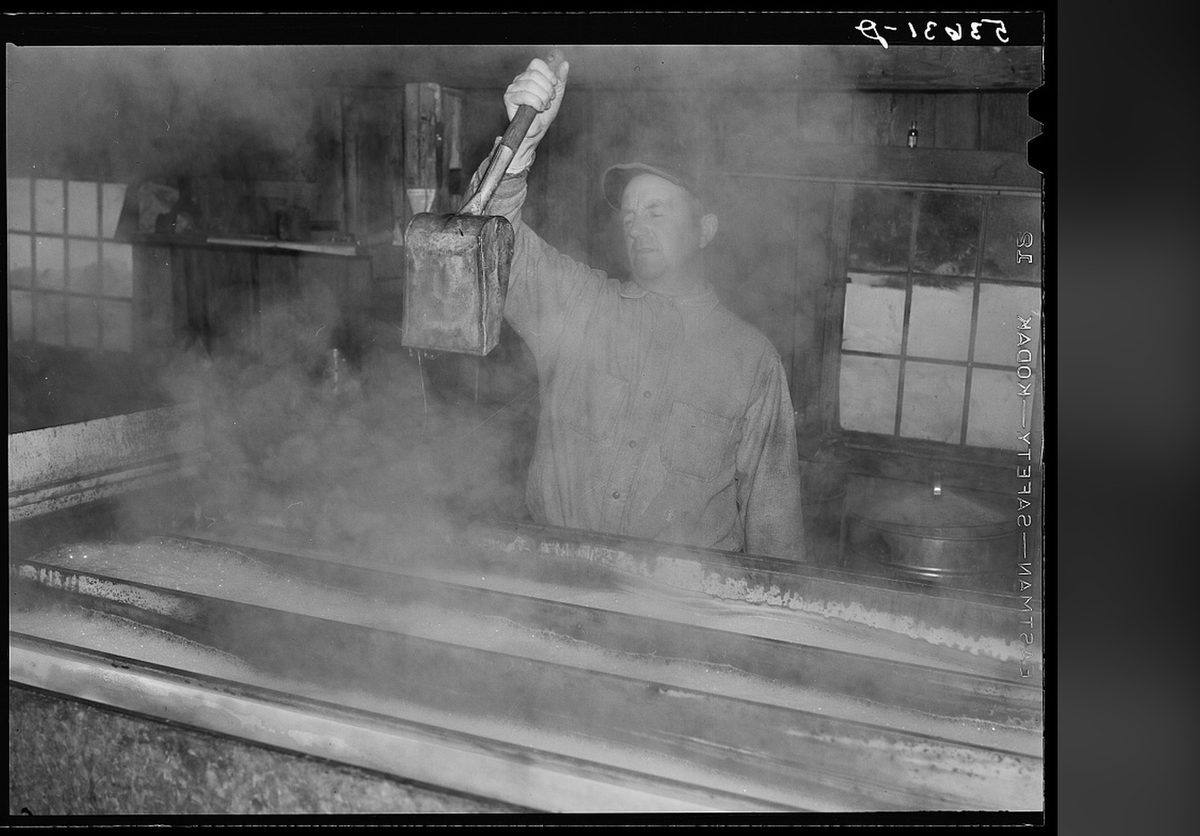
Hand-hung buckets never fully disappeared, and small producers still use them today for the same reason a 1940s Vermont farm did, but the industry built on top of them is now concentrated to an unusual degree. Quebec alone has accounted for the large majority of world production in recent years, and its producers’ federation controls supply and pricing tightly enough that it keeps an actual strategic reserve of barreled syrup, built up in strong years to smooth out weak ones, much the way an oil-exporting country stockpiles crude. Vermont remains the leading American producer by a wide margin; the U.S. Department of Agriculture’s most recent survey put the state’s output at just over three million gallons, more than half of all American maple syrup, drawn from roughly eight million taps.
Concentrating an entire commodity’s emergency stockpile inside one rural building turned out to have an obvious weakness. Between October 2011 and August 2012, a crew led by a man nicknamed the “barrel roller,” Richard Vallières, siphoned syrup out of barrels at the federation’s reserve facility in Saint-Louis-de-Blandford, Quebec, and quietly refilled the empty barrels with water so the theft would not show on a casual check. It worked for ten months, helped along by a facility with no security cameras at all. An inspector doing a routine walk-through in July 2012 noticed a stack of barrels leaning unevenly, opened a few, and found them either empty or full of water. Investigators eventually traced roughly 2,700 tonnes of stolen syrup, worth close to eighteen million dollars, moved through a legitimate New Brunswick operation and resold across Ontario and the United States. Police recovered only about 450 tonnes of it. Vallières and three accomplices were convicted; he received a sentence of nearly eight years, for what remains one of the largest thefts of any kind in Canadian history.
Watch the full history
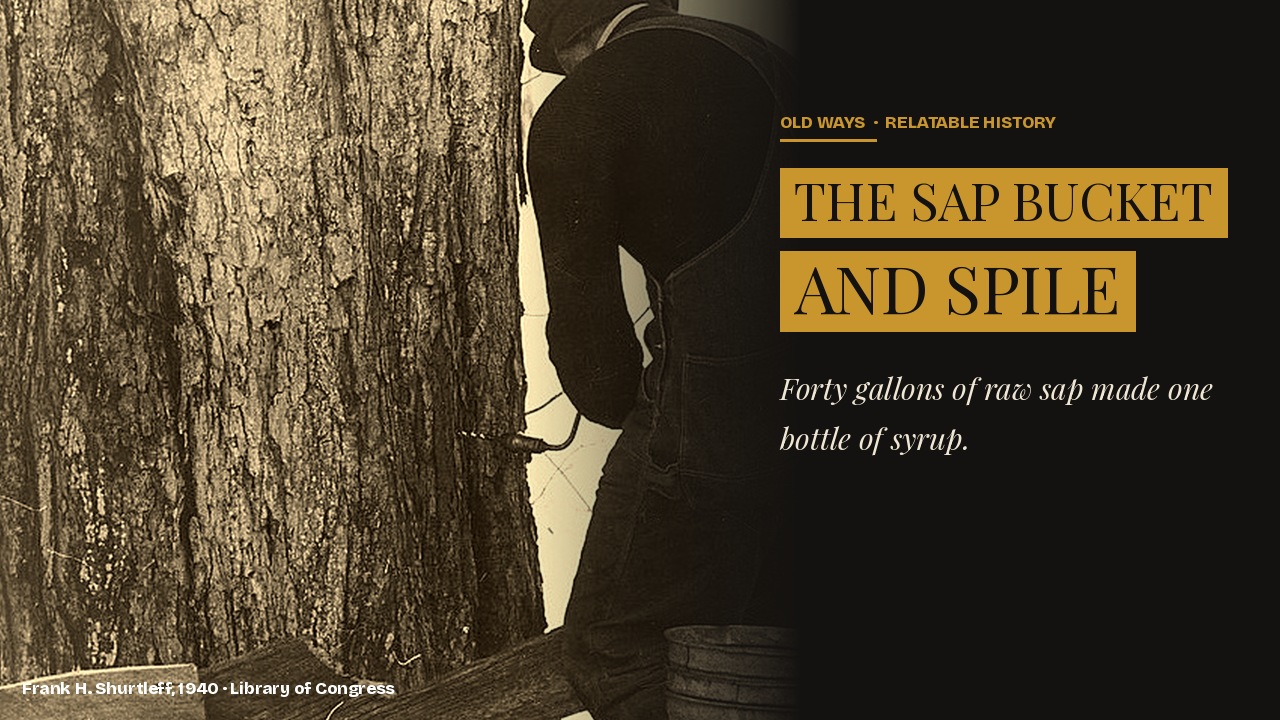
The video covers the bucket-and-spile rig itself: boring the tap, hanging the pail, and boiling down a winter’s worth of sap on a Vermont farm in 1940.

Every stage of this story runs on the same unforgiving arithmetic: a large volume of thin, nearly worthless liquid has to be reduced to a small volume of something genuinely valuable, and that narrow margin is what made the work worth fighting slavery over, worth patenting a half dozen competing tubing systems over, and eventually worth stealing eighteen million dollars of. The bucket and spile themselves never had to be clever. They only had to survive a freezing New England winter long enough to let that ratio do its work.
What actually changed across three and a half centuries was never really the tap or the pail. It was who did the walking, and who got paid for it. Indigenous communities worked out the chemistry first, on their own terms, with heated stones and birch-bark trays. Farm families inherited it as an unpaid household chore that doubled as the one real social event of a long winter. Engineers eventually automated the walking away entirely, and a criminal syndicate later proved just how much the result was worth protecting.
So before reaching for the next bottle of real syrup, it is worth asking the same question this series closed its video on: how many buckets, hung on how many trees, through how many freezing mornings, does it actually take to fill just one of them?
Related reading
- How Colonial Americans Dyed Cloth Before Store-Bought Dye Existed
- How the Cookie Press Was Invented
- The History of the Pie Funnel, From Plain Clay Tube to Ceramic Bird
- The Native American Craft Behind Every Farm Basket
Works cited
- Munson, Patrick J. “Still More on the Antiquity of Maple Sugar and Syrup in Aboriginal Eastern North America.” Journal of Ethnobiology 9, no. 2 (1989): 159–170. Link.
- Stanton, Lucia C. “Sharing the Dreams of Benjamin Rush.” In Fall Dinner at Monticello, November 2, 1990, in Memory of Thomas Jefferson, 1–12. Thomas Jefferson Memorial Foundation, 1990. Published online as “Sugar Maple,” Monticello/Thomas Jefferson Foundation.
- Jefferson, Thomas. Letter to Benjamin Vaughan, 27 June 1790. In The Papers of Thomas Jefferson, vol. 16, edited by Julian P. Boyd, 578–79. Princeton University Press.
- Jefferson, Thomas. Letter to William Short, 25 November 1791. In The Papers of Thomas Jefferson, vol. 22, edited by Julian P. Boyd, 334. Princeton University Press.
- Werner, Leo H. “Maple Sugar Industry.” Updated by Eli Yarhi and Jessica Poulin. The Canadian Encyclopedia, Historica Canada. Published 7 February 2006; last edited 30 March 2022. Link.
- Noakes, Taylor C. “Great Canadian Maple Syrup Heist.” The Canadian Encyclopedia, Historica Canada, 28 March 2022. Link.
- Post, Paul. “From Pails to Pipelines: The Origins of Plastic Tubing in the Maple Syrup Industry.” The Maple News, 26 June 2022. Link.
- United States Department of Agriculture, National Agricultural Statistics Service. 2026 Maple Syrup Survey, as compiled by University of Vermont Extension, “Maple Statistics.” Link.