
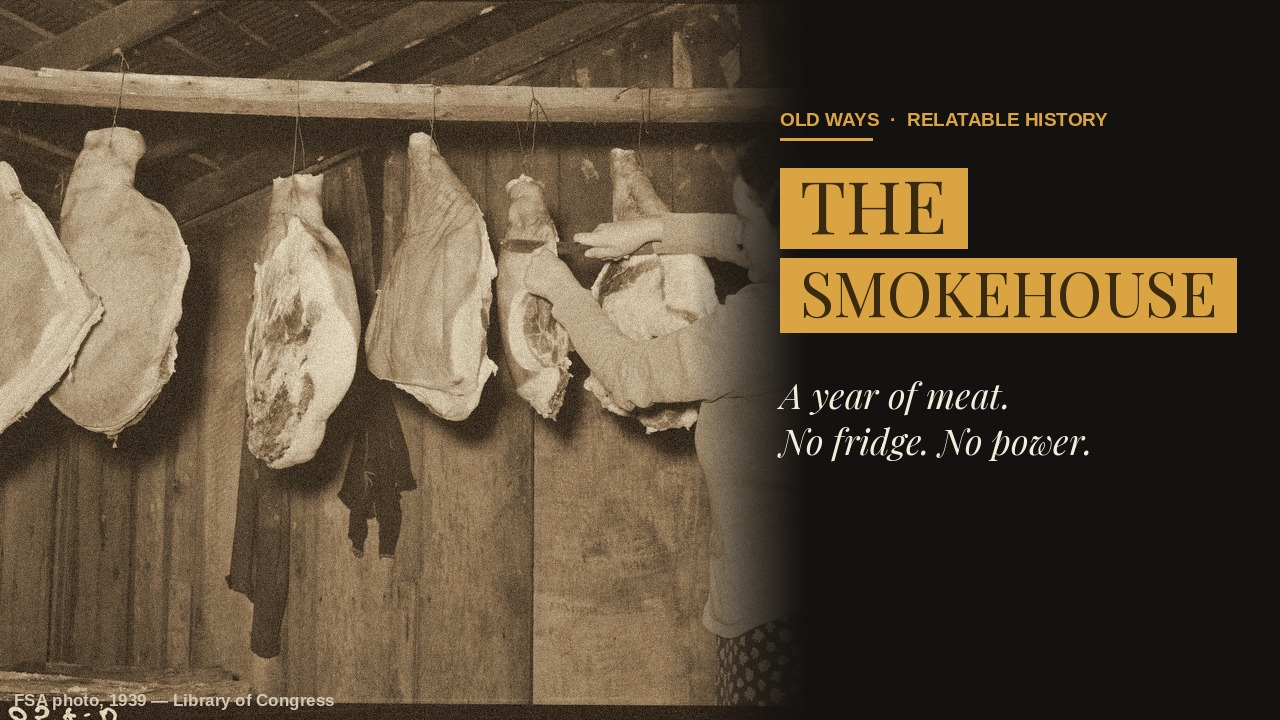
A Virginia farmhand curing hams the old way in the 1930s worked from a recipe that had barely changed in two centuries: eight pounds of salt and two pounds of sugar, worked by hand into every inch of a hundred pounds of fresh pork, timed to seven days per inch of the ham’s own thickness. Get the ratio wrong and the meat rotted from the inside before the smoke ever touched it. Get it right, and a smokehouse eight feet square could hold a family’s entire annual meat supply through a Virginia summer with no ice, no electricity, and no refrigeration of any kind — nothing but salt, smoke, and controlled rot working in the farm’s favor instead of against it.
It is tempting to picture the smokehouse as simple: a dark shed, a smoldering fire, done. It was closer to a piece of applied chemistry that happened to be built out of logs or brick. The building’s shape, the timing of the cure, the temperature of the fire, and even who was legally allowed to call the result a “Smithfield ham” were all worked out through centuries of trial, error, and eventually statute. What follows is how the mechanism actually functioned, who did the labor behind it, and what a Virginia museum is doing today with the last ham of its kind ever legally produced.
A smokehouse was built to trap smoke, not just store meat
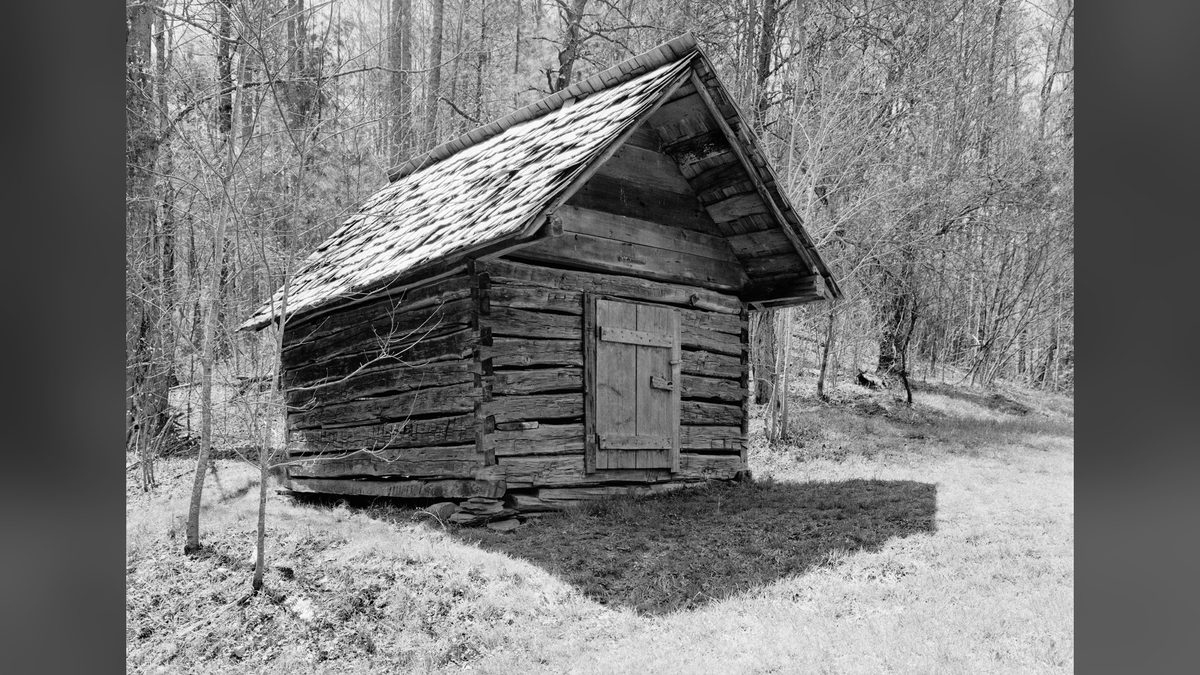
The building type shows up in the written record surprisingly late for something so essential to colonial life. The earliest known use of the term “smoak house” dates to 1716, on a plantation in York County, Virginia; by the first half of the eighteenth century it had become a standard fixture of the backyard landscape across the Chesapeake, typically a cubical wooden structure eight to fourteen feet square with a steep pyramidal roof designed to hold smoke in among the hanging meat. A 1742 real-estate listing in the Virginia Gazette advertised a Hanover County plantation’s “new fram’d Smoak-house, 8 Feet Square,” and a 1732 order for the glebe of Newport Parish in Isle of Wight County specified “a Smoak house eight foot square” with a “planked Dore” — the sturdy door was there to stop poachers, since the building held a family’s food security for the year once the fire went out. A 1785 property survey of Halifax County, Virginia, listed fifteen “smoak” houses and just one “meat house,” ranging from eight-by-eight feet up to sixteen-by-sixteen, with most clustered around twelve feet square — near-perfect little cubes.
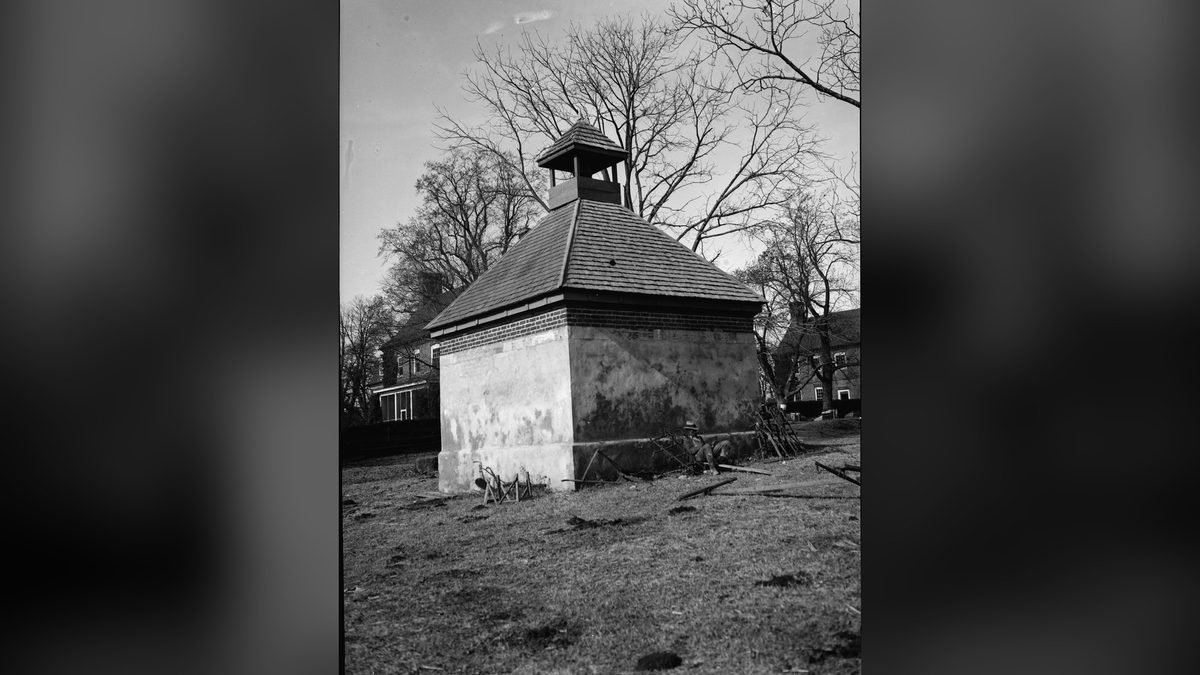
The square shape was not decorative. An account of a Pennsylvania plantation’s smokery, published in London in 1795, describes a twelve-foot-square room of dry wood with a firebox in the center of the floor and nails driven into the rafters to hang the meat; the fire burned unattended for four or five days running, with smoke escaping through the gaps between the boards rather than through any built flue. A centered heat source drives a naturally square footprint, and the steep roof did double duty: it held smoke and heat in longer, and its rafters gave more surface area for hanging hooks, pegs, and chains. At Shirley Plantation on the James River, whose brick smokehouse was used continuously until about 1953, the family burned apple wood for a sweeter flavor and let the fire run untended day and night, simply relighting it each morning if it went out.
The exact numbers behind the cure
Salt cures meat by pulling water out of it through osmosis and by binding whatever water remains so bacteria cannot use it — a mechanism food scientists call reducing water activity. Virginia Cooperative Extension’s modern guide to dry-curing Virginia-style ham, written by Virginia Tech food scientists Paul Graham, N. G. Marriott, and R. F. Kelly, gives the standard ratio as eight pounds of salt and two pounds of sugar per hundred pounds of fresh meat, plus two ounces of saltpeter or sodium nitrite to preserve the pink color and guard against bacterial growth. The cure goes on in two applications a week apart, rubbed by hand into every lean surface of the ham, and the timing is precise: seven days of curing per inch of the ham’s cushion depth, or roughly a day and a half per pound, held at 36 to 40 degrees Fahrenheit throughout. After the cure comes off, the ham sits for about two more weeks at 50 to 60 degrees so the salt can equalize evenly through the meat, a step the extension bulletin compares to letting a cheese age. The whole process costs the ham roughly 8 to 12 percent of its original weight.
Colonial-era accounts describe a slower, less precisely measured version of the same chemistry. Colonial Williamsburg’s own December salting tradition packs hand-salted pork into half-barrel tubs with holes drilled in the bottom, so that the “liquor” — the water the salt has pulled out of the meat — drains away into the dirt floor rather than pooling against the cure. Historically the salting period ran roughly six weeks, considerably longer than the extension bulletin’s modern week-per-inch formula, before the meat went into the smokehouse for one to two weeks of smoking over a deliberately “cool,” smoldering fire kept under 90 degrees. Hickory was the most common wood, though apple, peach, and other fruitwoods were used for flavor; resinous woods like pine or cedar were avoided because they left the meat bitter. The goal, in both the eighteenth-century and the modern version, was never to cook the meat — only to dry it and coat it with smoke’s own mild antimicrobial compounds.
Hog-killing day supplied a year of work in one
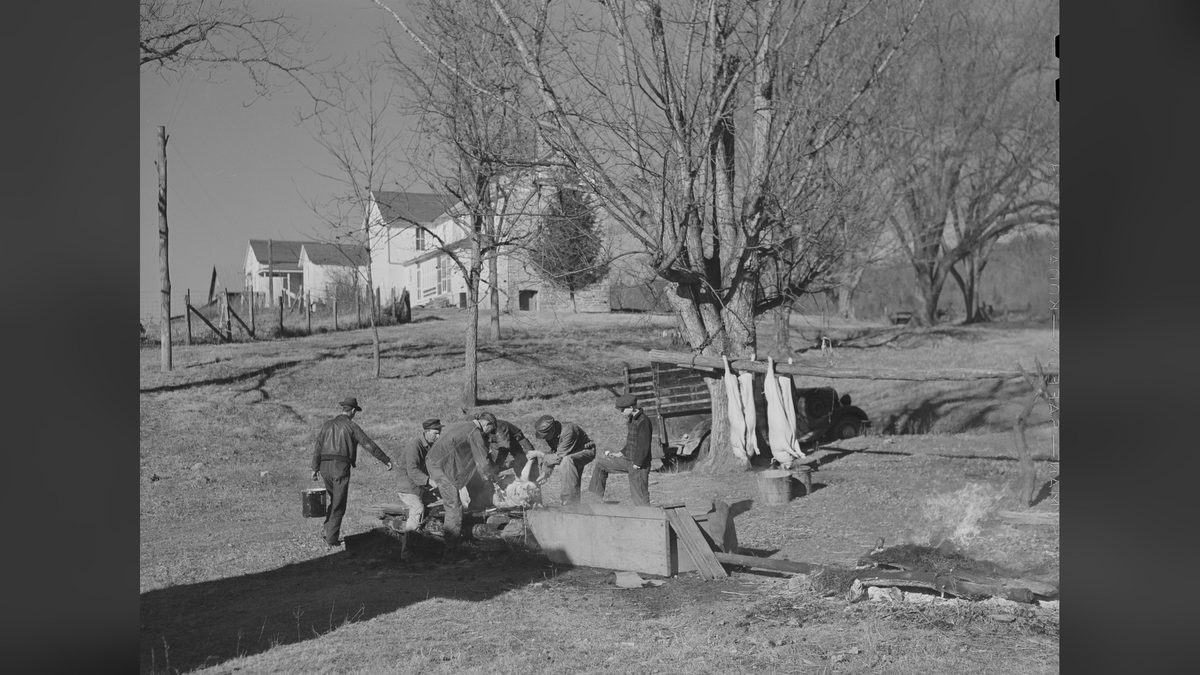
Everything a smokehouse would eventually hold started on a single frigid day. The Encyclopedia of North Carolina describes hog killing as traditionally beginning on the first hard-frozen morning of autumn or winter, when as many as a hundred hogs that had spent the year fattening on peas, potatoes, corn gleanings, or forest mast were slaughtered at once. Neighbors routinely pooled their labor for it: workers gathered before dawn, heated stones in an open fire and dropped them into barrels to make scalding water, then killed, bled, scalded, and scraped the hogs before hanging them to cool overnight. The cutting and salting happened the next day, with the meat — hams, sides, shoulders, jaws, and heads kept separate — packed onto a tilted platform inside the smokehouse itself, so that the dripping brine ran into a trough below and could be evaporated afterward to recover the salt for feeding livestock. Nothing about the day was casual; it produced the entire meat supply the household would eat for the next twelve months.
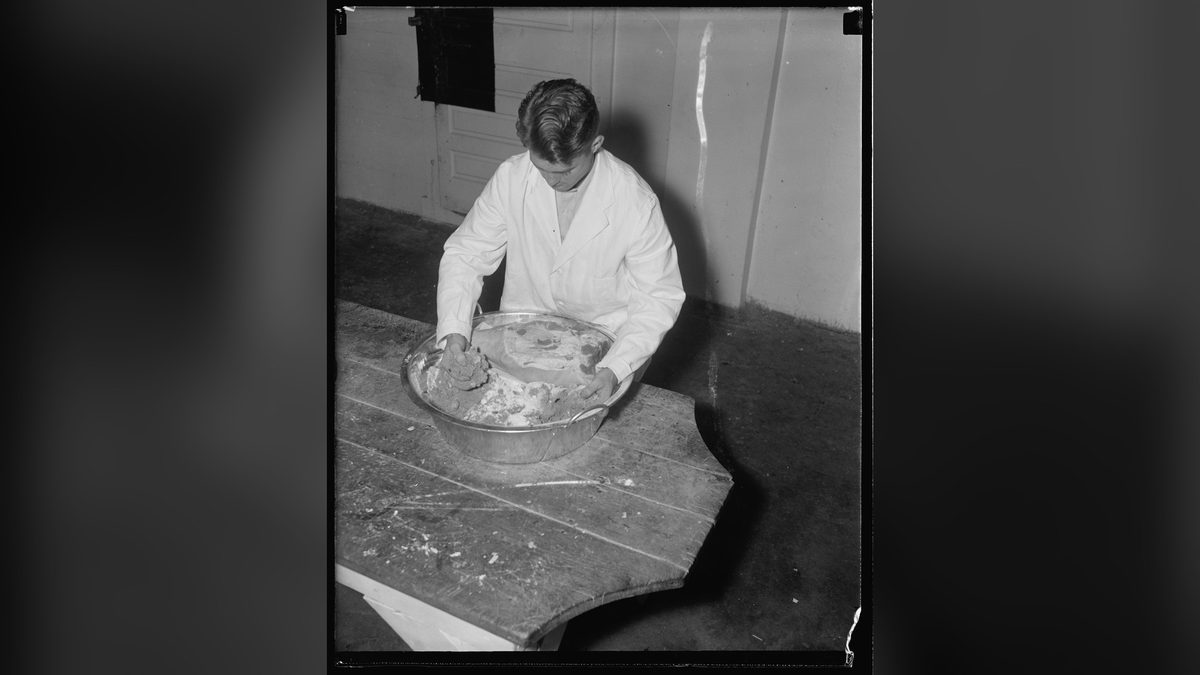
That labor was not always freely given. At George Washington’s Mount Vernon, it was enslaved workers who salted or pickled the meat and hung it on the smokehouse rails above the fire pit, and the building itself was kept locked during curing specifically to prevent theft — a precaution that did not always work. In May 1795, while Washington was living in Philadelphia as president, his farm manager William Pearce wrote to tell him that “some person ripped a plank off the Back part of the smoke House and Took out several pieces of Bacon,” adding that he had not yet found out who. The finished product, though, traveled in the other direction as a mark of hospitality: in 1786 Washington wrote to the Marquis de Lafayette in France that Martha Washington “had packed & sent…a barrel of Virginia Hams,” noting that “as they are of our own manufacture…we recollect that it is a dish of which you are fond.” The same building, the same fire, the same salt and smoke — produced both a stolen supper and a diplomatic gift.
A word the Commonwealth of Virginia still defines by statute
Nowhere did the smokehouse’s output matter more, legally speaking, than in the town of Smithfield, Virginia, where hams have been produced since the 1600s. The Code of Virginia still contains a section, § 3.2-5419, that defines exactly what a “Genuine Smithfield ham” is allowed to be: a ham “processed, treated, smoked, aged, cured by the long-cure, dry salt method of cure and aged for a minimum period of six months,” with every step of that salting, smoking, and aging performed within the corporate limits of the town itself. The provision was already written into the Code by 1950 and has been amended as recently as 2008; a companion section makes it illegal to label, advertise, or sell any ham as “genuine Smithfield” unless it meets that exact definition. Few American foodstuffs have ever had their production method locked this specifically into state law.
The law nearly outlived its last taker. In January 2024, Smithfield Foods — by then the only remaining producer curing hams within the town limits — announced it would discontinue the Genuine Smithfield brand, citing shifting consumer tastes. That final ham did not disappear: Virginia Commonwealth University anthropology professor Bernard Means and his Virtual Curation Laboratory field school traveled to the Isle of Wight County Museum in the summer of 2024 to digitally scan it, alongside the museum’s other famous holdings, including a ham that turned 122 years old that July and maintains its own social media presence via the museum’s continuous “HAM CAM” livestream. “I probably went through eight or nine pairs of gloves just moving the ham around for the scanner,” Means told VCU News, describing a surface that was, in his student Anna Carter’s words, “very honored and very greasy.” The scan is now downloadable for free, a 350-year-old preservation method preserved in turn by a laser.
What actually closed the smokehouse door
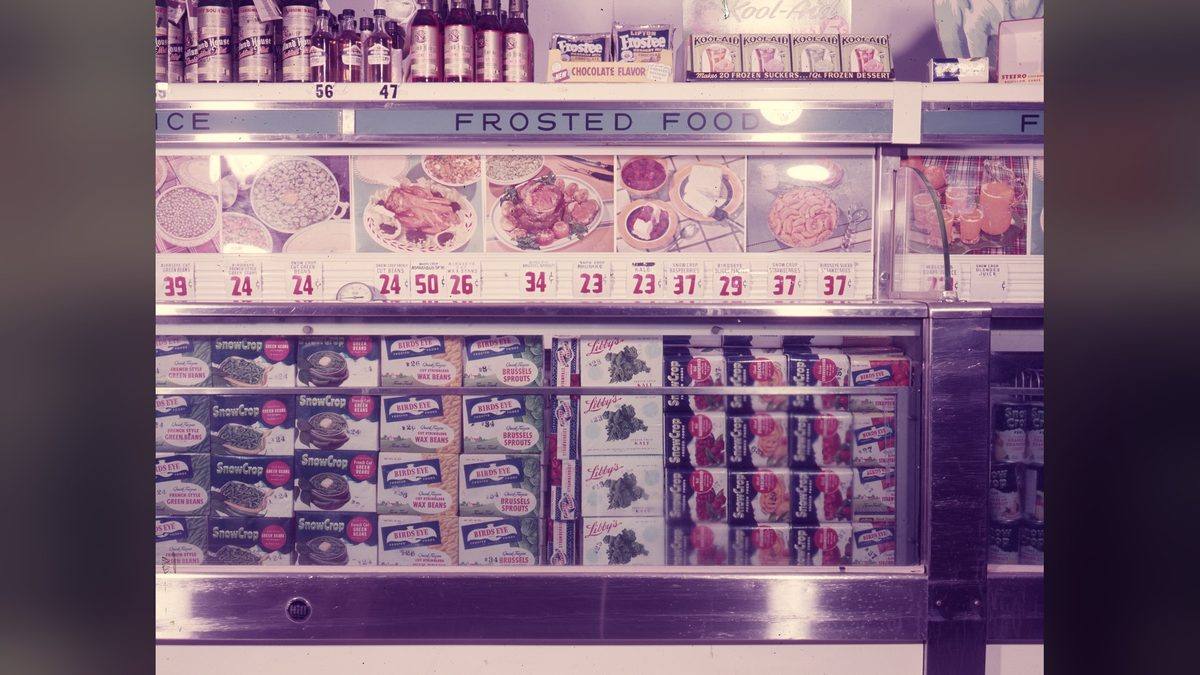
The smokehouse did not lose its usefulness to a single rival invention so much as to the slow arrival of an entire electrical grid. As of the early 1930s, roughly nine out of ten rural American homes had no electric power at all, according to WyoHistory.org, the encyclopedia of the Wyoming State Historical Society; farms still ran on kerosene light and hauled their own water. The federal Rural Electrification Administration, created in 1935, began closing that gap, and by 1942 close to half of American farms had electricity reaching the property. What followed electricity onto the farm was the appliance that made the smokehouse optional rather than essential: the home electric refrigerator, and not long after it, the chest freezer and the commercial “locker plant” that rented cold storage space by the month to families who had neither. A photograph from 1952 shows the endpoint of that shift plainly — a grocery store freezer case stocked with packaged frozen food, the smokehouse’s replacement sold by the pound under electric light.
Even so, the changeover on individual farms was gradual rather than sudden. A smokehouse cost nothing to operate once it was built, while a refrigerator required a power line the farm might not have for another decade, so plenty of rural households kept curing their own hams well into the twentieth century out of simple economic sense, long after city dwellers had switched over entirely.
What survives
The smokehouses at Shirley Plantation and dozens of other Virginia farms are still standing, their brick and timber walls often gone soft and crumbling wherever a century of salt worked its way into the mortar. The Code of Virginia still defines a Genuine Smithfield ham in exacting, six-month, town-limits detail — a legal fossil of a production method that, as of 2024, no one inside those town limits still practices commercially. And in a museum case in Isle of Wight County, a 122-year-old ham keeps drawing an audience it never could have had when it was cured: a livestream.
What the smokehouse leaves behind is not nostalgia for a simpler way of eating. It is a reminder that an entire year’s food security once rode on getting a chemistry problem right by hand — the correct ratio of salt to meat, the correct number of days per inch, a fire kept just cool enough — and that the people who actually solved that problem each winter, free or enslaved, neighbor or hired hand, rarely got their names attached to the result. The next time a refrigerator door swings open without a second thought, it’s worth asking what it would take to feed a family for a year if that door, and the grid behind it, simply weren’t there.
Watch the full history
The video walks the smokehouse from hog-killing day to the salting tub to the smoldering hickory fire, and on to the refrigerator that finally closed its door.

Related reading
- How Icehouses Worked Before Refrigeration — the farm’s other great pre-electric preservation system, this one built on packed pond ice instead of salt and smoke.
- How a Root Cellar Kept Vegetables All Winter — the smokehouse’s companion building, keeping the farm’s produce edible through the same winter months.
- The Crock and Sauerkraut — a third, fermentation-based answer to the same problem of feeding a family with no refrigerator.
- The Washboard and Wringer — another daily chore built entirely around hand labor before electricity reached the farmhouse.
Shop the items in this history
- Country Ham: A Southern Tradition of Hogs, Salt & Smoke by Steve Coomes
- Meat-curing salt
- Hickory smoking wood
Works cited
- Olmert, Michael. “Smokehouses: Foursquare and Stolid, These Buildings Were a Hardworking Adornment to the Colonial Backyard.” Colonial Williamsburg Journal, Winter 2004–05. (research.colonialwilliamsburg.org — blocks automated access; cited as print.)
- “Smokehouse.” George Washington’s Mount Vernon. (mountvernon.org — blocks automated access; cited as print.)
- Graham, Paul P., N. G. Marriott, and R. F. Kelly. “Dry Curing Virginia-Style Ham.” Virginia Cooperative Extension, Publication 458-223. Virginia Tech, 2011. Link.
- Code of Virginia. § 3.2-5419, “Smithfield Hams Defined.” Virginia General Assembly, Legislative Information System. Link.
- Wilkerson, Sian. “Nothing Ham-Handed About This Project: VCU Helps Digitally Preserve the Last Genuine Smithfield Ham.” VCU News, Virginia Commonwealth University, 17 September 2024. Link.
- Powell, William S. “Hog Killing.” In Encyclopedia of North Carolina. University of North Carolina Press, 2006. Hosted by NCpedia, Library of North Carolina. Link.
- “Rural Electrification Changed Farm Life Forever in Wyoming.” WyoHistory.org, Wyoming State Historical Society. Link.