
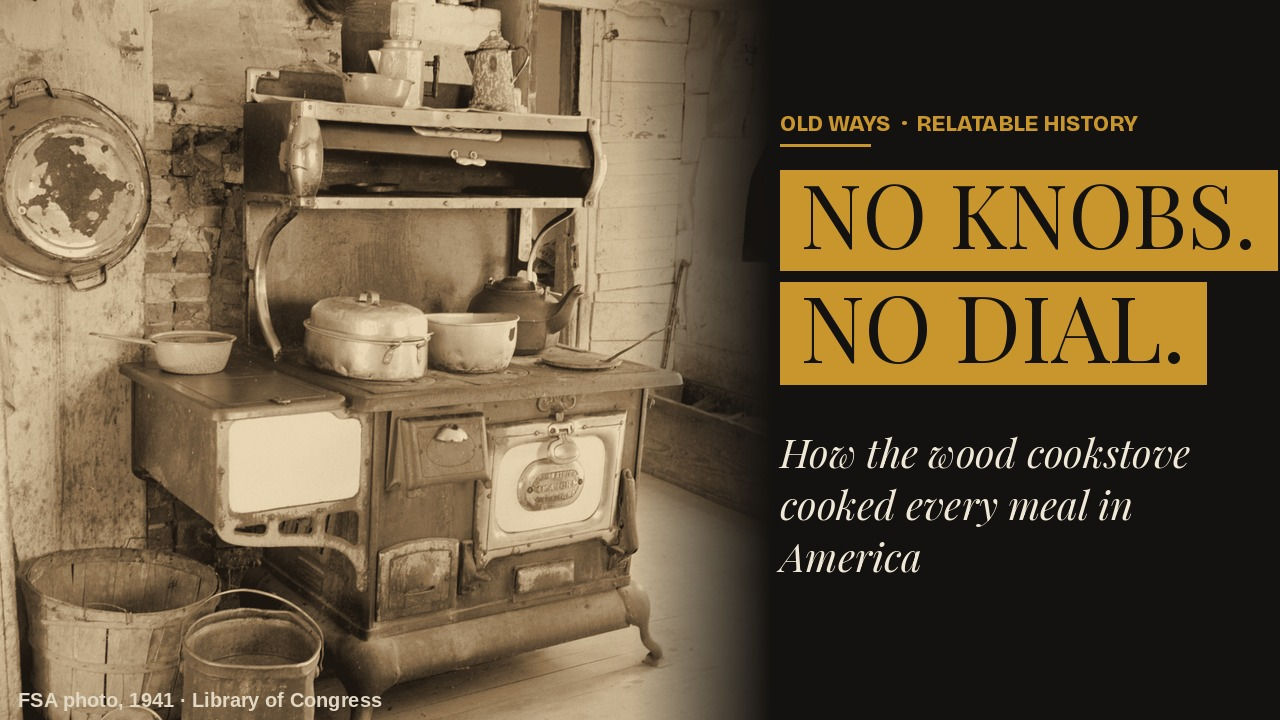
As late as 1940, roughly one American home in four was still reporting wood as its household fuel — more than a century after cast iron first replaced the open hearth. Before that replacement happened, an American kitchen had no fixed cooking surface at all: dinner came off a hook and a crane, swung over an open fire on the hearth, the same basic arrangement people had used for centuries. The device that changed that was not built by a professional stove maker. It was built, somewhat reluctantly, by a missionary trying to raise money for a college in Ohio.
What that stove became — a black cast-iron range with a firebox, an oven, a water reservoir and a row of iron lids on top — went on to run nearly every kitchen in the country for a hundred years. It had no thermostat and no dial. A cook set its heat by hand: sliding a pot closer to or farther from the fire, judging the oven by how long she could hold her palm inside it. It also asked something of a household that no kitchen appliance asks today — several cords of split, dried wood every single year, cut, stacked and carried in by someone in the family.
This is the mechanism behind that stove: who built it, how its parts worked together, what it cost, and what it demanded of the people who ran one every day for a century.
Before 1834, Every Meal Started at an Open Hearth
Cooking over an open masonry hearth was the American norm from the colonial period into the early nineteenth century. A cook worked with a swinging iron crane hung with pots at different heights over the fire, a reflector oven angled toward the coals for roasting, and a cast-iron Dutch oven set directly in the embers with coals heaped on its lid for baking. All of it meant crouching, reaching and lifting near open flame, in the same long skirts that were a constant fire hazard. Heat control meant raking coals closer or farther from a pot, or building up or letting die a fire that was also, in many households, the only heat source in the house.
None of this required an object that could be called a stove. A hearth was architecture, built into the house itself, and it produced most of its useful heat by accident, radiating in every direction rather than concentrating where the cooking actually happened. Fuel efficiency was poor, burns and clothing fires were common household dangers, and the work was constant: someone had to tend an open hearth fire nearly every waking hour it was in use.
A hearth also gave a cook almost no way to isolate heat for baking specifically. A reflector oven, a curved tin box angled toward the coals, could roast a joint of meat by radiant heat alone, but bread and pies generally meant the Dutch oven method: a lidded iron pot set into the hearth’s ashes with additional hot coals shoveled on top of the lid, so the food baked from both directions at once. It worked, and versions of it are still used by campers today, but it demanded constant attention to keep the coal supply topped up on both sides through however long the bread needed.
A Missionary Building a College Ended Up Inventing a Stove
Philo Penfield Stewart was born in 1798 in Sherman, Connecticut, apprenticed as a young man to a harness maker, and spent much of his twenties as a missionary to the Choctaw at Mayhew, Mississippi, serving as the mission’s tinsmith, shoemaker and millwright along with his teaching duties. In 1832 he joined his old friend John Jay Shipherd in Elyria, Ohio, and the two men’s plans — Stewart’s for a school open to poor working students, Shipherd’s for a self-sufficient religious community — combined into what became Oberlin Institute, now Oberlin College.
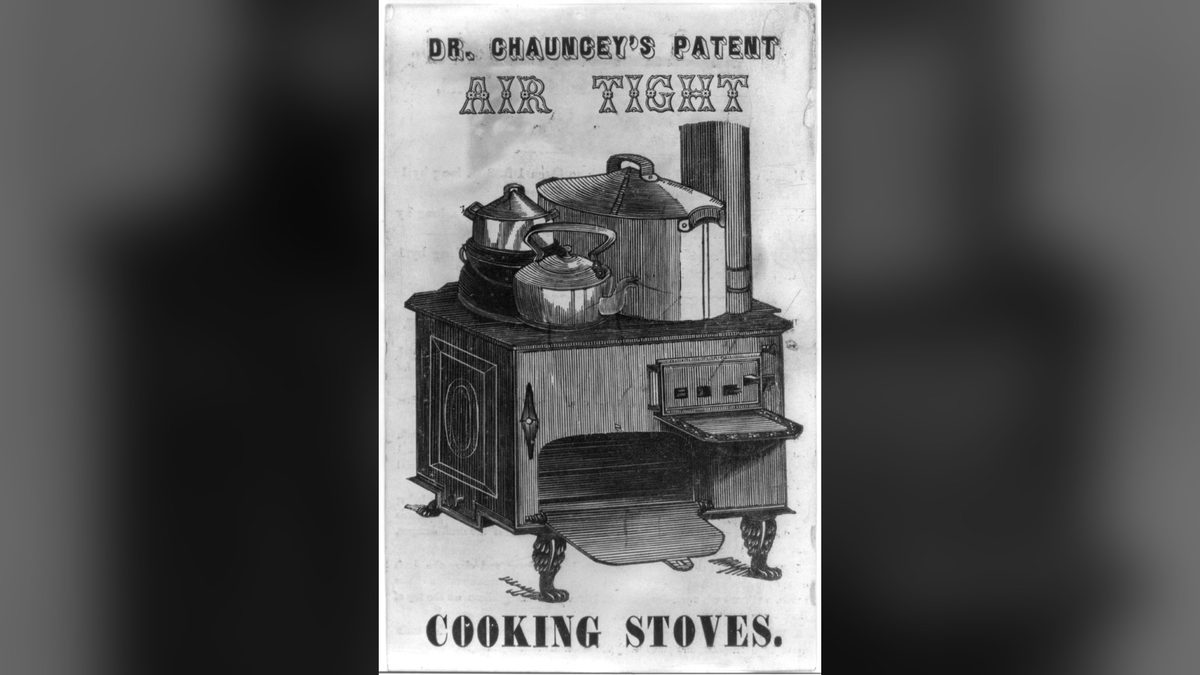
The stove came out of that project almost as an afterthought. Shipherd’s wife had no cooking stove and none could be bought locally at a price the colony’s impoverished founders could afford, so Stewart, who had grown up around Vermont’s iron-making district, built her one himself. His first attempt was a plain sheet-iron wood-fired heater; he then added an oven to it, and realized he had a design he could patent and sell to help finance the new institution. He fixed on Troy, New York, as a manufacturing base, selling through the firm of Fuller, Warren & Co. Stewart kept refining the design for decades, patenting an improved “Large Oven and Air-Tight Cooking Stove” in 1859 that went on, by one nineteenth-century county history’s count, to sell more than nine thousand units over thirty years.
Inside a Cast-Iron Range: Firebox, Oven, Damper, Reservoir
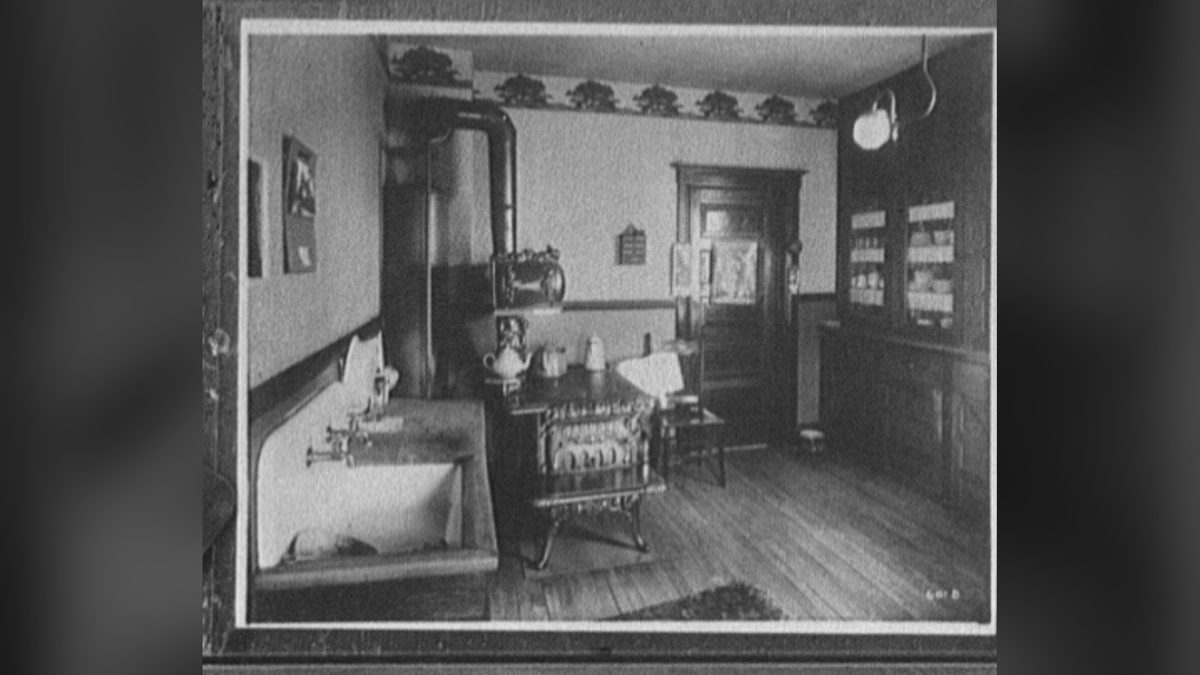
By the second half of the century, foundries across the Northeast and Midwest were casting ranges to a design that varied in decoration but not in basic layout. A firebox at one end burned the wood on a grate; beside or behind it sat a sealed oven box, its temperature controlled by a system of dampers that could route hot flue gas either straight up the chimney or on a longer path around the oven walls first. The cooking surface on top held four to eight round iron lids of graduated sizes, lifted with a separate iron handle, so a pot could sit directly over the firebox for a rolling boil or on a lid two positions away for a bare simmer. A water reservoir built into one side used waste heat from the firebox to keep wash and dish water warm all day, and a warming closet above the cooktop held finished dishes hot until the family sat down. A complete range typically weighed three to four hundred pounds of cast iron.
Competing manufacturers sold variations on this same layout under dozens of brand names — Glenwood, Home Comfort and Majestic among the better known — and what actually distinguished them to a buyer was rarely the mechanism itself. It was fuel economy, how evenly the oven held its heat corner to corner, how much nickel trim decorated the front, and how loudly a catalog could claim its stove beat the competition on all three at once.
Judging Heat by Hand, Not by a Dial
None of this came with a temperature readout. A cook regulated heat by where she put the pot — directly over the firebox for high heat, progressively farther across the lids for less — and by how wide she opened the dampers. The oven had no gauge at all for most of the century; cookbooks described the target heat in words rather than degrees, as a “quick,” “moderate” or “slow” oven, and a cook found out which one she had by holding her hand inside and counting, or by watching how fast a spoonful of flour scorched on the oven floor. Small thermometers built into the oven door started appearing on higher-end ranges only toward the very end of the nineteenth century; before that, the standard instrument for measuring oven heat was a cook’s own hand.
By the 1890s, a Range Was a Status Symbol
Stove making had become a substantial industry by the 1890s, sold through catalogs full of testimonials rather than diagrams. The Majestic Cook Book, a promotional catalog and recipe collection put out by the Majestic Manufacturing Company of St. Louis in 1899, printed customer letters alongside its pie recipes: one Minnesota buyer called her range “the Queen of the Kitchen”; a North Dakota customer wrote that his new steel range took only half the fuel of his old cast-iron stove. By 1902, Sears, Roebuck & Co. was offering nearly four hundred different stove models in its catalog, from a five-dollar starter stove called the Acme Wonder up to a nickel-trimmed range at $24.85, sold strictly cash with no installment terms. A family’s stove had become as much a statement of household standing as a cooking tool.
What a Cookstove Asked of a Family Every Year
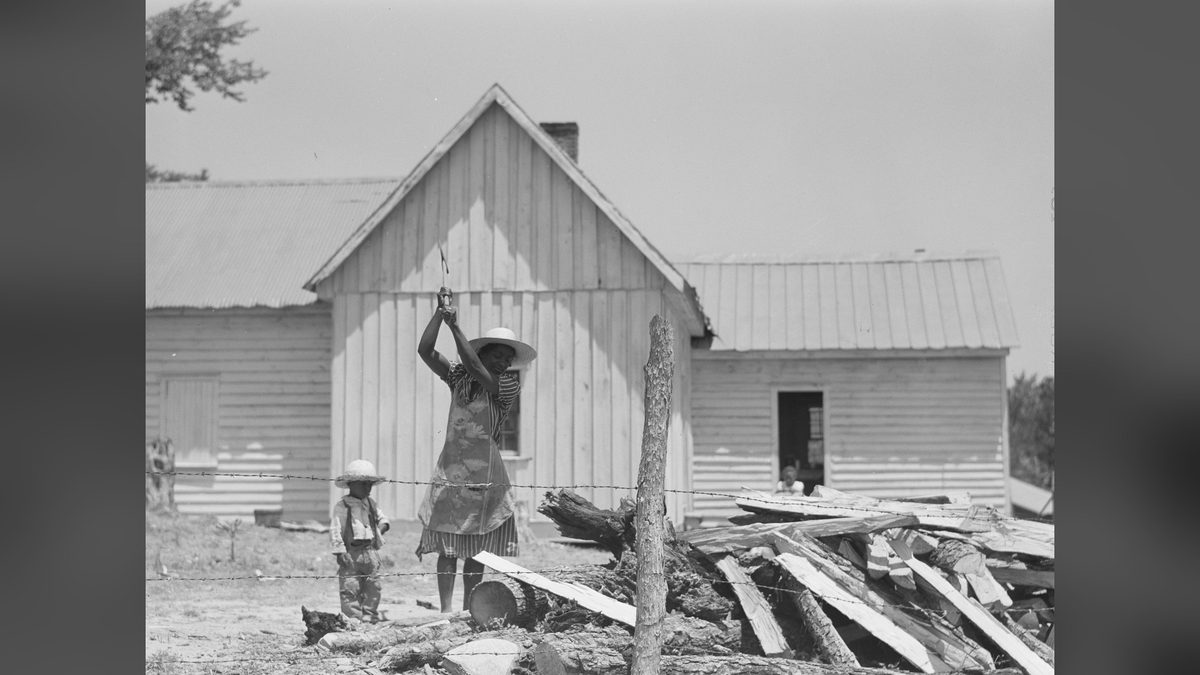
Running one of these ranges was a year-round job layered on top of the daily one. A kitchen range typically burned somewhere on the order of three to five cords of wood a year — cut, split, dried over a summer, and stacked close enough to the house to fetch in bad weather. Keeping the wood box filled was routinely a child’s chore. The fire itself came first and last: someone raked the coals back to life before daylight, because a stove that had gone completely cold could take an hour to bring back up to cooking heat, and someone banked the coals again at night, damping the fire down just enough that embers survived until morning. Iron rusted if it was not regularly blacked with stove polish, ash had to be carried out daily, and in the heat of summer many households moved the whole operation to a detached summer kitchen rather than run a wood fire in the main house.
Why It Held On Into the 1940s, and Where It Went
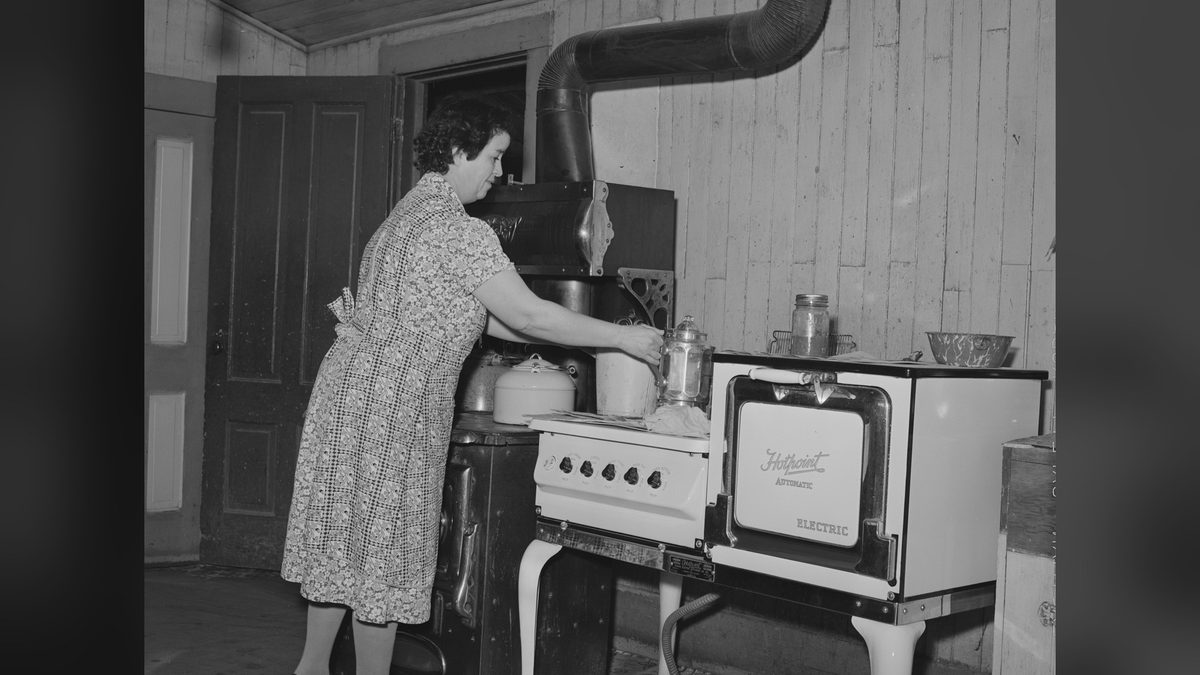
Gas ranges reached American cities from the 1880s and were the urban standard by the 1920s; electric ranges followed from the 1910s, though electricity itself did not reach most farms until federal rural electrification programs, created in 1935, strung lines out to them over the following decade. The 1940 Census of Housing still recorded wood as the reported household fuel in roughly 23 percent of American homes overall — and far higher in the rural South, where the same census found wood-fueled households above 75 percent in states like Arkansas and Mississippi. In most of those homes, the same cast-iron range that cooked the meals also heated the kitchen, which is precisely why it was the last appliance a family gave up.
The wood cookstove never entirely disappeared. Amish workshops in the American Midwest still hand-build cast-iron cookstoves today — the Kitchen Queen is one current model — for the small but genuine market of homesteaders and off-grid households who never stopped wanting one. The design they are building from is, in its essentials, still Philo Stewart’s.
What is easy to miss, looking back from a kitchen with a thermostat and a timer, is how much daily competence a wood range actually demanded of the person running it. Reading a fire well enough to hold an oven at a steady heat for forty minutes, entirely by feel, was a genuine skill, learned over years and rarely written down because everyone who needed it already had someone to learn it from. That knowledge mostly went with the stove when the stove went — which is a small, specific kind of loss, even set against everything a gas or electric range gave back in return.
Watch the full history
The video version walks through a full day at the stove, from the pre-dawn fire to the banked coals at night, in under five minutes.

Related reading
- Clothes Wringer History: From Courtship Gift to ‘Wringer Arm’
- The Mystery of the Beale Ciphers, Explained
- Why the Penny-Farthing’s Wheel Had to Be So Big
- How a Hand Pump Worked: Lifting Well Water With Nothing but Air Pressure
Shop the styles/items featured in this video:
- Woodstove Cookery: At Home on the Range, by Jane Cooper — the standard modern guide to actually cooking on one of these stoves.
Works cited
- Brewer, Priscilla J. From Fireplace to Cookstove: Technology and the Domestic Ideal in America. Syracuse University Press, 2000.
- Strasser, Susan. Never Done: A History of American Housework. Pantheon Books, 1982.
- Cowan, Ruth Schwartz. More Work for Mother: The Ironies of Household Technology from the Open Hearth to the Microwave. Basic Books, 1983.
- Sylvester, Nathaniel Bartlett. “Philo Penfield Stewart.” In History of Rensselaer Co., New York. Philadelphia: D. Mason & Co., 1880. Link.
- “Philo Penfield Stewart, Inventor of the Ideal Cook Stove.” A Stove Less Ordinary (research blog on the 19th-century American stove industry), January 22, 2015. Link.
- MacClain, Alexia. “Cooking the Majestic Way.” Unbound, Smithsonian Libraries and Archives, November 17, 2014.
- “Women in Clay County Were Thankful to Have a Cast Iron Stove.” Clay Today. Link.
- U.S. Census Bureau. “Occupied Dwelling Units Reporting Heating Fuel, by State: 1940.” Census of Housing historical time-series tables. Link.