
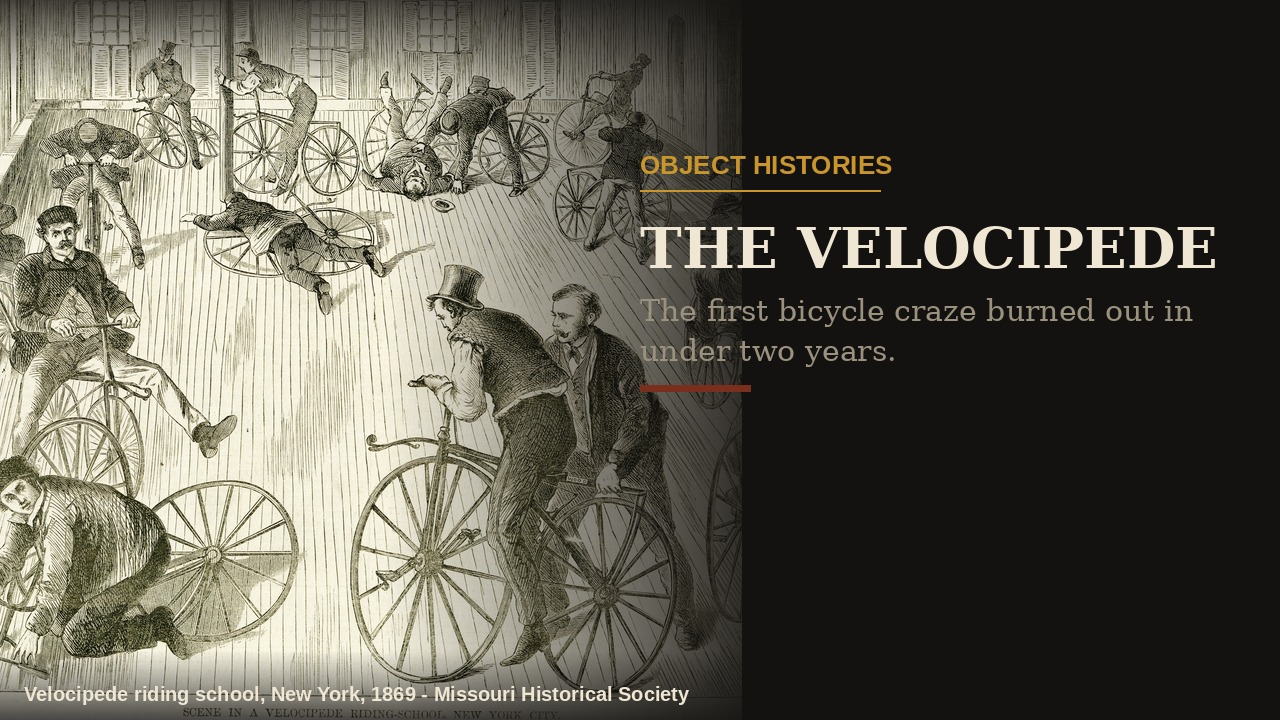
In the spring of 1869, a Frenchman living in London could buy shares in at least a dozen new companies racing to manufacture a machine that, eighteen months earlier, essentially did not exist as a commercial product. By the autumn of the same year, most of those companies were gone, the indoor riding academies that had taught thousands of beginners were emptying out, and the machine itself — the velocipede — was already being called old-fashioned.
This was the first bicycle craze, and it is also the shortest. It ran, by most reckonings, from the winter of 1867–68 to some point in 1870, and inside that window it went from a Paris workshop curiosity to a transatlantic fashion covered breathlessly by newspapers on both sides of the ocean, to bankrupt stock and firewood. Understanding why it collapsed so fast means understanding who actually built the thing, who patented it, and how thin the machine’s advantages really were once the novelty wore off.
A Paris carriage-repair shop turned a child’s toy into a vehicle
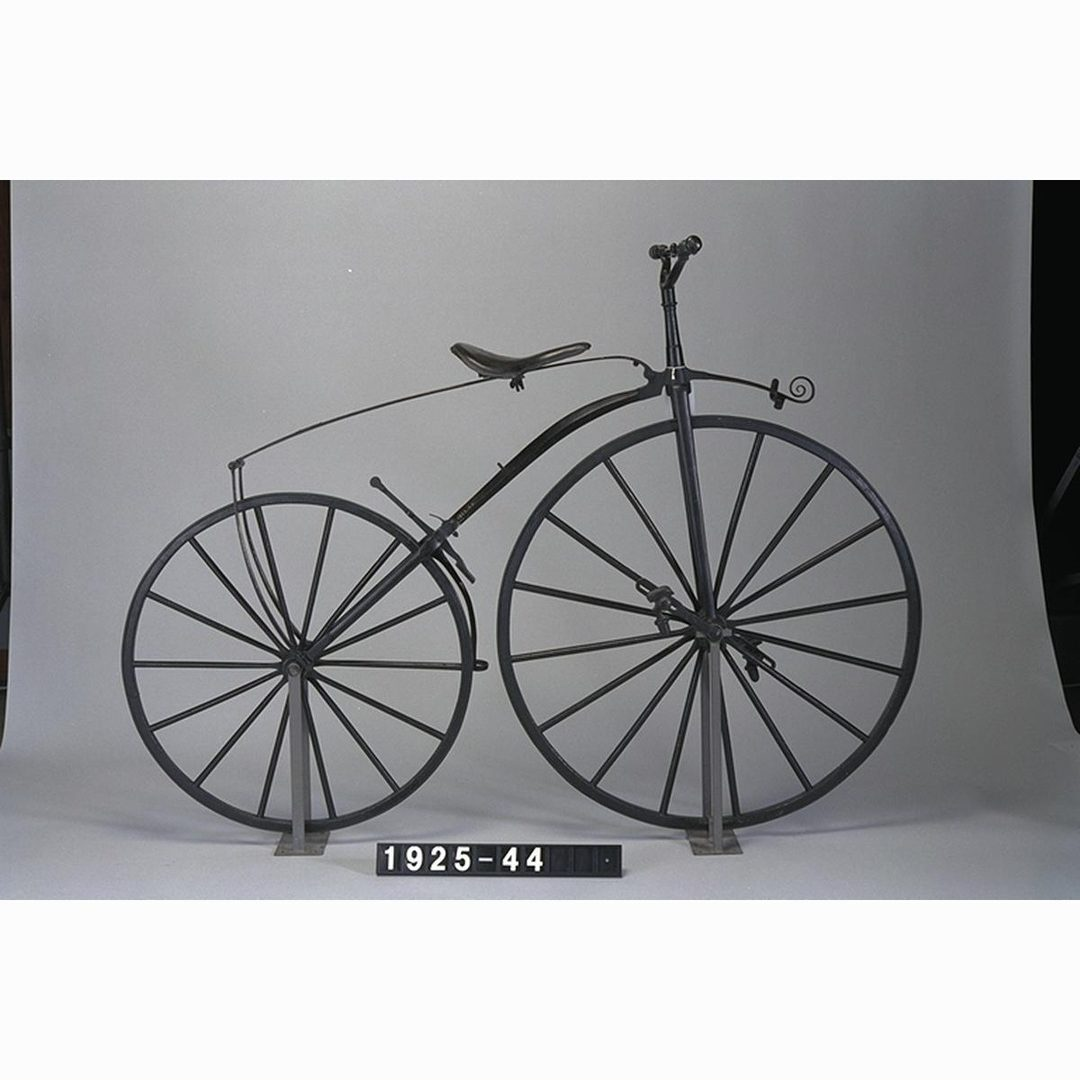
The velocipede did not start as an invention so much as a modification. A wheeled, unpowered “hobby-horse” that riders pushed along with their feet had existed since the early nineteenth century. What Pierre Michaux, a Paris blacksmith who repaired carriages and made parts for the carriage trade, and his son Ernest did — most likely around 1864, though the exact year is disputed — was bolt a pair of cranks and pedals directly onto the front wheel’s hub. That single change turned a coasting toy into something you could actually propel.
The Michaux workshop began building the machines in small numbers, selling a few hundred a year by the mid-1860s. In May 1868 Michaux formed a partnership with two brothers, René and Aimé Olivier, under the name Michaux et Cie, and moved into a larger factory near the Arc de Triomphe. The new firm switched from a wooden frame to one built from two curved pieces of cast iron bolted together — the “serpentine” frame — which was both more elegant and, importantly, easier to produce at volume. Accounts of exactly how many machines the factory turned out vary, but by 1869 it was unquestionably the largest velocipede manufacturer in the world.
The partnership did not last. In April 1869, after a dispute over money, Michaux sold his share to the Olivier brothers and left the company he had founded. It was dissolved and reformed as the Compagnie Parisienne des Vélocipèdes, under the Oliviers alone. Michaux, the man who had bolted on the first pedal, walked away from the business at almost exactly the moment it became a genuine industry.
None of this settles who actually deserves the credit, and contemporaries did not agree either. Ernest Michaux maintained for the rest of his life that he had fitted the first crank to a hobby-horse around 1861, as a teenager, to save himself the effort of scooting it along with his feet. Other workers who passed through the same workshop, including Pierre Lallement, told a different version in which they had done the essential work themselves. French courts heard versions of this argument as early as 1868 and reached no clean verdict, and historians who have gone back through the surviving workshop records since have not been able to settle it either. What is not in dispute is that the idea left the Michaux shop and reached the wider public within a few years of whenever it was actually conceived.
An immigrant mechanic filed the patent, and never saw the money
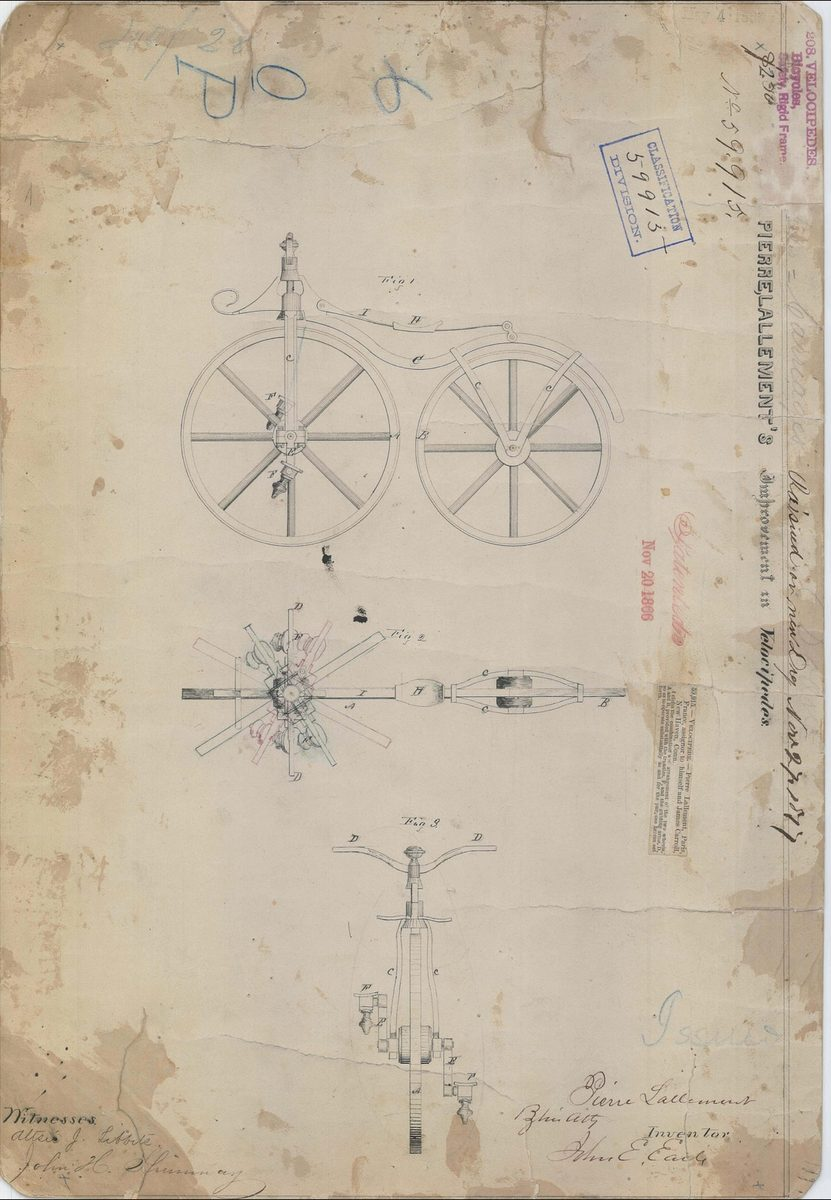
Exactly who deserves credit for the pedal is still argued over, and the argument is not new: it was already being argued in French courts in 1868. But the paperwork is unambiguous about one thing. The first patent for a pedal-driven velocipede anywhere — not in France, but in the United States — belongs to a young mechanic named Pierre Lallement, who had worked in or near the Michaux circle in Paris before sailing for Connecticut in 1865.
Lallement refined his machine in Ansonia and New Haven, found a local backer named James Carroll, and filed a patent application in April 1866 for “the arrangement of two wheels, the one directly in front of the other, combined with a mechanism for driving the wheels, and an arrangement for guiding.” It was granted as US Patent 59,915 on 20 November 1866. It is, by most accounts, the earliest patent anywhere for a pedal bicycle.
None of that made Lallement rich. He could not find an American manufacturer willing to license the patent, so he sold his rights to Calvin Witty, a New York carriage maker, and went back to France. Witty used the patent mainly to collect royalties from other American velocipede makers during the 1869 boom — the one financial windfall the invention produced, and it went to a man who had never built one. Lallement eventually returned to the United States and worked for the Pope Manufacturing Company, a later bicycle maker, and died in Boston in 1891, largely forgotten. His grave went unmarked for over a century.
Racing sold the machine faster than any advertisement could
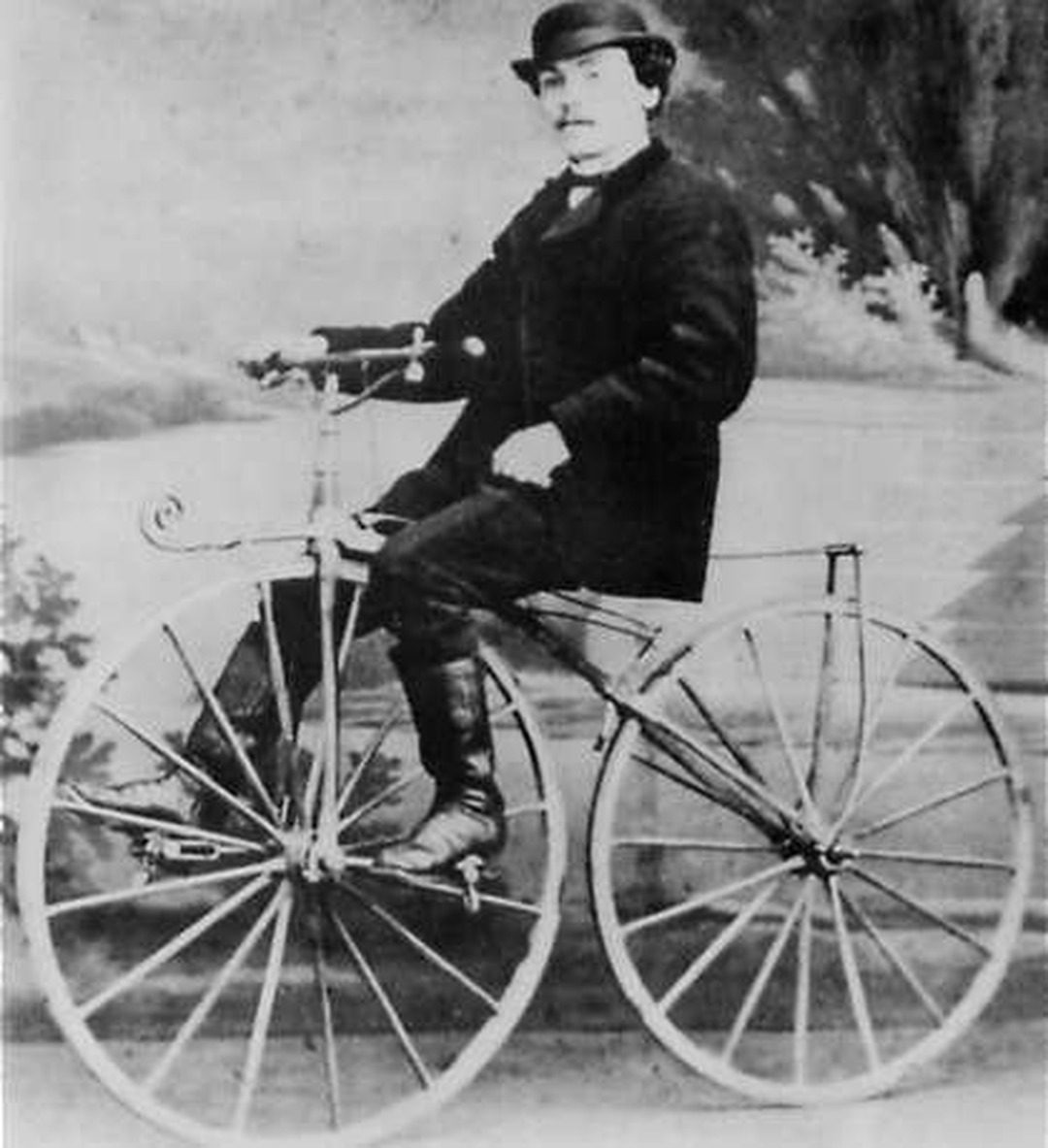
What turned the velocipede from a Parisian novelty into an international story was competition. On 31 May 1868, riders lined up at the Parc de Saint-Cloud outside Paris for what is usually described as the first organised velocipede race, a short 1,200-metre sprint won by an English expatriate named James Moore. The following year, on 7 November 1869, a far more ambitious event ran the 123 kilometres between Paris and Rouen — the first city-to-city cycle race in history. More than a hundred riders, some accounts put the number well over that, started; Moore won again, covering the distance in roughly ten hours and forty minutes, including time spent walking his machine up the steeper hills.
Races like these did two things at once. They generated exactly the kind of vivid newspaper copy — falls, crowds, a foreign winner — that sold the velocipede as a spectacle rather than just a vehicle, and they quietly advertised how physically brutal the machine was to ride any distance at all. A ten-hour race across cobbled and dirt roads on solid iron tyres with no free-wheel and no useful brake was not a subtle argument for comfort.
Buying one was its own kind of statement. A finished velocipede from a French or American workshop typically cost upward of a hundred dollars in 1869 money, at a time when many skilled tradesmen earned something in that range for a full month’s work. That price bought a machine with no gears, no free-wheel, and a seat mounted directly over the front axle, so that every bump in the road travelled straight up through the rider’s spine — which is where the nickname “boneshaker” came from. Paying that much for something that uncomfortable only made sense while the fashion was new.
America caught the fever and built rinks to teach it
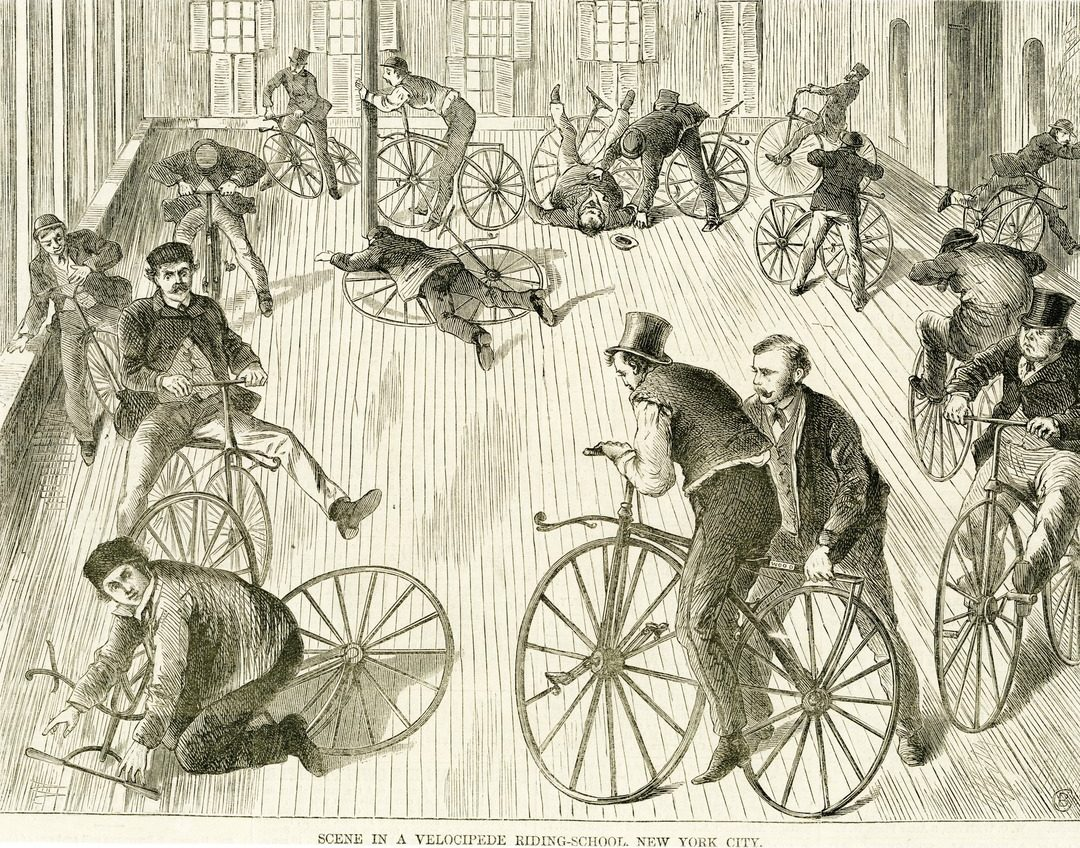
Velocipedes reached New York in the summer of 1868 and spread within months to Philadelphia, Boston, Baltimore and Chicago. What followed was less a fad than an entire small industry built around teaching people to ride. Indoor academies — many of them repurposed roller-skating rinks — opened in cities and small towns alike, charging admission for lessons, practice time and exhibition races. Newspapers ran columns on velocipede etiquette and velocipede injuries in the same breath.
The boom peaked in the first months of 1869 and unravelled with startling speed. By the end of May, contemporary accounts describe rinks standing empty and races drawing a handful of entrants where hundreds had turned out months before. The reasons given at the time hold up well against the machine itself: it was heavy, expensive by the standards of an ordinary wage, had no suspension of any kind, and asked the rider to steer and pedal from the same wheel — a combination that made it exhausting and genuinely difficult to control. A handful of American cities had also begun passing ordinances restricting where velocipedes could be ridden, which did nothing to help a fashion that was already losing its novelty.
A war in Europe finished what the machine’s own flaws had started
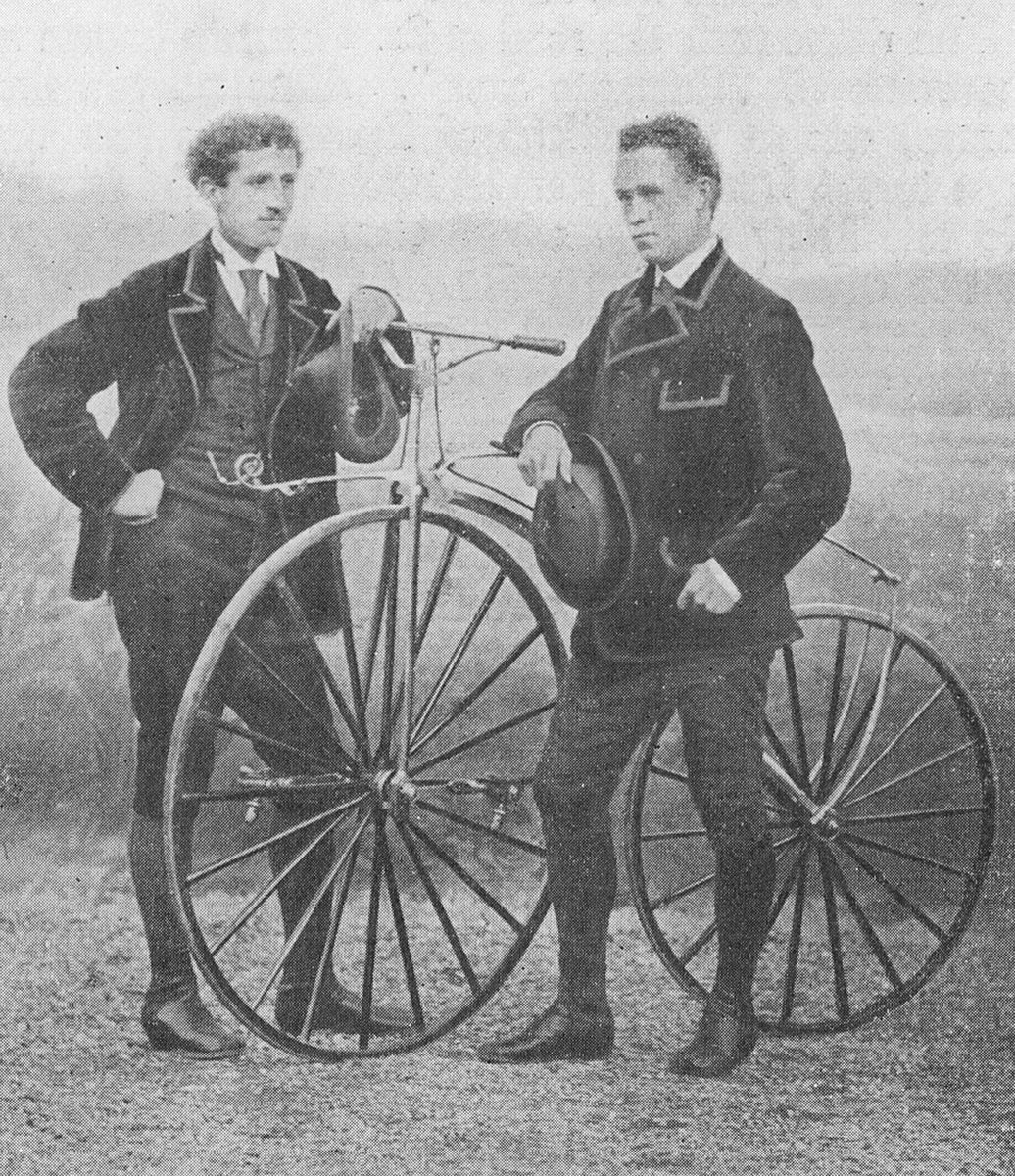
The French collapse had a second, entirely unrelated cause. In November 1868, an English visitor named Rowley Turner bought a Michaux velocipede in Paris and brought it home to Coventry, where his uncle Josiah Turner managed the Coventry Sewing Machine Company. The firm was impressed enough to take an order for around four hundred machines, built in England, for the French market.
They were never delivered. The Franco-Prussian War broke out in July 1870, and the French order collapsed along with much of the French velocipede industry itself — workshops requisitioned or shuttered, export markets gone. The four hundred machines built in Coventry were sold in England instead, and the company that had intended to be a supplier to the French trade became, almost by accident, the seed of the English bicycle industry. Coventry stayed a centre of British cycle manufacturing for the rest of the century.
So the velocipede craze did not end for one reason. The machine wore out its own novelty within about a year on both sides of the Atlantic, and then a war removed the industry that might have kept improving it. What replaced it, in the early 1870s, was the high-wheeled “ordinary” — a taller front wheel that let a single pedal stroke cover more ground, trading the velocipede’s brutal ride for a genuinely dangerous one. That machine, not the boneshaker, is what most people now picture when they imagine Victorian cycling.
Most velocipedes did not survive their own decade. They were cheap to make relative to what came after, heavy, and unfashionable almost overnight, and a great many ended up as scrap iron once the rinks closed. The ones that do survive are mostly in museum collections now — the Science Museum in London holds a Michaux-pattern machine, and the Smithsonian’s National Museum of American History keeps several American-built boneshakers from the same few years — which is itself a small irony. An object built by the hundreds for an eighteen-month fashion is now rare specifically because almost none of it was expected to last.
The boneshaker’s real legacy is quieter than the machine itself: the crank, the pedal, and the patent fight over who thought of them first, all of which the industry kept and refined for the next half-century, and none of which made its actual inventors any money. Michaux died in 1883, having sold out of the company that bore his name. Lallement died in 1891, in Boston, having sold his patent for far less than it turned out to be worth. The man who made money from the patent, Calvin Witty, never built a velocipede in his life.
Watch the full history
The video version covers the Michaux workshop, the patent fight and the American craze in under six minutes.

Related reading
- The Farm Soap That Almost Never Hardened Into a Bar
- The Contested History Behind Blue Monday Washday
- How Kerosene Lamps Actually Worked (And Sometimes Exploded)
- The Coal Scuttle Helmet: Why British Troops Named It That
Works cited
- Herlihy, David V. Bicycle: The History. Yale University Press, 2004.
- Cropper, Corry, and Seth Whidden. Velocipedomania: A Cultural History of the Velocipede in France. Bucknell University Press, 2022.
- Lallement, Pierre. “Improvement in Velocipedes.” US Patent 59,915, filed April 1866, issued 20 November 1866. Link.
- “The Development of the Velocipede.” National Museum of American History, Smithsonian Institution.
- “The Velocipede Invasion of 1869.” Charleston Time Machine, Charleston County Public Library. Link.
- “Pierre Lallement and the Modern-Day Pedal Bicycle.” Today in History, ConnecticutHistory.org (CTHumanities). Link.
- “1869 Paris-Rouen Cycle Race.” Graces Guide to British Industrial History. Link.
- “Michaux Velocipede.” Graces Guide to British Industrial History. Link.
- “Coventry Sewing Machine Company.” Coventry Society. Link.