
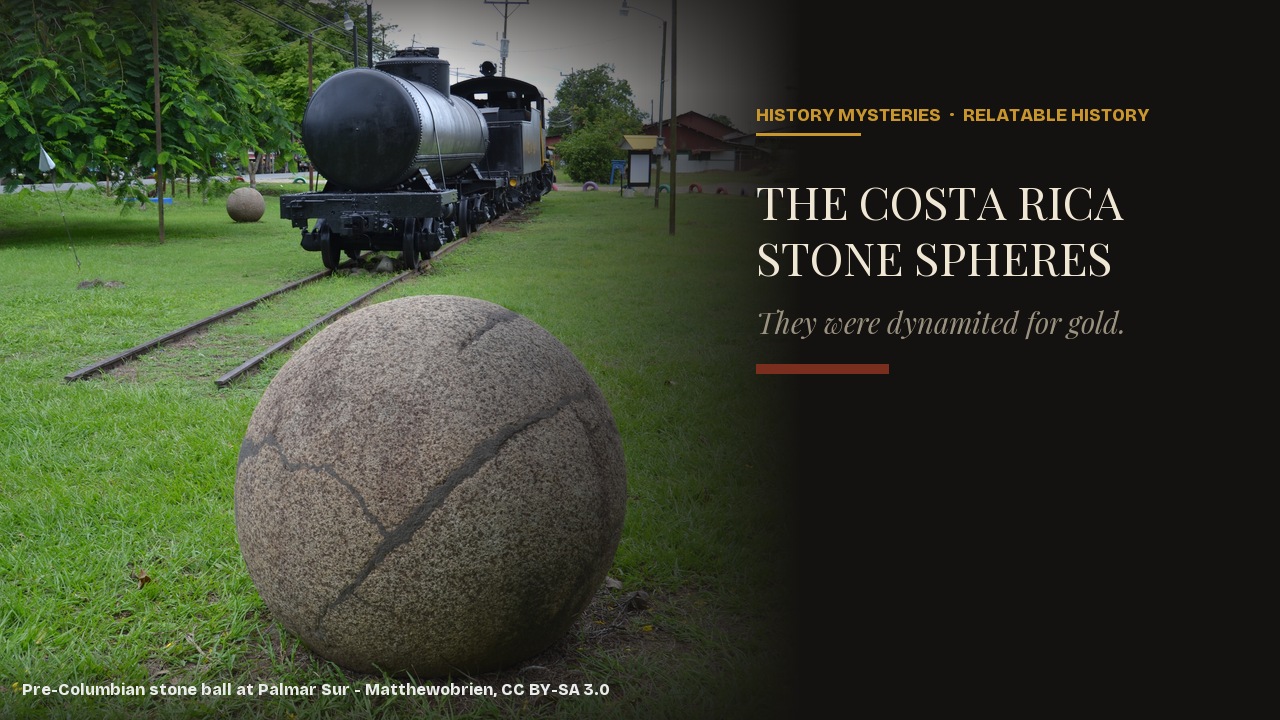
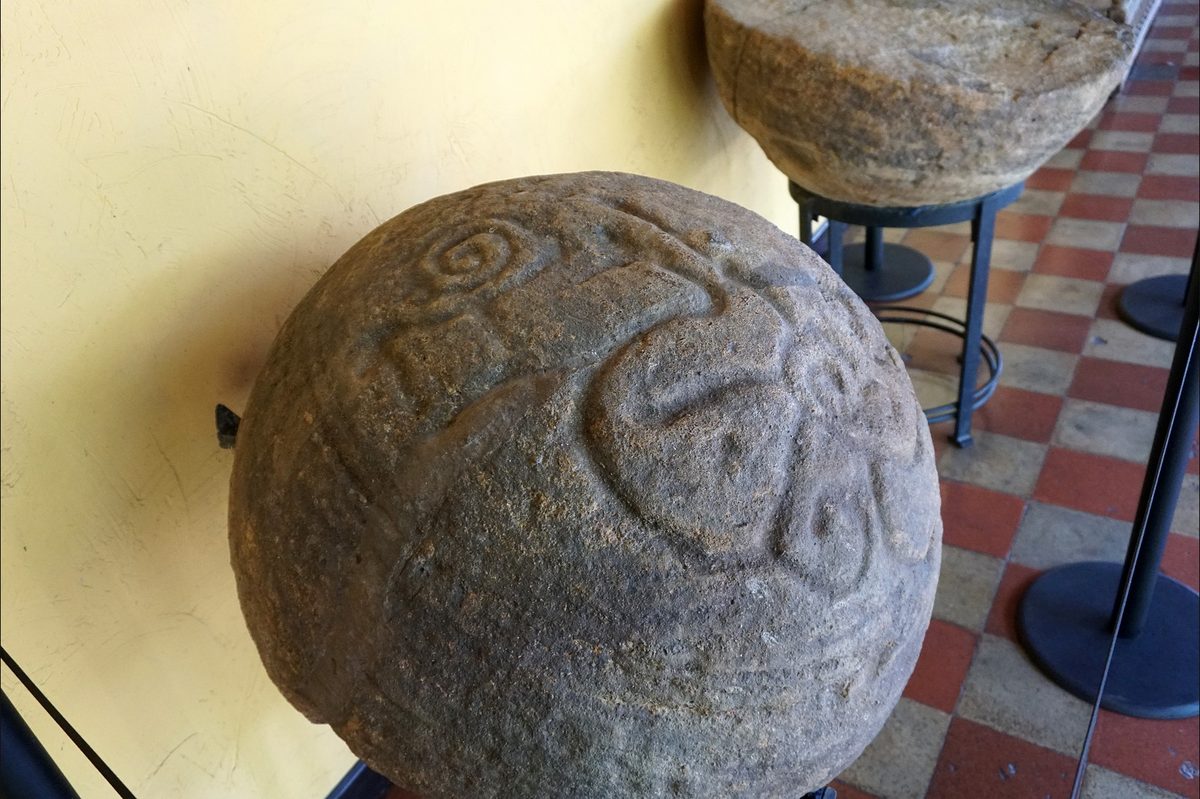
In 2012 an anonymous foundation gave the Metropolitan Museum of Art a sphere of gray-brown stone: 66 centimetres across, 385 kilograms, carved by hands that left no account of what it was for. The museum’s own published entry on the piece, written by assistant curator James Doyle, states plainly that its cultural and symbolic meaning is not well understood. That is not a gap waiting on a clever idea. It is the settled position of the people who have spent careers on this object.
More than three hundred of these spheres have been catalogued across southern Costa Rica’s Diquís Delta and the offshore Isla del Caño. Four of the sites that hold them — Finca 6, Batambal, El Silencio and Grijalba-2 — became a UNESCO World Heritage property in 2014, under the title Precolumbian Chiefdom Settlements with Stone Spheres of the Diquís. UNESCO’s own nomination document is just as direct as the Met’s: the spheres’ meaning, use and production, it says, remain largely a mystery.
What follows is not another account of how the spheres were found, which the video covers. It is a walk through what the evidence actually supports for what the stone spheres were for, which theory has the best claim on being right, where serious researchers disagree with each other, and what has happened to the spheres and the people studying them since the UN took notice.
The best-evidenced theory rests on exactly two spheres that never moved
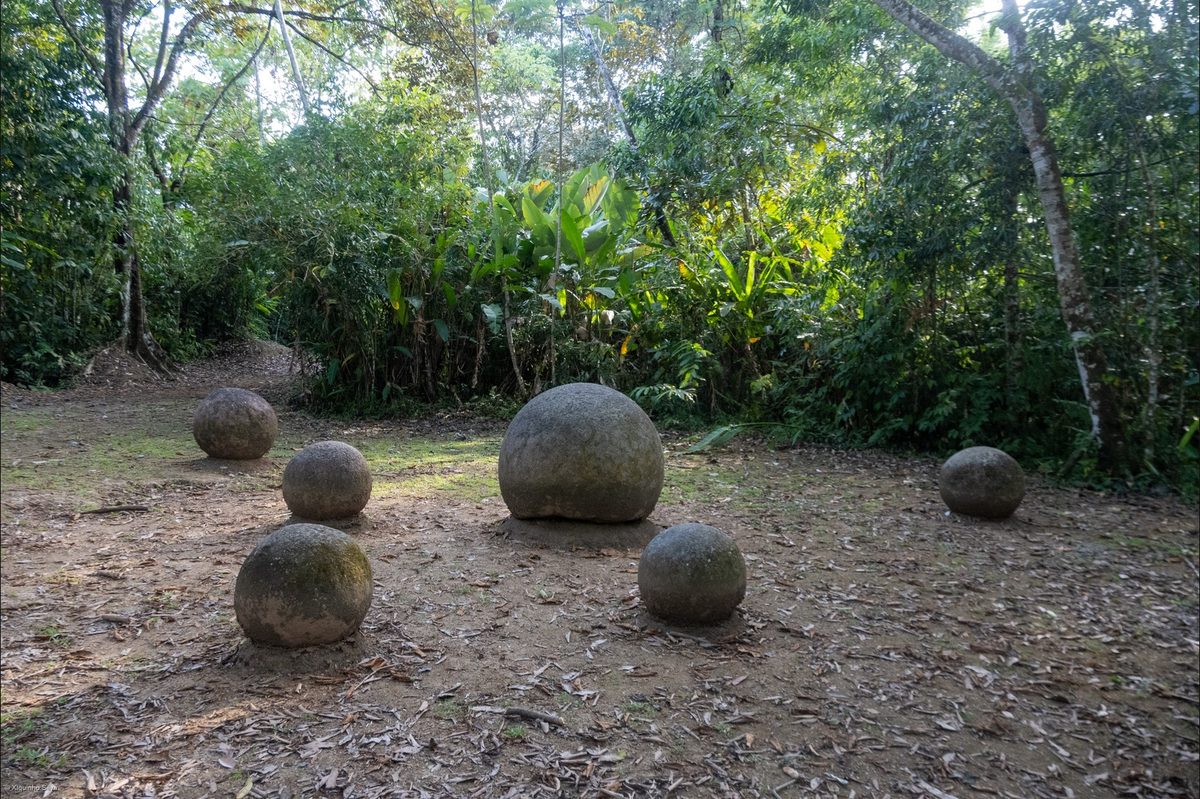
Archaeologist Francisco Corrales, of Costa Rica’s Museo Nacional, has worked the Diquís sites since the 1990s, and the single strongest piece of evidence anyone has produced came out of his fieldwork that decade: two spheres, found exactly where they had been set, flanking the entrance ramp of a house platform. The reading that follows from it is that spheres marked rank and approach — placed to announce the home of someone important — rather than serving any function of their own.
Finca 6 is where that reading gets its best support. Of roughly thirty spheres recorded there, seven are still sitting in the context they were placed in, and five of those run in a rough east-to-west line beside earthen mounds. It is, by a wide margin, the most completely preserved arrangement of spheres anywhere, which is exactly why it carries so much of the argument for any theory at all. Corrales has been careful about the limits of that argument. Asked which explanation was correct, he told Archaeology magazine in 2014 that no theory had been proven so far — a position he has not walked back since.
A minority view reads the labor itself as the point
Not every specialist accepts the status-marker reading as the whole story. John Hoopes, an anthropologist at the University of Kansas who has studied the spheres since 1990, argues that the significance was in the act of making them rather than in where they ended up. On his account, rounding a boulder pulled from a river was a way of asserting human control over a force the makers could not otherwise command, and the finished sphere carried that claim with it wherever it was placed.
The two views are not easily reconciled. Corrales’s is essentially architectural: the sphere’s value comes from its position relative to a house and a mound. Hoopes’s is essentially ritual: the value is already fixed before the sphere ever reaches its final spot. Both researchers are working from the same small set of undisturbed finds, which is a large part of why the disagreement has not resolved — there simply is not enough surviving context to force a choice between them.
Astronomy and myth are harder to dismiss, and harder to test
Two further theories circulate with real academic backing, and both run into the same wall. The first holds that certain sphere groupings line up with the sunrise position on the horizon at particular times of year, in the same broad family as the solar readings argued for sites like the Nazca lines in Peru. The second, floated by Corrales himself in a 2021 paper reported by the outlet HISTORY, proposes that specific spheres anchored origin or creation myths tied to particular lineages.
Neither can be properly tested, for the same reason the status-marker theory is hard to extend past Finca 6: an alignment argument needs the spheres to still be sitting where they were placed, and all but about a dozen of the three hundred-plus known spheres are not. A sphere moved onto a bank’s front lawn in San José cannot tell you what it once pointed at.
Below those four sit weaker proposals that do not hold up as well: that groupings tracked the phases of the moon, that the spheres represented sea-turtle eggs scaled up into monuments, or that they mapped constellations onto the ground. None of the researchers whose fieldwork underlies the stronger theories treats these as more than speculation, and none has published excavation data to support them. They persist mostly because, absent a confirmed answer, almost any proposal involving a round object and the sky finds an audience.
Most spheres are gabbro. The ones that are not became a 2025 conservation project
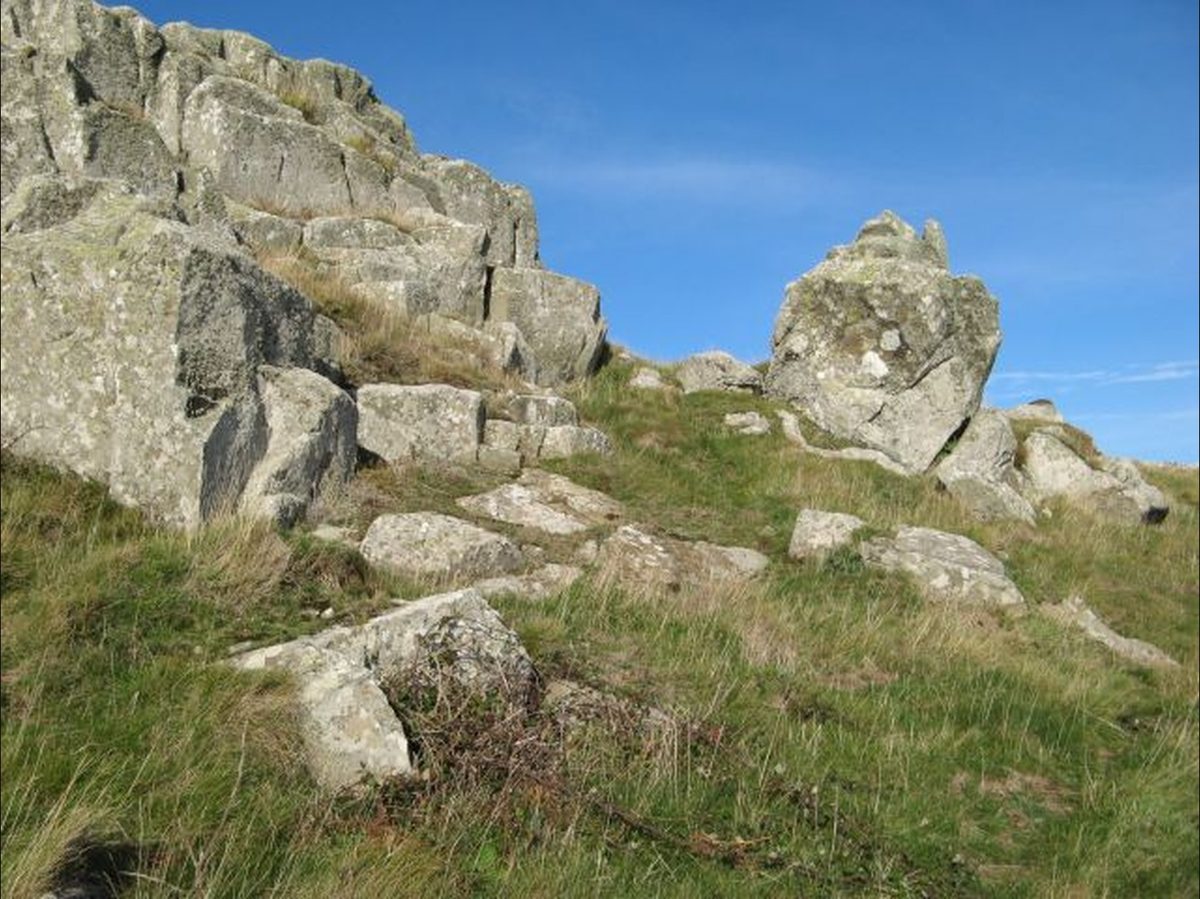
The bulk of the spheres are gabbro, a coarse, dense volcanic rock, worked by pecking the boulder with a harder hammerstone and then grinding the surface smooth with sand — there is no evidence of metal tools anywhere in the record, which places this in the same no-metal, pure-labor category of puzzle as objects like the Roman dodecahedra, whatever their makers actually intended. But gabbro is not the only material. A smaller number are a shell-bearing limestone, and the material itself turned out to matter: in July and August 2025, conservators from Costa Rica’s Museo Nacional and Mexico’s National School of Conservation, Restoration and Museography treated three limestone spheres, originally from a cluster called Finca 4, that were cracking and losing surface material in a way the harder gabbro spheres simply do not.
The work — part of a conservation partnership between the two institutions that by 2025 had already run a decade — involved mechanical cleaning, a mild bactericide against microorganisms, lime-based mortars mixed with limestone powder to stabilise fragile areas, and small reversible touches of natural pigment where the original surface was gone. The spheres now sit under a roofed shelter at the Finca 6 site museum with temperature and humidity monitored, the same preventive approach museums use for anything too soft to simply leave outdoors.
Three hundred and ninety-five looted objects came home in 2024
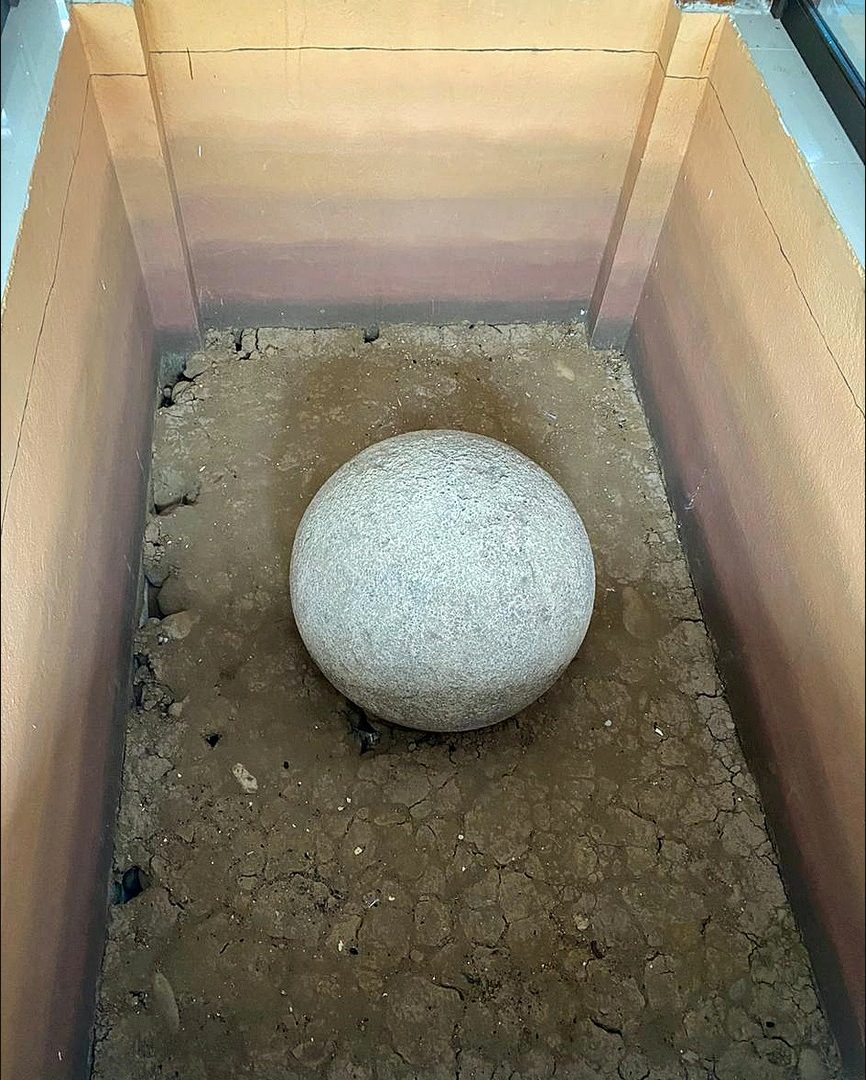
One sphere, about 65 centimetres across and most likely gabbro, was among 395 pre-Columbian artefacts returned to Costa Rica in 2024, alongside ceramics, metates, stone tools, polychrome vessels and ornamental stones that had been removed from the country at some point in the past. The return was made possible by a grant from the United States Embassy to a bilateral Cultural Agreements Fund; announcing it, US Ambassador Cynthia Telles said the two countries “share a common belief about the importance of preserving and celebrating our unique histories.”
The Met’s own sphere shows how a piece leaves the country in the first place and why getting one back is not simple. Its documented chain runs from Belgian collector Emile Deletaille, who bought it in the late 1960s from Amsterdam dealer Harvey Menist, through Deletaille’s homes in Brussels and then New York, to the Austen-Stokes Ancient Americas Foundation, which acquired it in 2008 and gave it to the Met in 2012. Nobody in that chain needed to do anything illegal by the standards in force when each sale happened; the sphere simply moved through a market that existed before Costa Rica’s export protections did, and once an object is a museum’s catalogued accession, getting it back requires exactly the kind of government-to-government agreement that produced the 2024 return.
That repatriation sits inside a much longer effort. Costa Rica gave the spheres and their sites legal protection as national archaeological heritage starting in the 1980s, which is also when exporting one became illegal, and the National Museum has run a dedicated research project on the sphere sites since 2005. The 2014 UNESCO inscription did not create that protection; it recognised an effort already two decades under way, and gave it, for the first time, an international audience with a stake in whether it succeeds.
Two infrastructure projects are the sites’ next real threat
The danger to what is left is no longer bulldozers clearing banana rows. In its most recent assessments of the property, UNESCO flags two proposed developments as the live risk: a Diquís hydroelectric dam and a Southern International Airport, either of which could reach Batambal, the one component site positioned to be seen from a distance and, for that reason, the most exposed to nearby construction. Costa Rica’s government has committed to running a Heritage Impact Assessment before either project goes ahead and to prioritising the property’s protection in the design, but the commitment is a planning condition, not a cancellation.
Three of the four component sites — Batambal, Grijalba-2 and El Silencio — are also not yet open to the public, which means most of what UNESCO protects is still being managed rather than shown. The management plan filed with the nomination runs on a six-year cycle and explicitly puts opening those three sites on the to-do list, alongside conservation work the National Museum has said plainly it does not yet have the staff and funding to finish quickly.
The people who made them were gone before anyone could ask
Whichever theory is right, there is a hard ceiling on ever proving it: the culture that carved the spheres did not survive to be asked. Spanish explorers moving through the region in the 1500s left no record of encountering the spheres at all, which most researchers take to mean the society that made them had already broken up by the time Europeans arrived. Why is its own open question. Hoopes has pointed to catastrophic flooding capable of ruining several seasons of farming in a floodplain society with no buffer against that kind of loss. Others point to warfare: stone statues from the same cultural sphere depict trophy heads and decapitation, which is not the imagery of a society at peace with its neighbours.
Either way, there was no one left to hand down an explanation, and the explanation that might otherwise have survived in practice — a dozen spheres still sitting exactly where their makers put them — is almost all the physical record that got to keep its context into the twentieth century. Everything else is a sphere with an excellent biography and no address.
Watch the full history
The video covers the 1930s discovery, the gold-rumour destruction that followed it, and the real trouble with dating anything that has been moved.

Related reading
- What Were Roman Dodecahedra Actually Used For? — another object with hundreds of surviving examples and no agreed purpose.
- Was the Baghdad Battery Real? — a case study in how far an unproven theory about an ancient object can travel.
- Why Were the Nazca Lines Made? — the same astronomical-alignment argument, tested against a much larger surviving site.
- How the Antikythera Mechanism Predicted Eclipses — what happens when the context problem goes the other way and the object turns out to be far more sophisticated than expected.
- The Plain of Jars: Older Than the Burials Inside Them — another megalithic landscape where later use has obscured the original purpose.
Works cited
- Lothrop, Samuel K. Archaeology of the Diquís Delta, Costa Rica. Papers of the Peabody Museum of Archaeology and Ethnology, Harvard University, vol. 51, 1963.
- Stone, Doris Z. “A Preliminary Investigation of the Flood Plain of the Rio Grande de Térraba, Costa Rica.” American Antiquity 9, no. 1 (1943): 74–88.
- Quintanilla Jiménez, Ifigenia. Esferas precolombinas de Costa Rica. Fundación Museos del Banco Central de Costa Rica, 2007.
- UNESCO World Heritage Centre. “Precolumbian Chiefdom Settlements with Stone Spheres of the Diquís.” World Heritage List, Dossier No. 1453, inscribed 2014.
- Doyle, James. “A Stone Sphere from Costa Rica.” Perspectives, The Metropolitan Museum of Art, August 19, 2014.
- Grunberg Banyasz, Malin. “Trenches: Off the Grid, Costa Rica.” Archaeology, November/December 2014. Link.
- Milligan, Mark. “Archaeologists Conduct Project to Conserve Costa Rica’s Stone Spheres.” HeritageDaily, July 20, 2023.
- “Stone Sphere Among Artefacts Repatriated to Costa Rica.” HeritageDaily, April 18, 2024.
- “Specialists Restore Mysterious Diquís Spheres.” Archaeology Magazine, September 22, 2025. Link.
- Clendenning, Alan. “The Mysterious Stone Spheres of Costa Rica.” HISTORY, July 11, 2025. Link.