
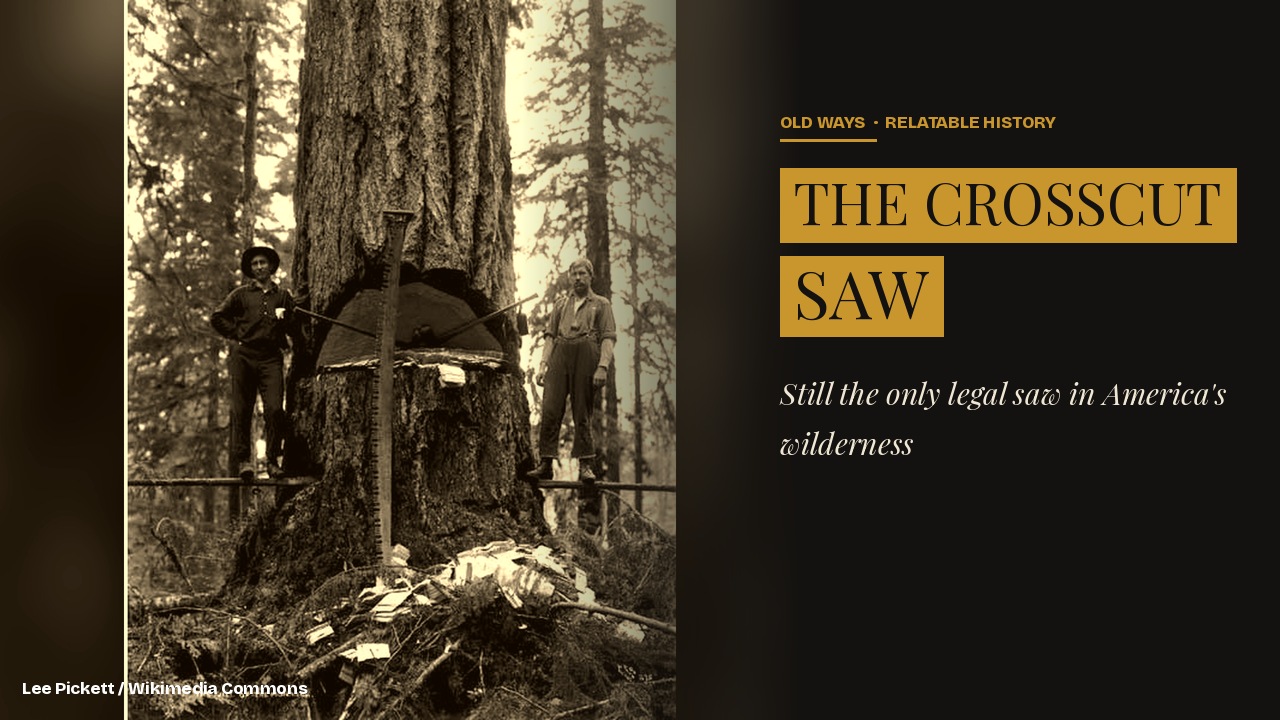
More than 25,000 volunteers and employees are currently certified by the U.S. Forest Service to run a steel saw with no motor, no battery, and a handle on each end — because federal law makes it illegal for them to bring anything else into most of the roughly 111 million acres of land Congress has designated as wilderness. The saw is the two-man crosscut, a design that predates the chainsaw by about a century. The law behind the ban doesn’t name any tool at all. It simply forbids a motor.
That law is the Wilderness Act of 1964, and the operative sentence is short enough to read in under a minute: no motor vehicles, no motorized equipment, no other form of mechanical transport, inside land Congress designates as wilderness, except where the agency running it decides a motor is the bare minimum needed to administer the area. A chainsaw is motorized equipment. A crosscut saw is not. Everything that follows from that one clause — who gets trained to use the old saw, how, and what happens when a single storm drops hundreds of trees across a trail system — traces straight back to a bill signed six years before the first genuinely practical production chainsaw reached American hardware stores.
Working out why the rule has held for sixty years means following two separate histories that collided mostly by accident: the legal fight over what “wilderness” should mean, and a century of quiet competition among saw manufacturers to build a blade two people could actually stand to use all day. Neither side was planning for the other.
The Law Doesn’t Ban Chainsaws. It Bans Motors.
Designated wilderness is a specific legal category, not just a description of remote country. Under the Wilderness Act, a qualifying area generally has to be at least 5,000 contiguous roadless acres and offer what the statute calls “outstanding opportunities for solitude or a primitive and unconfined type of recreation.” Once Congress designates an area, the restrictions in Section 1133(c) of the Act apply: no temporary or permanent roads, no motor vehicles, motorized equipment, or motorboats, no landing of aircraft, and no other form of mechanical transport — except, the statute says, “as necessary to meet minimum requirements for the administration of the area,” a category that explicitly covers emergencies involving the health and safety of people inside it.
Nothing in that text says chainsaw. It doesn’t have to. A chainsaw runs on an engine, which places it inside “motorized equipment” automatically, the same category that keeps out trucks, generators, and drones. The sentence that outlaws a $400 power tool is the identical sentence that outlaws a bulldozer. That is also why the ban has survived sixty years of chainsaw improvements without a single amendment: it was never written about saws in particular.
What the statute leaves open is the “minimum requirements” exception, and the two agencies that manage most wilderness acreage have not read it the same way. The National Park Service has generally treated clearing a blocked trail as exactly the kind of minimum administrative requirement the exception anticipates, and its wilderness trail crews have used chainsaws under that reading for years. The Forest Service, which manages far more wilderness acreage than the Park Service, has instead run something close to a no-exceptions policy: chainsaws stay out, and the agency trains an entire parallel workforce to do the same work by hand.
When the Rule Bends Anyway
That no-exceptions stance was tested directly in 2026. The Forest Service agreed to let the Idaho Outfitters and Guides Association run chainsaws on a limited set of trails inside the Frank Church–River of No Return Wilderness, one of the largest wilderness areas in the contiguous United States, to work through a backlog of storm-killed timber that hand crews could not clear fast enough on their own. Wilderness advocates warned that even a narrow exception sets a precedent other outfitters and other forests will ask to repeat. Other critics went further, accusing the agency of bending to a well-connected user group instead of funding the trail crews it already has.
Journalist Claire K. Thompson, who spent eight seasons on Forest Service trail crews in the Washington Cascades before writing about the decision for High Country News, argues the opposite problem is the one actually going unaddressed: understaffed crews facing climate-driven deadfall at a scale the hand-saw-only rule was never built for, while the public debate over the Idaho exception fixates on precedent rather than on the people doing the cutting. She isn’t alone in treating the chainsaw ban as live, unsettled policy rather than settled law — proposals floated elsewhere include battery-powered saws, which run far quieter than a gas engine, and simply paying for larger trail crews so hand tools can keep pace without a motor at all. None of that has been adopted Forest Service–wide, and outside the single Idaho exception, the agency’s baseline position is the one it has held since 1964.
A Blade With No Engine Had to Be Engineered Twice as Hard
None of this would matter if a hand-pulled saw simply couldn’t cut a tree down in a reasonable time, and for most of its early history, it genuinely struggled to. The Forest Service’s own training manual for the tool, Saws That Sing, traces the crosscut through centuries of mostly disappointing designs: a plain, evenly spaced “peg” tooth that worked tolerably on dry, hard wood but clogged solid in anything wet or resinous, and an alternating “M-tooth” pattern developed in southern Germany in the 1400s that improved on it without solving the problem on green timber.
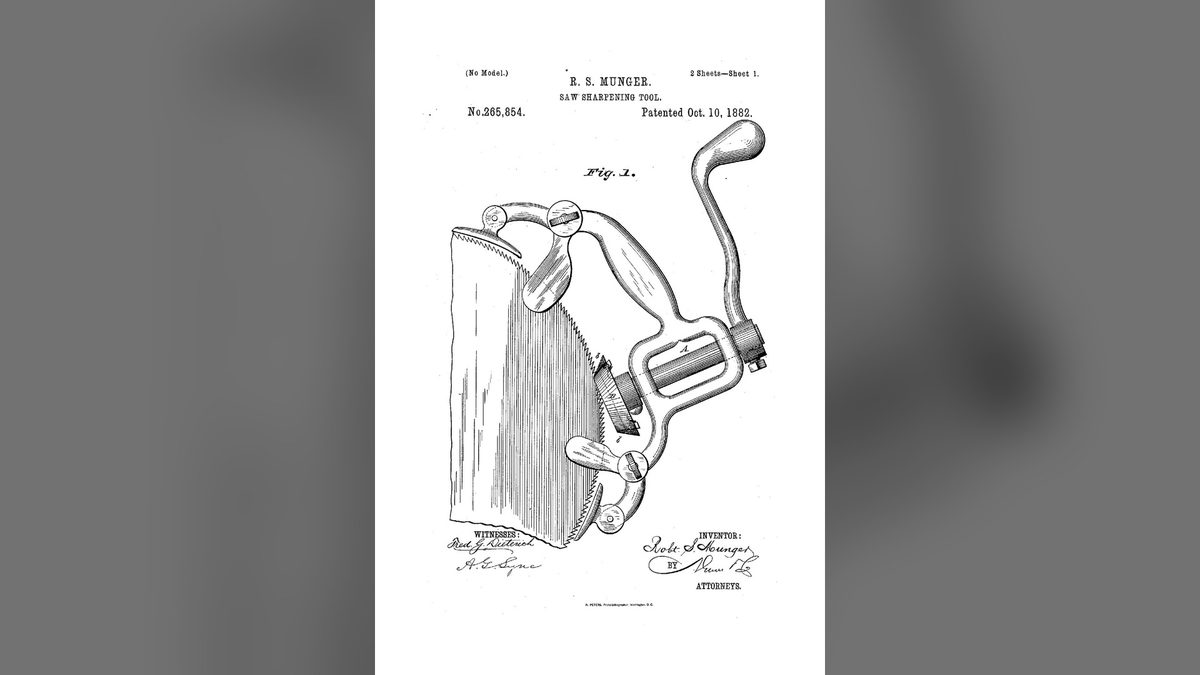
The eventual fix split one job into two kinds of teeth. A cutter tooth is filed to sever wood fiber, the way a knife would; a raker tooth is filed almost flat and does no cutting at all — it simply scrapes the fiber the cutters just severed out of the cut, in long curls that sawyers in some regions still call “noodles.” Arrange cutters and rakers in the right rhythm along one blade and the saw clears its own sawdust as it goes, instead of binding solid partway through a log. Several versions of that idea were sold under their own trademarked names: the Great American, or “crown,” pattern needed its own specialized teardrop-shaped file to keep sharp; the Champion pattern, built around a heavier, unset raker, was marketed for the hardwood forests of the eastern United States; and the lance tooth, sometimes sold as the “racer” pattern, became the standard choice for felling and bucking the soft, resinous fir, spruce, and redwood of the American West. A later refinement, the perforated lance tooth, punched small holes between the teeth to stiffen them against chatter in harder wood, and stayed the favorite in pine country well into the twentieth century.
Two Rival Sawmakers Chased the Same Problem
The companies selling those patterns into farms and logging camps were, by the late nineteenth century, dominated by two firms a thousand miles apart. Henry Disston, an English-born saw maker, opened his own shop in Philadelphia in 1840 after finishing an apprenticeship at another saw works; by 1859 he employed 150 workers, and a Civil War government contract — alongside the saws, his works also turned out sabers, bayonets, and rifle barrels — helped finance a move in 1871 to a much larger plant in the Tacony section of the city, where Disston also built housing for his own workforce. He died in 1878, and his son Hamilton took over a company that was, by then, among the largest saw manufacturers in the country.
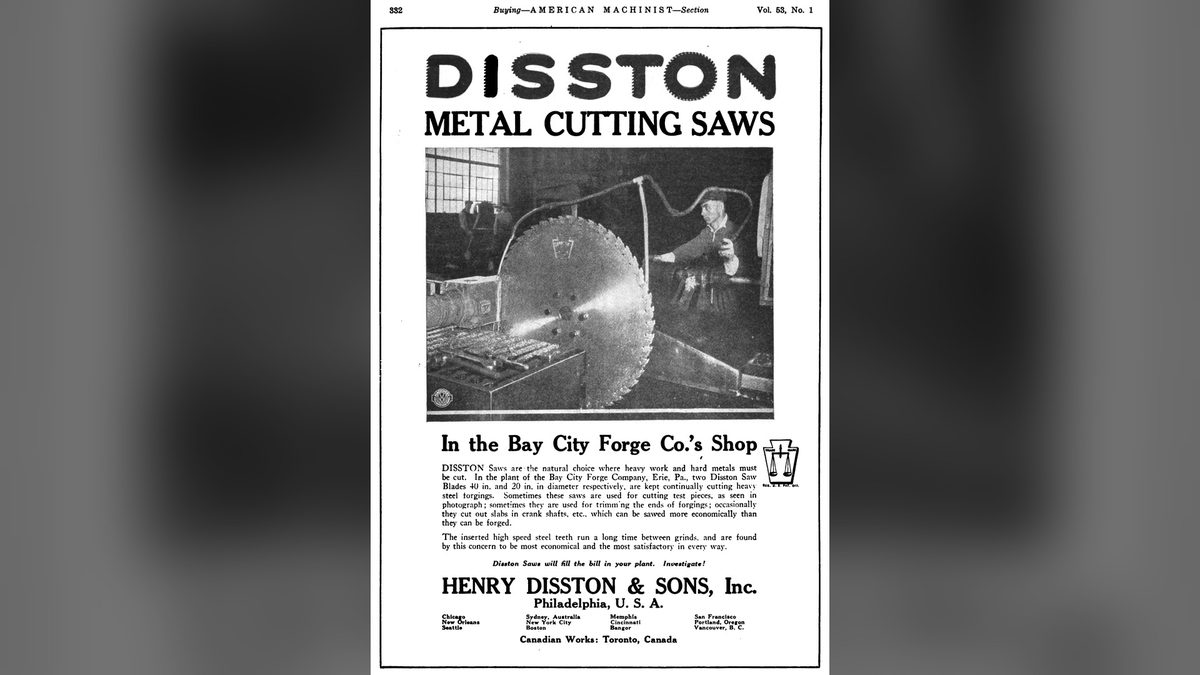
Thirteen hundred miles west, in Indianapolis, a saw factory founded in 1856 grew into E. C. Atkins and Company along much the same trajectory: a single founder’s firm that, by the time his son Henry Cornelius Atkins inherited the presidency on his father’s death in 1901, had become, by its own local historians’ account, one of the nation’s largest saw manufacturers. Disston and Atkins spent decades competing directly for the same farm and timber-camp customers, each selling its own branded tooth geometry as the one that cleared a cut fastest and held an edge longest. Keeping any of those patterns true in the field was a specialized job on its own; a poorly filed blade could turn an otherwise sound saw into dead weight no matter how hard the two sawyers pulled.
Training a Sawyer for a Job That Mostly Disappeared
By the 1950s, the crosscut’s working life outside of farms was effectively over. Lighter, more reliable gasoline chainsaws from postwar manufacturers let a single logger outcut a two-person crosscut crew in a fraction of the time, and commercial logging converted almost completely within a decade. What kept the older saw alive afterward wasn’t nostalgia; it was the 1964 law that followed a few years later and carved out exactly the acreage where a gasoline engine could never legally take its place.
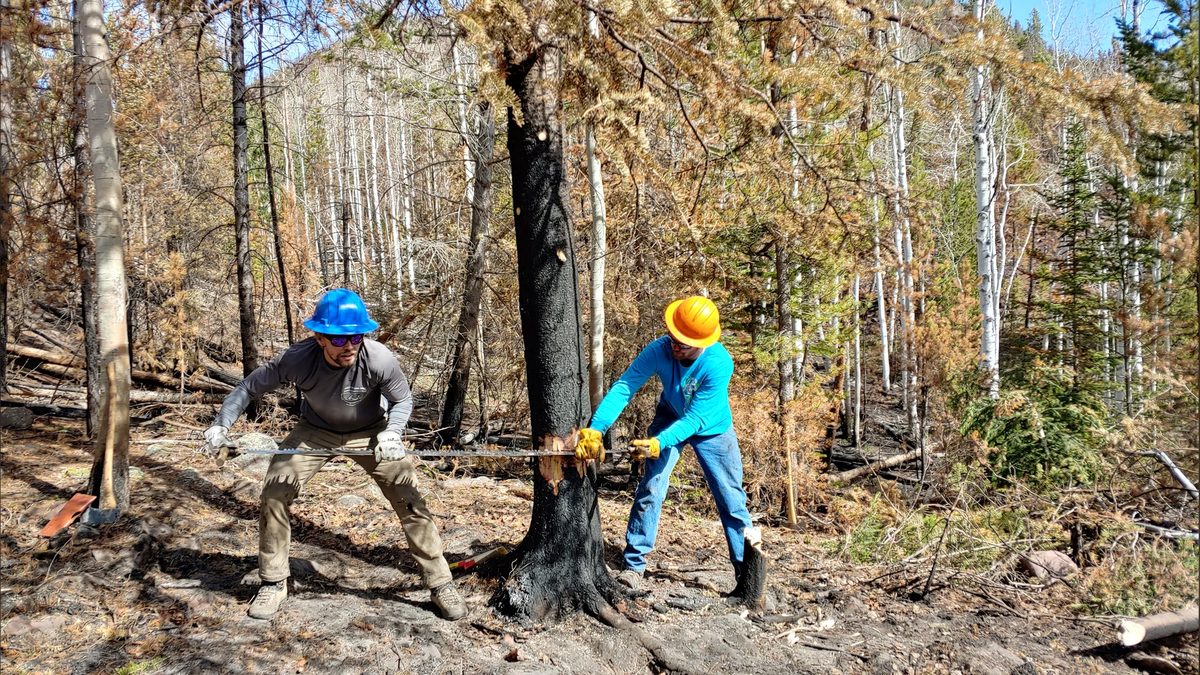
That created an unusual, ongoing need: a federal agency permanently training people to use a tool the rest of the country had already abandoned. The Forest Service runs its sawyers through a tiered certification ladder — trainee, then A, then B, then C — with each level unlocking more complex work. An A-level sawyer, typically after a year or two of supervised cutting, can take on straightforward trees; a B-level sawyer, the level most Forest Service sawyers hold, can work many situations unsupervised and help train A-level sawyers; and reaching C-level, the only certification cleared for the most dangerous situations — fire-weakened timber, storm-snapped trunks under tension, rotten wood that can fail without warning — can take seven to ten years. Sawyers can certify in chainsaw use for the land outside wilderness boundaries, in crosscut for the land inside them, or both, and every certification lapses after three years without a recertification course. At parks that run their own program, the requirements can differ in the details: Rocky Mountain National Park’s crosscut users must also follow federal logging-safety regulations and carry a minimum kit of hard hat, eye protection, and non-skid boots before they’re allowed to touch a blade.
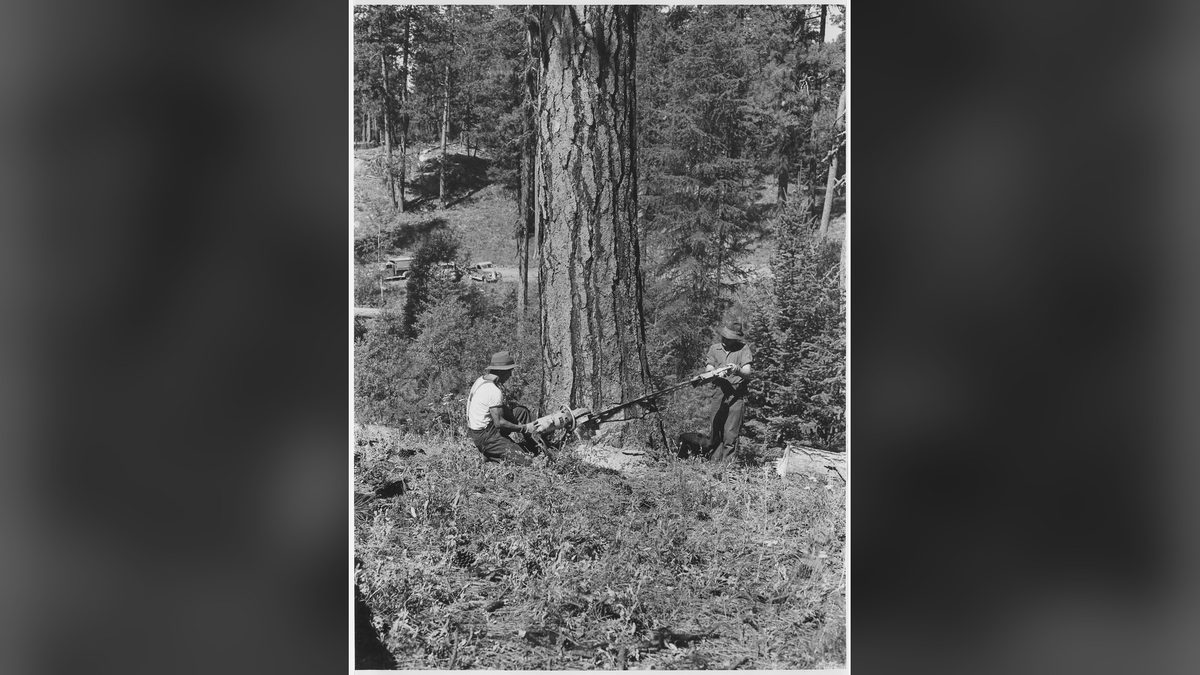
According to figures the agency reported in 2024 through its Intermountain Region program, more than 25,000 sawyers now hold active certification nationwide, covering a National Forest trail system of more than 150,000 miles — over half of which, in a typical year, is maintained by volunteers and partner organizations rather than paid staff. Training has expanded past the agency’s own instructors: groups such as the Pulaski Users Group and partner-run programs like the Stanley Workshop in Stanley, Idaho, now certify and recertify sawyers directly, under formal agreements with the Forest Service, specifically to cover ground the agency’s own trainers can’t reach alone. The National Park Service runs a parallel but separately administered system of its own — Rocky Mountain National Park, for instance, built its own three-tier crosscut program in 2011, with its own course and its own certification card — which means a sawyer certified to cut in one wilderness area isn’t automatically certified to cut in the next one over.
Watch the full history
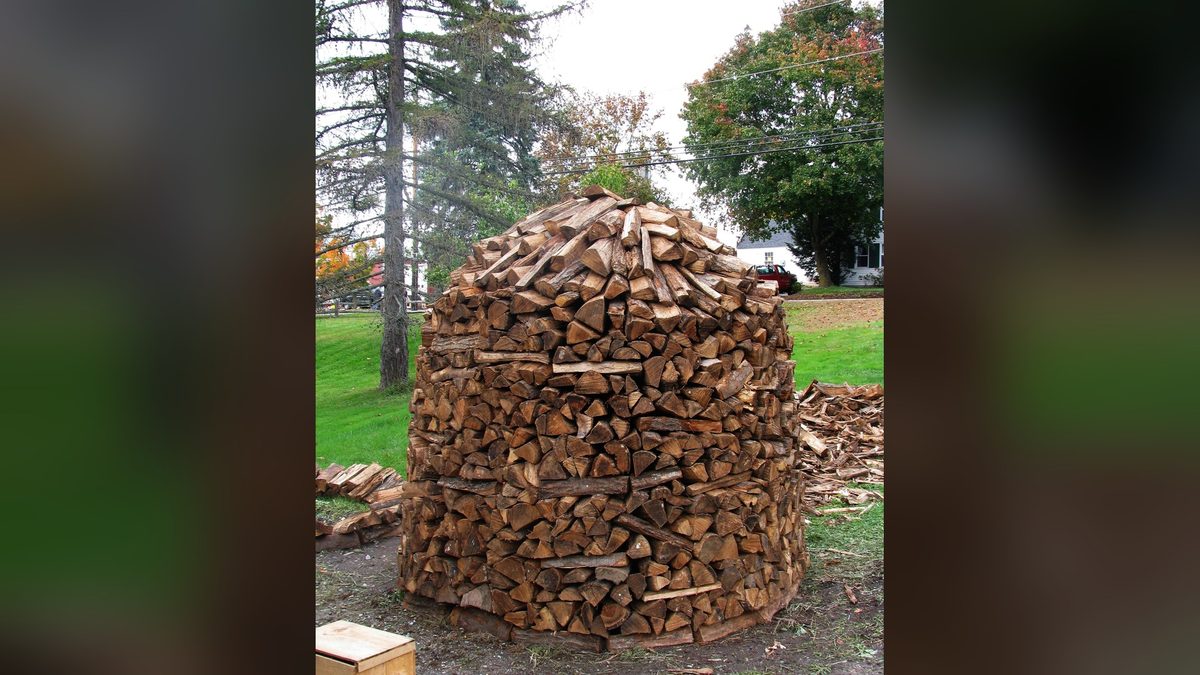
The video version covers the saw’s farm and logging-camp life in just over seven minutes — the raker tooth, the sawbuck, and the household math of heating a house with wood all winter.

Put the two histories side by side and the survival of the crosscut saw stops looking like an accident of sentiment. A nineteenth-century rivalry between two saw companies produced a tool good enough to do serious work without a motor; a mid-twentieth-century law, written to keep motors and roads out of the last roadless country the federal government owned, then made that tool legally necessary rather than merely quaint. Nobody drafting the Wilderness Act in 1964 was thinking about tooth patterns, and nobody filing a lance-tooth blade in 1890 was thinking about an act of Congress seventy years off. The two just happened to fit.
What that leaves, sixty years on, is an odd kind of living fossil: a commercially obsolete hand tool kept not in a museum case but in active federal service, with its own certification ladder, its own three-year renewal clock, and its own open argument over whether the rule protecting it still makes sense for the land it protects. The next time a trail crew works a storm-killed lodgepole off a wilderness path with a seven-foot blade and no engine, the saw isn’t there because anyone romanticized it. It’s there because the law never got around to mentioning anything else.
Related reading
- How Carpet Beaters Worked Before the Vacuum Cleaner
- How the Washboard Became a Musical Instrument
- How Oxen Were Trained to Plow Without Reins or a Bit
- Why Keyboards Use QWERTY — And What the Jamming Story Gets Wrong
Works cited
- Michael, David E. Saws That Sing: A Guide to Using Crosscut Saws. USDA Forest Service, Technology and Development Program, Pub. 0423-2822P-MTDC, December 2004 (revised June 2012). Link.
- 16 U.S.C. § 1133(c) (Wilderness Act of 1964). Link.
- Kohrt, Sabrina. “Making the Cut.” USDA Forest Service, Intermountain Region, October 17, 2024.
- Thompson, Claire K. “A Ban on Chainsaws in Wilderness Is Performative, Not Practical.” High Country News, July 28, 2026.
- Rocky Mountain National Park. Crosscut Saw Management Plan. National Park Service, July 2011.
- Silcox, Harry C. A Place to Live and Work: The Henry Disston Saw Works and the Tacony Community of Philadelphia. Pennsylvania State University Press, 1994.
- Tevault, Ellen. “Henry Cornelius Atkins.” Encyclopedia of Indianapolis, Indianapolis Public Library, revised February 5, 2021. Link.
- “National Crosscut and Chainsaw Program.” American Trails, March 2021.
- Lambert, Craig. “Old-Fashioned Warmth.” Harvard Magazine, January–February 2006. Link.
- “Fast Facts.” Wilderness.net, National Wilderness Preservation System, 2023 data. Link.