
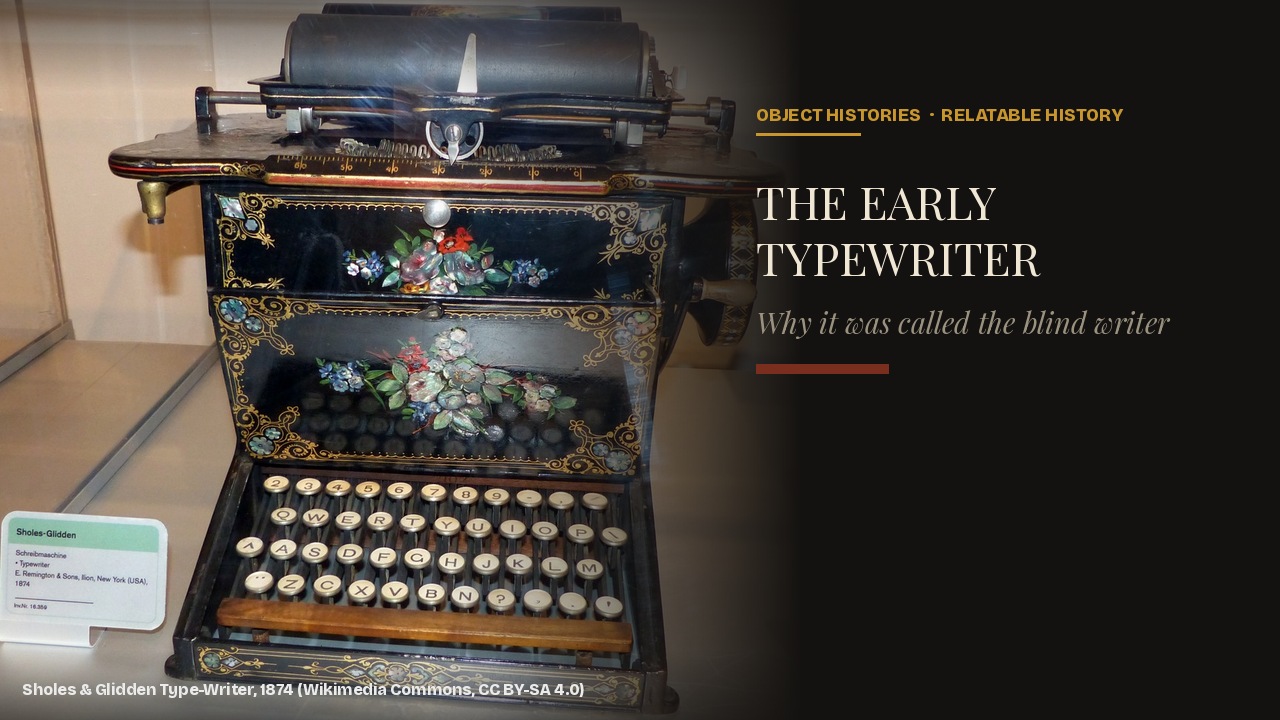
In 1868, three men in Milwaukee patented a machine that was, by any reasonable standard, worse at its job than a trained hand with a pen. It typed only capital letters. It let its operator see nothing of what had just been written, because the type bars struck the paper from underneath a roller the writer could not see around. And when a rifle manufacturer finally agreed to sell it to the public in 1874, almost no one could type on it faster than they could write longhand.
And yet the thing that machine put under its operator’s fingers — the scrambled run of letters across the top row, Q-W-E-R-T-Y — is still exactly the layout under yours right now, on a laptop, a phone’s glass keyboard, a supermarket self-checkout. No design decision from the 1870s has survived into the 2020s with less alteration. Why keyboards use QWERTY, of all the arrangements twenty-six letters could take, turns out to be a far less settled question than the usual one-line answer suggests.
The usual answer is that the letters were scattered on purpose to slow typists down and stop the machine’s internal parts from jamming. That story is repeated constantly, it is intuitive, and according to the research that has actually gone back to the patents and the machines themselves, it is probably wrong, or at least badly incomplete.
A machine that began as a tool for numbering pages
Christopher Latham Sholes was a Milwaukee printer, newspaper editor and sometime state and federal official, not an engineer by training. In 1866 he and a fellow tinkerer, Carlos Glidden, were working on a device meant to number the pages of books automatically. Partway through, Glidden reportedly asked Sholes why, if a machine could print numbers, it could not print letters too. A third collaborator, Samuel W. Soule, joined the effort, and the page-numbering project turned into something much larger.
The three men built a working prototype and filed for patent protection. Patent number 79,265, titled plainly “Improvement in Type-Writing Machines,” was granted on June 23, 1868. The surviving patent model — wood and brass, with only six keys, piano-style — is held today by the Smithsonian’s National Museum of American History as part of its Inventing in America collection. It looks almost nothing like the machine that eventually reached the market.
The mechanism that made it write blind
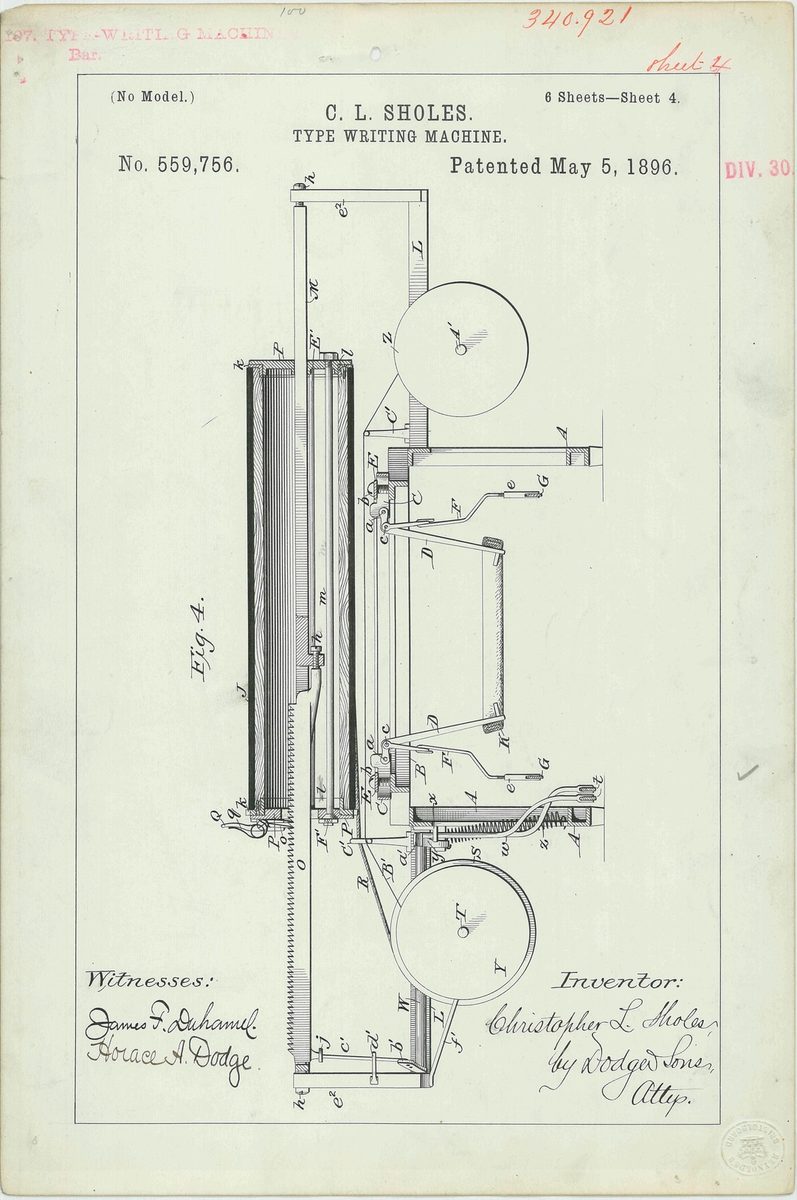
The 1868 patent covered a self-adjusting platen, a cushioning rest for the type bars, and a system for feeding and holding paper. Crucially, the type bars struck upward, hitting the underside of a cylindrical roller that held the paper wrapped around it. That single engineering choice, carried through years of redesign, is what made the machine an “upstrike” or “blind writer” device: the operator’s own paper and platen sat directly between their eyes and the point where ink actually met the page.
Development dragged on for years after the patent. A financier named James Densmore, who had bought into the project early, judged a batch of about fifteen machines built in Chicago in the summer of 1868 not yet good enough to sell. Sholes kept refining the design through 1869, switching from a flat platen and thin paper to a cylindrical one, and again in 1872, when the platen was reworked to take paper of any length and to space lines in a recognizably modern way. The escapement that advanced the carriage borrowed from clock mechanisms; the keys borrowed from telegraph equipment; the hammers that drove the type bars borrowed from piano actions. Almost nothing about the machine was invented from scratch — it was assembled from parts whose engineering problems other industries had already solved.
A rifle company’s unlikely bet
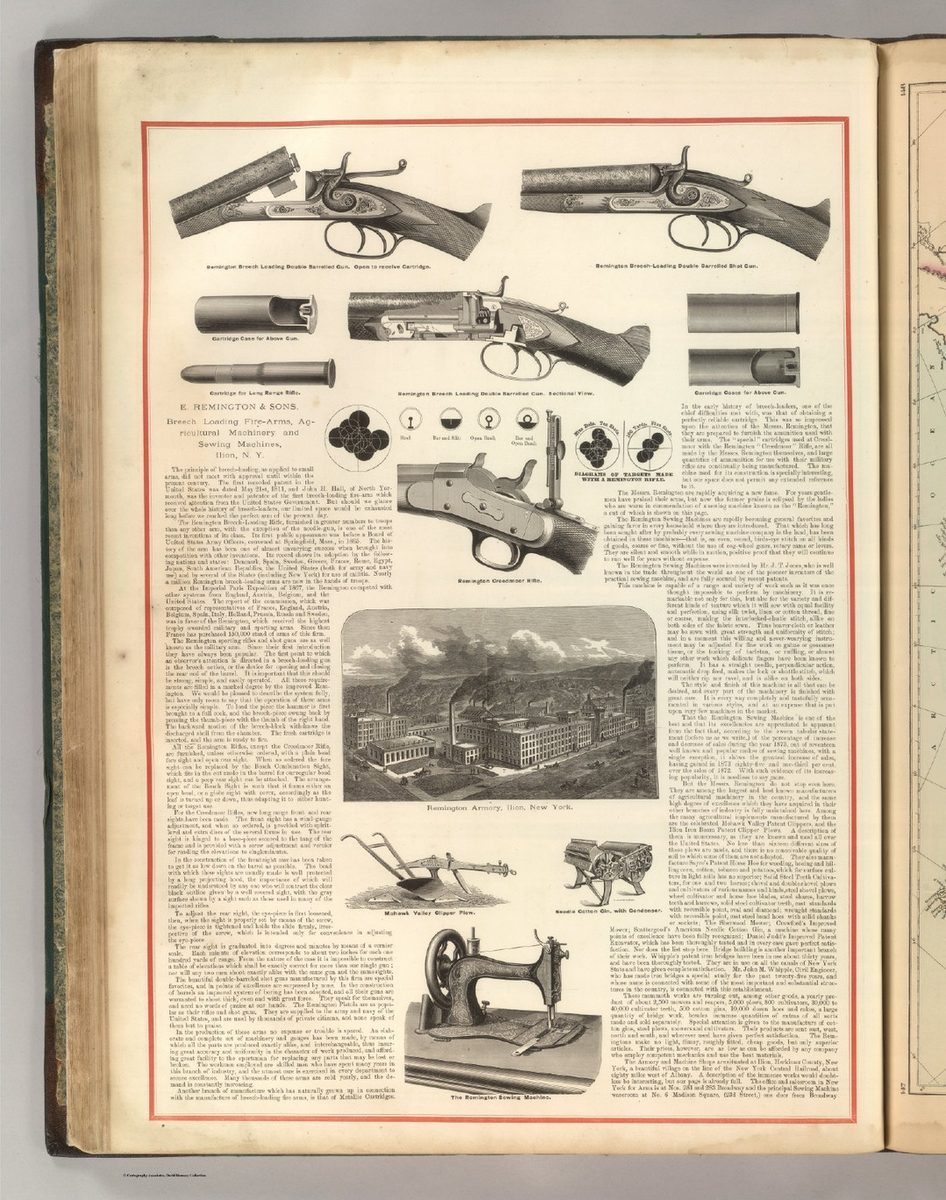
By March 1873, Densmore had a contract in hand with E. Remington & Sons of Ilion, New York, a firm that had built its name and its factory on military rifles. The contract committed Remington to build at least 1,000 of the machines, with an option to go as high as 24,000 if demand justified it. Densmore himself had to borrow money to cover a $10,000 advance payment to get manufacturing started — a serious bet on a machine that had already taken more than five years and multiple redesigns to reach this point.
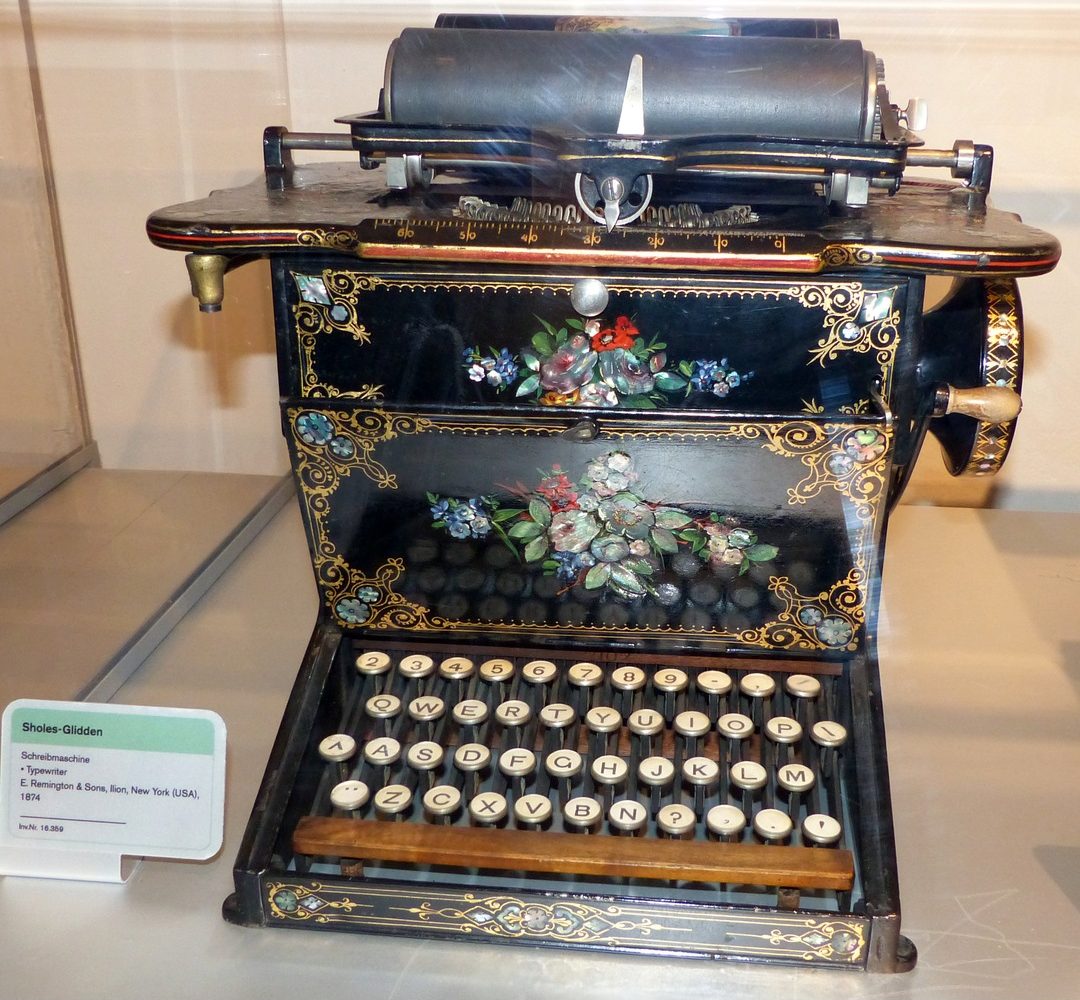
Production began in 1873 and the first machines went on sale in 1874 as the “Sholes & Glidden Type Writer,” built in the same works that turned out Remington rifles. Two of the company’s mechanics, William Jenne and Jefferson Clough, are credited with moving the design into a practical metal case and shrinking it for production. Remington also made sewing machines, bicycles and farm implements at the time, which is the more immediate reason the first commercial typewriters came decorated with painted flowers: the parlor styling was borrowed directly from how the company already dressed up its sewing machines, not from any attempt to disguise a weapons maker’s product.
Sales were slow at first. The machine was expensive, it typed only capital letters, and a buyer had to learn an entirely new way of writing to get any benefit from it at all. A second model, which added a shift mechanism and lowercase letters, followed in 1878 because customers specifically asked for more than shouting capitals. From there adoption accelerated: a trade publication counted 47 different typewriter makes on the market by 1891, and at least 89 by 1910. In 1893, five of the leading manufacturers — Remington, Caligraph, Yost, Densmore and Smith-Premier — folded into the Union Typewriter Company, which by then had settled on QWERTY as the industry’s de facto standard.
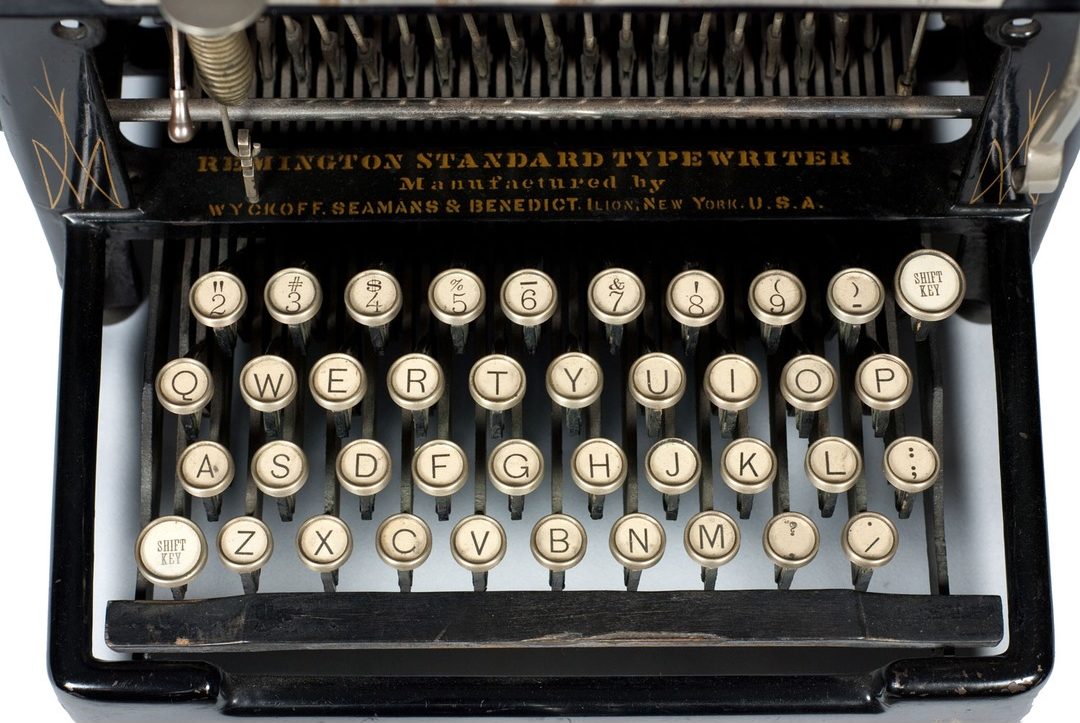
Why the Keys Ended Up Scrambled — Why Keyboards Use QWERTY
The familiar explanation for the layout is mechanical: the early machine’s type bars hung in a circle underneath the striking point, and if two bars for letters that commonly appear together in English were struck in quick succession, they could collide and jam. Densmore, so the story goes, pushed Sholes to separate frequently paired letters to slow that collision rate down, and the resulting scramble became QWERTY.
It is a tidy story, and it does not hold up especially well against the record. The earliest Sholes layout, from the 1868 patent era, was close to alphabetical. By 1873, when the Remington deal was signed, the machine had grown to 43 keys in a non-alphabetical arrangement, and a near-final prototype used a layout researchers have labelled “QWE.TY,” changed only at the last minute into the QWERTY most people would recognize. The earliest patent that documents the QWERTY arrangement in the exact form still used today is No. 207,559, issued in 1878 — a full decade after the original typewriter patent.
The jamming account also runs into a simple statistical problem: the letter pair “er” is one of the most common two-letter sequences in English, and on a QWERTY board the E and R sit right next to each other, exactly where a jam-avoidance scheme should have kept them apart. A 2011 paper by Kyoto University researchers Koichi and Motoko Yasuoka argues the layout instead evolved through direct feedback from the machine’s earliest professional users — telegraph operators, who needed a keyboard arrangement that matched how they were already transcribing Morse code. Their argument includes a detail that undercuts the jamming theory on its own terms: slowing typists down would have made it harder, not easier, for an operator to keep pace with an incoming telegraph signal, which is the opposite of what Sholes and his backers wanted from a machine they were trying to sell to telegraph offices.
What is better documented is how QWERTY outlasted the debate about its origins entirely. Remington ran training courses for typists, and typists trained on a Remington machine went looking for employers who had Remington machines, which meant the layout spread through the labor market rather than through any technical argument about its merits. By 1890, more than 100,000 QWERTY-based Remington typewriters were reportedly in use in the United States alone. When the Teletype machine adopted the same layout in 1910, and electric typewriters and then computer keyboards followed that precedent decades later, QWERTY was carried forward less because anyone re-evaluated it and more because retraining an entire workforce was never worth the trouble. Sholes himself kept trying to improve on it — a later keyboard patent of his, filed the year before his death in 1890, was issued posthumously and went nowhere. A far more famous challenger, August Dvorak’s alternative layout from the 1930s, performed well in its own promotional testing but has never come close to displacing the original.
The office job the machine invented along with the keyboard
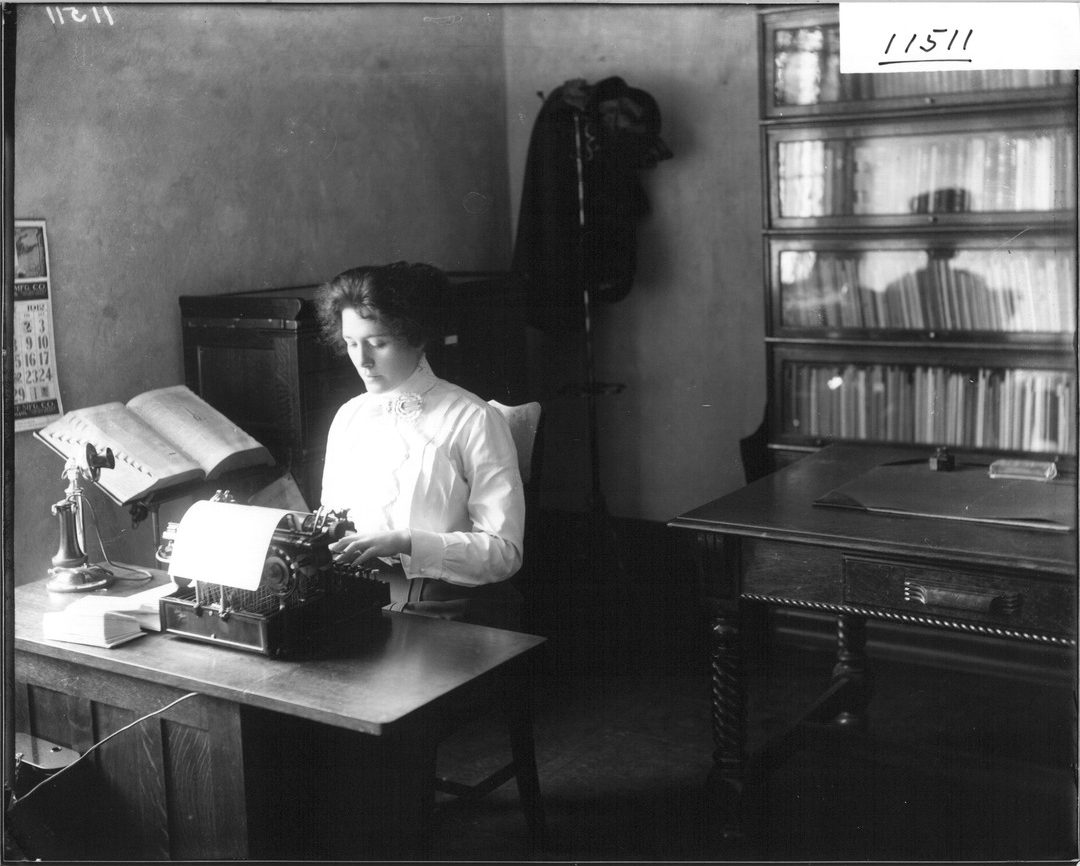
The typewriter did not just change how business correspondence got written; it created a labor category that barely existed before it. In 1874, women made up under four percent of clerical workers in the United States. By 1900, that figure had risen to roughly three-quarters. Typing was marketed, somewhat cynically, as respectable work for women specifically because it was new enough that it was not seen as taking a job away from a man who did something else instead.
Dedicated typing schools opened to teach the skill alongside shorthand and bookkeeping, and typewriting offices run by women became their own small industry. In Edinburgh, a businesswoman named Ethelinda Hadwen opened a typewriting office with a partner in 1886 — reportedly the first such office in Scotland — staffed almost entirely by women, and by 1901 essentially all of Scotland’s typists were women. Hadwen was also active in the suffrage movement and later won election to Edinburgh’s school board; in 1904 she donated her own Sholes & Glidden machine, made in 1876, to a museum collection, which is one of the more direct lines connecting this specific object to the social change it helped cause.
Fiction noticed the shift quickly. Arthur Conan Doyle gave Sherlock Holmes a typist client, Mary Sutherland, in an 1891 story, and Bram Stoker’s Mina Murray in Dracula (1897) is characterized in part by her competence with the machine. The pay gap that came with the new role proved far more durable than the machine itself: clerical and typing work remained lower paid than the handwritten clerk’s work it replaced for decades afterward, an imbalance British law did not formally address until the Equal Pay Act of 1970.
Watch the short
The short video that started this one covers the blind-writer mechanism and the Remington gamble in under 41 seconds; the long-form video on this object hasn’t gone up yet.

Related reading
- How Carpet Beaters Worked Before the Vacuum Cleaner
- Did Franklin Invent the Franklin Stove?
- How the Washboard Became a Musical Instrument
- How Farms Rendered Lard to Last a Whole Winter
Works cited
- Sholes, C. Latham, Carlos Glidden, and Samuel W. Soule. Improvement in Type-Writing Machines. U.S. Patent 79,265, granted June 23, 1868. Link.
- Smithsonian National Museum of American History. “Sholes, Glidden & Soule Typewriter Patent Model.” Object record nmah_850123, Inventing in America collection.
- American Society of Mechanical Engineers. “Sholes & Glidden Type Writer.” ASME Historic Mechanical Engineering Landmark No. 249. Link.
- Lemelson-MIT Program. “Christopher Sholes.” Massachusetts Institute of Technology. Link.
- Princeton University Graphic Arts Collection. “The Original Writing Machine: The Remington Type-writer.” Firestone Library blog, July 2012.
- Yasuoka, Koichi, and Motoko Yasuoka. “On the Prehistory of QWERTY.” Kyoto University Research Information Repository, 2011. Link.
- “Fact or Fiction? The Legend of the QWERTY Keyboard.” Smithsonian Magazine.
- National Museums Scotland. “Typewriters, Women and the Advancement of Workplace Equality.” Discover the Catalogue. Link.