
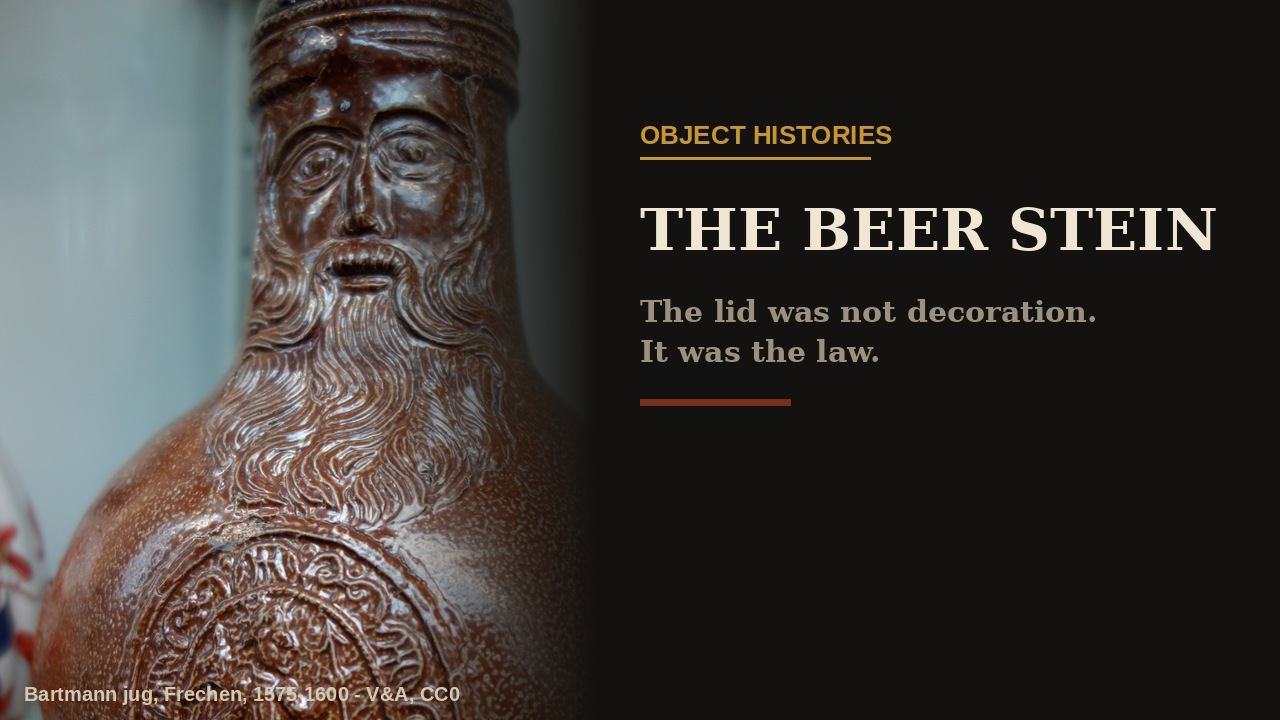
Nobody in fifteenth-century Nuremberg thought of the beer mug as a piece of public-health equipment. Cups were turned wood, sealed leather, drinking horn or coarse, porous earthenware, and none of them had a lid, because nobody had yet decided a lid was necessary. Then, across roughly three decades, an ordinary Rhineland drinking vessel acquired a hinged metal cap that would go on to outlast the regulation that created it by nearly three hundred years.
That vessel is the Steinkrug — literally “stone jug” — ancestor of what English speakers now shorten to “stein.” Its documented history runs through an insect problem, a patchwork of municipal law, a ceramics technology good enough to be worth capping, a guild of metalworkers, and a royal wedding that had nothing to do with beer mugs at all. By the time the story reaches Oktoberfest, the object has already stopped being about hygiene.
None of this is settled by a single decree from a single ruler. It is scattered across town ordinances, museum accession records and one very famous piece of food law, and pulling it into one sequence is the point of what follows.
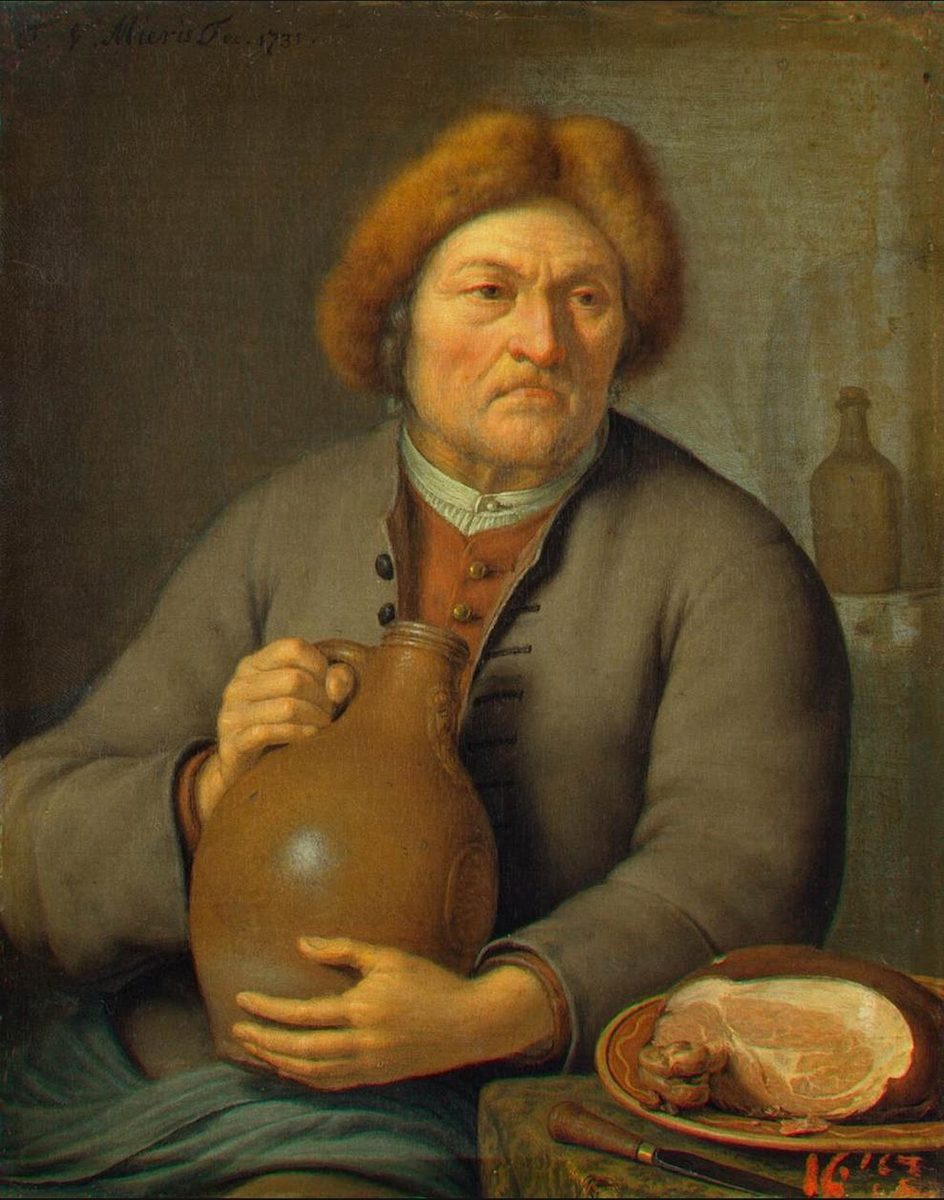
Germany’s covering laws were a patchwork, not one edict
Trade histories of the stein trace the trigger to a run of insect-heavy summers in the second half of the 1400s: swarms of small flies moving through central European towns in numbers bad enough that chroniclers recorded them. Nobody understood germ theory — that was still three and a half centuries away — but plague was recent memory, and filth, insects and death had already been linked in the popular imagination. Town and principality governments responded by regulating the object nearest at hand: an open container of food or drink.
What resulted, through the first decades of the 1500s, was not one empire-wide statute but dozens of local ordinances requiring covered vessels, passed town by town and principality by principality. Exactly which town legislated first, and in which year, is not something the surviving record settles cleanly — the ordinances themselves are scattered municipal documents rather than a single codified law, and later popular histories have smoothed that mess into tidier stories than the archive actually supports. What is not in dispute is the scope: the requirement covered food and drink generally, and in Germany that meant it covered the everyday beer mug for very nearly everyone.
The same decades produced Germany’s much better-known piece of beer law. On 23 April 1516, Duke Wilhelm IV of Bavaria issued the Reinheitsgebot at a meeting of the Estates in Ingolstadt, restricting beer to water, barley and hops. Historians of the law note its motives were not purely about drinkability: protecting wheat and rye for bakers during grain shortages, and making a valuable, heavily taxed product easier to standardise and inspect, mattered as much as keeping cheap adulterants out of the brew. Read next to the covering ordinances, it shows the same instinct twice in one generation: beer was too economically important to leave unregulated.
A lid is only worth fitting to a mug worth keeping
A hinged cap makes little sense on a cup that will crack, leak or sour within a season. It makes a great deal of sense on Rhenish stoneware, which by the 1500s was the hardest, most reliably waterproof ceramic available anywhere in Europe. Production centred on a cluster of Rhineland towns, each with its own look: Siegburg, with a pottery tradition documented from around 1150 and a body fired almost white; Raeren, whose workshops had by the end of the sixteenth century perfected massive salt-glazed forms covered in applied, cut and stamped relief; and Cologne and its neighbour Frechen, which turned out the ware in the greatest volume.
The finish that made all of it waterproof was salt glazing. At the peak of the firing, potters threw ordinary salt into the kiln, where it vaporised and reacted with the silica in the clay surface, leaving a thin, glassy, faintly pitted skin — the “orange peel” texture still visible on an old stein today. The body underneath was fired hot enough to vitrify completely, so unlike earthenware it did not absorb what was poured into it and did not carry the memory of the last drink into the next one. Cheap, hard, and genuinely sealed: a jug like that was worth protecting from flies with a lid, in a way a leaking wooden cup never was.
The Rhineland’s most famous export became a Protestant joke, then a ward against witches
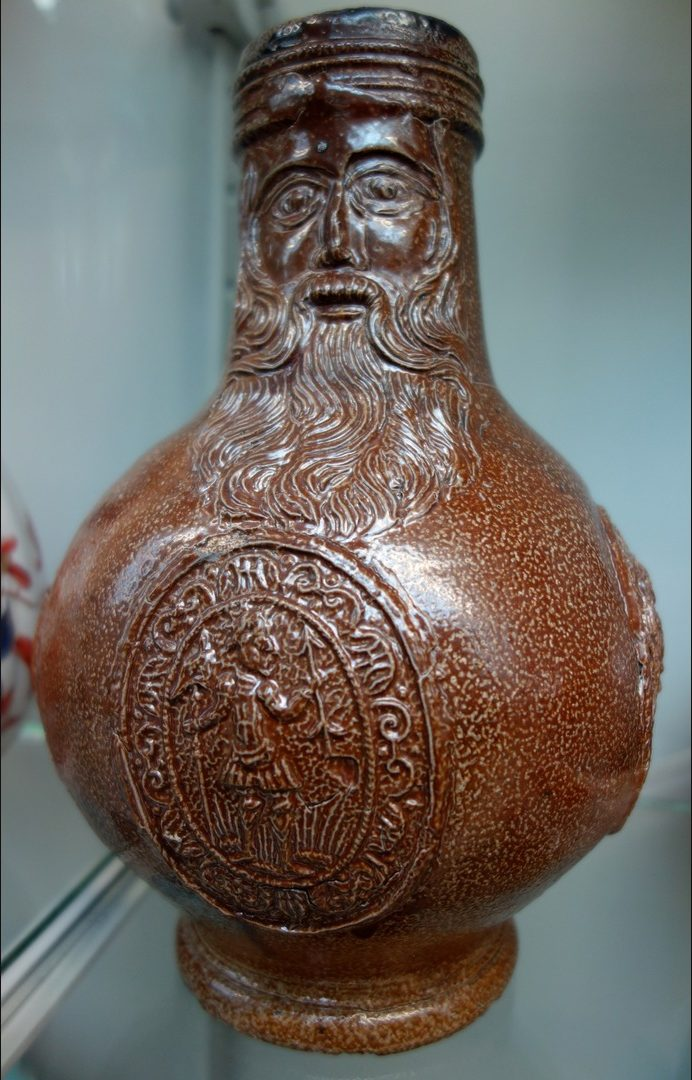
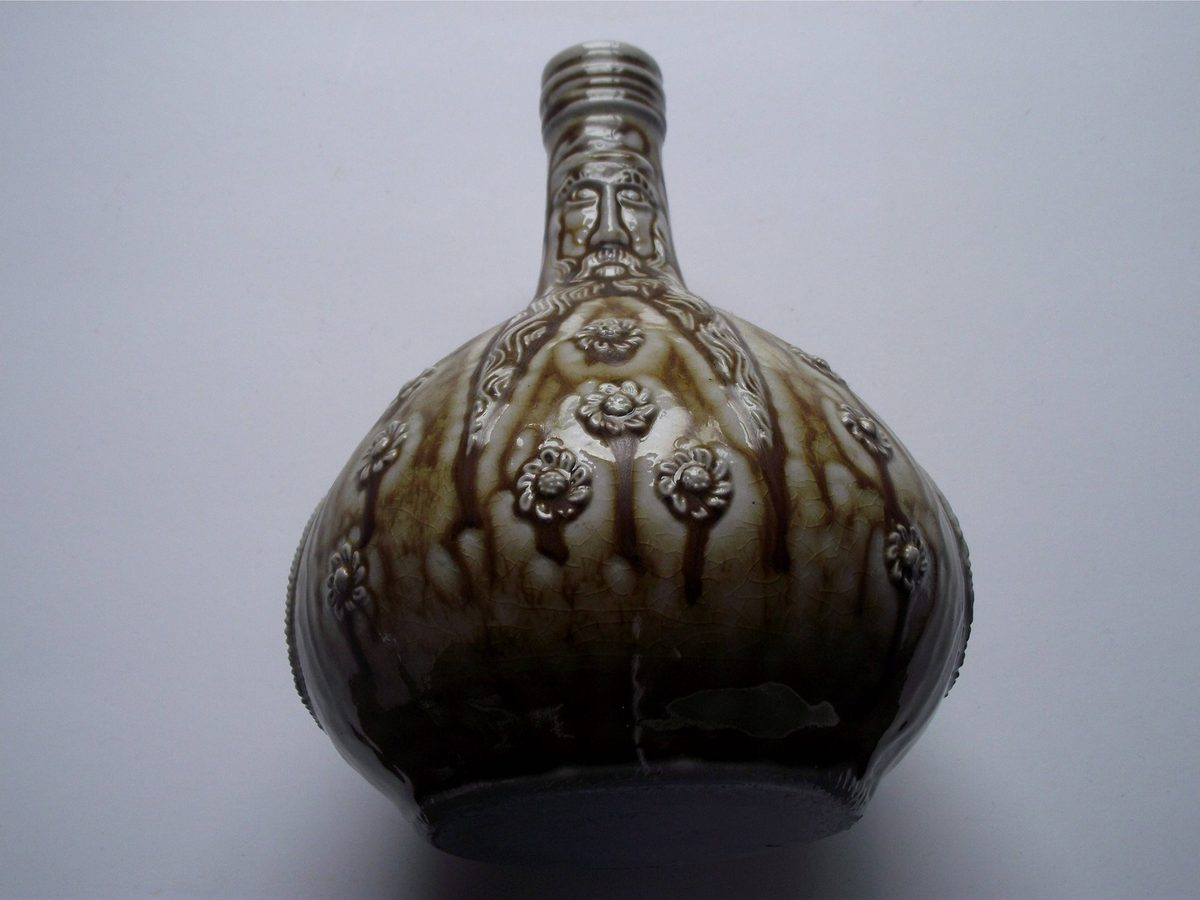
The single most recognisable thing the Frechen and Cologne kilns produced was not a mug at all. It was a round-bellied bottle with a scowling bearded face pressed into the neck — the Bartmann, or “bearded man,” jug, thought to draw on the wild-man figure of popular German myth. English Protestants nicknamed the type the “Bellarmine,” a jab at Cardinal Robert Bellarmine, whose polemical writings against the Reformation made his scowling likeness an easy target for a mug you could smash or drink from at will. The jugs were exported by the shipload and turn up in archaeological digs from Jamestown to London.
They had a second life English collectors rarely expect from tableware. Excavated examples of Bartmann jugs have been found reused as “witch bottles” — stuffed with pins, nails, hair or urine and buried under a hearth or threshold as a counter-charm against a suspected curse, on the folk logic that the bottle would trap and injure whoever had cast the spell. Researcher Brian Hoggard’s survey of roughly 250 recorded English witch bottles found that around half of them were Bellarmines, that iron pins or nails turn up in about 95 percent of bottles whose contents survive, and human hair in roughly a quarter — with about a quarter of tested examples also positive for urine. Half were buried near a hearth, a quarter under a threshold, the rest under floors or inside walls, which is to say: exactly where a household’s most vulnerable entry points were thought to be. The practice belonged mostly to England and its colonies rather than to Germany itself, a useful reminder that a single traded object can carry entirely different meanings on either side of the water that shipped it.
The lid itself was somebody else’s craft entirely
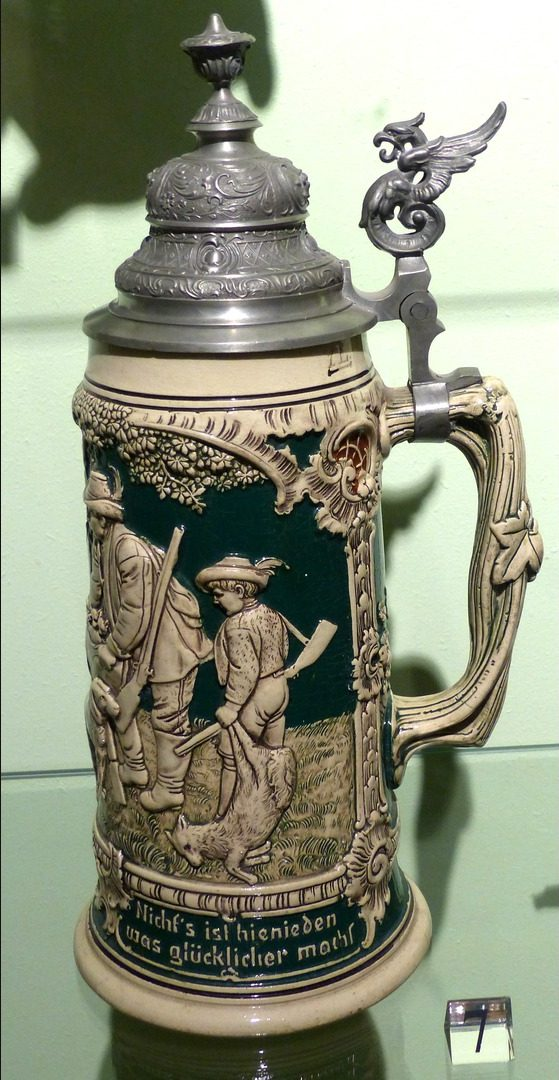
Stoneware potters did not make the lid. Pewterers did, in a separate trade with its own guild structure, and they fitted it with a hinge and a small lever — the thumb lift — positioned just above the handle. The lever is the whole piece of engineering: it lets a drinker flick the lid open with the thumb of the hand already holding the mug, drink, and let it fall shut again, without ever setting the beer down or bringing a second hand anywhere near it. A municipal sanitary rule had, by way of a metalworkers’ guild, produced a genuinely elegant piece of one-handed design.
Because pewter cost real money, the lid stopped being purely functional almost immediately. An elaborate hinge, a chased or figural pewter mount, eventually silver on the finest examples — all of it signalled what the stoneware body underneath could not: that the owner could afford more house than the law strictly required.
“Stein” is an English abbreviation, and not a perfectly accurate one
The German word for the object is Krug, or more precisely Steinkrug — stone jug — from Steinzeug, stoneware. English borrowed and clipped it: the word is attested in print by the mid-1850s, most likely a shortening of Steingut or Steinkrug rather than a direct translation of anything. English speakers then applied “stein” to any large beer mug, glass ones included — which is, strictly, a small linguistic error, since Stein means stone and a glass mug is not stoneware. German speakers themselves generally reserve Steinkrug for the ceramic original and would not call a glass Maß a stein at all.
A wedding, not a brewery, produced Oktoberfest
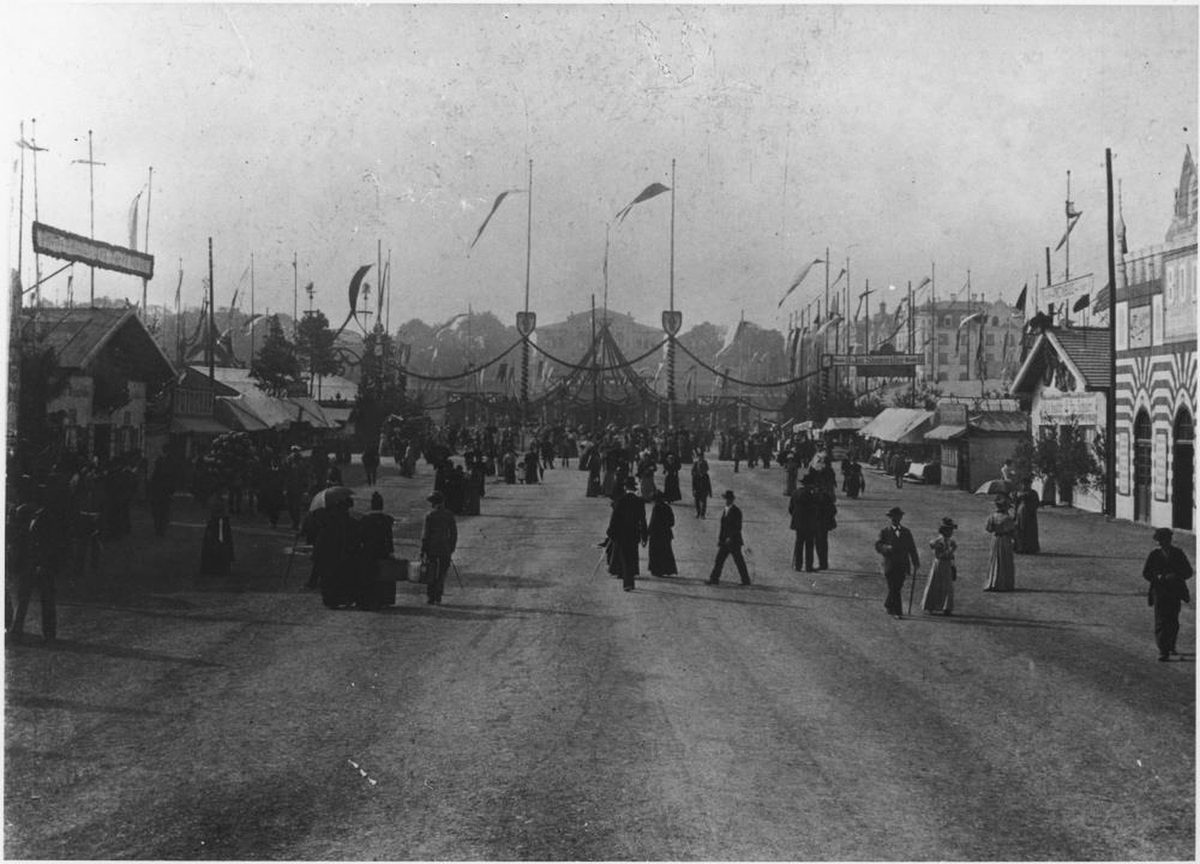
The covering laws had nothing to do with Munich’s most famous beer festival, which began by accident. On 12 October 1810, Bavarian Crown Prince Ludwig married Princess Therese of Saxe-Hildburghausen, and the city was invited to celebrate with horse races on the fields just outside the gates. Around 40,000 spectators are recorded watching from the surrounding hillside. The fields were renamed the Theresienwiese in the princess’s honour, the race was repeated the following year, and the annual gathering simply kept happening until it had become Oktoberfest.
For most of the nineteenth century the festival’s drinkware was unremarkable stoneware, lid and all. That changed in 1892, when the glass litre Maß was introduced at the festival and rapidly became its standard measure — a switch driven partly by hygiene, now achievable with cheaper industrial glass, and partly by the simple usefulness of being able to see how full, and how clean, a mug actually was. The lidded stoneware stein did not disappear. It retreated from the beer tent to the souvenir table.
The stein’s most elaborate decade arrived exactly as it stopped being everyday drinkware
That retreat coincided with the object’s commercial peak. Between about 1885 and 1910, the Villeroy & Boch works at Mettlach — a firm formed in 1836 from the merger of Nicolas Villeroy’s pottery with Jean-François Boch’s, operating out of a former Benedictine abbey on the Saar — turned out etched and chromolithographed steins of a quality no working drinking vessel has ever strictly needed: hunting scenes, guild emblems, entire villages worked into the relief, finished with figural pewter lids. Soldiers finishing their military service commissioned regimental steins painted with their unit, their barracks and their comrades’ names. These were objects nobody intended to drink from carelessly, made at the exact moment the everyday version of the same object was losing its job to a glass jug you could see through.
An object built by four separate trades that never met
Lay the pieces next to each other and the stein stops looking like a single invention and starts looking like a stack of unrelated decisions that happened to land on the same object. A fifteenth-century town council worried about flies. A cluster of Rhineland potters who had already spent two centuries learning to vitrify clay for entirely different reasons. A pewterers’ guild that saw a licensing requirement and built a genuinely clever hinge to meet it. A royal wedding that had nothing to do with any of the above. None of these people were working toward “the beer stein” as a goal. Each solved the problem in front of them, and the lidded mug is what was left over once all four solutions were bolted together.
That is also why the lid survived so long past its legal expiration. By the time German sanitary law stopped requiring covered drinkware, a lidded stein had been the normal, expected shape of a good mug for the better part of three centuries — long enough that going without a lid looked less like freedom from an old rule and more like an unfinished object, the way a teapot without a spout looks unfinished today. The regulation had, by sheer duration, turned into an aesthetic.
Watch the full history
The video companion covers the same ground in under six minutes, from the fly ordinances to the thumb lift.

Related reading
- How the Sedan Chair Actually Worked, and Why It Started as a Scandal
- The Chemistry Inside a Sauerkraut Crock, and Why It Actually Works
- Why Is a Hobby Called a Hobby? The 600-Year Path from Warhorse to Word
- The Warming-Pan Baby: The Bed-Warmer Behind a Royal Scandal
Works cited
- Historisches Lexikon Bayerns. “Purity Law, 1516 (Reinheitsgebot).” Link.
- “A Brief History of Beer Steins.” The Beer Stein Library. Link.
- “Beardman or Bellarmine jug.” German, Cologne-Frechen, c. 1550-1600. The Metropolitan Museum of Art, accession 07.187.1.
- “Jug.” Raeren stoneware, late 16th century. Victoria and Albert Museum, museum no. C.152-1919. Link.
- Hoggard, Brian. “Witch Bottles.” Apotropaios. Link.
- “The Mysterious Case of the Witch Bottle.” Historic England / Heritage Calling, 31 October 2016.
- “The Origin of Oktoberfest.” History.com, A&E Television Networks. Link.
- “Villeroy & Boch; Mettlach Steins.” Collectors Weekly. Link.
- Harper, Douglas. “Stein.” Online Etymology Dictionary. Link.
- “Your Essential Guide to Lager Drinkware.” Craft Beer & Brewing. Link.