
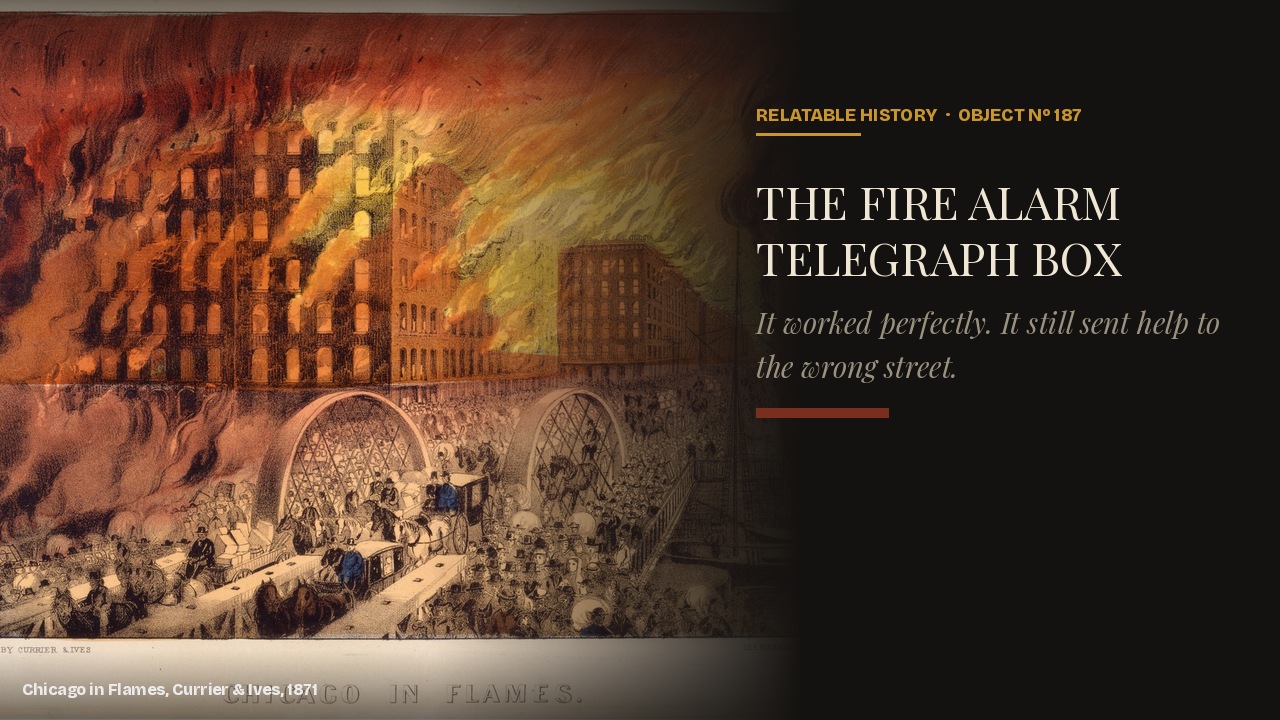
A fire alarm telegraph box never detected a fire. It had no heat sensor, no smoke sensor, no way of knowing whether anything was burning at all. What it did, when triggered, was announce a number — the number stamped on that particular box — to a central office a mile or more away. Everything else, including whether the number pointed anywhere near the actual flames, depended entirely on the judgment of whoever triggered it. That single fact is the key to how fire alarm telegraph boxes worked, and to why one of them nearly doomed a city.
For nearly twenty years before Chicago burned on the night of October 8, 1871, this was already a mature, reliable technology, running in dozens of American cities without a serious structural failure. The system that misdirected Chicago’s fire department that night did exactly what its designers built it to do. The problem was never the machine. It was what the machine could never be asked to verify.
That gap — between a device that reports a number flawlessly and a number that may simply be wrong — is the real subject of this object’s history, and it says more about how cities actually ran on new technology in the 1870s than any account of the fire itself.
A signal box reported a guess, not a location
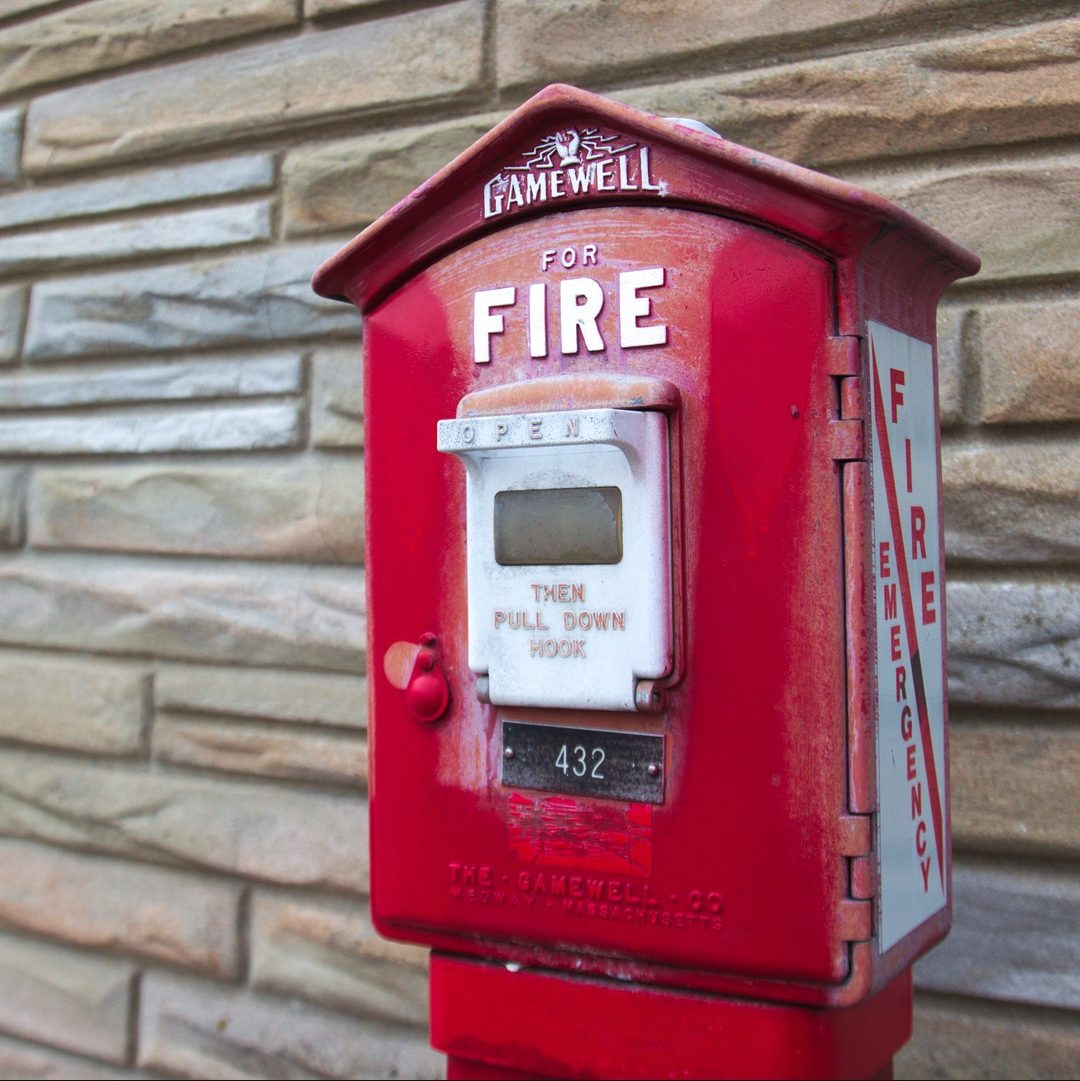
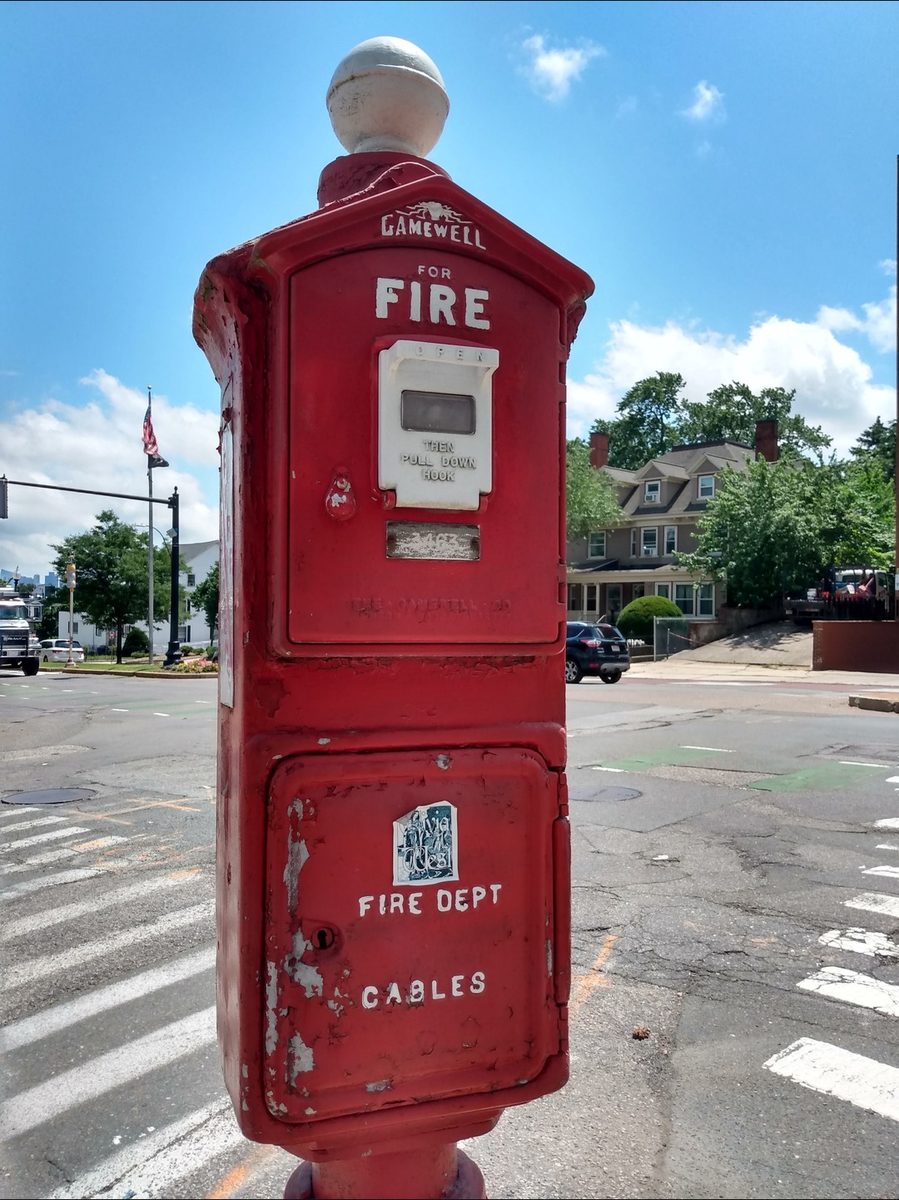
The basic unit of the system was the street box: a locked cabinet containing a small clockwork mechanism, mounted on a post or wall at a known, mapped intersection. Triggering it released a spring-driven wheel that broke and remade an electrical circuit in a fixed pattern — a sequence of pulses unique to that box’s number — which ran out along dedicated wires to a receiver at the fire department’s central office. An operator there matched the incoming pulses against a list of box numbers and addresses, and dispatched the companies assigned to that district.
Crucially, the signal carried only the box’s own identity. It said nothing about what had caused the alarm, how large the fire was, or even whether there was a fire at that box’s actual street corner. In most American cities in this period, including Chicago, the boxes sat in locked cases, and only police officers, firefighters, and a short list of trusted local residents held keys. A passerby who spotted smoke generally couldn’t trigger an alarm directly; they had to find a keyholder, and the keyholder had to decide which numbered box, and therefore which location, to report.
Many large cities, Chicago included, added a second layer on top of the street boxes: a watchman stationed in a high tower, scanning the skyline for the glow of a fire and reporting back by his own judgment of distance and direction. That watchman did not need a key to a street box at all. He simply told the central office which box number, on the map in front of him, looked closest to the light he was seeing. The telegraph signal that followed was therefore a report of where a man in a tower thought a fire was, encoded as a number, sent with total mechanical fidelity.
The system was not yet twenty years old
The whole apparatus was a genuinely new invention. Physician William F. Channing and engineer Moses G. Farmer built the first working version in Boston, putting a network of forty street boxes and sixteen alarm bells into service in the spring of 1852 — the first municipal electric fire-alarm system anywhere. Channing and Farmer patented the design in 1857, and over the next two decades city after city wired its own version: a dedicated circuit of boxes, bells, and a central office, running independently of the telegraph lines that carried commercial and news traffic.
Commercialization accelerated once John N. Gamewell, a South Carolina postmaster who had seen Channing lecture on the system, bought up the regional rights and eventually the underlying patents. His company and its successors would go on to install fire-alarm telegraph systems in roughly 250 cities by 1886 and 500 by 1890, becoming the dominant supplier in the field for the rest of the century. In 1871, the technology was still young enough that its own manufacturers were actively patenting improvements to it — and old enough that a city the size of Chicago had already trusted its fire protection to one.
Inside the Box: How Fire Alarm Telegraph Boxes Worked
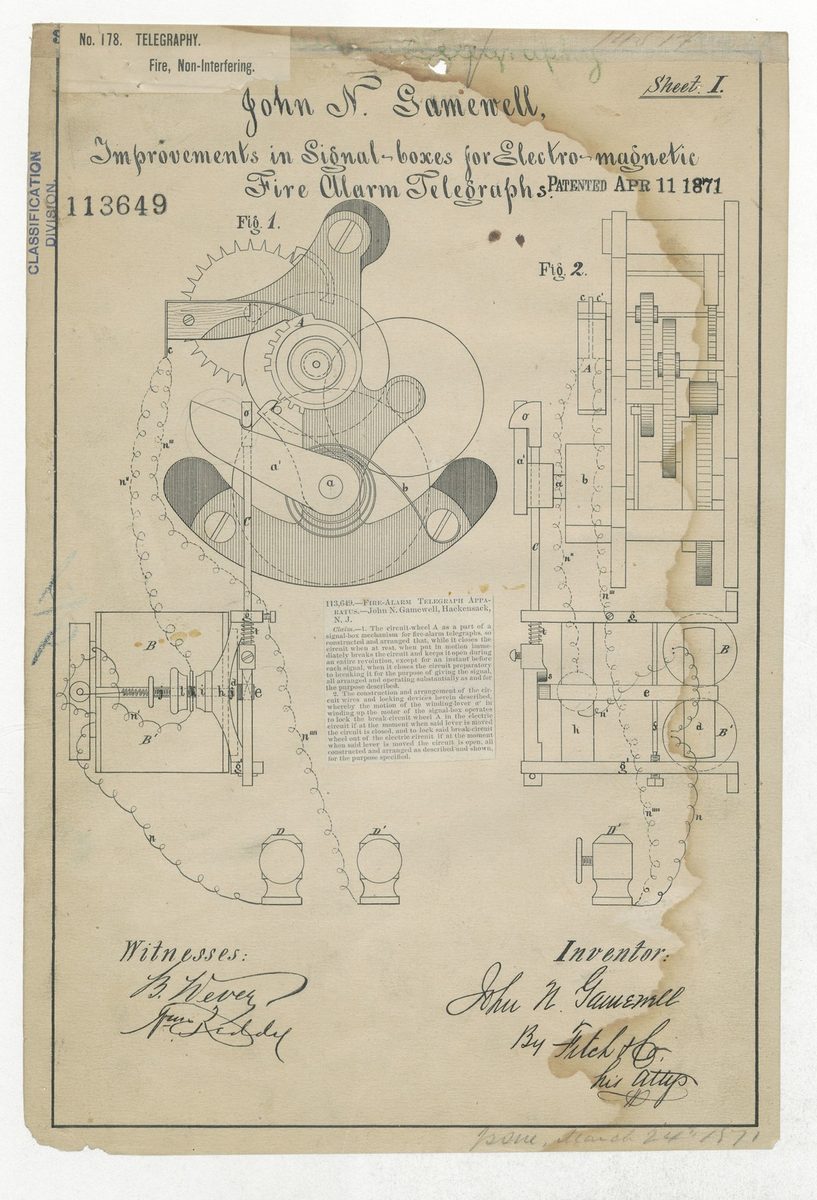
The mechanism inside a 19th-century signal box ran on a coiled spring, not outside electrical power, which was deliberate: a fire could take down power lines, and the alarm system had to keep working anyway. Pulling the box’s hook released that spring, turning a toothed code wheel set to the box’s own number. As the wheel turned, its teeth forced a pair of contacts open and shut, opening and closing the telegraph circuit in a pattern that was, in effect, the box’s number spelled out as a series of breaks rather than long and short beeps. A single use typically drained most of the spring’s stored motion; firefighters rewound it by hand with a crank after each alarm, since most boxes were only good for a handful of activations before they needed resetting.
A patent John N. Gamewell was granted on April 11, 1871 — almost exactly six months before Chicago burned — shows how fine-grained this engineering had become. It describes a break-circuit wheel that stays locked out of the circuit whenever another box on the same line is already mid-signal, specifically to stop two boxes triggered close together from garbling each other’s numbers into noise. Manufacturers were refining how reliably the wheel could report a number. No patent addressed, because none could, whether the number being reported was the right one.
Later box doors carried a blunt instruction plate: pull the hook down once, and only once. Repeated or hesitant pulls could scramble the pattern the wheel was trying to send, defeating the entire point of the code. It is a small design detail that captures the whole philosophy of the system: an extremely disciplined way of transmitting a single piece of information, with no mechanism at all for transmitting anything else.
Chicago had wired itself years before the fire
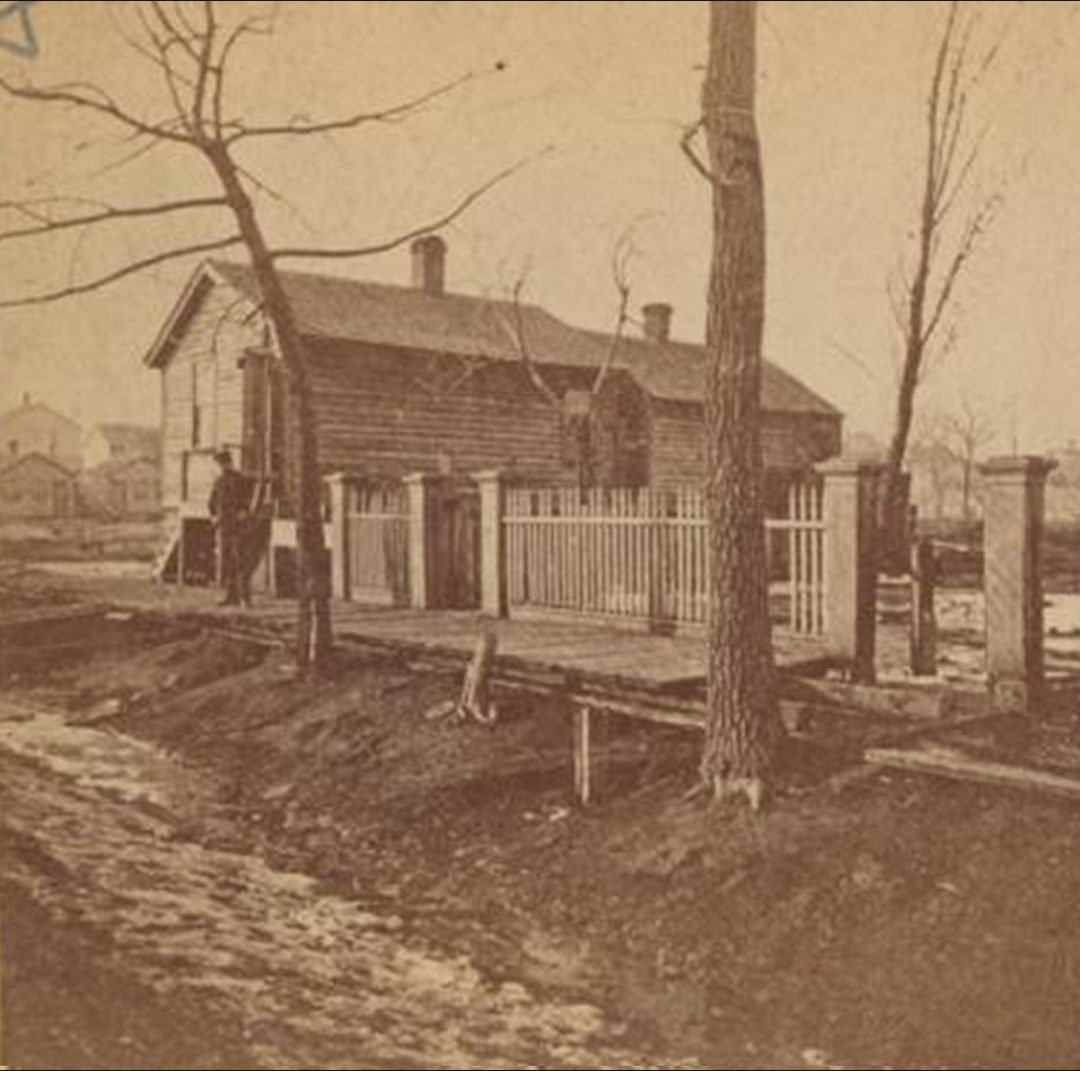
Chicago’s own network, built in the early 1860s and operating by 1864, used 116 locked street boxes feeding into the Cook County Courthouse downtown, which doubled as the city’s fire-alarm headquarters. As in other cities, keys went to firefighters, police officers, and a roster of residents considered responsible enough to hold one, and the courthouse tower carried a watchman through the night, standing watch over a city built overwhelmingly of wood, during an autumn so dry that the fire department had already fought dozens of serious fires in the preceding week.
On the night of October 8, that watchman was Mathias Schaffer. He had been on duty through an unusually bad run of small fires that week already, and when he caught sight of a new glow to the southwest, he worked out a box number from the cupola the way watchmen always did — by eye, against a map, in the dark, through smoke already drifting across the sky from the fires that had come before it.
The alarm that worked, and the alarm that didn’t
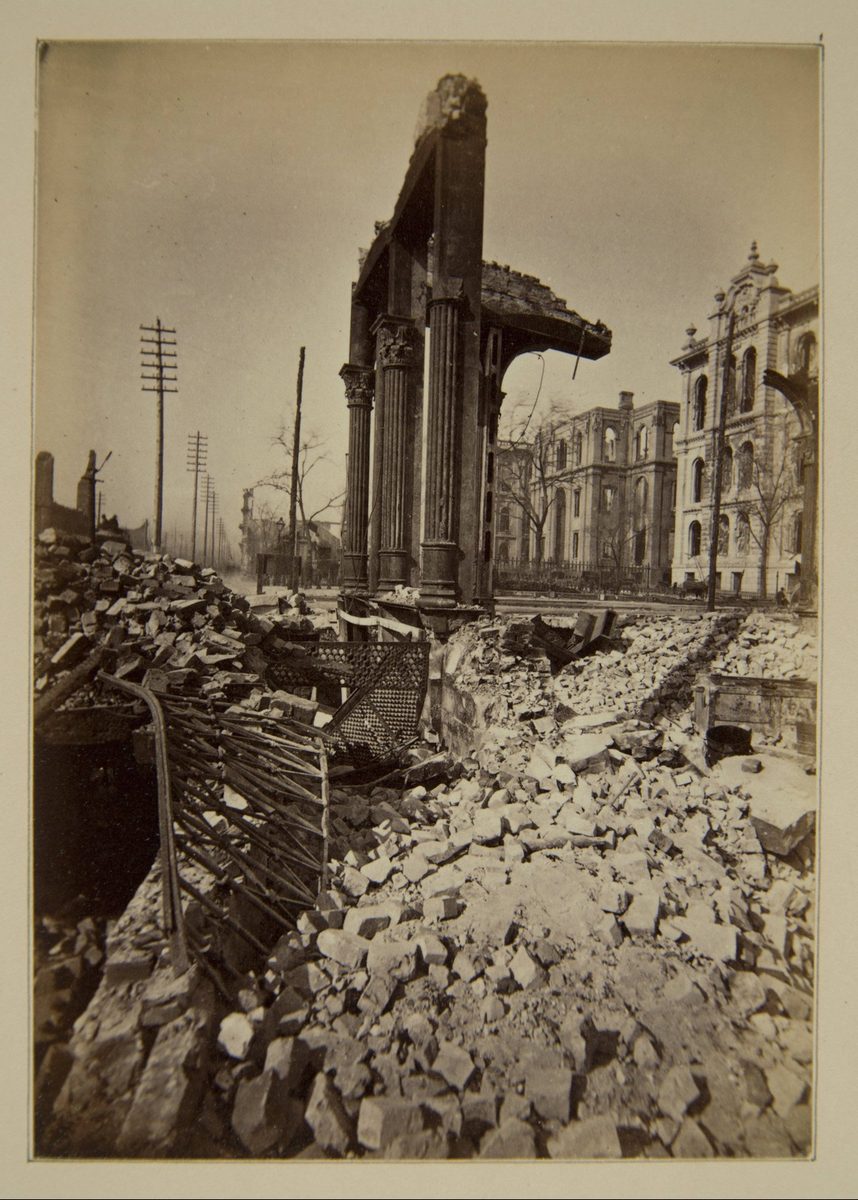
According to the fire marshal’s own official report, the alarm went out from Box 342, at Canalport Avenue and Halsted Street, at 9:30 that evening — a point, the report says, in the right general direction but a full mile beyond where the fire actually was, behind a cottage on DeKoven Street. The box transmitted exactly what it was built to transmit. Companies were dispatched exactly where it told them to go. Nothing about the signal itself was wrong, because the signal was never a location in the first place; it was a guess, correctly delivered.
Two separate retrospectives — PBS’s American Experience and Chicago public broadcaster WTTW’s Chicago Stories — agree on what happened next: Schaffer realized fairly quickly that he had the wrong box, and tried to get the central office to correct it. The operator on duty refused, reasoning that the companies already rolling would spot the real fire on their way past it — a judgment call that, in the dry, wind-whipped conditions of that night, cost critical minutes. Separately, a shopkeeper near the actual fire on DeKoven Street tried to send his own alarm from a nearer box. It never registered at the courthouse at all.
By the time a general alarm went out and companies reached the real fire, it had already outgrown what Chicago’s department, tired from a week of smaller blazes and now scattered a mile from where it needed to be, could contain. The fire alarm telegraph had not failed in the sense an engineer means the word. It had correctly reported a wrong guess, correctly refused to let that guess be corrected in time, and correctly failed to relay a second signal that, this time, pointed at the truth.
What the fire rewired
The fire itself tore through a large share of Chicago’s alarm circuit along with everything else downtown, including the courthouse that had housed the central office, but the system was repaired and back in service within a short time. The more lasting changes came over the following years, as cities nationwide that were watching Chicago rethought the weak points the night had exposed. Chicago introduced a device nicknamed “the Joker” in 1877, which routed an alarm straight to the nearest firehouse rather than only to a central office for a human to relay, automatically springing the stable doors, dropping the horses’ harnesses, and ringing the house gong — shaving a reported twenty to sixty seconds off every single response from then on.
The locked boxes themselves were gradually phased out in favor of boxes that sent an alarm the moment the door was opened, removing the keyholder bottleneck entirely and letting any passerby report a fire directly rather than going to find someone trusted enough to carry a key. Firehouse bells, which had existed mainly to summon volunteer crews, were retired once Chicago’s department was fully professional and on-duty around the clock; they were pulling current the alarm circuit needed elsewhere and, in a city still nervous about arson, were one more thing a bad actor could ring.
None of this made the underlying problem disappear so much as it shrank the window in which a human’s bad guess could cost a city real time. The telegraph box itself kept doing the one job it had always done well, reporting a number without error, right up until the telephone began quietly taking over that job instead — by 1940, roughly nine in ten of Chicago’s fire alarms were arriving by phone call rather than by street box. The box had never needed to get smarter. The city around it did.
Watch the full history
The video companion covers the same night in about six minutes, from the watchman’s first sighting to the alarm that never came.

Related reading
- The Truth Behind the Mrs. O’Leary Cow Myth
- How the Mechanical Turk Worked, and Who Was Hiding Inside
- The Kaleidoscope Patent That Failed Its Own Inventor
- Charles Babbage and the Organ Grinders He Hated
Shop the styles/items featured in this video
- Fire Alarm! The Fascinating Story Behind the Red Box on the Corner, by Paul Ditzel
- Vintage fire alarm box wall decor
Works cited
- Williams, Robert A. Official report of the Chicago Fire Marshal on the fire of October 8-9, 1871, as excerpted in The Great Chicago Fire & the Web of Memory, Chicago History Museum and Northwestern University. Link.
- “The Great Conflagration That Swept Through Chicago.” Fire Engineering 122, no. 10 (October 1, 1969).
- “Chicago on Fire.” American Experience, PBS/WGBH. Link.
- “The City on Fire.” Chicago Stories, WTTW.
- Lyle. “Calling 911, 1860-1877: Technology That Changed Chicago.” Chicago Public Library, August 18, 2014. Link.
- “Telegraph.” Encyclopedia of Chicago. Chicago History Museum, Newberry Library, and Northwestern University.
- “Electric Fire Alarm System.” Invention & Technology. Link.
- “Fire Alarm Hardware.” Boston Fire Historical Society. Link.
- Channing, William F., and Moses G. Farmer. “Improvement in Electro-Magnetic Fire-Alarm Telegraphs for Cities.” U.S. Patent 17,355, granted May 19, 1857. Link.
- Gamewell, John N. “Improvement in Fire-Alarm Telegraph Apparatus.” U.S. Patent 113,649, granted April 11, 1871. Link.
- “The History of Fire Alarm Boxes.” FireRescue1. Link.