
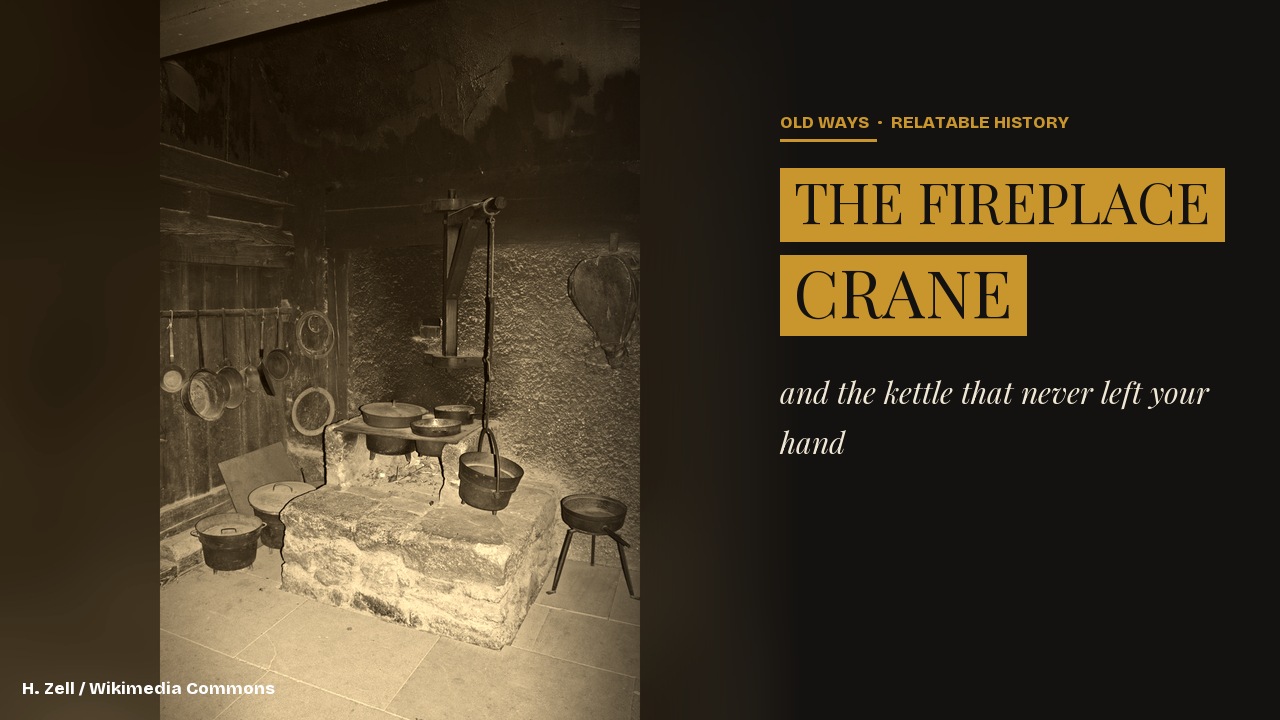
In 1989, archaeologists opening up the ground beneath a brick house in Bedford County, Virginia, found a corroded length of iron sitting in a root cellar under the floorboards. It took another thirty years and a specialist conservation lab before anyone could say with confidence exactly what it had been: a trammel, the notched or ratcheted hook that let a cook raise and lower a kettle over an open fire. No crane arm survived with it. No hearth tools, no cookware, nothing else that would make the find self-explanatory. Just the one working part that actually mattered — and knowing how a fireplace trammel worked is the only way to tell what that surviving part had actually been doing.
That is the thing people tend to get backwards about hearth-cooking ironwork. The swinging crane arm is the part that photographs well and the part every historic house tour points at, but it was only ever a delivery system. The trammel hanging from it was the actual control surface: the one piece of equipment standing between a cook and a pot that was either burning, boiling too hard, or barely simmering, with no dial, no gauge, and no way to turn the fire itself down. Get the trammel wrong and the crane’s elegant swing didn’t save dinner.
What follows isn’t the mechanism already covered in the video companion to this piece. It’s how a fireplace trammel worked once you go past the swinging arm: what three decades of archaeology, a Scots dictionary, a disputed word origin, a widely repeated myth, and an 1838 patent filing add up to, and why the trammel finally lost.
Two trammels, centuries apart in design
“Trammel” covers two genuinely different mechanisms that were used side by side for generations. The older of the two is the ratchet or saw-tooth style, documented in Western kitchens since at least the medieval period: two interlocking iron pieces that lock together at a chosen point along a row of saw-toothed steps, the way a car’s parking brake ratchets against its teeth. The example in Colonial Williamsburg’s collection, cataloged as object 1995-106 and dated to roughly 1750 to 1820, extends to 52½ inches and collapses to just under 37, with a span of nearly 5 inches across the teeth themselves — large enough to take real force without slipping.
The second style, which became more common over the course of the 17th century, swapped the ratchet for something closer to a pegboard: one iron piece simply dropped into whichever of several punched holes in the other gave the right height. It was a cruder fit than a ratchet, but far cheaper for a smith to make, which is probably why it spread as iron cranes themselves became more affordable. A piece in the Henry Ford Museum’s collection, cataloged under object ID 2017.0.34.1083 and dated to the same general 1750–1830 window, is a plain example of the type: a cast-iron bar whose only feature is the row of holes.
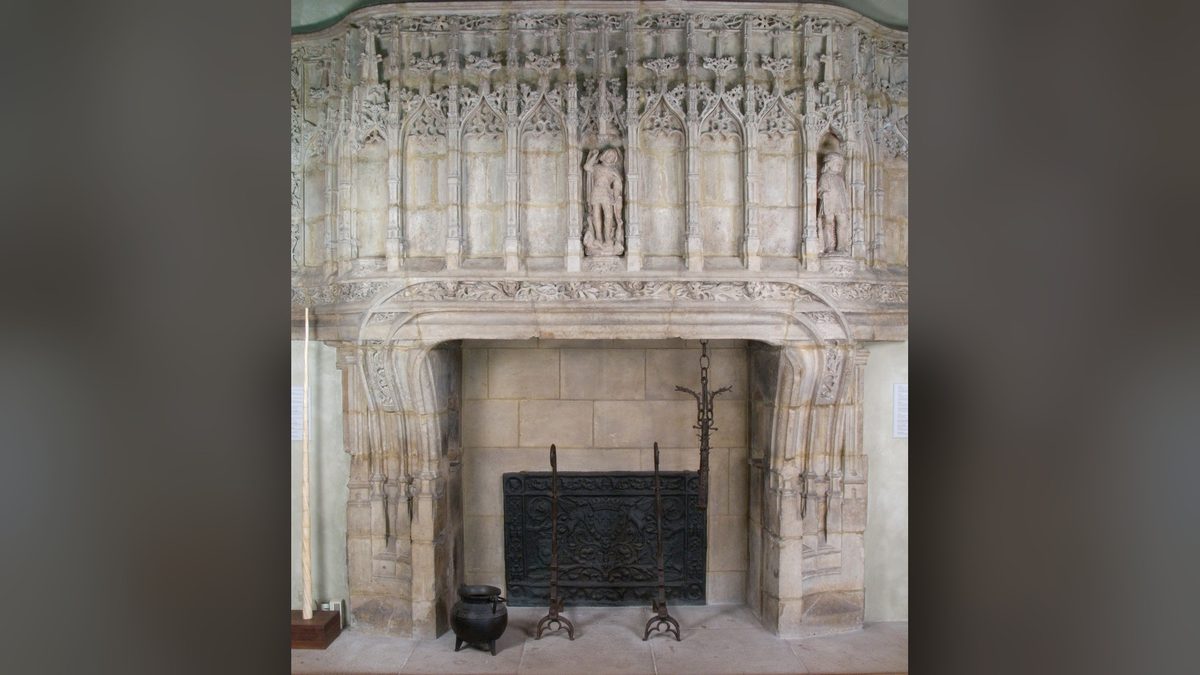
Both styles answered the same problem from opposite design philosophies: the ratchet gave finer control at the cost of a more difficult forging job, the pegboard style gave coarser steps that any village smith could punch out in minutes. Neither replaced the other outright. Museum collections show both still in use well into the 19th century, which suggests cooks and smiths alike treated the choice as a matter of what was on hand rather than which was objectively better.
What thirty years underground preserved at Poplar Forest
The Virginia find belongs to the 1857 Slave Dwelling at Poplar Forest, Thomas Jefferson’s retreat property in Bedford County. The building itself postdates Jefferson, who died in 1826: it was built under the Cobbs and Hutter families, who acquired the property after his death, as part of a slave quarters whose southern half, oral history holds, housed enslaved laborers while the northern half sheltered an overseer’s family. After emancipation the same brick structure kept being lived in, by Black and white tenant farm families, into the middle of the 20th century.
Archaeologists found the trammel in a root cellar beneath the building’s first floor, very likely suspended originally from an iron bar still embedded in the chimney stack, with an iron chain pot-hook still attached to it where the trammel itself had come loose and fallen. The bar that would have carried it was removed in a 20th-century renovation, which is why the trammel ended up in the ground rather than still hanging in place. The Maryland Archaeological Conservation Laboratory conserved the corroded iron in 2019, a process that for an object in that condition can run from several weeks to several years.
None of that makes this a famous artifact. It makes it a specific one: physical, datable evidence of exactly whose hands were actually working a hearth in one particular Virginia kitchen, at a site whose written records say comparatively little about the people who did the cooking — the same documentation gap that shows up at Jefferson’s own Monticello, where the plantation’s enormous 1,235-pound cheese wheel is recorded in exacting detail and the enslaved people who pressed it are barely named at all. A trammel photographed and labeled in a museum case tells you what the tool was. One excavated from underneath a known building tells you, far more specifically, who was using it.
A tool with as many names as regions
English-speaking households did not agree on what to call this arrangement. In large stretches of Scotland, the whole crane-and-trammel assembly went by “swey” (also spelled swy, swee, or sweigh), a word the Dictionary of the Scots Language traces to an Older Scots verb meaning “to swing to one side,” first recorded around 1460, with the lamp-bracket sense of the noun on record by 1688. Novelist John Galt used it in 1823 — “there was still hanging, on the swee, a kail-pot” — and the word was still being recorded in Aberdeenshire usage as late as 1960, describing “low fires with ‘sweys’ and whitewashed hearths.” A piece in Perth Museum’s own collection, an iron crane installed in an 1840s exhibit kitchen, is cataloged in English as a crane, with no trace of the dialect term on the record at all — a reminder that the object and its name didn’t always travel together even within one country.
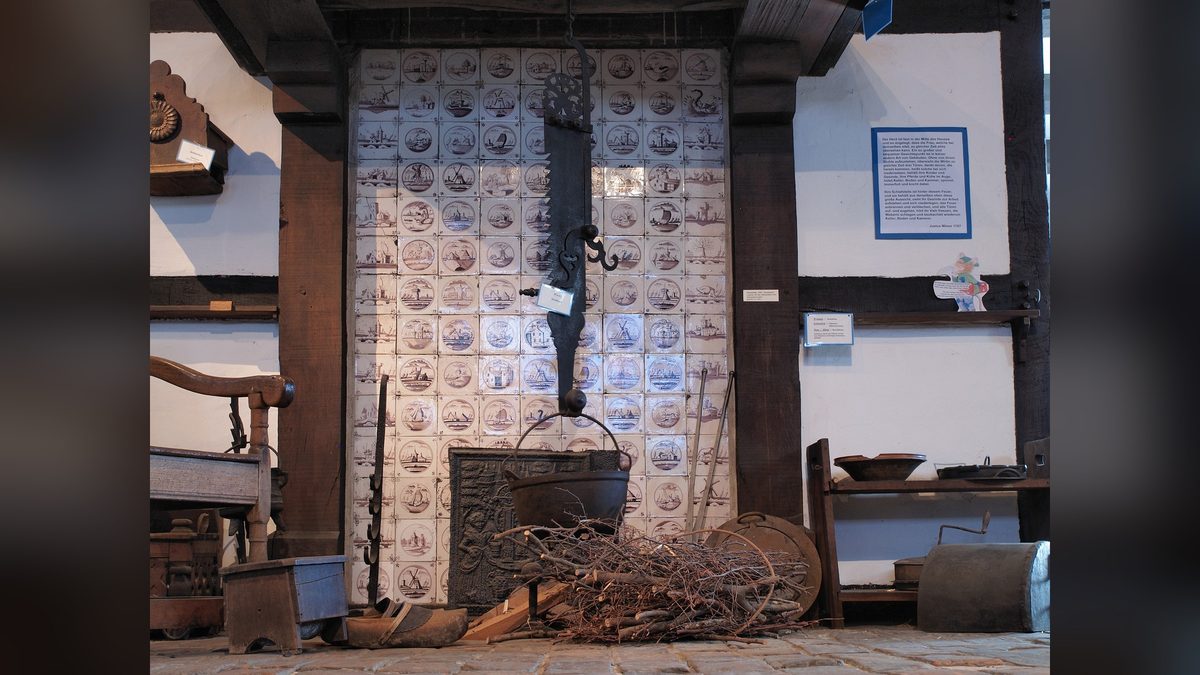
The English word “crane” itself carries more uncertainty than most people assume. The Online Etymology Dictionary dates the tool sense of the word — a machine with a long arm for moving weight — to the late 13th century, alongside equivalent words in German, French, and Greek that carry the same double meaning. What it does not supply is a documented account of which sense came first, or why the bird’s name attached itself to the tool. A popular explanation ties the household version’s name specifically to the lifting cranes used on docks and quaysides; the dictionary record doesn’t actually confirm that chain of borrowing, only that both the bird-word and the machine-word existed, in parallel, across several European languages, well before any surviving written source explains how they are connected.
How a Fireplace Trammel Worked Under Load
A loaded trammel is a lever problem as much as a cooking one. Hang a full iron kettle near the bottom of a crane arm, close to the pivot rod set into the chimney wall, and the arm carries a short lever with comparatively little strain on the iron. Hang the same weight further out along the arm, and the leverage — and the risk of a sagging or bent crane — both climb fast. That is a large part of why heavier cookware, not lighter, tended to end up on the hook nearest the pintle, with smaller pots riding safely further out.
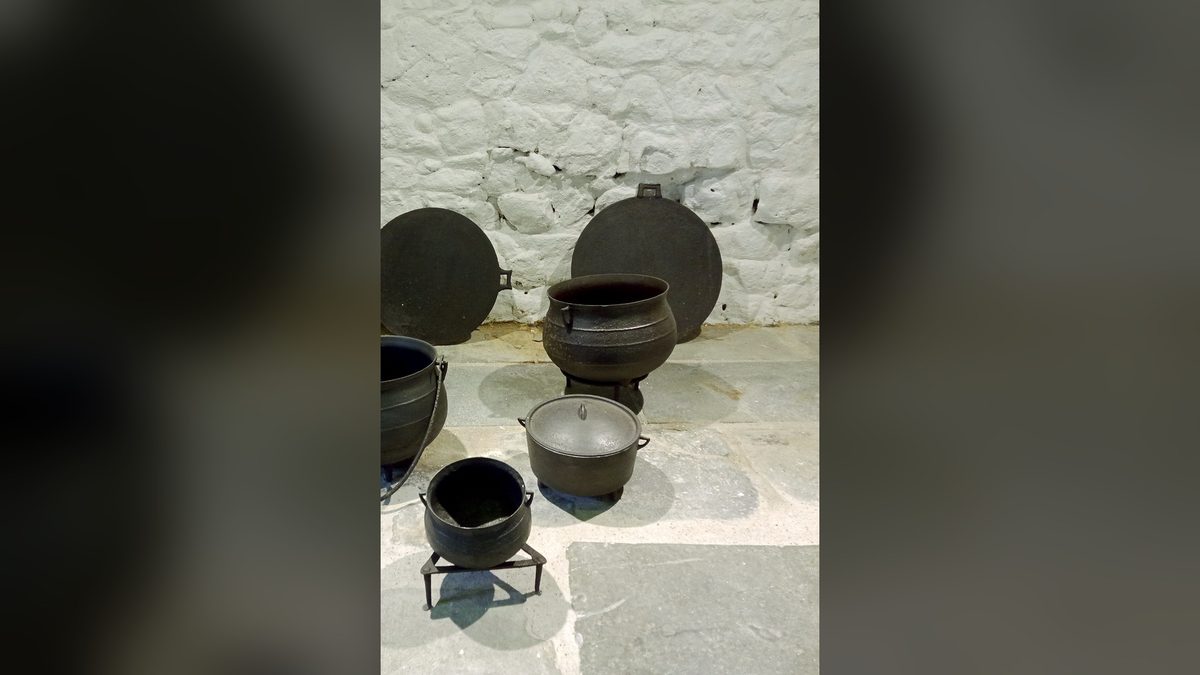
The trammel had to hold its position against exactly that strain, hour after hour, without a single moving part failing silently. A saw-tooth trammel like the one in Colonial Williamsburg’s collection does this by distributing load across several interlocked teeth rather than a single pin, which is why that style could be forged to extend more than 50 inches without the lock slipping under weight. A pole-and-hole trammel instead concentrates the load onto one punched hole at a time — mechanically cruder, and also more likely to wear a hole oval over years of daily use, at which point the trammel stopped holding its setting reliably and needed a smith’s attention. Neither style needed a separate trivet, pot stand, or pair of tongs to do its job; the iron itself carried the whole weight, continuously, for as long as a pot stayed on the fire.
The myth that didn’t survive the research
Any article about hearth cooking eventually runs into the claim that colonial and early American women died constantly from their skirts catching fire while they worked at the hearth, sometimes framed as the leading cause of death for women of the period, or the second-leading cause after childbirth. The claim is a myth, not a documented statistic. Historian Mary Miley Theobald, in Death by Petticoat: American History Myths Debunked, traces the exaggeration directly and is blunt about the real numbers: disease, not burns and not childbirth, was overwhelmingly the leading cause of death in the period. She does not deny that hearth-fire burns happened — “unfortunately some few women did die of burns,” in her own phrasing — only that the scale commonly claimed for it has no documentary support.
That distinction matters for a tool like the trammel specifically, because the trammel’s entire purpose was reducing exactly this kind of risk: letting a cook set a pot’s height once and walk away from the fire, rather than reaching back toward open flame every time a dish needed checking. It is easy to read a device built around a hazard and assume the hazard must have been catastrophic in scale. The honest version is narrower and, if anything, more useful: real but comparatively rare risk, engineered down further by tools that specifically targeted it, long before anyone could measure the result in population statistics.
Why an 1838 patent finally beat the crane
The crane and its trammels did not lose to one single invention so much as to a slow accumulation of cheaper, better-engineered cast-iron alternatives. One concrete marker of that shift survives in the U.S. Patent Office’s own records: Patent No. 930, filed by New York ironmaster Jordan L. Mott and dated September 19, 1838, for what the filing calls simply “Mode of Constructing Cooking-Stoves.” Mott’s claimed improvement was narrow and specific — a one-piece cast firebox meant to stop warping and keep ash from falling into the oven below, paired with a particular path for the smoke to travel around that oven before escaping — but it is exactly the kind of incremental patent that, multiplied across dozens of competing ironmongers through the 1830s and 1840s, is what actually displaced the open hearth.
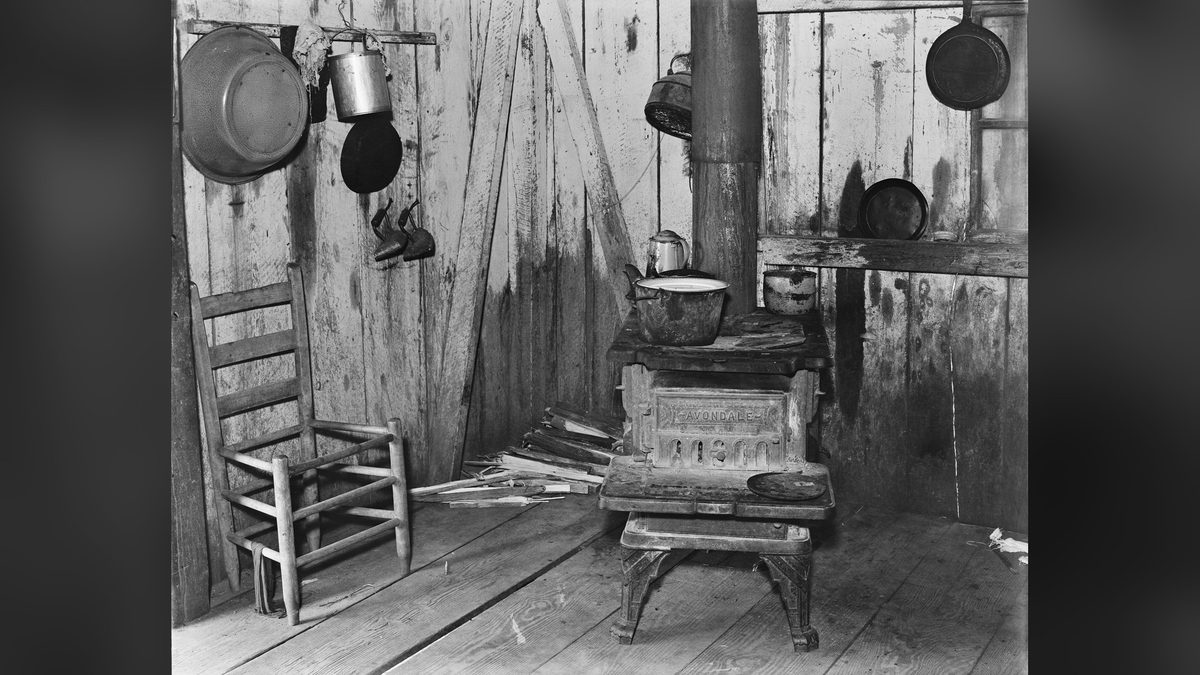
Historian Priscilla Brewer’s From Fireplace to Cookstove traces how unevenly that displacement actually landed. Cast-iron cookstoves spread fastest where cash and urban supply chains made them affordable, and by around 1850 most middle-class households in American towns had already made the switch. Poorer and more remote households did not switch on the same timeline, because a cast-iron stove, however fuel-efficient, still cost real money a family without it simply didn’t have — the same uneven, decades-long lag that shows up in how long farmers kept threshing grain by hand after mechanical threshers existed. The 1936 photograph of a bare kitchen wall in Hale County, Alabama, included above, documents exactly that lag: an open-hearth household still cooking the old way nearly a century after Mott filed his patent, for reasons that had nothing to do with preference and everything to do with what a working family could actually afford.
Put the pieces together and the trammel stops looking like a minor accessory to the more photogenic crane arm and starts looking like the actual technology at stake: a device good enough at controlling heat, cheap enough for a village smith to repair, and standardized enough in its basic mechanics that it barely changed in design from a medieval ratchet to a 19th-century Alabama tenant kitchen. What ended it, in the end, wasn’t a better trammel. It was a sealed iron box that didn’t need one at all — and a family had to be able to afford that box before the trammel’s two-century run was actually over for them.
The next time a restored hearth kitchen puts a crane on display, the object worth a second look is the smaller one hanging from it.
Watch the full history
The video companion to this article covers the crane itself — how the arm pivots, how a kitchen used it meal to meal, and how long it lingered in rural households — in just under eight minutes.

Related reading
- What Finding a Red Ear of Corn Actually Meant at a Husking Bee
- Threshing Grain by Hand: The Flail, the Floor, and the Riot That Tried to Stop the Machine
- The History of Cheese Pressing: From Roman Molds to Jefferson’s 1,235-Pound Wheel
- Why New England’s Stone Walls Run 240,000 Miles
Shop the hearth kitchen
- A modern reproduction fireplace crane, still forged for a working hearth.
- The Open-Hearth Cookbook: Recapturing the Flavor of Early America, for anyone who wants to try the cooking method itself.
Works cited
- McIlvoy, Karen. “Curator’s Curio: Cooking with the Trammel.” Council of Virginia Archaeologists. Link.
- “Saw Tooth Trammel,” object 1995-106, ca. 1750–1820. Colonial Williamsburg Foundation, eMuseum collection.
- “Trammel,” Object ID 2017.0.34.1083. The Henry Ford museum collection. Link.
- “Fireplace Crane,” object 987.14.1. Perth Museum & Art Gallery. Link.
- “Swey, n.” Dictionary of the Scots Language / Scottish National Dictionary. University of Glasgow. Link.
- Harper, Douglas. “Crane (n.).” Online Etymology Dictionary.
- Mott, Jordan L. “Mode of Constructing Cooking-Stoves.” U.S. Patent No. 930, issued September 19, 1838. United States Patent Office.
- Theobald, Mary Miley. Death by Petticoat: American History Myths Debunked. Andrews McMeel Publishing, 2012.
- “Death by Petticoat.” Past & Present podcast, The Colonial Williamsburg Foundation. Link.
- Brewer, Priscilla J. From Fireplace to Cookstove: Technology and the Domestic Ideal in America. Syracuse University Press, 2000.
- Crump, Nancy Carter. Hearthside Cooking: Early American Southern Cuisine Updated for Today’s Hearth and Cookstove. University of North Carolina Press, 2009.
- “Archaeology & Landscape Restoration.” Thomas Jefferson’s Poplar Forest. Link.