
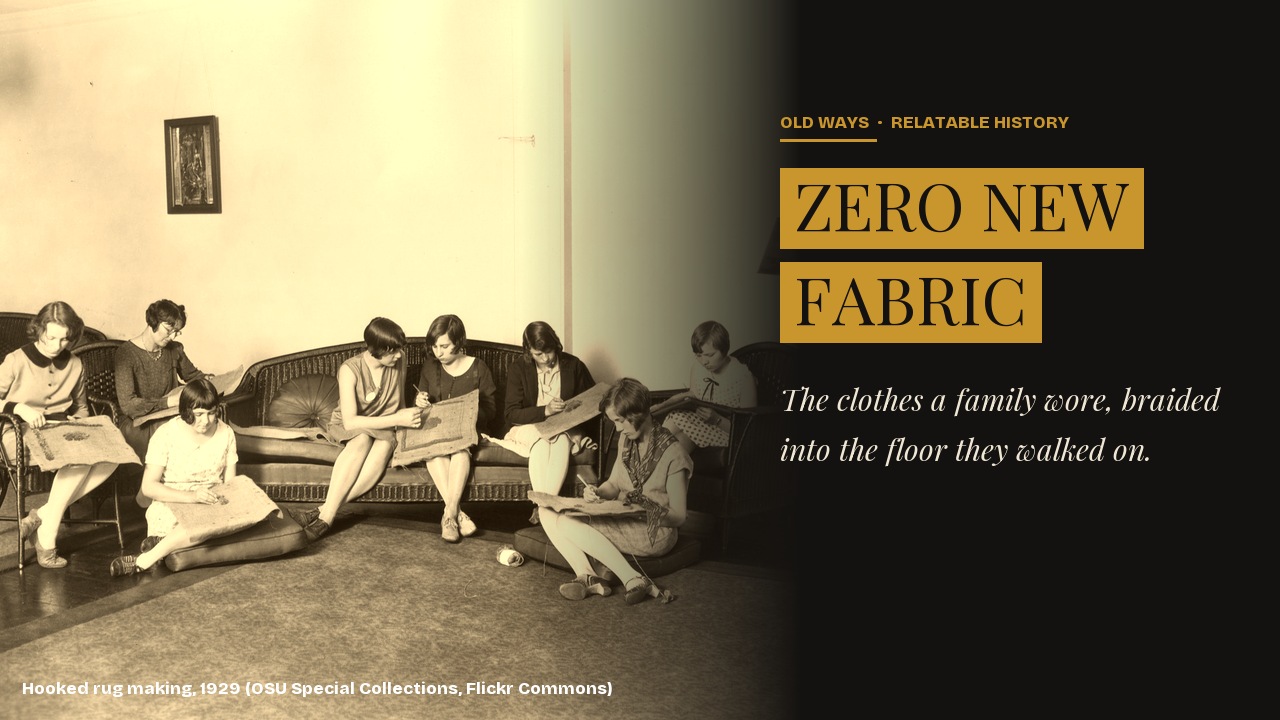
By the mission’s own count, sales of hand-hooked mats made from worn silk stockings rose from $27,000 in 1926 to $63,000 in 1929, and by that winter roughly 3,000 of them had been hooked along the coast of Newfoundland and Labrador. The women who made them were paid by the pound once a mission worker had weighed and graded the finished mat. For once, a rag rug was not purely a matter of thrift. It was also, for a few thousand households a very long way from any carpet shop, a wage. How rag rug making worked, underneath all that, depended entirely on which of three different crafts you meant.
That is the far end of a craft that most families practiced for nothing more than the cost of a worn-out shirt. “Rag rug” covers three genuinely different techniques — braided, hooked and woven — built on the same underlying logic that governed most of a household’s old clothes: a weekly chore like roasting coffee or beating a carpet, nothing with wearable fabric left in it went to waste. Each technique needed different tools, produced a different object, and, as it turned out, had a different fate.
None of the three died out by accident. One was standardized by a tin peddler with a set of zinc stencils. One was turned into paid piecework by a medical mission a thousand miles from its nearest market. And one nearly disappeared entirely before museums on two continents started collecting it on purpose.
How Rag Rug Making Worked: Three Crafts From One Rag Bag
A braided rug is made by sewing rag strips end to end, folding each strip so its raw edges face inward, then plaiting three such folded strips together the way you would plait hair. The finished braid is coiled into a spiral or an oval and laced flat with carpet thread run through the edges of adjoining rows, so that the stitches never show on the top of the finished rug. It needs no loom, no hook, and no backing cloth at all — the braid is the entire structure.
A hooked rug works the opposite way. A loosely woven backing — traditionally burlap or jute sacking — is stretched on a frame, and a narrow strip of rag or a length of yarn is pulled up through the backing in a continuous series of small loops, using a hook set into a wooden handle. The loops are packed tightly enough that the backing disappears under them, and the pile they form can be left as loops or sheared flat afterward.
A woven rag rug is a third craft again, and the one with the least in common with the other two: rag strips become the weft, beaten through a warp of strong cotton or linen string stretched on a floor loom, exactly as a weaver would work any other weft yarn. In French-Canadian households this was the catalogne; in Scandinavian ones, a woven rag runner was simply what covered a farmhouse floor. All three crafts used the same raw material and solved the same problem, but a braider, a hooker and a weaver needed three different skill sets and, usually, three different sets of tools.
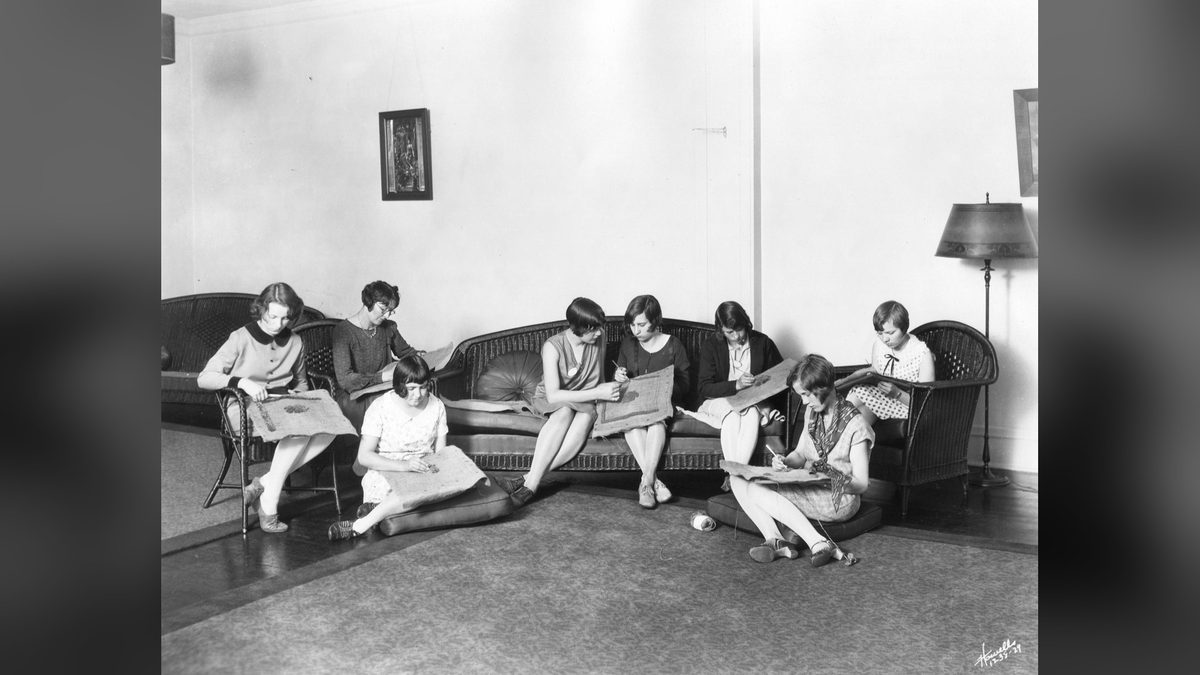
Braiding Needed No Tools At All, Which Was the Point
Of the three, braiding was the one almost anyone could do with what was already in the house. Early American braided mats followed straw plaiting, a colonial-era floor covering that was simply copied in wool once New England’s woolen mills made scrap wool cheap and steady through the early 1800s. A rug braided from whatever the rag bag produced that week, with no planning at all, became known as a “hit or miss” rug, and black ran through nearly every one of them for the simple reason that black wool was the most common color in a nineteenth-century man’s coat, suit and trousers.
More ambitious braiders worked to a pattern instead — concentric ovals, overlapping circles, or an eight-petaled “flower” whose radiating color bands echo rugs the Shakers made and sold. None of this changed the underlying mechanics. A braided rug is still, structurally, nothing more than plaited fabric laced to its neighbor, which is exactly why it needed no loom, no hook, and no cash outlay a household didn’t already have.
A Burlap Backing and a Maine Peddler Turned Hooking Into a Trade
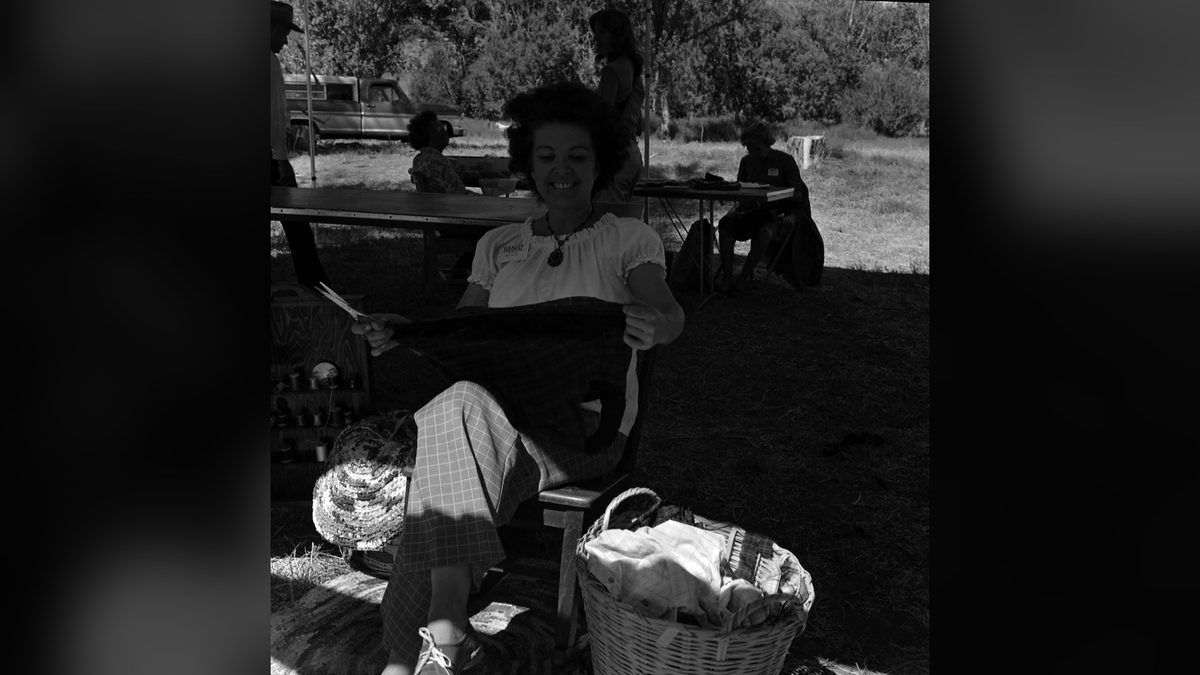
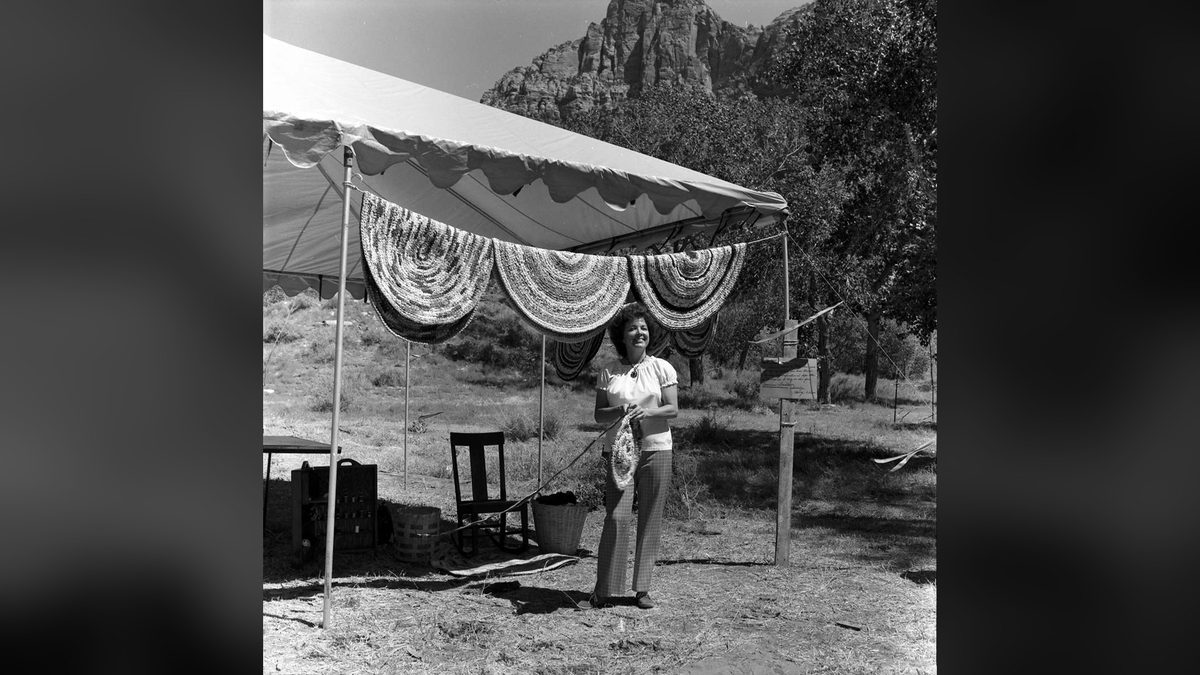
Hooking needed one thing braiding didn’t: a backing cloth loose enough to push a hook through, cheap enough to use on a floor covering, and available in quantity. Burlap sacking, imported in bulk to pack grain and other goods, became exactly that kind of material by the middle of the nineteenth century, and historians generally place hooking’s rise along the U.S. Eastern Seaboard and in the Canadian Maritimes and Newfoundland at roughly the same period, probably developing independently in several places at once. It was known plainly as the craft of the poor: people who could not afford an imported, machine-woven English carpet hooked their own instead.
A hooked rug from that earlier period, before any pattern was sold commercially, was drawn freehand onto the backing by whoever was going to hook it. Lucy Trask Barnard of Dixfield, Maine, hooked the rug below around 1860 with no stencil to follow at all: a farmhouse, a line of trees, a spray of garden flowers and a dark horse at a trot, composed entirely from her own eye.
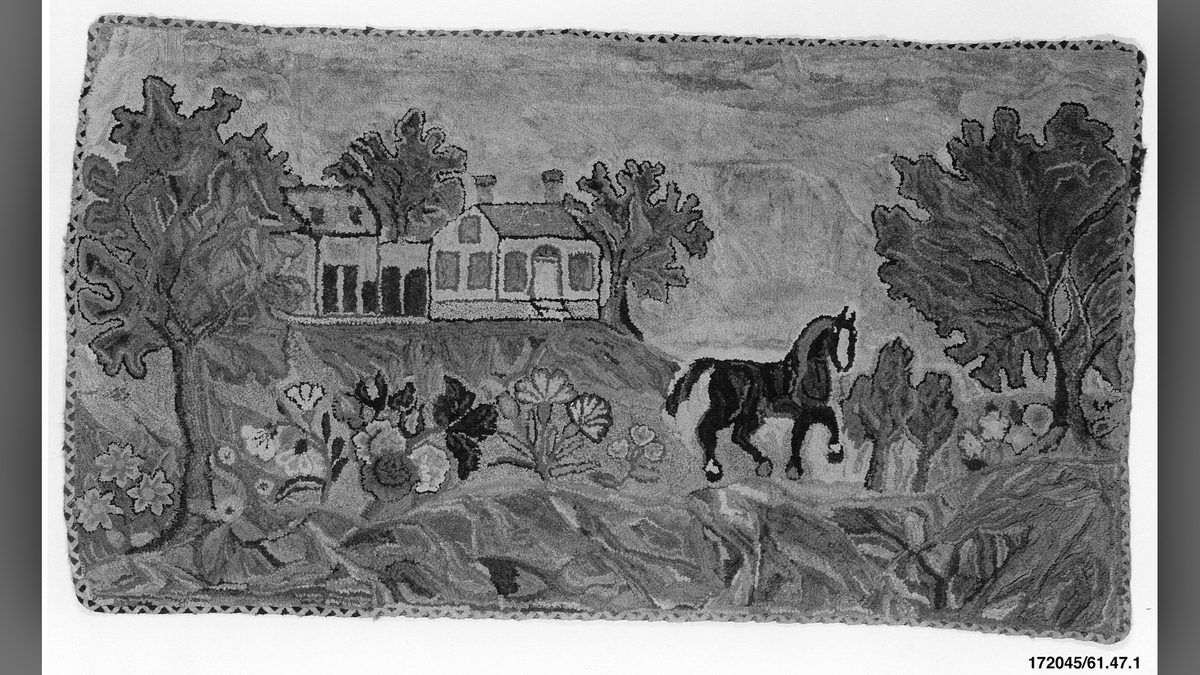
Standardization came less than a decade later. In 1868, Edward Sands Frost, a tin peddler working out of Biddeford, Maine, began cutting rug patterns from zinc into stencils and printing them directly onto burlap, which let him sell the same floral or geometric design to any number of households along his route. By the 1890s, pattern companies had taken the idea much further: Wells and Richardson of Montréal printed a Diamond Dye Rug Book of patterns in 1894 — and used it to urge readers to save their rags rather than sell them off to a rag-gatherer — and by 1905 Eaton’s department store was advertising its own Monarch hooked-rug patterns by mail order catalogue. A stenciled pattern made hooking faster and more consistent. It also, by most accounts, made the finished rugs more generic, trading the individuality of Barnard’s farmhouse scene for a pattern thousands of other households were hooking the same winter. The shift mirrors what mechanization did to other hand work on the same farms: faster, more uniform, and a little less anyone’s own.
In Newfoundland and Labrador, Hooking Became a Wage
Hooking had been an ordinary skill among the coastal women of northern Newfoundland and Labrador for generations, mostly learned in childhood, before Dr. Wilfred Grenfell built anything around it. Grenfell arrived in 1892 to run a medical mission along that coast, and, opposed to simple charity, organized a cottage industry the mission called “the Industrial” so that the craft people already had could be turned into cash income instead of a handout. The American occupational therapist Jessie Luther came north to St. Anthony in 1906 and started a formal matting club on 29 January 1908, with a standard burlap base the mission called “brin” and kits of fabric cut into quarter-inch strips.
Luther and, after her, Grenfell himself designed “picture mats” built around local motifs — dog teams, seals, polar bears, snowy owls — and by 1916 the mission had sixteen such designs in production, alongside plainer patchwork-style “scrap mats.” In 1928, the mission’s Industrial Supervisor, M. A. Pressley-Smith, put out a public appeal through the mission’s own quarterly for old silk and rayon stockings, which dyed well and hooked into a finer, denser pile than wool. Hooks were filed-down bent nails set into wooden handles, frames were four lengths of wood lashed together, and a finished mat might pack in as many as 200 stitches per square inch.
The finished mats were sold almost entirely outside Newfoundland and Labrador, at volunteer-run sales across New England and New York, at retail shops the mission opened in New York City and Philadelphia, and at outlets like the Dog Team Tavern in Ferrisburg, Vermont, which began stocking them in 1931. That sales network was what let revenue nearly triple between 1926 and 1929 even as Newfoundland headed into the same economic collapse as everywhere else — by 1932, close to 20,000 people on the island were on government relief paying six cents a day. For a mission that paid its workers by the finished pound and tracked what every family actually needed, a rug on a buyer’s floor in Vermont or Manhattan was, quite directly, income for a household on the Labrador coast.
Weaving Was a Third Craft, Worked on a Loom Instead of a Hook
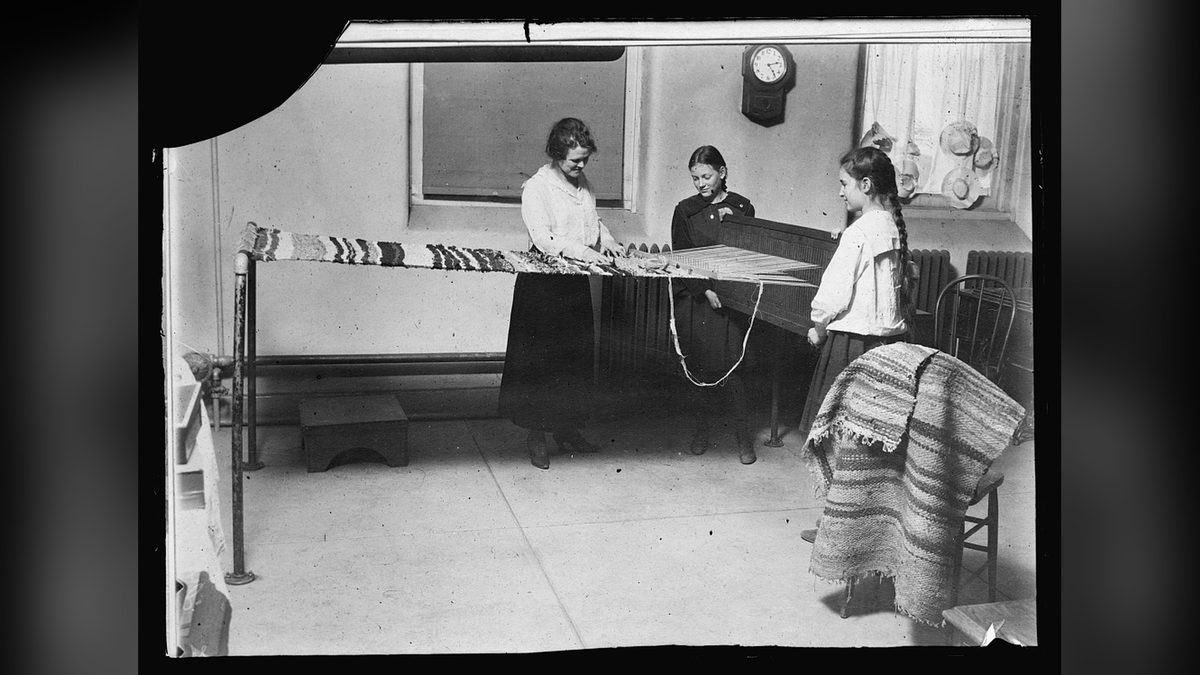
Woven rag rugs never went through anything like Frost’s stencils or Grenfell’s mission sales, mostly because weaving already required equipment most hookers and braiders didn’t have: a floor loom, strung with a warp of cotton or linen string strong enough to be beaten against for hours. Once that loom existed in a household or a shared weaving room, rag strips sewn end to end became just another weft, worked back and forth exactly as a weaver would work wool or linen yarn, and the result came off the loom as a long runner rather than a shaped mat. Because it depended on access to a loom rather than on tools anyone could make at home, woven rag rugs were more often a shared or commissioned piece of work than a solitary one — made in a weaving room with more than one pair of hands on the frame, as in the scene below from around 1920, rather than alone by a fireside.
The Craft Nearly Disappeared, Then Museums Started Collecting It on Purpose
The U.S. government took hooked rugs seriously enough to document them during the Depression: the Index of American Design, a Works Progress Administration project, put unemployed artists to work producing more than 17,000 watercolor renderings of American folk art and craft objects in the 1930s, hooked rugs among them, before the whole archive was transferred to the National Gallery of Art in 1943. It is, in effect, the most systematic portrait that exists of what ordinary American households were hooking just before the craft’s steepest decline.
Across the Atlantic, the same craft went by different names and used tools improvised from whatever a given trade had lying around. In the coal and shipbuilding districts of North East England, these were “hooky” and “proggy” mats (and, elsewhere in Britain, clippy, cleekie, clootie or peg rugs), and the tool used to push or prog the rag through the backing came from whatever was nearest at hand: a ram’s horn in sheep-farming country, a net-mending “fid” in the fishing port of South Shields, a heckle pin from a Wallsend rope works, or, in the shipyards along the Tyne, a hand-filed brass or copper progger made as a love token. In pit villages the equivalent tool was a cruder, all-metal design turned out by the colliery blacksmith. Interest in the craft nearly died out across Britain by the 1970s, which is roughly where a handful of other pre-industrial techniques also bottomed out before being deliberately preserved rather than simply remembered. Beamish Museum, in County Durham, has spent the decades since 1970 building what its own keeper, Rosemary E. Allan, calls probably the largest rag rug collection in any museum in the British Isles — around 250 mats, dated from about 1897 to the present, gathered from pit villages, mill towns and farmhouses across the north of England.
American museums did much the same for the American side of the craft. The Shelburne Museum in Vermont holds, among a great deal else, fifty statehood rugs hooked by Molly Nye Tobey and contemporary work by Patty Yoder, and rotates its hooked rugs through gallery exhibitions the way it would any other recognized form of American folk art. None of this changed how the craft actually works. A rag rug made today, by hand, is braided, hooked or woven by exactly the methods a Grenfell mission worker or a Tyneside shipyard apprentice would recognize instantly — only the reason for making one has changed, from necessity to choice.
Watch the full history
The video version covers the braided, hooked and woven techniques and the nineteenth-century American rag bag in about eight minutes.

Related reading
- The Cotton Bag Sewing Contest That Outlived the Great Depression — another feed-sack frugality craft from the same Depression-era rag bag
- How Carpet Beaters Worked Before the Vacuum Cleaner — the tool that kept a hooked or braided rug clean once it was finished
- How a Fireplace Trammel Worked in a Colonial Kitchen — another everyday object built entirely from a household’s own scrap materials
- What Washing Before Indoor Plumbing Really Looked Like — the domestic labor that rag rugs were themselves part of
Shop the styles/items featured in this video
Works cited
- Allen, Max. “Rugs and Rug Making.” The Canadian Encyclopedia, Historica Canada. Published 7 February 2006; last edited 16 December 2013. Link.
- “Silk-Stocking Mats: Hooked Mats of the Grenfell Mission.” Newfoundland and Labrador Heritage, Memorial University of Newfoundland.
- Stenson, Michelle, interviewed in “Rough Braid: A Glimpse at the History of Braided Rugs in America.” Antique Homes Magazine. Link.
- Index of American Design, exhibition record. National Gallery of Art, Washington, D.C. The Index holds more than 17,000 watercolor renderings made under the WPA Federal Art Project in the 1930s and transferred to the Gallery in 1943.
- “Textiles.” Shelburne Museum collection pages, Shelburne, Vermont. Link.
- Allan, Rosemary E. From Rags to Riches: Hooky and Proggy Mats of the North of England. Northern Heritage, 2007, published for Beamish Museum. Link.
- “Hooky and Proggy: A Beginner’s Guide.” Shipley Art Gallery / North East Museums. Link.
- “A Short History of Antique Hooked Rugs.” Doris Leslie Blau, New York.
- Metropolitan Museum of Art. Object record for Hooked Rug by Lucy Trask Barnard, ca. 1860, wool, Sansbury-Mills Fund, 1961.