
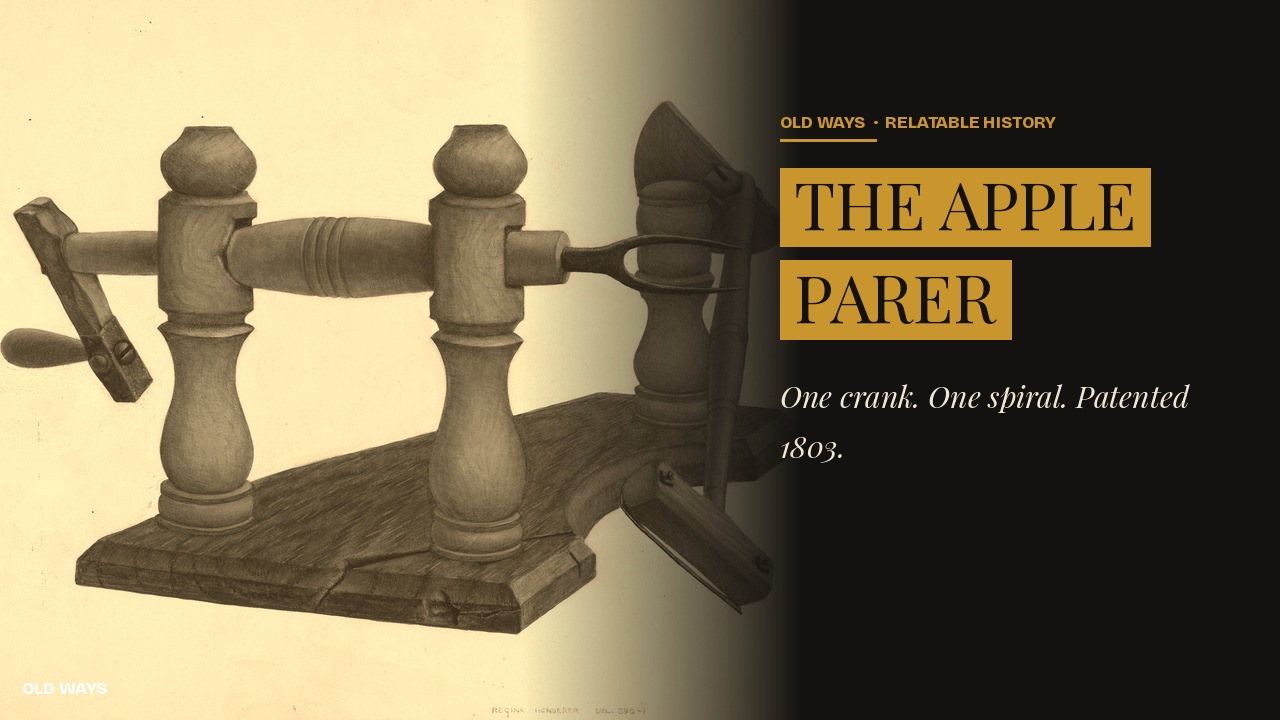
The reply survives. In the National Archives, filed among Thomas Jefferson’s papers, is a short letter dated 10 March 1804 and addressed to a Pennsylvania farmer named Moses Coates. Jefferson had not yet seen the “paring machine” Coates had written to him about, he said, but he meant to call at the Patent Office and look at it. He also wanted to know the price.
That one surviving exchange is as close as this object gets to a birth certificate, and it is only the beginning of the story. Over the following century, the U.S. Patent Office would process something on the order of 250 separate claims to a better apple parer — a volume of competing paperwork that turned a kitchen gadget into one of the most contested classes of invention in the country, complete with its own recorded priority disputes.
None of that paperwork, or the social ritual that grew up around the finished machines, gets much room in a seven-minute video, which necessarily covers how the apple parer worked only in outline. Here is the rest of it: the actual words Jefferson wrote back, the men whose names the patent office recorded and then mostly forgot, and the New England custom the parer’s own evening gatherings were quietly descended from.
What Jefferson actually wrote back
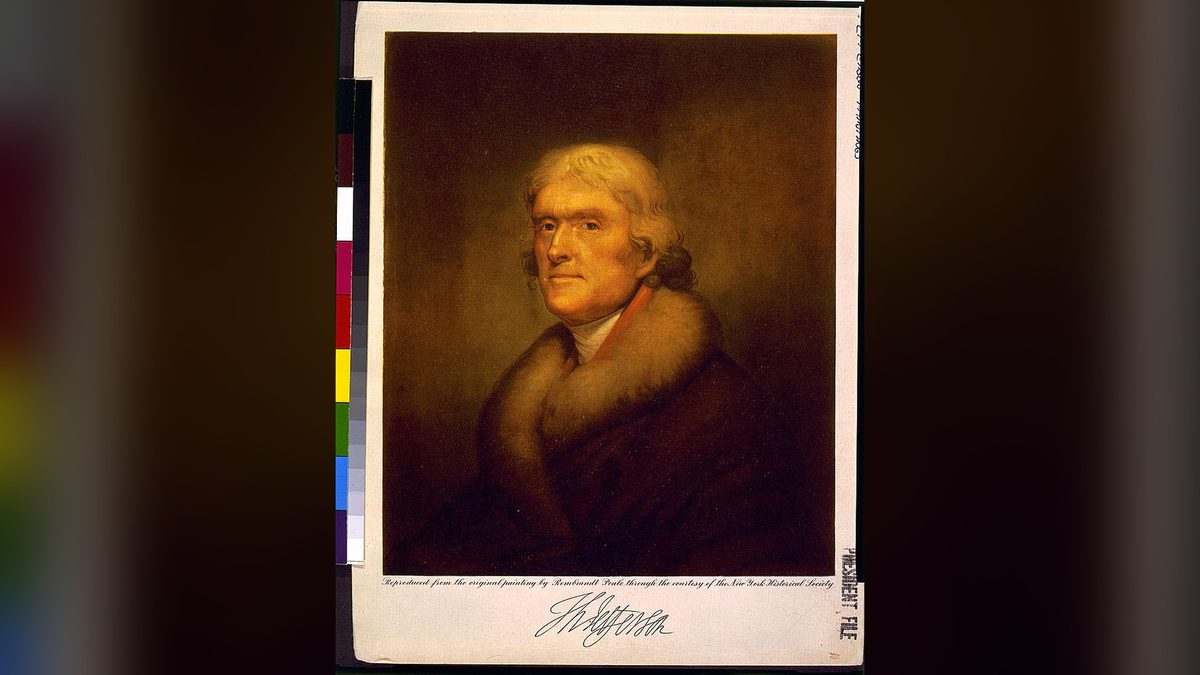
Coates’s own letter to Jefferson does not survive, but Jefferson’s reply does, and it undercuts the version of this story that usually gets repeated. Jefferson was not dismissive, but he was not effusive either. He wrote that he had not yet seen the paring machine himself and would call at the Patent Office “for that purpose,” and he asked where he might buy one and at what price, should he like it.
Coates, it seems, had also asked whether the federal government might simply buy out his patent rights, so the machine could be sold to ordinary households at a fraction of the price. Jefferson’s answer was a short, exact civics lesson: Congress, he wrote, “is not authorised by the Constitution to apply any money to an object of that kind” — only the individual state governments could do something like that. It is a small, telling moment: a sitting president declining, on narrow constitutional grounds, to nationalize an apple peeler.
Coates was not a young man chasing a fad. By the time he wrote to Jefferson he had already married twice, buried his first wife, and spent years working the fruit harvest near Downingtown, Pennsylvania, before he ever filed for a patent. Genealogical records credit him with building a working version of the parer toward the end of the 1790s, years before the 1803 patent made it official, and with at least two other inventions besides: a machine for cutting straw, and a self-setting saw mill that drew its own share of local attention. His son, Dr. Jesse Coates, later owned much of the land that became the town of Coatesville, Pennsylvania, named for the family.
Patent records show how the apple parer worked, and the fight it started
Coates’s design was never under patent protection for long by modern standards — early 19th-century patents ran fourteen years — and once it lapsed, nothing stopped the field from crowding in. Debra Schmidt Bach, an assistant curator of decorative arts at the New-York Historical Society, has put the number of distinct apple-parer patents filed between 1803 and 1910 at roughly 250, each one claiming some improvement on the last: a better grip, a self-returning blade, a frame that would not walk across the table while it ran.
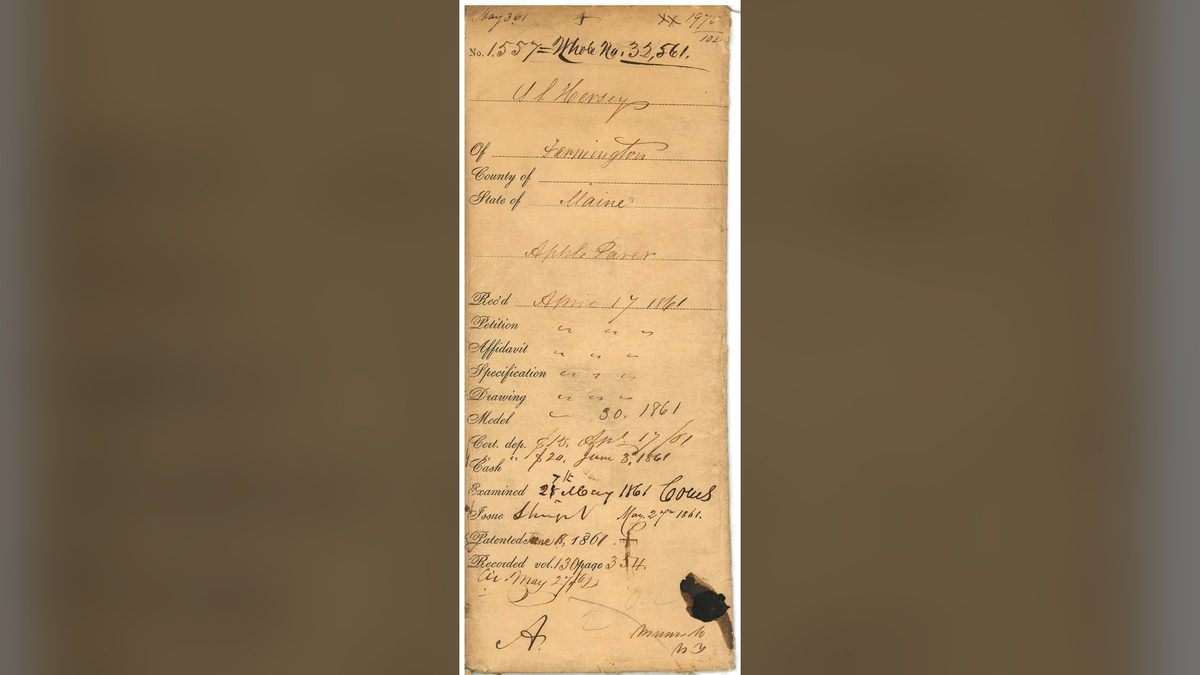
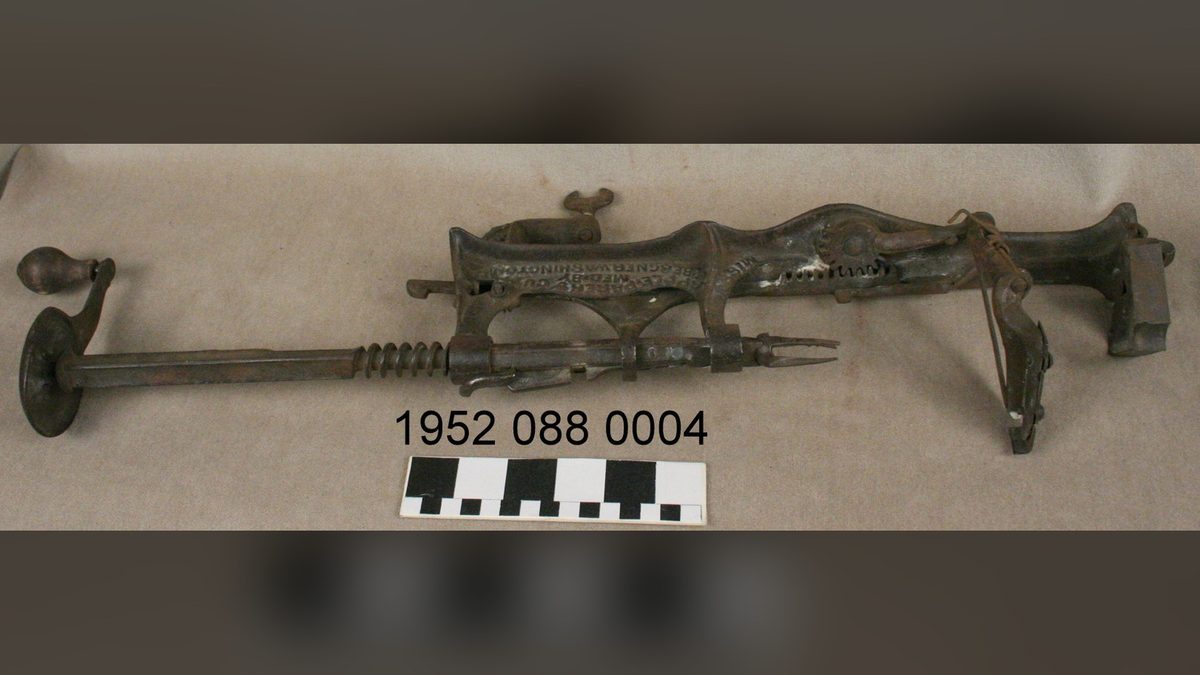
One of those inventors has left an unusually complete paper trail. On 17 April 1861, a man named S. S. Hersey, of Farmington, Maine, filed for a patent on an apple parer. The Patent Office’s own clerk’s docket for the application survives, written out by hand, tracking the petition, the affidavit, the model deposit, and finally the grant: Hersey’s patent, No. 32,561, issued on 18 June 1861. The machine it describes clamped to a bench; a hand crank rotated a fork that held the apple while a knife, carried on a toothed, sector-shaped arm, traveled around the fruit and was pulled back afterward by a spring; a small deflector kept the peeling clear of the gears, and a stop lever kept an overeager cook from cranking past a single turn.
Hersey did not stop there. A later docket in the same file shows the Patent Office opening a formal interference — a hearing to decide which of two rival applicants had actually invented something first — between Hersey’s improved design and a competing application from a man named L. F. C. Whittemore. The case dragged on for more than a year. On 7 September 1865 the office ruled in Hersey’s favor on priority of invention; the following January, the interference was formally closed. It is a small, bureaucratic footnote to most histories of the object, and a vivid one: by the 1860s, two men were willing to fight a federal administrative proceeding over who had first thought of a slightly better way to peel an apple.
A Warren County bee shows exactly how the evening actually ran
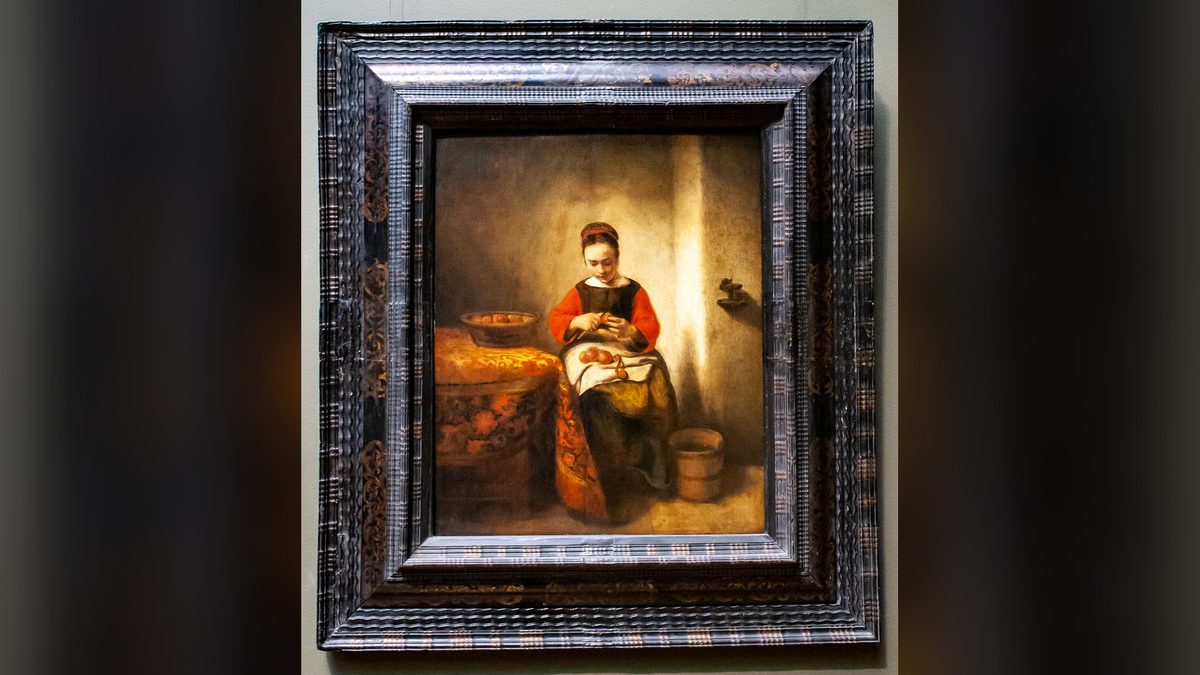
A first-hand account from Chandler’s Valley, in Warren County, Pennsylvania, describes one such gathering in detail: a paring bee held at Bob Shaw’s farm in November 1865, which drew somewhere between fifty and a hundred neighbors on foot from miles around. Guests sat in circles on plank benches around tubs, working with their own paring knives rather than a mechanical parer — a reminder that, even in 1865, hand-peeling and the machine coexisted, and a bee did not always mean a crank was turning. Boys kept the circles supplied, pushing cut apples toward the peelers with brooms, or with their feet, so no one had to break rhythm to reach for more fruit.
The drying method recorded there is specific enough to follow step by step. Pared apple pieces were strung on cotton string three to five feet long with a darning needle, the ends finished off with a half-hitch knot, and the loaded strings were hung from poles near the kitchen rafters, close enough to the stove’s heat to cure over the following weeks. Once dry, the fruit came off the string and went into sacks for winter storage, and the cotton string itself was wound back into a ball and saved for the following autumn rather than thrown away. The Jackson Run evening wound down, as these gatherings often did, with a candy pull, and ran past midnight.
New England’s bees were older, and already tangled up with temperance
The paring bee itself predates the mechanical parer by well over a century. In Puritan New England, communities held apple-paring gatherings as a deliberate substitute for wassailing, the English custom of singing to orchard trees to encourage a good crop, which the Puritans considered too close to pagan ritual to keep. Families set out every spare container the farmhouse owned, heaped barrels of apples in the middle of the room, and worked through them as a group, often closing the night with a harvest dinner built around the stored nuts, apples, and cider the season had produced.
That cider connection turned out to be a liability long before Prohibition ever reached an orchard. The temperance movement of the early 1800s — decades before the national ban that followed in the 1920s — already had New England farmers cutting down cider orchards on their own initiative, specifically because, once the pressing and drinking of hard cider fell out of favor, a tree whose apples were good mainly for the press no longer had an obvious reason to keep standing. The crop that the paring bee existed to process, in other words, was being argued over on moral grounds within a single generation of the Puritans who first held the bees.
The name behind the brand everyone still recognizes
By the 1860s, the field had a figure whose company would eventually dominate it. David H. Goodell, of Antrim, New Hampshire, received his first apple-parer patent in 1863 and, within a year or two, had a hand-cranked, lathe-style machine on the market that could peel, core, and slice an apple in about ten seconds — a single-motion design that made most of what came before it look like separate chores. The machine did not sell itself at first: a New York marketing firm Goodell hired managed only 2,400 sales in two years. Goodell then went out and sold it himself, as a traveling demonstrator, and moved 24,000 units in three weeks.
The company he built in Antrim grew into what was, for a time, the largest apple-parer manufacturer in the world. Its most popular single model, the lathe-style White Mountain parer, sold roughly 500,000 units in 1904 alone, and by then the factory’s catalog had expanded well past fruit tools to some 1,300 styles of cutlery. Goodell’s own career expanded with it: town clerk, state legislator, and in 1888, governor of New Hampshire, all while he continued to run the company until his death in 1915. His sons kept it going afterward; Chicago Cutlery bought the firm in 1983, the factory closed in 1989, and the mill building itself was added to the National Register of Historic Places in 2023 — a longer institutional afterlife than almost any other object this series has covered.
Strip away the brand names and the patent numbers, and what is left is a strangely intimate record of how much a society will invest in shaving a few seconds off a chore it has to do by the thousands, every single autumn, on a deadline set by the weather. A president took time to answer a farmer’s letter about it and explain, on constitutional grounds, why he could not just buy the farmer out. A federal office heard sworn arguments over which of two men in Maine had thought of a spring-loaded blade arm first. A company in a small New Hampshire town built a cutlery empire and sent its founder to the governor’s office on the strength of it. None of that happened because the apple parer was important. It happened because peeling apples was dull, repetitive, time-bound work that touched nearly every household in the country, and dull, repetitive, time-bound work is exactly the kind of problem people will spend two hundred and fifty patents trying to solve.
The bees themselves are mostly gone, folded into the same refrigerated, grocery-store world that ended the parer’s working life. The patents mostly expired a century or more ago. What is left is the plain mechanical fact at the center of all of it, the same one it was in 1803 and 1861 and 1904: a fall harvest that will not keep itself, a crank, and a clock running down to the first hard freeze. How many apples would you peel to dry enough for one winter?
Watch the full history
The video version walks through the mechanism itself and the paring-bee ritual that built up around it, in about seven minutes.

Related reading
- How a Fireplace Trammel Worked in a Colonial Kitchen
- Is Water Glassing Eggs Actually Safe? What a Century of Science Found
- Threshing Grain by Hand: The Flail, the Floor, and the Riot That Tried to Stop the Machine
Shop
Shop the styles/items featured in this video: Apple Parers, the definitive collector’s history of the machine, and the Johnny Apple Peeler, the modern hand-crank descendant of the parer.
Works cited
- Jefferson, Thomas. “Thomas Jefferson to Moses Coates, 10 March 1804.” Founders Online, National Archives.
- “Moses Coates and the Invention That Changed Apple Harvesting Forever.” The Daily Gardener, 14 February 2020. Link.
- “Coates, Moses.” Biographical and genealogical sketch, Chester County, Pennsylvania archives. Link.
- Bach, Debra Schmidt, quoted in “Apple of Your Eye.” Edible Manhattan, November/December 2010. Link.
- “Apple Parer, 1800-1860.” Object record, The Henry Ford Museum. Link.
- “Apple Parer, 1866-1870.” Object record, The Henry Ford Museum. Link.
- “A Paring Bee on Jackson Run.” Warren County, Pennsylvania local history archive. Link.
- “Nine Apple Cider Traditions No Longer With Us.” New England Historical Society. Link.
- U.S. Patent No. 32,561. S. S. Hersey, Farmington, Maine. “Apple-Parer,” patented 18 June 1861. United States Patent and Trademark Office.
- U.S. Patent Office case file. Interference between S. S. Hersey’s improved apple-parer application and that of L. F. C. Whittemore, priority decided in favor of Hersey, 7 September 1865; interference dissolved 16 January 1866. National Archives, via the Digital Public Library of America.
- Rizzo, Maurie. “Apple Peeler: 150 Years Later, Goodell’s Invention Still Saves Time.” Tehachapi News, 2022. Link.
- “Mill That Made 1800s-Era Apple Parers on Historical List.” Nashua Telegraph, 20 January 2023. Link.