
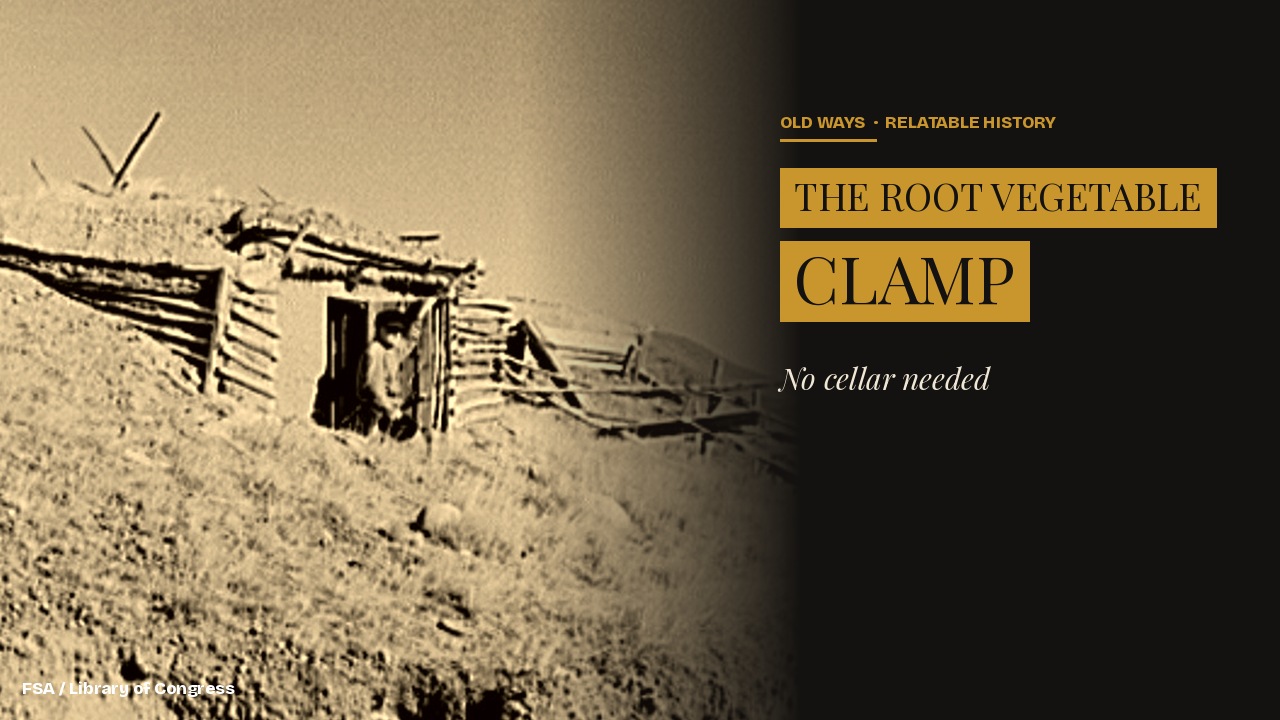
In the winter of 1942, researchers at the Rothamsted Experimental Station in England sank thermometers into a mound of potatoes covered in nothing more than straw and packed earth, and simply watched what happened. Within two weeks of being covered, the temperature inside the pile climbed from around 4–5°C to roughly 10°C, then held there, through the coldest stretch of an English winter, at a steady four degrees above the outside air. No fire, no insulation but dirt, no structure but a heap.
The thing they were measuring is called a clamp, and for well over two centuries it was the ordinary answer — across Britain and much of North America — to a problem nearly every farm had and most could not afford to solve any other way: what to do with several tons of potatoes, turnips, carrots, beets, and mangel-wurzels between the first hard frost and the following spring, with no stone-lined cellar dug under the house to put them in.
A clamp is four thin layers of straw and dirt, arranged in a specific order, and it rewards closer attention than that description suggests. Government scientists measured it with thermometers sunk a foot into the ground. Two governments legislated its construction down to the inch of straw during two world wars. And it is still being built today, essentially unchanged, by people who have never had reason to think about load-bearing earth at all.
A clamp existed because almost nobody had a root cellar to use instead
A proper root cellar — the kind dug into a hillside or under a farmhouse, lined with stone or timber, and insulated by the surrounding earth itself — took real capital and real labor to build. Plenty of farms never got one: smaller holdings, newer settlements, tenant farms, and anything built after the money had already gone elsewhere. What those farms had instead was dirt, straw, and, very often, more root vegetables than any cellar could have held regardless.
That second fact mattered as much as the first. Many of the crops piled into a clamp weren’t grown for the kitchen table at all. Turnips, swedes, and especially mangel-wurzels — a beet bred specifically as livestock fodder during Britain’s agricultural expansion — were grown by the ton to feed cattle through winter, and a single field’s worth could run to many tons, built into ridges running the length of a hedgerow. A below-ground cellar sized for that much feed would have been a serious piece of construction. A clamp cost an afternoon with a spade and a pitchfork, no lumber, no stone, and no fuel.
Building one followed the same four steps nearly everywhere it was used
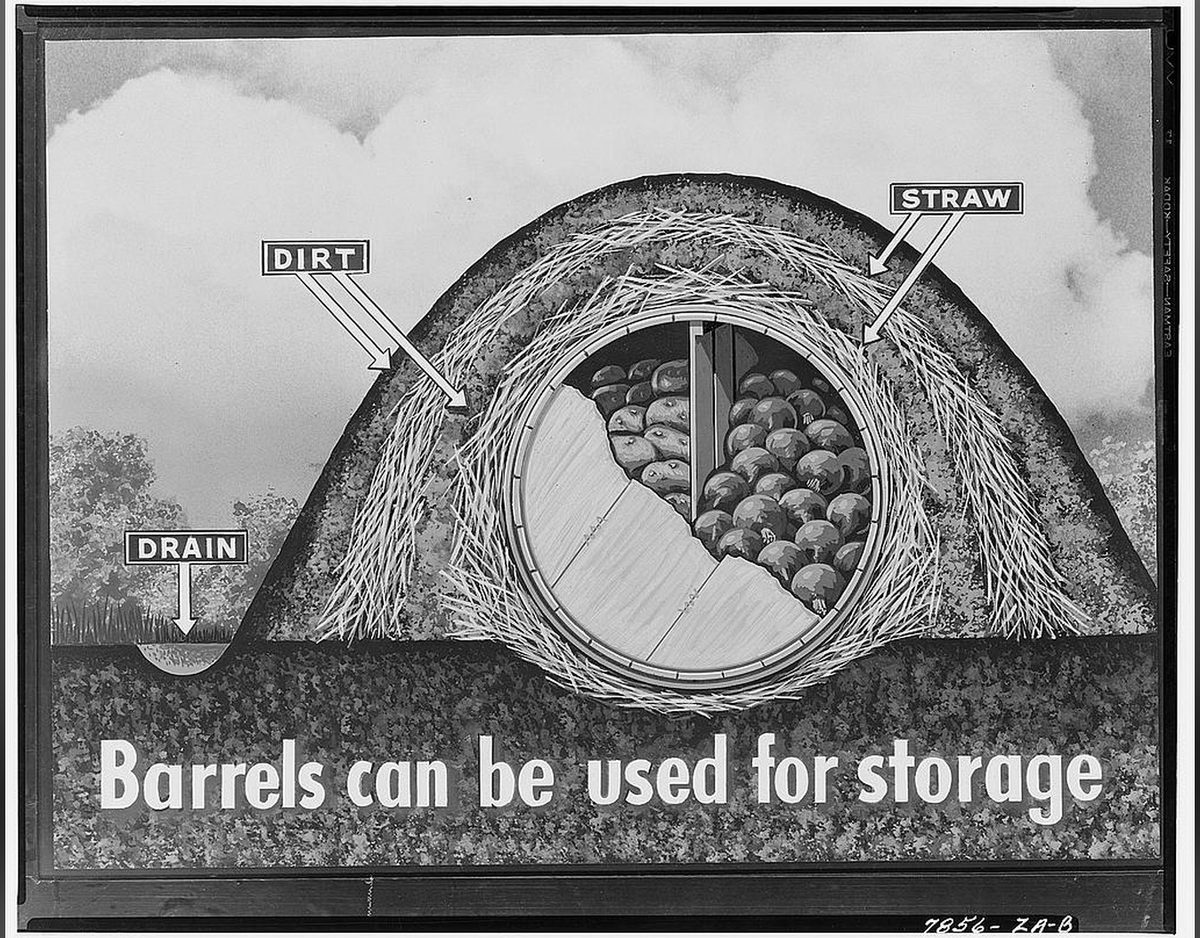
Despite being reinvented independently by generations of farmers on both sides of the Atlantic, the method converges on almost identical instructions wherever it’s written down. Pick a sheltered, well-drained site. Dig a shallow trench around the footprint, both to carry rainwater away and to supply the soil that goes on top later. Lay a bed of dry straw, then sort the harvest ruthlessly — bruised, cut, or diseased roots are left out, because a single rotten tuber can spread decay through an entire pile. Pile the sound ones into a cone or a long ridge, largest at the bottom.
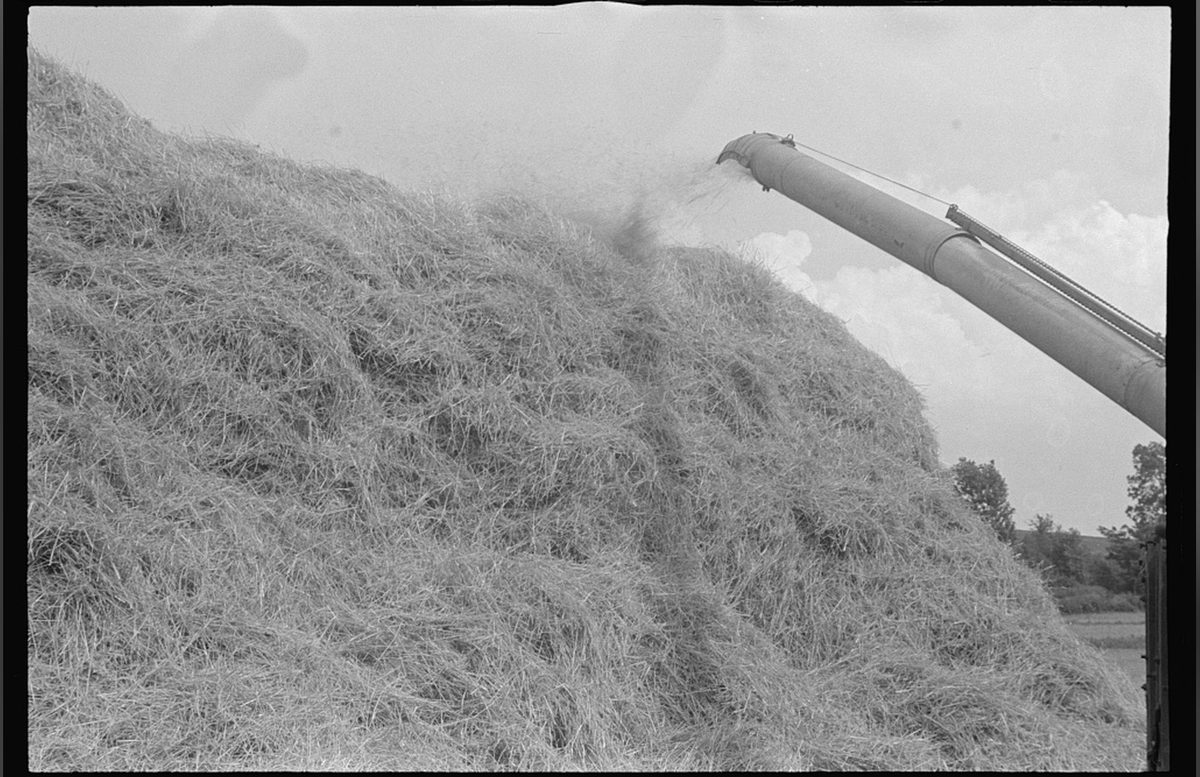
A second thick layer of straw goes over the heap — roughly five to six inches in the clamps Rothamsted’s scientists instrumented in the 1940s, close to the fifteen or twenty centimetres modern guides from the Royal Horticultural Society and self-sufficiency writers like Andy Hamilton still recommend. Then comes packed earth, around a foot thick at the base and tapering to about six inches at the ridge, beaten smooth with the flat of a spade so rain runs off instead of soaking through.
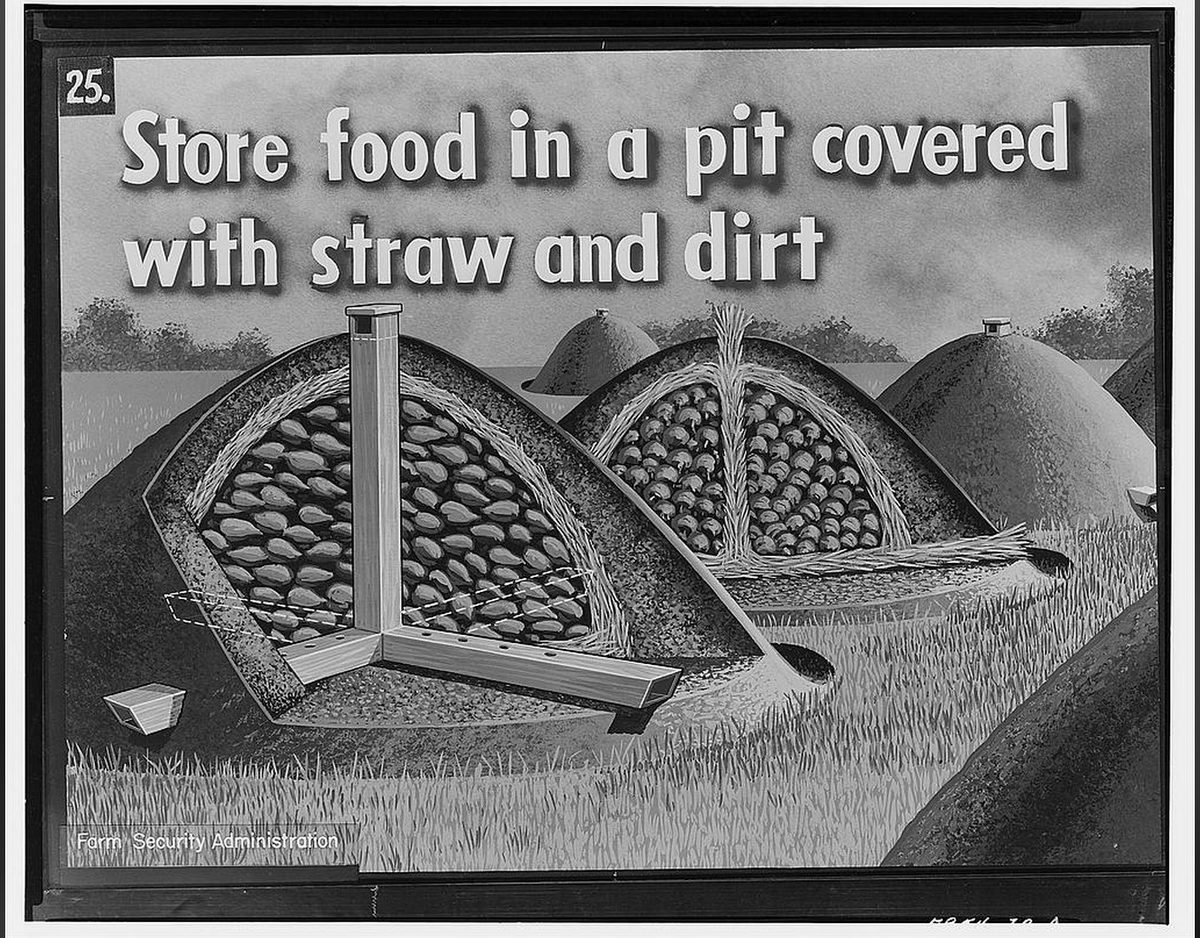
The one deliberate gap in all that sealing is the chimney: a loose twist of straw left poking straight up through the earth at the peak. Stored roots are still alive, respiring slowly, and that process gives off both heat and moisture — heat that keeps the pile from freezing, and moisture that will rot it from the inside if it has nowhere to go. The vent lets the damp air escape without letting the frost in. Nobody opened a whole clamp at once, either: a family worked from one end, cutting straight down through earth and straw for a week’s supply, then patting the covering back into place behind them before moving on. Built correctly in November, a clamp could still be yielding firm vegetables in March.
Rothamsted’s scientists proved, with a thermometer, both why it worked and how it could fail
The 1942 measurements weren’t a one-off curiosity. E. M. Crook and D. J. Watson instrumented potato clamps across two seasons at Rothamsted and published the results in 1950, and the numbers explain exactly what a clamp is doing. Through the heart of winter — mid-December to mid-February — their 1942–43 clamp held at an average of about four degrees above the surrounding air temperature, never falling below 7°C. That margin came entirely from the vegetables’ own low-grade metabolic heat, trapped by the straw and earth the same way a compost heap traps its own warmth.
The same clamp also showed how the method fails. From mid-February its internal temperature began climbing for a very different reason: bacterial soft rot, likely tied to blight, had set in, and the insulation that had been holding in metabolic warmth was now holding in the heat of decomposition. By late April the centre of the pile was averaging a weekly 34.8°C. The clamp collapsed on 27 April 1943 and the tubers inside were almost completely decomposed within about a week.
A follow-up experiment the next winter is, if anything, more revealing. Three clamps — labelled A, B, and C — were built to the same specification side by side. Clamp A never dropped below 6°C, the threshold above which potato starch doesn’t convert to sugar (the “sweetening” that ruins cooking quality). Clamps B and C, built the same way, fell below it in late February and sweetened anyway. Crook and Watson could not fully explain the gap between them — they point to possible differences in variety and ventilation, without settling on an answer. That unresolved variability is the real finding: even with construction standardised and measured to the degree, a clamp’s performance still depended on something nobody could fully predict, which is a large part of why it stayed a skill handed down by practice rather than a fully engineered method, science or no science.
In drier, flatter stretches of America, most farmers built something bigger instead
The United States Department of Agriculture’s Farmers’ Bulletin No. 847, written by senior horticulturist William Stuart and revised in 1933, describes an outdoor pit — essentially a clamp by another name, straw over the roots and soil over the straw, kept narrow in cold regions and wider in milder ones — as “the simplest method.” But the bulletin is just as clear that across the central and western United States, the dominant storage structure wasn’t the field pit at all. It was the dugout: an earthen-walled cellar, often three feet deep or more, sometimes framed with timber, sod, or even baled alfalfa, built at farms in places like Jerome, Idaho; Greeley and Carbondale, Colorado; and Sabin, Minnesota. In Maine’s potato country, the so-called “Aroostook type” went further still — concrete or masonry basements eight to twelve feet deep, some holding several thousand barrels.
The physics underneath both approaches was identical, and the bulletin states it in numbers nearly matching what Rothamsted would measure in Britain a decade later: an ideal storage temperature of 38–40°F, newly dug tubers held near 60°F for about ten days so cuts could heal before cooling further, and a freezing point around 28–29°F. A pit or a dugout, in other words, was chasing the same narrow band a clamp was — just inside a bigger, more permanent structure, built where land, lumber, or climate made that the better trade.
A clamp built for cattle feed ran on a different clock than one built for people
Not every clamp was racing the clock toward spring the way a potato clamp was. Henry Stephens’s Book of the Farm, in the edition revised by James Macdonald in 1889, treats stored mangel-wurzels almost as a two-stage product rather than a simple preservation problem. Fed straight out of the ground, mangels tended to cause scouring — digestive upset — in cattle, a problem the text says “disappears after the roots have been stored for two or three months.” Farmers clamping mangels for feed weren’t just protecting them from frost; they were deliberately ageing them, holding the harvest back rather than rushing to use it. Turnips, by the same book’s account, ran the opposite direction: left in the ground past November or December, their substance broke down into what Stephens calls “indigestible woody fibre,” so they had to come out and go under straw promptly, on the same clock a household’s potatoes were on. Two root crops, two different reasons to build the identical structure.
Two governments eventually made the clamp official policy, and kept worrying about it afterward
During the Second World War, Britain’s Ministry of Agriculture issued a run of illustrated “Dig for Victory” leaflets, two of which survive in museum collections today: a general winter-growing sheet held by the Garden Museum in London, and a leaflet titled Root Vegetables for the Small Grower, catalogued by The Food Museum in Stowmarket, which was found decades later in a tin in a donor’s family shed, pencil marks still on its allotment planting plan. These weren’t general encouragement. They were specific building instructions, treated as a piece of food-security knowledge nearly as important as growing the vegetables in the first place, at a moment when, as one household history of the period puts it, “every scrap of land had to be used for growing food.”
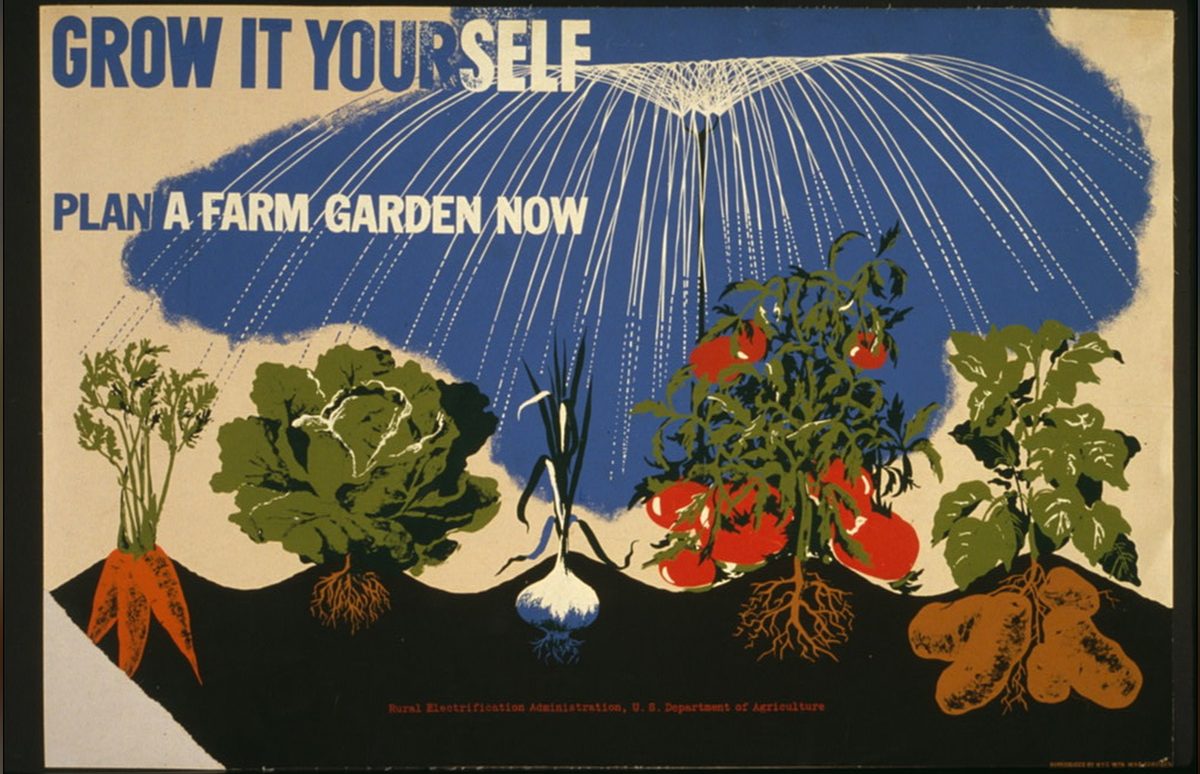
The concern outlasted the war. On 8 December 1947, with wartime shortages still biting, the MP Somerville Hastings asked the Minister of Agriculture, Tom Williams, whether the government would publicise the best way to store potatoes to cut down on waste. Williams’s reply — recorded in Hansard — pointed to an existing “Dig for Victory” leaflet already giving storage advice, and promised further publicity on top of it. Two years after the fighting ended, getting ordinary households to build a clamp correctly was still judged worth a government minister’s time in the House of Commons.
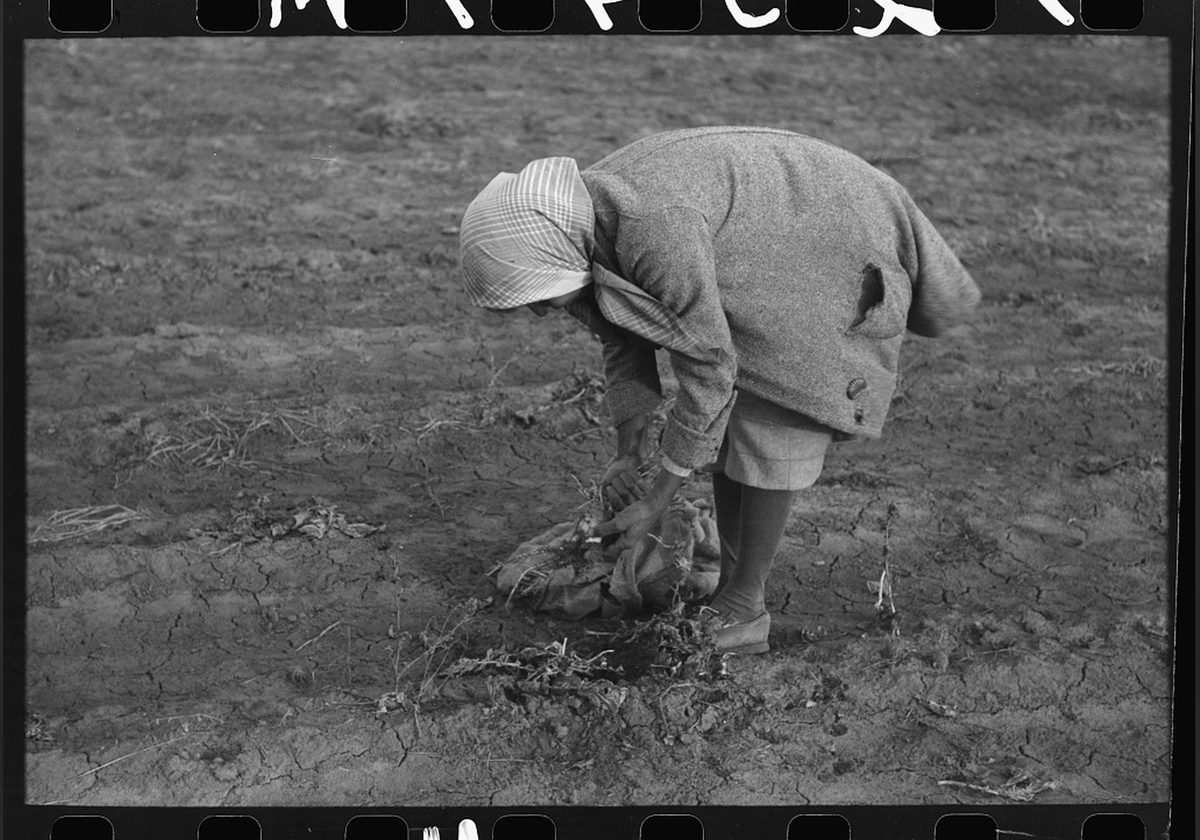
What finally ended the clamp’s working life wasn’t a better clamp. Nobody out-engineered a heap of straw and dirt; rural electrification and mechanical refrigeration simply removed the problem it had always solved. Once a farm had a cold room and a motor to run it, there was no reason to spend an autumn afternoon digging a trench and hauling straw across a field.
And yet the method never actually disappeared. Strip away the Rothamsted thermometers and the Ministry pamphlets, and the instructions a homesteader or allotment gardener follows today are, almost line for line, the ones William Stuart wrote for the USDA in 1917 and the ones a British household read off a government leaflet in 1940. It may be one of the only pieces of large-scale, government-tested wartime infrastructure advice that a backyard gardener can still carry out, unmodified, with a spade.
Would you trust a pile of dirt to keep your winter’s vegetables from freezing? For roughly two hundred years, that wasn’t a rhetorical question — it was how a very large share of the harvest actually got through to spring.
Watch the full history
The video version walks through building a clamp from bare ground to finished mound in about seven and a half minutes.

Related reading
- Drying Apples Before Refrigeration: How Farm Families Did It
- Why Corn Was Soaked in Lye Before It Became Breakfast
- Why Margarine Was Illegal in America for Almost a Century
- The Kecksburg NASA Files Nobody Can Find
- Who Invented the Electric Toaster, Really?
Shop the items in this history
Works cited
- Crook, E. M., and D. J. Watson. “Studies on the Storage of Potatoes II: The Temperature Conditions Inside Potato Clamps.” The Journal of Agricultural Science, vol. 40, no. 3, 1950, pp. 199–226. Rothamsted Experimental Station. Link.
- Stuart, William. Potato Storage and Storage Houses. United States Department of Agriculture, Farmers’ Bulletin No. 847, first issued 1917, revised 1933. Link.
- Royal Horticultural Society. “Root Vegetables: Storing.” RHS Advice Guide. Link.
- Dig for Victory: Grow for Winter as well as Summer. Ministry of Agriculture, c. 1940. Collection no. 1996.493, Garden Museum, London. Link.
- Dig for Victory No. 6: Root Vegetables for the Small Grower. Ministry of Agriculture, Fisheries and Food, Second World War. Object STMEA:1991-21.4, The Food Museum, Stowmarket. Link.
- “Potatoes (Storage).” HC Deb, 8 December 1947, vol. 445, c. 782. Link.
- Stephens, Henry, revised by James Macdonald. The Book of the Farm, Division II, 4th ed. William Blackwood and Sons, 1889. Link.
- Hamilton, Andy. “Making a Potato Clamp and Other Ways of Storing Vegetables.” Selfsufficientish, 6 July 2008. Link.