
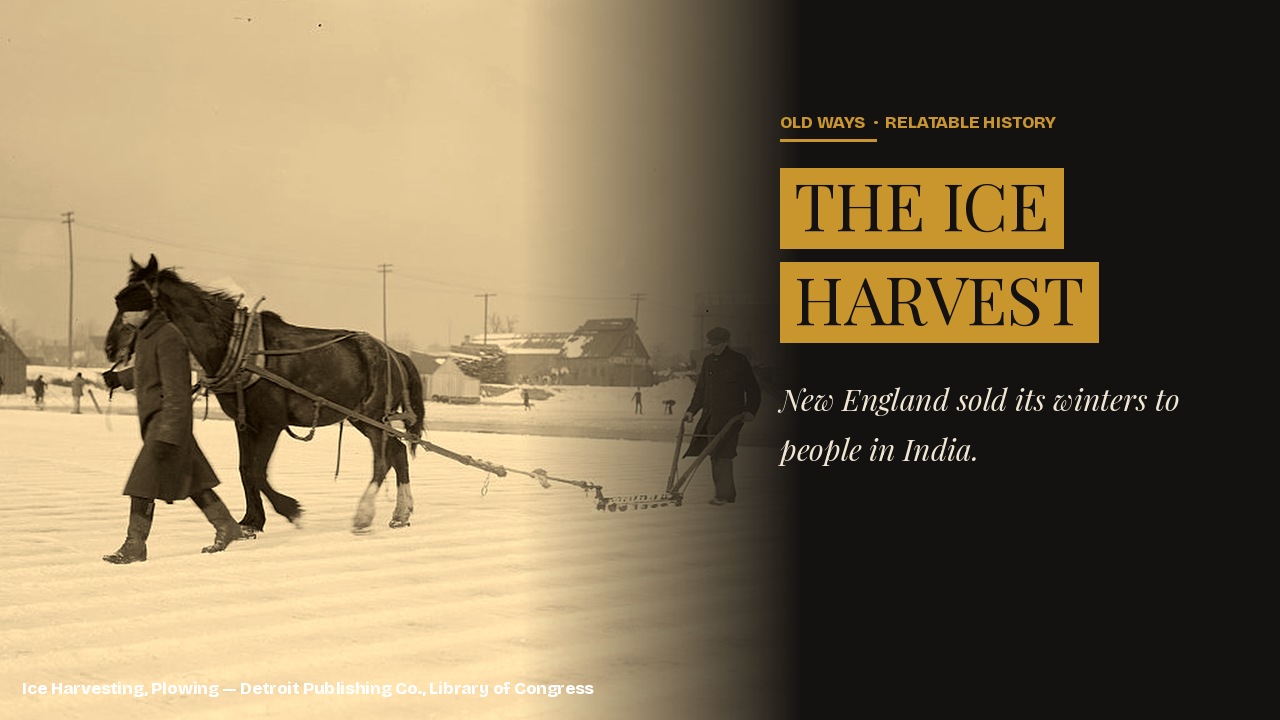
At the height of the trade, cutting and hauling natural ice put something like ninety thousand people and twenty-five thousand horses to work across the United States every winter — a seasonal workforce on the scale of a mid-sized industrial sector, assembled fresh in January and mostly gone again by April.
Most retellings of this story stop at Frederic Tudor, the Boston merchant who first shipped ice to the tropics, or at the icehouse that kept it from melting once it got there. Less gets said about the ice harvesting industry that grew up around the cutting itself: the patented machines built to outrun a thaw, the crews who risked drowning to fill a canal with floating blocks, the Maine river towns that briefly became some of the most fought-over real estate in New England because of it, and the two very different rivals — one in Norway, one in a Calcutta factory — that eventually broke it.
That is the side of the story the video doesn’t have room for: the tools, the danger, the business, and the undoing.
The Scale of the Ice Harvesting Industry
By the mid-nineteenth century, natural ice had become a genuine national industry with three real centers of gravity — New York, Boston, and Chicago — each supplying its own region and competing for export contracts beyond it. New York’s ice business alone was valued at $6,190,000 in 1880, more than six times Boston’s figure for the same year, according to the historian Peter Stott.
Much of that volume never went anywhere near a household icebox. Breweries were the single largest consumer of American ice: the trade’s own Ice Trade Journal estimated that brewers used roughly a million tons of ice a year just to make beer, and another two million tons to keep it cold on its way to a glass. A farmhouse icebox, however central it is to how this story usually gets told, was a side market next to the beer.
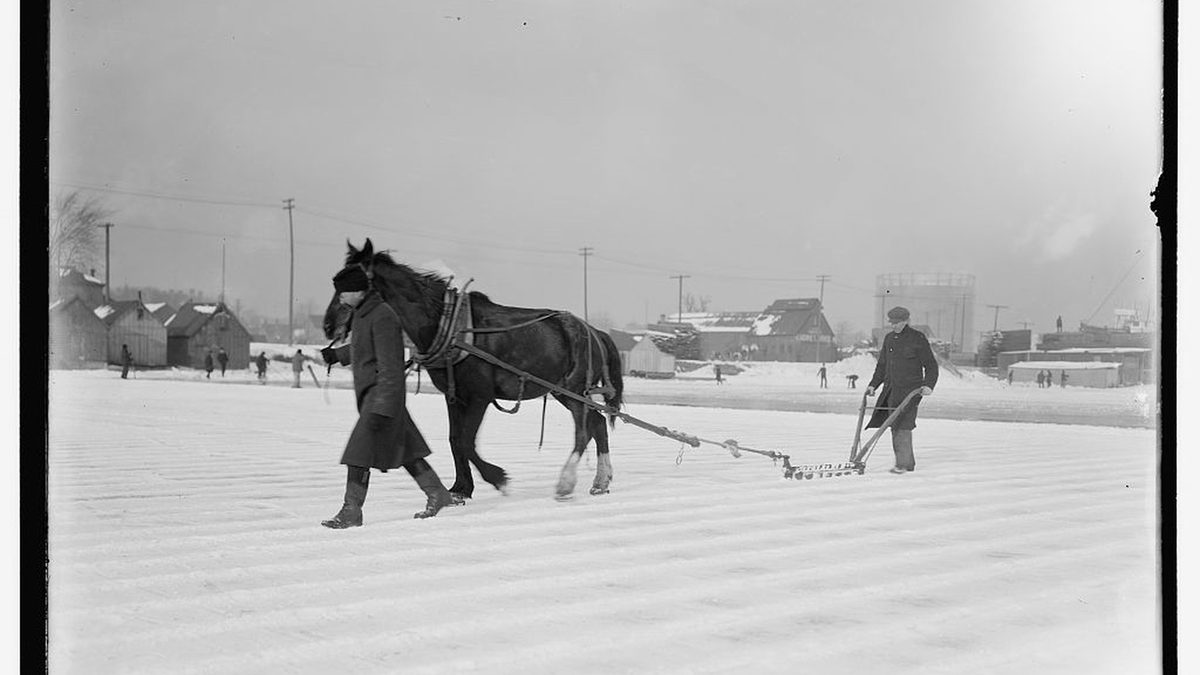
Nothing about the raw material cost a cent — the product was free water that froze on its own. What the industry actually sold was logistics: harvesting fast enough, insulating well enough, and shipping soon enough that a block cut in January was still solid when a customer in another hemisphere bought it in July. That, and not the ice itself, is what ninety thousand people and twenty-five thousand horses were really being paid for every winter.
Machines Built to Outrun a Thaw
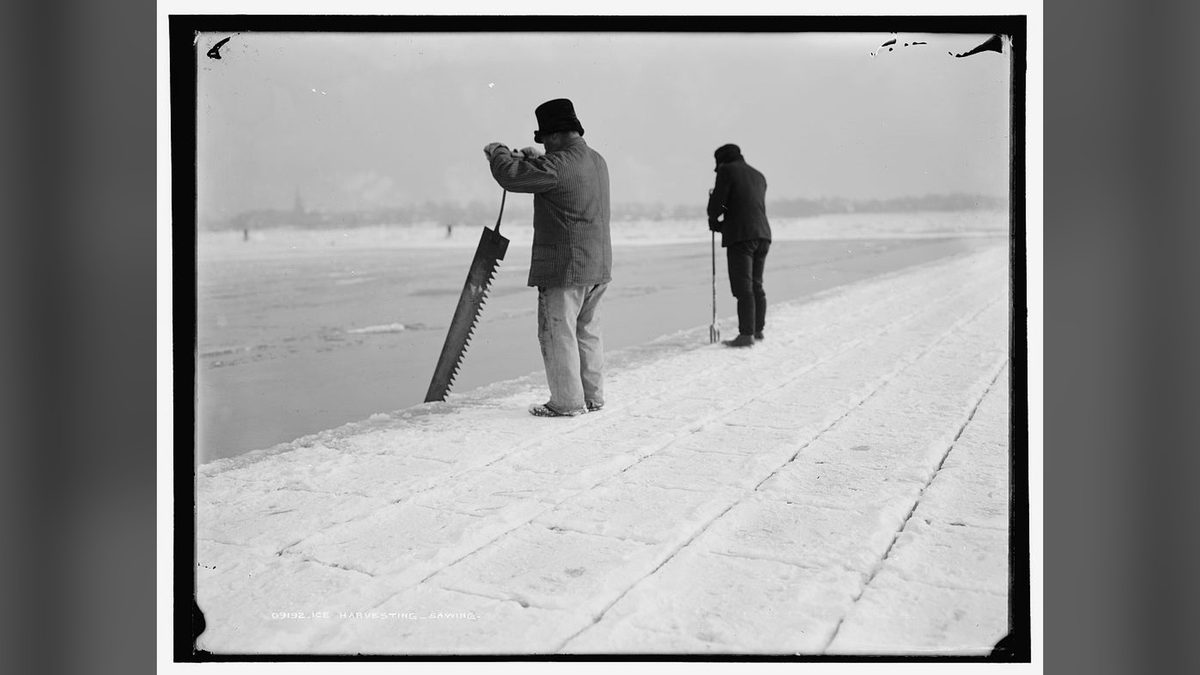
Before any machine entered the picture, cutting ice was simply manpower. A British naval officer’s 1827 account from Greenland describes a single hand saw suspended and worked by ten to twelve men at a time, with a crew of twenty-five to thirty on hand in total just to keep it moving and the blocks clear. Canadian crews used a related method well into the industrial era: clear the snow, then cut by hand saw mounted on a sled. Wyeth’s machines didn’t remove saws from the harvest entirely — crews still finished awkward corners by hand — but they replaced that scale of manpower with a horse and one or two men holding the handles.
Nathaniel Wyeth didn’t patent one ice-cutting device; he patented a sequence of them. His first, granted March 18, 1829 as patent No. 5,405X, covered a sled with two rows of cutting blades set at different depths — the shorter row made the first pass, and once the sled was flipped, a deeper row finished the cut. It was built specifically to put a horse in the place of a man with a saw.
A second patent, No. 1,877, followed in 1840 and solved a problem the first design hadn’t: chips jamming in the groove as the blade cut deeper. Wyeth’s fix mounted curved chisels through mortises in a main bar, each one ground with its own groove so that ice chips were carried up and out of the cut in a continuous stream rather than clogging it. Over his career he held more than a dozen patents covering tools for cutting, hauling, and storing ice — a scale of patenting matched by few other inventors in the pre-refrigeration cold-storage business, though the 1843 patent fight over the ice cream freezer came close.
Those machines did the grooving; the rest of the harvest was hand tools wielded by a crew. Historic New England’s account of Kennebec River operations lists busting bars to snap the scored ice apart, chisels and saws to finish stubborn corners, and tow hooks to drag a free block onto a horse-pulled sled or into a steam-powered elevator. None of it looked like a factory. All of it was patented, purpose-built equipment doing a factory’s job.
Ten Men, a Boss, and a Dangerous Season
A Kennebec harvest crew ran ten to fifteen workers under a single boss, with a separate team of “canal men” stationed at the water to feed blocks into the elevator chain and others stacking the icehouse floor by floor, bracing the growing walls with boards as they rose. The season itself was short on purpose: mid-February through early April in Maine, whatever window the weather actually allowed.
It was also genuinely dangerous work, and not only in the abstract. A three-hundred-pound block could crush a hand or a foot in an instant, and open channels of near-freezing water sat a few feet from where men worked all day. A 1933 Monthly Labor Review case, cited by JSTOR Daily, records an ice cutter who drowned in the Des Moines River in 1931 while working an eleven-day harvest for the Ottumwa Sand Co.; he had been earning $4.50 a day, and his widow was later awarded workmen’s compensation of $15 a week for 300 weeks. That is close to the only kind of record this workforce left behind — not wages or working conditions as such, but the paperwork generated when the job went wrong.
Maine’s Ice Boomtowns, and the Man Who Bought Them All
Rufus Page built the first large Kennebec River icehouse in 1826, and by 1882 the state’s annual harvest ran to roughly 1.5 million tons, two-thirds of it cut from that one river. At the trade’s 1870–1890 peak, something like twenty-five thousand men converged on the Kennebec ice fields each winter, and Maine ice was, by one contemporary reckoning, worth more in a season than California’s entire annual gold production.
Some of the operators stayed small and local: the Cedar Grove, Berry, and Lincoln Ice companies worked the river near Dresden, and in 1870 Lincoln Ice paid $1,000 for a local house, Bowman House, simply to put its managers up for the season. Others consolidated aggressively. The New York retailer James Cheeseman began building Kennebec icehouses in 1860, sold them to the Knickerbocker Ice Company in 1868, built a dozen more near Pittston, and by 1869 controlled roughly sixty separate river companies simply to keep prices from collapsing during a glut.
By 1890, Knickerbocker alone controlled about a third of all Kennebec production. What was left of the independents, including Lincoln Ice’s holdings, was bought up piece by piece between 1884 and 1888 by Charles Wyman Morse of Bath. In 1891, Morse folded the whole Northeast ice business — Kennebec and Hudson River operations alike — into his American Ice Company, a consolidation complete enough to earn him the nickname the “Ice King.”
None of that capital was safe from the weather that made it possible. Demand for Kennebec ice rose and fell with hot summers in the South and with how poorly the Hudson River — Maine’s chief rival — had harvested that year; a mild New England winter, on the other hand, could leave half a season’s planned cut never made at all. Entry costs were low enough that new operators piled in during any good year and promptly depressed prices again, which is as much why Cheeseman and then Morse kept buying up competitors as any pure ambition to dominate the river — consolidation was partly just a way of surviving a business that could never control its own raw material.
A Rival Across the Atlantic, and a Factory in Calcutta
New England never had the natural-ice trade to itself. Norway ran a parallel industry exporting ice from its own fjords and lakes to Britain from roughly 1870 into the 1910s, and it was organized much like a seasonal crop: a regular workforce, dedicated ice stores, and wooden chutes that carried blocks straight down to loading wharves. By 1899 those imports had passed half a million tons a year, with the Port of London alone taking in 40 to 50 percent of it. One Norwegian lake was even renamed “Wenham Lake” for the English market, borrowing the name of the Massachusetts pond that had made American ice famous there in the first place.
The more direct threat to Tudor’s old India trade came from the receiving end rather than a competing harvest. In 1878, the Bengal Ice Company began manufacturing ice mechanically in Calcutta itself — India’s first artificial-ice maker. A shipment of New England pond water that had to survive a four-month voyage before it could be sold was never going to compete on price or reliability with ice made a few streets from where it was bought. The transoceanic leg of the ice trade had lost its reason to exist years before refrigeration ever reached an American farmhouse.
What Finally Buried the Business
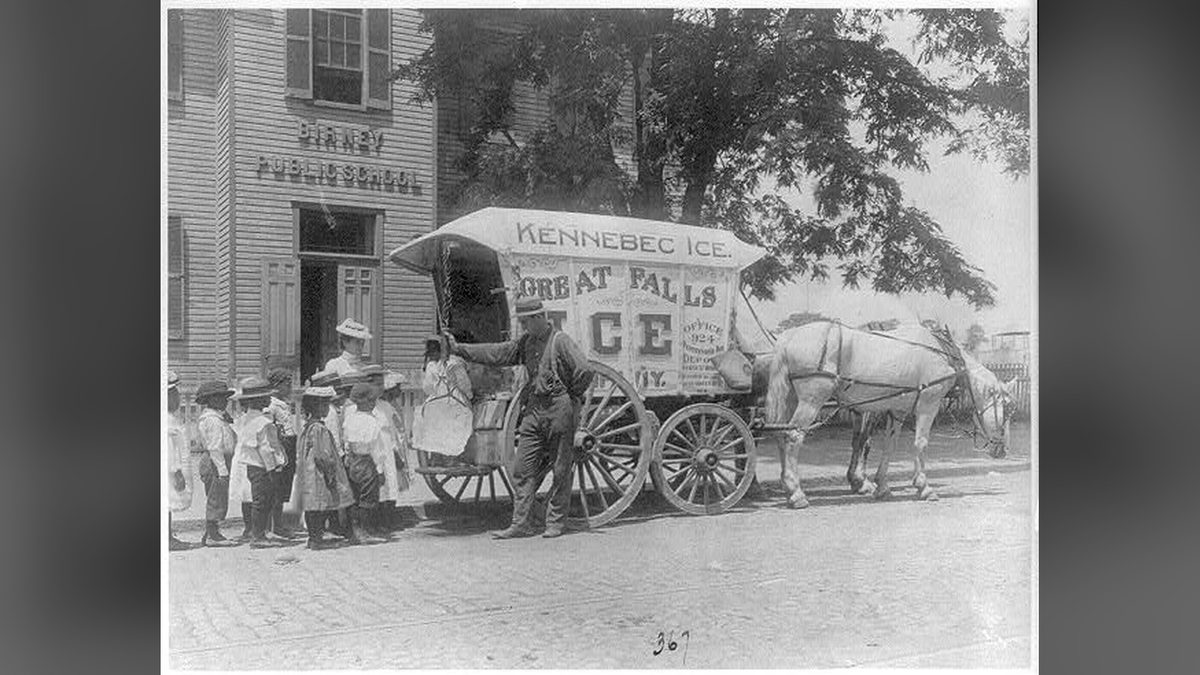
The household end of this business — the kitchen icebox a family filled from the iceman’s wagon, or from its own pond — outlived the commercial harvest by years, but it was living on borrowed time too.
By 1914, mechanically manufactured ice had already overtaken the harvested kind nationwide: American plants were turning out roughly twenty-six million tons of artificial ice a year against about twenty-four million tons still being cut from frozen lakes and rivers, according to contemporary Ice Trade Journal estimates. The harvest had lost the argument on cost and reliability before a single home refrigerator ever reached a farmhouse kitchen.
The smallest version of the business, though, outlasted every one of Morse’s companies, for a simple reason: it never depended on a railroad contract, a Kennebec lease, or a buyer in Calcutta. All it needed was a pond, a saw, and a shed with enough sawdust packed into it, which is a large part of why rural families kept cutting their own ice by hand for years after the corporate trade had folded into manufactured-ice plants or closed outright.
What’s easy to miss, looking back, is how genuinely industrial this all was while it lasted: patented cutting machinery, river-town monopolies, a labor force the size of a small army, and competitors operating on two different continents — an entire transnational business assembled fresh every winter out of nothing more than cold enough weather, and undone not by one clever invention but by a slow, steady replacement of weather with a machine.
It’s worth asking the same question the video closes on, from the other direction: given a crew of ten men under a boss, a horse, and Wyeth’s grooving sled, how many January days on a frozen pond would it actually have taken to keep one farmhouse’s milk and butter cold clear through an August?
Watch the full history
The video covers Frederic Tudor’s own rise, Nathaniel Wyeth’s ice plow, and Thoreau’s winter watching the Walden Pond harvest in about eight minutes.

Related reading
- How Icehouses Worked Before Refrigeration — the storage side of this same story.
- How Iceboxes Worked Before the Electric Refrigerator — the household end of the same supply chain.
- Who Invented the Ice Cream Freezer? The 1843 Patent, and the Man Who Profited Without One — another cold-storage patent fight from the same decades.
- How Soapstone Foot Warmers Worked, and What They Replaced — another New England winter object from the same Old Ways series.
Shop
- The Frozen-Water Trade, by Gavin Weightman — the standard history of Tudor’s ice business and the trade that followed it.
Works cited
- Freeman, Michael. Ice Blocks from Norway: The Importation of Natural Ice to Britain, Circa 1870–1925. Cappelen Damm Akademisk/NOASP, 2023.
- Wyeth, Nathaniel J. U.S. Patent No. 1,877, “Improvement in Machines for Cutting Ice,” issued December 1, 1840. Link.
- Cascio, Chris. “Museum Collection: Chilling with the Ice King of New England.” Hagley Museum and Library, February 24, 2026. Link.
- Maine Historical Society. “Ice: A Maine Commodity.” Maine Memory Network.
- Konitzky, Peggy. “Frozen in Time.” Historic New England, September 9, 2025.
- Singh, Akanksha. “On the Rocks.” JSTOR Daily, August 1, 2023. Link.
- Kohari, Alizeh. “How Ice Heated Up Trade Between India and America.” The Juggernaut, September 27, 2021. Link.