
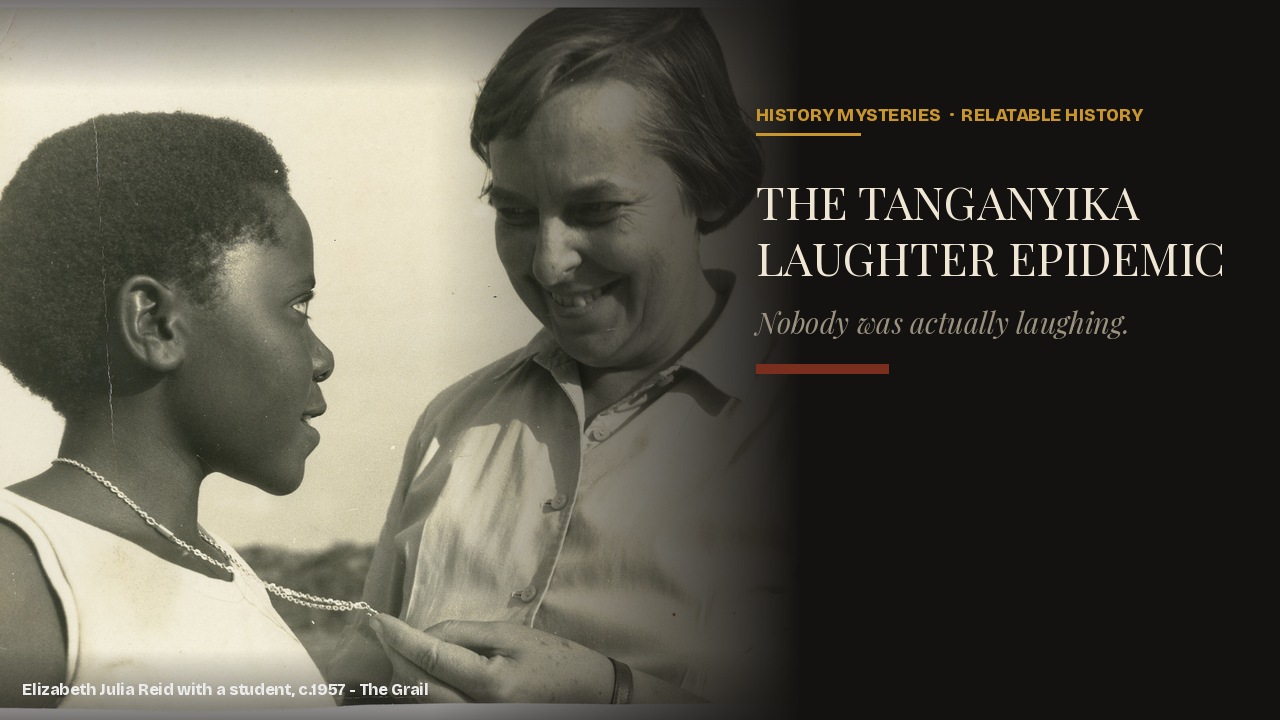
In 2007, a researcher who studies humor for a living sat down with the original 1963 medical report on the most famous “laughing epidemic” in history and reached an answer nobody had checked for forty-four years: almost none of it was actually laughing, in any sense that involves finding something funny. The fits were not sustained the way popular retellings describe, and the picture of a village helplessly giggling for months turns out to be, in his own words, exaggerated almost beyond recognition.
What did happen is documented and strange enough without embellishment. On 30 January 1962, three girls at a mission-run boarding school in Kashasha, on the western shore of Lake Victoria in what was then Tanganyika, began laughing and crying in fits they could not stop. Within seven weeks, ninety-five of the school’s hundred and fifty-nine pupils were affected and the school closed its doors. By the time the outbreak faded, roughly eighteen months and fourteen closed schools later, around a thousand people across a hundred-mile radius had been caught up in it.
The part almost never retold is what the two doctors who investigated it actually did, what they found, and what they were — and were not — able to conclude from it. That investigation, not the laughter, is the real story.
What Rankin and Philip actually tested
Two medical officers, A.M. Rankin of Makerere University College and P.J. Philip of the Tanganyikan government medical service, travelled to Bukoba district to examine the patients directly. They were not setting out to confirm a psychological theory. They wanted an organic cause, because an organic cause is one you can treat: an infection, a toxin, a nutritional deficiency, something visible under a microscope or in a blood count.
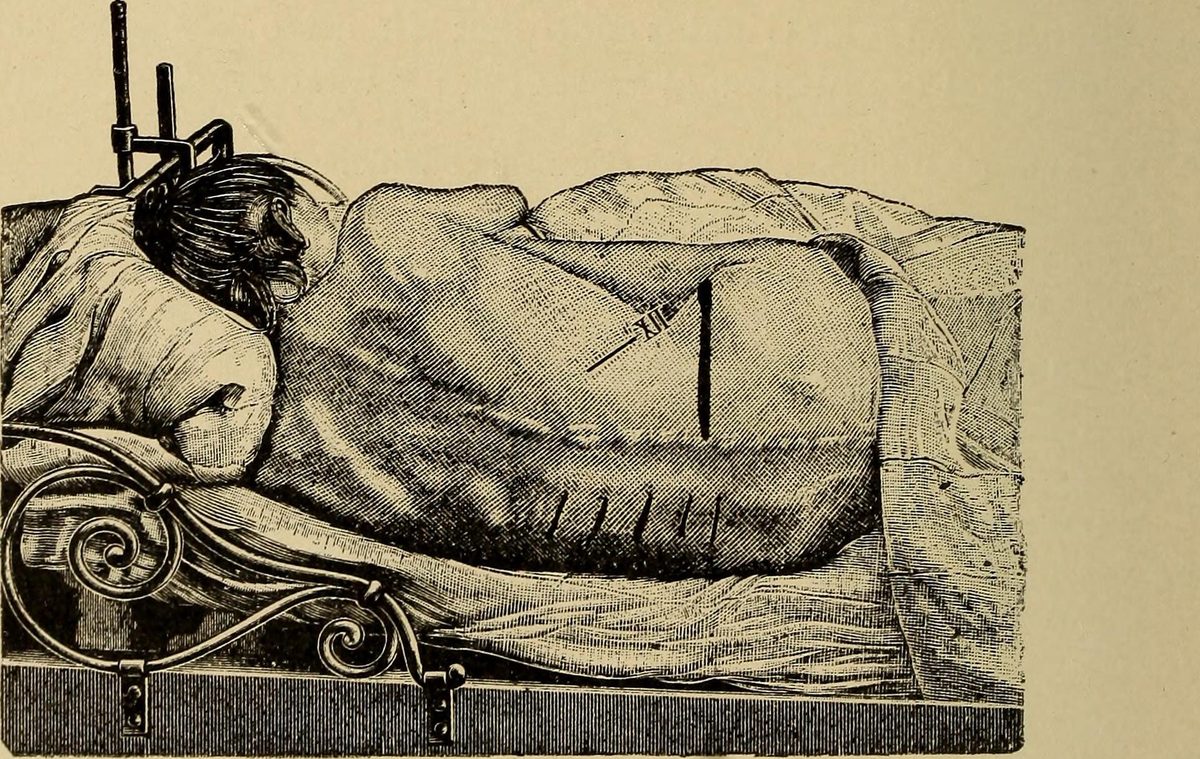
They took blood samples. They performed lumbar punctures, drawing spinal fluid to check for the kind of inflammation a brain infection such as encephalitis would leave behind. They carried out physical examinations looking for fever, convulsions, loss of consciousness, a stiff neck — the standard warning signs clinicians still check for today. They collected and tested the food the affected communities were eating, in case a contaminant was responsible.
Every test came back clean. The blood work was unremarkable. The spinal fluid showed nothing unusual. The food was not contaminated. Patients described real and specific distress — restlessness, pain, fainting, difficulty breathing, rashes — and, in Rankin and Philip’s own words, being “frightened of something” without being able to say of what. What the doctors could not find, by any method available to a rural district hospital in 1962, was a physical cause for any of it.
Locally, people had their own explanation, and the doctors recorded it rather than dismissing it: a “definite belief,” as their paper states, “that this is a contagious condition of some kind,” including a specific fear that the atmosphere itself had been poisoned by atomic bomb testing half a world away. It is a reminder of how far the nuclear anxieties of 1962 genuinely reached — all the way to a rural district in East Africa, as a candidate explanation for an illness that had no other story attached to it yet.
A diagnosis reached by elimination, not by evidence
Rankin and Philip published their findings in the Central African Journal of Medicine in 1963, in a paper that ran to about four pages under the plain title “An Epidemic of Laughing in the Bukoba District of Tanganyika.” Their conclusion was mass hysteria in a susceptible population — what they carefully called a culturally determined disease, one that had to be understood against the particular culture of the community rather than assumed to work the same way everywhere.
It is worth being precise about what kind of finding that is. Rankin and Philip did not identify a mechanism, a trigger, or a traceable chain of transmission. They ruled out what they were equipped to rule out, and named what remained. That is a legitimate clinical method — a diagnosis of exclusion works this way in any era of medicine — but it means “mass hysteria” here describes an absence of evidence for anything else, not a demonstrated cause in itself. The pattern was not without precedent: four centuries earlier, doctors had reached for the same kind of explanation to account for a dancing epidemic in sixteenth-century Strasbourg that they, too, could not otherwise explain.
Their paper also contains a sentence that has not aged well: that no “literate and relatively sophisticated members of society” had been affected. Read on its own, it sounds like a clinical observation. Read against what colonial psychiatry had already spent a decade arguing, it reads like a theory finding its confirmation.
Colonial psychiatry had already written this script
By 1962, the idea that westernization itself could destabilize the African mind was not a fringe view inside colonial medicine — it was close to orthodoxy. J.C. Carothers, the era’s most influential writer on the subject, had argued for years that what he called detribalization — Christian conversion, secular schooling, migration to towns — stripped away the traditional social structures he believed were doing psychological work an individual African mind could not do for itself. He made the case at length in a 1953 monograph commissioned by the World Health Organization, The African Mind in Health and Disease, and used a version of the same theory two years later to explain the Mau Mau uprising in Kenya as a product of cultural conflict rather than political grievance.
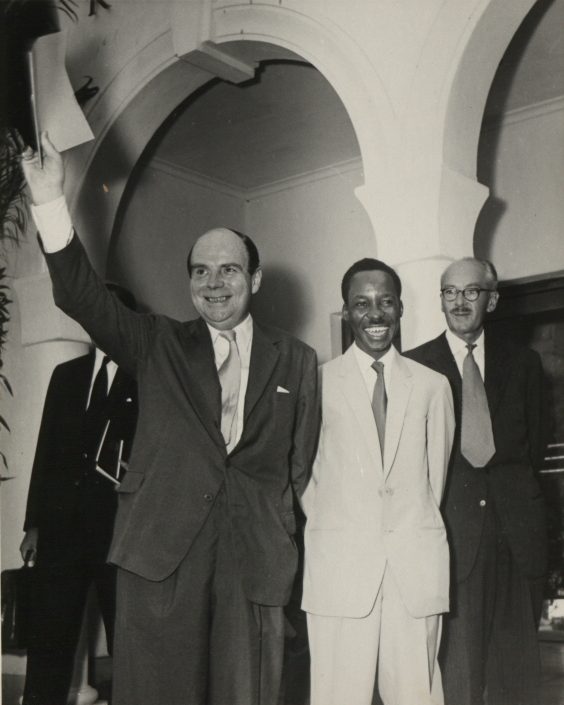
Tanganyika was seven weeks into independence when the first three girls at Kashasha fell ill, and its schools, hospitals and civil service were in the middle of exactly the upheaval Carothers’ theory predicted would be dangerous. For a colonially trained doctor encountering an illness that struck adolescents at a mission school and appeared to spare the better-educated, the explanation was already sitting on the shelf. Historian Yolana Pringle’s 2013 reassessment of the case makes the point directly: the investigators were not inventing a framework from nothing, they were reaching for the one they already had.
The outbreak that followed sent a psychiatrist who wasn’t allowed to treat anyone
Kashasha was not the only episode. In July 1963, a similar illness — reported locally as an “outbreak of lunacy” — struck Kigezi in south-west Uganda, closing the high school there. Blood was drawn and tablets handed out, but no psychiatrist was sent, and ten months later the district medical team was still filing reports that the epidemic had not ended.
In November 1963, it reappeared at Mbale in eastern Uganda, and this time a specialist did go: Benjamin Kagwa, a Ugandan-born psychiatrist recently returned from more than fifteen years practising in the United States. What Kagwa found there was not laughing but compulsive running, mixed with aggression and disorientation, which he divided into three stages — a violent onset lasting three or four days, sporadic relapses of agitation over the following one to two weeks, and finally a calmer phase in which patients were willing to be interviewed. He tested patients with lumbar punctures, hypnosis, drug-induced abreaction, and pinpricks to check for anaesthesia, and concluded, with confidence, that the cases were conversion hysteria brought on by the stress of rapid cultural change.
His conclusion mattered less than his constraints: Kagwa was not permitted to treat the patients he had diagnosed. It also sat awkwardly beside the explanation the Bagisu community itself preferred, which held that the outbreak had a specific cause — the anger of ancestral spirits — and most affected families responded by consulting traditional healers rather than the hospital that had sent a psychiatrist to study them.
What a humor researcher found when he finally checked the word “laughing”
The retelling that has circulated since treats the whole affair as a curiosity about contagious joy: a village helplessly giggling for months on end. In 2007, Christian Hempelmann, a researcher in humor studies, went back to Rankin and Philip’s original report to test that version against the clinical record, and the version did not survive.
Laughter, Hempelmann found, was one symptom among several reported at Kashasha and in the related Ugandan outbreaks, which also included running, violence, grimacing and aimless wandering — and it was not laughter produced by finding anything funny. More basically, he pointed out something the popular accounts make it easy to overlook: sustained laughter at the scale and duration these stories claim is not physically possible. A person laughs in bouts of seconds, not for hours, and certainly not for the sixteen days some of the worst individual cases ran. His verdict on the secondary literature that had grown up around the case was blunt — exaggerated, oversimplified, and silent on the facts that actually mattered.
What is still genuinely unresolved
None of this closes the medical question completely. A rival explanation has surfaced more than once over the decades: that the outbreak was a viral encephalitis affecting the parts of the brain governing emotional expression, since pathological, involuntary laughter is a real and documented neurological symptom in other conditions. It is not an unreasonable hypothesis in principle. It is also not supported by anything specific to this case — there was never a postmortem, never a confirmed viral isolate, and the pattern of spread tracked schoolgirls travelling home rather than anything resembling an infectious vector. Unresolved disease mysteries are not unusual in the historical record: the Plague of Athens has drawn competing diagnoses for twenty-four centuries without final agreement, and England’s sweating sickness vanished in the sixteenth century without ever being conclusively identified.
The record itself has real gaps. The three girls who started it at Kashasha are not named in any source that survives. Neither are the teachers who were never affected, nor most of the roughly thousand people eventually swept up across Bukoba, Kigezi and Mbale. Mass psychogenic illness, the modern term for what Rankin, Philip and Kagwa were each separately describing, is a genuine and still-studied phenomenon — a real illness produced by a group under real strain rather than by any pathogen you could isolate in a lab — but it is also, inescapably, the label applied to whatever is left once every alternative has been tested and ruled out.
What became of the people who investigated it
The aftermath says as much as the outbreak. Uganda’s own psychiatric profession grew directly out of this period: Makerere University’s Department of Psychiatry opened in 1966, three years after Kagwa’s fieldwork in Mbale, and by the early 1970s Ugandan psychiatry had earned real international standing — a trajectory that began, in part, with doctors improvising a response to an illness nobody yet had a name for.
Among the Bagisu community Kagwa studied, the outbreak is remembered on its own terms rather than the clinical ones. Elders interviewed decades later described it as “a disease of that time,” placing it in the same category of collective memory as HIV/AIDS — “a disease of today” — a sudden, frightening, unprecedented thing that arrived without warning, lasted a few months, and never came back. Families treated it the way they treated any serious illness during a period of profound uncertainty: with herbalists, protective charms, ritual specialists and the hospital, often all at once, hedging against a cause nobody — doctor or elder — could fully explain.

Kashasha today is a quiet lakeside community of a little over twelve thousand people, and nothing about it marks what happened there in 1962. That is, in its way, appropriate. The outbreak was never really about one place; it was about what happens when the tools available to explain a crisis — colonial psychiatric theory on one side, ancestral cosmology on the other — both run out before the crisis does.
What survives from it is a four-page clinical paper that tried, within the limits of 1962 medicine and 1962 assumptions, to follow the evidence rather than the theory already sitting on the shelf — and a popular legend, built in the decades since, that gets nearly every specific detail of that paper wrong. The gap between those two things is the actual mystery here, and it has nothing to do with laughing.
Watch the full history
The video version walks through the investigation, the two Ugandan outbreaks that followed it, and Hempelmann’s 2007 correction in just over eight minutes.

Related reading
- What Caused the Dancing Plague of 1518? — another documented outbreak of compulsive, involuntary movement that doctors at the time could not explain.
- What Caused the Plague of Athens? The Argument Never Ended — a different ancient epidemic where the diagnosis is still disputed twenty-four centuries later.
- What Caused the English Sweating Sickness? — a Tudor-era disease that vanished as suddenly as it arrived, and was never conclusively identified.
- Did Plague Doctors Really Wear Those Beak Masks? — how earlier medicine tried, and failed, to explain an epidemic it had no real tools to diagnose.
Works cited
- Rankin, A.M., and P.J. Philip. “An Epidemic of Laughing in the Bukoba District of Tanganyika.” Central African Journal of Medicine 9 (May 1963): 167–170.
- Hempelmann, Christian F. “The Epic Tanganyika Laughter Epidemic Revisited.” Humor: International Journal of Humor Research 20, no. 1 (2007): 49–71.
- Pringle, Yolana. “Investigating ‘Mass Hysteria’ in Early Postcolonial Uganda: Benjamin H. Kagwa, East African Psychiatry, and the Gisu.” Journal of the History of Medicine and Allied Sciences 70, no. 1 (2015): 105–136. Link.
- Kagwa, Benjamin H. “The Problem of Mass Hysteria in East Africa.” East African Medical Journal 41 (December 1964): 560–566.
- Carothers, J.C. The African Mind in Health and Disease: A Study in Ethnopsychiatry. World Health Organization Monograph Series no. 17. Geneva: World Health Organization, 1953. Link.
- Bartholomew, Robert E. Little Green Men, Meowing Nuns and Head-Hunting Panics: A Study of Mass Psychogenic Illness and Social Delusion. Jefferson, NC: McFarland & Company, 2001.
- Ebrahim, G.J. “Mass Hysteria in School Children: Notes on Three Outbreaks in East Africa.” Afya 3 (1969): 7–9.
- Conley, Robert. “Laughing Malady Puzzle in Africa.” New York Times, August 8, 1963, 29.
- Tanganyika Independence Act 1961, c. 1. United Kingdom Public General Acts. Link.