
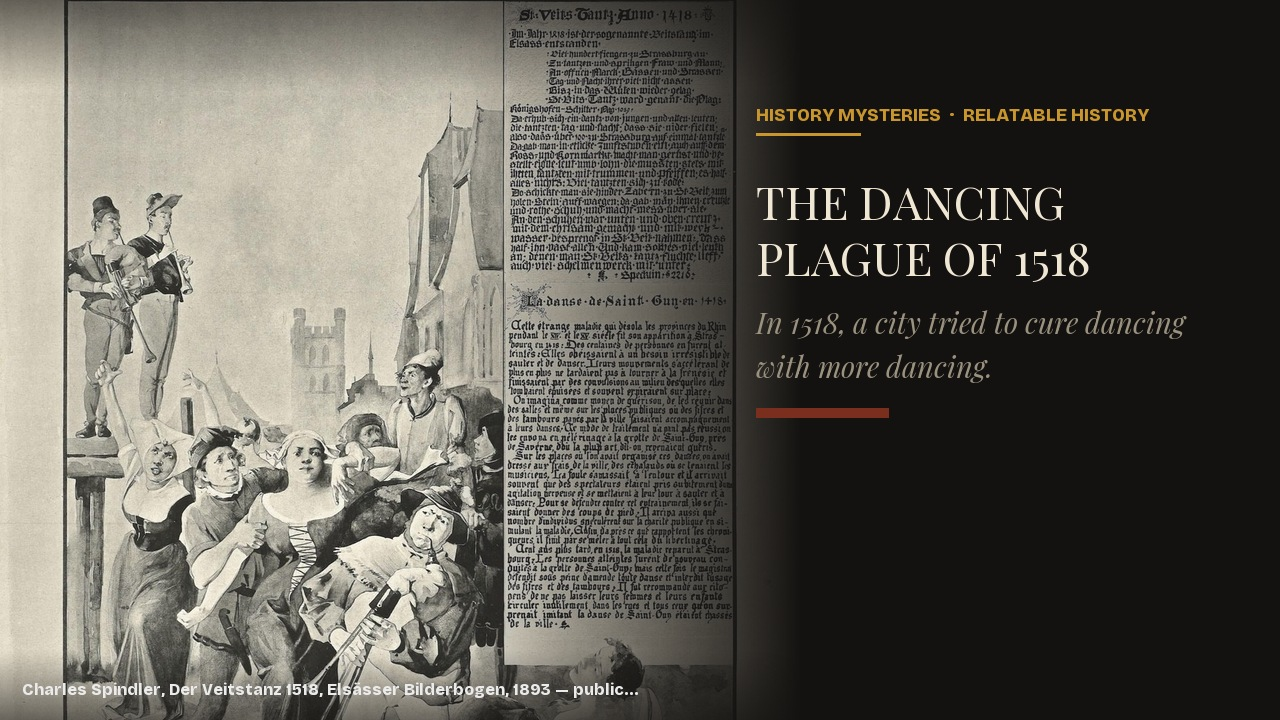
Strasbourg’s magistrates spent real civic money on the 1518 dancing plague, and nearly all of it went toward making the outbreak worse. Guild halls were emptied out, a wooden stage went up in the grain market, and the council hired fiddlers, drummers and pipers at public expense — a deliberate medical intervention, based on the best diagnosis available at the time, which held that the afflicted were suffering from an excess of heat in the blood that only sustained movement could burn off. The treatment did not work.
How many people actually danced, and how many of them died, is still argued over five centuries later, which says something about how thin the written record is even for an outbreak this famous. One widely repeated figure claims as many as fifteen people a day were dying at the peak; the historian John Waller’s more cautious reconstruction instead counts several dozen deaths from exhaustion, stroke and heart failure spread across roughly six weeks, and no surviving municipal document actually supports the larger number. What is solid: the affliction began with one woman dancing alone in mid-July, had drawn more than thirty participants within a week, and had grown to some four hundred by the time the city abandoned its strategy in August. What caused the dancing plague has never had one tidy answer, and the physicians who prescribed more dancing give the mystery its sharpest edge: they were arguing, in effect, for the wrong side of a disagreement historians are still having today, between a contaminated harvest and a traumatized population.
This article follows that disagreement from the physicians’ own reasoning through to the two theories that still compete for the explanation — ergot poisoning and mass psychogenic illness — and looks at why one of history’s strangest epidemics belongs to a particular window of time along the Rhine, and never recurred at this scale after it.
A woman started dancing, and the city escalated it
Contemporary chronicles differ slightly on dates and totals, which is typical of an event documented mostly after the fact rather than during it, but the shape of the story holds across every account. A woman named Frau Troffea began dancing in a Strasbourg street around 14 July 1518. She kept going, by most reconstructions, for four to six days before exhausted or alarmed neighbours had her carried off to a shrine outside the city. By then the behaviour had already spread: other residents, mostly women according to the surviving accounts, began dancing in the same involuntary, music-less way, and within roughly a week more than thirty people were affected.
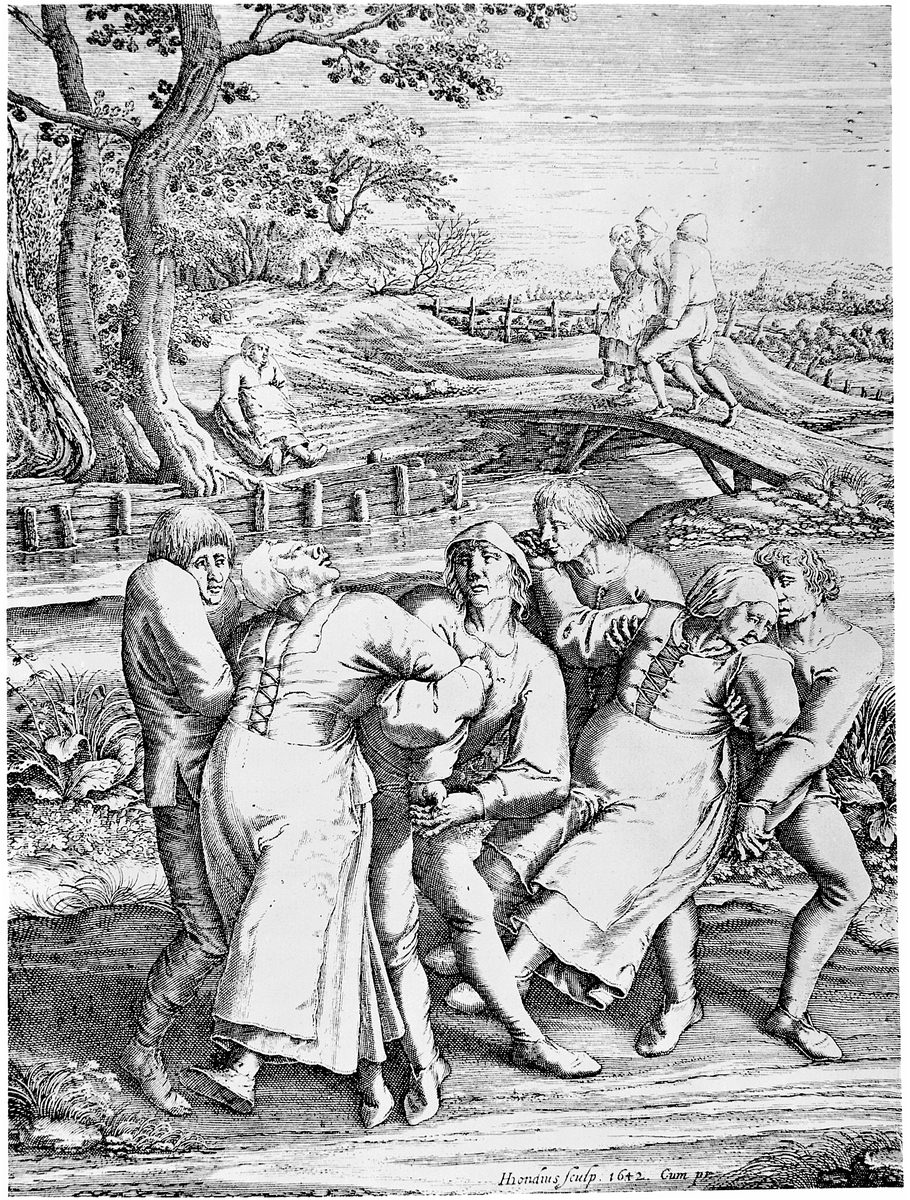
The council’s response escalated the outbreak rather than containing it. Guild physicians, working within the era’s Galenic medical framework, diagnosed the dancers with an excess of internal heat and prescribed continuous movement as the remedy, and the city acted on that advice at civic scale: it cleared the floors of two guildhalls, put up open-air stages in the horse market and the grain market, and paid professional musicians — drummers, pipers and fiddlers by various accounts — to keep rhythm going for the dancers around the clock. Putting an involuntary, visibly contagious compulsion on a public stage, with music supplied, turned out to be a remarkably effective way to recruit more dancers rather than fewer.
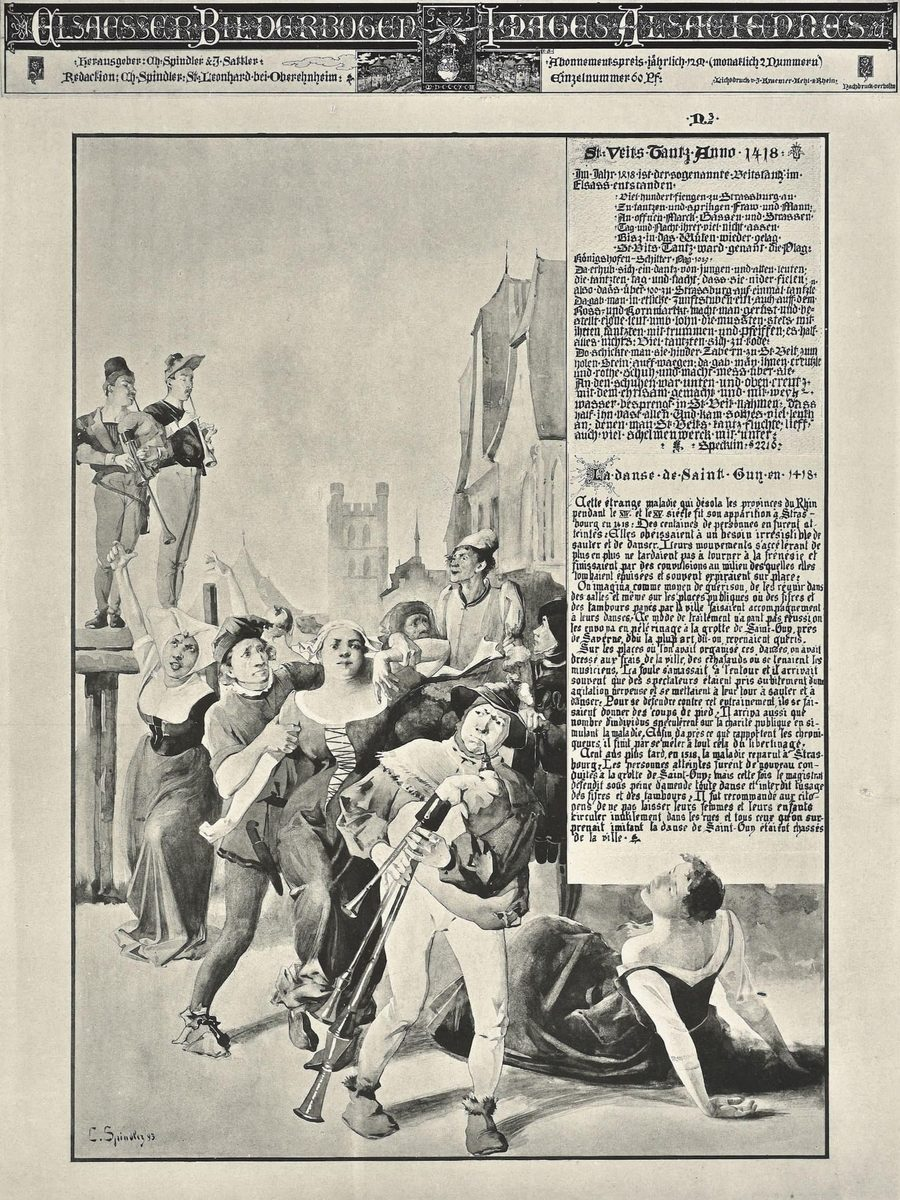
The diagnosis that made sense in 1518: too much heat in the blood
Galenic humoral medicine, the dominant framework in European medical practice for well over a thousand years by 1518, held that health depended on a balance among four bodily fluids — blood, phlegm, yellow bile and black bile — each carrying its own qualities of heat and moisture. An excess of hot, thin blood was understood to produce exactly the kind of restless, convulsive overactivity the dancers displayed, and the standard treatment for an excess humour was to work it off: sweat it out, bleed it out, or in this case, dance it out.
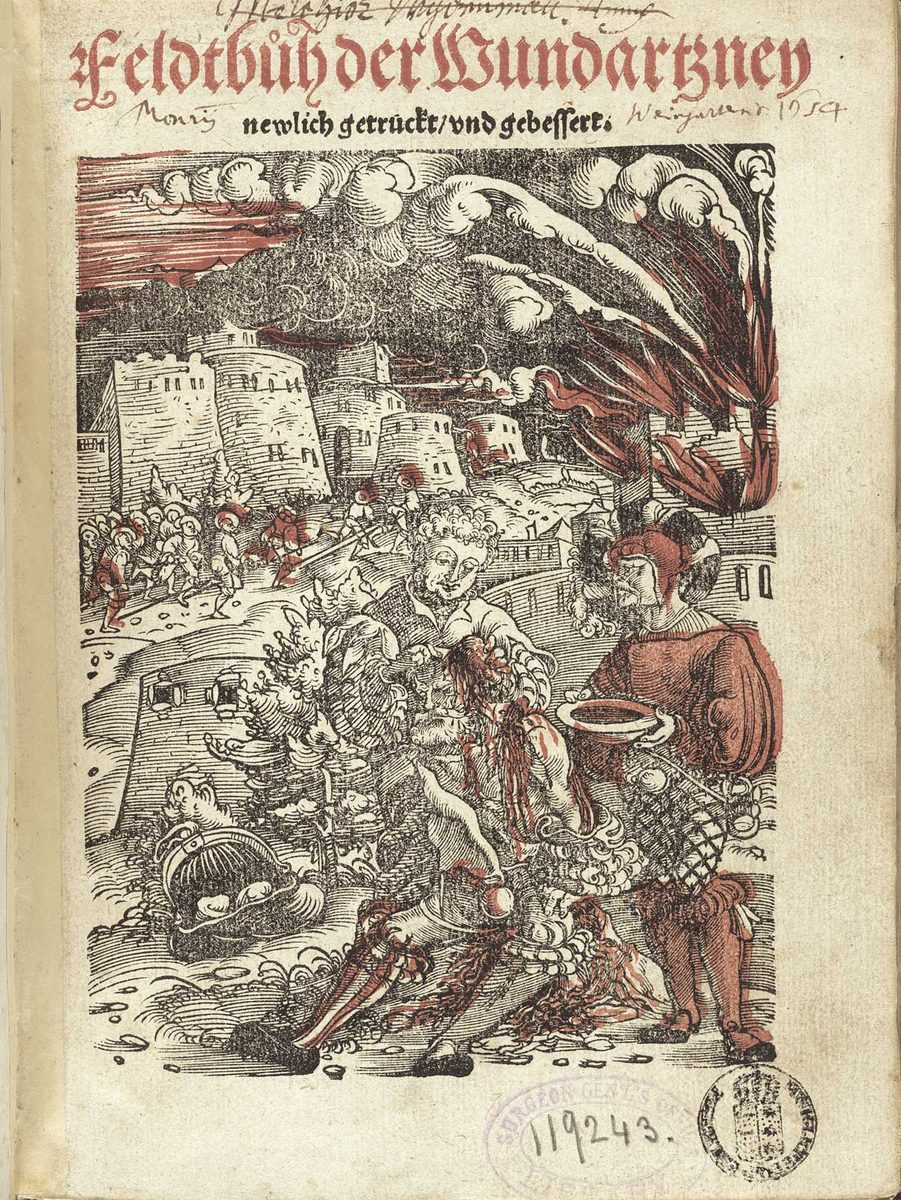
Strasbourg’s medical establishment was not improvising this on the spot. Hans von Gersdorff, a surgeon practising in the city, had printed his Feldbuch der Wundarzney (Field Book of Wound-Surgery) there in 1517, a year before the outbreak, and it shows how systematised Galenic medicine already was in Strasbourg’s professional community by the time the dancers appeared. The physicians who examined the first dancers were not reaching for folk remedy; they were applying orthodox, textbook medicine, and it is precisely because the diagnosis was orthodox that the city government was willing to fund an elaborate public cure built around it.
Dancing them to a shrine: the religious cure takes over
By early August, with the official medical cure plainly failing, the council changed course. A municipal decree issued around 10 August 1518 banned public music and organised dancing outright, and reassigned responsibility for the worst-affected sufferers to the city’s guilds, who were tasked with getting them — sometimes by cart — to the shrine of Saint Vitus in Saverne, a pilgrimage town roughly twenty-five miles southwest of Strasbourg. There, according to the municipal and devotional sources the historian Lynneth Miller has traced, dancers were fitted with small crosses and red shoes, sprinkled with holy water, and anointed with consecrated oil, in a rite meant to lift what was popularly understood as Saint Vitus’s curse.
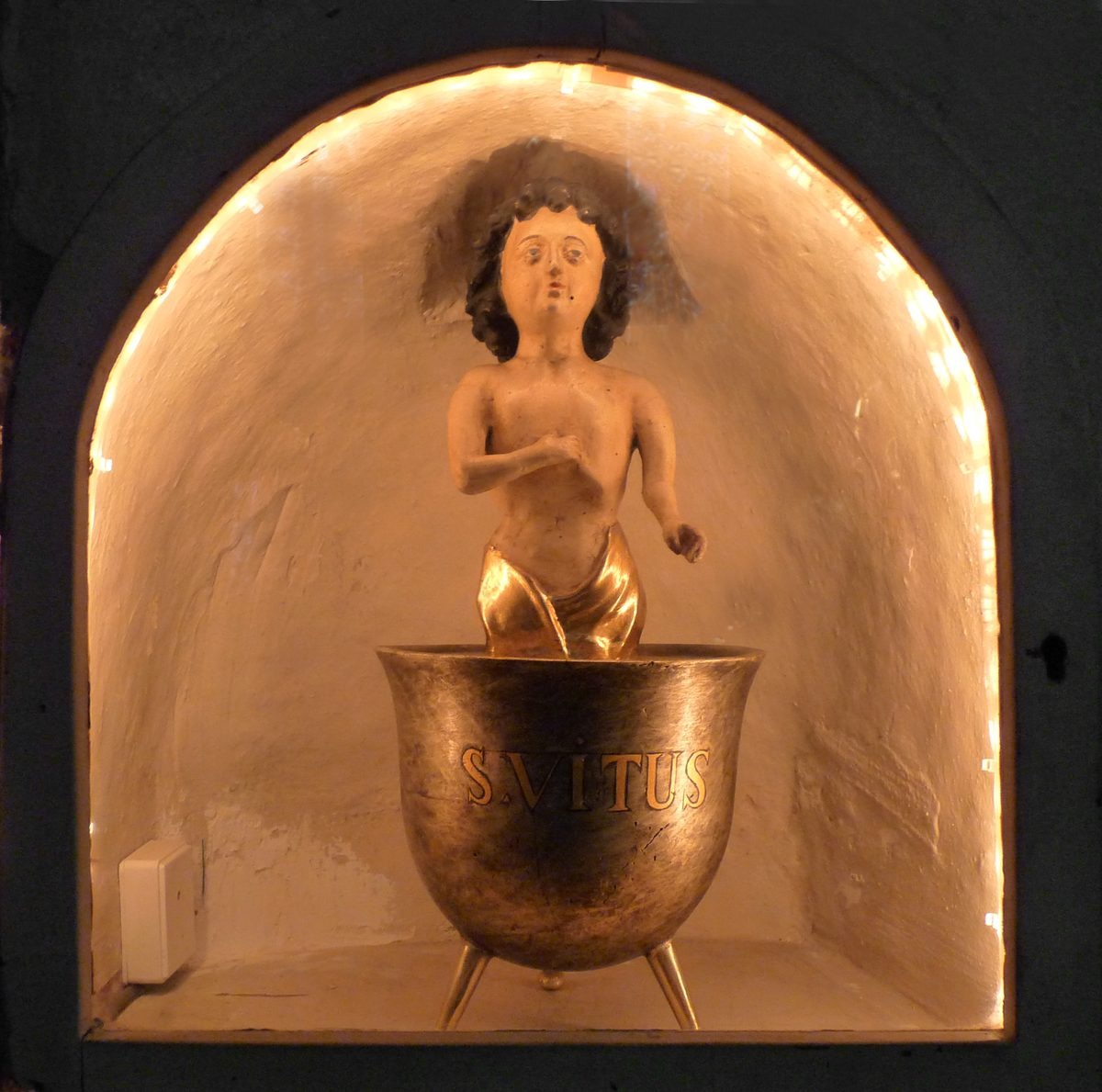
That belief was not an afterthought grafted onto a failed medical plan. Saint Vitus, a child martyr of the early Church, had been associated for at least a century before 1518 with a specific punishment: anyone who offended him, deliberately or not, could be struck with a compulsion to dance without stopping. The affliction even lent its name to a real neurological condition identified centuries later — Sydenham’s chorea is still sometimes called St. Vitus’s dance. In 1518, that belief gave sufferers a script to follow and a cultural confirmation that what was happening to them was real and had a recognisable shape, which is likely part of why the dancing took the specific, repetitive, almost trance-like form so many witnesses described.
The ergot theory, and why most historians no longer accept it
One long-standing explanation for the whole episode is biological rather than psychological: ergotism, poisoning by Claviceps purpurea, a fungus that infects rye and related grains in damp conditions and produces compounds chemically related to LSD. The theory was argued systematically by the Swedish medical historian E. Louis Backman in a 1952 study of religious dance and folk medicine, and it has an obvious appeal: ergot poisoning genuinely does cause convulsions and hallucinations, and 1518 followed several waterlogged harvest years in Alsace that plausibly left more contaminated rye than usual in the region’s bread.

The theory has also been the most thoroughly dismantled by subsequent historians. Waller, who has written the most extensively on the 1518 outbreak, points out that ergotism’s other signature symptoms are missing from every contemporary account of the Strasbourg dancers: the convulsive form of ergotism causes agonising, involuntary muscle spasms rather than days of coordinated, purposeful dancing, and the gangrenous form causes a loss of circulation and blackening of the extremities that no source mentions. Dancing outbreaks of this kind, moreover, cluster specifically along stretches of the Rhine and Moselle valleys across two centuries regardless of which grain a given town’s harvest depended on that year, which sits uneasily with a theory that requires the same toxin in the same crop every time.
What actually caused the dancing plague: stress wearing a saint’s mask
The explanation most historians working on the outbreak now favour is not biological at all. On this reading, what caused the dancing plague of 1518 was an unusually concentrated run of disaster converting itself into a specific, culturally recognised form of collective distress. The years immediately before 1518 had delivered, in overlapping waves, catastrophic flooding along the Rhine, a severe regional famine, a resurgent outbreak of plague, and the first wave of a new and terrifying disease, syphilis, moving through Europe. Strasbourg’s population going into the summer of 1518 was exhausted and frightened, and primed by a well-established belief — the Saint Vitus curse — that told them exactly what form their distress was supposed to take if it broke through.
Waller’s argument, laid out in his 2008 journal article and expanded into a full book the same year, is that this combination produced something close to what clinicians would now call mass psychogenic illness: a stress reaction that spreads through a population by observation and shared belief rather than by any pathogen, and that takes the specific symptomatic shape the surrounding culture already expects it to take. Communities under comparable strain in other periods expressed collective breakdown as fits of weeping, visions, or seizure; Strasbourg’s population, soaked in the Vitus legend and in memories of earlier, smaller Rhine valley dancing outbreaks reaching back to at least 1374, expressed it as dancing. On this account the compulsion was genuinely involuntary and the suffering real; it was the mind’s distress wearing a shape the surrounding culture had already prepared for it, not a toxin working through the bloodstream.
Not every historian frames the stress explanation the same way. The medieval dance historian Kathryn Dickason and the historian Lynneth Miller Renberg have both pushed back on reducing the dancers to a simple symptom: in a city staggering under famine, flooding, plague and a disease nobody yet had a name for, sustained collective movement may have worked as a form of public mourning as much as a pathology. On that reading the dancers were not malfunctioning; they were performing one of the only expressions of grief still available to an exhausted community.
Why Strasbourg’s dancing plague was nearly the last of its kind
The 1518 outbreak was not unprecedented, and contemporaries did not treat it as the singular mystery later writers would. Smaller dancing outbreaks are recorded along the Rhine and Moselle going back to at least 1374, and Strasbourg itself had seen earlier, smaller episodes. What makes 1518 the one every subsequent account returns to is its scale, and the fact that the city’s own magistrates generated an unusually thick paper trail trying to manage it.
It was also very nearly the last dancing plague of its kind. Historians studying the pattern note that recorded dancing manias effectively stop appearing in the historical record within a few decades of the early sixteenth century, and the timing lines up with the Reformation’s assault on the cult of saints. Once large parts of German-speaking Europe rejected pilgrimage shrines and saintly intercession as the remedy for affliction, the specific cultural script that had told sixteenth-century Strasbourgers their distress should take the form of a Saint Vitus curse lost its authority. The belief system that had given the affliction its shape disappeared, and with it, apparently, so did the affliction’s most dramatic form.
Watch the video
No long-form documentary exists for this topic yet — the clip below is the original 52-second short, covering the outbreak’s opening days and its stranger ending.

Related reading
- What Caused the English Sweating Sickness? — another Early Modern epidemic whose cause is still argued over
- Why the Fork Was Once Considered Sinful — the same century’s habit of treating ordinary behaviour as a moral and spiritual danger
- What Happened to the Lost Colony of Roanoke? — another History Mysteries case where the disappearance itself is better documented than the explanation
- Why Venice Made Mirror-Making a State Secret — a Renaissance-era institution reacting just as drastically to a different perceived threat
Works cited
- Waller, John C. “In a Spin: The Mysterious Dancing Epidemic of 1518.” Endeavour 32, no. 3 (2008): 117–121.
- Waller, John. A Time to Dance, a Time to Die: The Extraordinary Story of the Dancing Plague of 1518. London: Icon Books, 2008.
- Miller, Lynneth J. “Divine Punishment or Disease? Medieval and Early Modern Approaches to the 1518 Strasbourg Dancing Plague.” Dance Research 35, no. 2 (2017): 149–164.
- Backman, E. Louis. Religious Dances in the Christian Church and Popular Medicine. London: George Allen & Unwin, 1952.
- Murdock, Graeme. Review of A Time to Dance, a Time to Die, by John Waller. German History 27, no. 2 (2009): 286–287.
- Waller, John. “Dancing Plagues and Mass Hysteria.” The Psychologist, British Psychological Society, April 2009. Link.
- Pennant-Rea, Ned. “The Dancing Plague of 1518.” The Public Domain Review, July 10, 2018. Link.
- Campbell, Olivia. “What Caused Strasbourg’s Dancing Plague of 1518?” National Geographic, October 31, 2025. Link.