
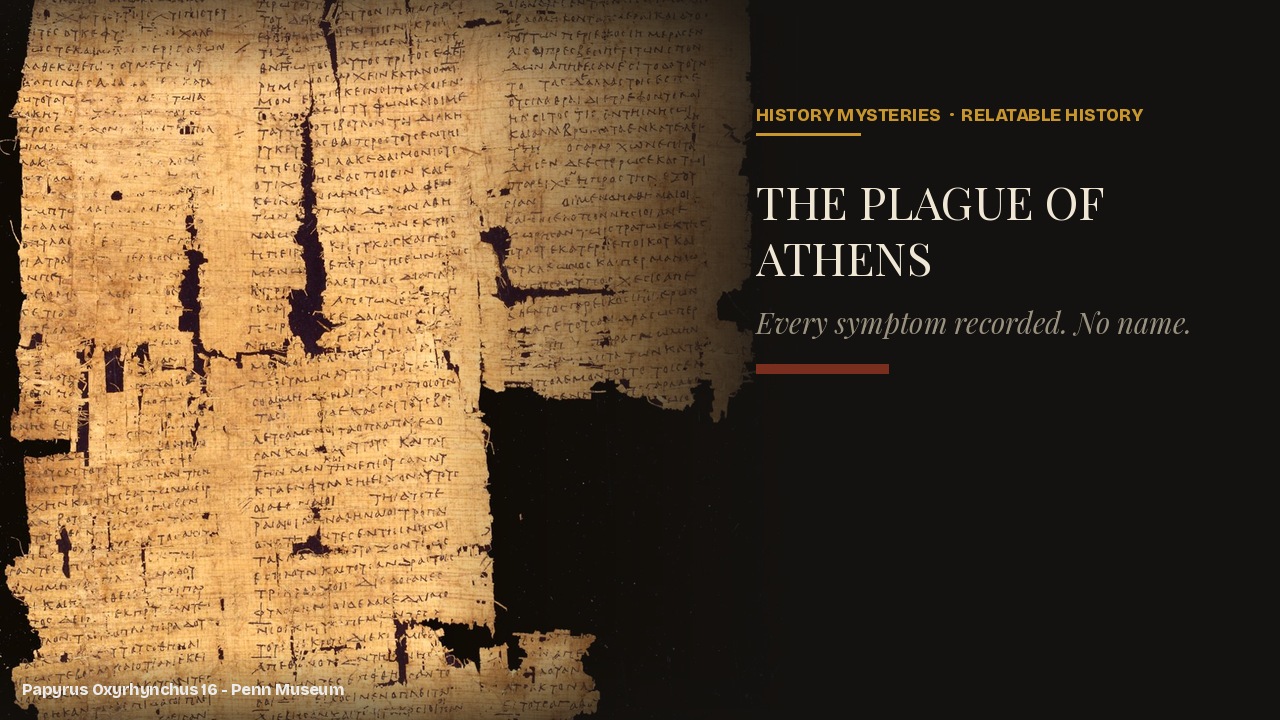
In July 2026 a medical journal that normally publishes work on current infectious-disease outbreaks ran a paper arguing that one of history’s best-documented epidemics had never been properly diagnosed. Three months later it ran a letter disputing that conclusion. A month after that it ran the original authors’ reply. What caused the Plague of Athens, the epidemic under argument, is still not settled science, twenty-four centuries after it happened in 430 BC.
The outbreak is the Plague of Athens, and the reason it still generates journal correspondence twenty-four centuries later is unusual: this isn’t an argument over a legend. It is an argument over a clinical description, written down on purpose by a man who caught the disease and survived it, and over actual teeth pulled from an actual mass grave that matches his account almost exactly. Most ancient epidemics left behind no symptoms and no bodies. This one left both, and the surplus of evidence has made the identification harder, not easier.
The disease itself is well known in outline: a city crowded by a wartime evacuation, a devastating death toll, the death of Pericles within the year. Less widely known is how contested the aftermath has become — the scientific argument over what caused it, which has produced half a dozen formal hypotheses, one celebrated DNA result, a rebuttal that overturned it within months, and, as of 2026, a fresh claim that the question needs reopening.
What caused the Plague of Athens starts with a general, not a physician
Thucydides is remembered as a general, not a doctor. He commanded an Athenian fleet, was exiled in 424 BC after failing to prevent Amphipolis from falling to a Spartan commander, and spent much of the next two decades writing the history he is known for today. The plague account sits early in that work, describing events from years before his own banishment, so he had time, distance and motive to get the details right. He set out at the start of the whole History to establish events with strict accuracy rather than report, and applies that standard with unusual literalness to the plague passage.
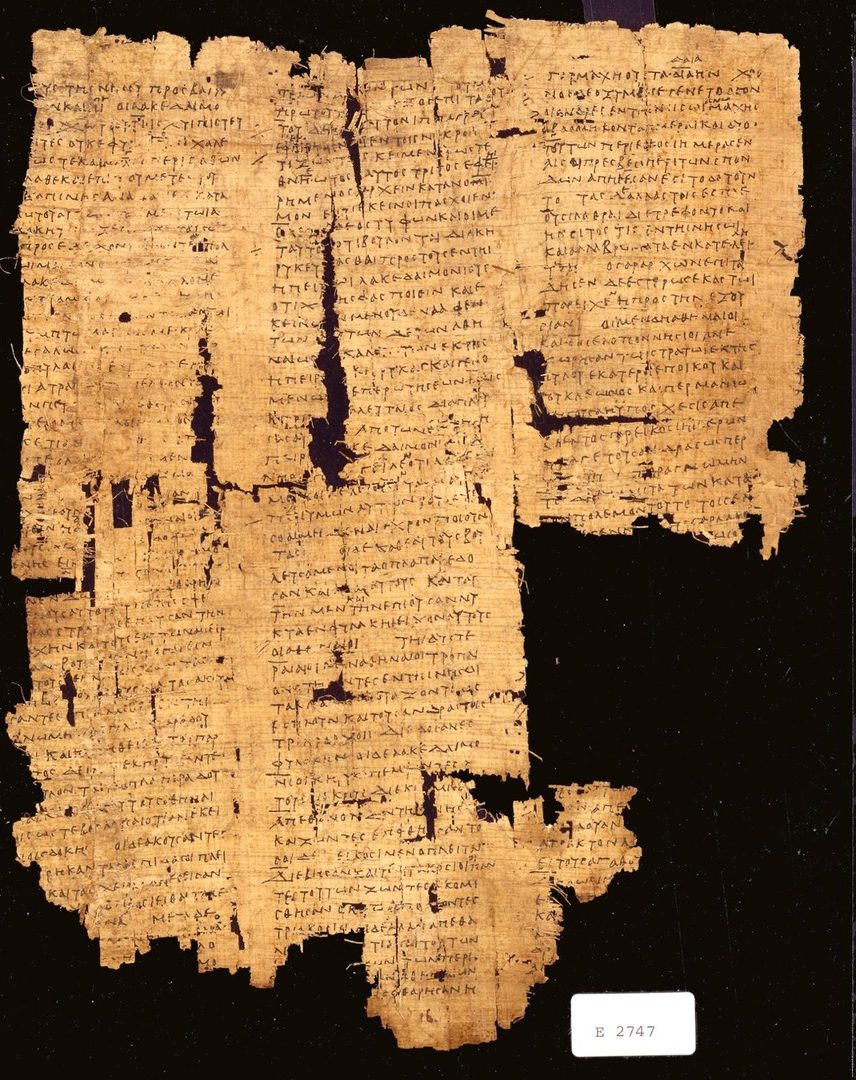
Where he doesn’t apply it is vocabulary. Greek medicine already had a developing technical language by 430 BC: the Hippocratic corpus, written across the same decades, used case-by-case clinical notation, tracking a patient’s course much the way a modern chart does. Thucydides doesn’t do that. He describes blisters, sores and burning heat in ordinary prose, without borrowing a single Hippocratic term, and classicists have argued for over a century about whether he knew the Hippocratic writings at all or developed his observational habit independently. J. C. F. Poole and A. J. Holladay took up the question in a 1979 Classical Quarterly paper, concluding the two traditions diverged enough that Thucydides should be read as his own kind of witness rather than a failed physician — and that readers borrowing his list to diagnose a disease are applying a specificity he never claimed for himself. That plainness is also why physicians still cite the passage: it reports what he saw, not what a contemporary medical theory predicted he should see.
The Long Walls turned a defensive strategy into an epidemiological trap
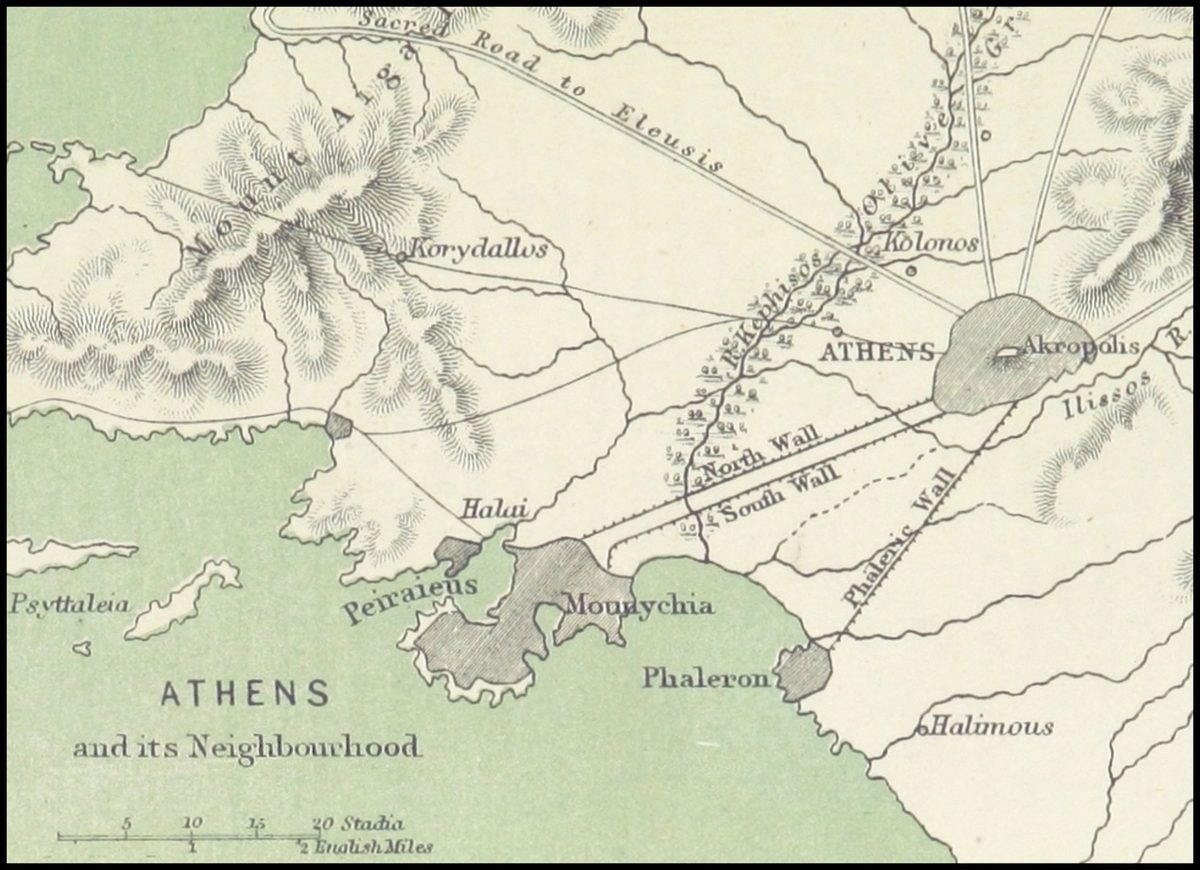
The walls that made the crowding possible were not new in 431 BC. Athens had built the first of them in the 460s BC, on the initiative of the statesman Themistocles, specifically so a besieged city could still reach its harbour and its fleet. By the time a Spartan army under King Archidamus led the first invasion of Attica, two parallel walls ran the roughly six kilometres from Athens to Piraeus, with a third, shorter wall running to the bay at Phaleron. The design assumed Athens might one day need shelter. Nobody had built it to house an entire province at once.
Thucydides records the practical side of the evacuation just before the plague account: farmers dismantling the woodwork of their own houses to carry into the city, driving flocks and animals with them, settling — those with no city relatives — into open ground and empty sanctuaries. Modern historians put Attica’s population at the time in the low hundreds of thousands, much of it funnelled into a corridor built for far fewer residents. Pericles had the stronger navy and knew his hoplites could not beat the Spartan army in open country; the Long Walls strategy traded a land war he was likely to lose for a siege he could win. It could not keep a displaced population healthy through a Mediterranean summer, and in the second year of the war it did not.
Smallpox has the oldest, and still the most cited, case file
The longest-running candidate is smallpox, argued most fully by the classicist Robert Littman and the epidemiologist David Morens in a 1992 paper for the Transactions of the American Philological Association. Their case rests on what epidemiologists call a “virgin soil” epidemic: a disease new enough to a population that nobody carries prior immunity, producing exactly the severity and rapid spread Thucydides describes. Smallpox’s classic rash — blisters maturing into firm, deeply seated pustules — lines up with his account of skin breaking out in sores too hot to bear covering, and the survivors who lost fingers, toes or sight match recorded smallpox complications: gangrene from vascular damage, corneal scarring from pustules near the eyes.
The case holds up partly because it answers a question other candidates struggle with: why a population experienced with endemic disease would have no resistance at all to something new arriving through a port. What it explains less cleanly is the timeline — most historical smallpox epidemics kill over a longer course than the seven-to-nine-day window Thucydides gives for most deaths. Littman and Morens call that gap inconclusive; critics counter that so careful an eyewitness would likely have mentioned smallpox’s hallmark face-and-extremity rash pattern if he had actually seen it.
A 1979 paper argued the whole exercise might be the wrong question
The strongest pushback against choosing any single diagnosis came not from a rival candidate but from a challenge to the method. Poole and Holladay’s 1979 reassessment argued that retrospective diagnosis — matching an ancient description against a modern disease category — carries a flaw that gets overlooked every time someone tries it here. A symptom list compiled by an observer without medical training, translated across twenty-four centuries and a major language shift, will almost always match several modern diseases about equally well, because ordinary descriptive language underdetermines diagnosis in a way a laboratory test does not. Treating Thucydides’s account as a differential-diagnosis checklist, they argued, imposes a specificity the source cannot bear.
They raised a second problem every later genetic study has had to contend with, whether or not it cited them directly: pathogens are not static across two and a half millennia. A bacterium or virus can shift in virulence, gain or lose genes, or go extinct as a distinct lineage while leaving descendants that no longer cause the same illness. It is entirely possible, they wrote, that the epidemic was not one disease at all but several moving through a starved, crowded population at once — in which case the argument over which single pathogen fits every detail is not just unresolved but unresolvable. Their paper predicted exactly the shape the search would take afterward: confident papers, each eventually challenged on grounds the previous one hadn’t anticipated.
A cancelled subway station handed scientists an actual body to test
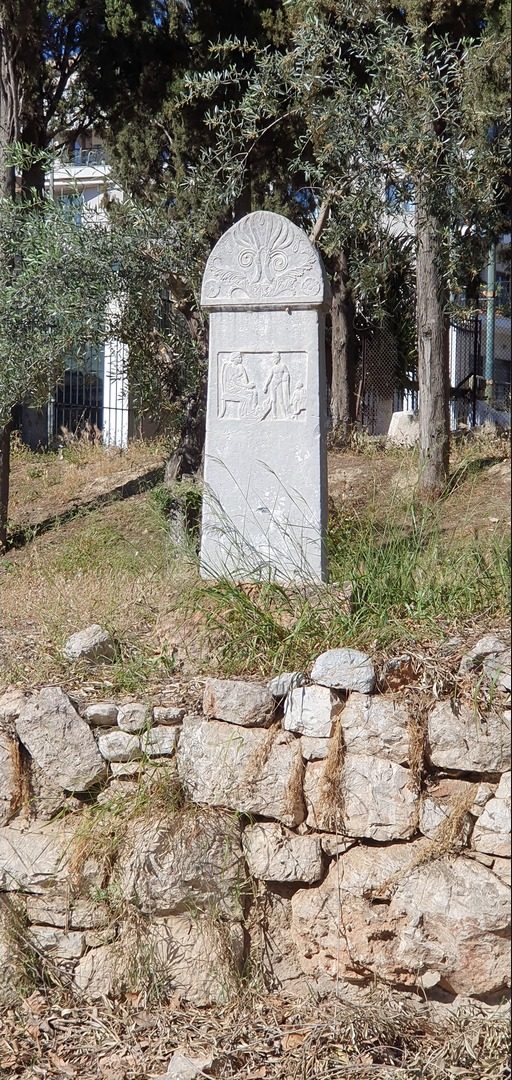
The textual case for an epidemic existed for twenty-four centuries before anyone found a body to test it against. That changed in 1994 and 1995, when rescue excavations ahead of a planned Athens metro station uncovered a mass grave just outside the Kerameikos, the city’s principal ancient cemetery. The excavator, Efi Baziotopoulou-Valavani, recorded roughly ninety skeletons, including ten children, with almost none of the grave goods an ordinary Athenian burial would include, dated by the funerary vessels found among the bodies to the years immediately following 430 BC. The dead had been placed in the pit within a day or two of each other, not over the months a normal family plot would take to fill. A tumulus above the shaft suggests it may originally have held far more remains, perhaps around a hundred and fifty. The date, the haste and the absence of ceremony match what Thucydides says happened to funeral custom once the disease overwhelmed it. The planned station was later cancelled for unrelated reasons, and the grave never became a public monument.
One grave did become well known, separately from the archaeology. Among the skeletons was an eleven-year-old girl, dated to the same crisis years, whose remains a University of Athens team led by the orthodontist Manolis Papagrigorakis used in 2010 and 2011 for a facial reconstruction, working with Swedish forensic specialists on the Manchester method — building soft tissue outward from a scanned replica of the skull at twenty separate muscle points, then finishing the face with features inferred from bone structure alone. The result, published in a peer-reviewed orthodontics journal in 2011, was given a name, Myrtis, and exhibited at Athens’s National Archaeological Museum — a strange kind of afterlife for a body buried as fast and anonymously as the survivors could manage.
A 2006 dental DNA result made headlines, and didn’t survive the year
Bones are one kind of evidence; the DNA inside them is another. In January 2006 Papagrigorakis’s team published a result that looked, briefly, like a final answer. Working from three teeth recovered at the Kerameikos pit, they drilled into the dental pulp — sealed inside the tooth and contamination-protected — and tested what survived against primers for six previously proposed pathogens: Yersinia pestis (bubonic plague), Rickettsia prowazekii (typhus), Bacillus anthracis (anthrax), Mycobacterium tuberculosis, cowpox virus and Bartonella henselae. All six came back negative. A seventh attempt, targeting Salmonella enterica serovar Typhi — typhoid fever — was positive in all three teeth, with roughly ninety-three percent similarity to the modern bacterium, using “suicide PCR,” where each primer pair is used only once in a given laboratory, run independently in separate buildings. The paper concluded typhoid was a probable cause, while noting that Thucydides’s symptoms matched modern typhoid only partially. The finding ran in newspapers worldwide within days.
It did not survive review for long. That same year the biologists Beth Shapiro, Andrew Rambaut and M. Thomas P. Gilbert published a direct rebuttal in the same journal, built on one objection: similarity scores are not evolutionary relationship. Papagrigorakis’s team had reported the ancient sequence as closer to Salmonella Typhi than to a related species, Salmonella Typhimurium, and treated that as support for typhoid. Shapiro’s team built an actual phylogenetic tree from the same gene segment and found the sequence falling outside both species entirely, with strong statistical support — meaning the small percentage difference carried no diagnostic weight. Their preferred explanation was a free-living soil bacterium, a possibility they noted the original study could have tested directly by sequencing the surrounding soil, and apparently had not. The original authors defended their methods in reply, and the matter sat formally unresolved for the next two decades.
In 2026, a new paper reopened the file, and the correspondence is still running
The disagreement did not stay at a standoff. In 2026, a team led by C. M. Trakatelli at Aristotle University of Thessaloniki integrated the historical, clinical and genetic evidence to argue for a diagnosis related to the 2006 claim without being the same thing: invasive non-typhoidal Salmonella enterica. Their argument runs through three filters — whether a candidate pathogen is zoonotic, meaning it can pass between animals and people; whether it fits the clinical picture Thucydides describes; and whether it is compatible with the ancient-DNA evidence. One detail does a surprising amount of work: Thucydides’s observation that scavenging animals feeding on the unburied dead either avoided the bodies or died after touching them. A purely human pathogen doesn’t explain that well; a zoonotic one does, and invasive non-typhoidal Salmonella, unlike typhoid, is exactly that kind of infection. The paper argues brucellosis, Q fever, leptospirosis, tularemia, anthrax and plague all fail at least one filter, leaving their candidate as the only one that clears every one, while acknowledging the precise serovar remains unidentified and that only further sequencing could settle it.
That paper did not go unanswered either. By October 2026 — months after the original ran — the same journal published a letter to the editor from the physician Gonzalo Rojo-Marcos challenging the reassessment, with a reply from Trakatelli’s team following within weeks. The specific grounds of that exchange were still being argued as this article was written, which makes the Plague of Athens one of the very few historical epidemics with an open, numbered correspondence running in a current medical journal. For a disease outbreak twenty-four centuries old, that is unusual, and it is unlikely to be the last word.
Watch the full history
The video covers the whole outbreak in one telling, from the siege strategy that caused the crowding to the DNA argument that is still running in 2026.

Pericles died of the disease in 429 BC, a year after it arrived, and the confidence behind the Long Walls strategy did not survive him. The epidemic returned twice more, in 427 and 426 BC, then stopped circulating in any identifiable form. Athens went on to lose the war in 404 BC, a quarter-century after the first infected ship reportedly entered Piraeus, for reasons owing far more to Persian subsidies and a catastrophic Sicilian expedition than to a disease a generation gone. The epidemic is a footnote to that larger military story in most textbooks; it is the main event here, because it is one of the only ancient disasters preserved well enough to still be under active investigation.
What keeps the file open is also what makes it worth reading closely: an eyewitness who refused to guess, a mass grave matching his account almost exactly, and a genetic record too degraded for a clean answer but not so degraded scientists have stopped trying. Smallpox explained the severity but not the timeline. Typhoid explained a similarity score but not the phylogenetic tree. Invasive Salmonella explains the dead animals but still lacks a confirmed serovar. Twenty-four centuries after a general who wasn’t a doctor wrote down everything he saw so that someone, someday, would recognise it, the recognising still isn’t finished.
Related reading
- What Caused the English Sweating Sickness? — another unidentified epidemic with a symptom list that still resists a single diagnosis.
- What Caused the Dancing Plague of 1518? — a different mass-illness mystery built from eyewitness testimony rather than physical remains.
- Did Plague Doctors Really Wear Those Beak Masks? — how a much later epidemic shaped the medicine meant to treat it.
- Why Ancient Trepanation Survival Rates Were So High — what the archaeological record of ancient-world medicine can and can’t tell us.
Works cited
- Thucydides. History of the Peloponnesian War, Book 2.47–54. Translated by Richard Crawley. Link.
- Poole, J. C. F., and A. J. Holladay. “Thucydides and the Plague of Athens.” Classical Quarterly 29, no. 2 (1979): 282–300. Link.
- MacArthur, W. P. “The Athenian Plague: A Medical Note.” Classical Quarterly 4, no. 3–4 (1954): 171–174. Link.
- Morens, David M., and Robert J. Littman. “Epidemiology of the Plague of Athens.” Transactions of the American Philological Association 122 (1992): 271–304.
- Papagrigorakis, Manolis J., Christos Yapijakis, Philippos N. Synodinos, and Effie Baziotopoulou-Valavani. “DNA Examination of Ancient Dental Pulp Incriminates Typhoid Fever as a Probable Cause of the Plague of Athens.” International Journal of Infectious Diseases 10, no. 3 (2006): 206–214. Link.
- Shapiro, Beth, Andrew Rambaut, and M. Thomas P. Gilbert. “No Proof that Typhoid Caused the Plague of Athens (a Reply to Papagrigorakis et al.).” International Journal of Infectious Diseases 10, no. 4 (2006): 334–340. Link.
- Trakatelli, C. M., K. Kitsios, M. Agathangelidi-Trakatelli, M. Sarigianni, D. Pilalas, and A. Trakatellis. “The Plague of Athens (430–427 BC): Integration of Historical, Clinical, and Ancient DNA Data Supports an Invasive Non-Typhoidal Salmonella enterica Etiology.” International Journal of Infectious Diseases 168 (2026): 108728. Link.
- Rojo-Marcos, Gonzalo. “Letter to the Editor on ‘The Plague of Athens (430–427 BC)…’ by Trakatelli et al., 2026.” International Journal of Infectious Diseases 171 (2026): 108991. Link.
- Trakatelli, C. M., K. Kitsios, M. Agathangelidi-Trakatelli, M. Sarigianni, D. Pilalas, and A. Trakatellis. “Reply to the Letter to the Editor Concerning ‘The Plague of Athens (430–427 BC)…’” International Journal of Infectious Diseases 171 (2026): 109042. Link.
- Papagrigorakis, Manolis J., Philippos N. Synodinos, Antonios Antoniadis, Emmanuel Maravelakis, Panagiotis Toulas, Oscar Nilsson, and Effie Baziotopoulou-Valavani. “Facial Reconstruction of an 11-Year-Old Female Resident of 430 BC Athens.” The Angle Orthodontist 81, no. 1 (2011): 169–177. Link.
- Axarlis, Nikos. “Mystery Mass Grave.” Archaeology Magazine Archive, Archaeological Institute of America, April 15, 1998. Link.