
On a riverbank cemetery in what is now Ukraine, a man in his fifties was buried sometime between 7300 and 6220 BCE with a wound in his skull that had closed over completely. The bone around the opening showed a raised, stepped rim and smooth new growth — the unmistakable signature of healing that continues for months or years after an injury. He had been trepanned, deliberately, and he lived long enough afterward for his own body to finish sealing the hole. It is the oldest known healed trepanation found anywhere on Earth, roughly nine thousand years before anyone thought to clean a surgical instrument, and an early data point in a pattern that runs through this entire object’s history: trepanation survival rates, it turns out, were rarely as grim as the procedure sounds.
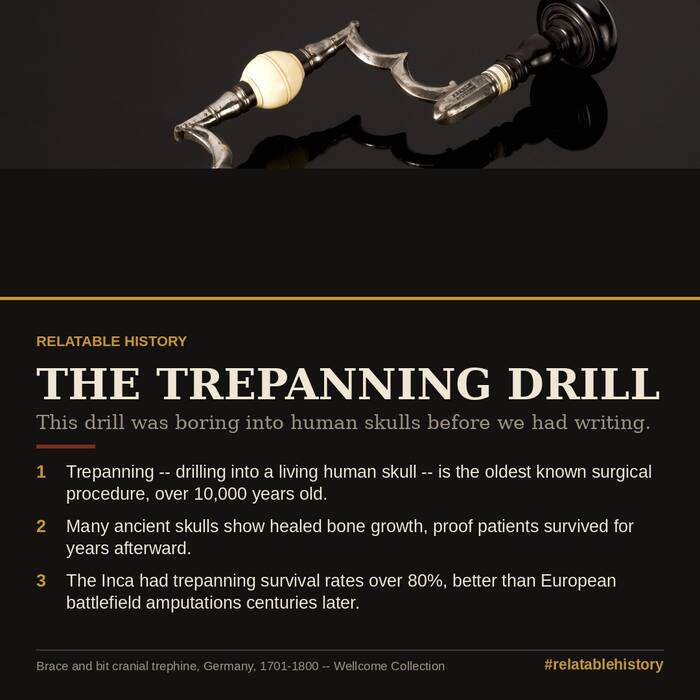
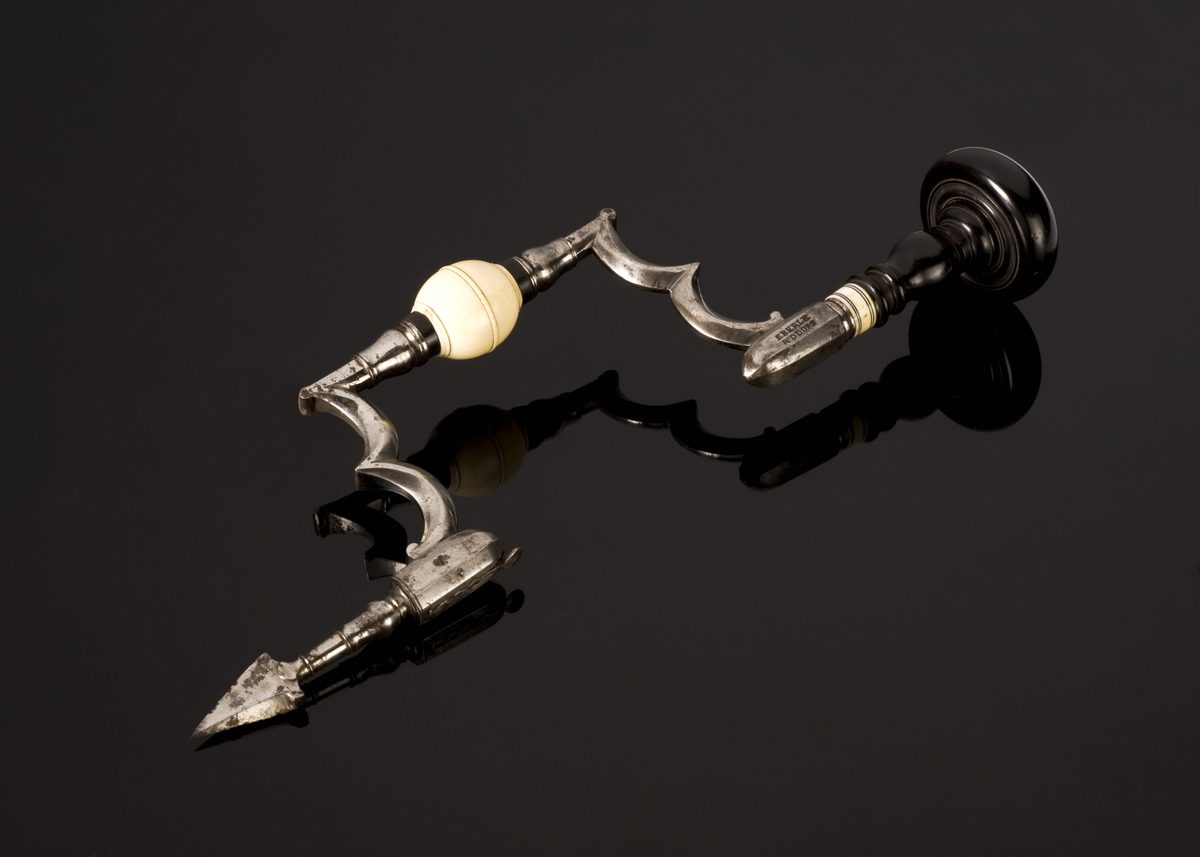
That is the part of this story that rarely makes it into the popular version. People with no writing, no anesthetic beyond whatever they could chew, and no concept of infection were regularly opening living human skulls and watching their patients get up afterward. The drill pictured here, a brace-and-bit cranial trephine made in Germany sometime in the 1700s, belongs to the very end of that story, not the beginning — the surgeons who used it inherited a technique that was already more than nine thousand years old.
What makes the object worth a closer look is not that the idea is ancient. It is that, by several independent measures, the ancient version of the operation outperformed the version that came centuries later.
The proof is written into the bone
Archaeologists can tell the difference between a hole drilled into a living skull and one made after death, and the difference is entirely in the edge. A fresh cut into bone is sharp. A wound the body had time to respond to develops a smoothed, rounded margin as new bone grows in from the sides, a process that takes months at the fastest and years in the slowest cases. When that regrowth is present, the patient was alive when the hole was made, and alive for a long time afterward.
The Ukrainian skull, excavated at the Vasilyevka II cemetery in the Dnieper Rapids region and radiocarbon dated by the Oxford Radiocarbon Laboratory, shows exactly that pattern. So does a skull found at Ensisheim in Alsace, France, which carried two separate trepanations: one that had healed completely and a second, larger one that was only partially healed when the man died at roughly fifty. Researchers led by Kurt Alt of Freiburg University dated the Ensisheim burial to about 5100 to 4900 BCE and described it as the earliest unequivocal evidence of the practice in the archaeological record, since the healing ruled out any explanation other than deliberate surgery the patient survived.
Neither skull came with an explanation for why the operation happened; no written language existed yet to record one. What the bone does provide, independent of any theory, is a body count that argues for itself: in most excavated samples, healed trepanations outnumber unhealed ones, by a wide margin, across thousands of years and every inhabited continent.
Andean surgeons reached trepanation survival rates Civil War doctors couldn’t match
The clearest numbers on trepanation survival rates come from a later period and a different continent: the central Andes, from roughly 400 BCE through the Inca Empire in the 1400s and 1500s CE. A 2018 study in World Neurosurgery by David Kushner of the University of Miami, John Verano of Tulane University, and Anne Titelbaum of the University of Arizona examined some 800 trepanned skulls from Peru and tracked outcomes across that whole span.
The earliest surgeries, from roughly 400 to 200 BCE, were rough; estimates of long-term survival for that period run from around 40 to 50 percent depending on which summary of the research is used, putting them on par with or worse than battlefield surgery two thousand years later. The technique then improved for centuries, and by roughly 1000 to 1400 CE survival in some sample groups reached as high as 91 percent. Averaged across the Inca period itself, Kushner’s team put mortality at 17 to 25 percent — meaning three out of four patients, and often more, walked away. The same study put American Civil War cranial-surgery mortality, thirteen centuries later and performed by physicians with formal medical degrees, at 46 to 56 percent.
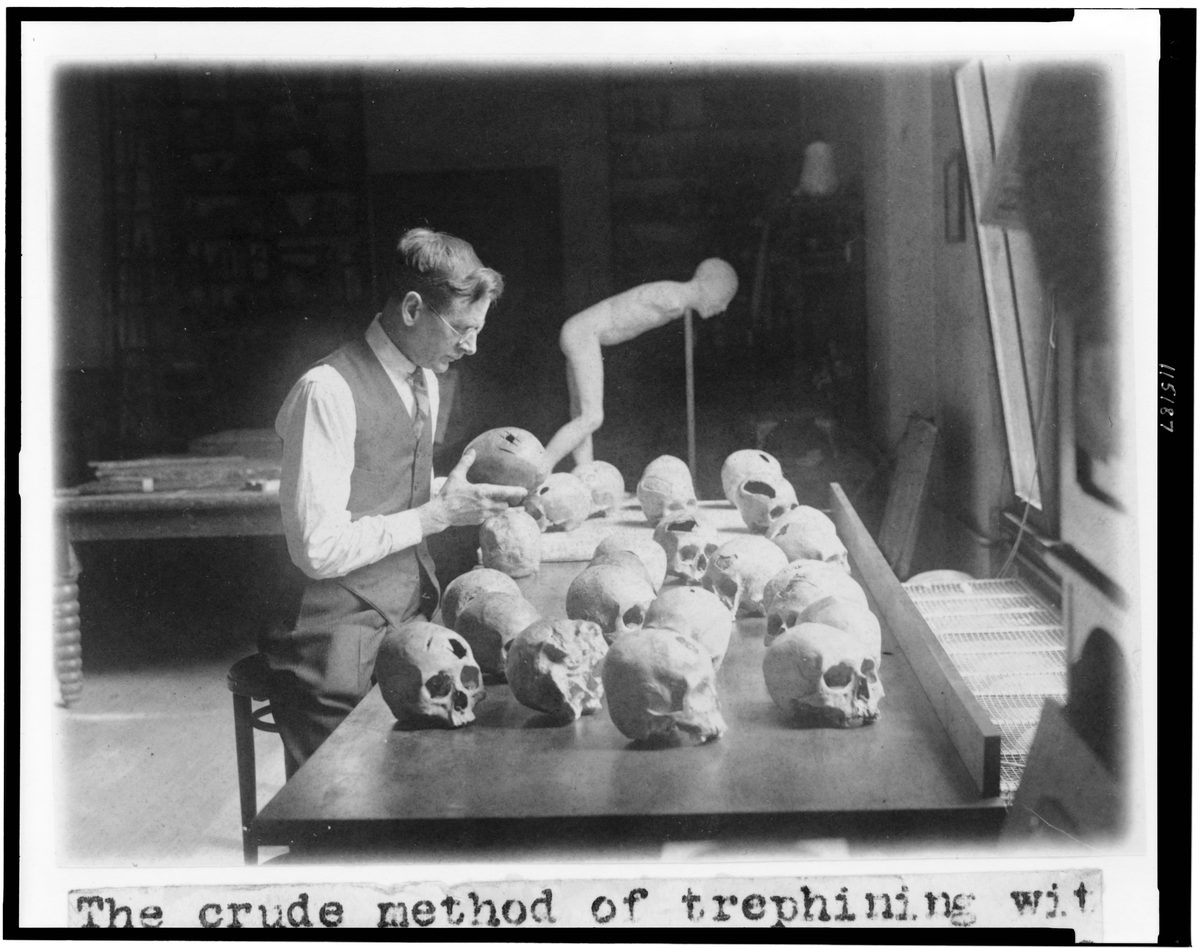
Andean surgeons began with bifacial obsidian blades and, by the Inca period, had largely shifted to bronze and copper, including a curved knife called a tumi. Over the centuries the method changed in ways that look like genuine clinical learning: later surgeons used smaller openings and scraped the bone away in a widening circle rather than cutting straight through, increasingly avoiding the dura, the membrane that protects the brain itself. What they used for pain is still an open question. Kushner has pointed to coca leaf or a fermented maize beverage as plausible candidates, while being direct about the limits of the evidence: “we just don’t know.” Some skulls show evidence of several successful operations on the same person across a lifetime.
Greek and Roman physicians wrote down when not to drill
The classical world treated trepanation as a documented clinical procedure, not a folk practice. Hippocrates devoted part of his surgical writing to head wounds, and what survives gives a systematic, non-spiritual framework for deciding when a fracture needed opening and when it would heal on its own. The text singles out wounds located at the skull’s sutures as especially dangerous — “a person wounded to the same extent will sustain a much greater injury…provided he has received the blow at the sutures” — and separately cautions surgeons against drilling directly over a suture line while performing the procedure. A 2007 historical review in Neurosurgical Focus by Symeon Missios traces how that framework carried forward into Roman medicine, with Galen among the physicians who continued to write about when and how the skull should be opened.
What the Hippocratic text shows is a discipline arguing with itself about risk in something close to modern clinical terms: when the danger of leaving a fracture alone outweighs the danger of opening it. That is a different kind of record than a healed skull. It is professional judgment being written down and handed forward, centuries before the word “neurosurgery” existed.
Medieval Europe turned the same idea into a swindle
By the time Hieronymus Bosch painted The Extraction of the Stone of Madness around 1501 to 1505, the logic of trepanning had curdled, in popular imagination, into a superstition that actual surgeons of the period would have recognized as nonsense. Folk belief held that foolishness could be caused by a literal stone lodged in a person’s skull, and that a sufferer could be cured by having it cut out. Bosch’s painting, now in the Museo del Prado in Madrid, shows a charlatan in a funnel-shaped hat — a visual joke marking him as a fraud rather than a physician — appearing to draw the object from a seated patient’s head while an accomplice looks on. What actually emerges from the wound in the painting is not a stone but a flower, which the museum’s own reading interprets as a dig at the money the con artist is really extracting from his credulous patient.
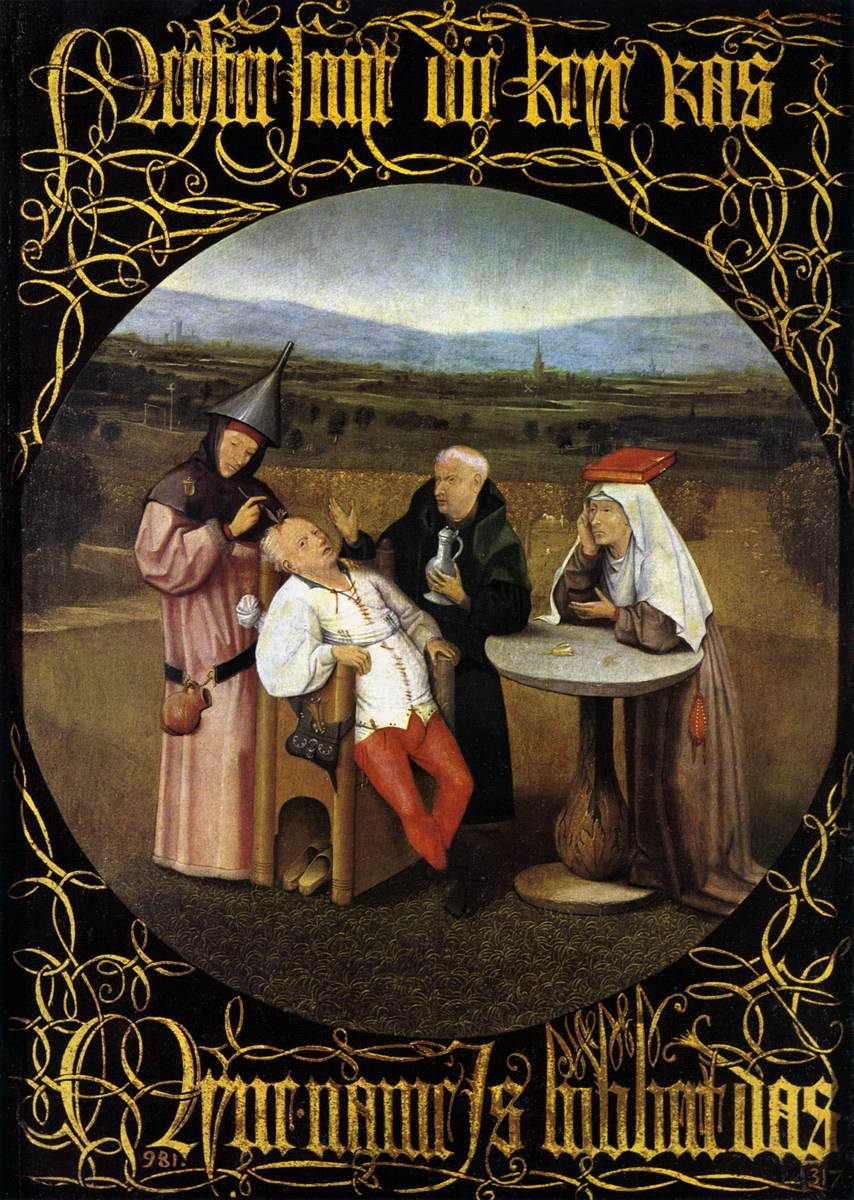
The painting is satire, not documentation, and nothing suggests real trepanations were being performed on demand by travelling con men. But the folklore it mocks did not come from nowhere; it grew out of the same association that millennia of genuine trepanation had built in the popular mind — a hole in the head as something that could change who a person was. Actual surgery, meanwhile, continued in parallel through the medieval period for real fractures and real injuries, carried forward largely unchanged from the Roman instruments Galen had described.
An 18th-century toolmaker turned trepanning into a standardized kit
The object behind this article is a product of exactly that continuity: a brace-and-bit cranial trephine made in Germany sometime between 1701 and 1800 by a maker whose name, Eberle, is stamped into the steel. It survives today in the Science Museum Group’s collection, inherited from Sir Henry Wellcome’s museum, and it is built from steel, turned wood, and ivory, with the kind of ornamental detailing a cabinetmaker would have been proud of. The brace turns the cutting bit the way a carpenter’s hand drill turns a bit through wood — a mechanical borrowing that makes sense once you know that instrument makers and tool makers of the period often trained in overlapping trades.
That decorative ivory and carved wood were, in hindsight, a liability nobody at the time had any way to recognize. Ornate surfaces and seams are exactly where organic material can lodge and where a cloth cannot fully clean a joint, more than a century before anyone connected infection to anything other than bad air or bad luck. Instruments like this one were carried by military surgeons through the Napoleonic Wars, standard equipment for treating skull fractures from sabre blows and musket balls, and the basic design changed very little for another hundred years.
Civil War surgeons used the same design and lost most of their patients
By 1861, field surgeons in the United States were still carrying trephines built on essentially the same brace-and-bit principle. The National Museum of Civil War Medicine’s own records describe the procedure: a surgeon cut through the scalp, used a trephine to bore a disc out of the fractured skull, and then used an instrument called Hey’s saw to scrape away loose bone fragments and smooth the edges, all without reliably sterilizing anything involved.
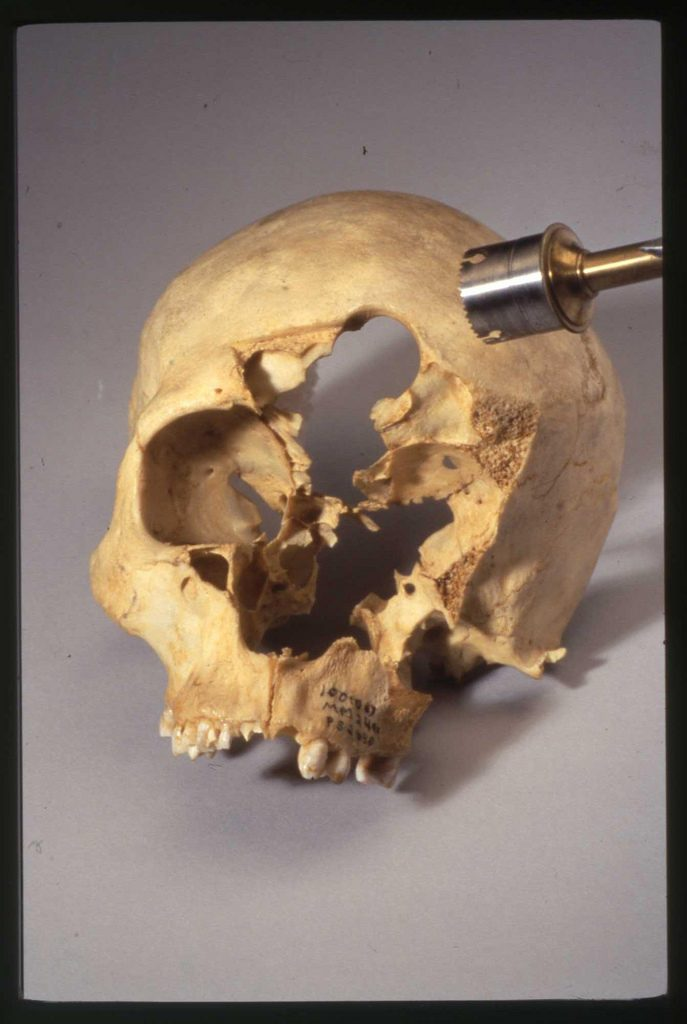
The museum’s case files put the toll in human terms. Corporal John Colvin of the 16th Pennsylvania Cavalry took a sabre wound to the skull in January 1864; surgeons removed roughly a square inch of fractured bone, and he recovered and returned to his regiment within weeks. Private William H. Lowey of the 6th Tennessee Cavalry, wounded by a musket ball that October, underwent the same basic procedure and was treated afterward with an extract of cannabis for pain; he died of pneumonia and brain complications in November. The museum records roughly 200 trephinations performed over the course of the war with an overall mortality near 57 percent. A separate postwar analysis by the surgeon Samuel W. Gross put the operation’s mortality at just over 60 percent — though he also found that patients treated conservatively, without surgery, fared even worse, dying just over 74 percent of the time.
Nothing about the surgeons’ manual skill had gotten worse since the Inca Empire; nineteenth-century anatomical knowledge was far ahead of anything available to a pre-Columbian healer. What had gotten worse, or rather never existed in the first place, was any defense against what happened to a wound after the cutting stopped.
Germ theory retired the hand drill, and some people tried to bring it back
The thing that finally changed trepanation’s odds was not a new idea about the brain. It was Joseph Lister’s work on infection in the 1860s. After learning of Louis Pasteur’s germ theory, Lister built a chemical barrier against infection around carbolic acid: carbolic washes for surgeons’ hands, carbolic baths for instruments, and for a period an actual carbolic acid spray pumped into the air of the operating theatre. The Science Museum’s own account credits the system with a measurable, then irrefutable, drop in post-surgical infection as the practice spread through the 1870s and 1880s. Once a wound could be reliably kept clean, the hand-cranked, ivory-handled trephine became a historical curiosity almost overnight, replaced by sterile instruments and, eventually, anesthesia that meant speed was no longer the surgeon’s main concern.
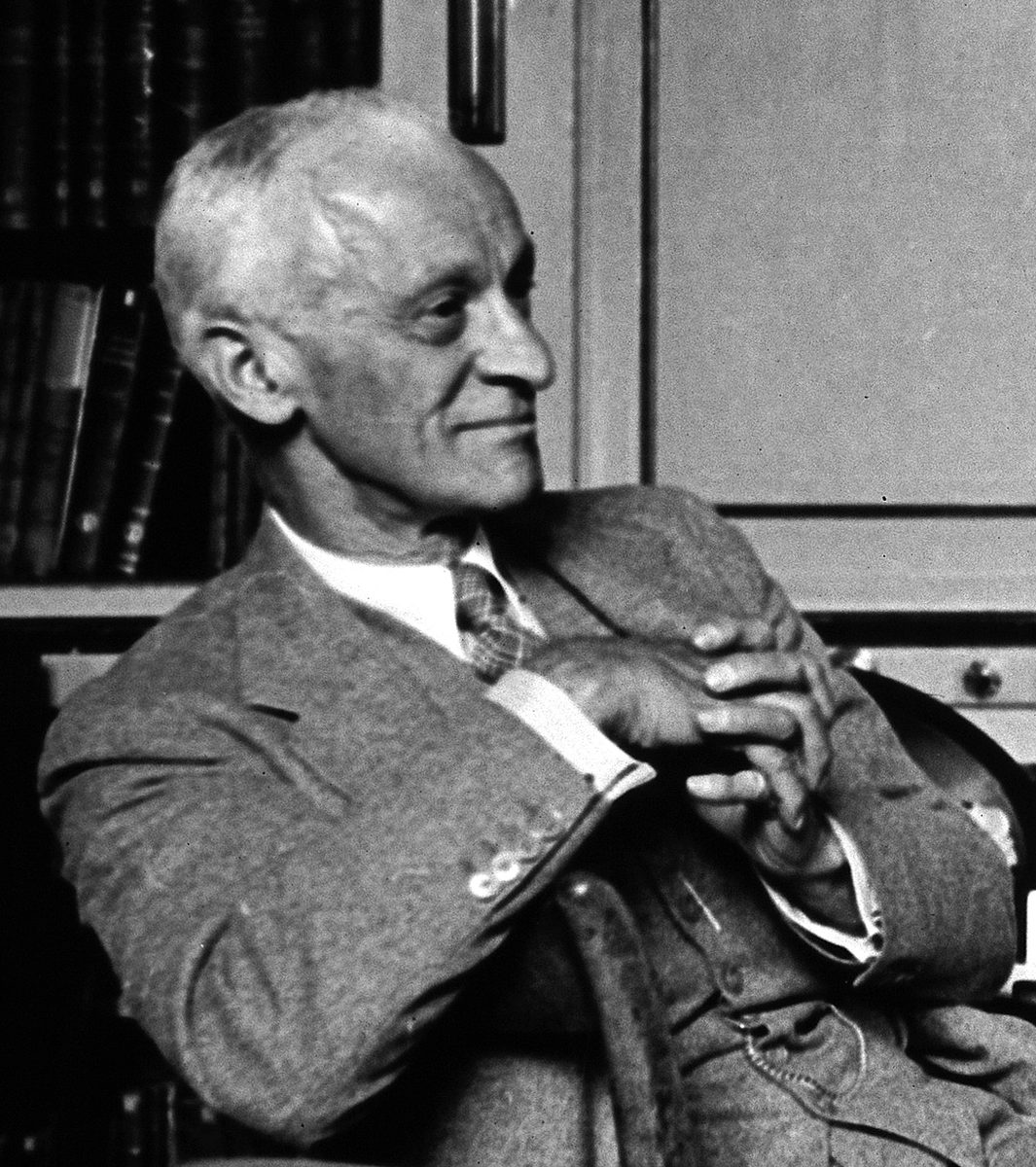
What replaced it was modern neurosurgery, and the surgeon most credited with shaping that transition is Harvey Cushing, operating in the first decades of the twentieth century. Cushing refined the same basic act — opening a hole in the skull, now called a burr hole — into a precise, sterile, carefully planned procedure, work that helped found the discipline that carries the name neurosurgery today. The tool in a modern operating room descends directly from the Georgian brace-and-bit trephine in function and intent, with almost none of its risk.
The idea never entirely let go of people outside medicine, either. In 1962 a Dutch former medical student named Bart Huges published a theory that the skull’s bony closure in infancy permanently restricted blood flow to the brain, and that trepanation could reopen that flow and restore a kind of heightened consciousness. He trepanned himself with an electric drill in January 1965. A small circle of believers followed, documented in detail in a 2017 history published in Arquivos de Neuro-Psiquiatria: the Englishman Joey Mellen succeeded on his third attempt in 1970 after two earlier tries went wrong, and the artist Amanda Feilding underwent the procedure that same year and later stood for the British Parliament twice on a platform that included funding trepanation research through the National Health Service. None of it was ever taken seriously by mainstream medicine, and no controlled study has supported Huges’s theory of blood volume. But as a footnote it says something real: an idea this old, once loose in a culture, does not fully disappear just because the profession has moved on from it.
Watch the full history
No long-form video has been produced for this object yet; the short version below covers the Neolithic origins of the practice and this drill’s place at the end of that story in under a minute.

Related reading
- How Phrenology Hiring Practices Took Over Victorian Workplaces — a Victorian pseudo-medicine that also claimed to read what was inside the skull
- How the Violet Ray Machine Worked, and Why It Took Decades to Debunk — a later gadget sold on the same promise of a quick medical fix
- Were Tapeworm Diet Pills Real? — another medical-quackery object with real, documented casualties
- Did Plague Doctors Really Wear Those Beak Masks? — another medical image people get wrong, from a different pre-modern epidemic
Works cited
- Alt, Kurt W., Christian Jeunesse, Carlos H. Buitrago-Téllez, Rafael Wächter, Eric Boës, and Sebastian Pichler. “Evidence for Stone Age Cranial Surgery.” Nature 387 (1997): 360. Link.
- “Mesolithic Surgery.” Archaeology (Archaeological Institute of America), news brief on the Vasilyevka II cranial surgery find, Dnieper Rapids, Ukraine. Link.
- Missios, Symeon. “Hippocrates, Galen, and the Uses of Trepanation in the Ancient Classical World.” Neurosurgical Focus 23, no. 1 (2007): E11. Link.
- Kushner, David S., John W. Verano, and Anne R. Titelbaum. “Trepanation Procedures/Outcomes: Comparison of Prehistoric Peru with Other Ancient, Medieval, and American Civil War Cranial Surgery.” World Neurosurgery 114 (June 2018): 245–251. Summarized in a University of Miami press release. Link.
- “Trepanation Reveals the Success of the Incas.” Bulletin of the American College of Surgeons, November/December 2022, From the Archives. Link.
- Science Museum Group Collection. “Brace and Bit Cranial Trephine, Germany, 1701-1800.” Object A622729, Wellcome Collection provenance. Link.
- “A Hole in the Head — Civil War Trephination.” National Museum of Civil War Medicine. Link.
- “Joseph Lister’s Antisepsis System.” Science Museum, London. (Live; returns a non-200 to this machine’s automated link check, confirmed accessible by direct retrieval.)
- Museo Nacional del Prado. “The Extraction of the Stone of Madness.” Collection entry for Hieronymus Bosch, P02056. (Live; returns 403 to this machine’s automated check, confirmed accessible by direct retrieval.)
- André, Charles. “Evolving Story: Trepanation and Self-Trepanation to Enhance Brain Function.” Arquivos de Neuro-Psiquiatria 75, no. 5 (2017): 307–313. Link.
- Turner, Fred. “Like a Hole in the Head.” Cabinet, no. 28 (Winter 2007/08). Link.