
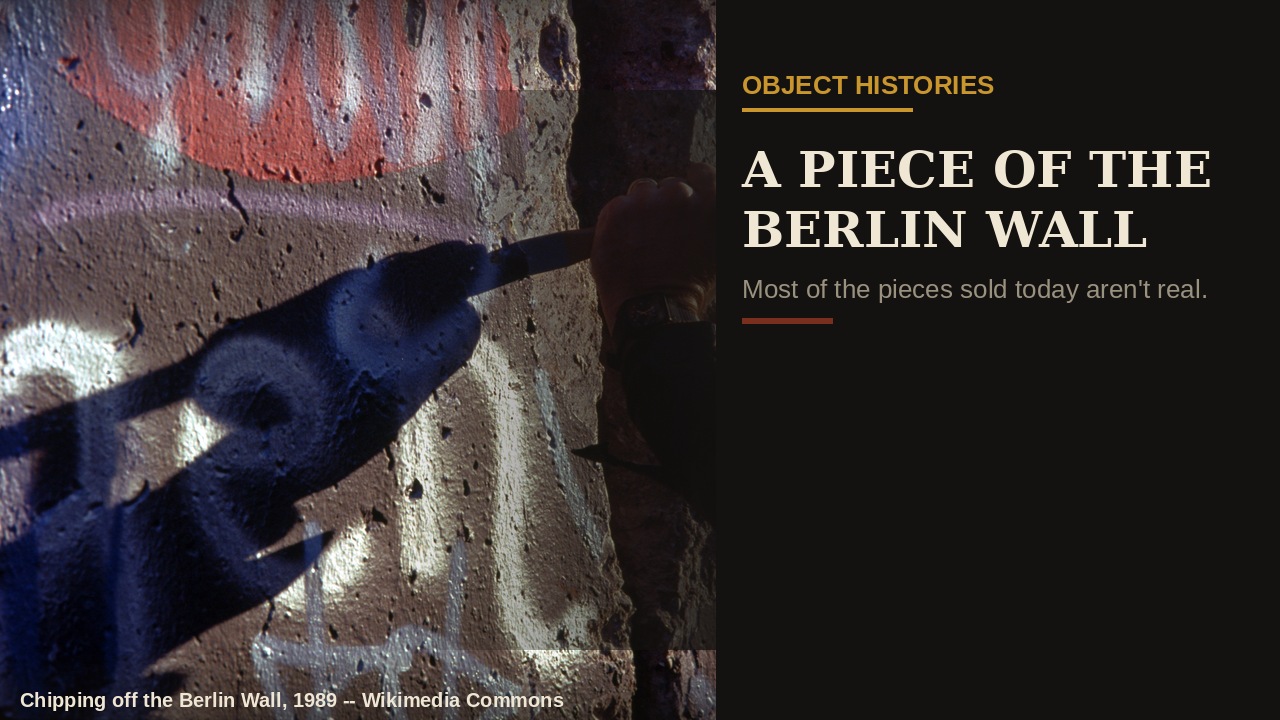
Telling real Berlin Wall pieces from the fakes sold right beside them has been close to impossible since the week the Wall came down. By the spring of 1990, street vendors in Berlin were selling more pieces of the Wall than the Wall could possibly have contained. Tourists lined up to buy chunks of grey concrete, some daubed with a stripe of spray paint to suggest graffiti, sold out of cardboard boxes near Checkpoint Charlie for a few Deutschmarks each. Almost none of it had ever been part of the actual border fortification. The real Wall was, by then, already being sold somewhere else — in an auction house, to a government-licensed export company, for sums that ran into the tens of thousands of dollars a slab.
That split — a worthless flood of fakes on one side, a tightly controlled, well-documented sale of the genuine article on the other — is the actual story of what happened to the Wall after it fell. It is also why, more than three decades later, there is still no reliable way for an ordinary buyer to tell the two apart just by looking.
To understand why, it helps to know what the Wall actually was, how long it stood, what it cost to cross it, and exactly who decided to turn the rubble into revenue.
A border built overnight, then rebuilt for twenty-eight years
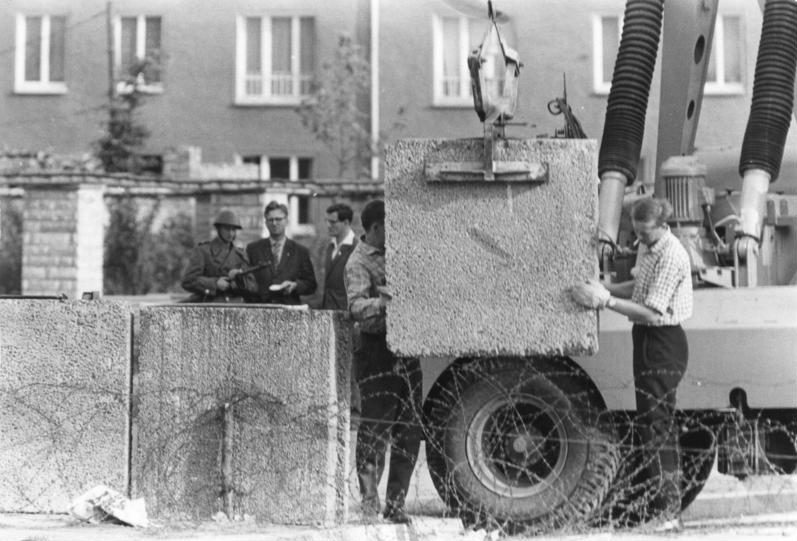
The structure people picture when they hear “Berlin Wall” was not what went up on 13 August 1961. That first barrier was barbed wire, strung by East German troops along the sector boundary before most Berliners were awake, closing a border that had stayed porous for thirteen years after the city’s postwar division into Soviet, American, British and French zones. Within days the wire was backed by concrete blocks. Over the next two decades East Germany rebuilt and reinforced the line four separate times, ending with the fourth-generation Grenzmauer 75: prefabricated concrete slabs roughly 3.6 metres tall, capped with a smooth pipe coping to defeat climbers, running a total of about 155 kilometres (96 miles) around the whole of West Berlin.
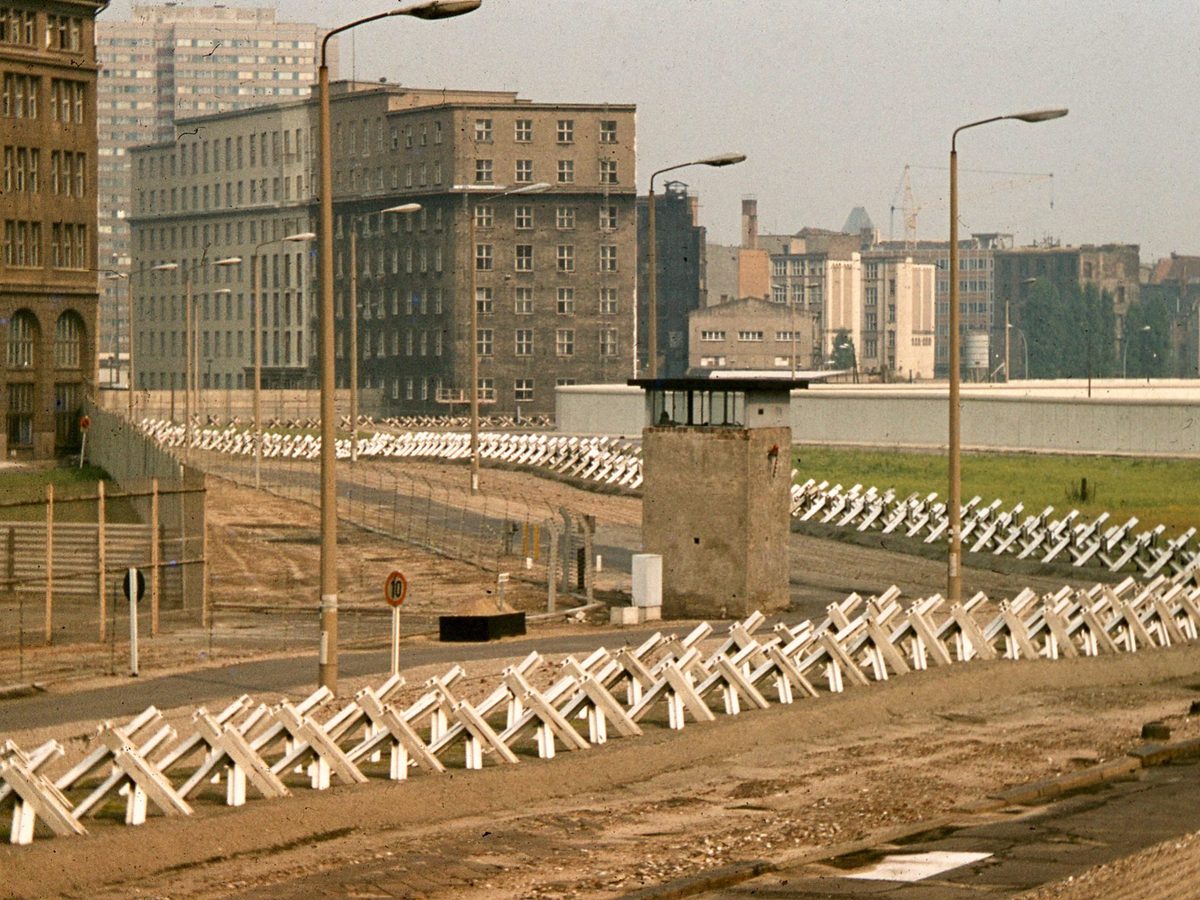
What made the Wall lethal was not the visible barrier facing the West. It was the second, inner wall East Germany built a little further back, and the strip of cleared ground between the two that guards called the death strip. Border troops raked the sand there smooth each morning specifically so a crossing attempt would leave visible footprints. Floodlights, trip-wire alarms, patrol roads, guard dogs on running leads and manned watchtowers filled the gap. Troops in the death strip operated under a standing shoot-to-kill order, formalised in GDR border law, for anyone attempting to cross without authorisation.
At least 140 people died at the Wall — and researchers still argue over how many more
The most carefully documented figure comes from a joint research project run from 2005 to 2011 by the Centre for Contemporary History Potsdam and the Berlin Wall Foundation, led by the historians Hans-Hermann Hertle and Maria Nooke. Working from border-troop files, Stasi records and the 1990s border-guard trial transcripts, and supplementing them with interviews of surviving family members, the project identified at least 140 people killed at the Wall itself between 1961 and 1989: 101 who died attempting to escape, 30 bystanders and a Soviet soldier killed without trying to flee, and eight GDR border soldiers killed in the line of duty. A separate tally puts at least 251 further deaths among travellers at Berlin’s border crossings before, during or after processing.
That is the figure the Berlin Wall Memorial itself now uses, and it is lower than some earlier counts — a reminder that even a heavily studied modern atrocity can carry real historiographical argument. A Free University of Berlin study of the wider inner-German border put the death toll at 327, using broader criteria for what counted as a border-related death; the Foundation’s own figure for that longer, 1,400-kilometre frontier is roughly 260, rising toward 650 if deaths in the Baltic Sea and other indirect cases are included. The disagreement is not about whether people died trying to leave East Germany. It is about where the line falls between a documented killing and a death the regime’s border policy merely made more likely.
One of the earliest deaths put a face on the death strip for the entire Cold War West. Peter Fechter, eighteen years old, was shot by East German guards in August 1962 while climbing toward the Western side near Checkpoint Charlie. He fell back into the death strip in full view of crowds and Western photographers and bled to death there over nearly an hour; neither side’s guards retrieved him until he was already dead. The photographs ran worldwide and turned a secret killing into undeniable evidence of what the Wall actually enforced.
It came down because of one official’s unscripted answer
For most of its existence the Wall looked permanent enough that even its most famous critic did not expect to see it fall. When President Ronald Reagan stood at the Brandenburg Gate on 12 June 1987 and called out, “Mr. Gorbachev, open this gate… Mr. Gorbachev, tear down this wall,” the line was contested even inside his own administration as too confrontational to keep in the speech. It happened anyway, a little over two years later, and by most accounts almost by accident.
On the evening of 9 November 1989, Politburo spokesman Günter Schabowski held a press conference to announce loosened travel rules he had only just been briefed on and had not fully read. Asked when the new rules took effect, he answered, in substance, from now. Reuters and West German television reported within the hour that the border was open. Thousands of East Berliners headed for the crossings that same night, and the border guards on duty, holding no orders for a crisis nobody above them had planned for, simply let the gates swing open rather than risk a confrontation with an unarmed crowd that size.
The regime that built the Wall sold it off to pay its bills
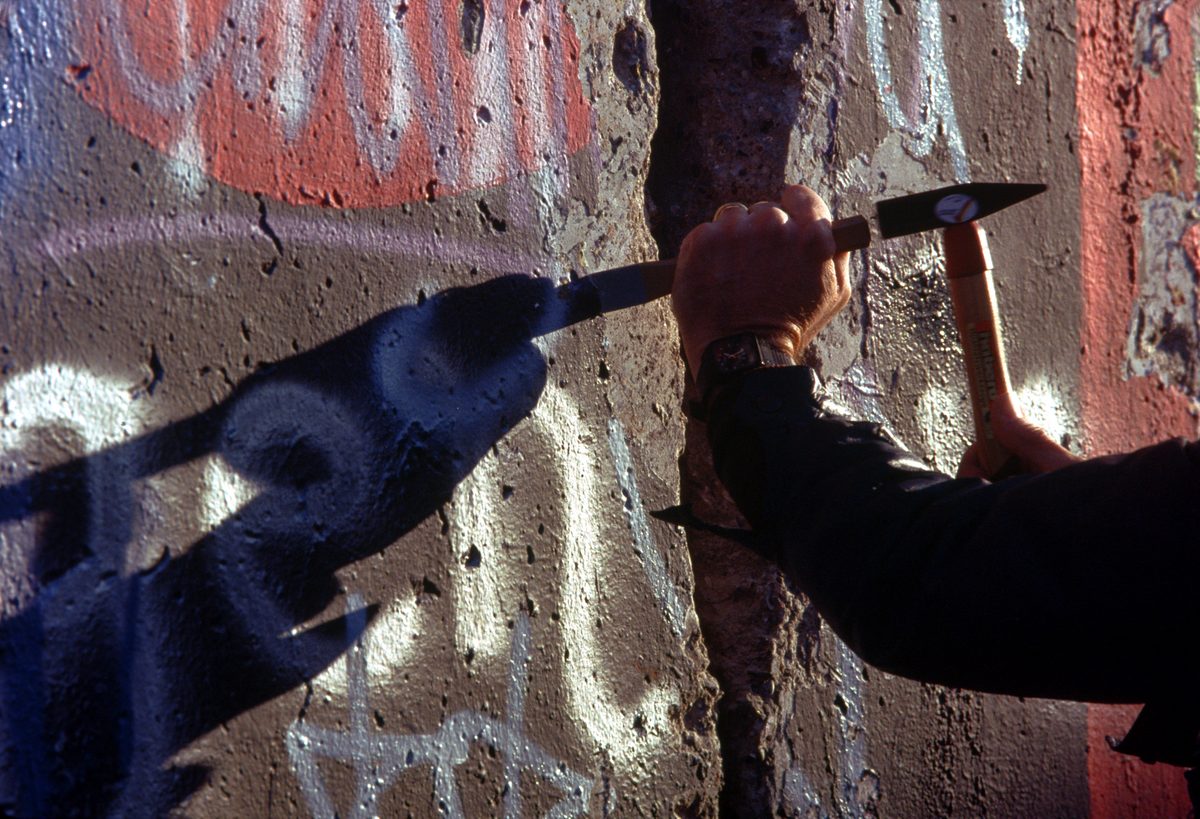
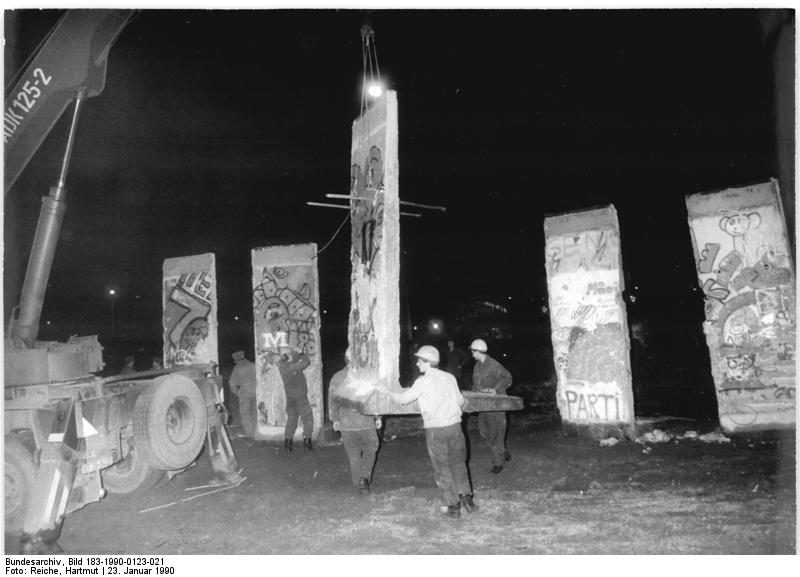
The hammer-and-chisel souvenir hunters, the Mauerspechte or “wall peckers,” started working the Wall’s western face within hours of the border opening and kept at it for months, selling fragments on the street almost as fast as they could chip them loose. But the East German state controlled by far the larger share of the actual Wall, and by January 1990, with its economy collapsing, it decided to monetise that control. The Ministry of Foreign Trade granted the state import-export firm Limex an exclusive licence to market and sell Wall segments, including sections removed from the former border-crossing points and pieces judged especially valuable. Limex sold directly and through a partner, the Berlin Wall Commemorative Group, in the United States, and through a West Berlin firm called LeLe Berlin.
The biggest sales were staged as auctions. A Berlin sale in April 1990 brought in disappointing results; a Monte Carlo auction that June did much better, moving around seventy segments for a reported 1.8 to 2.2 million Deutschmarks, and at a separate 1990 sale forty pieces changed hands for a combined $630,000, with a single unidentified Swiss buyer taking eight slabs for $175,000. Individual 1.2-metre segments through 1990 generally fetched anywhere from $60,000 to $200,000 apiece, depending on how much graffiti they carried and how the auction house staged the sale. Proceeds from at least one 1990 sale were earmarked for East German public health services, a detail that makes the regime’s final use of its own border wall almost impossible to satirise.
The street artists who painted the Wall sued the company that sold it
Much of what made a segment valuable was not the concrete at all. It was the graffiti — and some of that graffiti had real, named authors who had never been paid for it and had not agreed to its sale. The French artist Thierry Noir and his collaborator Kiddy Citny had been painting murals on the Wall’s western face since 1984, when doing so was itself a minor act of civil disobedience; once their work became an export commodity, Limex and LeLe Berlin began selling segments carrying it, and Limex argued in court that the paintings amounted to damage done to GDR state property rather than protected artistic work. Noir and Citny sued and won, establishing that the murals were their intellectual property even after the state that had owned the wall beneath them ceased to exist.
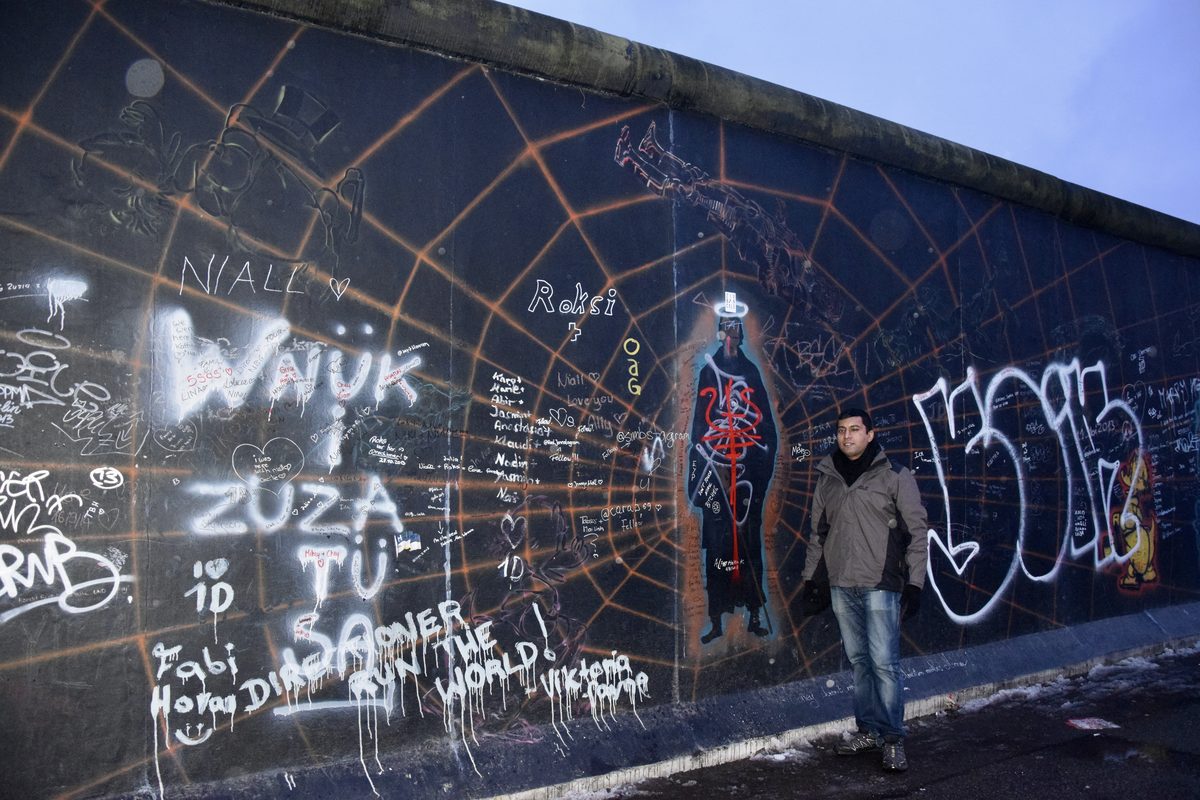
Not every painted stretch of Wall was sold off piece by piece. A 1.3-kilometre run along the Spree River, on what had been the Wall’s eastern, previously blank face, was deliberately spared from demolition and handed to artists instead. Between the summer and September of 1990, 118 artists from 21 countries painted it floor to ceiling, creating the East Side Gallery. Its single most-reproduced image, by the Russian painter Dmitri Vrubel, shows Soviet leader Leonid Brezhnev and East German leader Erich Honecker locked in a kiss on the mouth, based on a real 1979 photograph; it has been repainted more than once as the open-air gallery weathers, and it still draws millions of visitors a year to a wall that, a hundred metres in either direction, no longer exists.
Where the verified pieces actually went
Properly documented segments ended up in an unusually wide, and occasionally undignified, range of places. The CIA installed three sections, removed from near Checkpoint Charlie at Potsdamer Platz in November 1989, as a monument outside its Langley, Virginia headquarters, dedicated on 18 December 1992 and deliberately placed so staff walk past its graffitied western face and whitewashed eastern face every day. Businessman Fred Meijer bought three fragments through the Berlin Wall Commemorative Group for display in Grand Rapids, Michigan; the Jakarta-based artist Teguh Ostenrik bought panels from Limex in 1990 and later built them into a sculpture in Indonesia; and an Italian businessman named Marco Piccininni bought a segment at the 1990 Monaco sale and donated it to the Catholic shrine at Fátima in Portugal, where Pope John Paul II blessed it in 1991.
And then there is the men’s restroom at the Main Street Station casino in Las Vegas, where a certified section of Wall is mounted behind a sheet of glass between three urinals — installed, according to the property’s current owner, before the company bought the building, and preserved specifically so that visitors’ own waste never touches it. Women who want to see it have to ask a security guard for an escort into the men’s room. It is, by any reasonable measure, one of the strangest resting places any Cold War artefact has ever found, and it is entirely genuine.
Why real Berlin Wall pieces still can’t be told from fakes just by looking
None of that documentation trail survives contact with the open souvenir market. A legitimately sold Limex segment usually came with a certificate and, often, a numbered plaque, but certificates are themselves trivially easy to forge, and plenty of genuine certificates have long since been separated from the concrete they described. Meanwhile, ordinary rubble from the general demolition, or concrete that was never part of the border system at all, has been spray-painted and sold as Wall fragments in tourist markets for more than thirty years, with no chemical or visual test that reliably tells genuine Wall concrete from a convincing fake. The Checkpoint Charlie Museum still sells small certified pieces through its own shop and website today, which is one of the only channels left with a documented chain back to the original demolition. Walk a hundred metres from that shop to any street vendor, and the guarantee disappears completely.
Watch the full history
The video version covers the Wall’s twenty-eight years, the night it fell, and the souvenir economy that followed, in a little under six minutes.

Related reading
- The Diya: How a 5,000-Year-Old Lamp Became Diwali’s Icon
- The Hatpin Peril: How a Fashion Pin Became an Outlawed Weapon
- What Was the Wow! Signal? Inside Astronomy’s Most Famous Unsolved Case
- How Hog Killing Day Worked on the American Farm
Works cited
- Hertle, Hans-Hermann, and Maria Nooke, eds. The Victims at the Berlin Wall, 1961–1989: A Biographical Handbook. Centre for Contemporary History Potsdam (ZZF) and Berlin Wall Foundation, 2017. Link.
- Berlin Wall Foundation (Stiftung Berliner Mauer). “How many people died at the Wall?” Link.
- Central Intelligence Agency. “Berlin Wall Monument.” CIA.gov, Headquarters Tour. Link.
- “Tear Down This Wall,” item #567. Making the History of 1989. Roy Rosenzweig Center for History and New Media, George Mason University. Link.
- “Gunter Schabowski Press Conference,” item #704. Making the History of 1989. Roy Rosenzweig Center for History and New Media, George Mason University. Link.
- Della Zazzera, Elizabeth. “Where Have All the Fragments Gone?” Lapham’s Quarterly, Roundtable, 5 November 2019. Link.
- Geiling, Natasha. “The Las Vegas Bathroom and 6 Other Unexpected Places to See the Berlin Wall.” Smithsonian Magazine, 6 November 2014.
- “Chunks of Berlin Wall Up for Auction.” Reuters, via History News Network, 18 September 2008. Link.
- Associated Press. “$33,000 for a Chunk of Concrete — Yes, if It’s the Berlin Wall.” Deseret News, 25 June 1990. Link.
- Orte der Einheit (Places of German Unity). “East Side Gallery.” Federal project on sites of German reunification. Link.