
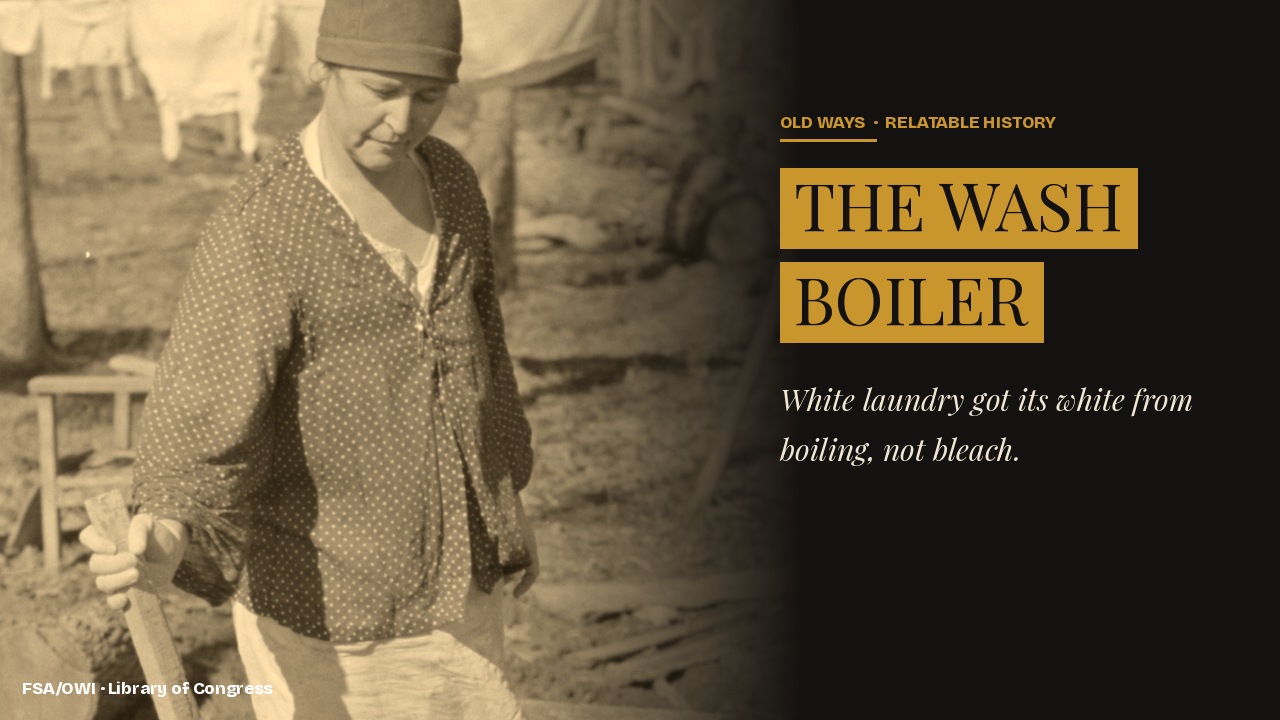
Wash day before washing machines had an oddly industrial origin point: in 1916, the only bleach the Electro-Alkaline Company of Oakland, California made was too strong to put anywhere near a shirt. The business had been founded three years earlier when five investors each put in a hundred dollars to build the country’s first commercial liquid-chlorine bleach plant, and its customers were paper mills and textile finishers, not housewives. The product that would eventually help retire the wash boiler from American kitchens started out as an industrial chemical nobody expected a family to use.
That detour says something true about wash day generally: nothing about getting laundry clean in the nineteenth and early twentieth century happened by way of one clean invention. It took a federal patent office granting incremental improvements to a metal tub almost every decade, a home soap recipe handed down like a family heirloom, a blue dye bought specifically to trick the eye, a wringer redesigned because it kept catching people’s hands in its gears, and two separate companies racing from opposite directions to solve the same Monday morning. Most of that paper trail never made it into the family stories about wash day being the worst day of the week.
This is the part of the story — wash day before washing machines — that lives in patent filings, company archives, and museum collection records rather than in anyone’s memory of a particular Monday: who patented what, what the lye soap recipe actually called for, what the blue in the rinse water was actually made of, and why two different men both claimed to have built the first electric washing machine.
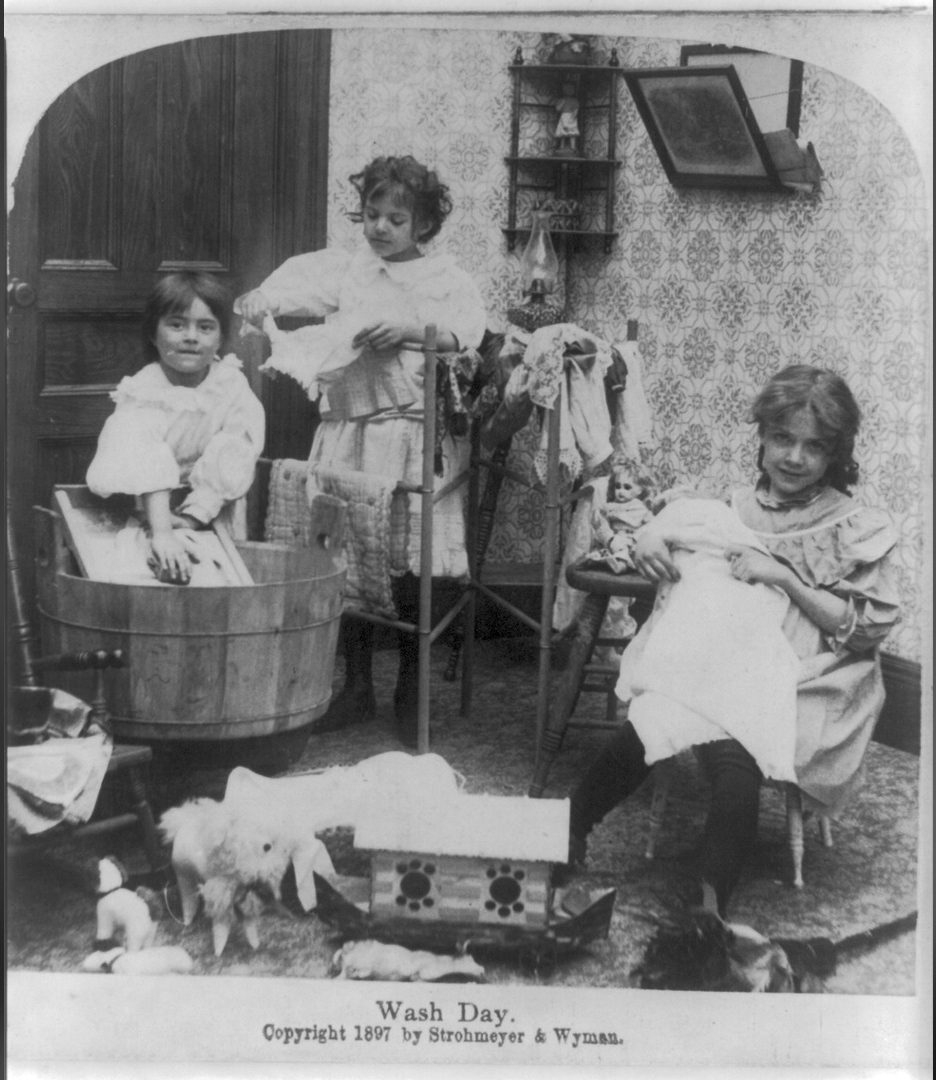
Wash Day Before Washing Machines Started With a Patent Fight
The wash boiler did not begin as a single invention so much as a running argument conducted through the U.S. Patent Office. In 1833, a design for a ribbed laundry washboard was patented, and the effect on rural communities was almost immediate: local artisans who had never thought of laundry equipment as a product realized they could build their own versions. Tinsmiths crimped tin or sheet iron into ribbed panels, joiners built the wooden frames to hold them, and turners and potters got into the business too, each working in whatever material their trade already used. The handmade boards these craftsmen turned out were eventually crowded out by cheaper factory versions, but for a few decades a washboard could be a genuinely local product.
The boiler itself kept being reinvented well into the industrial era. In January 1870, the Patent Office granted Thomas Evans a patent, No. 98,679, for an improved “fountain wash-boiler” — the surviving patent model, held today by the Hagley Museum and Library, shows a design that moved the elevating pipes to the outside of the boiler and gave it a removable bottom fitted with one or more waterways, letting water circulate through the laundry instead of just sitting under it. Evans was one of a long line of inventors who filed variations on the same basic object across the second half of the century, each claiming to have solved some version of the same problem: how to move boiling water through a tub of cloth without scalding whoever was standing over it.
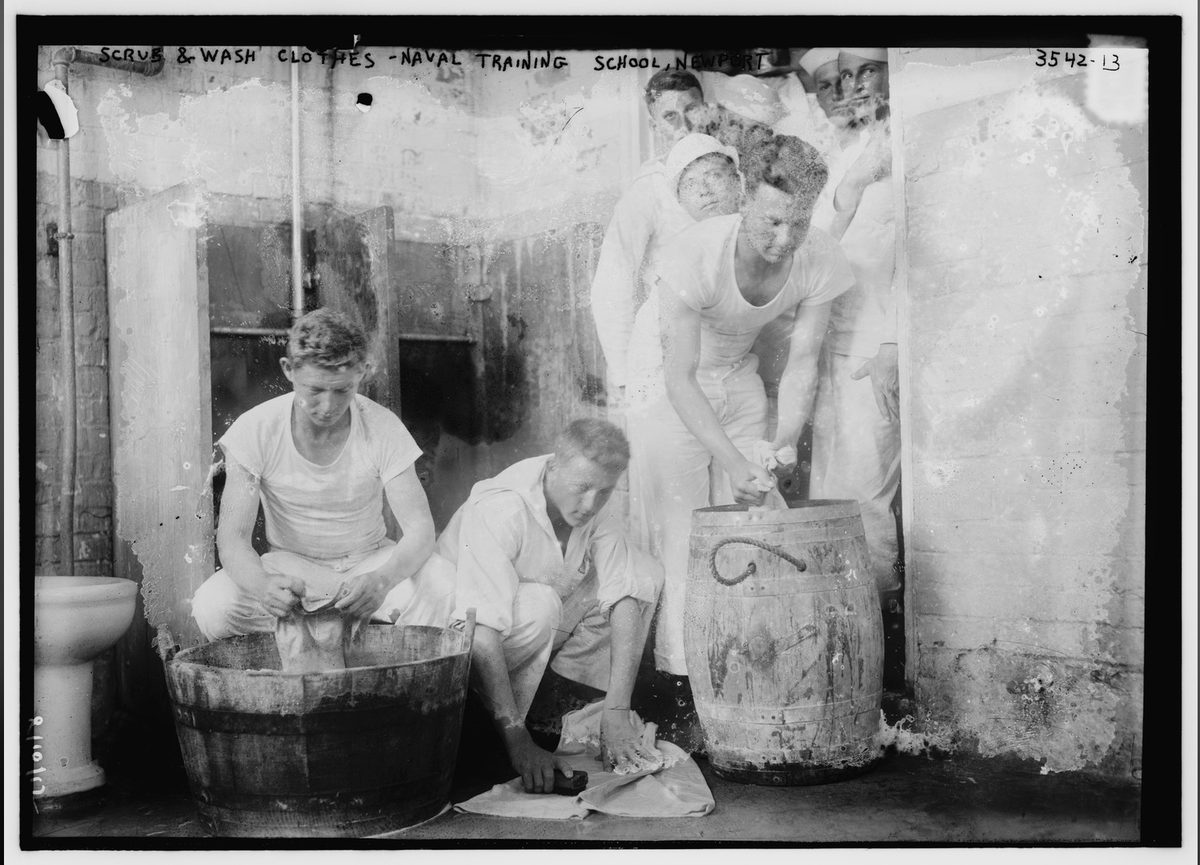
None of this labor belonged only to farmhouses, either. Military and institutional laundries ran the same boil-scrub-wring routine at a larger scale, with recruits and staff assigned to it the same way they were assigned to any other duty — a reminder that wash day was a logistics problem wherever enough people lived under one roof, not only a domestic one.
Soap Was Rendered at Home, Not Bought
Before a wash boiler was ever filled, somebody had made the soap that went into it, and making lye soap was its own small industrial process, not a recipe pulled off a store shelf. The starting material was wood ash, saved all year from the fireplace and stove and run through water again and again until the runoff was strong enough to use — repeated passes made a stronger lye, and frontier households built dedicated ash bins just to collect the raw material.
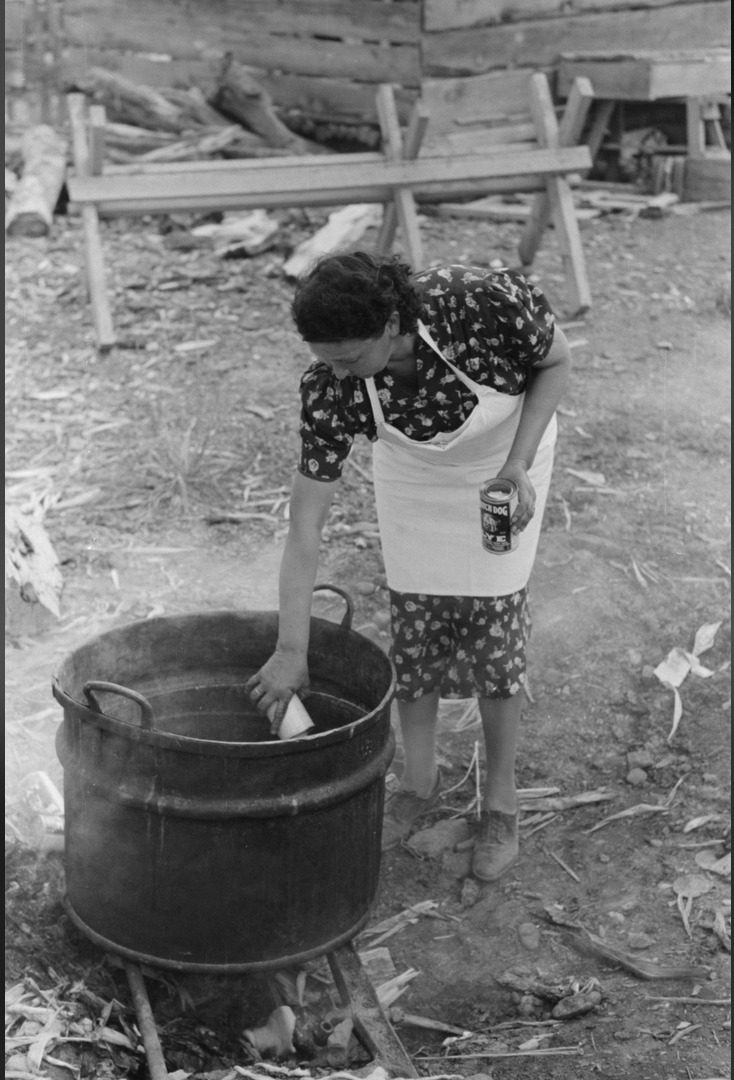
Delbert Trew, a Texas Panhandle rancher and writer who grew up watching his mother and grandmother make soap, preserved one specific family recipe in a 2003 Farm Collector column: a can of lye dissolved in three pints of cold water, combined with three pints of melted, strained lard, plus half a cup of ammonia or bleach and a scoop of borax if the household had it. The lye went into the water first, the warm lard went in second, and the mixture was stirred until it thickened to the texture of honey before being poured into pans to harden overnight — a process Trew noted that humid weather could slow down for days. It was not a gentle product. The same caustic chemistry that cut through grease and ground-in dirt also reddened and cracked the hands of whoever used it regularly, which is part of why the boiling mattered so much: heat did real cleaning work that a milder soap never could have managed alone.
“Whiter Than White” Was an Optical Trick, Not a Bleach
The last step before clothes went on the line, the bluing rinse, worked on a principle that had nothing to do with actually removing dirt or stains. According to CAMEO, the Museum of Fine Arts, Boston’s materials-science reference, laundry blue is a fine pigment stirred into rinse water specifically to counteract the yellow cast that alkaline soap leaves on white cotton and linen — it cleans nothing, it just adds a tint that cancels the yellow out to the eye.
The pigment itself changed over time. Through the late eighteenth century and into the mid-nineteenth, the blue was typically Prussian blue or natural indigo. From the 1850s onward, Reckitt’s Blue — sold as a powder, a solid block, or a dye coated onto paper — used synthetic ultramarine instead, and the brand became dominant enough in English-speaking households that “the blue” and “Reckitt’s” were nearly interchangeable for a couple of generations. By the early twentieth century, water-soluble synthetic dyes such as methyl violet had begun replacing the older mineral pigments as a bluing agent, a shift that anticipated the “optical brightener” chemicals modern detergents still use for exactly the same trick.
Patent Filings Admit the Wringer Was Dangerous
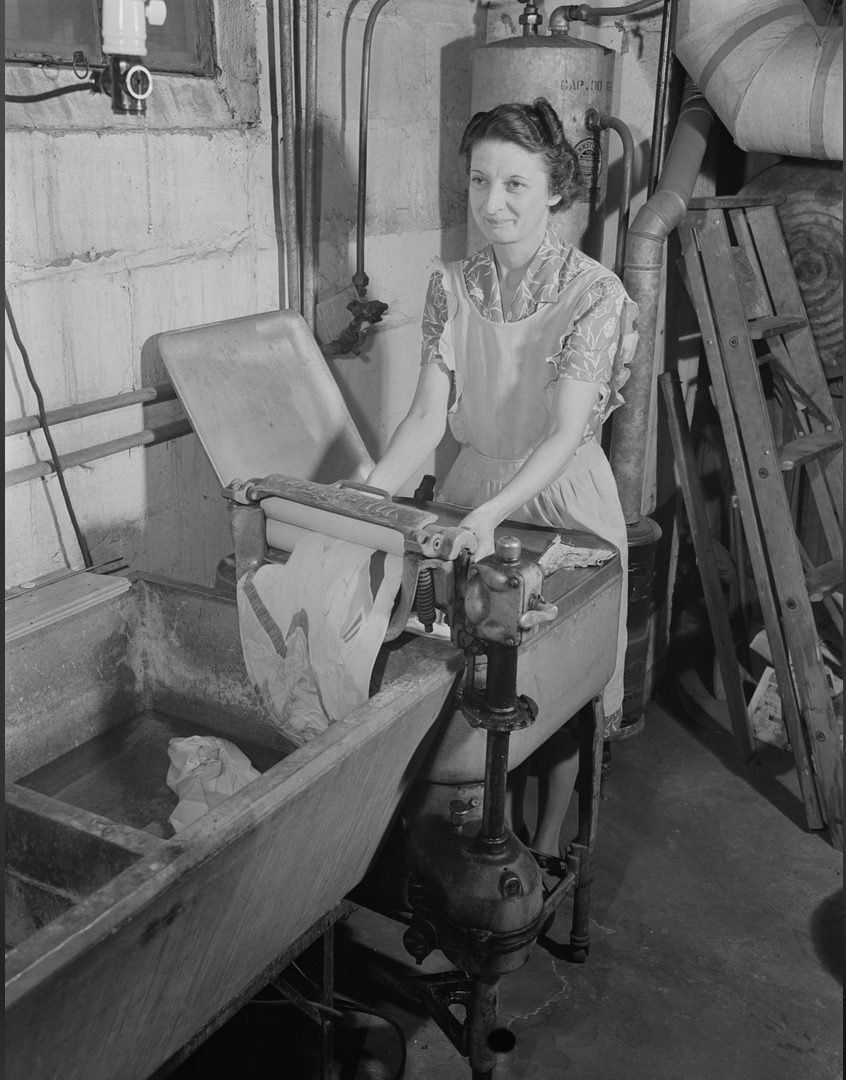
The hand-cranked wringer that squeezed water out of boiled laundry before it went to the line had an obvious design problem: a set of gears and two rollers turning under hand power, positioned exactly where a person’s fingers had to be to feed cloth through. Patent records show manufacturers addressing this directly rather than treating it as an acceptable cost of doing business. Melvin N. Lovell of Erie, Pennsylvania, received U.S. Patent No. 198,494 on December 25, 1877, for a redesigned wringer frame, and two of its selling points were explicitly about safety: a hood or flange to cover the gears “so clothing is not accidentally caught and damaged,” and separate guards to keep fabric away from the roll’s journals.
That a patent from 1877 bothered to solve this problem at all is itself evidence of how common the hazard was — manufacturers do not add safety features to a product line unless customers are getting hurt, or at least complaining loudly enough that a competitor’s safer model becomes a selling point. The wringer did not disappear because of these redesigns; it disappeared because it eventually got folded into something that eliminated the hand crank altogether.
Two Men, Two Companies, One Disputed “First”
The invention that actually replaced the hand-cranked wringer and the boiling kettle together was the electric washing machine, and even that story does not have one clean inventor behind it. In 1907, both O. B. Woodrow and Alva J. Fisher separately claimed to have built the first electric washer, each doing essentially the same thing: bolting an electric motor onto an existing hand-operated dolly-type washing machine. Only about 8 percent of American homes had electricity that year, so the earliest machines were frequently built to also run on gasoline power or by hand, with electricity as just one option among several.
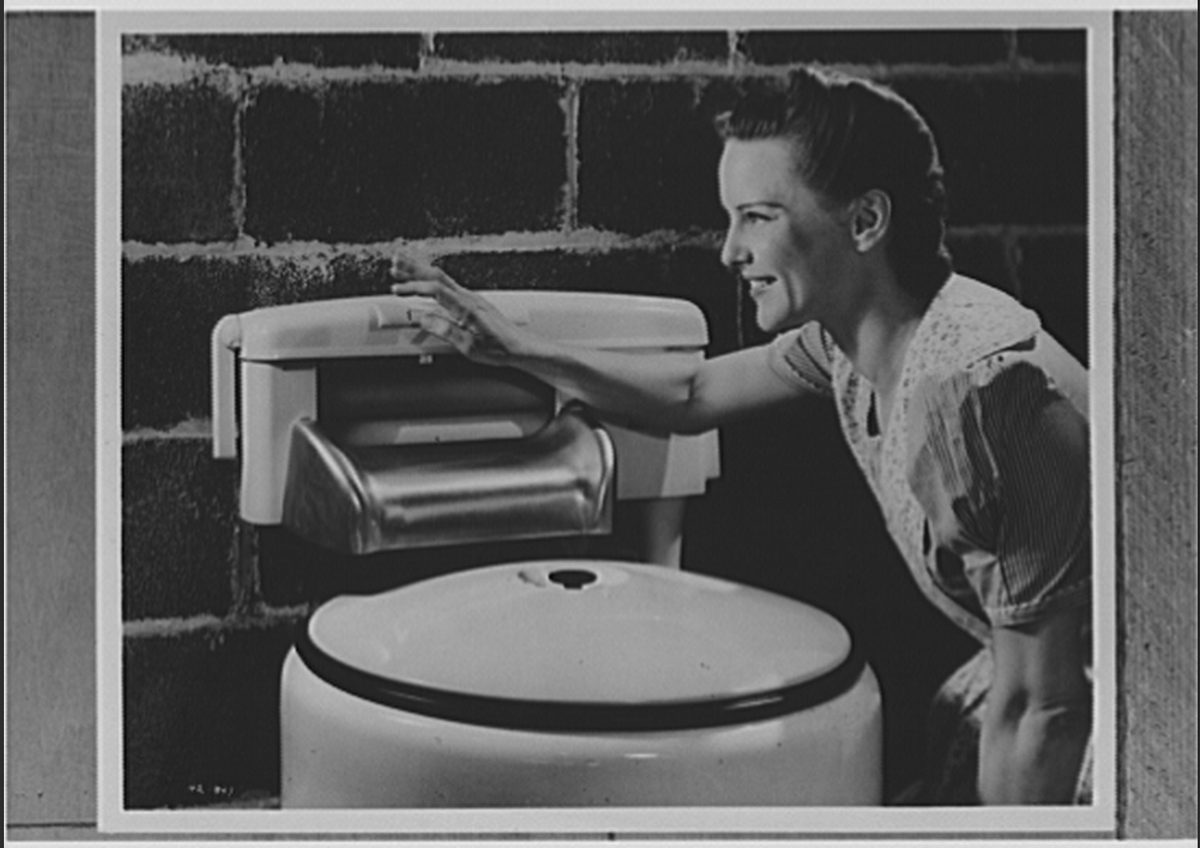
Adoption tracked the spread of household wiring almost exactly. By 1910 and 1911, several manufacturers — including Maytag, whose 1911 model used a swinging wringer designed by Howard Snyder — were selling electric washers with a wringer already attached, finally combining the two separate pieces of equipment into one machine. Only about 35 percent of American homes were wired for electricity by 1920, and that figure did not cross 80 percent until 1941; a genuine majority of American households did not own an electric washing machine until after that point, and ownership did not reach roughly 90 percent until 1958. Measured that way, the wash boiler’s actual working life ran a good thirty years longer than its reputation as a strictly nineteenth-century relic suggests.
The Bleach That Wasn’t Built for Laundry at All
The other half of the wash boiler’s replacement — modern chemical bleach — came from a company that did not start out making a household product, or even trying to. The Electro-Alkaline Company was founded on May 3, 1913, when five Oakland businessmen each invested a hundred dollars to build the country’s first commercial liquid-chlorine bleach plant. Its first product, in 1914, was a concentrated, industrial-grade bleach sold to businesses like paper mills and textile finishers; that was also the year the company registered the name and diamond trademark it still uses: Clorox.
The household version exists because of one employee’s wife. William Murray became the company’s first general manager in 1916, and his wife Annie thought a milder formula could sell directly to home cooks doing their own laundry. She gave away free samples at the Oakland grocery store the couple ran, the company found a dedicated broker for the home market, and in 1917 a Clorox exhibit at the California State Fair introduced the product to thousands of ordinary farmers and consumers for the first time. It took until 1932 for home-use Clorox to reach national distribution in quart-sized bottles — meaning the wash boiler and the bottle of bleach actually coexisted in American households for a decade and a half before either one gained a clear advantage.
Watch the full history
The video tells the wash-day routine itself, start to finish, in about seven minutes.

Related reading
- How Tallow Candles Were Made, and Why Candle Day Was Dreaded
- How Sorghum Syrup Was Made Before Sugar Came in a Sack
- The Spinning Wheel’s Economics Were Worse Than You Think
- How Much a Feather Bed Was Worth, in Pounds and Shillings
Shop the styles/items featured in this video
None of this reads like the story most families tell about wash day, which tends to collapse into one dreaded Monday and a vague sense that things got better once the washing machine arrived. The actual record is messier and more interesting: a patent office issuing incremental fixes to the same metal tub for most of a century, a soap recipe passed down specifically because no store sold the real thing, a dye bought for an optical illusion rather than a chemical one, a wringer redesigned because it kept hurting people, and two unrelated companies — one building motors, one building bleach — independently converging on the same Monday-morning problem from completely different directions.
What actually ended the wash boiler’s reign wasn’t a single invention crossing a finish line. It was two slow curves meeting in the middle: household electrification climbing from single digits to a clear majority between 1907 and the early 1940s, and a bleach brand clawing its way from an industrial-only product to a national one over almost twenty years. By the time both curves had actually crossed, a wash boiler sitting on a stove looked old-fashioned enough that it started turning up as a flower planter instead — which, by most accounts, is still the most common place to find one today.
Works cited
- Strasser, Susan. Never Done: A History of American Housework. Pantheon Books, 1982.
- “Patent Model — Improvement in Wash-Boilers,” Thomas Evans, U.S. Patent No. 98,679 (1870). Hagley Museum and Library, Model Collection. (Page blocked an automated fetch behind a bot challenge; cited as print.)
- “Laundry Blue.” CAMEO: Conservation & Art Materials Encyclopedia Online, Museum of Fine Arts, Boston. (Page returned a publisher bot-wall response to an automated fetch; cited as print.)
- Locher, Paul. “How the 1833 Washboard Patent Changed Early American Laundry.” Farm and Dairy, August 2, 2026. Link.
- Trew, Delbert. “It’s All Trew: Lye Soap Will Clean a Hide, and That’s No Lie.” Farm Collector, March 1, 2003. Link.
- Lovell, Melvin N. “Improvement in Wringers,” U.S. Patent No. 198,494, granted December 25, 1877. Link.
- “Electric Washing Machine Introduced.” EBSCO Research Starters. Link.
- The Clorox Company. “Our Heritage” company history and timeline. Link.
- “Gas Fired Wash Boiler,” object 1963-185. Science Museum Group Collection. Link.