
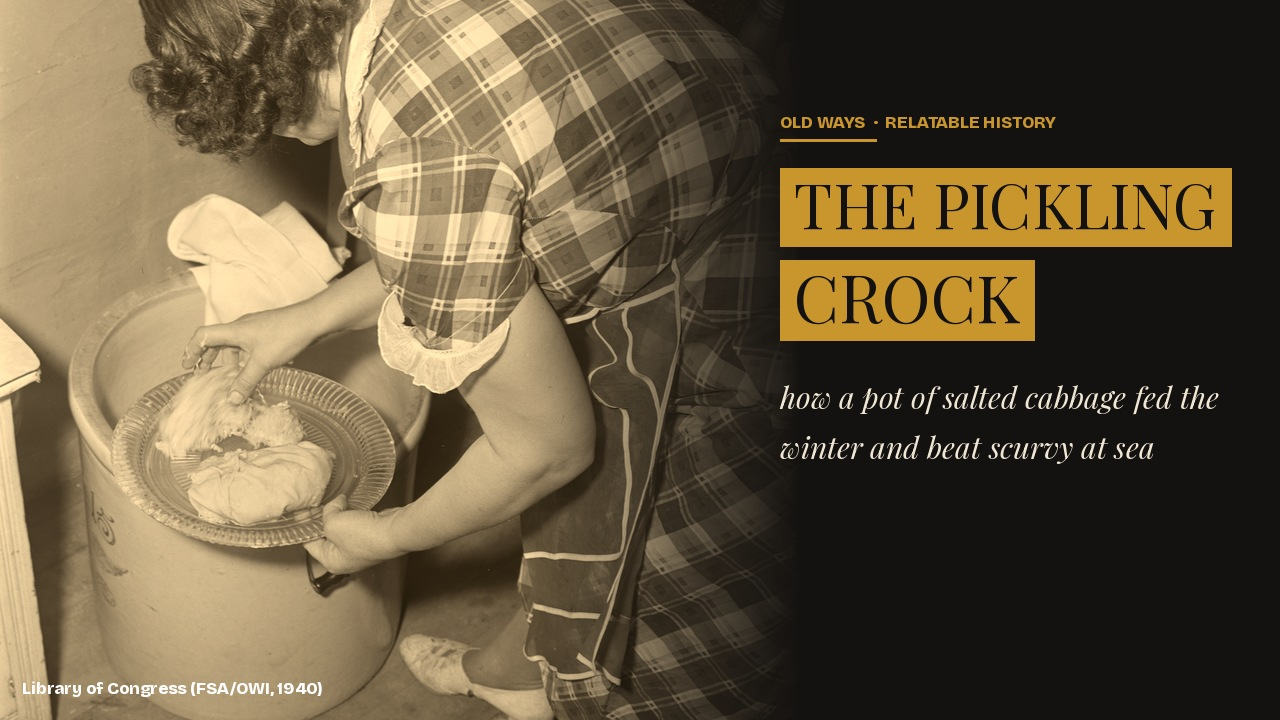
In the autumn of 1863, Confederate soldiers occupying Chambersburg, Pennsylvania, made an unusual demand of the town’s leaders: twenty-five barrels of sauerkraut. The townspeople assumed it was some kind of insult or trick, until it became clear the soldiers were suffering from scurvy and wanted the one food they knew would fix it. An army in the field, in the middle of a war, sent a detail to requisition fermented cabbage as medicine.
That request only makes sense if you already know something most people don’t: a crock of salted, fermented cabbage is not really a recipe. It is a small, self-running chemistry experiment, and the chemistry is the entire reason it kept people alive through centuries when nothing else would. The pot itself — heavy, glazed, stacked in a cellar corner — gets remembered as a quaint kitchen object. What happened inside it is the more interesting story.

Salt doesn’t preserve cabbage — it picks a winner
Shredded cabbage is covered in microbes the moment it’s cut, most of them harmless, some of them exactly what you don’t want multiplying in a crock in a warm kitchen. Salt is not there to kill all of them. It is there to run a selection process. At roughly 2 to 2.5 percent of the cabbage’s weight, salt draws water and sugars out of the plant cells by osmosis, creating a brine, while inhibiting the spoilage bacteria and rot-causing organisms that can’t tolerate that concentration. The lactic acid bacteria already living on the leaves can tolerate it easily, and with the competition suppressed, they get the run of the crock.
What follows is a handoff, not a single process. Leuconostoc mesenteroides, a mild, gas-producing species, dominates the first few days, softening the cabbage and dropping the pH just enough to usher in a series of more acid-tolerant Lactobacillus species, which finish the job over the following weeks. Each wave makes the environment a little less hospitable to the one before it and a little more hospitable to actual pathogens’ worst enemy: acid. By the time fermentation is done, the brine has usually reached a pH low enough that nothing dangerous can survive in it, sealed in from the outside for a taste most people now think of as simply sour.
None of this requires a thermometer, a starter culture, or any ingredient beyond salt and time. The bacteria are supplied for free by the cabbage itself. That is the part of the process easiest to miss: the crock is not adding life to the vegetable. It is arranging a contest among the life already there and betting, correctly, on which side wins.
It is also not a German invention, even though the German-American kitchens this article is mostly about did more than most to keep it alive. Cultures with no contact with one another arrived at the same trick independently: Chinese labourers building sections of the Great Wall ate suan cai, cabbage fermented in rice wine, and Korean kimchi traditions run back over a thousand years for the identical reason — getting a household through a winter with no fresh vegetables at all. Wherever cabbage, salt, and a cold season overlapped, someone seems to have found the same chemistry on their own.
Keeping everything under the brine was the one job that mattered
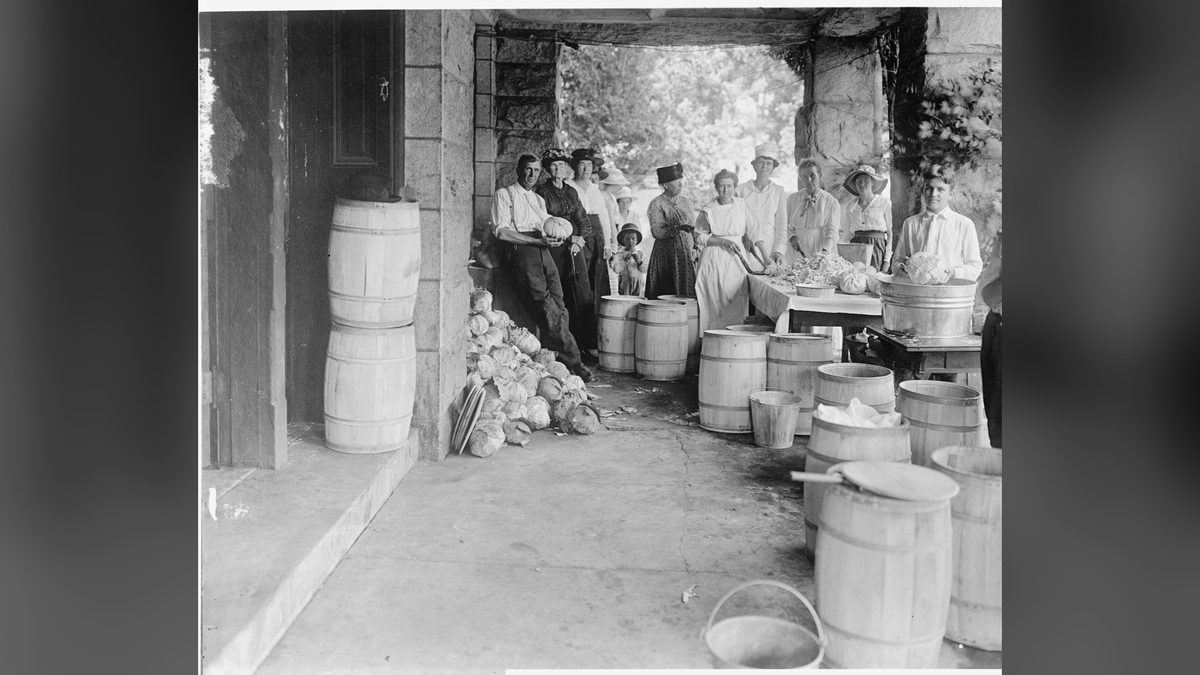
Lactic acid bacteria work without oxygen; almost everything that spoils food needs it. A plate cut to fit inside the crock’s mouth, weighted with a scrubbed stone or a water-filled jar, pushed every shred of cabbage below the surface of its own brine and kept it there for the full three to six weeks fermentation typically took. Anything that broke the surface and stayed exposed to air was liable to grow mold or a filmy yeast, and a family that skipped this step, or let the plate float loose, could lose the whole batch to spoilage at the top even while the cabbage below it fermented perfectly well.
Modern extension guides still describe the same physical setup, almost unchanged, because the chemistry hasn’t changed: the National Center for Home Food Preservation’s current guidance calls for 2 to 2.25 percent salt by weight and a weighted cover that holds the shredded vegetable at least an inch under its own liquid throughout fermentation. A nineteenth-century cellar and a twenty-first-century countertop are, chemically, running the identical process.

It had to be stoneware, and that meant a second furnace-hot process
A crock full of brine is a crock full of acid, held for weeks against whatever the vessel is made of. Cheaper earthenware pottery is fired at a low enough temperature that it stays porous, and potters traditionally sealed that porosity with a lead-based glaze — exactly the wrong choice for something acidic, which can leach lead out of the glaze over time. Stoneware solved the problem by being fired hot enough in the first place that the clay itself vitrified: turned, at around 2,300 degrees Fahrenheit, into something closer to glass than to earth, with no porosity left to seal.
American stoneware potteries typically finished that vitrified surface with a second, almost theatrical step: salt glazing. At peak kiln temperature, the potter shoveled raw rock salt directly into the firebox. The salt volatilized instantly into sodium and chlorine vapor, and the sodium reacted with the silica already in the clay body to form a thin, glassy coat of sodium silicate across every surface the vapor touched — inside and out, without a brush ever being involved. The mottled, slightly pitted “orange peel” texture on an old stoneware crock is the fingerprint of that vapor settling unevenly across the surface, a texture no other glazing method produces.
Potters were turning these out by the thousand before the salt-glaze trick was even standard
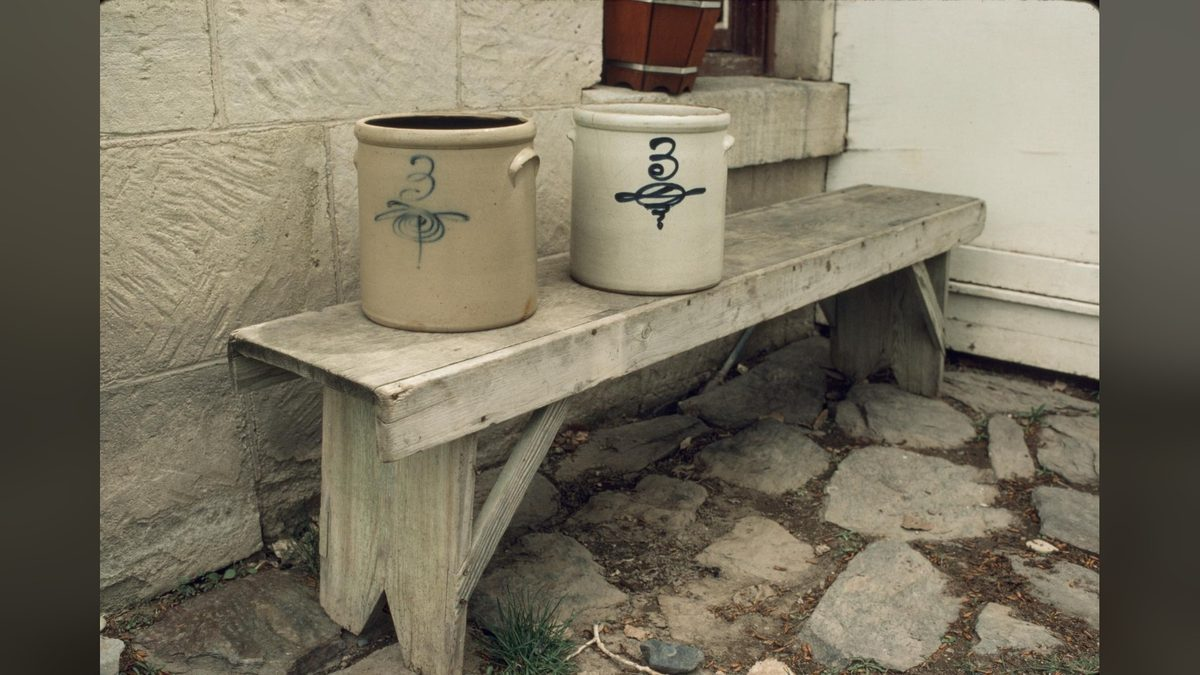
American salt-glazed stoneware production dates to around 1720 in Philadelphia and Yorktown, Virginia, and had spread across the northeastern seaboard within two generations. By the turn of the nineteenth century, the Crolius and Remmey families, working out of Manhattan, had set something close to a house style for the whole trade: straight-sided jars and crocks, decorated freehand in cobalt blue slip with tulips, birds, and looping foliage, and stamped with their capacity in gallons so a household could ask for exactly the size it needed.
A one-gallon stoneware butter crock in the Smithsonian’s National Museum of American History collection, made by the potter John Burger in Rochester, New York, sometime between 1854 and 1867, shows the pattern: hand-painted cobalt florals below the rim, brown-glazed inside, made for one specific household task among dozens a working pottery like Burger’s turned out — preserve jars, churns, pitchers, jugs, even stove tubes. Early in the century, potters painted these designs themselves; later, potteries increasingly hired women decorators, whose training in domestic needlework and writing translated directly into fluent, fast freehand painting on wet clay.

It carried a British warship around the world without a single confirmed scurvy death
Scurvy is caused by a severe, prolonged vitamin C deficiency, and on a long ocean voyage with no fresh produce it produced a specific, grim progression: blackened skin, open ulcers, teeth loosening and falling out, and swollen gum tissue that rotted in the mouth. Historians estimate it killed more than two million sailors during the Age of Sail, more than combat, storms, and shipwreck combined, which is why the British Admiralty was willing, by the 1760s, to test a long list of possible remedies — portable broth, dried orchid-root powder, malt, vinegar, concentrated citrus juice, and sauerkraut — across four separate Pacific voyages. James Cook’s ship Endeavour left port in 1768 carrying 7,860 pounds of sauerkraut — enough for two pounds per sailor per week — alongside portable broth, malt, and concentrated citrus juice. His crew would not touch it at first, assuming a strange-smelling fermented vegetable was somehow beneath them. Cook’s fix was social rather than medical: he had sauerkraut served daily at the officers’ table, in plain view of the rest of the crew, until ordinary sailors decided that anything the officers valued must be worth wanting for themselves.
Cook returned from that voyage, and from his second circumnavigation with roughly 20,000 pounds of sauerkraut in the hold, reporting no scurvy deaths either time — a genuine rarity for a long ocean voyage in that era. He was careful, in his own account to the Victualling Board, not to credit sauerkraut alone: he attributed the crew’s health to a combination of sweet wort, marmalade, portable broth, and sauerkraut together, while noting that the last “can never be enough recommended.” Historians studying the voyage logs have also flagged three deaths on that first voyage — the Raʻiatean priest Tupaia, the astronomer Charles Green, and Lieutenant Zachary Hicks — that may have had a scorbutic component the official record downplays. Cook’s achievement was real, but it was not quite the clean, single-cause result popular history sometimes makes it.
What replaced the crock, and what it left behind
Sauerkraut fermentation itself never really went away — it is the same bacteria doing the same job in a glass jar today as in a cellar crock two centuries ago. What changed was the vessel and the household’s dependence on it. Mason’s screw-top glass jar, patented in 1858, and boiling-water-bath canning turned preservation into a one-time, shelf-stable process rather than a weeks-long fermentation that had to be managed, tasted, and eventually eaten down before it spoiled. Mechanical refrigeration and, later, the home icebox and electric refrigerator removed the underlying problem the crock had always been solving: keeping food edible without cold storage.
The industry that supplied the crocks contracted accordingly. Red Wing, Minnesota — by the 1890s one of the largest stoneware producers shipping crocks west by the trainload — stopped making stoneware entirely in 1947, shifting to dinnerware and art pottery for a market that no longer needed a fifty-pound jar for its winter cabbage. The wider pottery struggled on for another two decades before foreign competition, aging plant, and a labor strike closed it for good in 1967. A stoneware crock made today, by any of the handful of potteries still doing it, is built to the same design as one made in 1870, for people who now buy it deliberately rather than because there is no alternative.
What is easy to miss, looking at a crock in an antique shop or a museum case, is that it was never really a container. A barrel, a tin, a glass jar — those are containers, holding food inert until it’s needed. The crock was closer to a piece of equipment, built to host a specific, living, timed process and then get out of the way. Its straight sides, its weight, its impermeable glaze all serve the bacteria doing the actual work inside it, not the cabbage sitting passively on a shelf.
That is also why the object survived Cook’s voyages, a Confederate requisition order, and two centuries of German-American winters essentially unchanged, while the pottery that made it did not survive the refrigerator. The chemistry never needed updating. Only the reason to depend on it went away.
Watch the full history
The video covers the crock itself, the kraut cutter, and the winter rhythm of a homestead kitchen in about four minutes.

Related reading
- How Quill Pens Were Actually Made, and Why Steel Killed Them
- How Sod Houses Were Built on the Nebraska Prairie: The Construction, the Homestead Act, and the Life Inside
- Why the Spittoon Disappeared: The Laws That Made Spitting a Crime
- How One Farmer’s Patent Rebuilt the American Barn
Shop
Sandor Ellix Katz, The Art of Fermentation (Chelsea Green, 2012) is the standard modern reference for fermenting vegetables in a crock at home: available on Amazon.
Works cited
- Pennsylvania Historical and Museum Commission. “Pennsylvania Dutch Tradition.” The Land of Penn and Plenty: Bringing History to the Table, 2012. Link.
- National Center for Home Food Preservation, University of Georgia. Preparing and Canning Fermented Foods and Pickled Vegetables (USDA Complete Guide to Home Canning, Guide 6), rev. 2015. Link.
- Katz, Sandor Ellix. The Art of Fermentation. Chelsea Green Publishing, 2012.
- de Grijs, Richard. “‘Plague of the Sea, and the Spoyle of Mariners’—A Brief History of Fermented Cabbage as Antiscorbutic.” Hektoen International, Spring 2021. Link.
- Cook, James. “The Method Taken for Preserving the Health of the Crew of His Majesty’s Ship the Resolution during Her Late Voyage Round the World.” Philosophical Transactions of the Royal Society of London 66 (1776): 402–406.
- Ketchum, William C., Jr. American Stoneware. Henry Holt and Company, 1991. Link.
- National Museum of American History, Smithsonian Institution. “Stoneware Crock,” John Burger pottery, Rochester, New York, c. 1854–1867. Object ID CE.319884.161.
- “Salt and Soda Firing.” Digitalfire Reference Library. Link.
- Gillmer, Richard S. Death of a Business: The Red Wing Potteries. Ross & Haines, 1968.