
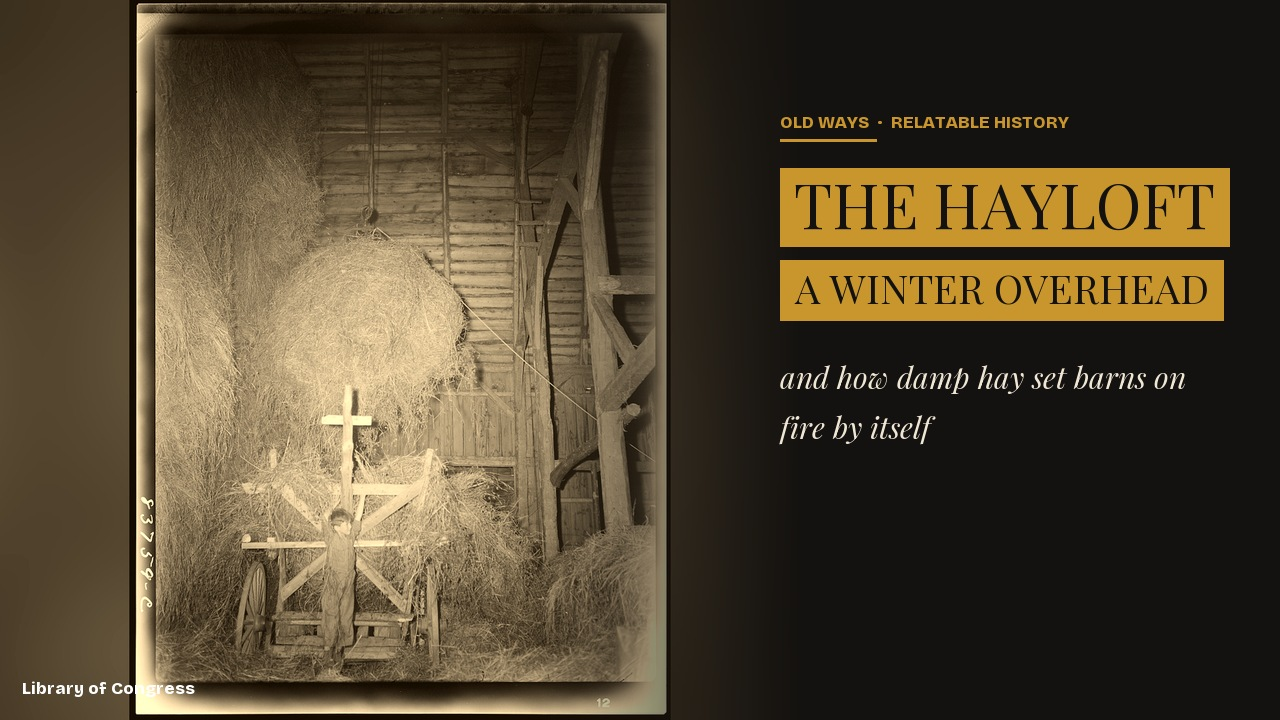
An old barn’s upper floor is not an attic. It is a machine for feeding animals through a season with no forage in it at all, and for roughly a century running it meant solving two problems that pulled in opposite directions: get an entire winter’s hay under the roof as fast as possible, and keep that same hay from quietly setting the barn on fire from the inside — with no spark, no lightning, and no match anywhere near it.
The second problem is the stranger one. A pile of cut grass, packed tight and left the smallest amount too damp, generates its own heat through bacterial action, and left alone that heat compounds until the stack reaches a temperature at which it ignites on contact with the air already inside it. County extension offices still teach farmers to walk a haystack with a thermometer for exactly this reason, in numbers barely changed from what a nineteenth-century farmer would have used.
The first problem is where the hardware comes in: a single patent filed in 1867 by a small, sickly farm boy from Iowa, which let American barns grow a second story almost for free, and a scramble of competing fork, harpoon and trolley designs that followed it for the next forty years. Between the fire risk and the fix for moving hay is most of what a hayloft actually was.
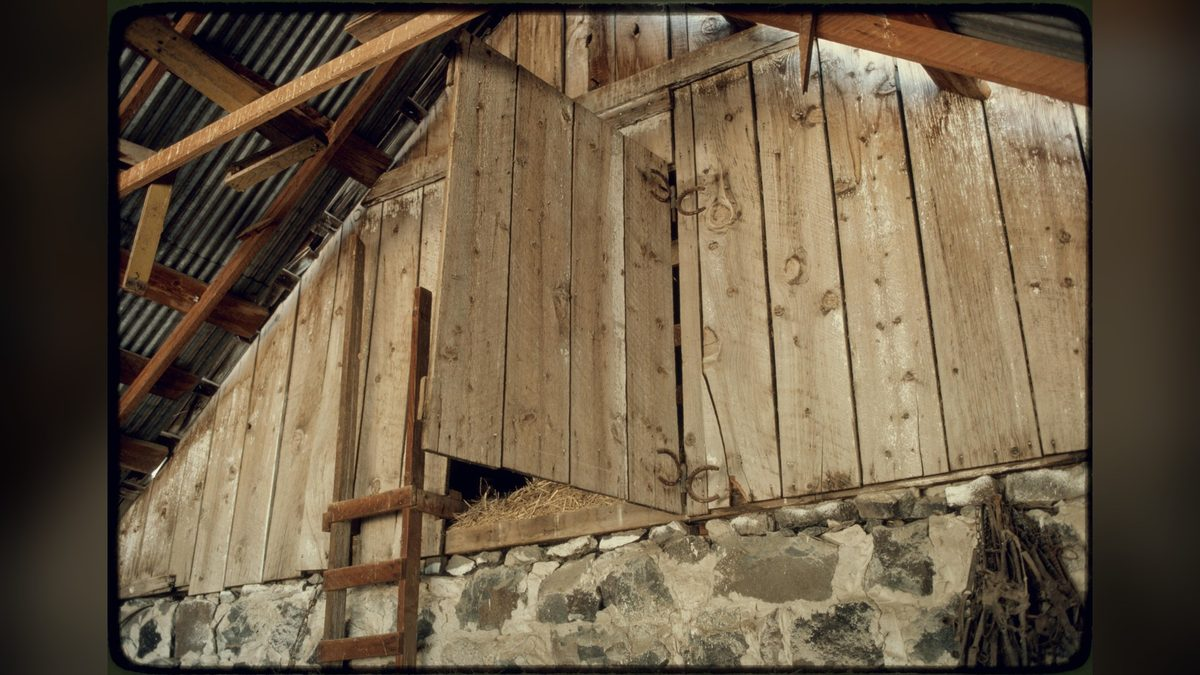
A barn’s upper floor exists because the roof is the expensive part
Building a barn with a full second story costs less, per square foot of storage, than building a wider single-story barn to hold the same hay, because the roof — not the walls, not the floor — is the most expensive single piece of the structure. Put a loft under the same roof you were already building and you have roughly doubled your usable space without doubling your cost. That arithmetic, more than any comfort for the animals below, is why American barns are shaped the way they are.
It is also why the problem of getting hay up there mattered so much. A loft only pays for itself if you can actually fill it before the crop spoils on the ground, and for most of the nineteenth century filling one meant a man standing in the heat under the roof, forking loose hay by hand, one load at a time, all day, every day, for as long as haying season lasted.
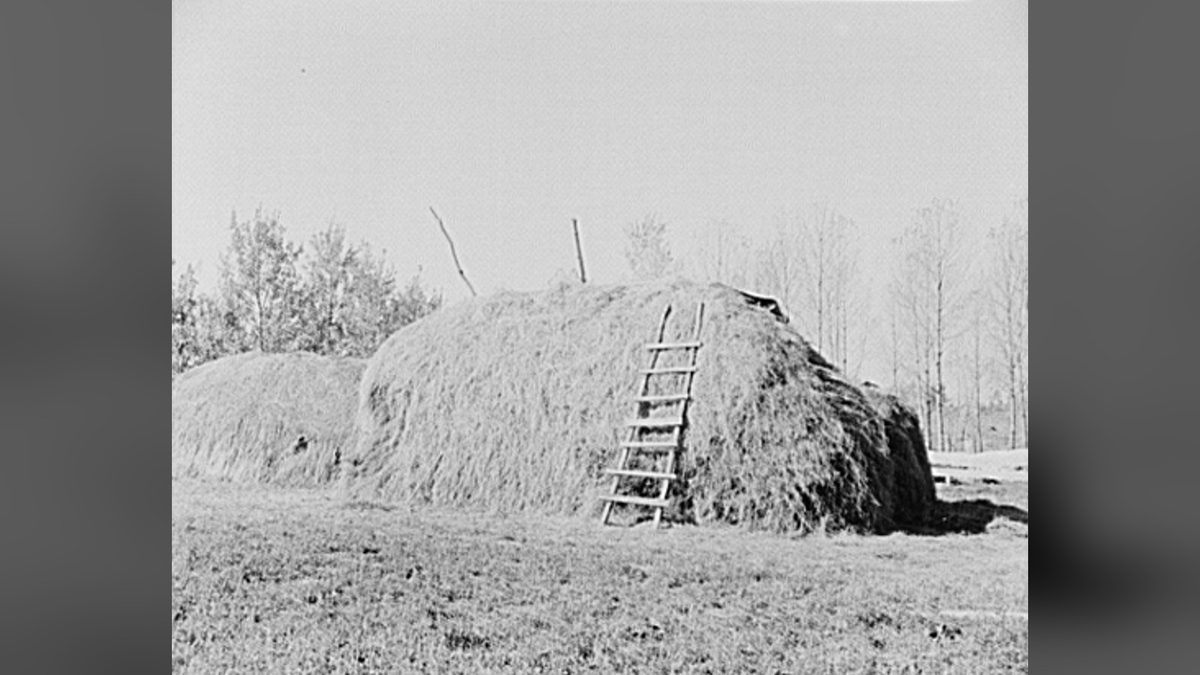
William Louden’s small build reshaped the American barn
William Louden was born in 1841 in Cassville, Pennsylvania, and moved with his family to Iowa before he turned one. He was small and often sick as a child, which made ordinary farm chores harder for him than for other boys his age. He could not change his own body, so, by his own later account, he set about changing the tools instead.
In 1867 he applied for his first two patents: one for a device to lift and stack hay, the other to carry it into the barn once it was lifted. Neither made him rich overnight. He started his first agricultural business in 1868 out of space on his father-in-law’s farm, moved the operation to Fairfield, Iowa, in 1870, and was forced into bankruptcy in 1877. He spent the next seven years travelling farm to farm installing his own equipment by hand and building a customer base one barn at a time. He founded the Louden Machinery Company in 1887 and incorporated it in 1892, putting his brother in as president so he could stay on the invention side. Over the following four decades the company would file for roughly 200 patents, including the all-steel cow stall and the flexible barn door hanger.
Louden was not the only one filing. Patent researchers who have gone through the U.S. Patent Office’s records count some 335 registered hay-carrier patents industry-wide between 1865 and 1942, of which only about 180 were ever actually manufactured. At the trade’s peak there were as many as fifty companies making the hardware, though roughly eight of them accounted for some sixty percent of the market. The busiest stretch for new patents ran from 1880 to 1910 — and after that, the design had mostly stopped changing, because it already worked.
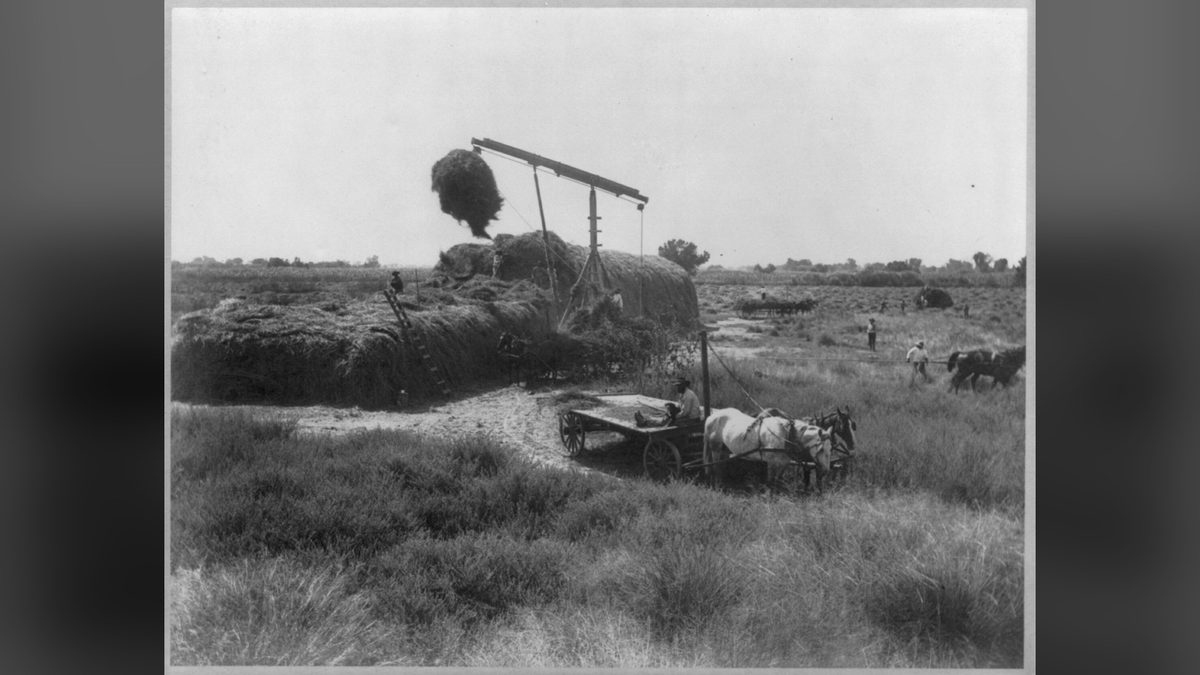
Forks, harpoons and slings did the actual lifting
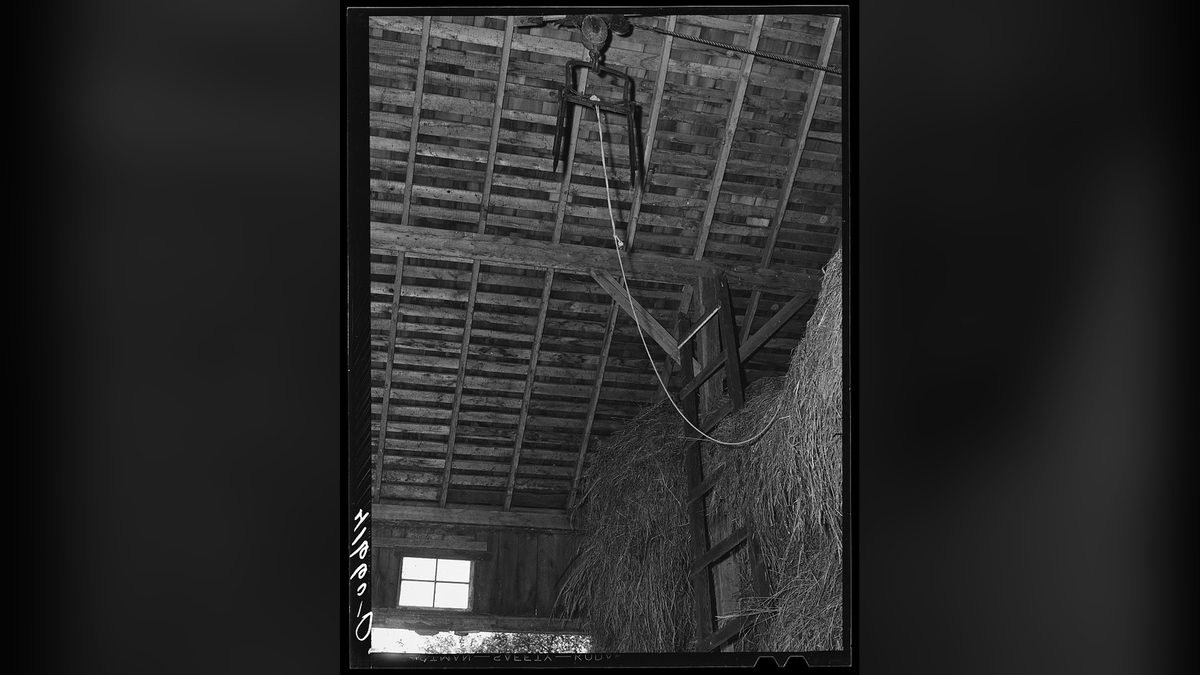
The carrier system itself was simple: a steel track bolted along the peak of the barn, a trolley that rode on it, and a rope running out through a pulley to a horse standing in the yard. What varied, endlessly, was the tool that actually bit into the hay on the wagon below.
The earliest and simplest was a single large fork on a trip rope, in wide use from the mid-1800s: drive the loaded wagon under the barn’s gable overhang, sink the fork into the load, and let a horse outside walk away with the draft rope. The fork rode up to the trolley, ran along the track to the spot the man in the mow wanted, and a second rope tripped the tines to vertical, dropping the load. The horse then backed up, the rope was pulled again, and the empty fork returned to the wagon for the next load.
Aaron Nellis patented a harpoon-style version of the same idea in 1873. Rather than a single hinged fork, the harpoon was driven straight down into the loose hay on the wagon; small blades near the point then opened once it was buried, so the load itself, rather than a hinge, did the gripping. Nellis’s design and its many competitors — single harpoons, double harpoons, even a triple-harpoon version, plus four- and six-tine grapple forks — were all answering the same question: how do you get the largest possible bite of hay off a wagon in one motion, without a person climbing up onto the load itself.
Slings were the alternative to any of the forks. Lengths of rope or light chain, spread about four to five feet apart on short wooden sticks, were laid across the wagon rack before it was loaded; the hay went on top of them two or three feet deep, and a second sling was laid down for the next layer, usually three to a load. Back at the barn, a pair of pulleys on the carrier hooked into steel rings at each end of the sling, and the whole bundle went up and into the mow as one round mass, to be tripped open by a tagline once it was in place. Farmers who preferred forks would often still sling the first layer of a load, since a harpoon fork could not reliably clear hay resting directly on the wagon bed.
By the 1880s some barns had dispensed with the horse walking the draft rope entirely, replacing it with a friction windlass winch driven by a small steam or gas engine of four to seven and a half horsepower. One advertised model held 250 feet of three-quarter-inch rope and could safely lift 2,000 pounds. The fork, trolley and rope stayed exactly the same; only the horse’s job changed hands.
The exact temperature at which hay ignites itself
None of that machinery solved the other half of the hayloft’s problem, because the danger was chemical, not mechanical. Hay baled or stacked at more than about twenty percent moisture is already carrying the bacteria that will heat it: mesophilic bacteria take hold first, and can hold the interior of a stack between 130 and 140°F for as long as forty days. If nothing else happens, that heat eventually falls back off on its own. If it does not — if a second population of heat-tolerant, thermophilic bacteria takes over instead — the same stack keeps climbing, and once it passes roughly 175°F it can ignite without any outside source of flame at all.
Extension services publish an explicit action table for exactly this danger curve, and it has hardly changed in decades: at 125°F, no action is needed; at 150°F the stack has entered the danger zone and should be checked twice a day, with bales pulled outside to let air circulate; at 160°F it should be checked every few hours, with a tank of water kept on hand; between 175 and 190°F, hot spots or an actual fire pocket are likely, the fire department should be alerted, and the barn should be closed up to starve the fire of moving air while hot hay is carefully pulled with help from crews on scene; above 200°F, fire is already present inside the stack.
Checking the temperature safely was its own skill. A probe lowered roughly eight feet into a large stack and left for ten minutes gives an accurate reading; an infrared thermometer aimed at a withdrawn metal pipe is a faster, cruder substitute. The genuinely dangerous part was walking on the stack at all — a hot interior can burn out a cavity under an intact-looking crust, and a person can fall straight through it, which is why the guidance still calls for spreading your weight on planks and working in pairs with someone standing clear, in voice range, in case you go in.
The mowing machine changed how much hay there was to move
All of this handling technology existed because the volume of hay a farm could put up had already grown far past what a man with a scythe could manage. The 1911 Encyclopædia Britannica put a number on the shift: “with a modern improved machine taking a swathe as wide as 5 or 6 ft., some 10 acres per day can easily be mown by one man and a pair of horses.” A wider cut, not just a faster one, was the actual gain — a horse-drawn mower covered in a single pass what a man with a scythe needed several strokes to cover, which is most of why the arithmetic of haying changed so completely in the second half of the nineteenth century.
More cut hay moving off more acres per day is exactly what made the carrier and fork industry necessary in the first place. A farm that could mow ten acres a day needed a way to get that hay off the wagon and under the roof at a matching pace, or the crop would sit rained on in the field while a single man forked it up by hand.
Why the lofts finally went silent
The earliest hay balers, dating to the late 1800s, were powered by a horse walking an inclined treadmill that drove a plunger through a chain-and-sprocket mechanism; hay was forked in by hand, wooden blocks were dropped in to size each bale, and the wire or twine binding was tied off by hand before the next charge went in. Steam traction engines replaced the horse on the treadmill, and internal-combustion tractors eventually replaced the steam engine. The decisive change came by the 1930s, when balers were mounted directly on tractors and began picking hay up from the windrow automatically, with no one forking it in by hand at all.
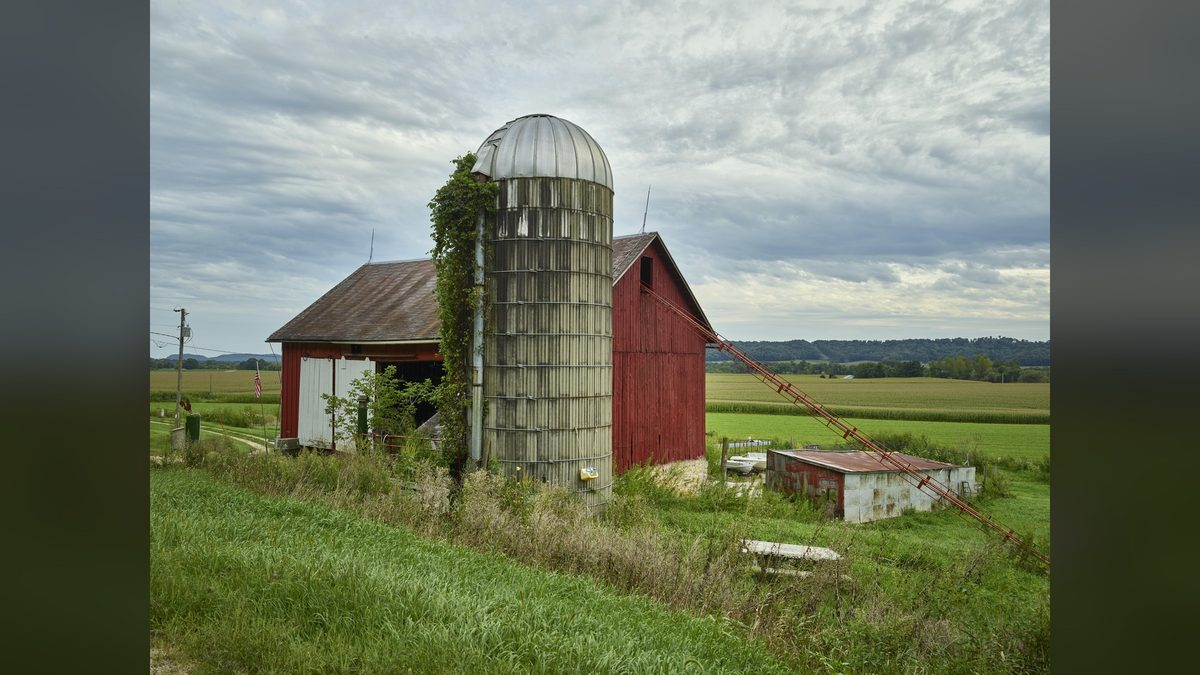
A bale, unlike a mow full of loose hay, does not need a covered upper story to keep. It sits perfectly well on the ground, in a shed, on a flatbed, anywhere a truck can back up to it. Once the crop was coming out of the field pre-compressed into a stackable unit, the entire reason for a purpose-built overhead cavern — and for the elaborate fork-and-trolley hardware built to fill one — went away within a generation. The tracks are still bolted to the ridge of plenty of old barns. The ropes that ran through them are not.
The instinct that sent a farmer out to his own barn at midnight with an iron rod is worth keeping, even now that almost nobody stores loose hay overhead anymore. It is a plain example of a working community engineering around a slow-moving hazard instead of simply hoping it would not arrive: a numbered danger curve, a monitoring routine, and the discipline to act on 150°F before it ever became 200°F. Anyone who piles up mulch, wood chips or compost in quantity is managing a smaller version of exactly the same problem, usually without a checklist anywhere near as good as the one a nineteenth-century hay farmer inherited from his neighbors.
Watch the full history
The video version covers the loft itself, the fire risk, and the fork-and-trolley system in about four minutes.

Related reading
- Butter and Egg Money: How Farm Wives Financed the Household
- Why the World’s First Bicycle Craze Collapsed in Eighteen Months
- The Farm Soap That Almost Never Hardened Into a Bar
- The Contested History Behind Blue Monday Washday
Works cited
- 1911 Encyclopædia Britannica, “Hay (fodder).” Link.
- Ohio State University Extension, Agronomic Crops Network. “Hay Barn Fires are a Real Hazard.” 2021. Link.
- Washington State University Extension (hosting Cornell Cooperative Extension guidance). “Preventing Fires in Baled Hay and Straw.” Link.
- National Museum of American History, Smithsonian Institution. “Louden Hay Carrier.”
- National Museum of American History, Smithsonian Institution. “Louden Double-Harpoon Hayfork.”
- History San José Research Library, via Calisphere. “Nellis Hay Harpoon.” Link.
- McGrew, Dennis, and Doug DeShazer. “A Bit About Hay Carriers.” Progressive Forage, March 28, 2012. Link.
- Betts, Douglas. “Hay Baler.” How Products Are Made, Encyclopedia.com. Link.