
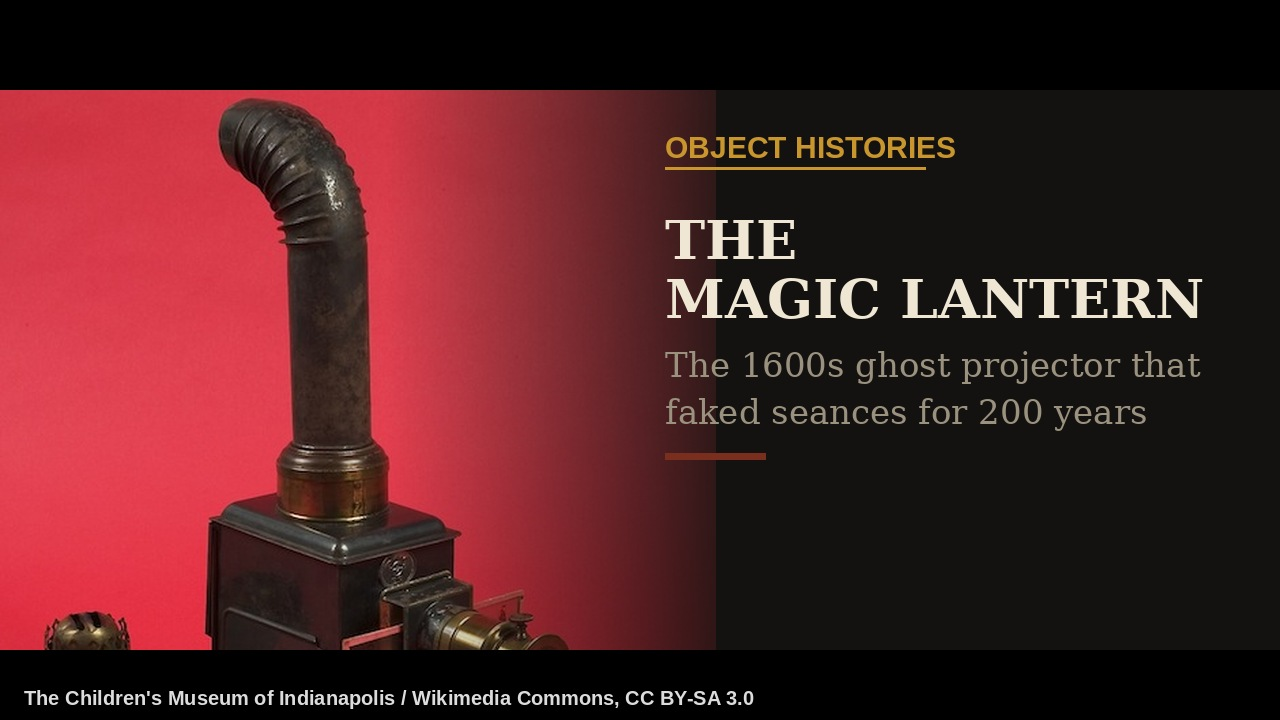
In November 1659, a Dutch scientist built a device that could throw a painted skeleton across a darkened room using nothing but a candle, a lens and a sheet of glass — and then more or less hid it in a drawer. Christiaan Huygens, one of the sharpest optical minds in Europe, thought the magic lantern was beneath him: closer to a parlor trick than to the mathematics he wanted to be remembered for. He never published a proper account of his own invention. His own father kept pestering him by letter to send one anyway, so he could “frighten his friends with it.”
That embarrassment is the reason the magic lantern’s popular origin story gets the credit wrong, and it is also the first clue to how the device would spend the next two hundred and fifty years: invented by people who took it seriously, and made famous by people who didn’t. By the time it reached its strangest hour — a converted monastery crypt in revolutionary Paris, in 1798 — the lantern had already been a scientific curiosity, a teaching aid, a street con and a toy. It would go on to become a Victorian lecture hall fixture, a parlor game, and eventually the ancestor of both the slide projector and the word “slideshow” itself.
A Dutch scientist invented it and wouldn’t take credit
Huygens had a working lantern by late 1659, and surviving sketches show him testing it with a deliberately morbid subject: a figure of Death, repeatedly removing his own skull and putting it back on. Those sketches are the oldest surviving documentation of the invention. But because Huygens never wrote the device up for publication, the credit drifted to other people almost immediately. The London optician John Reeves was selling lanterns by 1663, and the diarist Samuel Pepys bought one from him in August 1666, writing afterward that it made “strange things appear on a wall, very pretty.” None of that was written down as Huygens’s invention at the time, because Huygens hadn’t claimed it.
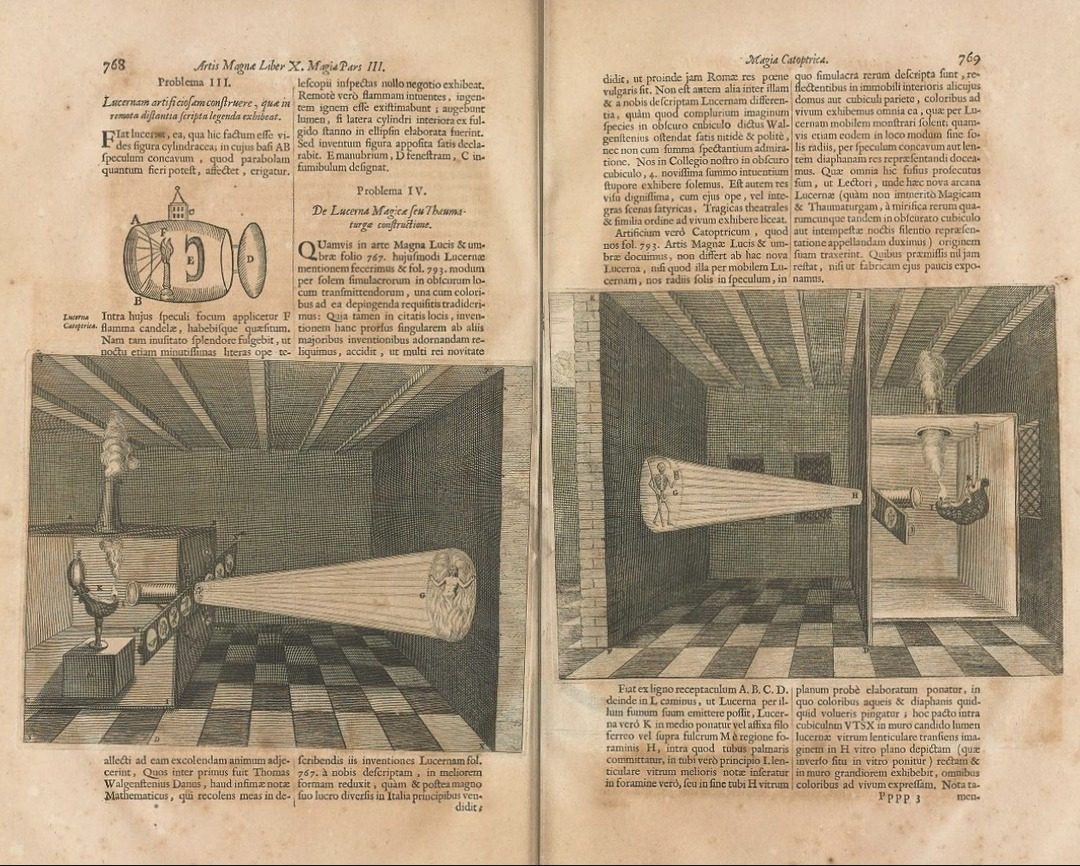
The figure who did get the credit, for centuries afterward, was the German Jesuit polymath Athanasius Kircher. His revised 1671 edition of Ars Magna Lucis et Umbrae carried the first published illustration of a magic lantern in action, showing a candlelit box throwing a winged, skeletal figure onto the wall of a furnished room. It is a striking image, and it spread across Europe far faster than Huygens’s private demonstrations ever could. The trouble is the timing: Kircher’s book came out twelve years after Huygens had a working lantern, and six years after Pepys had bought one from a London shop. The historian Koen Vermeir, reviewing the evidence in The British Journal for the History of Science, dates the invention to the 1660s and credits Huygens as the most probable originator — while noting that other historians still argue for Kircher. Two and a half centuries on, the argument has never fully closed.
It was sold as a toy years before anyone thought to weaponize it
Whoever built the first one, the lantern trade that followed was, for a while, entirely upfront about what it was selling. Lanterns went out from workshops packaged in wooden boxes with a tin chimney to vent the candle’s smoke, alongside a slide box of hand-painted glass plates showing the planets, the seasons, or simple moral fables for children. It was marketed as a teaching aid for astronomy and anatomy lessons and, just as often, as a toy.
What changed the lantern’s reputation wasn’t a new machine. It was a realization, made independently by showmen across Europe, that in a world with no photography and no electric light, a projected image didn’t read as a demonstration of optics. It read as sorcery. Traveling performers known as Savoyards carried lantern boxes strapped to their backs from village to village, painting glass slides of skeletons and the danse macabre and charging peasants a coin to be genuinely frightened. Outright conmen used the same trick to fake seances, projecting a ghostly face onto smoke or gauze and charging grieving families for a glimpse of the dead.
None of them, however, gets credit for inventing the format that made the lantern famous, and this is where the popular version of the story — the one built around a single showman named Robertson — leaves something out. The first advertised ghost show in revolutionary Paris was not Robertson’s. It belonged to a German performer working as Paul de Philipsthal, sometimes billed as “Philidor,” who staged shows of spirits, ghosts and grand wizards on 21 January 1793, within weeks of the execution of Louis XVI. The Magic Lantern Society, drawing on research published in its own journal, is blunt about what happened next: Robertson “stole” the idea from Philipsthal. Robertson built a better machine and a better legend, and history mostly remembers him for it.
Robertson turned a monastery crypt into a ghost machine
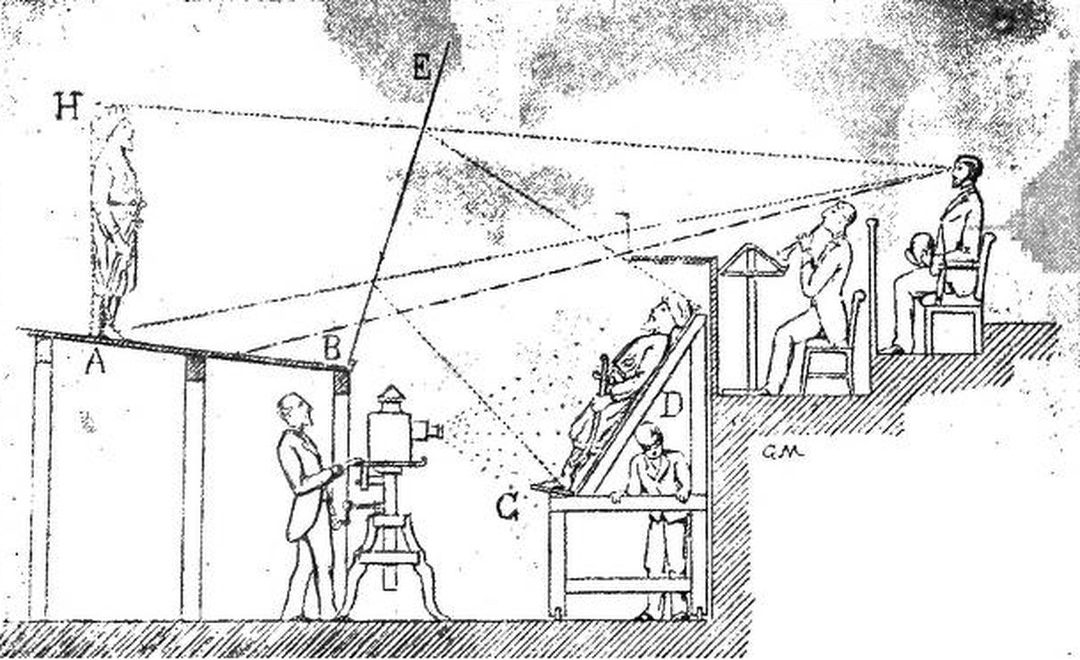
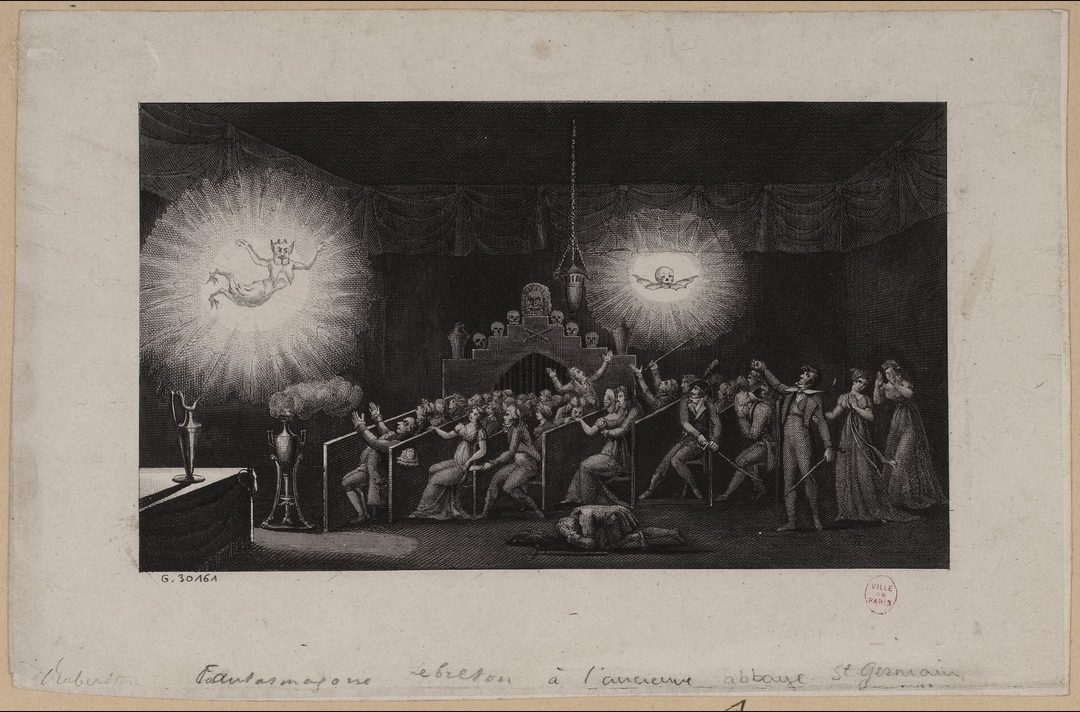
In 1798, the Belgian physicist Étienne-Gaspard Robert, performing under the stage name Robertson, rented an abandoned Capuchin monastery near the Place Vendôme in Paris. Its crypt was still stacked with real skulls, left over from centuries of burials and, more recently, the Revolution. He called his production the Fantasmagorie. Audiences filed into a pitch-black converted chapel and sat in silence while Robertson, hidden behind a semi-transparent screen, conjured skeletons and the freshly guillotined dead using a lantern mounted on a wheeled cart of his own design, which he called the Fantascope.
The mechanical trick was genuinely clever. By rolling the lantern backward and forward on hidden rails, Robertson could make an image swell and shrink smoothly, seeming to rush toward the crowd and then retreat into the dark, without ever losing focus — a purpose-built rig doing, mechanically, what a modern zoom lens does electronically. He projected onto gauze he had coated with wax and ironed smooth, which produced a floating, translucent image with no visible edge, and timed the whole sequence to a thunder machine, a glass armonica moaning in the background, and hidden actors screaming on cue. Contemporary accounts describe audience members fainting or bolting for the doors.
Ghosts sold as science, on purpose
What makes Robertson more interesting than a simple showman is that he never stopped insisting the Fantasmagorie was scientific education rather than sorcery. He sold tickets, and alongside them he sold his own pamphlets, debunking the very superstitions about ghosts and spirits that his show spent every evening exploiting. It was, in effect, a magic trick that revealed its own method to the audience while still terrifying them — proof, delivered live, that a ghost was nothing more than a trick of light and machinery, and proof that knowing the trick didn’t make it any less unsettling to sit through.
That double move — a technology of fear that also markets itself as the cure for superstition — is part of why phantasmagoria became more than a footnote in theatre history. The literary scholar Terry Castle has argued that the word and the experience it named eventually detached from the lantern shows altogether and became a metaphor for the machinery of the mind itself: memory, reverie and imagination all described, by writers who had never seen Robertson’s crypt, as a kind of interior phantasmagoria. A funfair attraction became, within a generation, a way educated Europeans talked about their own consciousness.
The lantern goes respectable: from ghost show to Christmas lecture
Once the shock value of ghost shows faded, the lantern didn’t disappear. It went respectable. John Tyndall, who succeeded Michael Faraday as Professor of Natural Philosophy at London’s Royal Institution in 1853, used his own magic lantern slides of the Alps — where he climbed and studied glaciers — to show lecture audiences phenomena they could never otherwise see: the structure of ice, the behavior of light in mountain air. Missionary societies and temperance campaigners packed church halls with painted scenes of foreign missions or the ruin of drink, aimed at audiences who might never leave their home county otherwise.
Lantern makers then invented the biunial and triunial lantern — two or three lanterns bolted together and aimed at the same screen, so an operator could fade one image smoothly into the next. The technique, called dissolving views, became one of the most popular entertainment formats of the mid-1800s, long before anyone had heard the word cinema. Some of the most elaborate shows were staged at the Royal Polytechnic Institution on Regent Street, founded in 1838, where screens roughly twenty-five feet across were run by teams of four, five or six large-format projectors, accompanied by musicians and sound-effects performers behind the screen. The Polytechnic closed in 1876; its slide collection was auctioned off in 1882 for a total of £900, and a share of it survives today in the Science Museum Group’s collection.
The lantern comes home, then becomes the cinema
The device also shrank for domestic use. In the 1860s, cheap kerosene-burning models like the Marcy Sciopticon put a tabletop version of Robertson’s ghost machine directly into middle-class parlors. Kerosene gave a dimmer light than the limelight used at the Polytechnic, but it was far safer, which made lanterns practical for “thousands of amateurs in homes, churches, schools, and fraternal societies,” as the Museum of American Magic Lantern Shows puts it — probably about as common in a middle-class home of the 1870s as a games console is today. Dedicated lantern societies formed in Britain and America to trade slides and technique, and some of those same societies, along with private collectors, still exist, restoring antique lanterns and running Victorian-style shows for modern audiences.
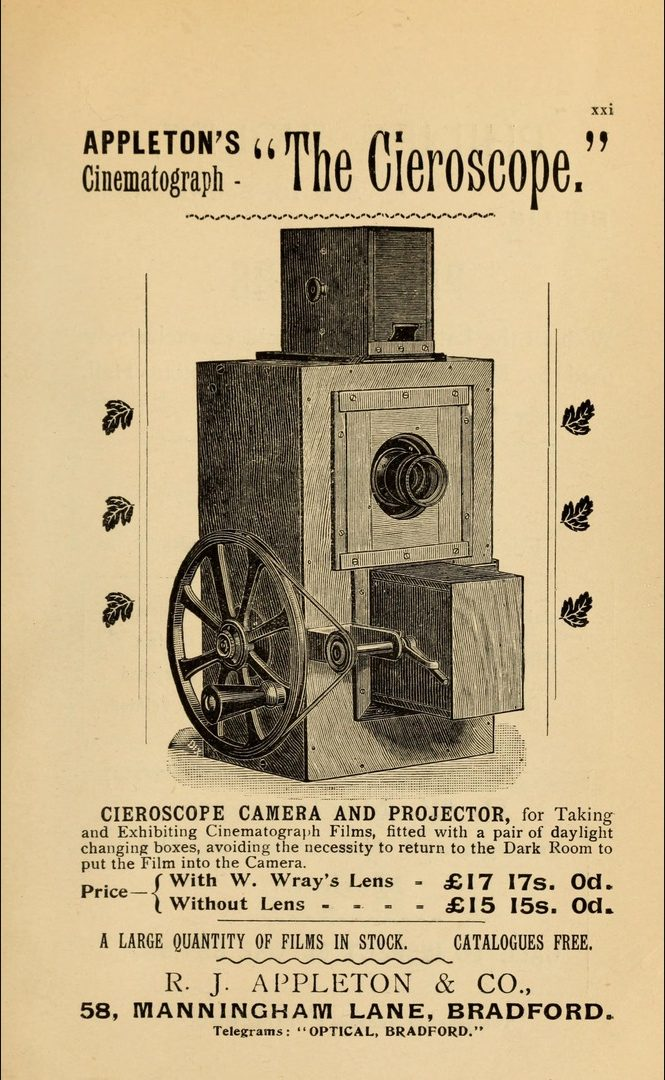
By the 1890s, the lantern and the brand-new cinematograph were sharing the same touring programs, and manufacturers raced to build hybrid machines that could do both jobs. An 1899 trade advertisement for R. J. Appleton & Co.’s Cieroscope sold exactly that: a combined camera and projector, priced at seventeen pounds and seventeen shillings with a lens, built to show painted glass slides and flickering motion-picture film from the same box. When cinema finally won out for good, it inherited the lantern’s entire toolkit — the blacked-out room, the fixed screen, a sequence of images used to build a story rather than just illustrate one.
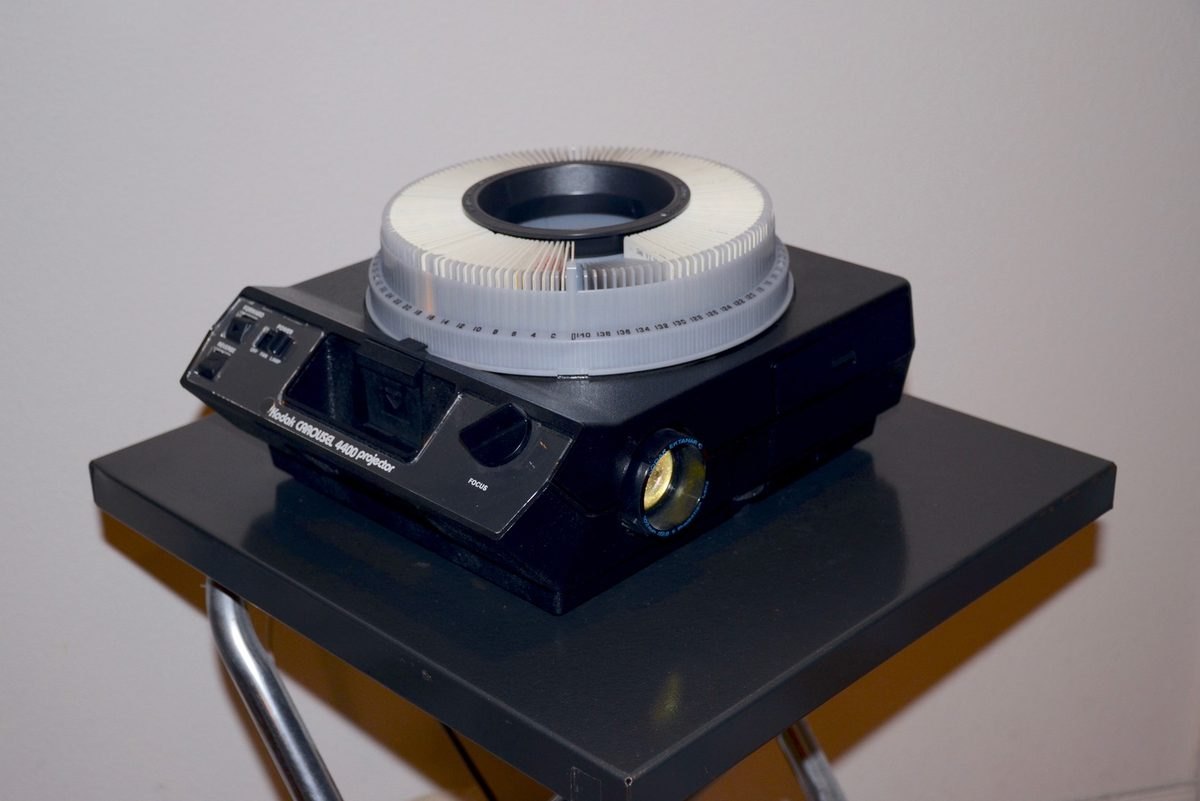
The office slide projector, the classroom carousel and even the word still used today for a business presentation — a slideshow — all trace directly back to a candle, a lens and a sheet of painted glass that a Dutch mathematician was once too embarrassed to publish.
What the magic lantern’s two and a half centuries actually track is not really the history of a machine. It’s the history of how a new way of putting light on a wall got absorbed by a culture: first as a private curiosity, then as a fairground fear, then as a scientific demonstration, and finally as furniture. Robertson’s genius wasn’t the wheeled cart or the wax-coated gauze. It was noticing that a society could be sold the same object twice — once as a source of terror, and once, a few decades later, as proof that the terror had never been real. Would a projected ghost still get a rise out of an audience raised on genuinely photographic horror? Or did Robertson prove, in that monastery crypt in 1798, that the fear was never really about the light at all — it was about the dark room built around it?
Watch the full history
The video version covers Huygens’s original device, Robertson’s Fantascope, and the lantern’s slow climb to respectability in under six minutes.

Related reading
- How the Well Sweep Drew Water Before There Were Pumps
- The Clothespin Patent History Behind America’s Favorite Free Dryer
- The Stereoscope Craze That Swept Victorian Parlours
- The WPA Sanitary Privy Program That Built Two Million Outhouses
Shop the styles/items featured in the video
- Children’s torch-and-projector toy set, the magic lantern’s modern descendant
- Illuminated 35mm slide and film viewer
- Instructive Optical Toys: Magic Lanterns, Cinematographs, Stereoscopes and More
Works cited
- The Magic Lantern Society. “A History of the Magic Lantern.” Lantern History. Link.
- Vermeir, Koen. “The Magic of the Magic Lantern (1660–1700): On Analogical Demonstration and the Visualization of the Invisible.” The British Journal for the History of Science 38, no. 2 (2005): 127–159. Link.
- Castle, Terry. “Phantasmagoria: Spectral Technology and the Metaphorics of Modern Reverie.” Critical Inquiry 15, no. 1 (1988): 26–61. Link.
- Barber, X. Theodore. “Phantasmagorical Wonders: The Magic Lantern Ghost Show in Nineteenth-Century America.” Film History 3, no. 2 (1989): 73–86. Link.
- Houstoun, R. A. “Athanasius Kircher and the Magic Lantern.” Science Progress 45, no. 179 (1957): 462–464. Link.
- Heard, Mervyn. Phantasmagoria: The Secret Life of the Magic Lantern. Hastings: The Projection Box, 2006.
- Science Museum Group Collection. “Four magic lantern slides used at the Royal Polytechnic Institution.” Link.
- Borton, Terry. “Kinds of Lanterns.” Museum of American Magic Lantern Shows. Link.
- Meier, Allison C. “The Magic Lantern Shows that Influenced Modern Horror.” JSTOR Daily, May 12, 2018. Link.