
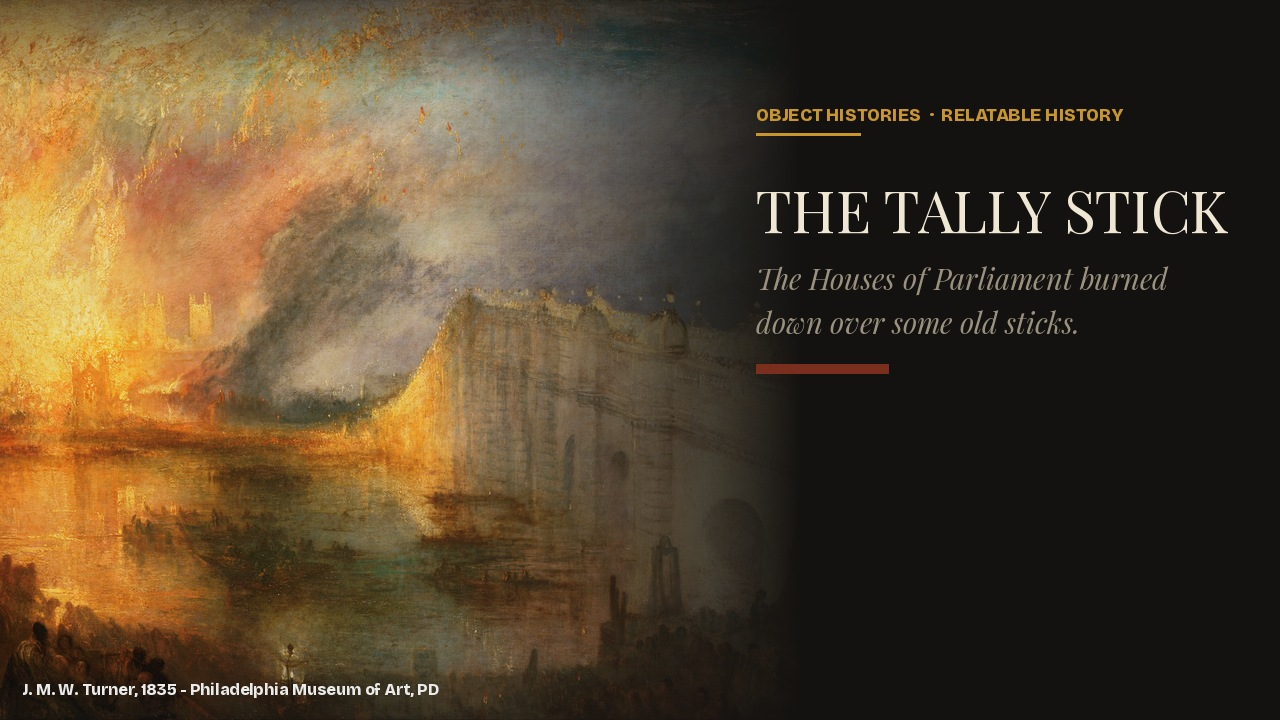
On the afternoon of 16 October 1834, two labourers named Joshua Cross and Patrick Furlong were told to feed a pile of obsolete government paperwork into a furnace under the House of Lords. By six-thirty that evening the Palace of Westminster was on fire from end to end, and by morning both Houses of Parliament were a smoking ruin. The paperwork was not paper. It was wood — two cartloads of it, notched and split, the accumulated financial records of six centuries.
Those objects were tally sticks, and for most of English history they were not a curiosity. They were how the Exchequer kept its books, how the Crown proved what it was owed, and eventually how a piece of government debt could change hands in a London street without either party being able to read. The system outlived the Normans, the Plantagenets, the Tudors and the Stuarts, and it took the seat of British government down with it on its way out.

A tally recorded money as cuts in wood, not words on a page
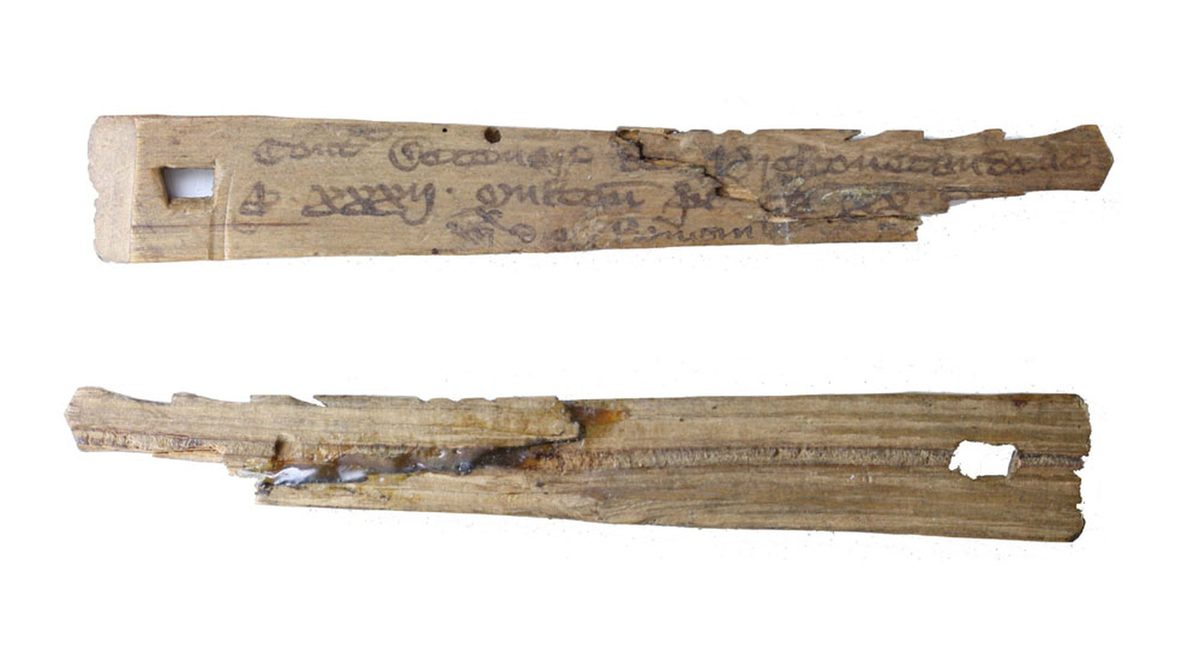
A tally stick was a squared rod of hazel or willow, ranging from a few inches long for a small sum to well over a foot for a large one. The record was cut directly into the wood as a series of notches along one edge, and the size of each notch was fixed by convention rather than left to the cutter’s judgment. A notch the width of a man’s palm represented a thousand pounds. A thumb’s width meant a hundred. The breadth of the little finger stood for twenty pounds, a swollen barleycorn for a single pound, and a plain narrow cut for a shilling. A penny needed no removed wood at all — just a single knife-split in the grain.
This scheme survives in unusual detail because a Treasury official wrote it down. Around 1179, Richard fitz Nigel — treasurer to Henry II, and known to history by the Latinised Richard FitzNeal — composed the Dialogus de Scaccario, the Dialogue Concerning the Exchequer: a manual for running royal finance, framed as a conversation between a master and an impatient pupil. It explains the notch sizes with the weary precision of someone who has watched junior clerks get them wrong, and it remains one of the earliest surviving administrative handbooks from anywhere in medieval Europe.

The stick was split so the two halves could never be forged apart
Once the notches were cut, the tally was split lengthwise, straight through the middle of every notch, from one end almost to the other so the two pieces stayed loosely joined until pulled apart. This is the detail that made the system work as more than a shared ledger. The longer piece, which kept a small handle, was called the stock; the shorter piece was the foil. The stock went to whoever had paid money in, or was owed money out. The foil stayed at the Exchequer.
Wood does not split in a straight line. It follows the grain, and no two rods of hazel grow with identical grain, so a stock cut from one stick could never be matched to a foil cut from another. When a debt was settled, the holder brought the stock back, a clerk laid it against the Exchequer’s foil, and the fit — or the failure to fit — was visible to everyone in the room. There was no reading involved and nothing to forge convincingly, which mattered enormously in a country where most people, including most merchants, could not read a written receipt or verify a seal.
A tally stock became a tradable form of government debt
Because a stock was physical, portable and unforgeable, it did not have to stay with the person who first received it. A merchant owed money by the Crown could sell his stock to someone else, usually at a discount, in exchange for immediate cash rather than waiting on the Exchequer’s own schedule. The buyer then held the claim and could redeem it, or sell it again. In effect, notched sticks were circulating through London as a negotiable instrument of government debt centuries before printed paper currency existed in England.
The word for this survived the object. The lender’s half of the tally was called the stock, and that is the direct root of “stock” in its modern financial sense — a claim on future payment, tradable independently of the debtor. By the time the Bank of England was founded in 1694 to help finance the government’s wars, London’s merchants had already spent roughly five hundred years learning, stick by stick, what it meant to lend to the Crown and sell that debt onward.
Reform arrived slowly, then the sticks became a disposal problem
Wood-based bookkeeping did not scale well against paper. Ledgers could be copied, cross-checked and filed in ways a rod of hazel could not, and by the eighteenth century several of the Exchequer’s ancient tally-keeping offices had become comfortable sinecures — posts that paid a salary and required almost no actual work. An act of Parliament in 1782 ordered the old offices wound up, though the officials already holding them were allowed to keep drawing their pay until they died or retired. The last of them held on for decades. Tally-cutting at the Exchequer did not fully stop until 1826, when the system finally gave way to paper accounts entirely.
That left several centuries of retired tallies sitting in storage beneath the Palace of Westminster — by most accounts, roughly two cartloads of them by 1834. They were financially worthless. They were also, as it happened, perfectly dry, well-seasoned firewood in a city where plenty of people were cold that October. Giving the sticks away to the poor was the obvious way to be rid of them, and it was specifically rejected: Richard Weobley, the Clerk of Works, judged it undignified to hand out bundles of former royal financial records to the public, and ordered them burned instead, discreetly, in the two underfloor furnaces beneath the House of Lords.
Burning them in a closed furnace overheated flues nobody was watching
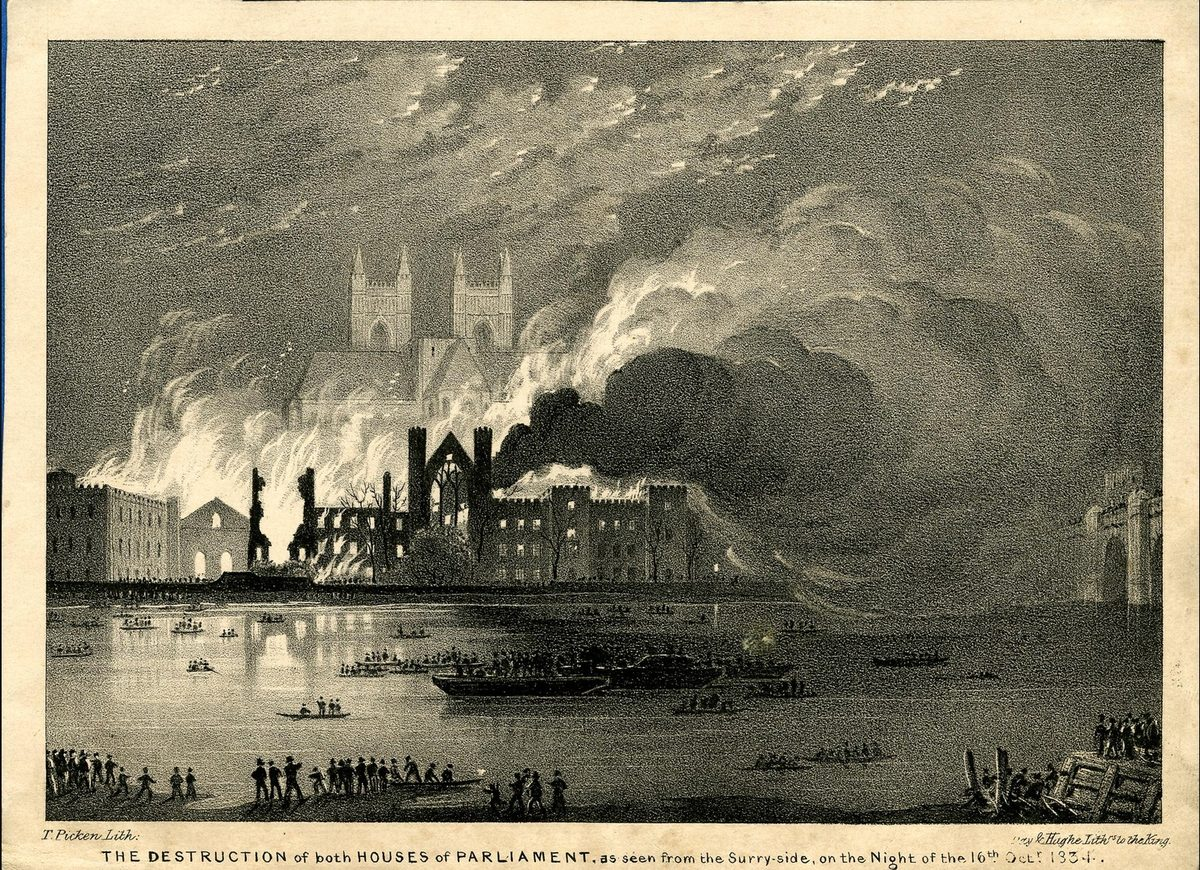
Cross and Furlong fed the furnaces through the day on 16 October, doors shut, working to get through the whole pile. The furnaces’ flues ran up through the structure and past the floor of the House of Lords chamber above. Tally wood, close-grained and thoroughly dry, burns hot, and the copper linings of the flues began to glow well beyond their ordinary working temperature. That afternoon, visitors being shown through the Lords chamber later recalled that smoke made it hard to see and that the floor felt warm underfoot. The deputy housekeeper reported a smell of burning. Nobody halted the work, and the labourers went home for the evening once the pile was gone.
The panelling around the overheated flues ignited a short time later, and the fire came out of the walls almost simultaneously across the Lords chamber. What followed was the largest fire London had seen since the Great Fire of 1666: within hours the old Palace of Westminster, home to Parliament for centuries, was burning end to end, watched by crowds packed onto the bridges and along the riverbank.
One fire chief’s decision determined what survived
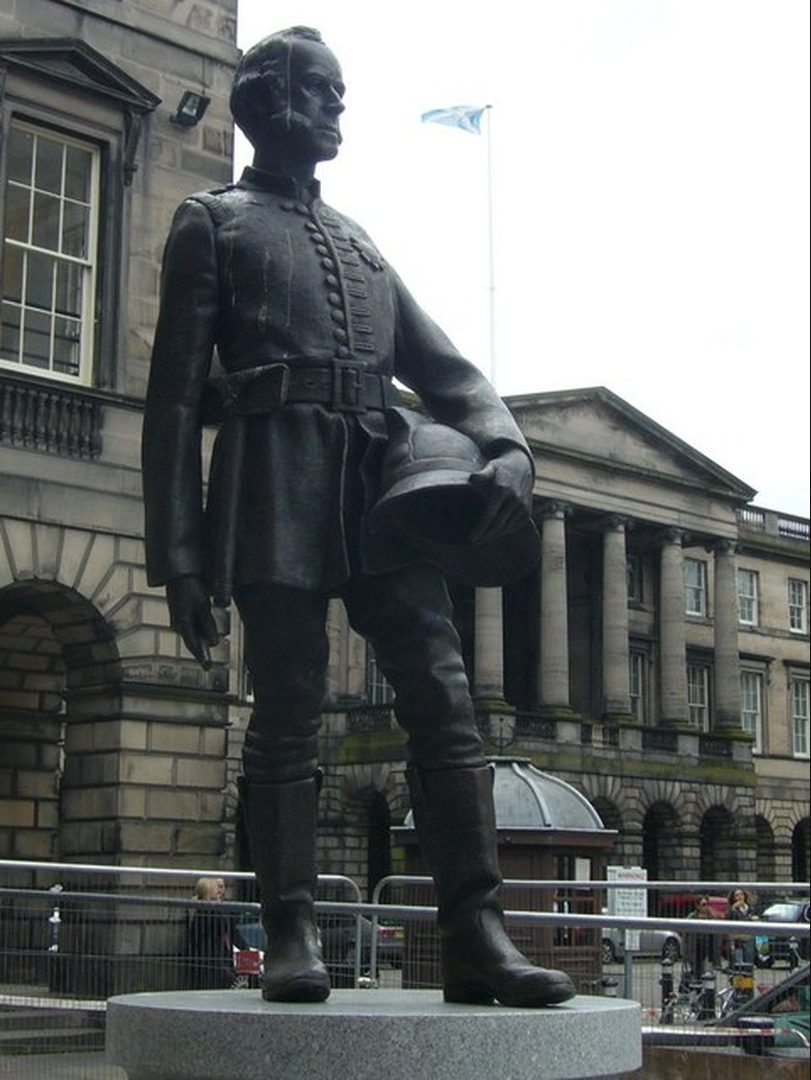
James Braidwood, who had been running London’s newly formed fire brigade for only two years, made the call that saved the one part of the old Palace still standing today. Rather than spread his men and engines thin trying to save the whole complex, he concentrated everything on Westminster Hall — the medieval hall with its great oak hammerbeam roof, already six hundred years old in 1834 — and let the newer chambers go. Jets were trained on the Hall’s windows and roof through the night while the rest of the Palace burned around it. The gamble worked. Westminster Hall still stands, its medieval roof intact, while almost everything built around it in the centuries after was destroyed and had to be rebuilt from scratch.
The fire drew artists as well as crowds. J. M. W. Turner watched from the south bank and from a boat on the Thames, filling sketchbooks, and later painted the blaze twice in oil — the two canvases are now among the most reproduced images of the entire event. John Constable watched from a stopped cab on Westminster Bridge. Out of the competition to design a replacement came Charles Barry and Augustus Pugin, and the Gothic Revival Palace of Westminster, clock tower included, that stands on the site now.
Charles Dickens later called it official folly, and he had a point
Twenty-one years afterward, in June 1855, Charles Dickens gave a speech at Drury Lane Theatre on administrative reform, and he used the tally sticks as his central example of bureaucratic self-sabotage. He noted that giving the obsolete sticks away as firewood to the poor “would have been the very easiest thing in the world to do,” but that official routine could not tolerate the sticks being useful to anyone, so “the order went forth that they were to be privately and confidentially burned.” He went on to draw the wider point: that Britain’s private ingenuity and its public administration were, in his experience, running at two entirely different speeds. A government department had managed to burn down its own legislature rather than let firewood reach anyone who might actually have benefited from it.
A small number of tallies escaped the fire and the furnace both — recovered from earlier housekeeping sweeps rather than from the blaze itself — and survive today in collections including the National Archives and various local museums. They look, unglamorously, exactly like kindling. That was rather the point of the design: a tally stick was never meant to be beautiful or durable beyond its working life. It was meant to be an unforgeable receipt made from whatever was at hand, and for six hundred years that is precisely what it was.
Watch the full history
The video version covers the notch system, the FitzNeal manual, and the afternoon everything went wrong in just under six minutes.

Related reading
- How a Water-Powered Grist Mill Turned Wheat Into Flour, No Cash Involved
- How Semaphore Flags Actually Worked at Sea
- How Farmers Harvested Wheat With a Grain Cradle
- The 24 Years Wampum Was Legal Tender in Massachusetts
Shop this story
- The Day Parliament Burned Down — Caroline Shenton
- Debt: The First 5,000 Years — David Graeber
- Turner, “Burning of the Houses of Parliament” — 18×24 art print
Works cited
- Richard fitz Nigel. Dialogus de Scaccario (The Course of the Exchequer). Translated and edited by Charles Johnson, with corrections by F. E. L. Carter and D. E. Greenway. Oxford: Clarendon Press, 1983.
- Shenton, Caroline. The Day Parliament Burned Down. Oxford: Oxford University Press, 2012.
- Dickens, Charles. “Administrative Reform.” Speech delivered at Drury Lane Theatre, London, 27 June 1855. Reprinted in The Speeches of Charles Dickens, edited by K. J. Fielding. Oxford: Clarendon Press, 1960.
- “Medieval Exchequer Tally Sticks.” Science Museum Group Collection. Link.
- “Tally Sticks.” UK Parliament, Living Heritage.
- “The Fire of 1834.” UK Parliament Heritage Collections.
- “Payments Through Time.” Bank of England Museum, 325 Years exhibition, 2019. Link.
- Shenton, Caroline. “The Man Who Saved Westminster Hall.” carolineshenton.co.uk. Link.
- “The Palace of Westminster Fire — 16 October 1834.” Museum of Scottish Fire Heritage. Link.