
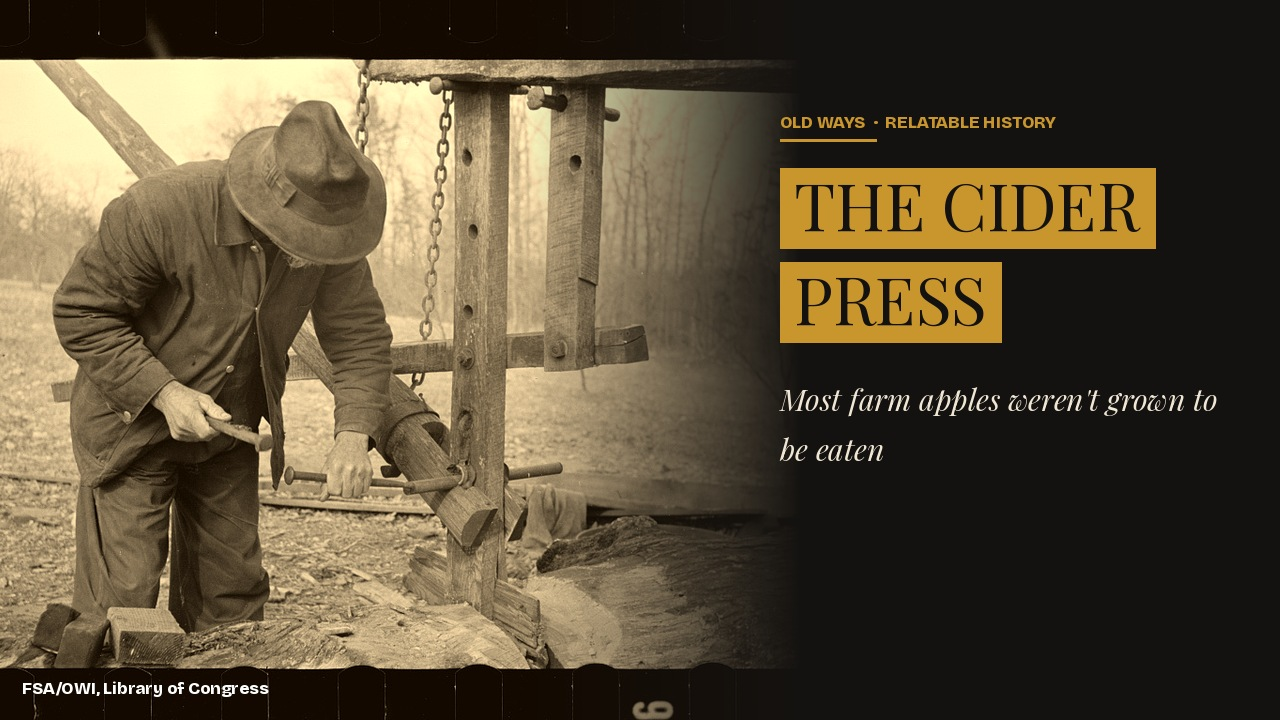
Most apples grown on a colonial American farm were never meant to be eaten. Grown from seed rather than grafted from a known sweet variety, the fruit that came up was small, bitter and often inedible off the tree — and that was fine, because eating was not the point. Those orchards existed to be pressed. By the mid-1700s, a New England household might go through an estimated thirty gallons of hard cider a year, per person, children included, and the machine that made that possible — a hand-cranked grinder paired with a wooden screw press — barely changed in design for three hundred years.
That number is worth sitting with. Thirty gallons a year works out to well over a cup a day for every member of a household, and some contemporary estimates run even higher. It was not recreational drinking in the modern sense. It was closer to how a household today treats tap water: something poured without comment, at every meal, by everyone old enough to hold a cup.
This is the story of the machine behind that number — how it was built, how it actually squeezed a year’s drink out of a fall harvest, who required farmers to plant the trees that fed it, and what finally slowed it down.
The press was two machines, not one
A cider press only starts at the press. Before any pressing happened, whole apples had to be broken down into pulp, a job done by a separate grinder. On most farms that meant a hand-cranked wooden or cast-iron drum, studded with teeth, that chewed a bushel or two at a time into a coarse mash called pomace. Larger community mills, shared by several farms, used a heavier solution borrowed from an older technology entirely: an edge-runner, a single stone wheel sometimes weighing over a ton, rolled around a circular stone trough by a horse walking a sweep — the same arrangement used for centuries to crush olives for oil.
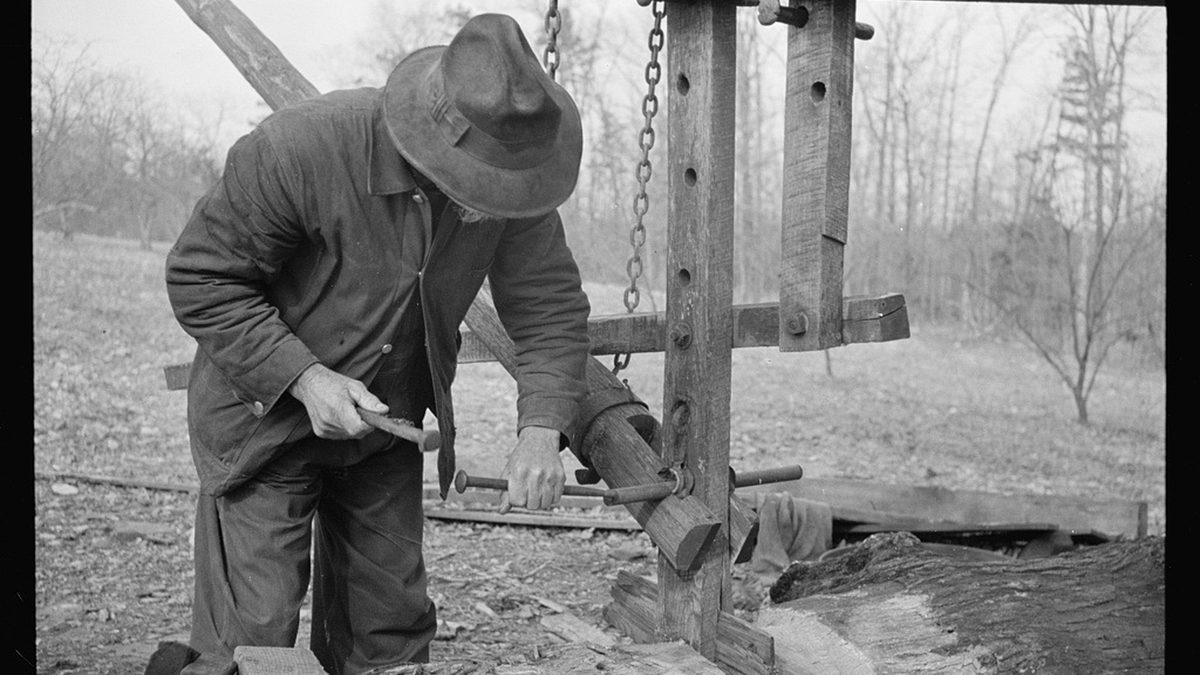
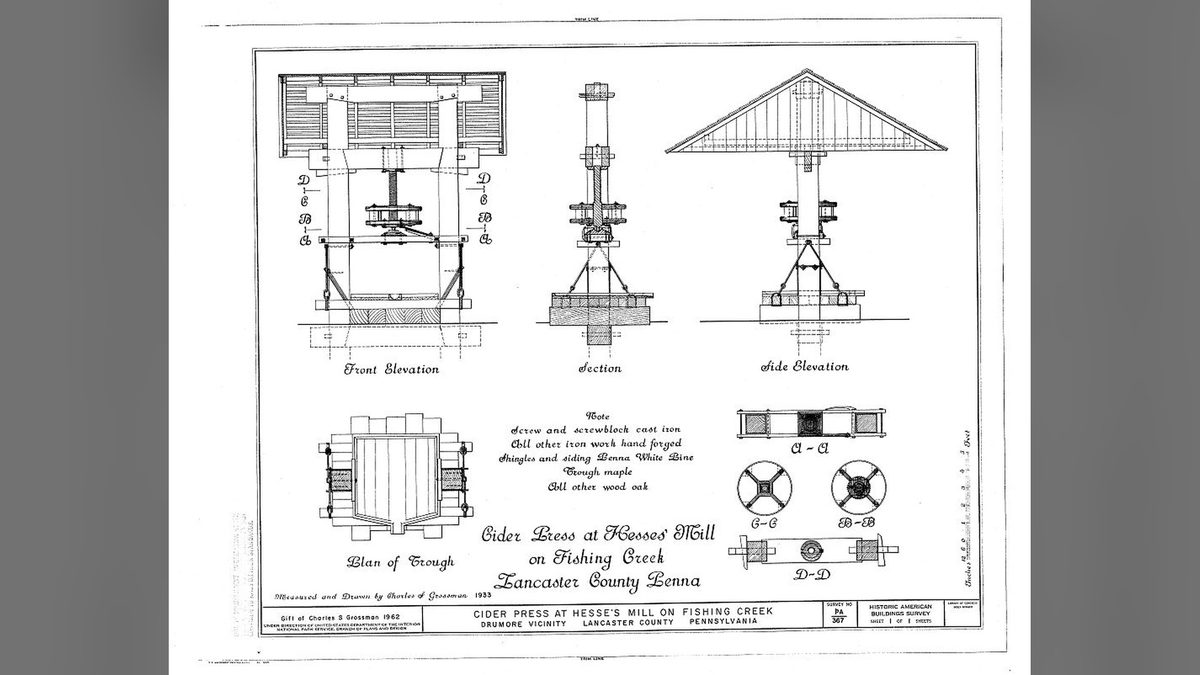
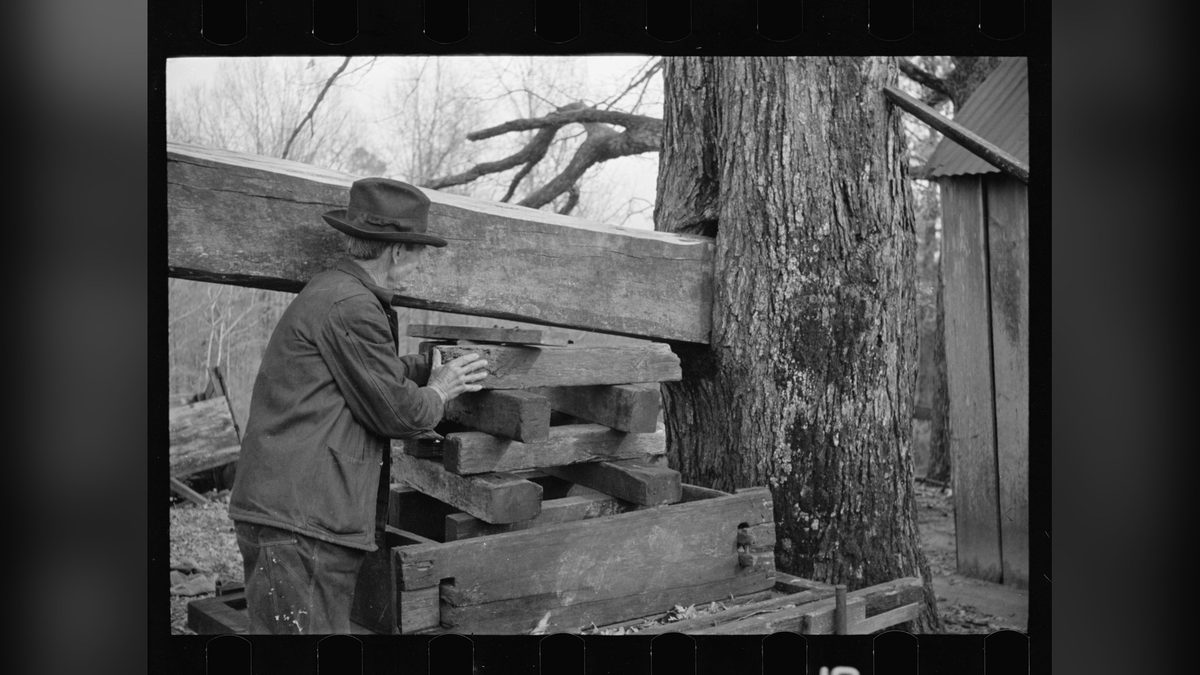
The press itself was the English part of the design, carried over by the earliest settlers and barely modified afterward: a heavy timber frame, a screw thick as a fence post, and a long lever bar to turn it. Pomace from the grinder was shoveled onto coarse cloth or clean rye straw laid over a wooden rack grooved on its top face. The corners folded over the pulp into a flat parcel; another rack went on top; the process repeated, layer after layer, until the stack — known in the trade as a cheese — stood two or three feet tall. The screw came down slowly and pressed the entire tower at once, and juice ran down the grooves into a trough and into a waiting tub below.
A bushel answered differently depending on who was asking
How much juice a bushel of apples actually gave up is one of those numbers that looks precise and isn’t. Farm accounts and modern reconstructions of a hand-cranked screw press generally put it around two and a half to three gallons per bushel — roughly forty-eight pounds of fruit for three gallons of juice, the figure that shows up in most accounts of the traditional process. Penn State Extension’s own hard-cider industry survey, by contrast, cites yields of eleven to fifteen gallons per bushel for modern commercial operations. The gap isn’t a contradiction so much as two different machines being described with the same unit: a hydraulic press extracts far more juice from the same fruit than a hand-turned wooden screw ever could, and apple variety changes the number further still. The three-gallon figure is the one that belongs to the farm press this article is about.
Whatever the yield, nothing from the harvest went to waste. The flattened, juice-drained pomace left in the cheese wasn’t thrown out — it went to the hogs, or was broken up, re-wetted with water, and pressed a second time to wring out a thin, weak drink called ciderkin, the closest thing a colonial pantry had to a second-run pot of coffee.
Land grants required the trees; one man made a business of selling them
The orchards that fed this system weren’t incidental. Starting in 1792, the Ohio Company of Associates offered settlers on the frontier beyond the first permanent Ohio settlements a hundred acres of land on the condition that they prove they intended to stay: within three years, a claimant had to plant fifty apple trees and twenty peach trees. An orchard, in other words, was not a lifestyle choice but a legal requirement for keeping the land, and it had to be an orchard of cider apples, because grafted eating varieties were scarce, expensive, and slow to establish compared with cheap seedling stock.
That is the gap John Chapman — the real man behind the Johnny Appleseed legend — filled for decades. Chapman collected seeds discarded by cider mills, planted nurseries on land ahead of the settlement line, fenced them against livestock with felled trees, and returned periodically to tend them before selling the young trees to arriving families. He was not handing out apples to eat. Seedling apples are unpredictable and usually sour, which made them useless for the table but perfectly adequate for the press, and it was exactly that seedling stock Chapman spent his life selling.
Cider was safer than water, and the legends about who drank it run ahead of the record
The standard explanation for why colonial households drank so much cider is that water was suspect — wells sat close to privies and livestock, and a mildly alcoholic drink fermented naturally by wild yeast on the apple skins was a safer bet than whatever came out of the ground. That explanation holds up. Where it gets shakier is in some of the specific stories used to illustrate it. John Adams is often credited with starting every morning of his life with a full tankard of hard cider. His own diary tells a smaller story: in July 1796, at around sixty years old, Adams recorded drinking “about a Jill of Cyder” — a gill, a quarter of a pint — each morning for a few days, specifically because he believed it settled his stomach. That is a documented, modest, short-lived medicinal habit, not a lifelong tankard. The popular version has outrun the primary source, which is a useful reminder that a good story about a founding father is not the same thing as a footnote.
The scale of ordinary household drinking, on the other hand, is well attested independent of any one person’s diary. Cider displaced not just water but coffee, tea and small beer at many rural tables, watered down for children into ciderkin, served at breakfast as unremarkably as milk. It was also cheap in a way imported drinks weren’t: an orchard, once established, produced a harvest every year at no ongoing cost beyond labor, while tea and coffee had to be shipped in and paid for in cash a farm family rarely had much of.
Winter turned some of it into something stronger
Left in a barrel, wild yeast already living on the apple skins and in the press’s own wood went to work without any intervention, and sweet cider was noticeably alcoholic within weeks. Some households pushed it further using nothing but a cold winter: barrels were left outside, and as the liquid began to freeze, the ice that formed — mostly water, since water freezes before alcohol does — was skimmed off and discarded. Repeating that a few times concentrated what remained into applejack, a drink that could run several times stronger than the cider it started as, made with no still, no fire, and no equipment beyond a barrel and a cold night. Whatever wasn’t drunk kept fermenting past hard cider into vinegar, which became the standard household preservative for pickling meat, eggs and vegetables through a winter with no refrigeration at all.
What ended the era wasn’t quite what the popular story says
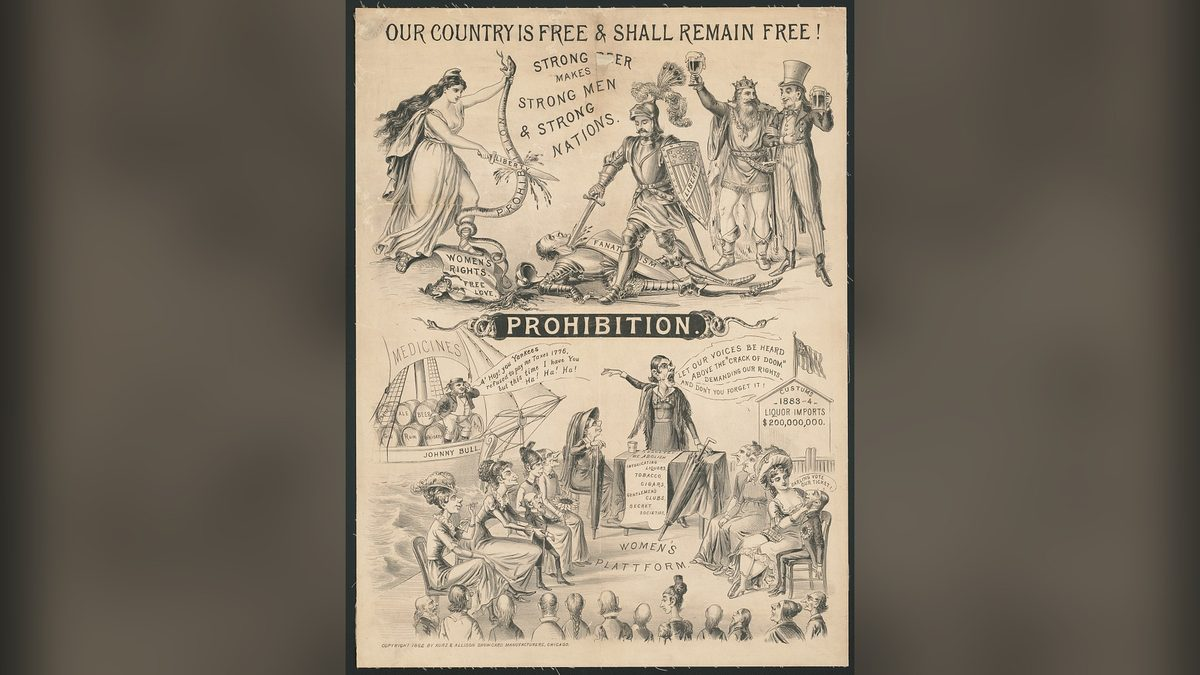
Cider’s decline is usually told as a single dramatic event: Prohibition arrived in 1920, and federal agents chopped down cider-apple orchards by the thousand of acres, erasing regional varieties overnight. Writer Michael Pollan gave that version wide circulation, and it captures something real — Prohibition did target the ingredients of alcohol, not just its sale, and cider-specific varieties did all but vanish from American orchards by the time Prohibition ended in 1933. But cider historians who have gone looking for the specific claim of federal agents burning orchards have not been able to document it at that scale; the Montezuma Orchard Restoration Project’s own accounting of the myth finds a handful of documented cases of orchards being cut by their own owners, out of religious conviction, rather than a coordinated campaign of destruction. The more mundane truth is that cider had already been losing ground for a century before 1920, as industrializing cities favored beer — grain travels and stores far better than fruit — and temperance sentiment built steadily rather than arriving in a single blow. Prohibition delivered the last, decisive push to an industry already leaning over, not the whole story by itself.
What came back after repeal was sweet, pasteurized apple juice rather than hard cider, and that’s still what most Americans picture when they hear the word today. The old wooden screw press never fully disappeared — scattered farms kept using theirs for another half-century — but the industry it once supported effectively started over beginning in the 1990s, when a wave of new producers grew hard cider from around 271,000 gallons a year to more than five million within half a decade, riding the same craft-beverage curiosity that built the microbrewing movement. Chasing genuine cider flavor sent some of those producers hunting the old varieties back down: a single surviving Hewes Crab tree, a colonial cider apple presumed extinct, turned up near Williamsburg in the 1990s and is now propagated by growers trying to rebuild exactly the orchards Prohibition-era temperance and a century of industrial brewing had squeezed out.
Watch the full history
The video walks through the grinder, the screw press and the cheese in under four minutes, with the numbers as they were recorded on the farm rather than in a modern extension survey.

Related reading
- The Full History of the German Beer Stein
- How a Water-Powered Grist Mill Turned Wheat Into Flour, No Cash Involved
- The Chemistry Inside a Sauerkraut Crock, and Why It Actually Works
- How a Root Cellar Kept Vegetables All Winter
Shop
The New Cider Maker’s Handbook by Claude Jolicoeur, for the modern version of the process described above.
Works cited
- Adams, John. Diary entry, 26 July 1796. Adams Papers Digital Edition. Link.
- Kerrigan, William. “Planting the Cider Orchard: Creating Ohio’s Fruitful Landscape, 1790–1860.” Filson Historical Society. Link.
- “What Was in Colonial Cups Besides Tea? Cider, Water, Milk, and Whiskey.” National Museum of American History, Smithsonian Institution, 2012.
- Handwerk, Brian. “The Real Johnny Appleseed Brought Apples—and Booze—to the American Frontier.” Smithsonian Magazine, 2014. Link.
- “Cold Weather and Apples Were Two Things the American Colonies Had. Industrious Scottish Immigrants Turned Them Into a Favorite Spirit.” Smithsonian Magazine, 2023. Link.
- “What’s Cooking? Drink: Cider, Punch, Chocolate.” The Colonial Williamsburg Journal, Colonial Williamsburg Foundation, 2007.
- “Burn Them! A Myth of Cider, Orchards, and Prohibition.” Malus, no. 11. Montezuma Orchard Restoration Project, 2020. Link.
- “Cider Mill.” Old Sturbridge Village building collection.
- “Hard Cider Business Benchmark Survey.” Penn State Extension, College of Agricultural Sciences. Link.