
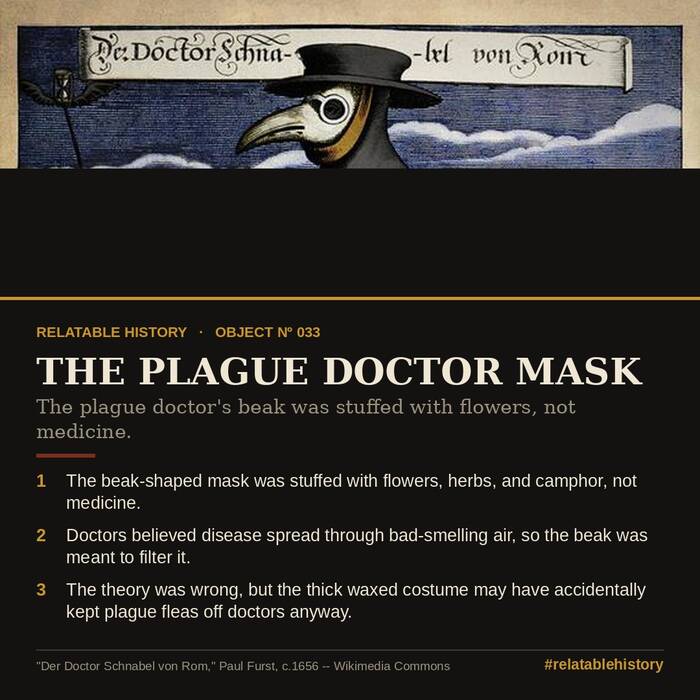
The plague doctor is one of the most reproduced images in the history of medicine: the long black coat, the wide-brimmed hat, the leather mask with its foot-long beak. It shows up in textbooks, Halloween costume catalogs, and, since 2020, in a thousand online jokes comparing it to an N95 respirator. What almost never comes along with it is the fact that historians who have gone looking for solid seventeenth-century evidence that doctors actually wore this costume while treating plague patients have come back with surprisingly little.
The image is usually dated to 1619, credited to a French royal physician named Charles de Lorme, and explained as a response to miasma theory, the belief that disease traveled on corrupted air. Two peer-reviewed investigations published in the last few years, one working from the written record and one from the only surviving physical masks, have each taken that story apart and found it does not hold together the way it is usually told.
None of this means the beaked mask is pure invention, and the video version of this story, like most retellings, follows the popular account because that is the image everyone already knows. What the research actually shows is a more interesting story: not a single inventor’s eureka moment, but three mismatched sources, a biographer with a credibility problem, and two museum relics that may never have treated a single patient.
The image everyone pictures comes from one satirical print, not a plague-year record
The single most reproduced plague doctor image, the one with the beak, the glass-eyed lenses and the cane, is a print titled Der Doctor Schnabel von Rom — “Doctor Beak of Rome” — engraved and sold by the Nuremberg printmaker Paul Fürst around 1656. Rome had just come through a serious plague year: city authorities walled off the infected Trastevere district in June of that year and did not declare the epidemic over until August 1657, by which point an estimated 10,000 of the city’s roughly 120,000 residents had died. Among the measures Rome’s health authorities ordered that year were, specifically, protective goggles, gloves and masks for physicians.
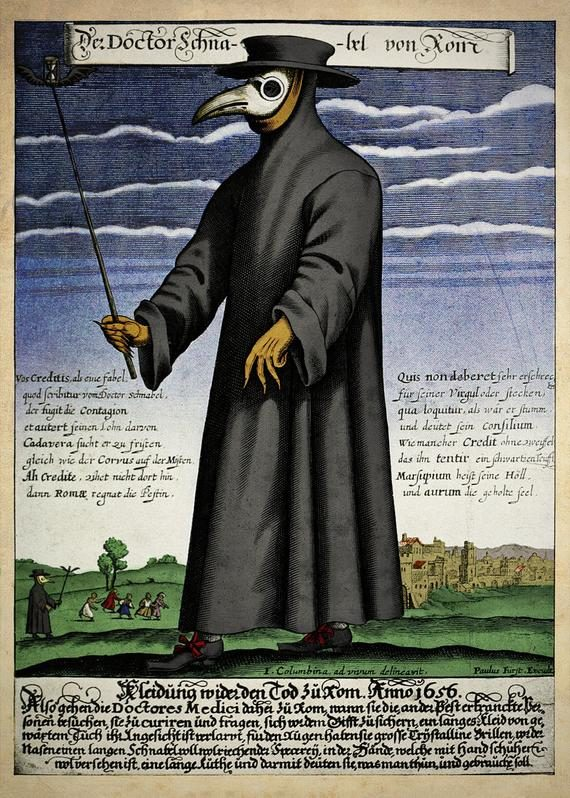
Fürst’s print, though, was not a government health notice. It was a satire, sold to the public, with a mocking verse underneath that accuses “Doctor Beak” of caring more about his fee than his patients. The costume it depicts — long coat, wide hat, beaked mask, cane — is the first confirmed image of this specific outfit anywhere. That is itself worth sitting with: the defining image of plague medicine, reproduced in every book on the subject, is a piece of 1650s political cartooning, made decades after Europe’s worst plague years and designed to mock the medical profession rather than document it.
The inventor credit rests on one biographer with a reputation for exaggeration
Charles de Lorme (1584–1678) was a real and successful figure, a physician who served the French royal court for decades. The claim that he personally designed the beaked costume in 1619 comes from a single source: a biography of de Lorme written by Michel de Saint-Martin. A 2024 study in the European Journal for the History of Medicine and Health went back to Saint-Martin’s text directly and found a problem historians had mostly skipped past — Saint-Martin had a documented reputation for gullibility, and his book contains other claims that are demonstrably false. Taken at face value, the study argues, Saint-Martin’s actual description of de Lorme’s plague suit bears “hardly any resemblance” to the beaked costume everyone now associates with him.
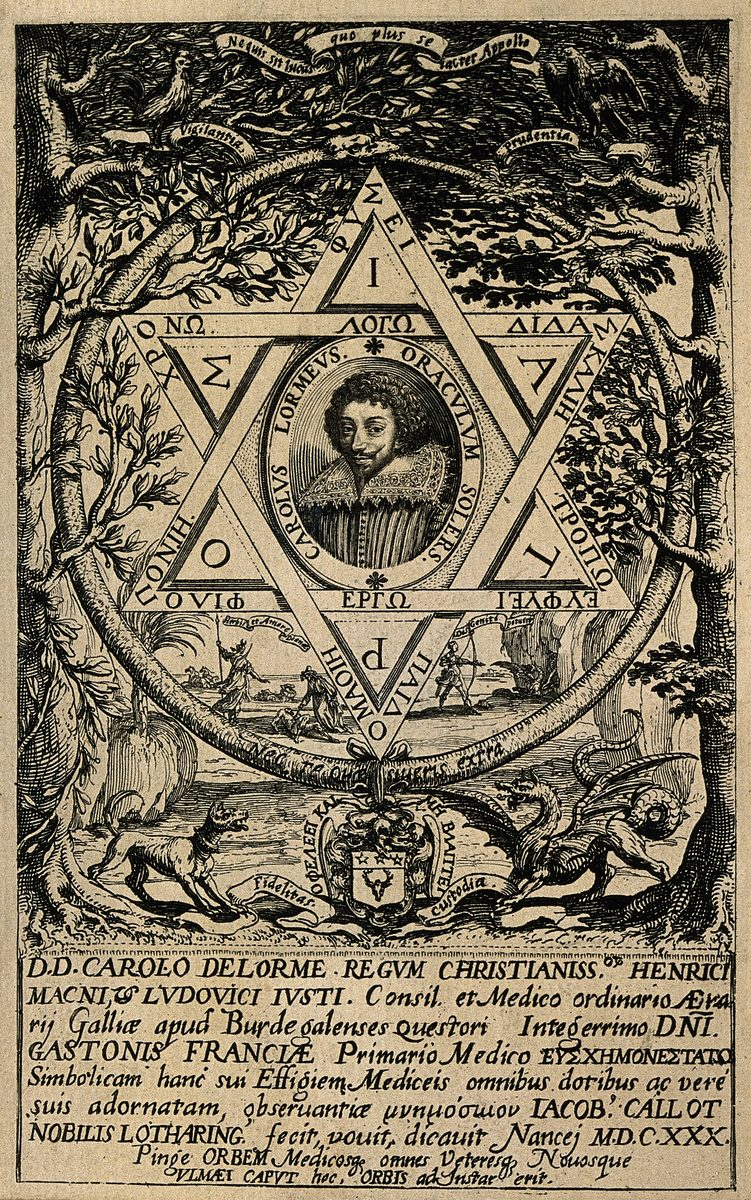
The same study traces the modern, composite “plague doctor” back to three separate sources that do not actually agree with one another: Fürst’s 1656 satirical prints, Saint-Martin’s unreliable biography of de Lorme, and a print and description that appear in Jean-Jacques Manget’s 1721 plague treatise, published in Geneva more than sixty years after Fürst and a full century after de Lorme’s supposed invention. According to the study, these three were merged into one tidy origin story much later, during a period when protective equipment itself became newly topical again around the turn of the twentieth century, and the merger has been repeated ever since as if it were a single, continuous seventeenth-century record.
What the beak was actually packed with, and the theory behind it
Wherever the specific costume came from, the theory behind the beak is well documented. European medicine of the period was still governed by miasma theory: the idea that disease was carried by corrupted, foul-smelling air rather than by direct contact or an invisible organism. A doctor’s mask built around that theory needed to filter smell, not germs, so the beak was packed with whatever aromatic material was on hand — dried flowers, lavender and other strong herbs, camphor, a vinegar-soaked sponge — on the logic that sweet or sharp-smelling material could overpower and block the bad air before it reached the wearer’s lungs. Glass lenses protected the eyes from infected fluids, and a wooden cane let a doctor lift clothing or take a pulse without bare-handed contact, which, whatever the reasoning behind it, was not a bad precaution against a disease we now know spreads partly through touch.
The theory was wrong, but it was not stupid for its time: miasma ideas stretch back to classical medicine and persisted precisely because disease really did cluster around foul-smelling places like swamps, sewers and overcrowded slums, for reasons no one in the 1600s had the tools to see. A thick waxed coat and sealed mask may have incidentally kept some infected fleas off a doctor’s skin, which would make the costume partly effective for a reason its wearers could not have articulated.
Two museum masks have been examined forensically, and neither checks out as real protective gear
If the written record is tangled, the physical evidence is thinner still. A 2020 study in the journal NTM examined the two beaked plague masks most often shown in museums, one held in Ingolstadt’s German Museum of the History of Medicine and one in Berlin, and found that the beaked mask “is not mentioned before the mid-seventeenth century, and then only in Italy and Southern France,” with no documented use anywhere in Central Europe during an actual outbreak. More strikingly, the construction details of both surviving specimens raised doubts about whether either one ever functioned as real medical equipment at all, as opposed to a later theatrical prop, souvenir or museum-made replica.
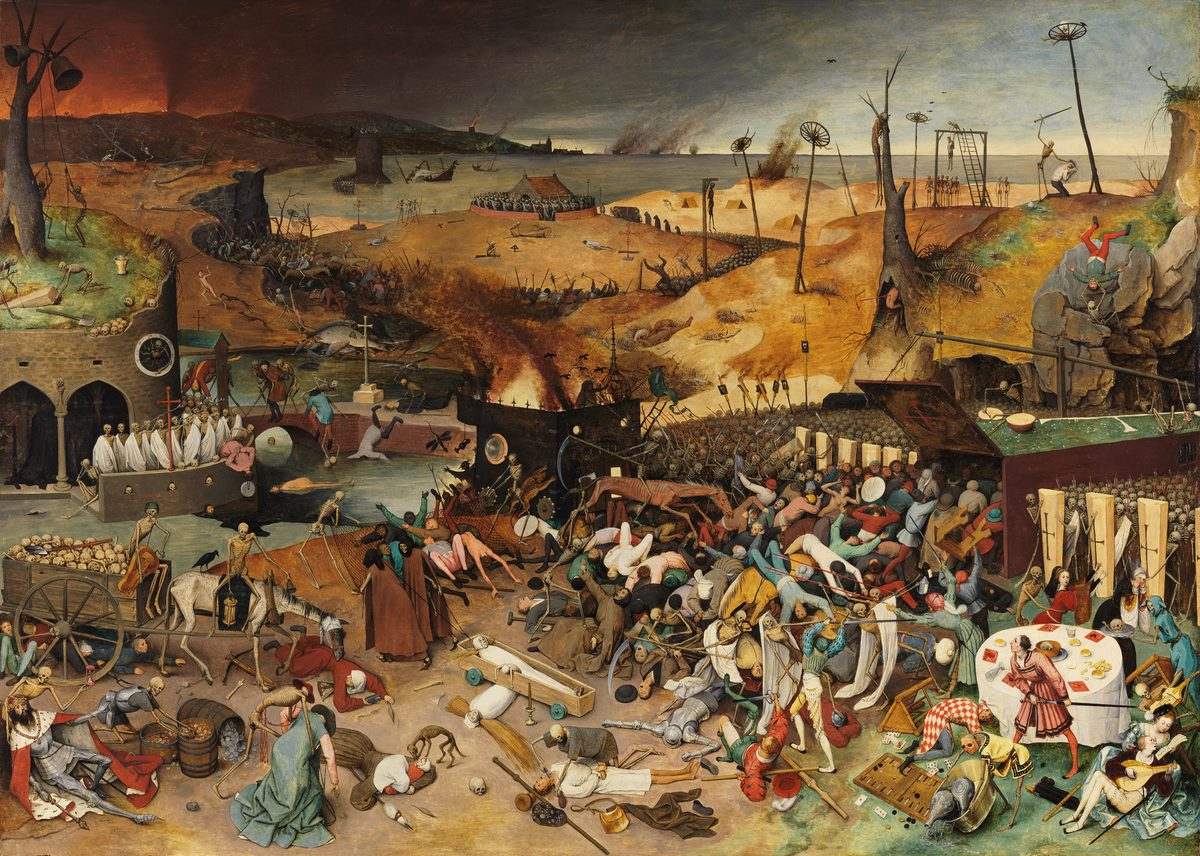
Berlin’s own Deutsches Historisches Museum reached a similar conclusion about the mask in its own collection in a 2020 post re-examining the object: there is, the museum wrote, a complete absence of written or visual sources documenting this costume’s use during any of the plague waves that struck Europe from 1348 onward, and the 1656 image itself recalls the stock character of the Dottore from commedia dell’arte theatre more than it resembles a known medical uniform. The museum’s own mask is made of ochre-coloured velvet over a waxed linen lining, with lenses of selenite crystal, traditionally called Marienglas, set into a beak of hardened, punched leather — a handsome object, and one whose workmanship reads more easily as costume-making than as emergency medical kit. The museum’s own suggestion is that the costume’s visual grammar may owe at least as much to the stage as to the sickroom. None of this proves no doctor ever wore a beaked mask. It means the burden of proof, when historians actually went looking for it, turned out to be much harder to meet than the confident textbook image suggests.
The theory under the mask lost to an actual bacterium, two centuries later
Miasma theory did not get disproven quickly or gracefully; it took the rise of germ theory across the nineteenth century, and a specific discovery at its end. In 1894, during a plague outbreak in Hong Kong, the Swiss-French physician Alexandre Yersin, trained in the bacteriological methods of Emile Roux and Robert Koch, isolated the bacterium responsible for plague, working in parallel with the Japanese researcher Kitasato Shibasaburō. The organism was first named Pasteurella pestis and was later renamed Yersinia pestis in Yersin’s honor.

Identifying the bacterium did not immediately explain how it spread. That took another researcher, Paul-Louis Simond, who demonstrated in 1898 that the oriental rat flea carried plague between rats and from rats to people — a finding a 2022 reassessment in the journal Medical History notes was initially met with skepticism and took years to be fully accepted by Simond’s peers. Put together, it took roughly two and a half centuries to get from a mask stuffed with flowers to an accurate account of fleas, rats and bacteria — and the flea, not the smell, had been the actual threat the whole time.
The beak outlived the question of whether anyone really wore it
What the beaked mask did not do was disappear once its underlying theory collapsed. A 2018 study in Medical Anthropology traces how plague-era protective imagery keeps resurfacing whenever a new epidemic makes personal protective equipment newsworthy again, with the beaked silhouette functioning as instantly recognizable shorthand for “epidemic” regardless of whether it was ever common medical dress. Its most durable modern home has been performance rather than medicine: the beaked figure became fixed in Venice’s Carnival tradition as the Medico della Peste, worn today by revelers who are invoking an idea of plague-era dread rather than reenacting documented hospital rounds.

That is, in its way, a fitting afterlife for an object whose origins were always more theatrical and literary than medical. The mask survived not because it worked, and not even because historians can firmly prove doctors wore it as pictured, but because it is a genuinely striking piece of design: a human face stretched into a bird’s, worn by a figure whose job was to walk toward the thing everyone else was fleeing.
None of this is really a story about the seventeenth century. It is a story about how a good image outruns its own evidence. A single satirical print, a biography from an unreliable source, and a treatise published a century later got stitched into one tidy object — a named inventor, a wrong-but-understandable theory, a dramatic silhouette — and the stitched version was simply easier to believe and repeat than the messier truth that nobody is entirely sure what seventeenth-century plague doctors actually wore, or whether the famous ones wore anything like it at all.
Watch the full history
The short video covers the popular version of the story in under two minutes; this article is where the sourcing gets checked.

Related reading
- What Caused the Dancing Plague of 1518?
- What Caused the English Sweating Sickness?
- The Mercury Cure for Syphilis Lasted Four Hundred Years
- Inside the 150-Year History of Vibration Therapy
Shop the look
Items related to this topic, selected for the video companion post:
- Plague doctor mask replica (costume/collectible)
- The Black Death, illustrated history book
- Venetian carnival mask replica
- N95 respirator masks (the modern descendant of “filtering bad air”)
Works cited
- Mattie, Herbert J. “Men in Tights: Charles De Lorme (1584–1678) and the First Plague Costume.” European Journal for the History of Medicine and Health 81, no. 1 (2024): 1–13. Link.
- Ruisinger, Marion Maria. “The ‘Plague Doctor’s Mask’ in the German Museum for the History of Medicine, Ingolstadt.” NTM Zeitschrift für Geschichte der Wissenschaften, Technik und Medizin 28, no. 2 (2020): 235–252. Link.
- Bovenmyer, Peter. “Birds of Plague: Der Doctor Schnabel von Rom (Doctor Beak of Rome), Engraved and Sold by Paulus Fürst, 1656.” Journal of the Northern Renaissance, 2016.
- Cluster of Excellence “Religion and Politics,” University of Münster. “Measures to Combat the Plague in Rome in 1656/57.” Link.
- Deutsches Historisches Museum. “Plötzlich wieder aktuell? Dr. Schnabel im DHM.” DHM Blog, April 30, 2020.
- Deutsches Medizinhistorisches Museum Ingolstadt. “Pestarztmaske.” Objektgeschichten.
- Lynteris, Christos. “Plague Masks: The Visual Emergence of Anti-Epidemic Personal Protection Equipment.” Medical Anthropology 37, no. 6 (2018): 442–457. Link.
- Lynteris, Christos. “In Search of Lost Fleas: Reconsidering Paul-Louis Simond’s Contribution to the Study of the Propagation of Plague.” Medical History 66, no. 3 (2022): 242–263. Link.
- Butler, Thomas. “Plague History: Yersin’s Discovery of the Causative Bacterium in 1894 Enabled, in the Subsequent Century, Scientific Progress in Understanding the Disease and the Development of Treatments and Vaccines.” Clinical Microbiology and Infection 20, no. 3 (2014): 202–209. Link.
- “Alexandre Yersin.” Encyclopaedia Britannica. Link.