
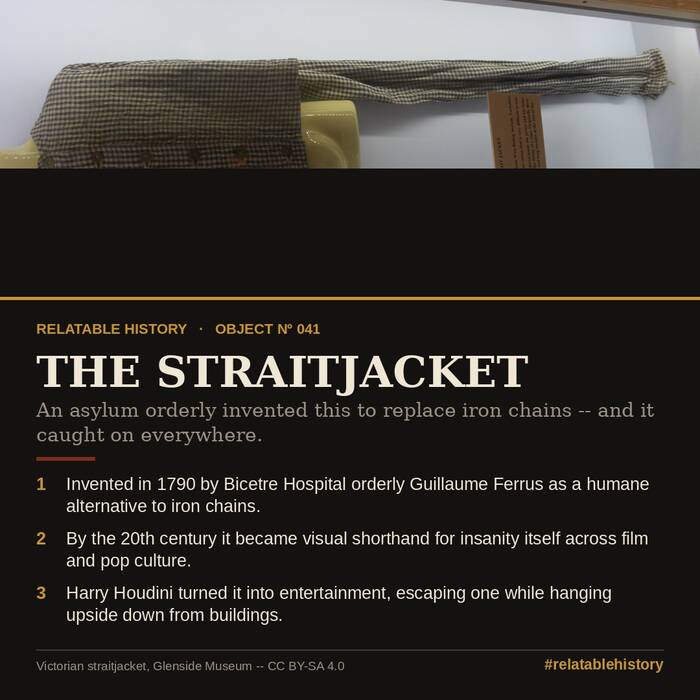
The story usually goes like this: in 1790, at the Bicêtre asylum outside Paris, an attendant grew tired of watching patients chained to the walls and sewed them a canvas jacket instead — mercy, stitched by hand, in place of two centuries of iron. It is a tidy story. It is also missing eighteen years, because a published medical textbook already described essentially the same garment in 1772 — which is the real problem with trying to pin down exactly when the straitjacket was invented.
Historians who have gone looking for a cleaner answer keep running into that gap, and nobody has closed it. What the surviving record does show clearly is everything around the gap: centuries of chains and restraint chairs treated as ordinary equipment, a reform movement that took decades longer than its champions later claimed, a journalist who proved the “humane” jacket was still being used for punishment, and an escape artist who turned the most frightening object in psychiatric medicine into a box-office attraction.
None of that fits the tidy Paris legend. It is, however, what survives in the textbooks, the museum catalogs, and the hospital and court records, which is where the rest of this comes from.
Two hundred years of iron came first
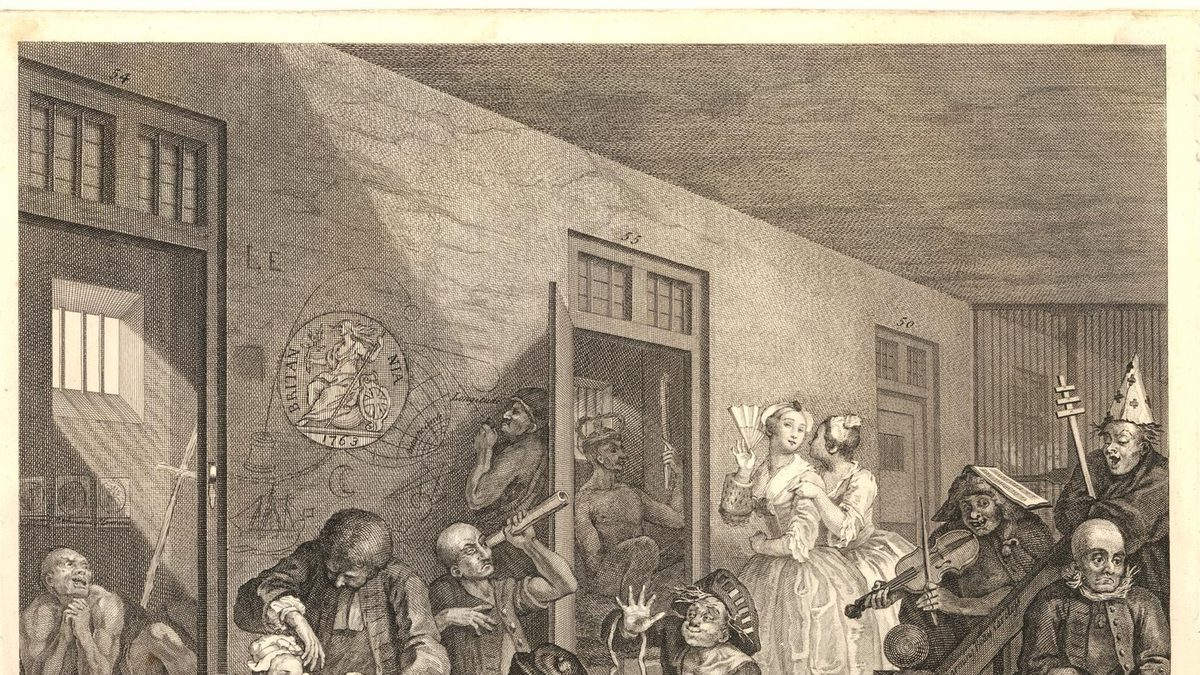
Long before anyone sewed a canvas jacket, restraining a person judged dangerously insane in Europe generally meant metal. Bethlem Hospital in London — founded in 1247 as a small priory and already housing people in mental distress by 1403 — was equipped for it: records from the period describe “chains, manacles, locks and stocks” as standard fixtures of its wards. The hospital moved to a larger site at Moorfields in the mid-1670s, and through the following century it ran a sideline that would be unthinkable today: fee-paying visitors could walk the wards and view the patients, a practice the institution did not end until 1770.
Even Bethlem itself — the hospital whose name gave English the word “bedlam” — did not formally abandon mechanical restraint until 1852, under its resident physician Charles Hood. That date matters: it falls a full six decades after the straitjacket supposedly arrived as the humane alternative to chains. For most of the time in between, asylums simply used both.
When, exactly, was the straitjacket invented? Nobody agrees
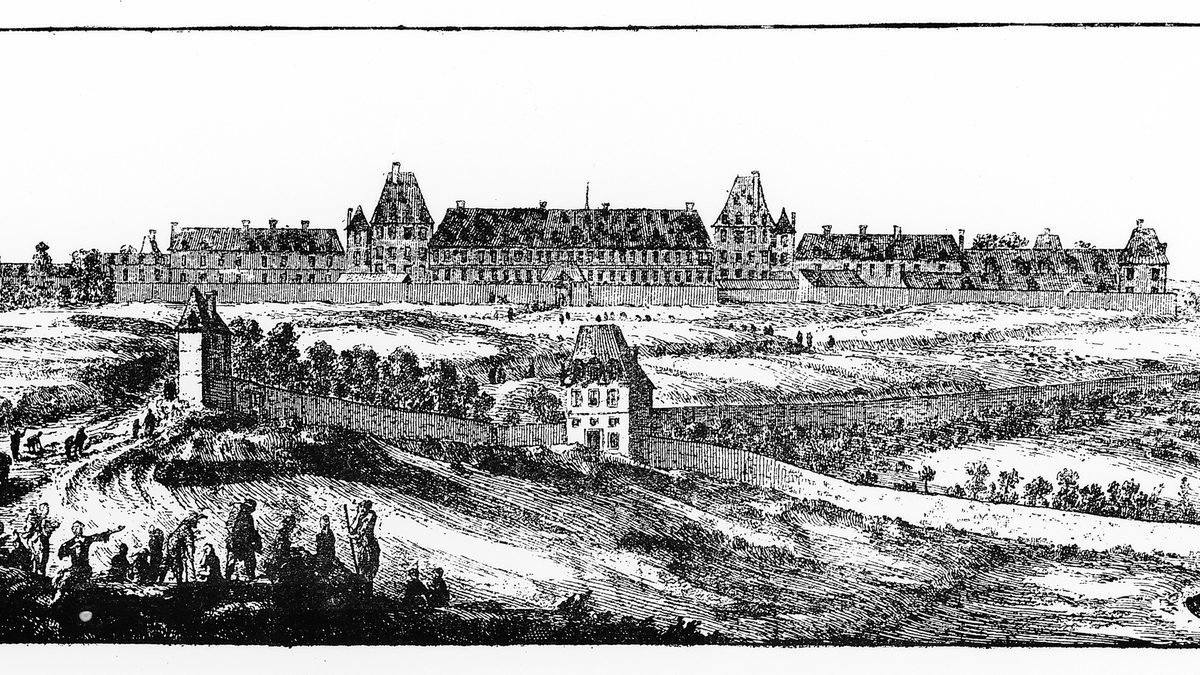
The Paris-1790 version traces back to the philosopher Michel Foucault, who credited an upholsterer named Guilleret, working at the Bicêtre, with sewing the first camisole de force — literally, the “jacket of force.” Foucault dated the invention to 1790; more recent historians working from the hospital’s own records push the date back to 1770. Either way, there is an earlier paper trail that neither date accounts for.
In 1772, the physician David Macbride published A Methodical Introduction to the Theory and Practice of Physic, a textbook assembled from lectures he had already been delivering for years. It describes, in passing, a canvas restraint of essentially the same design — sleeves long enough to pin a patient’s arms when tied behind the back. The Science Museum Group, which holds a surviving example in Sir Henry Wellcome’s collection, independently dates the garment’s first written description to that same 1772 text. If Macbride was describing an established device rather than a brand-new one, the real invention predates the famous legend by at least two decades — and quite possibly belongs to no single inventor at all, since a restraint this simple could easily have been devised independently in more than one institution.
The surviving objects back up how simple the design really was. A canvas restraint suit in the Science Museum Group’s collection, made in Europe sometime between 1925 and 1935, measures roughly 790 by 415 by 375 millimetres as displayed, built from canvas, leather and iron, with a separate waist belt over a metre long. There is no engineering to speak of: overlong sleeves, a lacing system closer to corsetry than clothing, and buckles. The museum’s own cataloguers note it served “both as a restraint as well as for treatment,” a distinction that mattered enormously to the doctors prescribing it and barely at all to the patient wearing it.
Pinel’s chains and the birth of “moral treatment”
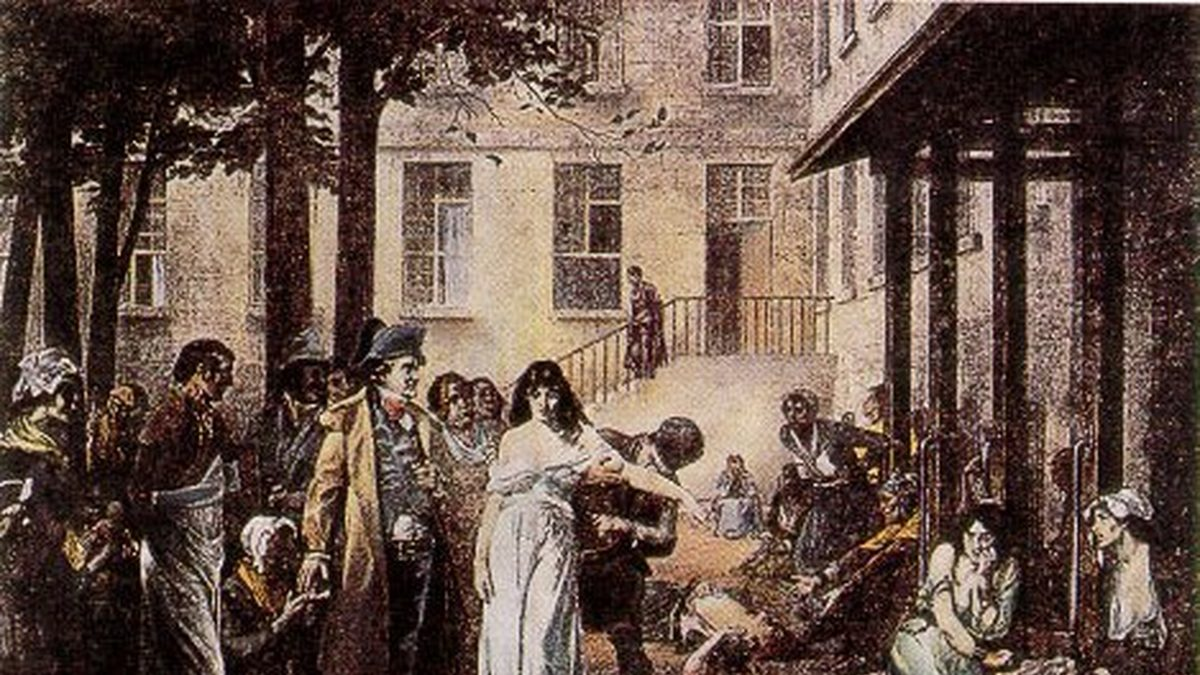
Whoever actually sewed the first one, the canvas restraint spread because of a genuine reform movement, not despite one. Philippe Pinel, a French physician convinced that the mentally ill were sick rather than criminal or possessed, is remembered for striking the iron chains from patients at the Bicêtre and then, in 1795, from the women confined at the Salpêtrière. Pinel’s underlying argument — that confinement should treat illness rather than punish it — became the founding idea of what the era called “moral treatment,” and the camisole de force was marketed explicitly as that philosophy made physical: restraint that could be tied on and off in seconds, caused no lasting injury, and needed no blacksmith to fit or remove.
The same reasoning crossed the Channel. In Yorkshire, the Quaker tea merchant William Tuke opened the York Retreat in 1796 on the premise that patients recovered faster through quiet routine and ordinary respect than through chains or locked rooms — one of several English reformers, working around the same time as Pinel, pursuing the same basic idea that madness was an illness to be treated rather than a crime to be punished.
Britain’s “non-restraint” movement didn’t have one hero
The popular version of this story jumps straight from Pinel to total abolition, but the English evidence is messier and more interesting. In 1838, Robert Gardiner Hill, house surgeon at the Lincoln County Asylum, announced that the institution had entirely abolished mechanical restraint — no straitjackets, no leg locks, no handcuffs. The following year, John Conolly, newly appointed resident physician at the much larger Hanwell Asylum in Middlesex, followed Lincoln’s example; within twelve years, according to his own biographers, “a revolution had been effected in the care of the insane in England.”
A 2004 study of Northampton Asylum’s actual admission records complicates that triumphant account. Northampton’s superintendent, Thomas Prichard, claimed in 1840 to have abolished mechanical restraint completely — yet researchers who examined the hospital’s first fifty admissions found that 16 percent arrived already restrained, and while most had their restraints removed on admission, 8 percent still required temporary mechanical restraint during their stay. The study’s own conclusion is the honest one: non-restraint “occurred gradually across multiple institutions simultaneously,” not through any single reformer’s breakthrough, whatever the plaques and biographies claimed afterward.

Nellie Bly proved the “humane” jacket still hid abuse
Even where asylums claimed to have reformed, the canvas restraint kept being used as punishment rather than treatment — and the proof came from outside the profession entirely. In 1887, the journalist Nellie Bly had herself committed to the Women’s Lunatic Asylum on Blackwell’s Island in New York by feigning insanity, then spent ten days documenting what she found for Joseph Pulitzer’s New York World. Her account, published as Ten Days in a Mad-House, described patients tied into straitjackets and left for hours, cold baths used as punishment, and sane women held alongside the genuinely ill with no real medical evaluation at all.
Bly’s reporting accomplished what decades of institutional reform pledges had not: it forced a grand jury investigation and a budget increase for the asylum system, precisely because it came from a credible outside witness rather than from the institutions grading their own progress. The straitjacket she described was, by then, nearly a century removed from its supposed debut as an act of mercy — and functioning exactly like the chains it had replaced.
Watch the full history
The short version covers the same arc — Bicêtre, Bedlam, and Houdini’s escape act — in about ninety seconds.

Houdini turned restraint into a spectacle
The straitjacket’s strangest afterlife began with a visit, not a performance. Harry Houdini later wrote that he first saw one used in earnest while touring a Canadian asylum in the 1890s, watching a patient struggle against it, and went looking for one to practice with the very next day. By the 1910s he had built an entire act around escaping one, usually in full view of the audience rather than hidden inside a cabinet, because the visible struggle was the entire point.
The mechanics, which Houdini spelled out in his own 1910 book Handcuff Escapes, depended on leverage and a tolerance for pain rather than any trick: wedge an elbow against something solid, drive it upward past the head until both arms come around to the front, then use the teeth to work the buckles on the cuffs before the hands can reach the ones fastened at the back. He performed the escape most famously while suspended upside down from cranes and buildings, a position that made the arm movement slightly easier and the buckle work considerably harder — exactly the trade-off he wanted the crowd below to see him making.
Houdini’s own brother, Theodore Hardeen, had developed the public escape format first; Harry’s fame simply made it the version that stuck. And stick it did — through The Cabinet of Dr. Caligari in 1920, through One Flew Over the Cuckoo’s Nest in 1975, through the Sex Pistols wearing one as a costume in 1977 — until a straitjacket on screen no longer needed any explanation at all.
What finally retired the canvas restraint from ordinary psychiatric practice was not a reformer or a journalist but a drug. Chlorpromazine, marketed in Britain as Largactil, reached asylums in the 1950s and gave staff a chemical alternative to mechanical restraint for agitated patients — one that required nobody to be physically pinned down at all. Use of mechanical restraint fell sharply in the decades that followed, and Britain’s medical establishment eventually rejected it outright as standard care.
The psychiatrist R. D. Laing, writing during the anti-psychiatry movement of the 1960s, argued that the drugs had not actually ended restraint — they had only made it chemical and invisible, a “chemical straitjacket” standing in for a canvas one. Whether or not Laing’s framing fully holds up, the straitjacket itself survived mainly as a costume and a punchline, detached from the asylum it was built for and from the argument, now two and a half centuries old, over what actually counts as a merciful way to restrain another person.
Measured against that, the straitjacket’s real story is less a tale of one merciful inventor than a two-and-a-half-century argument about where the line sits between treatment and control — an argument that moved from iron to canvas to chemistry without ever fully settling the question, just changing what the restraint looked like.
Would you have called Macbride’s garment — or Guilleret’s, or whoever really sewed the first one — an act of progress?
Related reading
- Who Discovered Ether Anesthesia? The Feud That Ruined Three of the Four Men Who Claimed It
- Inside the 150-Year History of Vibration Therapy
- Why Ancient Trepanation Survival Rates Were So High
- How Phrenology Hiring Practices Took Over Victorian Workplaces
Shop the styles/items featured in this video
- Madhouse: A Tragic Tale of Megalomania and Modern Medicine
- Houdini: The Elusive American (biography)
- Ten Days in a Mad-House by Nellie Bly (reprint)
- Straitjacket-style escape trick kit
Works cited
- Bedlam. Encyclopedia Britannica.
- “From Bethlehem to Bedlam: England’s First Mental Institution.” Historic England.
- “Bethlem Royal Hospital.” Bethlem Museum of the Mind. Link.
- “Straitjackets: The History of an Archaic Restraint Device.” History Hit. Link.
- Macbride, David. A Methodical Introduction to the Theory and Practice of Physic. London: W. Strahan and T. Cadell, 1772.
- “Strait jacket, Europe, 1925–1935.” Science Museum Group Collection, object A130344. Link.
- Wiles, Will. “Practicing Restraint: The Madness of the Straitjacket.” Cabinet, no. 46 (Summer 2012). Link.
- “From Asylums to Anarchy: The Straitjacket and Popular Culture.” National Science and Media Museum.
- Haw, Camilla, and Graeme Yorston. “Thomas Prichard and the Non-Restraint Movement at the Northampton Asylum.” Psychiatric Bulletin 28, no. 4 (2004): 140–142. Link.
- “Inspiring Physicians: John Conolly.” Royal College of Physicians.
- Bly, Nellie. Ten Days in a Mad-House; or, Nellie Bly’s Experience on Blackwell’s Island. New York: Ian L. Munro, 1887. Link.
- “Houdini: Escape Secrets.” American Experience, PBS. Link.