
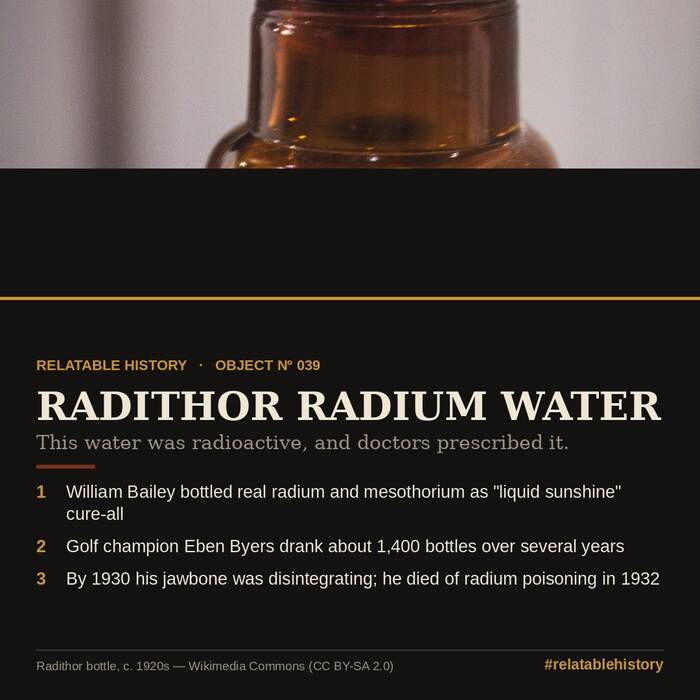
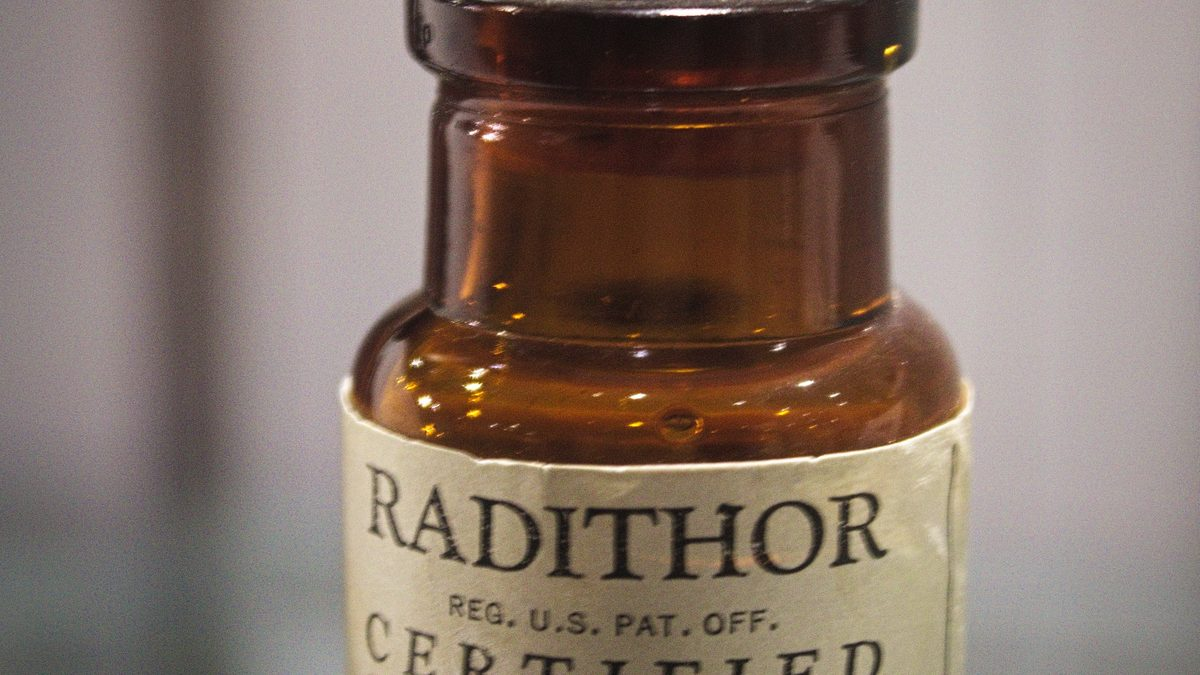
Radithor was, by any modern measure, a radiological hazard: a two-and-an-eighth-inch bottle of distilled water carrying at least one microcurie each of radium-226 and radium-228, sealed with a cork and sold for a dollar. For most of the 1920s it was also a legal, physician-endorsed, drugstore-shelf health tonic. The company that made it ran a standing offer in its advertising: a reward to anyone who could prove a bottle held less radium than the label promised. Nobody ever collected.
The product’s most devoted customer was Eben Byers, a Pittsburgh steel executive and former U.S. Amateur golf champion, who drank it by the bottle for years until doctors could no longer locate where his jawbone used to be. By the time the Federal Trade Commission moved against the company that sold it to him, in December 1931, Byers had already testified against its owner from what was left of his own sickbed. He had less than four months to live.
What follows is the full case behind that collapse: the shape Eben Byers radium poisoning actually took, from a genuine scientific marvel turned into a consumer product, to the one property that made radium famous also making it lethal in the body, to one wealthy man’s death doing something a decade of poisoned factory workers had not yet managed to do.
A newly isolated element made “radioactive” sound like a selling point
Marie and Pierre Curie isolated radium from tons of processed pitchblende ore in 1898, and the element did something no one had seen a piece of matter do before: it glowed faintly and continuously, with no flame, no charge, and no external power source, for as long as anyone cared to watch it. Newspapers treated the discovery as something close to a miracle, and over the next quarter-century a popular, badly mistaken idea took hold — that a trace of an element capable of glowing on its own might also be capable of topping up a tired human body with the same limitless energy.
Nobody marketing a radium product in the 1920s understood radiation biology in any rigorous sense, and nobody prescribing one did either. Ionizing radiation was a laboratory curiosity, not yet a known carcinogen in the public mind, and a glowing element seemed like exactly the kind of thing a flagging nervous system or an aging joint might benefit from. That gap between a real discovery and a complete misunderstanding of what it did to living tissue is where an entire consumer industry grew.

A ceramic water jar got there first, selling in the hundreds of thousands
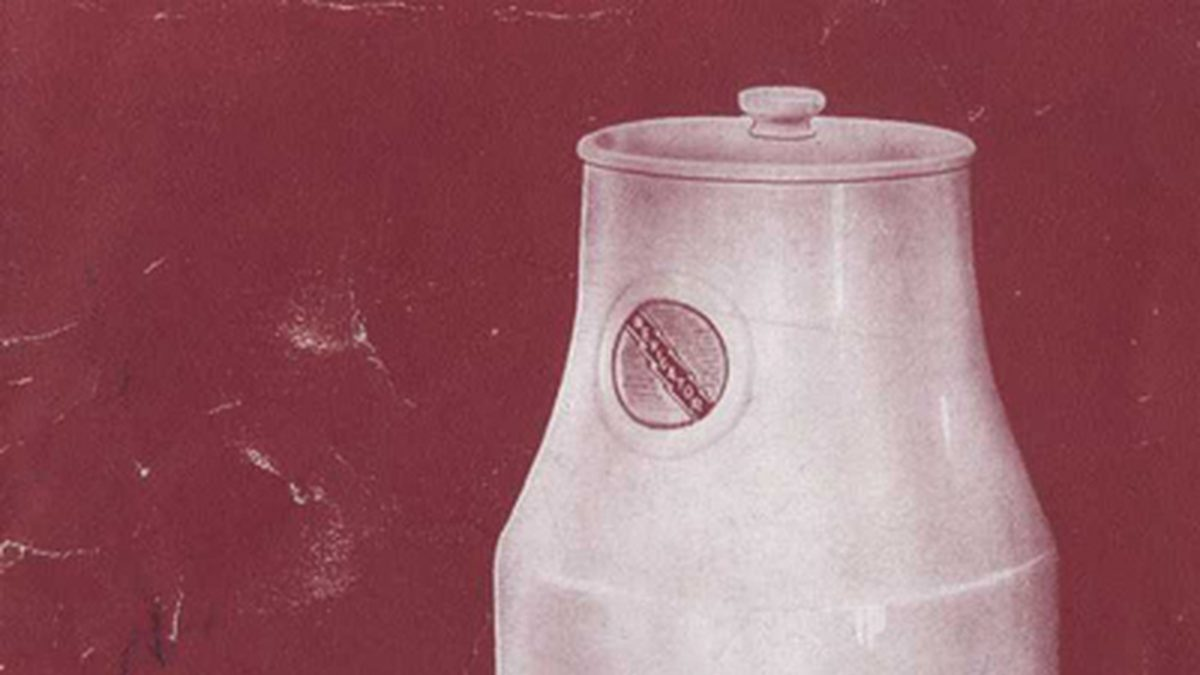
Radithor was not the first radium-water product to reach the market, and it was not the biggest. In 1912 a German immigrant named Curt Schmidt patented a ceramic crock lined with uranium ore; filled with ordinary tap water overnight, it let the water absorb radon gas released by the ore’s decay, in concentrations that ran from hundreds to hundreds of thousands of picocuries per liter. Marketed from the mid-1920s as the Radium Ore Revigator, under the slogan that it offered “nature’s way to health,” the jar sold in the hundreds of thousands of units between 1924 and 1930, with instructions to drink six or more glasses of its water daily.
The Revigator sat on a kitchen counter rather than a medicine cabinet, which mattered: it normalized radioactive water as an ordinary household health habit, not a doctor’s prescription, before Radithor ever asked anyone to buy a bottle. By the time William Bailey entered the market, a meaningful slice of the American public already believed that invisible radioactivity in their drinking water was a wellness feature rather than a warning sign.
Radium-water products were, in fact, the mild end of the fad. In Britain from 1917 a line called Radior sold radium-infused night cream, rouge, face powder, and even wrinkle-fighting chin straps through Harrods, Selfridges, and Boots, promising that the rays would “vitalize and energize all living tissue.” In Paris from 1933, a cosmetics house called Tho-Radia built an entire product line — cream, powder, lipstick, even toothpaste — around thorium chloride and radium bromide, and bottles recovered decades later still registered as radioactive on a Geiger counter. Next to a wrinkle cream advertised as radioactive on purpose, a bottled tonic that merely claimed to cure arthritis looked almost restrained.
William Bailey built an entire company on the same mistake
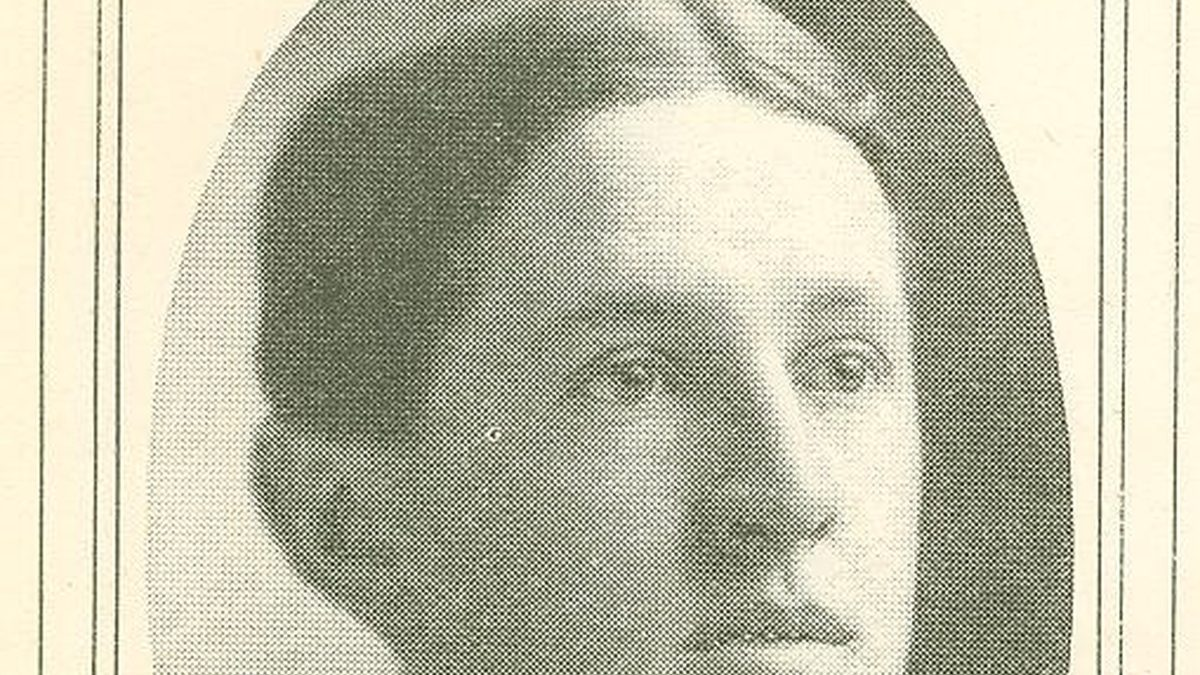
Bailey, born in Boston in 1884, attended Harvard for three semesters and left without a degree. He preferred to be addressed as “Doctor” anyway, on the strength of a doctorate from the University of Vienna that he had not actually earned. By the time he founded Bailey Radium Laboratories in East Orange, New Jersey, he was already a repeat offender: arrested for fraud in 1912 over a fake car company called the Carnegie Engineering Corporation, which took orders and investment money for automobiles it never built; fined and jailed for thirty days in 1915; fined again in 1918 over a bogus impotence cure; and found guilty in 1927 of illegally practicing medicine.
None of it stopped him from selling Radithor as a cure for more than 150 conditions — fatigue, arthritis, and, conveniently, impotence among them — at a profit margin of roughly 400 percent per bottle. Over the back half of the decade the company sold more than 400,000 bottles. Each one delivered a dose the company’s own paperwork was honest about: at least one microcurie each of radium-226 and radium-228, measurable at roughly two microroentgens per hour a foot away and thirty-five on direct contact. Doctors who had no better understanding of nuclear physics than their patients prescribed it in good faith, and pharmacies stocked it next to the aspirin.
Eben Byers made it a daily habit
Byers was exactly the customer that made a quack tonic look respectable: the 1906 U.S. Amateur golf champion and twice runner-up, a wealthy Pittsburgh steel executive, and a man happy to tell his friends what he swore by. In 1927, returning from a Harvard-Yale football game, he fell from an upper berth on the train home and injured his arm. The ache never fully went away, and his physician, trying to help, recommended Radithor.
Byers did not take it occasionally. Beginning in December 1927 he drank it most days for roughly two years, by some accounts averaging close to three bottles a day. Exactly how many bottles he consumed in total is one of the few points where the record genuinely disagrees: some retellings put the figure around 1,400, others estimate 1,000 to 1,500 over the full three-plus years he was a customer, and the number depends entirely on which stretch of his drinking the source is counting. What the sources agree on is that it was enough, and that he kept going until his teeth started falling out, around 1930.
What Eben Byers radium poisoning did to his skeleton
Radium is chemically similar enough to calcium that the body cannot tell the two apart, and it deposits radium the same way it deposits calcium: directly into bone. Once lodged there, it does not pass through and leave. It sits, emitting alpha radiation into the surrounding tissue continuously, for years, from the inside, and the bone it occupies begins to die.
By 1930 Byers’ teeth were loosening and falling out. Within a few years his jawbone was disintegrating outright. Surgeons operated repeatedly, cutting away dead bone in stages, until holes opened through his jaw and into his skull. He died at his Long Island estate on March 31, 1932, at the age of 51. Accounts of the case often repeat a headline attributed to the Wall Street Journal: “The Radium Water Worked Fine Until His Jaw Came Off.” Because his body still carried a dangerous radium burden, he was buried in a lead-lined coffin.
His death moved regulators in a way factory workers’ deaths hadn’t
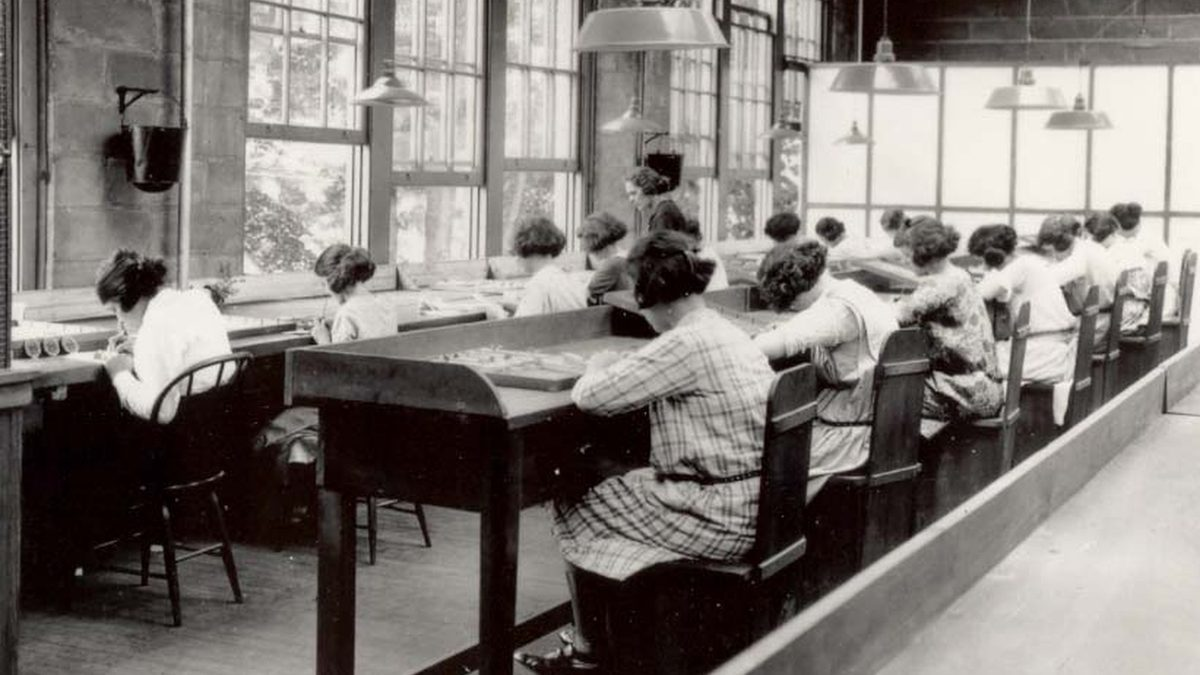
Byers was far from the first American poisoned by this element. Through the 1920s, the U.S. Radium Corporation in New Jersey and similar firms employed an estimated 4,000 women across the country to hand-paint luminous watch and instrument dials with radium paint, instructing them to point their brush tips with their lips to keep a fine edge. The women absorbed radium with every stroke. By 1927, more than fifty of them had died of anemia, bone collapse, and the same jaw necrosis that would later take Byers. Five of the surviving dial painters sued U.S. Radium in 1927; the case settled out of court on June 4, 1928, for $10,000 each and a small annuity, and none of the women lived more than two years past the settlement.
That litigation made headlines and sympathy, but it did not move federal regulators to act against radium quackery at large. Byers’ case did. He testified before the Federal Trade Commission against Bailey in 1931, and on December 19, 1931, the FTC ordered Bailey Radium Laboratories to cease and desist from its safety and therapeutic claims; Bailey did not contest it. The disparity is hard to miss: thousands of working women had been dying in public view for most of a decade, and it took the decline of one wealthy, prominent man to produce a federal order. Byers’ case, alongside the dial painters’ litigation, is still cited among the scandals that built momentum toward the Federal Food, Drug, and Cosmetic Act of 1938, which gave the government, for the first time, real authority to require proof that a product was safe before it reached a shelf.
The man who sold it outlived his customer by seventeen years
Bailey was never criminally prosecuted over Radithor specifically — the FTC’s order was a civil one — and he kept selling radioactive novelties for the rest of his career: a thousand-dollar device called the Radiendocrinator, worn against the skin to restore vitality through a radium-lined pad, and Thorone Tablets, sold as a general tonic in the same vein as Radithor itself. None of it was ever stopped by a criminal court. He died in 1949, of bladder cancer, at 64. When researchers exhumed and tested his remains in 1970, his body was still radioactive, and the measurements pointed to the radiation itself as the likely cause of the cancer that killed him. The man who had spent two decades selling perpetual energy in a bottle had been running on roughly the same slow fuse as the customers he sold it to.
What makes the Radithor story worth returning to is not that a con artist sold something dangerous — that happens constantly and rarely needs retelling. It is that the danger was never hidden. Bailey’s own paperwork stated the radium content accurately. The measurements were real, the dosage was real, and the people prescribing it could have measured the same radioactivity for themselves with equipment that already existed. What was missing was not information. It was anyone with the authority, or the incentive, to act on it before a famous man’s jaw gave out.
Watch the full history
The short version of this story, on William Bailey’s scheme and the year Byers’ case finally reached a courtroom, runs about a minute and a half.

Related reading
- How the Iron Lung Worked, and Who Was Still Breathing Inside One in 2026
- How Many Lobotomies Did Walter Freeman Actually Perform?
- Who Discovered Ether Anesthesia? The Feud That Ruined Three of the Four Men Who Claimed It
- Why Ancient Trepanation Survival Rates Were So High
Shop the styles/items featured in this video
- ☣️ “The Radioactive Boy Scout” and other radium-era history (book)
- 🧪 Vintage-style apothecary bottle / decor piece
- 💡 Radium Girls: The Dark Story of America’s Shining Women (book)
Works cited
- Macklis, Roger M., Marguerite R. Bellerive, and John L. Humm. “The Radiotoxicology of Radithor: Analysis of an Early Case of Iatrogenic Poisoning by a Radioactive Patent Medicine.” JAMA 264, no. 5 (1990): 619–621.
- Evans, Robley D. “Inception of Standards for Internal Emitters, Radon and Radium.” Health Physics 41, no. 3 (1981): 437–448.
- Oak Ridge Associated Universities. “Radithor (ca. 1928).” Health Physics Historical Instrumentation Museum Collection. Link.
- Oak Ridge Associated Universities. “Revigator (ca. 1924-1926).” Health Physics Historical Instrumentation Museum Collection. Link.
- Bennett, James. “Radioactive Cosmetics.” Cosmetics and Skin. Link.
- White, April. “The Radioactive ‘Miracle Water’ That Killed Its Believers.” Popular Science, September 29, 2025. Link.
- Daugherty, Greg. “How a Radium-Laced Health Fad Turned Deadly in the 1920s.” History.com, A&E Television Networks, October 30, 2025. Link.
- Atomic Heritage Foundation / National Museum of Nuclear Science & History. “The Radium Girls.” Link.
- “The Radium Girls: ‘Living Dead Women.’” Headlines and Heroes, Library of Congress blog, March 2019. Link.
- U.S. Food and Drug Administration. “Part II: 1938, Food, Drug, Cosmetic Act.” Link.
- “Byers’ Lead Coffin.” Spark, Institute of Physics. Link.