
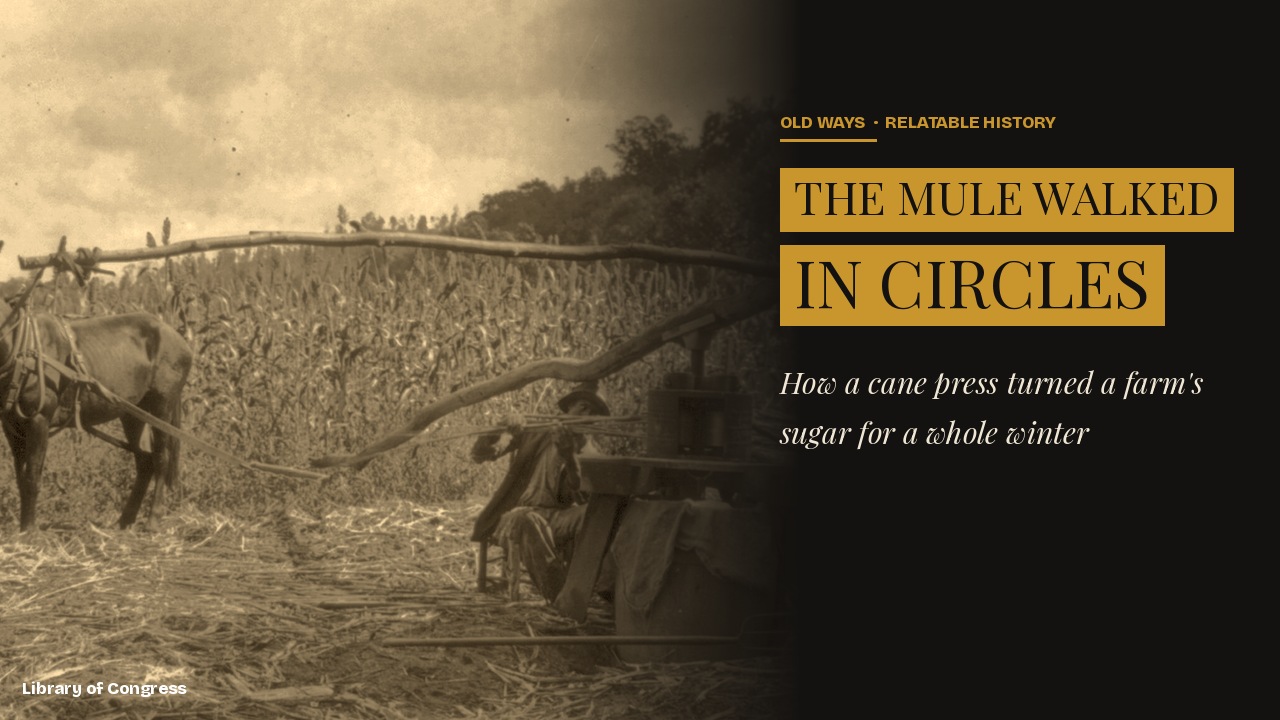
For about forty years after the Civil War, the United States government ran one of its longest-running and least successful agricultural experiments: trying to turn sorghum cane into ordinary granulated sugar. Chemists at the U.S. Department of Agriculture worked the problem for over a decade. The National Academy of Sciences was called in to investigate. State experiment stations built actual sugar factories and ran them for years. Almost none of it produced sugar anyone could sell.
What those same labs and farms got instead, almost by accident, was something that turned out to matter a great deal more to ordinary households: a reliable method for boiling sorghum cane juice down into syrup, standardized by federal bulletin, improved by a wave of competing patents, revived by two world wars, and still made today by hand in a handful of Appalachian and Southern towns that never stopped.
The failure and the success came from the same plant, grown on the same farms, often by the same families. One story is about a government that spent decades chasing an industrial product it couldn’t make work. The other is about millions of households that solved their own, smaller version of the same problem every autumn, the same kind of self-reliance that kept a family in home-dipped tallow candles — until Washington started writing the instructions.
Washington Spent Forty Years Trying to Turn Sorghum Into Real Sugar
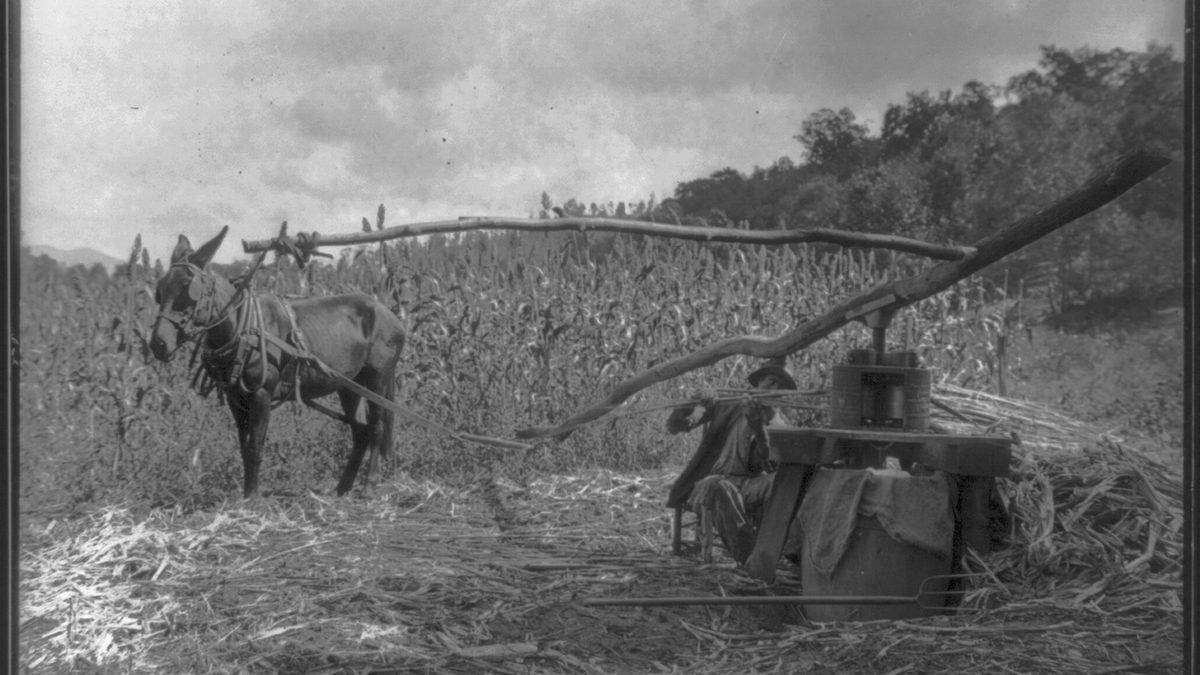
The plant arrived in the United States in the late 1850s by way of a British sugar planter named Leonard Wray, who had spent nearly thirty years in Natal before bringing a strain of Chinese sugarcane sorghum back with him. France noticed the plant’s sugar-producing potential before America did — the first seed sent to the United States reportedly arrived by way of the French horticulturalist Louis de Vilmorin, who credited Wray with introducing the plant in the first place. Within a few years it had spread across both Northern and Southern farms, and sirup-making — the 19th-century spelling the USDA itself used for decades — was already underway in much of the country by the late 1850s and 1860s.
What farmers couldn’t manage, no matter how hard they boiled, was getting that syrup to crystallize into actual table sugar the way cane and beet sugar did. The USDA’s chemical division took up what officials simply called “the sorghum question” around 1878, and on January 30, 1882, Commissioner of Agriculture George B. Loring formally asked the National Academy of Sciences to investigate. The Academy’s 1883 report is blunt about the record so far: commercial sugar-making attempts had mostly failed. Good crude sugar appeared occasionally, and syrup sometimes threw off a few sugar crystals on its own, but nobody had worked out the conditions needed to make it happen reliably.
Kansas became the real laboratory. From 1878 to 1893 the USDA ran sustained sugar experiments in the state, and from 1886 the Kansas Agricultural Experiment Station tested the sugar content of different sorghum varieties, with the state legislature chipping in subsidy money for manufacturing trials in the program’s final years. Named varieties like Black Amber, grown since about 1880, and Standard Sumac and Kansas Orange, both established by 1888, were bred and judged specifically for their sugar yield. By 1893, sorghum sugar production in Kansas had climbed to nearly a million pounds in a single year — and then the whole effort collapsed almost overnight. Low prices, a run of dry years that left the sugar factories short of cane, a harvest window too narrow to process the crop in time, and the arrival of a far more reliable competitor in sugar beets ended the Kansas sugar industry within a few more years. Syrup, not sugar, was what sorghum was actually good for, and by the 1890s almost everyone involved had quietly accepted it.
The Patent Race to Build a Better Syrup Pan
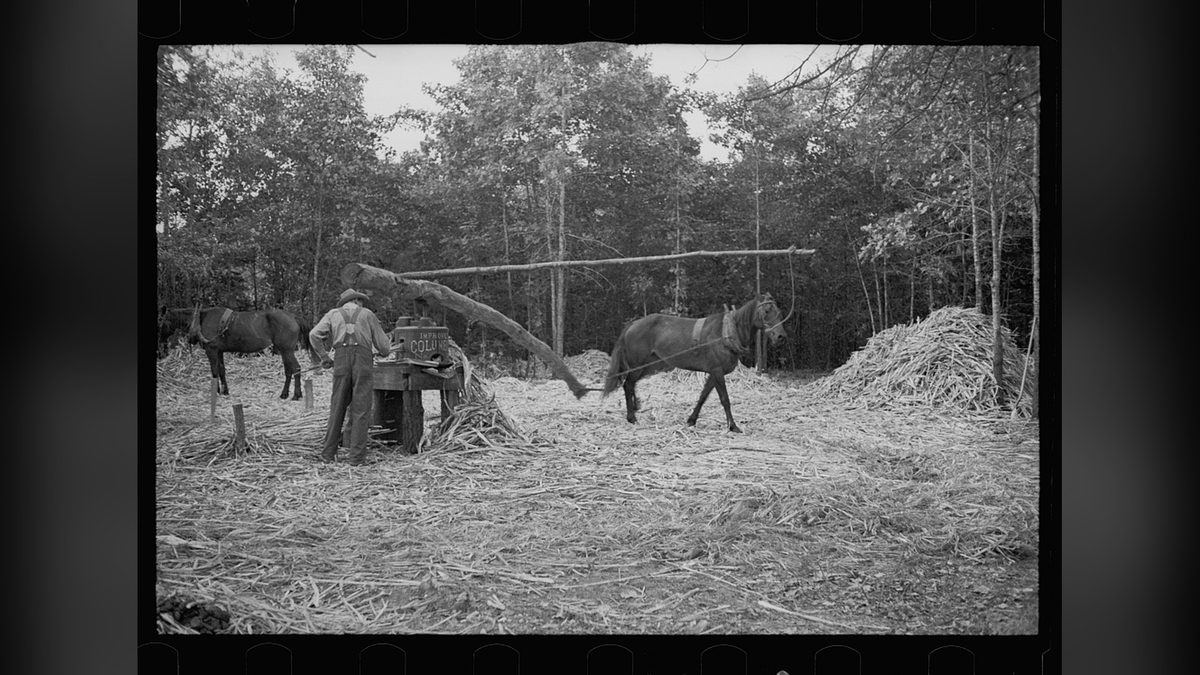
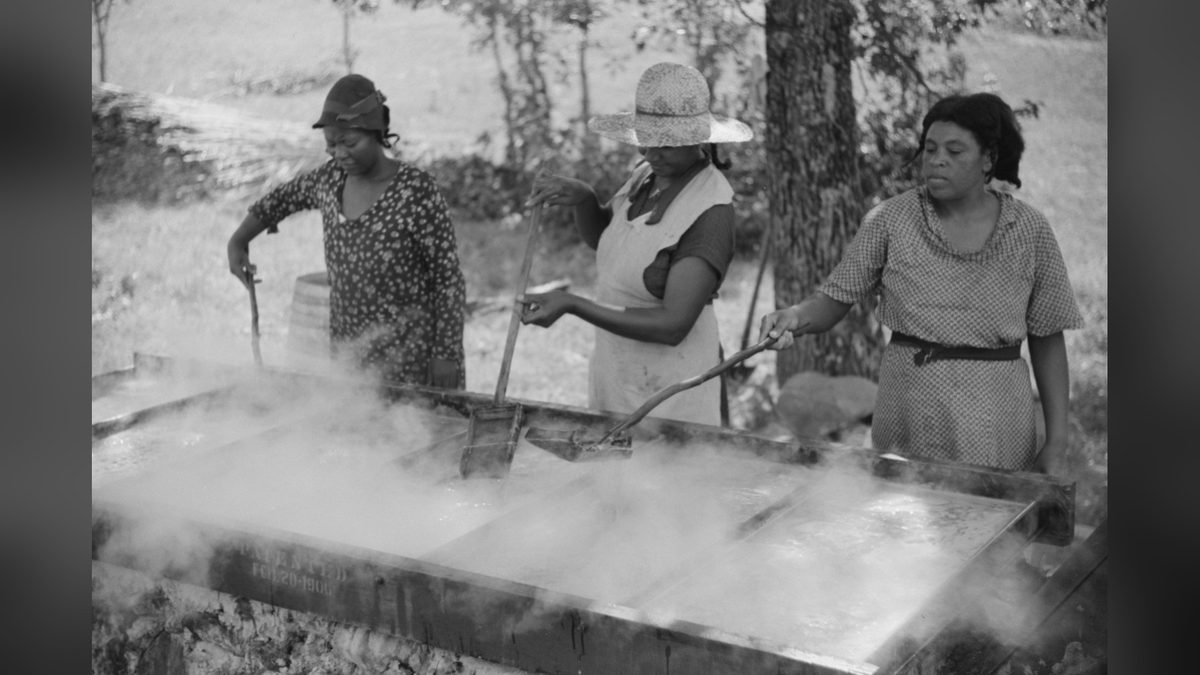
If sorghum sugar was a dead end, sorghum syrup equipment was the opposite — a genuine, competitive field of American invention through the 1860s. The earliest syrup makers boiled juice in a single open kettle, which meant constantly dragging the thickening syrup around by hand to keep it from scorching in one spot. On June 9, 1863, a farmer named N. Z. Potter of Uniontown, Illinois, patented a fix: an evaporating pan divided into a zigzag chain of compartments, each one sloped sideways in an alternating direction so that syrup drained from section to section by gravity alone as it thickened, rather than needing to be pushed along. It was a small piece of engineering, and it mattered — scorched syrup turned bitter and often had to be thrown out after a full day’s work.
A more commercially successful rival came from Daniel McFarland Cook, an Ohio-born tinkerer who patented his own portable evaporator in 1858 and improved it with an internal “drop flue” design in 1863. Cook never built or sold the pans himself; he sold the manufacturing and sales rights to regional firms instead, including Hedges, Free & Co. of Cincinnati, Blymeyer, Bates & Day of Mansfield, and dealers as far off as Vermont. By one count, roughly 6,000 of Cook’s evaporators were already in use by November 1863, and more than 20,000 had been sold by 1868 — marketed for maple sugar country and sorghum country alike, sometimes in the same advertisement. Cook himself never profited much from the design’s success; he lost his own farm and died in 1897 with little money to show for an invention that had, by then, become close to a generic industry standard.
The Government Wrote the Instruction Manual
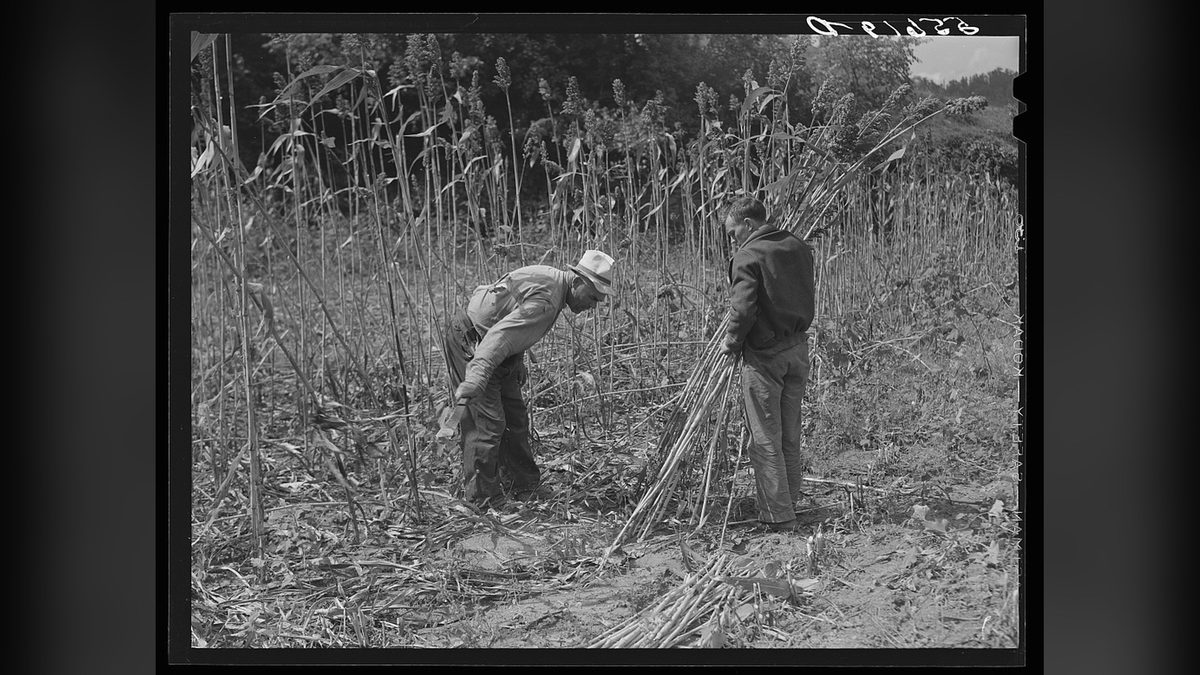
By the early 1900s, with evaporator pans multiplying in dozens of patented and unpatented forms and home production spreading into nearly every region with a frost-free growing season, federal and state extension services stepped in to standardize the whole process. USDA chemist A. Hugh Bryan wrote the department’s Farmers’ Bulletin on sorghum syrup manufacture in 1912, and revised it again in 1918 together with co-authors C. H. Hudson and S. F. Sherwood — specifying exactly how juice should be strained, skimmed, and judged for doneness, down to the texture of the foam and the way finished syrup sheeted off a skimmer.
State agricultural colleges ran their own parallel campaigns. North Carolina’s Agricultural Extension Service, for instance, issued Extension Circular No. 117, Equipment for Making Sorghum Sirup, written by extension specialist M. W. Hensel, laying out recommended mill and pan specifications county by county — the same extension-service logic that, a little later, standardized countless other pieces of farm machinery, right down to the cream separator nearly every dairy farm eventually bought. Multiply the sorghum circular by every sorghum-growing state and the pattern becomes clear: the reason a sorghum mill in the Carolina hills and one in rural Kansas looked so similar by the 1920s wasn’t just shared farm tradition passed hand to hand. It was also a deliberate, decades-long federal and state campaign to put the same tested method in front of every farm family willing to read a bulletin.
When the Government Asked Farmers to Grow More Sorghum
Sugar was the first food rationed in the Second World War, and the push toward home sorghum syrup actually began before the ration books did. On January 29, 1942 — more than three months before sugar sales were formally halted to set up the ration system — the Raeford, North Carolina News-Journal ran an appeal from E. C. Blair, an extension agronomist at North Carolina State College, urging farm families to grow “a crop of sugar” that year, meaning sorghum cane for syrup. Sugar was already visibly running short in grocery stores, Blair noted, and sorghum would grow well in every part of the state.
The full ration system followed that May: an initial allotment of 26 pounds of sugar per person per year, about half of what Americans had used in 1941, with the ration not lifted again until June 1947. For households with a cane patch and a neighbor’s mill, sorghum syrup filled exactly the gap rationing created. The surge shows up clearly in production records — in Alabama alone, sorghum and cane syrup output hit roughly 2,860,000 gallons in 1945, the last full wartime year. By 1954, with sugar rationing a decade in the past and the big commercial syrup brands fully restocked on grocery shelves, that figure had collapsed to about 375,000 gallons — not so different from how a pie safe full of home preserves mattered most exactly when store shelves ran thin. A plant that briefly mattered to the whole country’s sugar supply went back to being a regional specialty within less than ten years.
The Tradition That Outlived the Need for It
Once cheap, plentiful refined sugar came back for good after 1947, the economics of a mule, a mill, and a full day’s skimming stopped making sense for most families, and thousands of mills were sold for scrap or simply left to rust in a fencerow. But the practice never fully died out — in a handful of places, communities deliberately kept it running as heritage rather than necessity. The Sorghum Festival in Blairsville, Georgia, traces back to 1969 and, according to founder Junior Bridges, started with little more than a few volunteers and a funeral tent set up on the town square. Local government later donated land where the group — then the Blairsville Jaycees, now the Blairsville Sorghum Syrup Makers — built a permanent cooker in 1971. The festival still runs two full weekends every October, grinding cane with a mule-driven mill and cooking it down in a wood-fired evaporator much the way a fall husking bee once turned hard seasonal labor into a community event, with proceeds now funding scholarships and family support through Enotah CASA for Children.
Hancock County, Kentucky, which still markets itself as the “Sorghum Capital of the World,” revived its own county festival in the early 2000s specifically as a tourism and farm-income strategy after production had dwindled — some producers there now run syrup both ways side by side, through a modern power mill for volume and a horse- or mule-powered mill for demonstration, so visitors can see the method that fed their grandparents’ generation. What’s left of the industry today sells as a boutique product rather than a household necessity, prized by cooks specifically for the deep, slightly smoky flavor that refined sugar never had — a strange kind of comeback for a crop that millions of families once grew purely because they had no other choice.
Watch the short
No long-form video exists yet for this topic — the clip below is the original 44-second short, which covers the mule-powered mill itself.

Related reading
- How Cream Separators Worked, and Why Every Farm Wanted One
- The Pie Safe That Kept Flies Out With Nothing But Holes
- What Finding a Red Ear of Corn Actually Meant at a Husking Bee
- How Tallow Candles Were Made, and Why Candle Day Was Dreaded
- The Spinning Wheel’s Economics Were Worse Than You Think
Works cited
- National Research Council. Investigation of the Scientific and Economic Relations of the Sorghum Sugar Industry: Being a Report Made in Response to a Request From the Hon. George B. Loring, Commissioner of Agriculture. Washington, D.C.: National Academies Press, 1883. Link.
- Bryan, A. Hugh. Sorghum Syrup Manufacture. Farmers’ Bulletin. Washington, D.C.: U.S. Department of Agriculture, 1912. Link.
- Bryan, A. Hugh, C. H. Hudson, and S. F. Sherwood. Sorghum-Syrup Manufacture, rev. ed. Washington, D.C.: U.S. Department of Agriculture, 1918. Link.
- Hensel, M. W. Equipment for Making Sorghum Sirup. Extension Circular No. 117. Raleigh: North Carolina Agricultural Extension Service.
- Potter, N. Z. “Improvement in Evaporating-Pans for Sorghum-Juice.” U.S. Patent 38,839, filed June 9, 1863. Link.
- Sorghums for Kansas. Bulletin 304. Manhattan: Kansas Agricultural Experiment Station, Kansas State College. Link.
- Harden, Sid. “Sugarcane and Sorghum Syrup Production.” Encyclopedia of Alabama. Link.
- Blair, E. C., quoted. “Sugar Is Becoming Scarce.” The News-Journal (Raeford, N.C.), January 29, 1942, p. 1. Link.
- Thomas, Matthew. “Evaporator Company Histories: Cook’s Patent Evaporator.” MapleSyrupHistory.com. Link.
- Jones-Wall, Mikala. “A Whole-Town Family Reunion: The Blairsville Sorghum Festival.” Salvation South, October 14, 2023.