
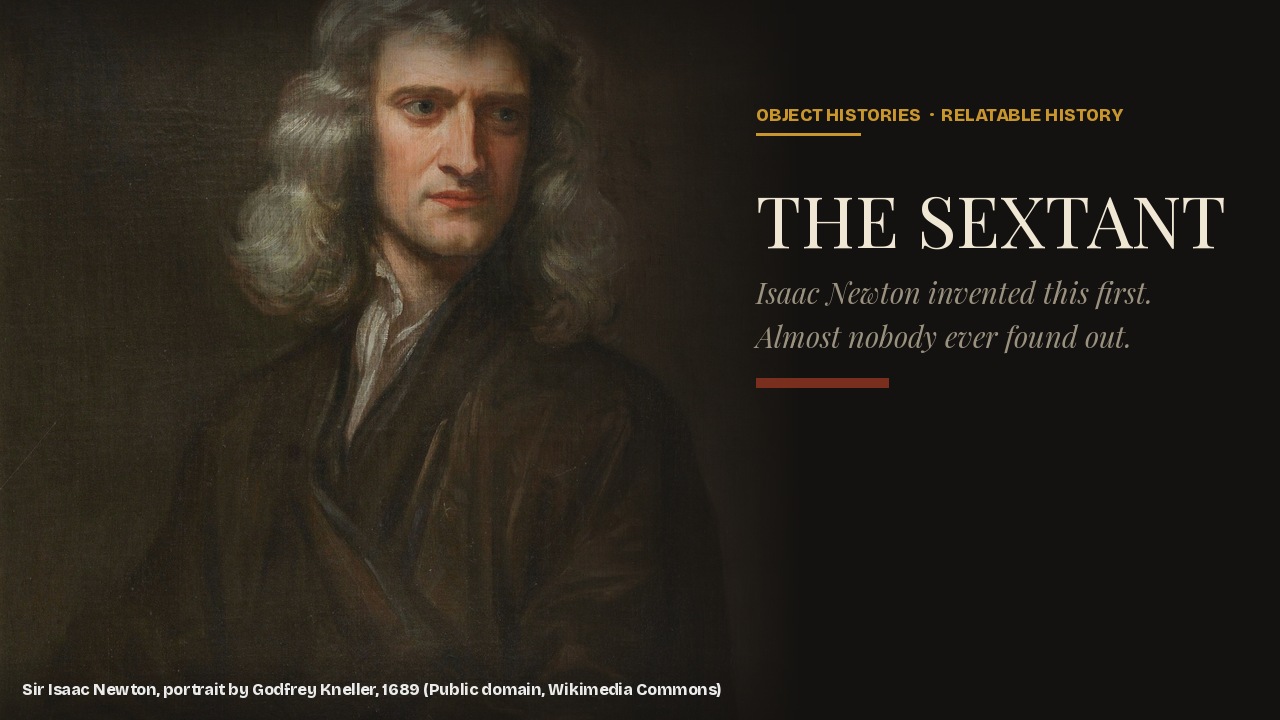
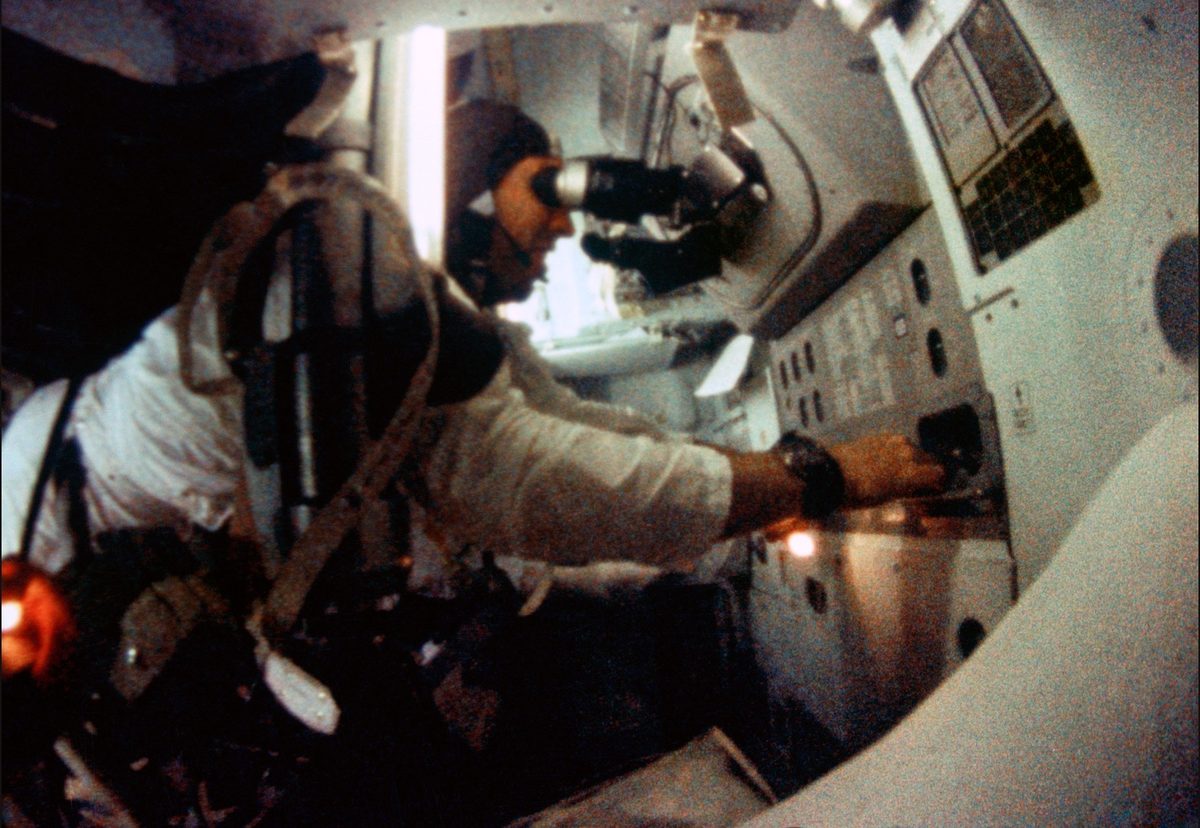
At 105 hours and 18 minutes into Apollo 13’s flight, with the spacecraft’s main guidance computer powered down to save the little electricity and water the crew had left, Mission Control talked them through a course-correction burn flown entirely by eye. Jim Lovell held the ship steady by keeping Earth lined up against a mark on his window; Jack Swigert timed the burn on his own wristwatch. It lasted fourteen and a half seconds, and it worked. No computer touched it, and no sextant either — just eyes, a window mark and a watch.
That is the condition the sextant was built for. Long before anyone needed to fly a disabled spacecraft home, sailors needed a way to know exactly where they were on an ocean with no landmarks, using nothing but a star, a horizon and their own hands — and once that problem was solved, in the 1730s, the solution turned out to be so good that nobody meaningfully improved on its mechanism for the next two hundred and fifty years. It flew on Apollo as backup to the very computer Lovell’s crew had to switch off, and it is the reason a handful of people, in very different centuries, came out of genuinely desperate situations alive.
Here is how the thing actually works, and the places — a bomber cockpit, an open lifeboat in the Southern Ocean, a spacecraft, a modern destroyer’s bridge — where that mechanism kept getting called back into service.
How a sextant works: two mirrors instead of a steady horizon
A sextant has two mirrors, and the whole instrument is built around what happens when light bounces off both of them in sequence. The index mirror is fully silvered and mounted on a moving arm; swing the arm, and the mirror swings with it. The horizon mirror is fixed to the frame and only half-silvered, so a navigator looking through the instrument’s small telescope sees two things at once in the same sightline: the horizon, straight through the clear half of the horizon mirror, and whatever the index mirror is reflecting, bounced across to the mirrored half.
The optics obey a fixed rule — when a ray reflects off two mirrors in turn, the angle between the original ray and the final one is exactly double the angle between the mirrors. Swing the index mirror 30 degrees off parallel, and the star’s reflected image shifts a full 60 degrees relative to the horizon. That doubling is also where the instrument’s name comes from: its arc only needs to span a sixth of a circle, 60 degrees, to measure altitudes up to 120 degrees.
It is also the whole reason the thing works on a moving deck. The star’s reflected image and the horizon seen through the clear glass are locked into the same field of view, so when the ship rolls, both references move together and the angle between them barely changes. A navigator bracing against a pitching deck does not need a steady platform. The instrument supplies its own.
A drum geared to a fifth of a nautical mile
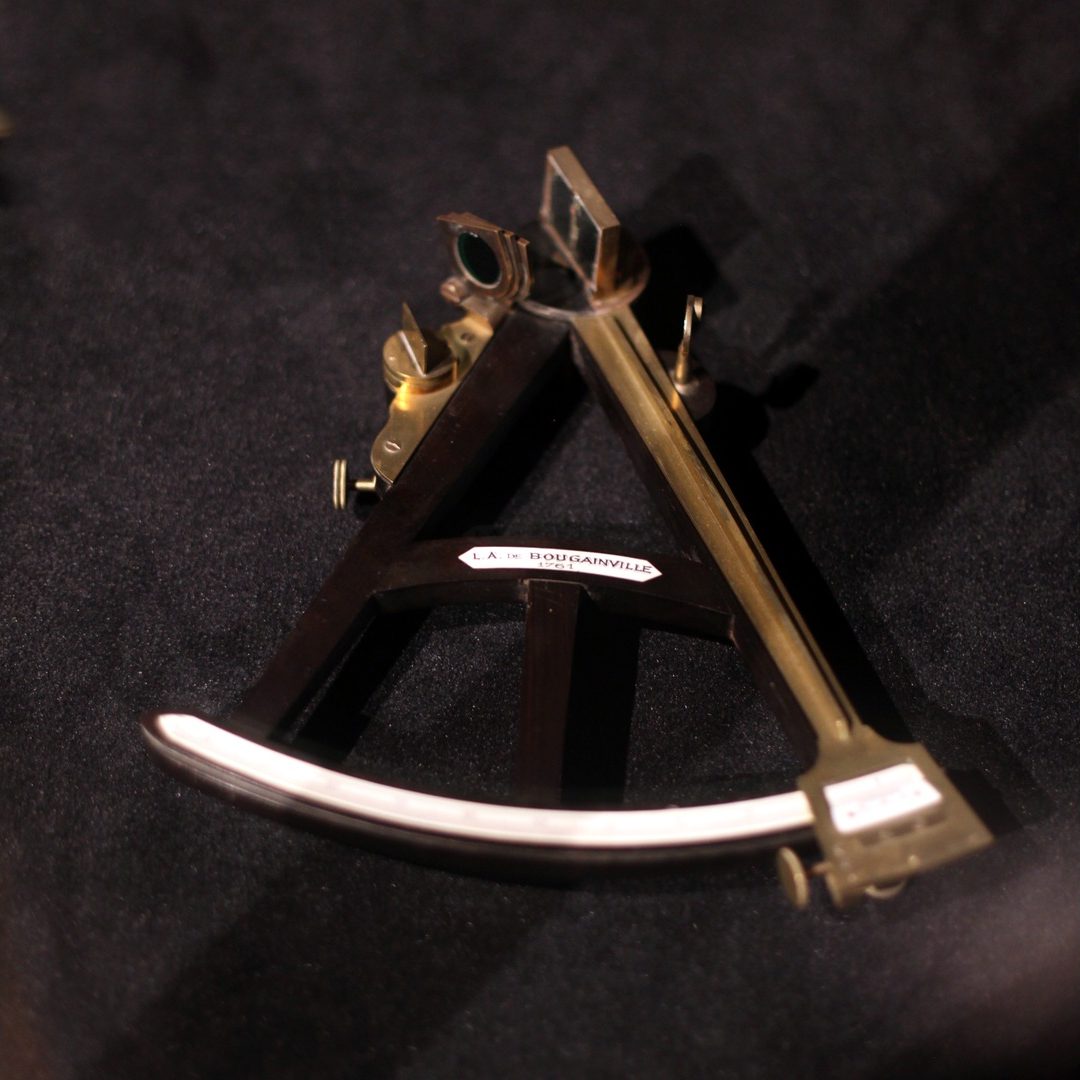
Reading the big arc alone only gets a navigator to the nearest whole degree, which is far too coarse — one minute of arc, a sixtieth of a degree, corresponds to roughly one nautical mile of position error, so sloppy reading translates directly into being lost. The fine reading comes from a micrometer drum at the base of the index arm, geared to the worm-and-rack mechanism that moves the arm itself. A navigator brings the star down to the horizon with the arm’s clamp released, then turns the drum for the final, precise alignment, reading minutes and fractions of a minute off its scale — on a good instrument, to within a fifth of an arcminute, which is to say a fifth of a nautical mile.
None of that means anything if the instrument itself is lying. The standard check is index error: set the arm to exactly zero using the drum and clamp, then look at the horizon. If the two mirrors are not perfectly parallel at that setting, the true horizon and its reflected twin will not quite line up — a visible step where there should be a single unbroken line. A small adjustment screw on the horizon mirror corrects it, though fixing it tends to introduce a second, smaller misalignment in the other direction, so the two adjustments are made in alternating, shrinking steps until both settle. Whatever error is left over after that gets subtracted by hand from every sight taken that day.
One sighting draws a circle around the whole Earth
A single sextant reading is an altitude: how many degrees above the horizon a particular star stood at a particular, precisely logged moment. On its own, that number describes an enormous circle on the Earth’s surface, centred on the point directly under the star, because every observer standing anywhere on that circle would measure the exact same altitude. The navigator calculates what the altitude ought to have been from a rough guessed position, compares it to what the sextant actually measured, and the difference between the two — the “intercept,” expressed directly in nautical miles because one minute of arc equals one nautical mile — says how far off that guess was, and in which direction. One star gives a line. Sight two or three different stars in the same session and their lines cross at a single point: an actual fix, accurate on a good night to a mile or two, computed with nothing but angles, a clock and a book of tables.
Bubbles replaced the horizon when there was no horizon to see
A marine sextant needs a visible sea horizon as its second reference, which an aircraft often does not have — above cloud, at night, or banking through a turn, there is nothing level to sight against. Aviation solved it by replacing the horizon mirror’s view outward with a small internal spirit-level bubble, centred in the field of view as an artificial horizon the navigator could align the star against instead. The U.S. Army Air Forces’ A-10A bubble sextant became one of the most common instruments of its kind, with tens of thousands built during the war and many still in service into the 1950s; a more sophisticated version built by Ed Link, better known for his flight simulator, added an averaging mechanism that automatically smoothed out several readings to cancel the aircraft’s own short, irregular rolling motion in turbulence.
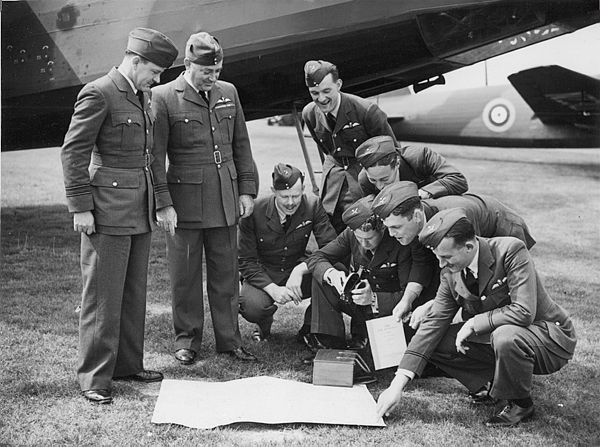
A 1939 photograph of New Zealand’s No. 75 Squadron, taken in front of a Wellington bomber, shows exactly how deliberate the whole process was on the ground before a flight: a cluster of airmen crouched around a map spread on the grass, one of them, Pilot Officer Trevor Freeman, holding the bubble sextant itself, another holding the squadron’s copy of the Air Almanac, the annually published tables of star and sun positions no celestial fix could be worked without. Night navigation over Europe, with no lit landmarks below and frequently no radio aid that could be trusted, leaned on exactly this kit.
A lifeboat navigator’s four good sightings in sixteen days
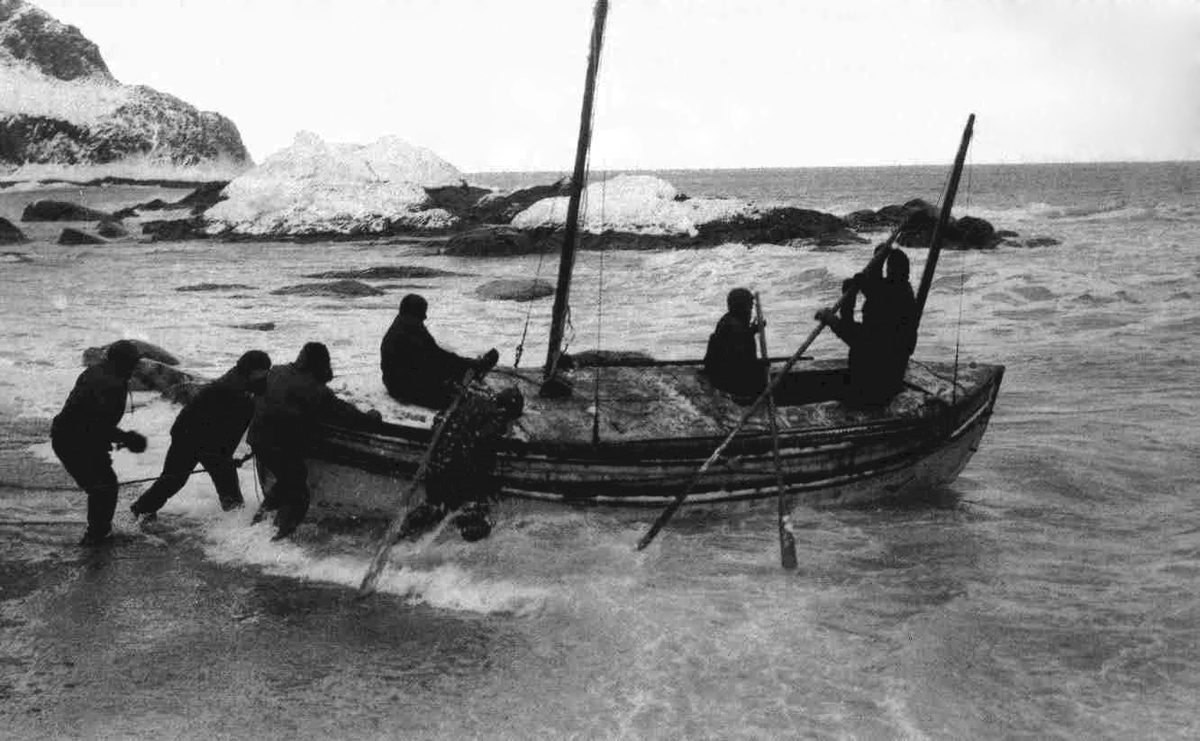
In April 1916, after Ernest Shackleton’s ship Endurance had been crushed in Antarctic pack ice, its captain and navigator, Frank Worsley, took a small sextant with a Heath & Co. telescope aboard the ship’s boat the James Caird for an 800-mile open-boat crossing to South Georgia — the only realistic chance of reaching help. Across sixteen days at sea, Worsley later reckoned he managed only four usable sightings; the sun broke through the Southern Ocean’s permanent storm cover perhaps once or twice a week, for long enough to shoot. He took them kneeling on a thwart, held upright by two crewmen, while the boat leapt on the crest of each wave and dropped away beneath him. Missing South Georgia by even a small margin meant drifting past it entirely, with nowhere to make landfall for another three thousand miles. He did not miss.
The backup that flew to the moon
Each Apollo command module came equipped with its own 28-power sextant, built into its own navigation station, alongside a wider-field scanning telescope for identifying stars in the first place — the same double-mirror principle used at sea, adapted for sighting a star against a landmark on the lunar horizon or the Earth’s edge instead of an ocean horizon, to let the crew check and correct their guidance platform’s alignment independent of any signal from the ground. On Apollo 13, after the oxygen tank explosion forced the crew into the undamaged lunar module and the computer went dark to conserve power, that redundancy is exactly what the mission had been built around — a navigation method that needed no electricity at all once the humans aboard had worked out, by eye and by hand, what to point at.
Why the U.S. Navy brought it back
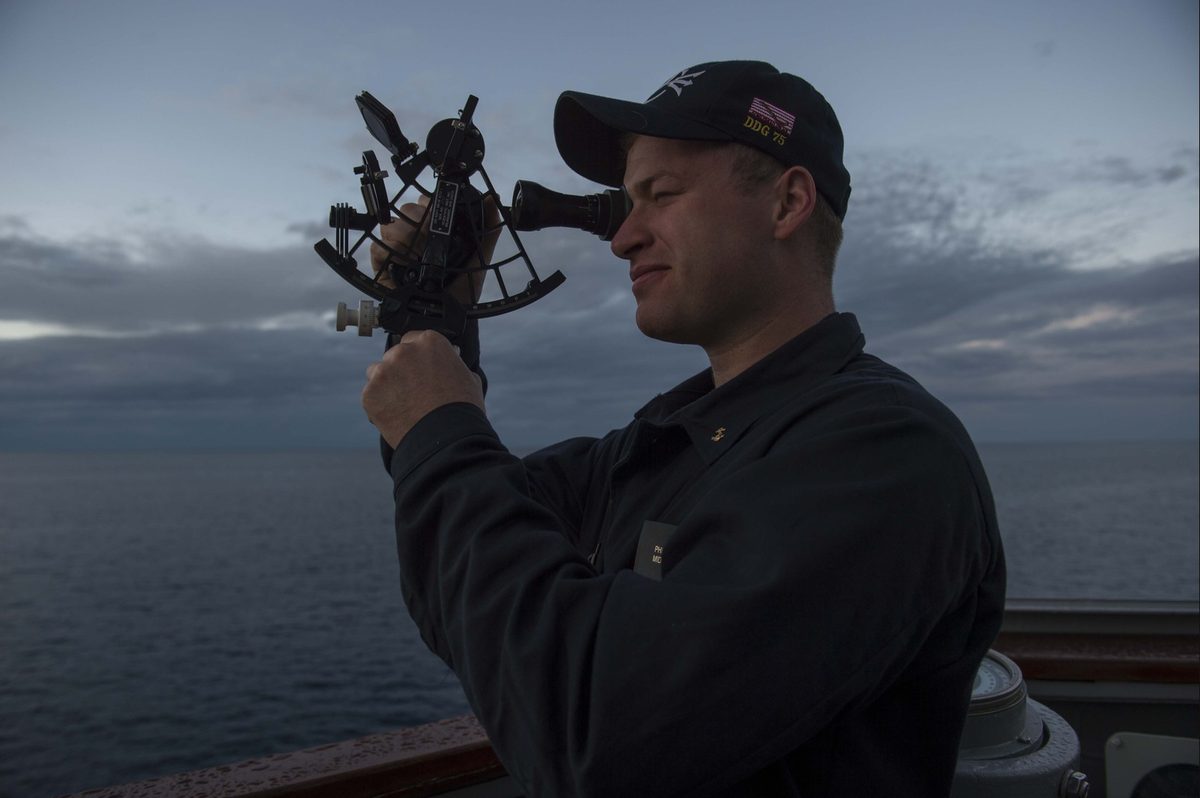
Celestial navigation disappeared from the U.S. Naval Academy’s classrooms in 1998, after a 1996 review judged it outdated under then-Superintendent Adm. Charles Larson; by the academy’s 2010 training manual, it had been dropped from the books entirely. It came back in 2015, as a short three-hour module, with the Class of 2017 the first to graduate having had any exposure to it at all. The officers who pushed for its return were not primarily worried about a satellite simply switching off; Lieutenant Commander Ryan Rogers tied the decision to the fleet’s broader cyber vulnerability, a GPS signal that could be spoofed or jammed rather than one that fails outright. The Navy had ended fleet-wide celestial training in 2006 and only resumed training officers in it in 2011, a gap of exactly the years GPS was treated as sufficient on its own. Weems & Plath, a maker of marine instruments, reported that sextant sales had fallen sharply across that same stretch.
None of that required a new instrument. The sextant a midshipman picks up today reads the same arc, through the same doubled reflection, that Hadley’s first working model read in 1731. What changed is only ever the reason to trust it again: no batteries to fail, no signal to spoof, nothing it needs from outside the ship but a horizon, a clear patch of sky, and someone who knows how to read the drum.
Who actually thought of it first is still argued
The familiar version of the invention story credits the English mathematician John Hadley, who brought a working reflecting octant before the Royal Society in 1731, with the Philadelphia glazier Thomas Godfrey independently building something close to the same device the same year and a long transatlantic dispute over credit following. A 1940 account in the U.S. Naval Institute’s Proceedings complicates the usual telling in both directions: it dates Godfrey’s own design to the spring of 1730, disclosed to the Philadelphia scholar James Logan and sea-tested on a voyage to Jamaica between November 1730 and February 1731 — which, if accurate, puts Godfrey’s working instrument more than a year ahead of Hadley’s own Royal Society presentation on 13 May 1731. The same account states flatly that Godfrey was never actually paid a cash award by the Royal Society for the claim, contrary to the version of the story that has circulated since. Separately, Hadley’s octant was sea-tested by the astronomer James Bradley to an accuracy of about one arcminute and was, in the historical record that actually survives in print, the design that spread: it is Hadley’s 1731 paper in the Royal Society’s Philosophical Transactions, not Godfrey’s sea trial, that put the double-reflecting principle in front of the instrument makers who then built on it. Two and a half centuries on, the paper trail still does not fully settle who gets to be called first.
Watch the full history
The video traces the Hadley–Godfrey dispute and Newton’s forgotten 1699 design in full; this piece picks up where it leaves off, on the mechanism itself and what came after.

Related reading
- Drift Bottle Science: How Sealed Notes Helped Map the World’s Oceans — the other low-tech tool that let sailors map an ocean with no instruments beyond patience.
- The Nebra Sky Disc Dating Dispute, Explained — a much older instrument built to read the sky, and the argument over when.
- The Strange, Three-Thousand-Year History of the Ship’s Figurehead — another fixture of the same quarterdeck a sextant was read from.
- How Scrimshaw Was Made, From Whale’s Tooth to Keepsake — what sailors on the same long watches carved to pass the time.
Shop the story
Works cited
- Kym. “How Sextants Work: An Illustrated Guide.” Casual Navigation. Link.
- Bowditch: The American Practical Navigator, Vol. 1, Chapter 19, “Sight Reduction.” National Geospatial-Intelligence Agency. Link.
- “Tools of the Trade.” Time and Navigation, Smithsonian National Air and Space Museum.
- “Group of No. 75 Squadron Pilots Examining a Map and a Bubble Sextant in Front of a Wellington, 1939.” Air Force Museum of New Zealand collection, via Digital New Zealand. Link.
- Heath & Co. sextant telescope, Shackleton Endurance Expedition, 1914–16. Scott Polar Research Institute Museum, University of Cambridge. Link.
- McCahey, Daniella. “How Shackleton’s Navigator Saved the Crew of the Endurance.” The Maritime Executive, March 13, 2022. Link.
- “Houston, We’ve Had a Problem.” NASA history office. Link.
- “Naval Academy Reinstates Celestial Navigation.” Military Times, November 1, 2015. Link.
- “American Inventor of the Reflecting Quadrant.” U.S. Naval Institute Proceedings, August 1940.
- O’Connor, J.J., and E.F. Robertson. “John Hadley.” MacTutor History of Mathematics Archive, University of St Andrews. Citing Hadley, “The Description of a New Instrument for Taking Angles,” Philosophical Transactions 37 (1731). Link.