
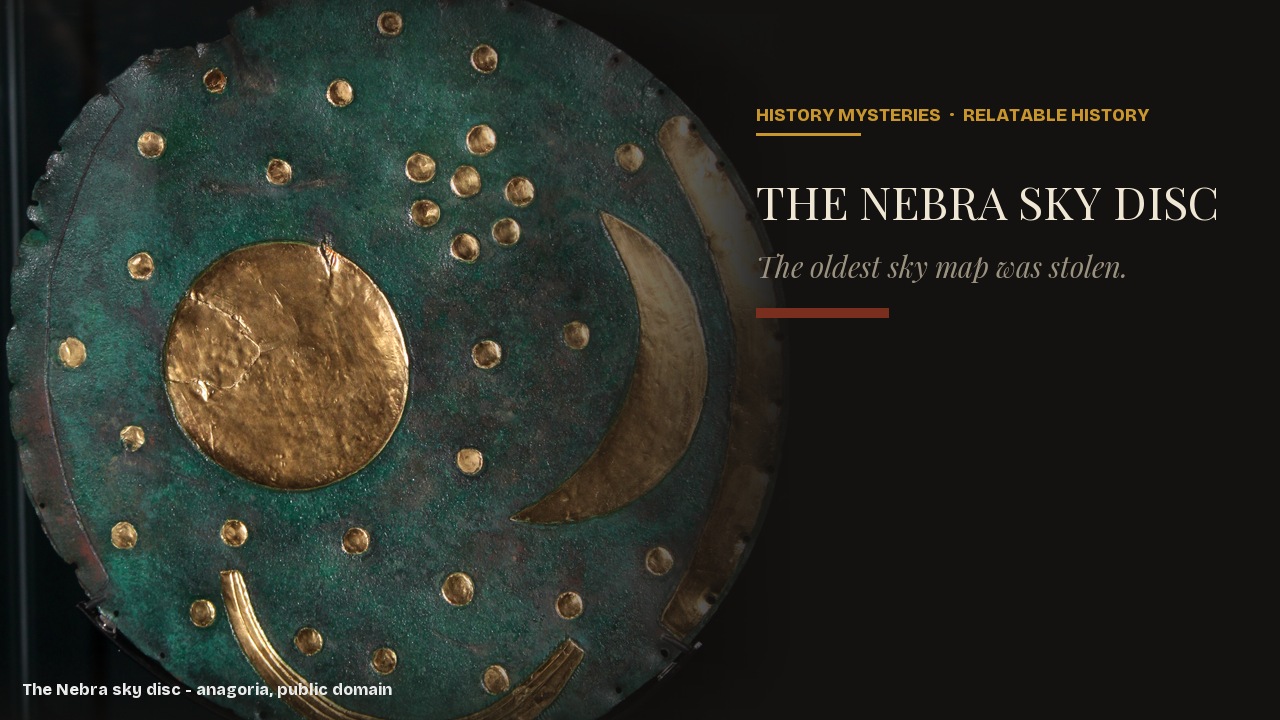
In November 2020 the museum that owns one of the most famous objects in European prehistory published a formal rebuttal to a claim that its own prize exhibit might not be what the label said. The claim had come from two respected German archaeologists, not from a skeptic with a blog, and it was not about whether the object was genuine. It was about whether the date on the wall was off by roughly a thousand years.
The object is a bronze plate a little under a foot across, gone the blue-green of weathered copper, with a sun or full moon, a slim crescent, and three dozen small gold dots standing in for stars worked into its face. Seven of those dots sit close enough together that most people who look at the disc read them as the Pleiades, the star cluster visible to the naked eye across most of the inhabited world. For two decades it has carried the label ‘the oldest known concrete depiction of the cosmos,’ dated to roughly 1600 BC. The 2020 paper argued that label might belong a good thirteen centuries later.
This is the Nebra Sky Disc dating dispute in full: what the gold actually shows, how a hoard gets dated once the people who dug it up are the only witnesses to where it came from, and the specific evidence each side put on the table.
The gold went on in at least three separate sittings
The bronze disc was cast first, plain. The earliest layer of gold came afterward: the thirty-two small dots, the large round plate read as a sun or full moon, and the crescent. Researchers can tell this layer came first because of what happened to it later — some of those dots had to be moved or simply covered over when the next addition arrived, which only makes sense if they were already there.
The second addition was a pair of gold arcs, set along opposite edges of the disc, made from gold with a measurably different trace-element signature than the first phase. Fitting them cost the original design one star relocated and two more hidden underneath, leaving thirty of the original dots visible. A third arc went on after that, along the bottom edge, in gold from a third source again — usually read as a boat, sometimes with faint strokes taken for oars. Last of all, between thirty-eight and forty small holes were punched around the rim, close enough together that the exact count is uncertain where the edge itself has been damaged.
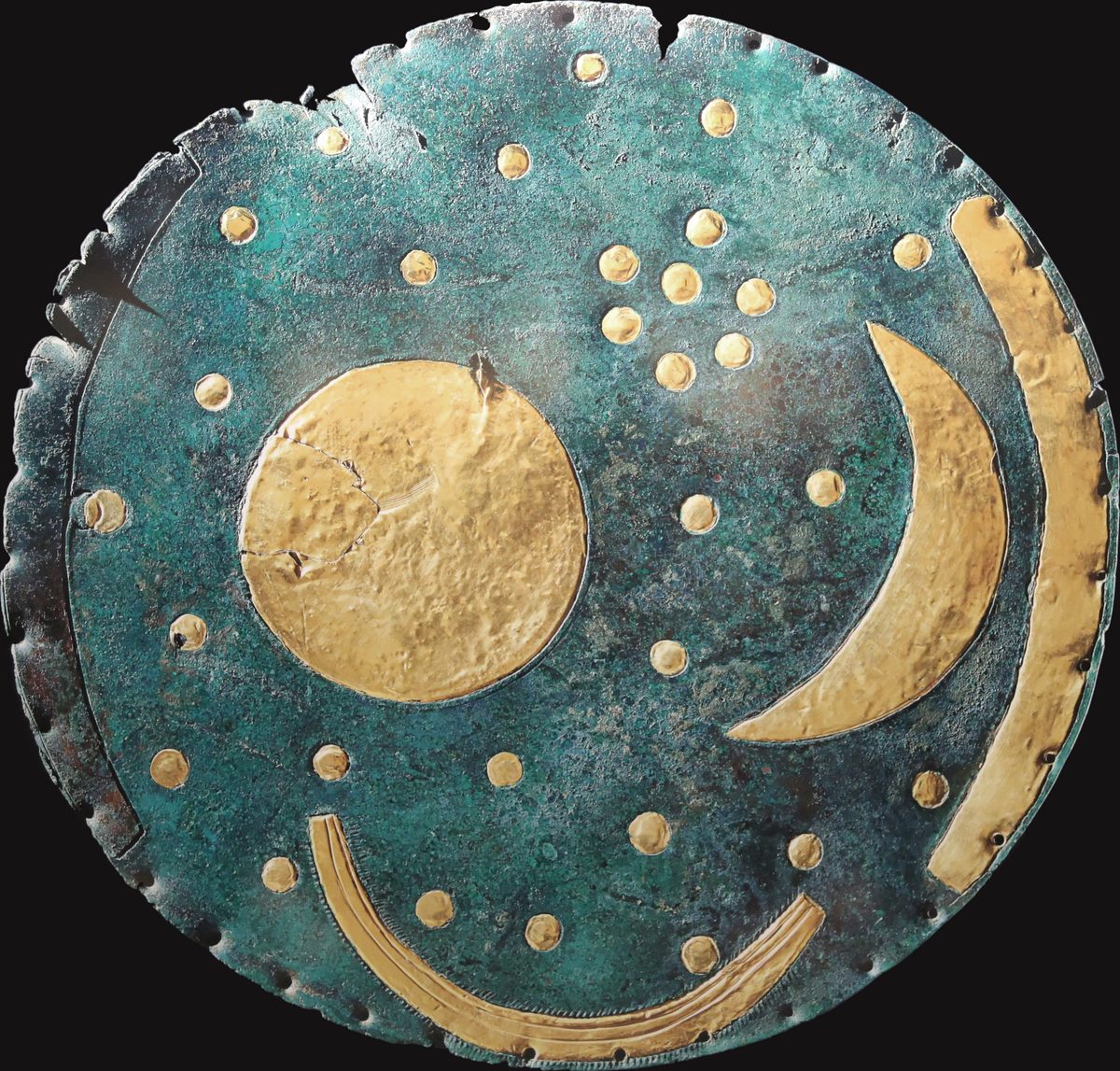
None of this is guesswork about style. It comes from analysing the metal itself: three distinguishable gold sources, applied in a sequence that left physical evidence of the order, on top of one casting of bronze. Whoever finished the object did not design it in one sitting and was not shy about reworking an existing, presumably valuable, religious or ceremonial piece to add new information to it.
The two side arcs turn the picture into an instrument
The horizon arcs span roughly 82.7 degrees. At the latitude of the Mittelberg, the hill near Nebra where the disc was dug up, that is the precise angular distance between where the sun sets on the longest day of the year and where it sets on the shortest. Stand on the hill and sight along the upper end of the western arc and the line runs to the Brocken, the highest point in the Harz range on the horizon — exactly where the sun goes down at the summer solstice. That is not a coincidence anyone has managed to explain away: it ties the object to one specific hilltop and one specific sky.
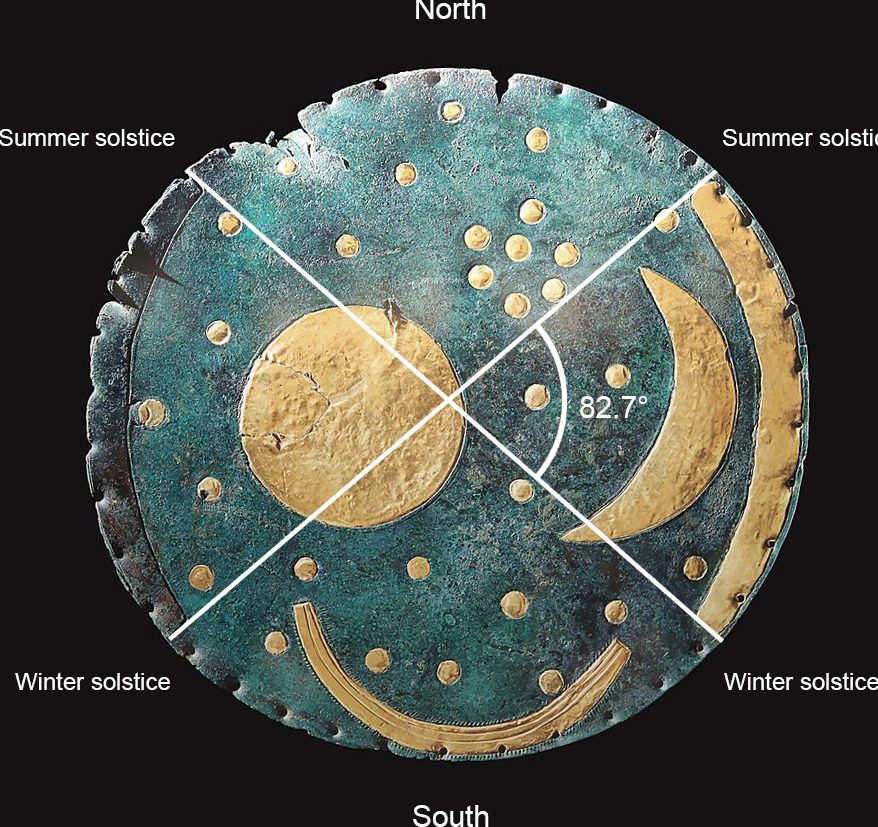
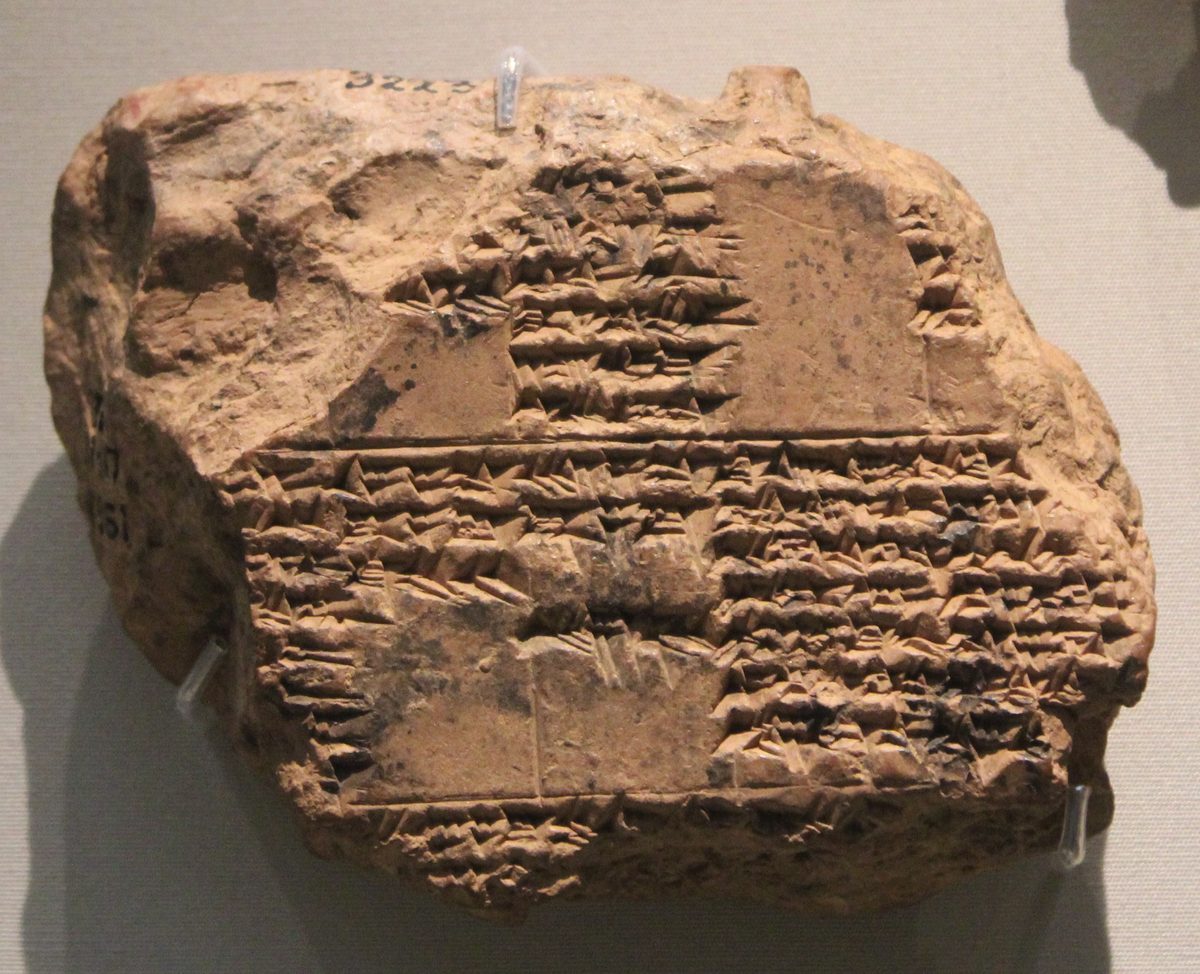
The stars carry a second, more contested reading. A few researchers have proposed that a young crescent moon positioned beside the Pleiades records a rule for inserting an extra month into a lunar calendar — something every lunar calendar eventually needs, since twelve lunar months run about eleven days short of a solar year. A comparable rule turns up nine centuries later in MUL.APIN, a Babylonian compendium of star lore and calendar instructions, though several Assyriologists and astronomers think the resemblance is coincidental rather than a shared tradition. Other proposals exist alongside it: one argument reads the thirty-two gold dots as encoding the rough equivalence of thirty-two solar years to thirty-three lunar ones, and a separate paper has argued for a nineteen-year Metonic cycle instead. None of these readings is settled, and the disc carries no writing of any kind to confirm any of them — every calendar interpretation is an inference drawn from geometry, not a translated instruction.
Dating a hoard means dating everything buried with it
Bronze and gold cannot be radiocarbon dated directly, so a Bronze Age hoard is normally dated two other ways: by comparing the style of its metal objects to other hoards whose place in the sequence is already secure, and by radiocarbon-dating any organic material that happened to survive alongside them. Both applied here. The swords buried with the disc are typed as early examples of the Sögel style; the chisel compares closely to the Kläden hoard; the fragments of spiral arm ornament compare to the Luzice hoard. All three comparisons place the group in the same late phase of the Únětice culture, conventionally dated to around 1600 BC.
The one piece of absolute dating available came from an unglamorous source: birch-bark fragments that had been wrapped around one sword’s hilt as a grip. Radiocarbon analysis in 2005 returned a range of 1681 to 1401 BC — consistent with, though wider than, the typological estimate. That is also precisely what makes the whole case fragile. The disc itself has nothing organic on it and nothing stylistically unambiguous about it; its date has always depended entirely on the assumption that it was genuinely buried together with the swords, the axes and the arm rings, and not merely found near them by two men digging without a permit.
The Nebra Sky Disc dating dispute started with a five-centimetre gap
Rupert Gebhard, director of the Bavarian State Archaeological Collection, and Rüdiger Krause, a prehistorian at Goethe University Frankfurt, published their challenge in Archäologische Informationen in 2020, built from the published excavation reports and the looters’ own testimony across two separate criminal trials. The detail they fastened on: the two men told investigators the disc had been lying only about five centimetres under the surface, while Bronze Age material elsewhere at the site, including in the official 2002 excavation, generally sat fifteen to twenty centimetres down.
Gebhard’s reading of that gap was not that the looters were lying about the depth, but that the depth was real and the disc had therefore probably come out of a different spot on the hill entirely — nowhere near the swords and axes that have anchored its date ever since. Without a provable link to that typologically dated group, he and Krause argued, the disc has to be judged on its own stylistic terms, and those terms, in their view, sit more comfortably in the ornamental world of the Iron Age, roughly 800 to 50 BC, with Gebhard’s own estimate closer to 500 BC. They were also unconvinced by the sun-boat reading of the bottom arc, suggesting a rainbow instead and pointing to comparable motifs on Iron Age Celtic swords, while admitting they had no alternative explanation for the side arcs at all. If they were right, the disc would not just be younger — it would stop being the oldest known sky map by a wide margin.
The reply ran to thirty-four pages, soil samples and lead isotopes
The response, in Archaeologia Austriaca in 2020, carried thirteen names led by archaeometallurgist Ernst Pernicka, with Harald Meller — the state archaeologist who recovered the disc in 2002 — among the co-authors. Its evidence does not depend on the looters’ account of where they were standing. Forensic soil analysis compared sediment still clinging to the disc, to one of the swords, and to an axe against a reference sample taken from the excavated findspot; the match came out at 95, 90 and 81 percent respectively, which the authors called strong enough to make a common Mittelberg origin highly probable, while being candid that one comparison cannot prove it outright. Mineral analysis of the clay under the disc matched the hill’s own bedrock.

The metallurgy goes further than the soil. Lead isotope ratios tie the copper in the disc and in every other hoard object to ore from the Mitterberg district near Salzburg — and more precisely to an older set of veins the authors call the Buchberg lode, worked most heavily between the sixteenth and thirteenth centuries BC, chemically distinct from the copper that supplied the Iron Age settlement at nearby Bischofshofen. The earliest layer of gold traces to a natural source on the River Carnon in Cornwall, the same stretch of England that supplied the tin alloyed into the bronze, anchored in part by a wooden antler pick from ancient Cornish streamworking that itself radiocarbon-dates to 1620 to 1497 BC. None of that depends on where, exactly, a spade happened to strike metal in 1999; it depends on where the metal was mined, and on this reading, every line of it points to the second millennium BC.
Watch the full history
The video covers the human side of the story — the 1999 looting, the 2002 sting that got the disc back, and the Naumburg trial that followed — in about eight minutes.

Related reading
- How the Antikythera Mechanism Predicted Eclipses — another ancient instrument built to track the sky, reverse-engineered from the mechanism itself.
- Was the Baghdad Battery Real? What the Evidence Actually Shows — a parallel fight over what an ancient object’s own materials can and can’t prove.
- Linear Elamite’s Decipherment Evidence Has a Provenance Problem — a different field, the same problem: a find whose context didn’t survive intact.
- Why No One Can Read the Phaistos Disc — or Agree That It’s Real — another single object carrying the full weight of its own authentication.
Works cited
- Pernicka, Ernst, Jörg Adam, Gregor Borg, et al. “Why the Nebra Sky Disc Dates to the Early Bronze Age: An Overview of the Interdisciplinary Results.” Archaeologia Austriaca 104 (2020): 89–122. Link.
- Gebhard, Rupert, and Rüdiger Krause. “Critical Comments on the Find Complex of the So-Called Nebra Sky Disc.” Archäologische Informationen 43 (2020), Early View. Link.
- State Museum of Prehistory Halle (Landesmuseum für Vorgeschichte Halle). “The Nebra Sky Disc: Key Facts.” emuseum Himmelswege, Archaeo Stories. Link.
- State Museum of Prehistory Halle. “Research History: The Nebra Site.” emuseum Himmelswege. Link.
- State Museum of Prehistory Halle. “The Hunt for the Sky Disc.” emuseum Himmelswege, Archaeo Stories. Link.
- Federal Foreign Office of Germany. “The Nebra Sky Disc Inscribed on UNESCO’s Memory of the World Register.” Press release, 19 June 2013. Link.
- O’Hare, Erin. “Is This Ancient Map of the Cosmos Younger Than Previously Thought?” Smithsonian Magazine, September 17, 2020.
- Bracholdt, Claudia. “The Amazing Sky Calendar That Ancients Used to Track Seasons.” Nautilus, December 22, 2014. Link.
Outside investigators have made similar points about the limits here: archaeologist Emilia Pásztor, who was not involved in either paper, has noted that without an absolute dating method for the metal itself, the argument could in principle run indefinitely. One of the disc’s own two horizon arcs makes the point physically — it was prised off the object at some point after burial and has never been recovered, which means even the piece in the display case in Halle is missing part of the evidence. What is not in dispute is the trade network behind it: whoever finished this object was drawing copper from the Austrian Alps, tin and gold from Cornwall, over a thousand kilometres away, and sighting a solstice sunset precisely enough to land within a fraction of a degree. The two men who dug the hole in 1999 are the only people who will ever know exactly what the ground looked like before the spade went in. Everyone else is reading the metal.