
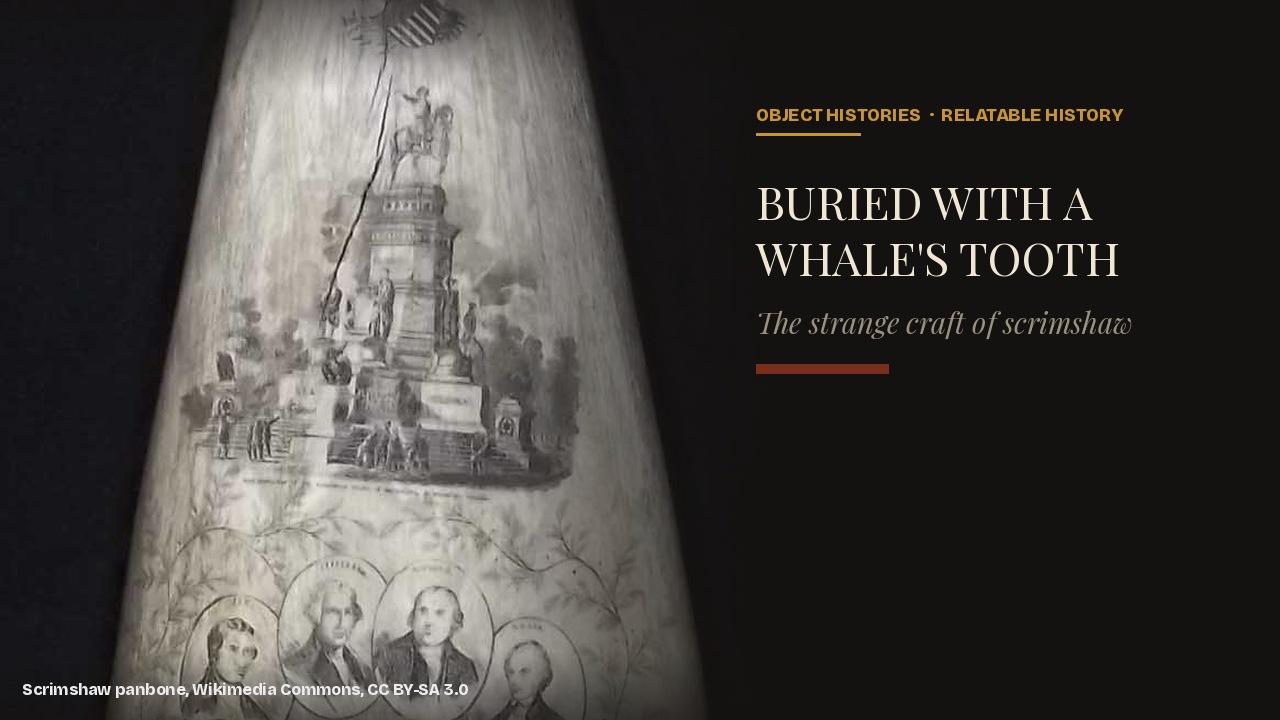
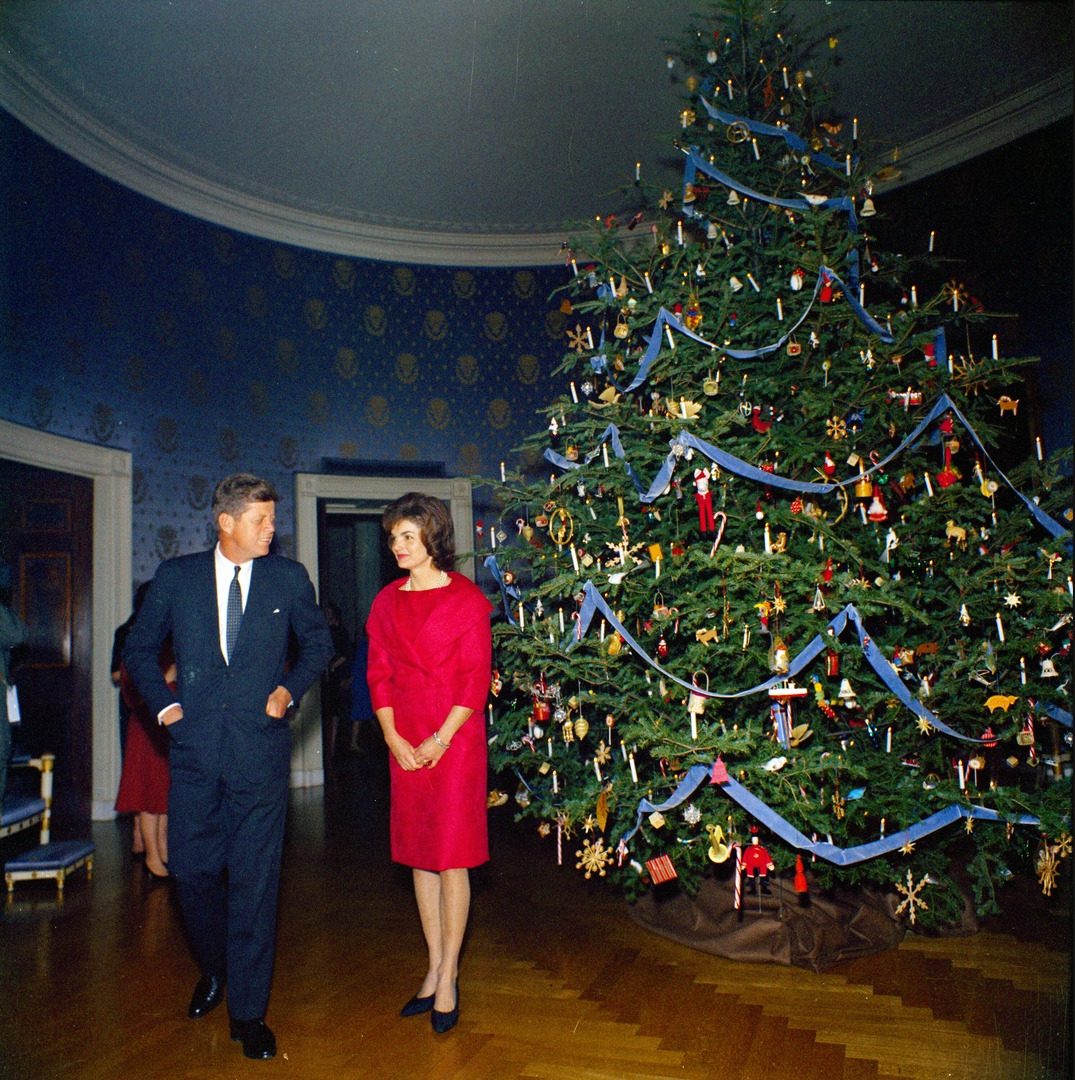
Scrimshaw is the name for the folk art American whalemen carved into idle months at sea, and how scrimshaw was made is inseparable from why it was made: there was nothing else to do. On the evening of November 13, 1963, President Kennedy gave one piece of it away at a White House dinner, to the actress Greta Garbo. Ten days later he was dead, and for the next thirty-six years, nobody outside Garbo’s own family knew the tooth existed.
It surfaced only because a curator at the John F. Kennedy Presidential Library, James Wagner, found an old thank-you letter from Garbo to Jacqueline Kennedy while going through the library’s files in 1999. In it, Garbo mentioned that she still had “the President’s tooth.” Wagner had no idea what that meant until he worked out it was almost certainly a piece of Kennedy’s own scrimshaw collection — by then more than thirty pieces, built up over a decade with help from his old school friend Kirk LeMoyne “Lem” Billings. It took him weeks of calling actors’ unions before he reached Garbo’s estate and got the tooth back for the library’s records, thirty-seven years after it left the White House.
That piece turns out to be the easiest of Kennedy’s scrimshaw to lose track of, and the hardest one to find again. The far more famous story about his collection — the one about a tooth that was buried with him — is a different object entirely, and untangling the two says something real about how the whole craft worked: who carved it, where its own name probably comes from, and why owning a two-hundred-year-old piece today still depends on a single date on a federal calendar.
How scrimshaw was made, starting with the raw material
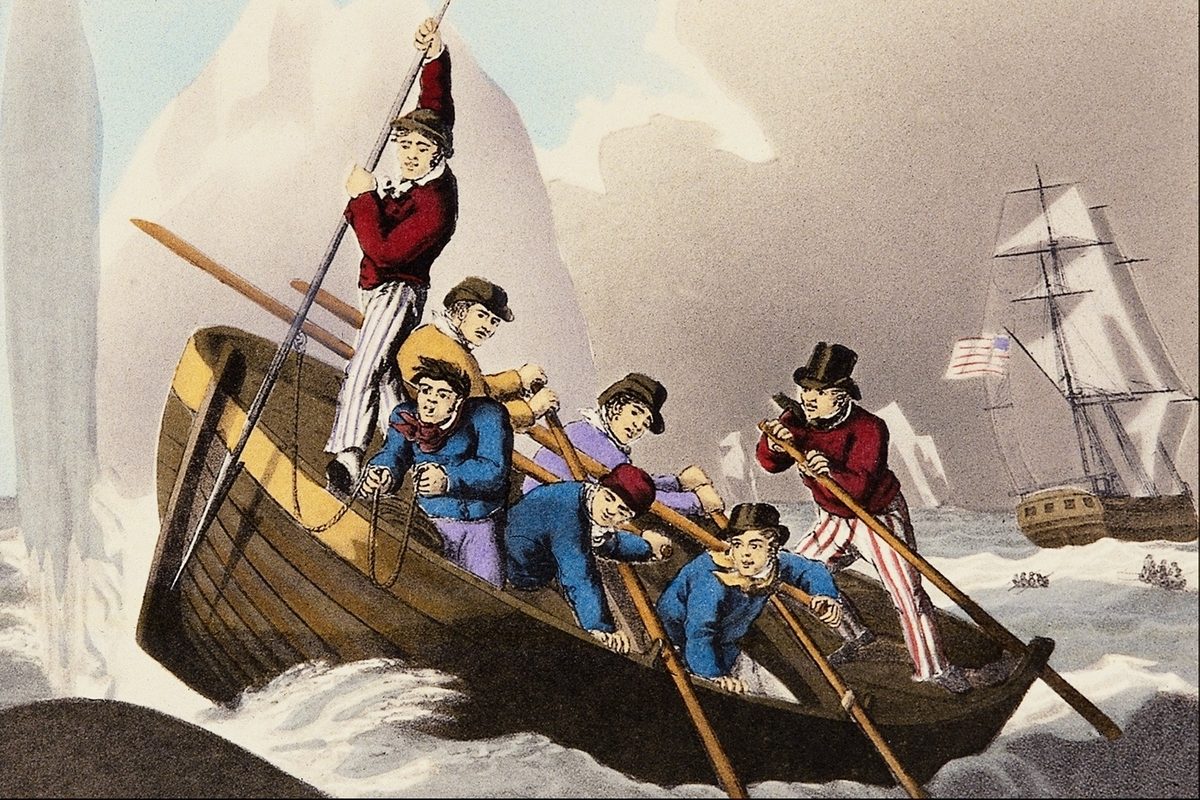
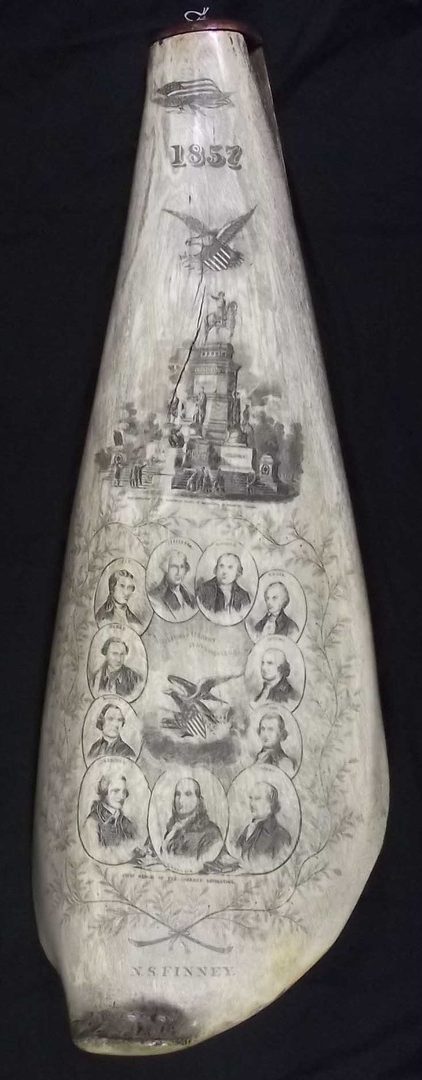
Everything about the craft starts with what a whaling voyage produced that nobody at home wanted. A sperm whale’s teeth were pulled and kept by the crew as an unofficial perk, outside the ship’s formal division of the oil profits. Sailors also held onto walrus tusk, traded from Arctic hunters at ports of call, and panbone — the flat, dense jawbone of the whale itself, wide enough to work like a plank.
Baleen, the whale’s actual commercial cargo, was treated differently. It belonged to the ship’s owners, not the crew, and was shipped home intact to be cut into the stiffening “bone” for corsets or steamed into bandboxes once ashore. The material a sailor could personally keep and carve — tooth, tusk, and panbone — was the leftover that had no other buyer.
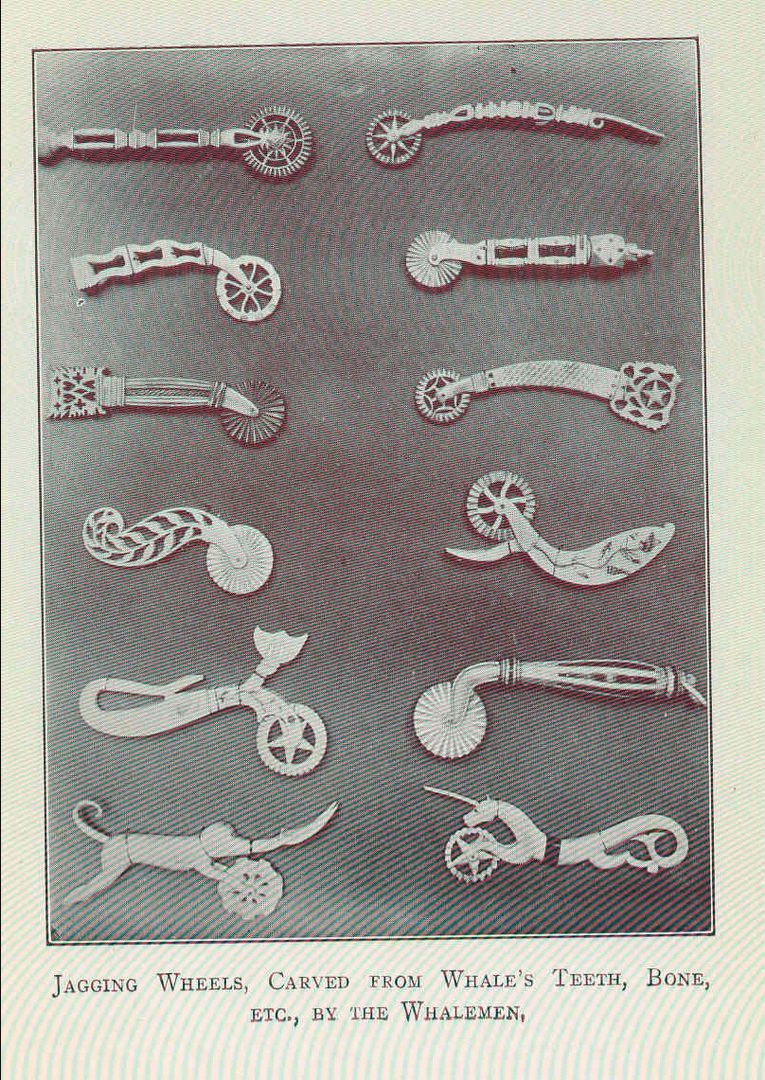
With no scrap wood to spare aboard ship, crews pressed that leftover into the ship’s own carpentry tools: the vessel’s lathe, a carpenter’s chisels, a sailmaker’s needle. What came off them was rarely decorative first. Pulley blocks, fids for splicing rope, navigation instruments, bodkins, and teething rings for children waiting at home were all turned out of tooth and bone before anyone worried about pictures. One triple-cage yarn swift in the Nantucket Historical Association’s collection is built from hundreds of thin panbone ribs, a construction so intricate that it may have taken its maker years to finish between voyages.
Nobody agrees on where the word itself comes from
The craft’s own name is argued over almost as much as its pictures. The earliest written form on record, scrimshonting, turns up in American English around 1825. Scrimshander appears in Herman Melville’s Moby-Dick in 1851. The spelling scrimshaw itself isn’t attested until 1864, and the word wasn’t used as a verb until about 1883 — which makes the object’s name younger, in print, than the craft had already been practiced for generations.
One dictionary calls the whole family of spellings “unstable orthography,” and the disagreement runs deeper than spelling. One theory treats scrimshaw as a later back-formation from scrimshander and scrimshonting, whose own origin is simply called obscure. A second ties it to scrimshank, old nautical slang for dodging your duties, for loafing — which, if true, means the craft was named, a little mockingly, after exactly what it was: something a sailor did instead of working. A third candidate is the English surname Scrimshaw, on record since the twelfth century and traced to an Old French word for a fencing-master, though no source claims a confirmed link between that surname and the carving term. All three keep getting repeated, and none has settled the question.
One sailor’s three dozen teeth made him scrimshaw’s first named artist
Almost none of the millions of pieces produced during the nineteenth century carry a maker’s name. Frederick Myrick is the exception that proves how unusual that anonymity was. Aboard the Nantucket whaler Susan, between December 1828 and September 1829, Myrick engraved roughly three dozen sperm whale teeth, each one picturing the ship itself — whaling off Japan on one side, sailing home past a lighthouse on the other — and, unusually for the craft, several of them signed and dated in his own hand.
That signature is what makes the group traceable at all. Collectors in the twentieth century started calling them “Susan’s Teeth,” a name coined in 1955 by the collector Everett Crosby, and a catalogue raisonné published in 2000 now tracks where each surviving tooth in the group ended up. Most of Myrick’s contemporaries left nothing comparable. The Nantucket Historical Association’s own collection catalogs several of its finest pieces only by nicknames historians invented afterward — “the Ceres Artisan,” “the Banknote Engraver” — because no record says who actually held the blade.
The same president kept two different whale’s teeth, and only one went into the ground
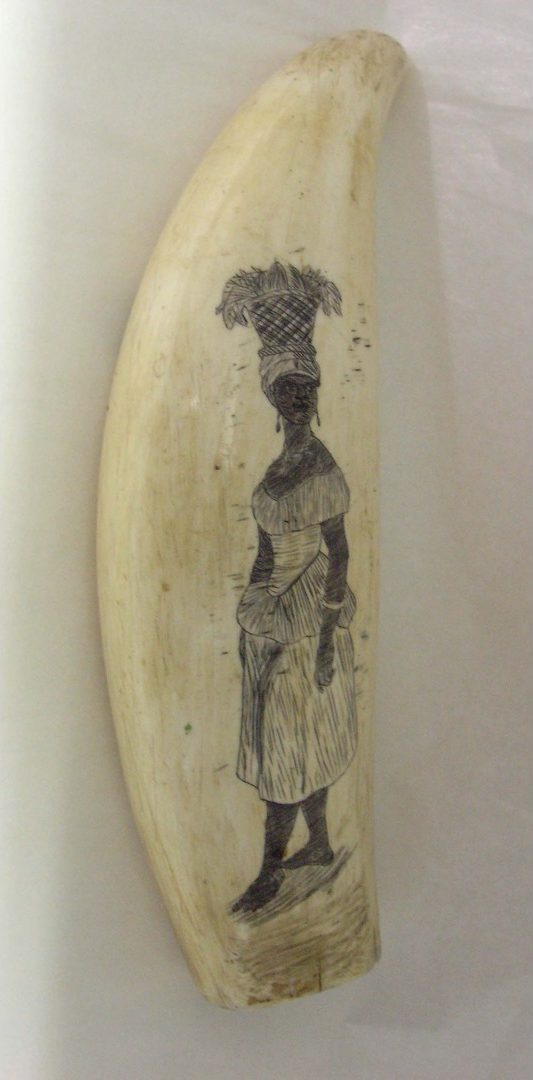
Kennedy didn’t grow up collecting scrimshaw; by most accounts he took it up as a senator, and it grew into more than thirty pieces by the time he reached the White House. One came from Lem Billings and stayed on his Oval Office desk — the National Archives’ own catalog describes it as a whale’s tooth, engraved on the front with a frigate under full sail and, on the back, a woman in a floor-length dress. Jacqueline Kennedy had given him an earlier tooth of her own, showing an American ship under full sail, which is usually credited as the piece that actually started his collecting.
For Christmas in 1962, she commissioned something different again: a bull whale’s tooth cut with the presidential seal, made by a scrimshaw artist named Milton Delano of Fairhaven, Massachusetts, who by some accounts was a distant, Republican-leaning relation of the Delano family that gave Franklin Roosevelt his middle name. By the Kennedy Library’s own account, it became the president’s favorite piece in the whole collection.
Those two objects — the desk piece from Billings and the presidential-seal piece from Jacqueline Kennedy — get run together in a lot of retellings, understandably, since both are whale’s teeth that sat somewhere in the Kennedy White House. Only one of them matters for how the story usually ends. According to Stacey Bredhoff, a curator at the John F. Kennedy Presidential Library, it was the presidential-seal tooth, not the one that had sat on the desk, that Jacqueline Kennedy placed in his coffin before he was buried at Arlington National Cemetery in November 1963.
The third Kennedy tooth, the one given away at that dinner with Greta Garbo, is different from either of these — and that is exactly why a letter written in 1963 was the only way anyone found it again, thirty-six years on.
The industry behind all of it collapsed within about a decade
None of this material stayed cheap and plentiful forever. On August 27, 1859, Edwin Drake’s well near Titusville, Pennsylvania, struck oil at a depth of sixty-nine and a half feet — by the Drake Well Museum’s own account, the first large-scale commercial petroleum operation in the country, drilled to supply kerosene refining. Petroleum-based kerosene undercut whale oil as lamp fuel within a few years, and the New England whaling fleet that had supplied both the oil and the idle shipboard hours that produced scrimshaw began shrinking for good.
That decline mattered to the craft as much as to the industry it rode on. Fewer long voyages meant fewer fresh teeth, less panbone, fewer months with nothing to do but carve. What survived afterward was increasingly made ashore, from material already on hand, by people who had never been to sea at all — a folk art slowly turning into a collectible, decades before anyone thought to put a price on it.
Buying or selling an old piece today comes down to a single year
Commercial whaling for sperm whales has been under an international moratorium since 1986, but that is not the date that actually governs an old scrimshaw tooth changing hands in the United States. Under the Marine Mammal Protection Act, the legal line is 1972. Material taken before the Act — so-called “pre-Act” parts — can still be bought and sold, but NOAA Fisheries’ own guidance is explicit that a sale needs a Letter of Determination establishing that the piece actually predates the law. Material taken afterward generally cannot be commercially traded at all, no matter how old the carving on it looks.
That single cutoff is why a Myrick tooth from 1829 can still legally cross an auction block while a freshly carved whale tooth cannot, and it’s why most working scrimshaw artists today use mammoth ivory, micarta, or other substitutes instead of new whale or walrus material at all. The craft adapted to the law the same way it once adapted to a three-year voyage with nothing to do: by working with whatever material it was actually allowed to have.
Which is really what the Garbo tooth proves, in miniature. It didn’t survive because it was valuable or well documented at the time — it survived because one person happened to keep a letter. Most of the millions of pieces whalemen carved left no letter, no signature, no provenance at all, which is the real reason a signed Myrick tooth or a named Kennedy gift stands out: not because they’re rarer objects, but because they’re rarer records.
Watch the full history
The video version covers the whaling voyages, the materials, and the tooth that was actually buried with Kennedy in about six minutes.

Related reading
- How Tallow Candles Were Made, and Why Candle Day Was Dreaded — another household material turned craft under the same kind of hand labor
- The Spinning Wheel’s Economics Were Worse Than You Think — a look at the real economics behind another hand-craft the history books romanticise
- How Artificial Eyes Were Made, From Ancient Iran to Modern Acrylic — another material shaped by hand across centuries, with its own legal afterlife
- The Truth Behind the Mrs. O’Leary Cow Myth — a parallel case of a tidy popular story that the documented record doesn’t quite support
Shop
Items related to this history:
- “Scrimshaw: The Whaler’s Legacy” by Martha Lawrence — the definitive illustrated history
- Rough Rider Alaskan Scrimshaw Moose Lockback Pocket Knife — a modern, working example of the tradition
Works cited
- Dalati, Sammy. “Scrimshaw on Nantucket.” The Magazine ANTIQUES, August 12, 2019. Link.
- “Scrimshaw.” Nantucket Historical Association. Link.
- “Panbone Busk.” New Bedford Whaling Museum collections, object 187024.
- “Susan’s Tooth, Signed and Dated, F. Myrick, Aug. 28, 1829.” Hyland Granby Antiques. Link.
- Harper, Douglas. “Scrimshaw.” Online Etymology Dictionary.
- Sweeney, Chris. “John F. Kennedy Had a Thing for Scrimshaw.” Boston Magazine, July 31, 2016. Link.
- Bowen, Croswell. “The Scrimshaw Collector.” American Heritage 15, no. 6 (October 1964). Link.
- “Scrimshaw” (Object MO 63.6112). John F. Kennedy Presidential Library and Museum, National Archives.
- “JFK’s Missing ‘Tooth’ Found.” John F. Kennedy Presidential Library and Museum, press release, May 10, 2000.
- “Protected Species Parts.” NOAA Fisheries. Link.
- “Site History.” Drake Well Museum and Park, Pennsylvania Historical and Museum Commission. Link.