
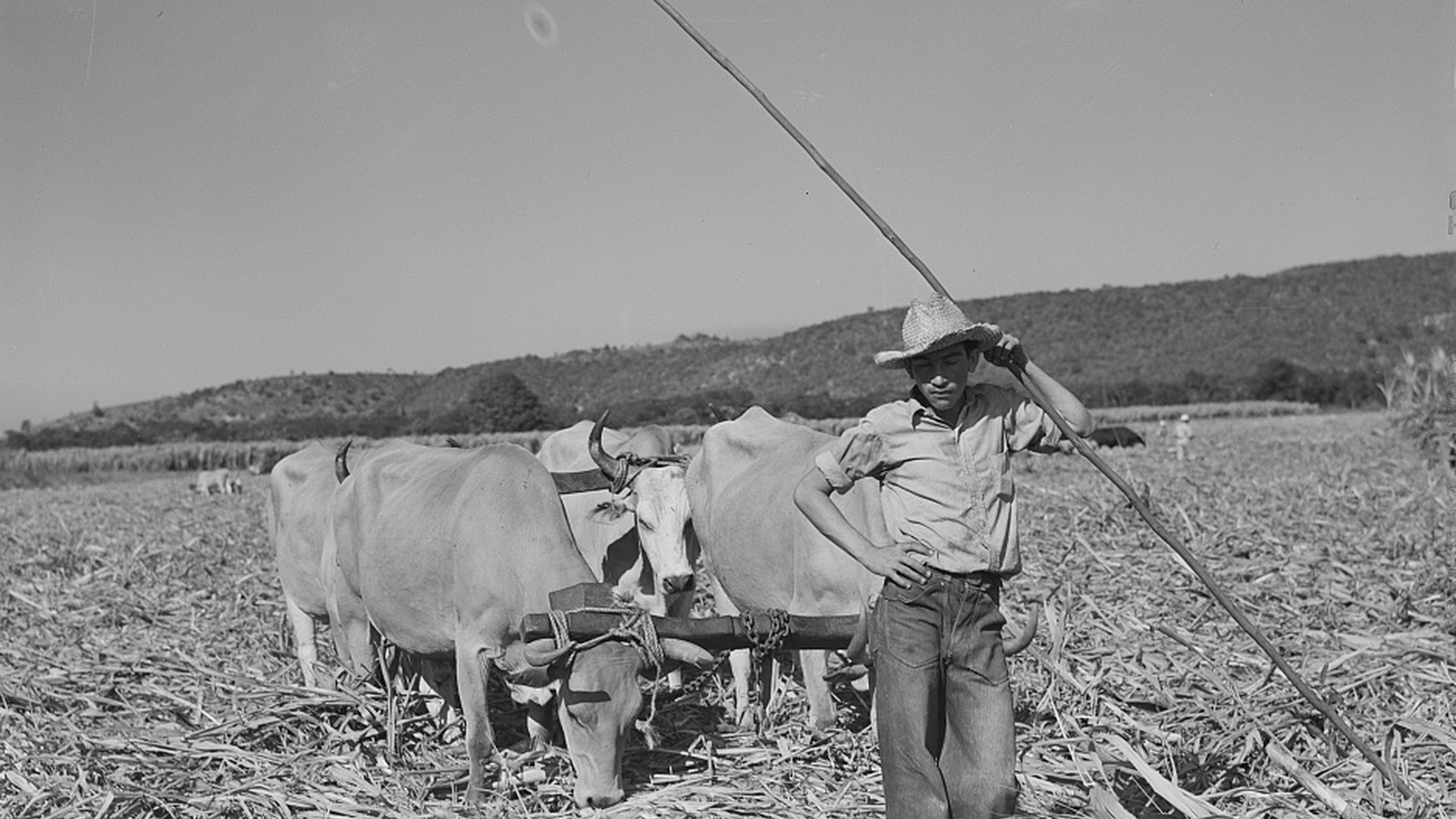
In medieval Kent, the word for a pair of oxen was also the name of a measured stretch of farmland, and the English crown taxed it that way for roughly seven hundred years. A “yoke” was, on paper, the amount of ground one pair of oxen could plough in a season. A 1425 rental for the manor of Otford lists a dozen of these yokes side by side, running from 51 acres on good valley soil to more than 230 acres on the thin clay of the surrounding downs — the same unit, stretched or shrunk to match how hard the ground underneath it actually was.
None of that farmland got ploughed by an animal that simply knew what to do. Figuring out how oxen were trained to plow — and to haul logs, and to stop a half-ton animal with no bit and no reins — is really the story of how a plain carved beam of hardwood turned two untrained cattle into something a family with no capital could rely on for the heaviest work on a farm.
That beam is the part most people picture. The training underneath it, the precision the carving actually demanded, and the hard arithmetic that made oxen the only realistic option for most new farms are the parts that usually get left out. This fills them back in, along with what finally ended the practice in America and the handful of places where it never fully stopped.
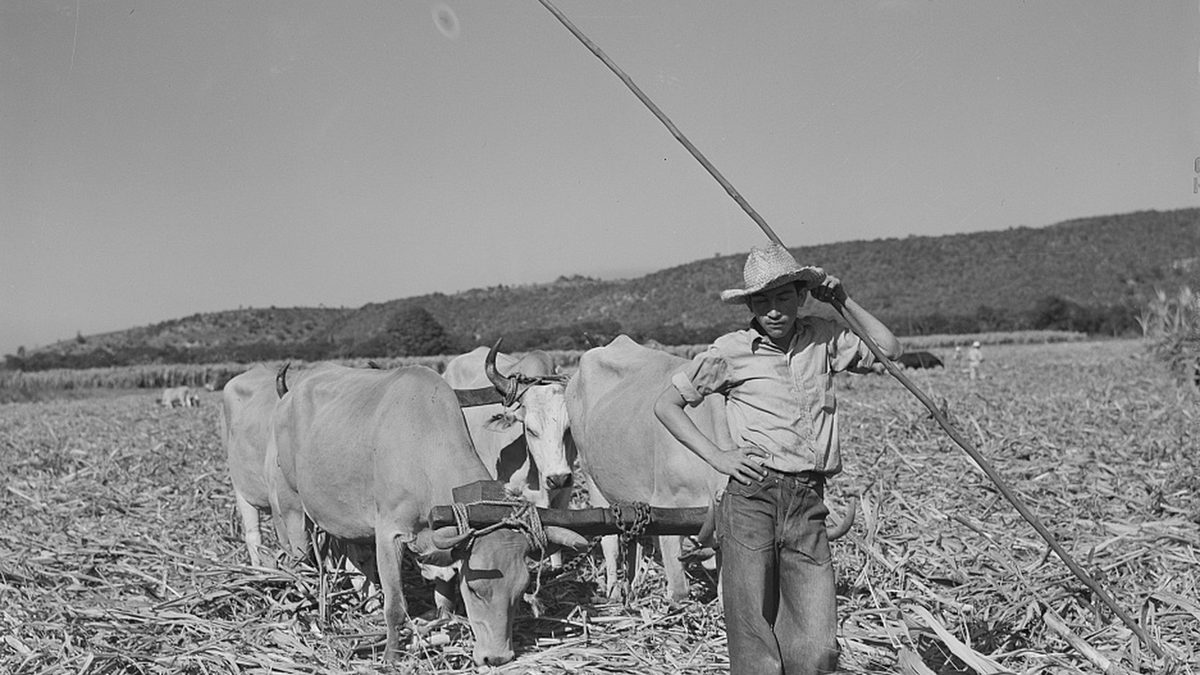
A “yoke” of land was never a fixed size, and that was the whole point
Kent’s Domesday Book entries use two land units that appear nowhere else in the 1086 survey: the “sulung” and the “yoke.” A yoke was a quarter of a sulung, and a sulung was supposed to represent the land a full plough team of eight oxen could work. In practice, the fit was never exact. Historian Gordon Ward, writing up the Otford rental in the journal Archaeologia Cantiana, found that Domesday’s assessors were recording fiscal value, not acreage — a yoke owed a fixed set of rents and labor services regardless of how many actual acres sat inside its boundary, which is why a valley yoke and a hillside yoke could owe the same and cover wildly different ground.
The name outlived the uncertainty. Yokes show up in Saxon charters, in manorial rentals as late as the eighteenth century, and as farm names into the twentieth. Ward traced one theory back to the Roman Empire: the emperor Diocletian taxed parts of the eastern empire in units called “juga,” each worth roughly five to sixty acres depending on soil quality, and some scholars have proposed that Kent’s yoke is a distant descendant of that Roman fiscal unit, carried forward through a gap in the written record that nobody has ever closed. Ward himself treated this as a live possibility rather than a settled fact, which is the honest way to leave it.
What the land unit confirms, independent of its origin, is how central the two-ox team was to how medieval England actually measured productive capacity. Before anyone talks about training a team or carving a beam, “a yoke of oxen” was already shorthand for a specific, taxable amount of farm work.
Two different yoking traditions grew up on opposite sides of the same ox
Across cultures, oxen have been harnessed to a load in three structurally different ways, and the choice says as much about regional cattle breeds and farming style as it does about engineering. A withers yoke sits on the ridge where neck meets shoulder, spreading the pull across muscle and soft tissue that can cushion a hard jolt. A head yoke, by contrast, straps onto the horns themselves, so the animal drives the load with its skull and the strain runs straight down through its spine. Drew Conroy, a University of New Hampshire researcher who has studied yoking systems on three continents, has argued that neither approach is simply superior — each reflects roughly four centuries of refinement by teamsters working with the cattle and terrain they actually had.
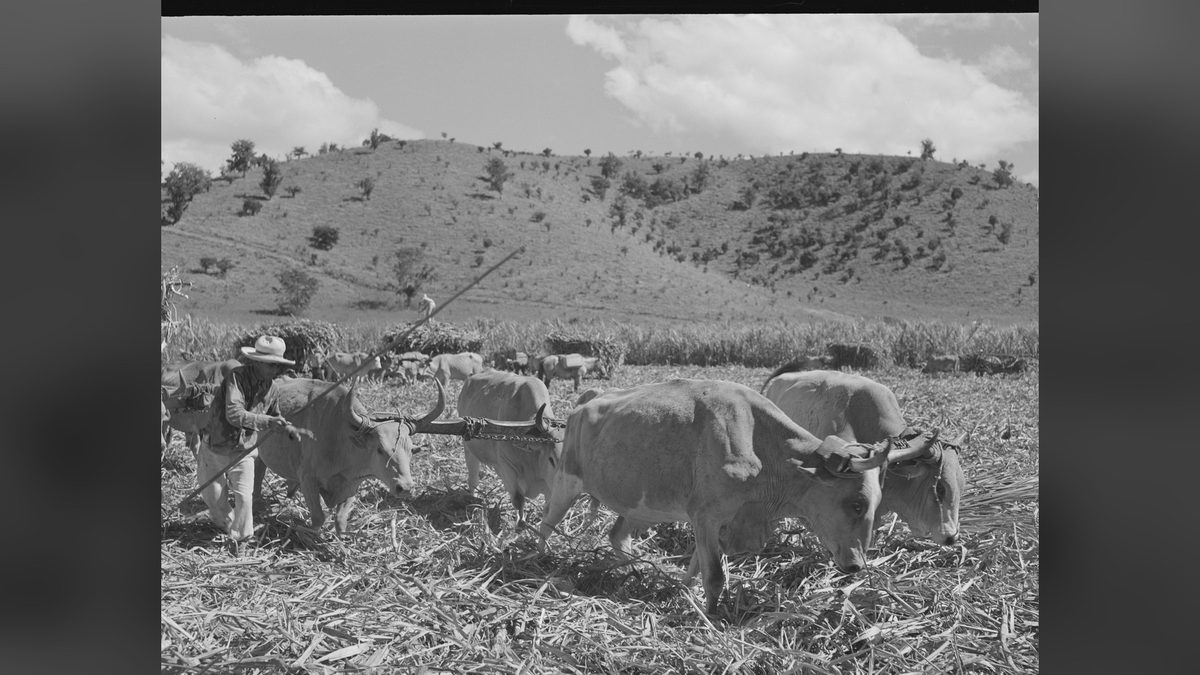
English colonists brought the withers-and-neck style to America almost without exception, and it stuck. A head yoke, by contrast, keeps a team locked tightly together with almost no independent head movement, which suits animals of closely matched size and training but turns into a liability the moment one ox is stronger, taller, or simply has a different stride than its partner. It also has to be recarved as a young ox’s horns grow, since it fits onto the horns themselves rather than onto soft neck tissue that stays roughly the same shape. The neck-and-shoulder style, used throughout the American colonies, gave a driver more room for individual animals to shift and find their footing, at some cost in how tightly the pair stayed coordinated.
A less common variant, the sliding neck yoke, let each animal’s bow pivot independently around a center point on the beam, trading some coordination for comfort on rough or icy ground — a refinement that shows up specifically in the northeastern American ox-driving tradition, where working teams on frozen New England hillsides never fully disappeared from the regional culture the way they did almost everywhere else.
A working yoke was carved to the shoulder, not to a pattern
A beam’s dimensions followed a rule of thumb rather than a fixed blueprint: teamsters sized a yoke by the width of its bows, and a beam ran roughly six and a half to seven times that bow width end to end — a seven-inch bow meant a beam somewhere near four feet long. The best wood was shagbark hickory, strong and resistant to splitting under repeated flex; white oak came a close second. Whatever species a maker used, the log had to be knot-free and wide enough that the beam could be split or quarter-sawn away from the weak, pithy center grain, since a beam cut straight through the heart of a log would fail exactly where the strain was highest.
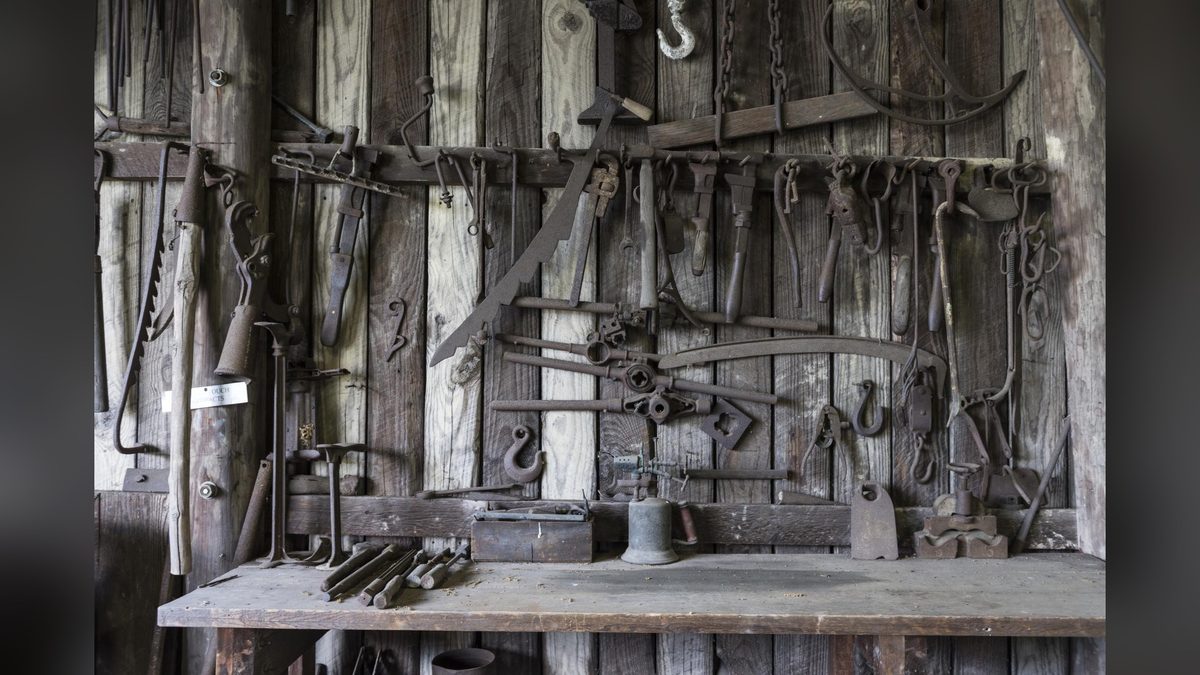
The neck seat — the curved underside that actually rests on the animal — was the part a careless carver could ruin a team over. It had to be smooth, free of cracks, and evenly curved on both sides, because even a small asymmetry meant one ox carried more of the load than the other and wore raw while its partner barely strained. The holes for the bows mattered just as much: drilled off-center, they threw the pull unevenly across the pair in exactly the same way a lopsided neck seat did. Fitting was personal, not generic — a beam built for one pair of oxen could chafe or choke a different pair entirely, which is why a serious teamster measured and checked the fit of every animal every time the team was yoked, not just on the day the yoke was carved.
The payoff for getting all of this right could be considerable. Teamsters in the long-running New England ox-pulling tradition — a competitive culture that has kept working oxen continuously present in that region for roughly two centuries — have recorded a well-matched pair of Chianina oxen moving more than six tons across dry sand in a single pull, a figure that gives some sense of how much raw capacity a properly fitted neck yoke could actually transmit from animal to load.
The arithmetic of owning oxen, not sentiment, decided who used them
On the Oregon and California Trails of the 1840s through 1860s, the choice of draft animal came down to a ledger, not a preference. Historian John D. Unruh Jr., in his landmark study of the overland migrations, estimated that oxen pulled more than half of all emigrant wagons; other firsthand trail accounts compiled by historian Merrill Mattes suggest the true share ran closer to two-thirds or three-quarters. A yoke of oxen in the late 1840s cost between twenty-five and sixty-five dollars — a real but manageable sum for a family that could never have afforded the grain bill a team of horses required for the same months of continuous hauling.
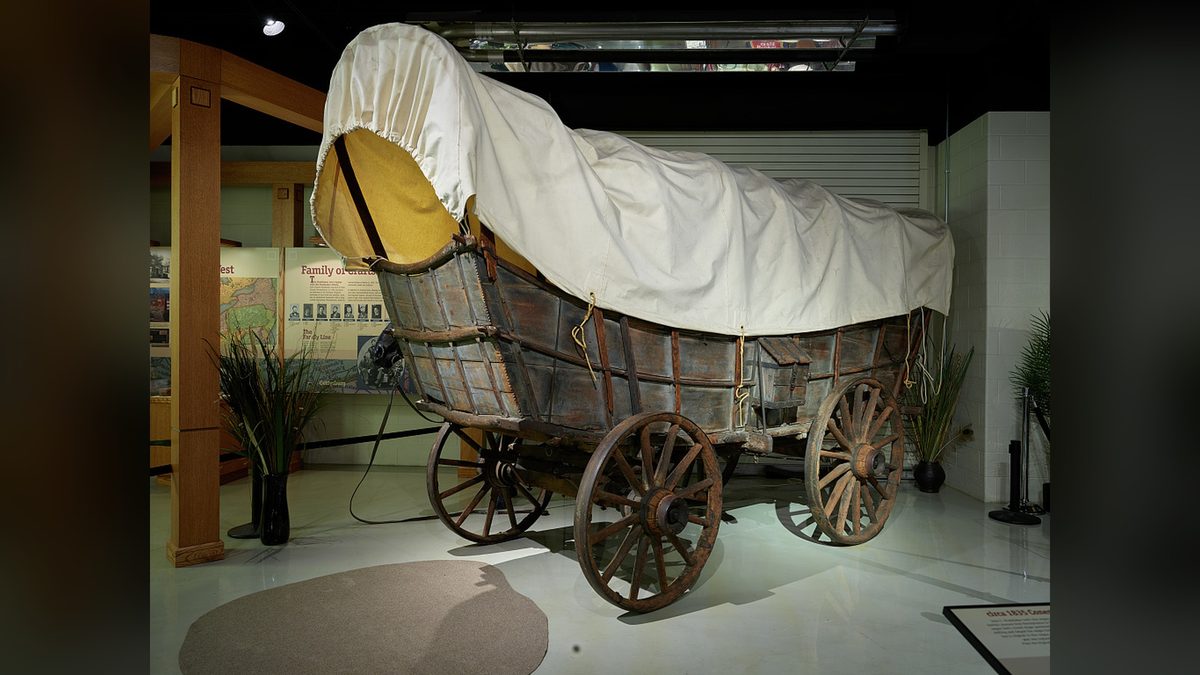
That gap in running cost, not raw speed, was the deciding factor. An ox could sustain hard pulling on pasture grass alone, shrug off the mineral-heavy water on dry trail stretches that left a horse dangerously ill, and held so little resale appeal to a raider hunting fast, valuable livestock that teams were rarely stolen. A family’s loaded wagon, typically ten to twelve feet long and carrying something like fifteen hundred to twenty-five hundred pounds of goods on top of its own thousand-plus-pound frame, needed exactly the kind of patient, sustained pull that a grass-fed ox could deliver day after day without faltering. Not every company went all-ox, either: one 1848 party recorded by the Oregon Historical Society ran two wagons behind oxen and a third behind horses in the same train, which is a useful reminder that frontier households often split the difference rather than committing entirely to one animal.
The same economics explain who could physically drive the team. Once a pair was broken and steady, managing it took patience and a trained voice more than brute strength, which is why diaries and company rosters from the trail routinely show women and older children handling the family’s oxen while able-bodied men worked elsewhere in the train or on the farm waiting at the other end.
A steel plow finally gave oxen their single hardest job, then started taking it away
Breaking virgin prairie sod was the most punishing work a yoke of oxen was ever asked to do, and for decades it was a job the standard cast-iron plow genuinely could not finish. According to the Illinois State Museum, the state’s rich black prairie soil clung to a cast-iron blade so persistently that a farmer had to stop and scrape it clean every few steps, which made plowing the open prairie barely practical even with a full team straining at the beam. Blacksmith John Deere solved it in 1837 by polishing a steel plowshare smooth enough that the state’s sticky black soil slid cleanly off on its own instead of caking against the metal, and the museum credits that single invention with making it realistic to convert the Grand Prairie to cropland at scale — by 1850, most of it had been.
Deere’s plow needed exactly the sustained, unglamorous pulling power a yoke of oxen specialized in, which is why oxen rather than horses did most of the early steel-plow work on virgin ground. The irony is that the same wave of agricultural mechanization that made Deere’s plow possible kept building. Cleared, stump-free, well-drained fields are where a horse’s speed advantage over an ox finally starts to matter more than raw pulling force, and as more of the Midwest and East reached that state through the 1860s and 1870s, farmers who could afford it traded up. Oxen held on longest where land was still being broken for the first time — the newest Plains homesteads, Pacific Northwest logging camps — for exactly the reason they always had: a working horse’s feed bill ran to real cash that an animal fattened on pasture simply didn’t rack up.
Oxen never fully disappeared; they moved to wherever grain is still the expensive option
The gasoline tractor did to the horse what the horse had slowly started doing to the ox, and by the 1920s and 1930s the working ox yoke in America had become mostly a barn-wall relic. But “mostly” leaves room for a real continuation. Tillers International, a nonprofit founded in Michigan in 1981, still teaches ox-powered farming, logging, and blacksmithing on its 430-acre campus, and its reach now extends well beyond American hobbyists and living-history farms. Its longtime director has spent weeks at a stretch training farmers in Uganda, and for several years the Howard G. Buffett Foundation funded Tillers to teach ox-powered biological agriculture and soil conservation in South Africa — places where, exactly as in 1840s America, the deciding question is still whether a family can afford to feed a draft animal on grain or has to rely on one that thrives on grass alone.
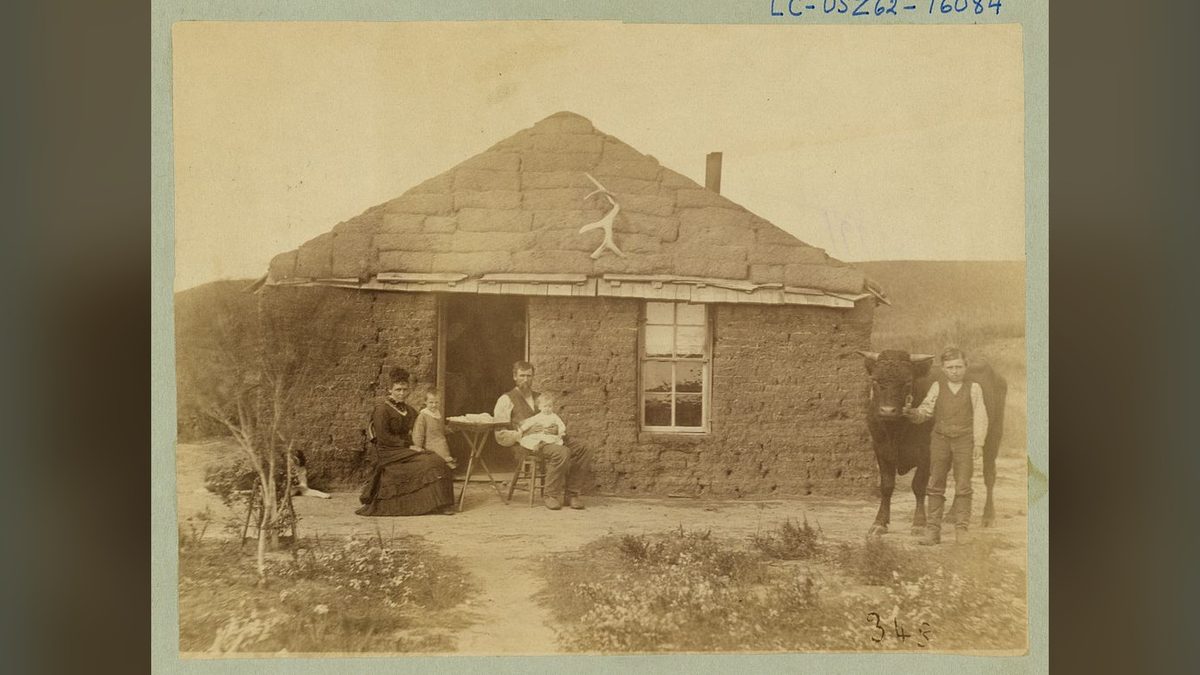
That is the same calculation that put a yoke of oxen in front of nearly every overland wagon on the Oregon Trail, and the same one that once made “a yoke” worth taxing as a unit of land in medieval Kent. The device changed remarkably little in between. What changed was who needed it, and where.
Watch the full history
The eight-and-a-half-minute video version covers the physics of why an ox outpulls a horse on the heaviest ground and what finally ended the practice on American farms.

Related reading
- Why New England’s Stone Walls Run 240,000 Miles — the same ox-drawn stoneboat that hauled fieldstone off these pastures is the one mentioned above.
- Threshing Grain by Hand: The Flail, the Floor, and the Riot That Tried to Stop the Machine — the hand labor that turned an ox team’s plowed field into stored grain.
- How a Fireplace Trammel Worked in a Colonial Kitchen — another hand-forged piece of iron a homestead could not do without.
- The Real History of the Worm Fence — the zigzag rail fence that enclosed the fields an ox team spent its life breaking.
Further reading, in print
For anyone who wants to go deeper than one article can: Oxen: A Teamster’s Guide to Raising, Training, Driving & Showing by Drew Conroy is the standard English-language handbook on working oxen, written by the same researcher cited above — available on Amazon.
Works cited
- Ward, Gordon. “A Note on the Yokes of Otford.” Archaeologia Cantiana, vol. 42. Kent Archaeological Society, 1930. Link.
- Conroy, Andrew B. “Ox Yokes: Culture, Comfort and Animal Welfare.” University of New Hampshire Scholars’ Repository, 2004. Link.
- Plainfield Historical Commission. “Ox Yokes.” Plainfield, Massachusetts local history archive. Link.
- Lindsey, Michelle. “Ox Yokes and Collars: Neck Yokes and Head Yokes.” Homestead on the Range.
- Oregon-California Trails Association. “How Long Was the Journey from the Missouri ‘Jumping Off’ Place to California or Oregon? More Trail Facts,” citing John D. Unruh Jr., The Plains Across: The Overland Emigrants and the Trans-Mississippi West, 1840–60 (University of Illinois Press, 1979), and Merrill J. Mattes.
- “Oregon Trail.” The Oregon Encyclopedia, Oregon Historical Society.
- “Central Prairie: Plowing the Prairie.” Changes exhibit, Illinois State Museum. Link.
- Mumma, Tracy. “Draft Animal Power for Farming.” National Center for Appropriate Technology (NCAT/ATTRA). Link.
- Zerilli, Ursula. “For Some Farmers, a Return to Animal Power.” Kalamazoo Gazette/Associated Press, via The Christian Science Monitor, April 5, 2013. Link.
- Harper, Douglas. “Yoke.” Online Etymology Dictionary.
“Would you rather have broken a field with an ox, or a horse?”