
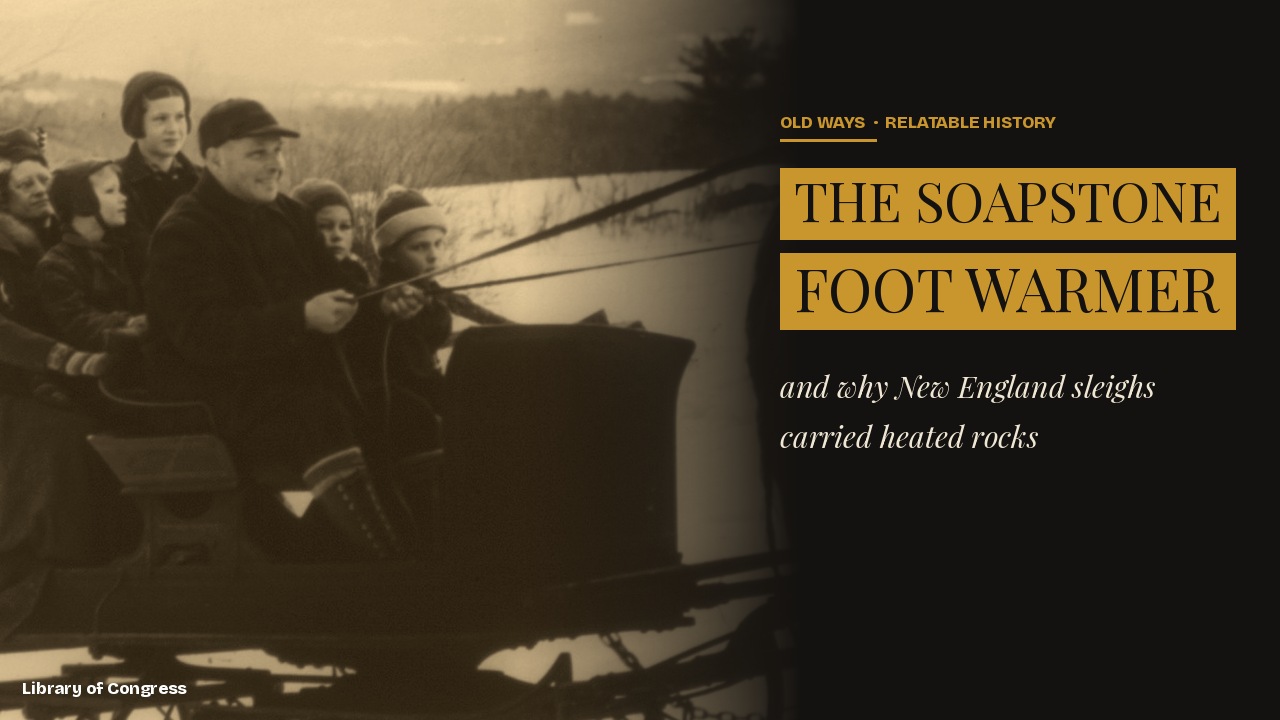
A piece of steatite, gram for gram, holds nearly twice as much heat as a piece of iron heated to the same temperature. Nobody warming a stone on a woodstove in 1890 had a number for that, but they knew the effect: a flat gray rock, once hot, stayed usefully warm for hours, while a heated brick or flatiron went cold within one. That one physical fact, more than any folk tradition, is the short answer to how soapstone foot warmers worked, and it is why they spent more than a century riding in sleighs, sitting in church pews, and warming the feet of bedridden farmhands across rural New England.
The object itself could not be simpler: a slab of quarried stone, heated against a firebox, wrapped in cloth so it would not scorch skin or bedding. What makes it worth 2,000 words is everything around that simplicity — a specific Vermont quarrying trade that supplied it, a specific open-flame technology it replaced in unheated churches, and a specific sequence of 20th-century inventions that made it obsolete one winter ride at a time.
How Soapstone Foot Warmers Worked: Nearly Double the Heat of Iron
Soapstone is the trade name for steatite, a rock that the U.S. Geological Survey’s 1951 survey of Vermont’s deposits describes as consisting “almost entirely of talc,” with the state’s steatite containing little or no carbonate mineral mixed in. The same survey credits it with “softness, denseness, impermeability, and high heat-resistivity,” which is a geologist’s way of saying it can be cut with an ordinary saw, does not crack under repeated heating, and does not conduct that heat away quickly once it has absorbed it.
The numbers back up the folk wisdom. By standard engineering references, steatite has a specific heat capacity of about 830 joules per kilogram per degree Kelvin, against roughly 450 to 490 for iron and plain steel. In practice that means a soapstone slab heated to the same temperature as an iron one of equal weight is carrying close to double the stored heat, and it gives that heat up slowly rather than all at once. A heated brick did the same job in a pinch, but lost its warmth fast enough that an unwrapped one could scorch a sleigh blanket on the way out and go cold on the way home.
None of this required anyone to understand thermodynamics. It only required a family to notice, winter after winter, which stone kept working after the others had gone cold — and to keep driving wagons to the same Vermont hillsides to get more of it.
Before the Hot Stone, Churchgoers Carried Live Coals in a Tin Box
Soapstone did not invent the idea of carrying your own heat to an unheated building. For more than a century before it became common, New England congregations met in meetinghouses with no stove at all, on the belief, as Puritan doctrine held it, that sufficient religious zeal would keep a body warm. The diary of the Boston magistrate Samuel Sewall records just how well that worked in practice: on January 24, 1686, he wrote that the communion bread had frozen so hard it “rattled sadly into the plates.”
What congregations actually relied on was the foot stove: a small punched-tin or pierced-metal box holding live coals, carried in by hand and set under a pew. Boston’s Old South Meeting House tolerated them but worried about the obvious fire risk; in December 1771 the sexton was instructed to hunt down foot stoves congregants had left behind after service and collect a fee from their owners for the trouble. The First Church of Roxbury went further after a fire in 1747 damaged its meetinghouse: foot stoves were banned outright in the rebuilt building, and congregants fell back on hot stones carried in baskets, fur muffs, or, by at least one account, the family dog curled across their feet.
A stove heated at the kitchen fire and installed in the meetinghouse itself was the obvious fix, and it arrived town by town, unevenly and often over real objection. Hadley, Massachusetts, bought an iron meetinghouse stove as early as 1734. Hingham’s Old Ship Church, built in 1681, went without one until 1822 — nearly a century and a half of frozen Sundays. When Litchfield, Connecticut, finally installed a stove, the Reverend Henry Ward Beecher told a story about a parishioner so opposed to it that she fainted from imagined heat on a Sunday when, in fact, nobody had lit it at all. A soapstone slab, by contrast, needed no vote, no fire marshal’s attention, and no sexton’s cleanup. It just needed a stove at home and a blanket to wrap it in.
A Single Family’s Quarry Supplied the Stone for Half a Century
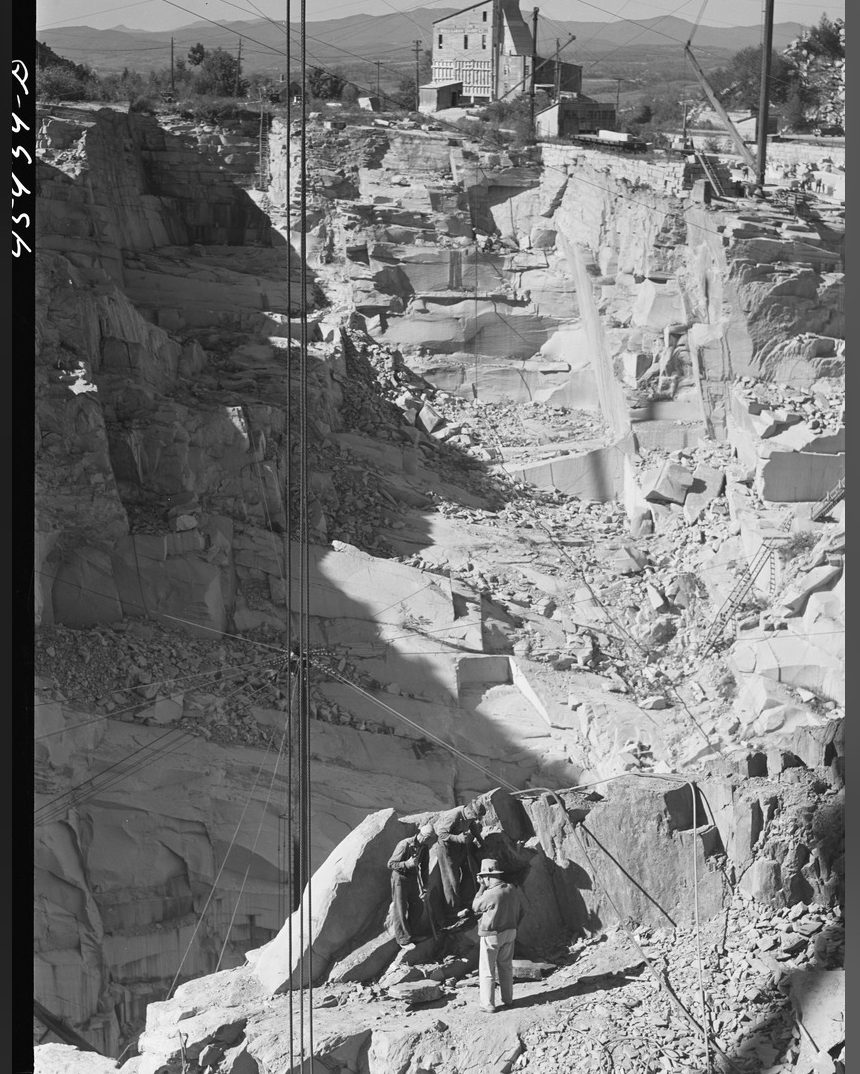
Vermont’s steatite belt runs through a string of towns the 1951 USGS survey lists by name: Johnson, Waterville, Cambridge, Stowe, Moretown, Fayston, Reading, Windham, Chester, Ludlow, and Grafton among them. The Grafton deposit is unusually well documented because one family’s business correspondence survives. The Goodridge Soapstone Quarry there was owned by Sophia Goodridge and operated from roughly the 1840s into 1910. For more than twenty years, from 1874 to 1896, her financial advisor Sidney Holmes wrote to her about the business, and those letters — preserved today at the University of Vermont — are mostly about who was leasing the quarry and what it was worth. Through 1891 or 1892 the lease belonged to Butterfield and Smith, a local Grafton firm; afterward it passed to a lessee in Francestown, New Hampshire.
Forty miles north in Chester, the trade was organized differently — around a processing mill rather than a single family’s royalties. The Union Soapstone Company ran a mill there with up-and-down saws built for cutting the stone into slabs, and in February 1887 a second operator, the National Soapstone Finish Company, leased land from the Chester Steam Power Company to build a plant that ground waste stone into powder for building finish. Nothing about soapstone quarrying was wasteful: a foot warmer, as the local historian Ron Patch has written, was typically cut from whatever offcut was too small to be sawn into a stove top, a sink, or a griddle.
Two surviving examples give a sense of what that offcut actually looked like finished. A pair held by the Conway Historical Society in Massachusetts measure 8 by 4¼ by 2 inches and 8 by 6 by 1½ inches, each fitted with a metal handle for carrying them hot from the stove to a sleigh or buggy. They are, unglamorously, worn, chipped, and scarred — which is itself a kind of evidence. A stove top gets replaced when it cracks. A foot warmer, if soapstone’s own geology held true, almost never did.
The Warmer Rode in the Sleigh, the Pew, and the Bed
The soapstone foot warmer held in the collections of The Henry Ford, dated to 1800 to 1829, is built from wood and soapstone together: a wooden frame holding the heated slab, small enough to ride under a lap robe in a carriage or church pew. The museum’s own catalog entry notes that some rival warmers of the period held charcoal instead, and others held hot water — soapstone was one option among several, distinguished mainly by how long it stayed warm and how little attention it needed once it was wrapped.
Farther north, at the Southern Aroostook Agricultural Museum in Littleton, Maine, a soapstone foot warmer dated to about 1900 illustrates the routine directly: heated on the kitchen stove, then carried out and set in the bottom of a sleigh or pung for a cold drive. The museum’s own note on the object makes the practical case for soapstone over its live-coal predecessor in one line — unlike a foot warmer heated with coals, this one “posed no fire risk.” That is the whole technology in a sentence: all of the heat of a foot stove, none of the burning embers riding loose under a child’s feet on an icy road.
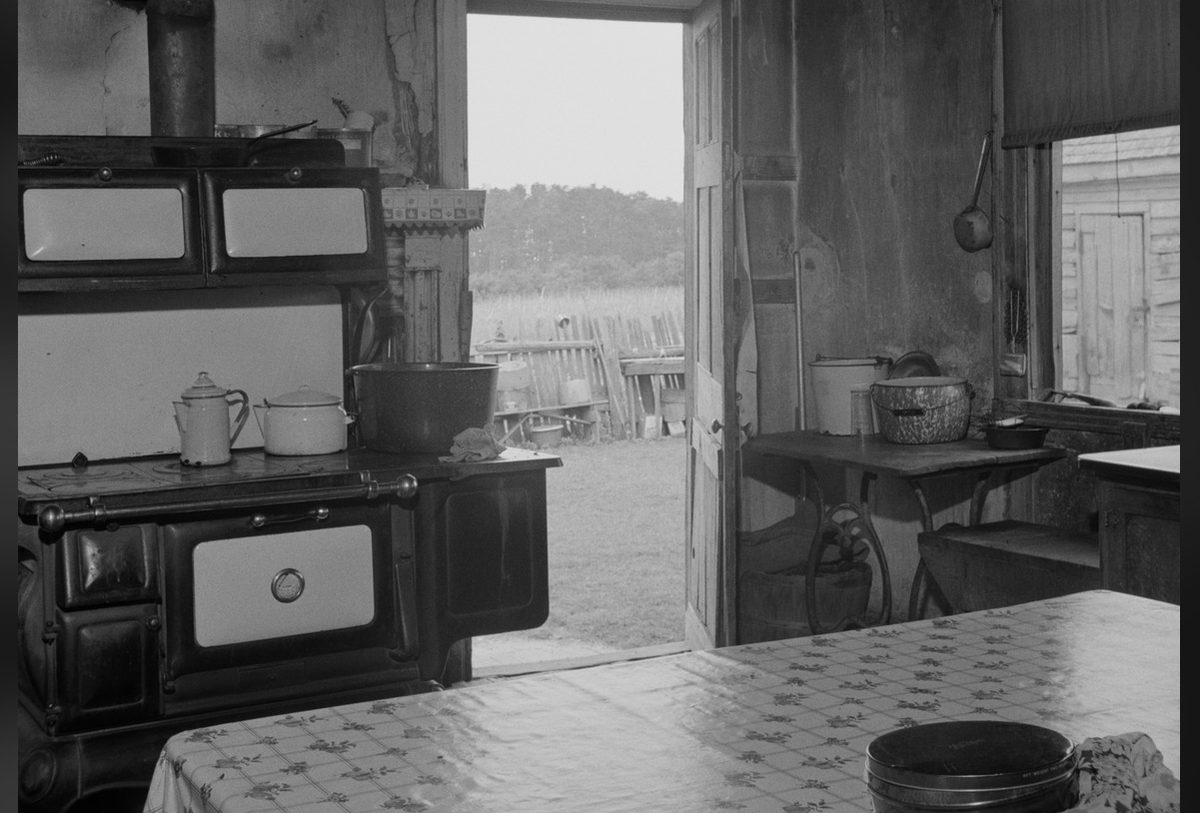
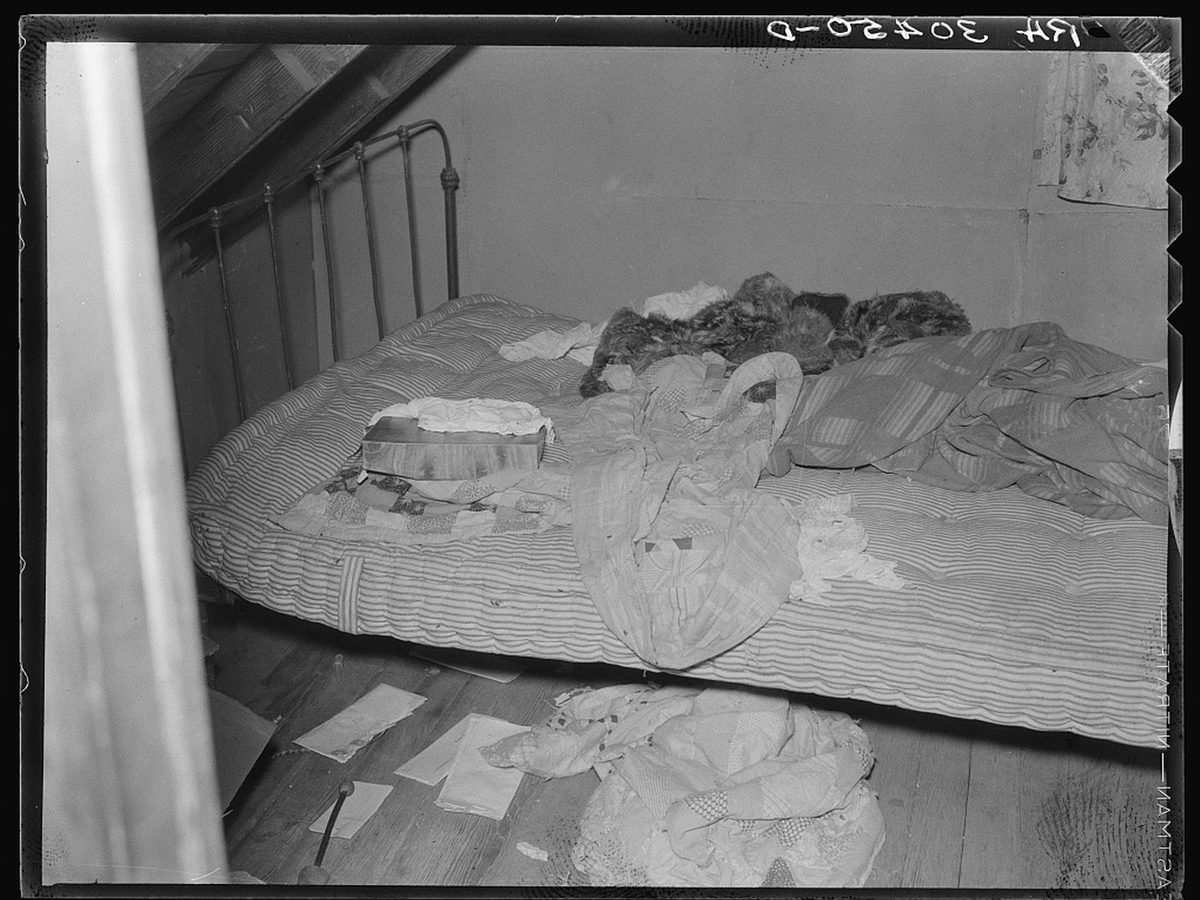
The same stone did double duty at home. Reheated at the kitchen range after the evening meal, it went upstairs wrapped in flannel to warm the foot of an unheated bedroom before anyone climbed in — a role that, in a farmhouse without central heat, mattered as much as the feather bed it was warming.
The Replacement Arrived in Three Separate Waves, Not One
Nothing single-handedly ended the soapstone foot warmer. It lost ground to three different technologies, each solving a different piece of the problem it had covered for a century.
The first wave was the rubber hot water bottle. Mid-19th-century improvements in vulcanized rubber made a flexible, refillable bottle practical where earlier metal, ceramic, and glass versions had cooled fast and risked burns. Rubber “India Rubber” hot water bottles were advertised in British newspapers by the late 1860s — Thornton and Co. ran one in the Glasgow Herald in November 1867, pitched at invalids. The bottle solved the bed-warming half of the job: no stove trip required, just a kettle.
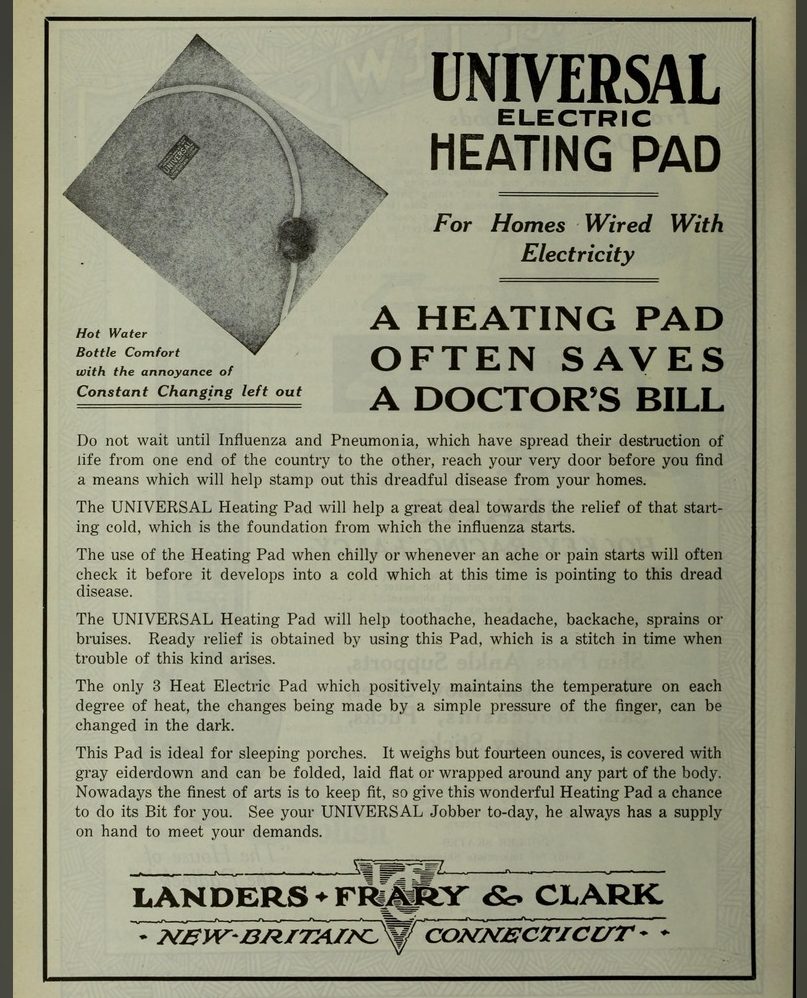
The second wave was the electric blanket, which solved the same problem with no reheating at all. Sidney Russell, credited as its inventor, built an electrically heated pad for keeping patients warm in 1912, and by the 1920s similar pads were standard equipment in tuberculosis sanatoriums, where patients often slept in deliberately drafty rooms. Consumer versions followed through the 1930s as luxury or sickroom items, and General Electric was advertising an automatic blanket by 1945, the same year the war that had delayed its wider sale was ending.
The third wave, and the one that ended the sleigh ride altogether, was the car heater — and it arrived more slowly than either. Early enclosed automobiles, after Cadillac and Hudson popularized the fully closed body in the 1900s and 1910s, were warmed exactly the way a sleigh had been: with a heated brick or soapstone slab set in a metal box on the floor. Exhaust-gas heaters appeared as accessories by 1907, though some leaked deadly carbon monoxide into the cabin. Real engine-coolant heaters did not become practical until the mid-1920s, when better water pumps and thermostats let manufacturers tap the engine’s own waste heat, and they spread through the 1930s as aftermarket add-ons from companies including Modine, Arvin, and Fedders before Ford, GM, and the rest built them in. A hot-water heater did not become standard equipment across GM’s lineup until 1962; automakers did not stop offering a heater as an option at all until 1968, when new defrosting rules made one mandatory.
Put the three dates together and the shape of the decline becomes clear: the bed went electric in the 1930s and 1940s, the sleigh ride went obsolete as cars replaced horses across the same decades, and the stove-heated stone simply had nowhere left to ride. Vermont’s quarries had already shifted most of their output to ground talc for paper and rubber manufacturing by mid-century, the same shift that had earlier emptied out stove and sink production once enameled iron took over — much the way the icebox lost its purpose to the electric refrigerator rather than to any single competing invention.
Watch the full history
The video walks through the Vermont quarry, the kitchen-stove routine, and the decade the car heater finally took the job away, in just over seven minutes.

Related reading
- How Much a Feather Bed Was Worth, in Pounds and Shillings
- Did Franklin Invent the Franklin Stove?
- How a Fireplace Trammel Worked in a Colonial Kitchen
- How Farms Rendered Lard to Last a Whole Winter
- How Iceboxes Worked Before the Electric Refrigerator
Works cited
- Chidester, A. H., Billings, M. P., and Cady, W. M. Talc Investigations in Vermont, Preliminary Report. U.S. Geological Survey Circular 95, 1951. Link.
- “Footwarmer Used in Horse-Drawn Vehicles, 1800–1829.” The Henry Ford, object ID 75.156.10. Link.
- “Soapstone Foot Warmer, ca. 1900.” Southern Aroostook Agricultural Museum, via Maine Memory Network, Maine Historical Society.
- “Soapstone Foot Warmers.” Conway Historical Society collections, Conway, Massachusetts. Link.
- Goodridge Soapstone Quarry Records, finding aid. University of Vermont Special Collections.
- Patch, Ron. “More Soapstone History.” The Vermont Journal.
- Landrigan, Leslie. “The Puritanical Controversy Over the Meeting House Stove.” New England Historical Society. Link.
- “All Warmed Up: The Early Days of Car Heaters.” Hagerty Media. Link.
- “Specific Heat of Common Substances.” The Engineering ToolBox. Link.
- Hornsey, Richard, Anna Greenwood, and Hilary Ingram. “A Brief History of Britain’s Obsession With the Hot Water Bottle.” The Conversation. Link.
- “Electric Blanket.” How Products Are Made, vol. 6. Link.