
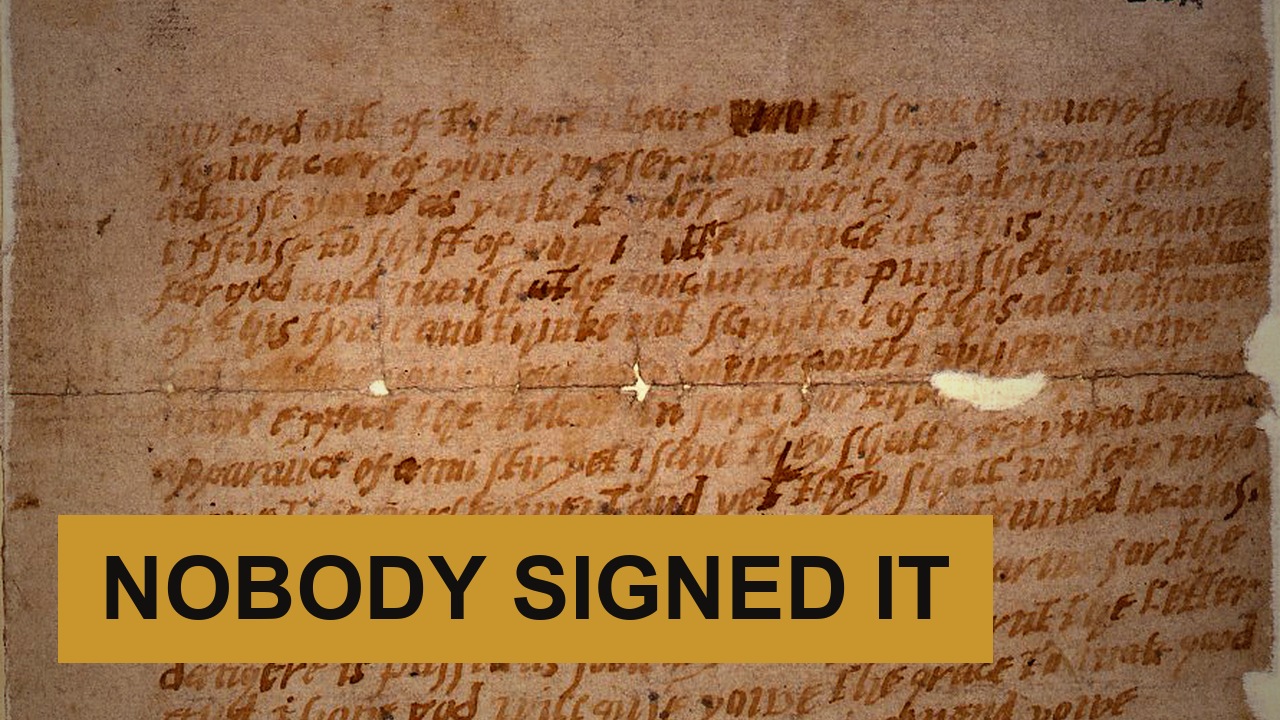
Inside the Monteagle letter, underneath the careful disguise, is a single crossed-out word. The writer started to put down an ordinary “you” in their own natural hand, caught the slip before it gave anything away, and scratched it out before continuing in the stiff, deliberately altered script that fills the rest of the page. It is the closest thing to a fingerprint the letter left behind. In the four hundred and twenty-one years since, nobody has matched it to a name.
That one detail says something the video version of this story doesn’t have room to dwell on: the letter was built, from its first line, to survive exactly the kind of inquiry this article is about. Over the centuries, at least six people have been named in print as its possible author. Two of those namings came out of genuine document investigations — one by a solicitor in 1902, one by a handwriting analyst in 1916 — working independently of each other and arriving at two different servants. Neither persuaded the historians who came after. The case has not meaningfully moved in thirty years, and it isn’t for lack of people trying to move it.
What follows is the case file: the document itself, the six names that have been put forward for who held the pen, the evidence assembled for each one, and the specific objection that has kept every single theory parked in the same column — possible, never proven.
The letter was built to defeat exactly this kind of inquiry
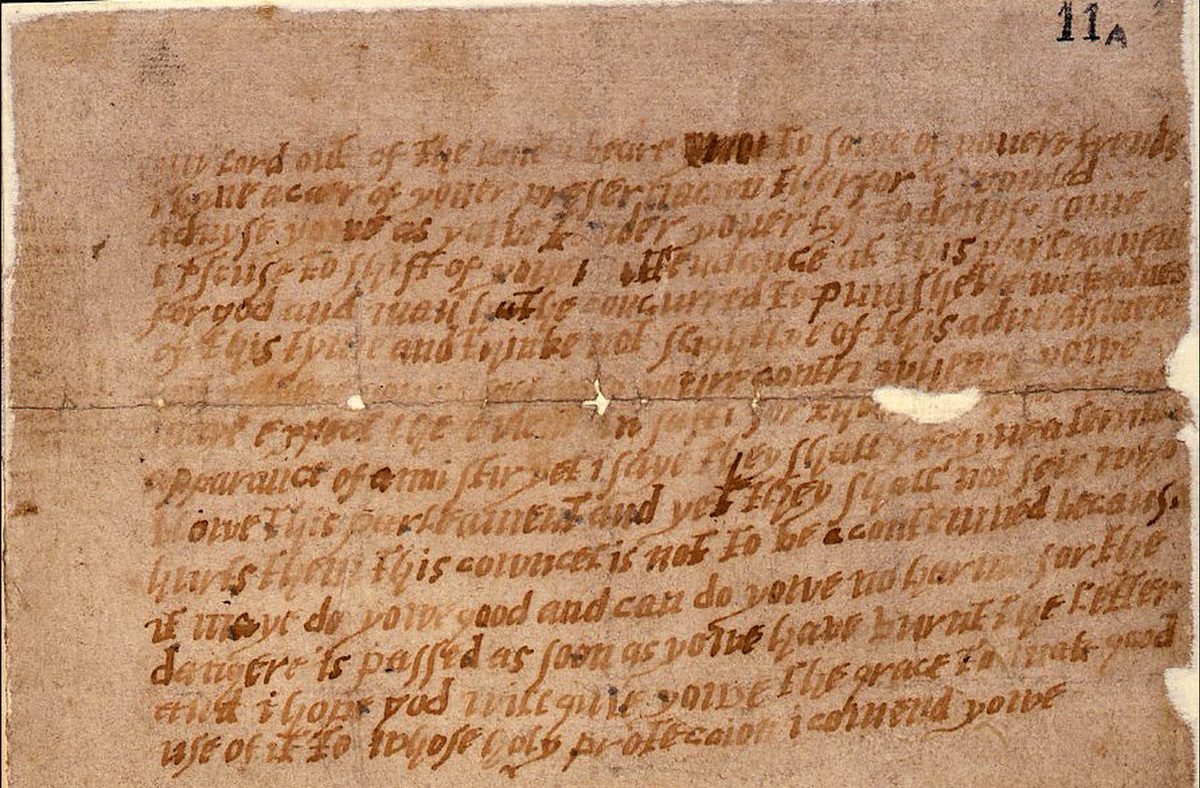
On the evening of 26 October 1605, a footman walking near Hoxton, just north of the City of London, was stopped by a man he did not recognise. The stranger handed him a letter for his master, William Parker, 4th Baron Monteagle, and left without giving his own name. The letter itself gave nothing away either: no date, no signature, about a hundred and sixty words, written in a hand that a government secretary who examined it soon afterward described, simply, as disguised.
Its content was blunt. It urged Monteagle to find some excuse to stay away from the opening of Parliament, warning that those who attended would receive a terrible blow without ever seeing who had struck it, and it asked him to burn the page once he had read it. He did not burn it, which is the only reason any of this is verifiable: the letter survives today at the National Archives at Kew, catalogued as SP 14/216 Part 1, item 11a — not SP 14/216/2, a reference that gets attached to it in some retellings but actually belongs to a different document in the same volume, Levinus Munck’s written account of the affair, drawn up on 7 November.
The disguise is the most examined part of it. George Blacker Morgan, a London analyst who spent years on the handwriting question, argued in 1916 that the script’s unusually broad quill strokes, its small first-person “i,” and its twisted, deliberately ungainly letterforms were a performance rather than a natural hand — and that the single cancelled word is where the performance briefly slipped. A writer consciously altering their script, Morgan argued, is exactly the kind of writer who would catch themselves mid-word and correct it. An innocent, unselfconscious hand has nothing to catch.
The man who received it had his own reasons to want it to exist
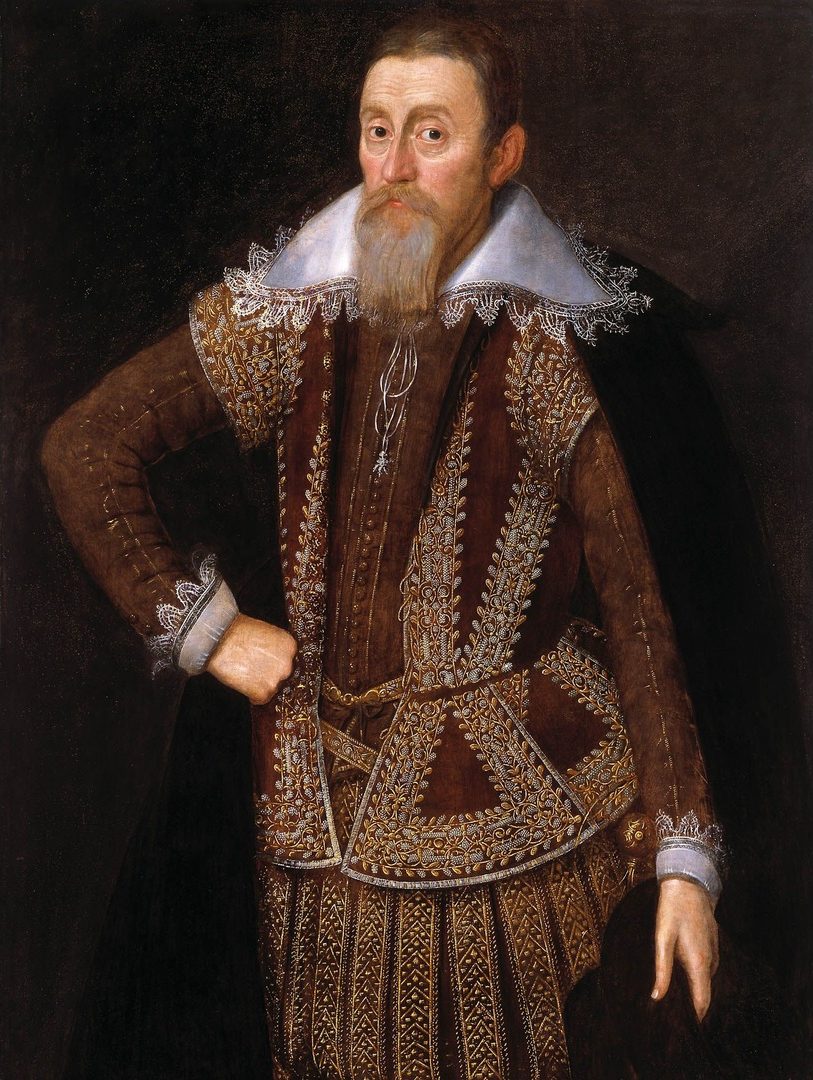
Monteagle was not a neutral party before any of this happened. He had ridden out with the Earl of Essex’s failed rebellion against Elizabeth I four years earlier and remained, in 1605, a man the new king’s court watched rather than trusted. He was also related by marriage to one of the plotters: his wife’s brother was Francis Tresham, newly and reluctantly brought into the conspiracy earlier that same October.
What Monteagle did with the letter is not in dispute. He rode straight to Whitehall and handed it to Robert Cecil, Earl of Salisbury, the King’s Secretary of State, rather than burning it as instructed. What Cecil then did with it is where the story gets interesting: he showed it to other privy councillors, and then waited. James was away hunting at Royston and did not see the letter until he returned around the end of October. When he did, he fixed on a single word — blow — and read it as pointing to gunpowder, a conclusion later accounts suggest Cecil let the King reach for himself rather than hand it to him outright.
Antonia Fraser’s account of the plot proposes that Monteagle wrote the letter himself, after Tresham had warned him verbally and left him needing a way to raise the alarm without naming his own brother-in-law as the source. The historian John Bossy, reviewing that account for the London Review of Books, raised an awkward complication: Monteagle’s own servant, Thomas Ward, independently got word of the letter back to Catesby within days. If Monteagle had sanctioned that leak, he was running both sides of the warning at once; if Ward acted on his own, Monteagle had every reason to be furious rather than quiet about it, and the record shows no fury at all. There is also the reward to weigh: a grateful king granted Monteagle a substantial pension, reported in different accounts as anywhere from two hundred to seven hundred pounds a year — generous enough, on its own, to make a cynic wonder whether the gratitude was for a warning received or a warning staged.
His own in-laws produced two more names
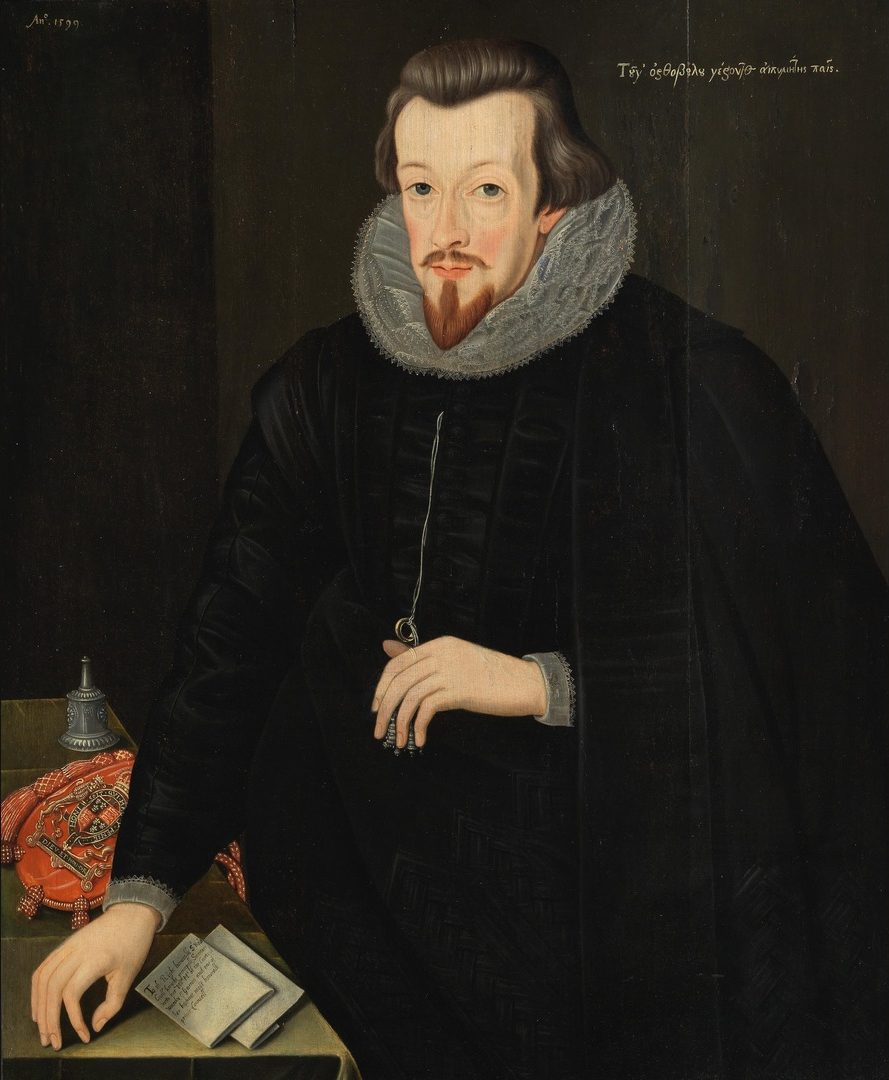
Word of the letter reached the plotters almost immediately, through that same leak from Monteagle’s household, and Robert Catesby’s reaction is the most telling detail in the entire episode. He did not wonder aloud who might have written it. He turned at once on his cousin, Francis Tresham, and he and Thomas Wintour confronted him outright. Tresham denied it and, for the moment, satisfied them.
The case against Tresham, on paper, is strong. He was Monteagle’s brother-in-law and Catesby’s first cousin, raised alongside him. He had been let into the plot only in mid-October, days before the letter, at which point he reportedly pushed back on one specific point: he wanted Monteagle, and a second Catholic peer, Lord Stourton, warned out of the chamber before the fifth of November, a condition the others would not meet. He died in the Tower on 23 December, before any trial, of a urinary illness, which closes off the one source — a confession under examination — that might otherwise have settled the question. The one document he did leave, a statement dictated on his deathbed because he was too weak to write, concerns an entirely different matter: a retraction about the Jesuit priest Henry Garnet and an earlier 1602 plot. It does not address the Monteagle letter at all, which can be read either way — as the silence of a man with nothing to confess, or simply as a dying man’s statement staying narrowly on the one topic he was asked about.
Fraser’s own alternative candidate, laid out in the same book, is Monteagle’s sister, Mary Habington, married into the Habington family of Hindlip Hall in Worcestershire — a household notorious enough for sheltering priests that, within weeks of the plot’s discovery, searchers spent twelve days taking the house apart before finding two of the hunted Jesuits, Henry Garnet and Edward Oldcorne, inside one of its hides. The standing objection to Mary Habington is stylistic rather than circumstantial: the letter’s clumsy, workmanlike phrasing reads to most who have studied it as unlikely to be the work of a gentlewoman of her background. A whole book was published in 1902 arguing for one specific identification along these lines, and it persuaded almost nobody.
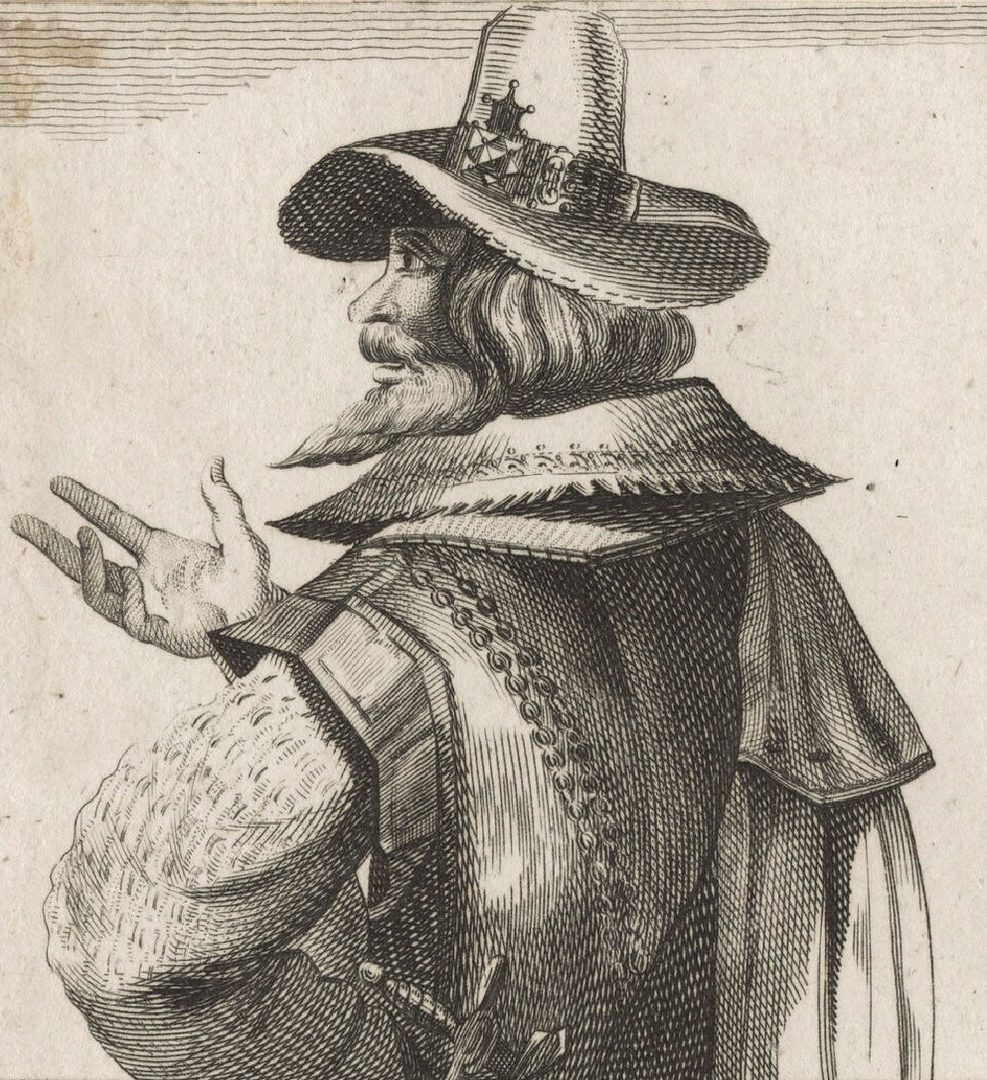
Two independent investigations pointed at two different servants
That 1902 book belonged to Henry Hawkes Spink Jr., a solicitor who reasoned his way to authorship from a different angle entirely: if a conspirator wanted to send a warning without his own hand exposing him, he would need someone else to hold the pen. Spink proposed a specific chain — Christopher Wright, one of the plot’s later recruits, passing word through Thomas Ward (the same servant who later carried word to Catesby) to the Jesuit priest Edward Oldcorne, whom Spink named as the actual penman. He called this chain a moral certainty rather than a mathematical one, which is a fair description of its evidentiary weight: suggestive, built on who plausibly knew whom, and resting on no document in which any of the three admits it.
Fourteen years later, Morgan approached the question as a pure handwriting problem and named someone else again: William Vavasour, a servant in Tresham’s own household. Morgan compared the letter against two documents genuinely in Vavasour’s hand — a false statement Vavasour gave to the Lieutenant of the Tower, and a dictated statement he had written out for his master — and argued that the same disguise habits recurred in both: an unusually long initial “s,” twisted “t”s, and “h”s whose tails dropped below the line. There is an odd symmetry buried in this theory that Morgan himself did not flag: the dictated statement he used as his comparison sample is the very same document Tresham produced on his deathbed, the one that never mentions the Monteagle letter. If Morgan is right, the man he suspected of writing the warning is also, provably, the man who took down Tresham’s final, unrelated one.

The theory that refuses to die is that the government wrote its own tip-off
A sixth name has circulated since almost the moment the dust settled: Robert Cecil himself. The shape of the suspicion is simple — a plot this useful to the Crown, discovered this conveniently, discovered by the one minister positioned to control exactly how and when, invites the question of whether he knew more than he let on. Samuel Rawson Gardiner, working through the surviving State Papers in 1897, examined this directly and rejected it: he found no sign of foreknowledge in Cecil’s own contemporary correspondence, no reason his fellow commissioners — several of them no friends of his — would have covered for a staged discovery, and concluded that the traditional account, government caught off guard and scrambling to respond, held up against the documents. That remained close to the consensus view for most of the twentieth century.
The Jesuit historian Francis Edwards pushed back hard in a 1969 study arguing for direct government involvement, and when Mark Nicholls published the fullest modern investigation of the whole affair in 1991, naming Edwards as the theory’s most persistent advocate, Edwards answered him at length in the journal British Catholic History in 1993 — still defending his case, still unable to produce the one document that would close it. Nicholls’s own reading, like Gardiner’s before him, rates Tresham as the likeliest single name among the six, while being explicit that likeliest is not the same word as proven.
Watch the full history
The video version walks the same timeline — the letter, the six-day wait, the search, the arrest — in under nine minutes.

Related reading
- Who Was the Man in the Iron Mask? — another Early Modern identity puzzle built almost entirely out of what the record refuses to say.
- Sealing Wax and Signet Rings: The Secret History — how a seal, not a signature, was the real proof of a letter’s origin in this period.
- The 160-Word Letter That Undid the Gunpowder Plot — the fuller story of the search, the torture warrant, and the law the plot’s discovery left on the books for 253 years.
- How Houdini’s Code Worked, and Why It Could Never Prove Anything — a different kind of document that resists proof no matter how closely it’s read.
Shop
Two books on the plot, for anyone who wants to keep reading.
Works cited
- The National Archives (Kew). The Monteagle Letter. State Papers Domestic, James I, SP 14/216 Part 1 (11a), 26 October 1605.
- The National Archives (Kew). Levinus Munck’s contemporary account of the plot’s discovery, SP 14/216/2, fos. 34r–41r, 7 November 1605, described in “How the Gunpowder Treason Was Discovered,” The National Archives blog.
- Nicholls, Mark. Investigating Gunpowder Plot. Manchester University Press, 1991.
- Fraser, Antonia. Faith and Treason: The Story of the Gunpowder Plot. Doubleday, 1996.
- Haynes, Alan. The Gunpowder Plot. Alan Sutton, 1994.
- Gardiner, Samuel Rawson. What Gunpowder Plot Was. Longmans, Green, 1897. Link.
- Spink, Henry Hawkes, Jr. The Gunpowder Plot and Lord Mounteagle’s Letter: Being a Proof, with Moral Certainty, of the Authors of That Letter and That Plot. London and York, 1902. Link.
- Morgan, George Blacker. The Identification of the Writer of the Anonymous Letter to Lord Monteagle in 1605. London, 1916. Link.
- Edwards, Francis, S.J. “Still Investigating Gunpowder Plot.” British Catholic History 21, no. 3 (1993): 305–346. Link.
- Irvine, Amy. “What Was the Monteagle Letter’s Role in The Gunpowder Plot’s Downfall?” History Hit, 6 November 2023. Link.