
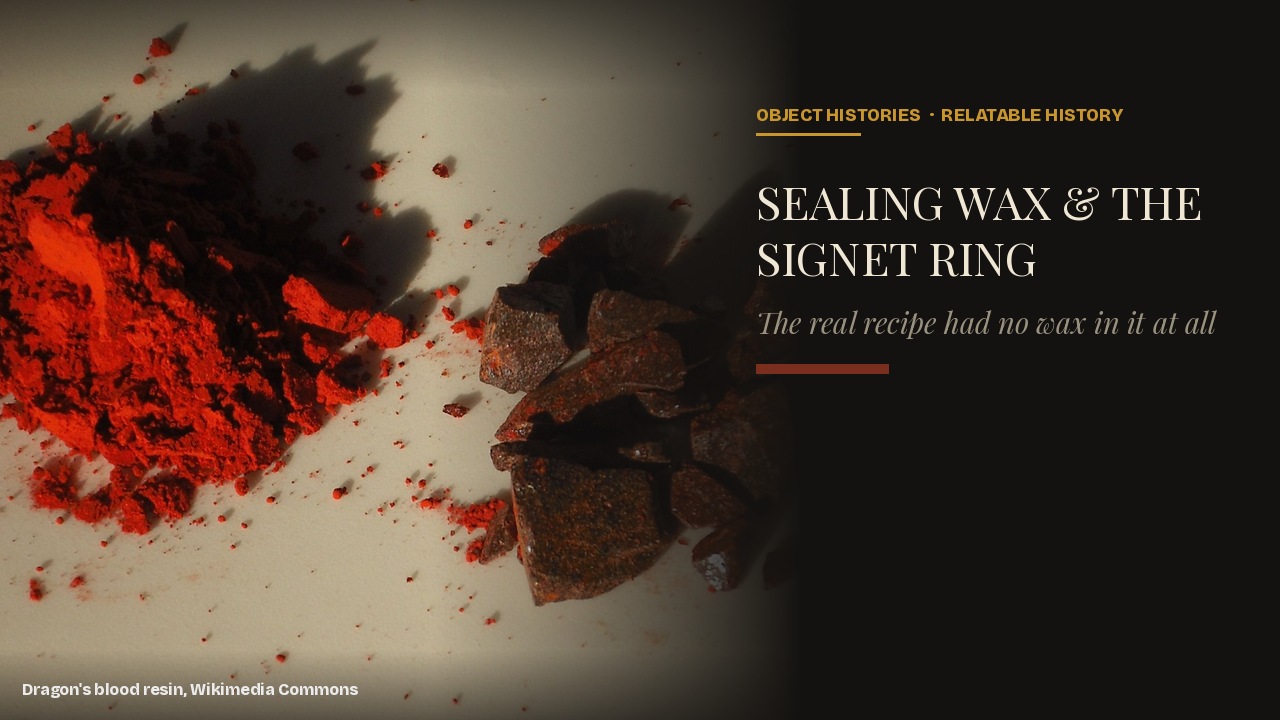
Sealing wax never had a drop of wax in it. For roughly four hundred years, the deep red stick melted beside letters across Europe was built from shellac — a resin secreted by a tiny insect — mixed with pine resin and ordinary chalk, then colored with a substance traders sold under one of history’s better marketing names: dragon’s blood. None of that was explained to the customer. What mattered at the writing desk was simpler. Press a signet ring into the warm result, and the letter carried something no forger could casually fake, in a world where very few people could sign their own name at all.
That pairing of sealing wax and signet rings did more than finish a letter. It closed treaties, authenticated royal decrees, and made it obvious at a glance whether someone else had already opened your mail — which is exactly why, for roughly two centuries, several European governments ran secret offices built around quietly defeating it. This is the story of the recipe, the ring, the resin trade behind the color, and the one cheap invention that made the entire system obsolete within about a year.
Sealing wax and signet rings didn’t invent the idea — they perfected it
The habit sealing wax served is far older than the recipe itself. The Metropolitan Museum of Art dates the first cylinder seals — small carved stones rolled across wet clay to leave a raised, reversed design — to roughly five thousand years ago, around the same period writing itself was invented in Mesopotamia. They were rolled directly onto clay tablets and clay envelopes carrying letters, receipts, and treaties, and the museum’s own curators describe the mark they left as functioning “much like a signature.” The practice held on, in one form or another, for more than three thousand years.
By the European Middle Ages, the seal had moved from clay to wax, and the wax itself was unglamorous: plain beeswax, sometimes stiffened with a little pine resin, pressed with a lord’s or a bishop’s own device. It did the job. It did not, however, hold a crisp impression especially well, and a soft beeswax seal could sometimes be warmed, lifted, and pressed back down without obvious damage. That single flaw is what the shellac recipe eventually fixed, several centuries later.
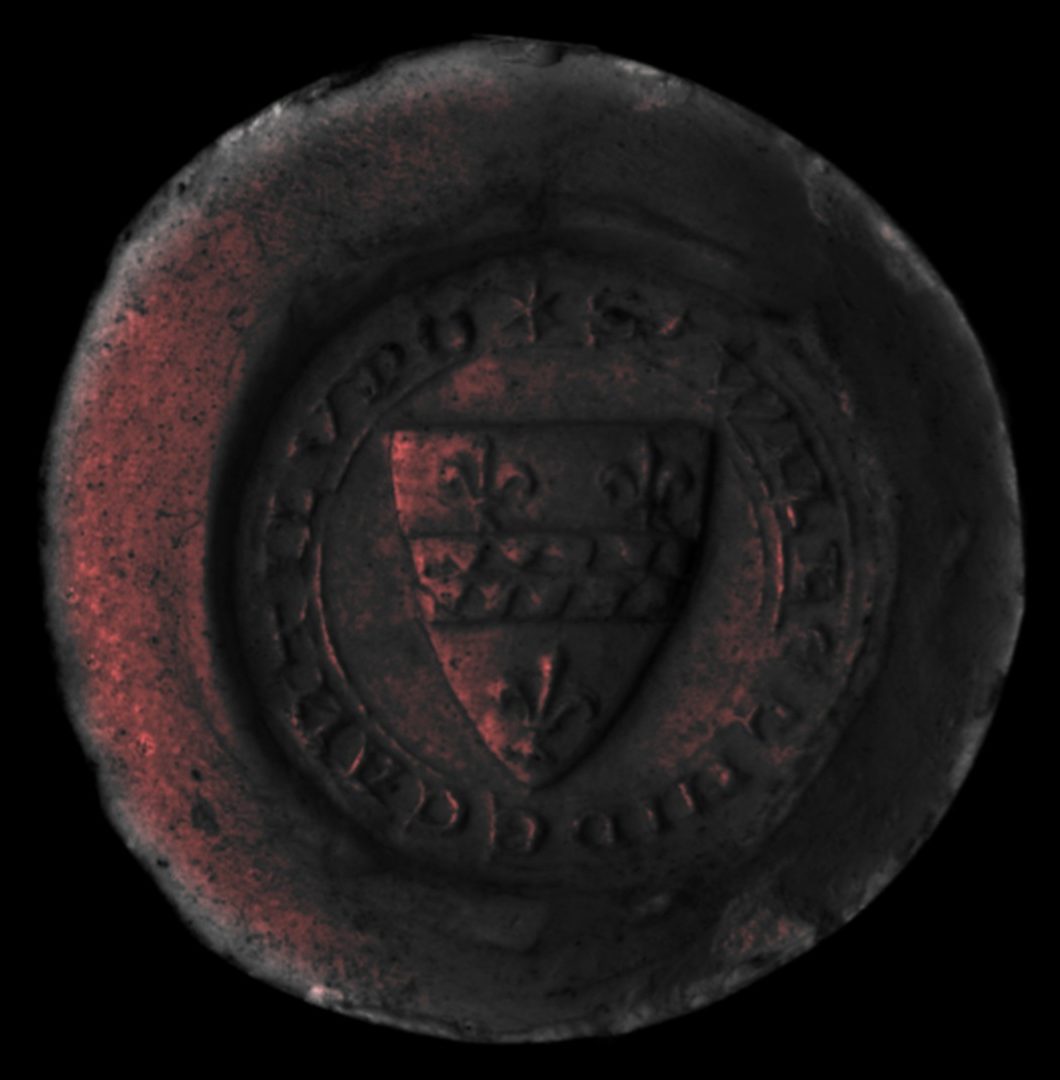
Forging someone’s seal was treated like counterfeiting the king’s own coin
Because a seal carried the weight of a signature, faking one was never treated as a prank. English court records make this explicit. In 1288, a man named Walter of Barton was charged in Dorset with counterfeiting the king’s own seal, and the case against him drew an unusually large jury. When Barton tried to claim benefit of clergy — a legal shelter that could have spared him a harsher royal court — the record states plainly that the offense “touches the king” directly, so he was held rather than released, and the matter escalated all the way up: he was moved to the Tower of London and petitioned Parliament directly while the case waited on King Edward I, who was then away in Gascony.
Legal historians studying cases like this note that English courts and lawbooks of the period lumped seal forgery together with counterfeiting royal coin, treating both as a form of lese-majeste — an offense against the crown’s own authority, not merely against whichever private person got cheated. A counterfeit coin and a counterfeit seal both borrowed the king’s own image to vouch for something false, and both were prosecuted accordingly. Centuries before England built a system like wooden tally sticks to make fraud physically harder, a forged seal was already being punished as a crime against the state itself.
The real recipe came from an insect in India, not a candle shop
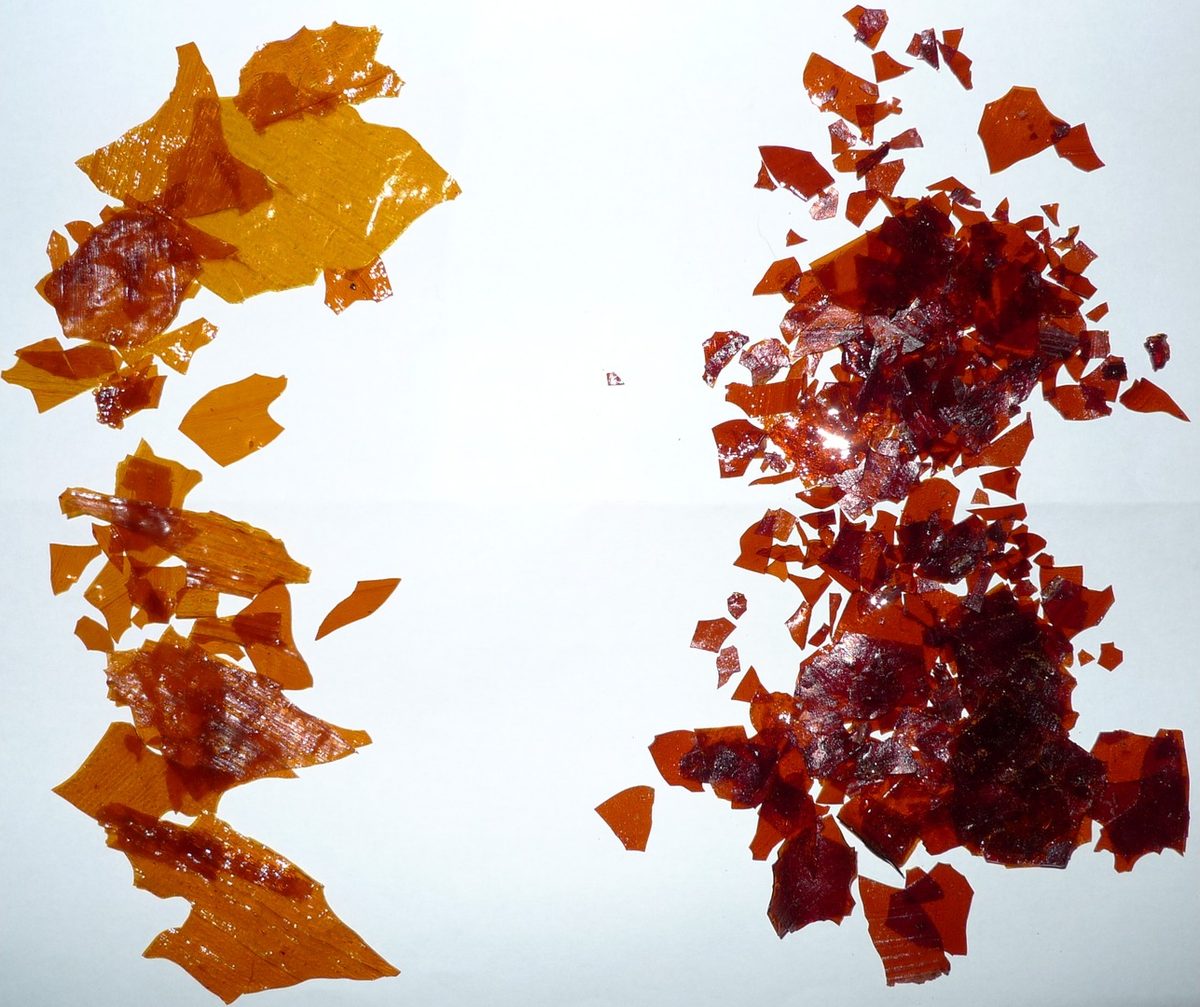
What eventually replaced that fragile beeswax was, by any ordinary definition, not wax at all. The key ingredient was shellac: a resin that the lac insect secretes onto the twigs and young branches of certain trees across South and Southeast Asia, which traders scrape off as a crust known as stick-lac. According to the Encyclopaedia Britannica, lac products had already been used in India as a plastic, moldable decorative material for roughly three thousand years before European traders began carrying lac dye, and eventually shellac itself, back to Europe during the seventeenth century, where it quickly became a commercially important import. A Pakistani entomological study of the insect’s two main South Indian species notes that one of the earliest Western illustrations of it came from Garcia de Orta, a sixteenth-century physician working for the Portuguese governor in Goa — a reminder that this was a documented trade good moving along real colonial shipping routes, not a folk remedy.
Melted down, strained, and bulked out with ordinary chalk and a little pine resin, shellac set up harder and more brittle than beeswax ever had. That brittleness was the entire point. A shellac seal took a sharper, cleaner impression from a signet ring, and — crucially — it could not be warmed and lifted off intact the way soft beeswax sometimes could. It snapped. A letter sealed in shellac was either untouched or visibly broken into, with nothing in between, which is precisely the property four centuries of correspondents were paying for.
The deep red was sold as dragon’s blood, and the trade wasn’t entirely a lie
The stick’s color had its own story, and for once the marketing was closer to true than you’d expect — just not in the way anyone selling it meant. For centuries, the richest red sealing wax was tinted not with a dye mixed up in a workshop but with a genuine plant resin called dragon’s blood, and it came from at least two completely unrelated plants sold under the same dramatic name.
One source was Dracaena draco, the dragon tree, native to the Canary Islands, where, according to a JSTOR Daily account of the plant’s history, the islands’ indigenous Guanche people used its red sap for embalming long before European contact. A closely related tree, Dracaena cinnabari, grows only on the Yemeni island of Socotra, and its resin was already being traded in the ancient world under the dragon’s blood name. The earliest detailed European description of the Canary Islands tree dates to 1402, recorded by the French chroniclers Pierre Boutier and Jean Le Verrier during Jean de Bethencourt’s expedition to the islands, and naturalists kept returning to it for centuries afterward — John Gerard described it in his 1633 Generall Historie of Plantes, and the collector Sir Hans Sloane gathered specimens of the resin in the late seventeenth century.
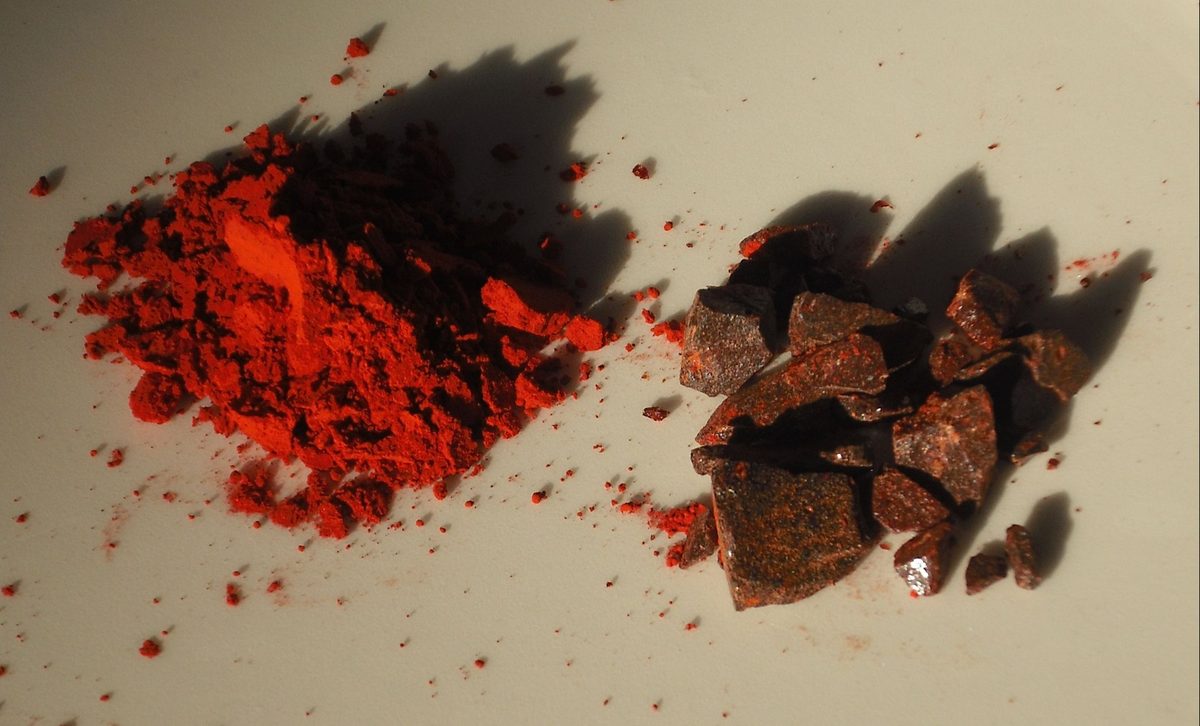
The second, entirely different source was Daemonorops, a genus of climbing rattan palm native to Southeast Asia, which produces a nearly identical crimson resin scraped from the surface of its unripe fruit. Nobody selling either version had much incentive to clarify which dragon a given stick actually came from, and both moved along the same kind of long, expensive supply chains — overland routes out of Arabia, then later trading-company ships — that also carried cowrie shells and other goods whose value came partly from how far they had traveled. A stick of genuinely deep-red sealing wax, in other words, was quietly carrying the cost of a global trade network every time someone melted it down to close a letter.
One signet ring has stayed in continuous use at the top of the Catholic Church
If you want a sense of how seriously a signet ring’s authority was once taken, the clearest living example still exists. The pope’s Ring of the Fisherman is, per the Encyclopaedia Britannica, one of two historical papal seals (the other a lead seal called a bulla), and it was “formerly used as a seal for the pope’s private letters and papal briefs” — exactly the function any other signet ring performed for its owner, just at the highest level of the Church’s own diplomacy.
The ring is no longer used to stamp wax. Instead, each newly elected pope simply receives his own version of it as a symbol of his authority, and the ring associated with his predecessor is retired. That retirement is not a quiet filing-away: tradition holds that a pope’s ring is defaced or destroyed at the moment of his death, specifically so it can never again be used to authenticate a document in his name. It is, in effect, the same security logic that made a shellac seal snap rather than peel — an identity marker deliberately built to be unrecoverable the instant it stops being legitimate.
Entire government offices existed just to reopen a sealed letter
A seal that showed tampering at a glance was obviously a problem for anyone who wanted to read somebody else’s mail without being caught — and several governments solved that problem institutionally rather than give up the practice.
The most thoroughly documented case is Austria’s. Emperor Charles VI established a dedicated interception unit in Vienna in 1714, and the operation — researched in detail by cryptography historian Marty Busse — ran in some form all the way to the collapse of the Habsburg monarchy in 1918, with a formally separate office, the Ziffernkanzlei, closing in 1848. Flagged letters arrived for processing in four batches a day, every day, with copying teams — sometimes four people assigned to a single letter — working against a strict deadline so the mail would not visibly fall behind schedule. Prince Eugene requested additional postal relay stations specifically to support the work in 1735, and the long-serving chancellor Wenzel Anton von Kaunitz, who held the office from 1753 to 1793, reportedly pushed to have every piece of mail opened rather than only flagged correspondence. Staff turnover was a constant headache: the work required people fluent in several languages, and the volume regularly caused backlogs.
Austria wasn’t unique. Historian Karl de Leeuw has documented a comparable black chamber run by the Dutch Republic’s Grand Pensionary Anthonie Heinsius during the War of the Spanish Succession, operating from roughly 1707 to 1715 under his private secretary Abel Tassin d’Alonne, who worked with a postal director in the Southern Netherlands to intercept French and allied diplomatic correspondence. Keeping one meeting’s proceedings secret, the way the delegates at the 1787 Constitutional Convention did, is one kind of information control. Running a standing bureaucracy whose entire job was reading other countries’ sealed mail, on a fixed daily schedule, for decades, is a different scale of the same impulse.
A cheap gummed envelope ended four centuries of candles in a single year
All of that effort — the recipe, the ring, the resin trade, the secret offices built to defeat it — came apart almost at once, and the cause was not a better seal but a cheaper letter.
Britain’s Penny Post launched on 10 January 1840 under Rowland Hill, cutting the cost of sending a letter so sharply that ordinary people began mailing things constantly rather than occasionally. Hill ran a design competition for prepaid stationery to go with the new system, and the winning entry — illustrated by the painter William Mulready and known simply as the Mulready — came pre-folded and gummed shut along its own edge, needing no separate stick of wax or open flame at all.
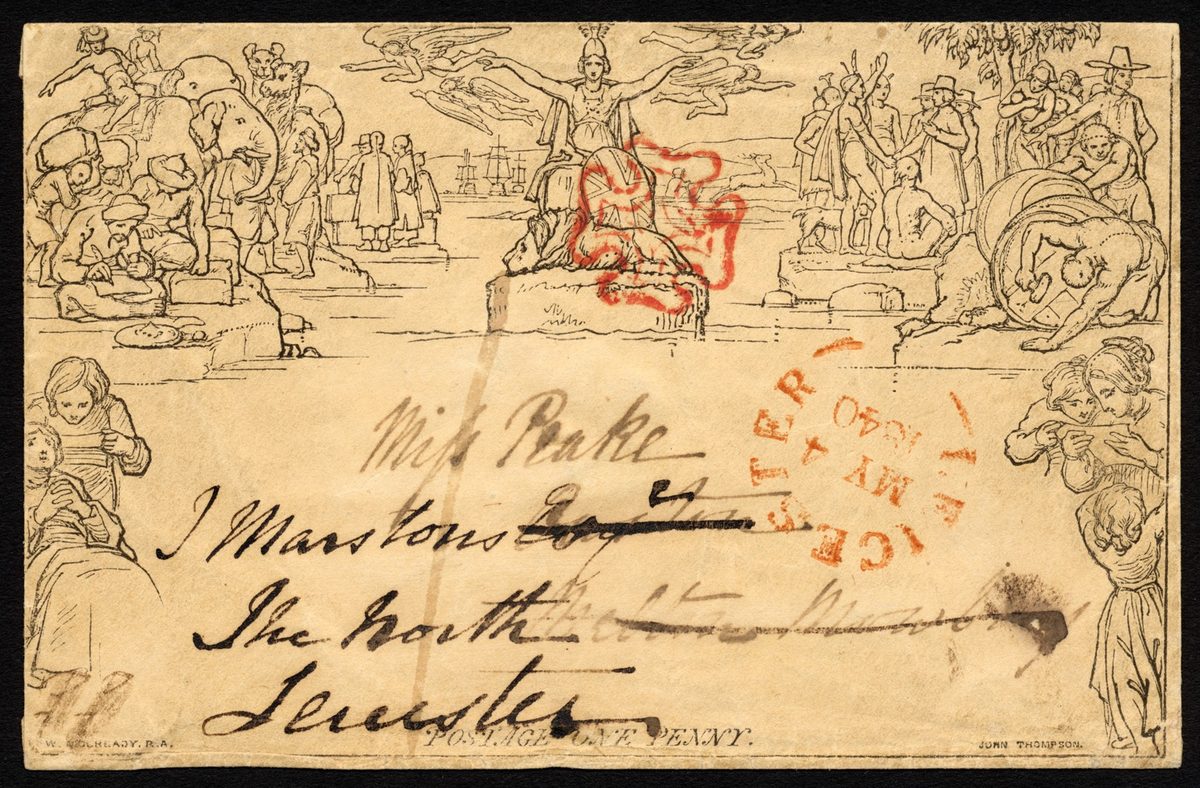
It was also, by near-universal agreement, a design disaster. According to Victorian scholar Catherine J. Golden, the Mulready’s dense allegorical artwork left too little room for an actual address, and the public responded by buying parody versions in bulk: caricaturists including John Leech and Hablot Knight Browne lampooned its imagery mercilessly, with jokes aimed at everything from Mulready’s own Irish background to the ongoing First Opium War. The design was withdrawn within a year, in 1841.
What survived wasn’t the envelope. It was the underlying idea — a letter that sealed itself without a flame — combined with the item Hill himself had originally treated as an afterthought to the whole scheme: the adhesive postage stamp. The Penny Black, issued alongside the Mulready in May 1840, became an immediate and lasting success. For the flood of everyday mail the Penny Post had created, melting wax for every single letter was suddenly a bottleneck nobody had time for, and within only a few years gummed, machine-folded envelopes had taken over ordinary correspondence.
Watch the video
The short version of this story — forty-three seconds — covers the shellac recipe and the dragon’s blood color in under a minute.

Related reading
- Rohonc Codex Deciphered? Inside a 450-Page Mystery — another case where secrecy and disputed authorship tangle together.
- The 24 Years Wampum Was Legal Tender in Massachusetts — another everyday object a government made legally binding.
- The Truth Behind the Mrs. O’Leary Cow Myth — a popular story that, like dragon’s blood, got the facts wrong for a long time.
- What Actually Happened to the Amber Room — another well-traveled, well-documented object with a stranger story than its reputation.
- How Carrier Pigeons Carried Messages Through Two World Wars — another object built specifically to get a message past people trying to intercept it.
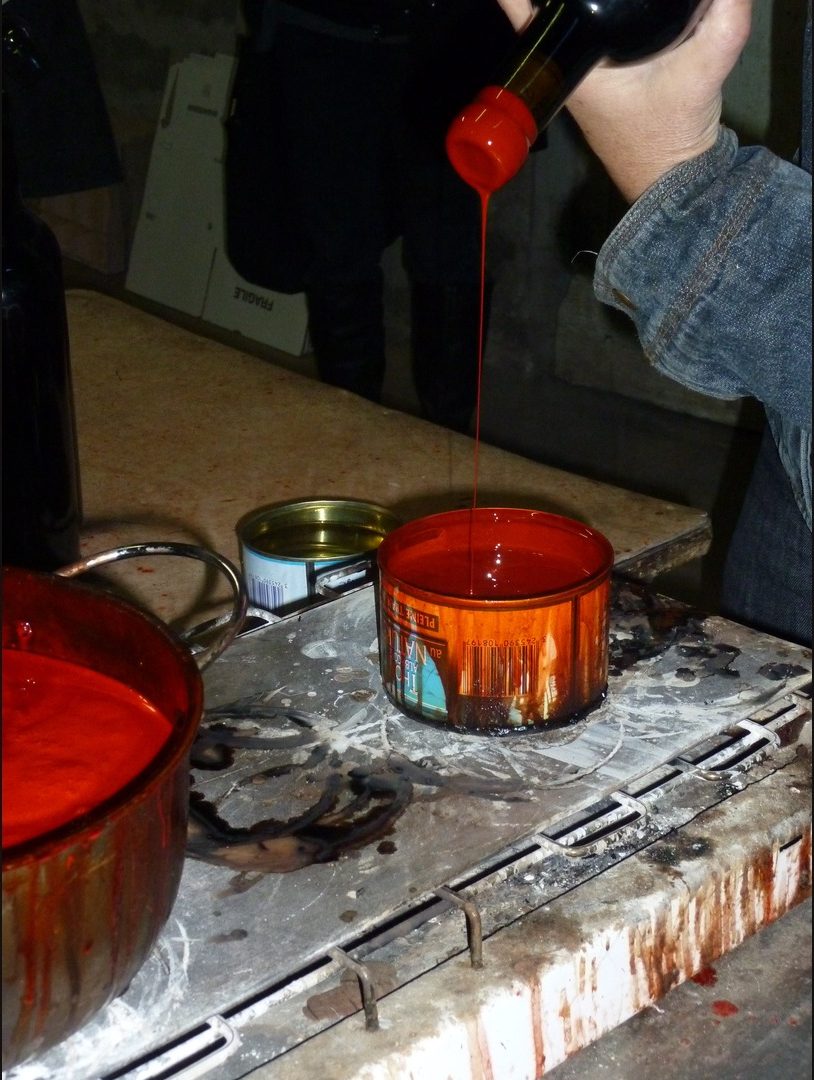
Walk into a liquor store today and you’ll find the one place sealing wax never really left: bottles of Maker’s Mark bourbon still arrive with a hand-dipped red wax drip around the neck, a touch its founder’s wife, Margie Samuels, added as a finishing flourish not long after the brand’s 1958 launch — reportedly worked out at home by melting sealing wax in the family deep fryer, according to whiskey writer Katelyn Best. The company trademarked that specific drippy look in 1985. It carries none of the original security function; nobody is checking whether a bourbon bottle was secretly reopened. What survives is the signal the signet-and-shellac system always sent alongside its practical one: that somebody cared enough to do this by hand.
That’s really what got lost in 1841, more than the wax itself. A gummed envelope closes a letter exactly as effectively as a shellac seal did. It just doesn’t tell you anything about the person who closed it. How many letters would you have broken a stranger’s seal to read, back when doing so left no way to hide that you had?
Shop the styles/items featured in this video:
Wax seal stamp kits
Signet rings
Works cited
- Rakic, Yelena. “Cylinder Seals: Tiny Treasures That Leave a Big Impression.” The Metropolitan Museum of Art, May 30, 2018.
- Summerson, Henry. “Counterfeiters, Forgers and Felons in English Courts, 1200–1400.” In Anthony Musson, ed., Expectations of the Law in the Middle Ages, 105–116. Boydell & Brewer, 2001. Link.
- “Shellac.” Encyclopaedia Britannica.
- Mahdihassan, S. “The Two Lac Insects of South India, a Wild and a Cultivated Species, Part I.” Pakistan Journal of Scientific and Industrial Research 34, nos. 2–3 (1991). Link.
- Pickering, Victoria. “Plant of the Month: The Dragon Tree.” JSTOR Daily, July 1, 2020. Link.
- “Fisherman’s Ring.” Encyclopaedia Britannica.
- Busse, Marty. “And a Lurking League of Letter Openers: The Austrian Black Chamber.” Link.
- de Leeuw, Karl. “The Black Chamber in the Dutch Republic during the War of the Spanish Succession and Its Aftermath, 1707–1715.” The Historical Journal 42, no. 1 (1999): 133–156. Link.
- Golden, Catherine J. “Prepaid Stationery and the Penny Black.” Victorian Web, last modified July 8, 2010. Link.
- Best, Katelyn. “Behind the Seal: The Story of the Maker’s Mark Bottle.” The Whiskey Wash. Link.